1001 Midnights


A 1001 MIDNIGHTS Review
by Thomas Baird


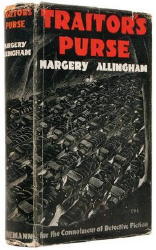
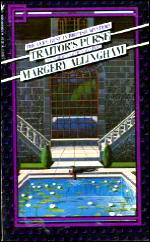
MARGERY ALLINGHAM Traitor's Purse

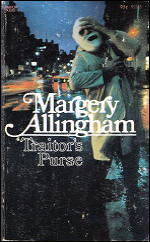
MARGERY ALLINGHAM – Traitor’s Purse. Doubleday Crime Club, US, hardcover, 1941. First published in the UK: Heinemann, hardcover, 1941. Reprinted many times, in both hardcover and paperback.

   England is at war. The country is threatened by a catastrophic stroke, and time is desperately short. All lines of investigation have gone slack, and only one man knows the enormity of the situation. Only one man has the faintest clue to the heart of the conspiracy. As the story opens, Albert Campion awakes in a hospital bed with total amnesia from a blow to the head.

   Hearing himself described as the killer of a policeman, he recklessly escapes and heads for the Bridge Institute, a research organization that is “a living brain factory.” The Masters of Bridge are a hereditary group who are the governors of the Institute, and Sir Henry Bull is one of the Senior Masters. When the secretary to the masters is killed, the police question Campion, who was the last man to see him alive.

MARGERY ALLINGHAM Traitor's Purse

   Campion’s investigations are invested with the psychology of paranoia. He walks a tightrope, of sifting clues while trying to reestablish his memory. Stanislaus Oates, head of the CID, has disappeared, and Campion can’t confide his memory loss to his love interest, Amanda, because of her trust in him.

   The only really practical help that comes his way is from his man, Magersfontein Lugg, who recognizes what a blow to the head can do and protects Campion from the police manhunt and from the gang of criminals on his track.

   The search for the traitor weaves through the criminal conspiracy and the institute itself (and by extension into the government) and leads into the cavernous heart of Nag’s Head, the rocky headland that looms over the town of Bridge.

   Many characters appear, disappear, and reappear throughout the saga, including friends and relations; the policemen Oates, Yeo, and Luke; and the spymaster L. C. Corkran.

MARGERY ALLINGHAM Traitor's Purse

   This story is Campion’s trial by fire — afterward he is a changed man. Later in his career, he has less to do and becomes a sort of consultant.

   After Allingham’s death, her husband continued the Campion adventures in three more novels. One novel that has received much critical approval, The Tiger in the Smoke (1952), in some ways seems overdrawn and overwritten.

   Other recommended titles by Allingham are Mystery Mile (1930), Look to the Lady (1931), Sweet Danger (1933), and More Work for the Undertaker (1948). Inducements to read them include the memorable names of characters, both major and minor, and of the various settings. And if you’re a fan of that Golden Age staple, a proper plan or map of the scene, these provide cartographic delight.

         ———
   Reprinted with permission from 1001 Midnights, edited by Bill Pronzini & Marcia Muller and published by The Battered Silicon Dispatch Box, 2007.   Copyright © 1986, 2007 by the Pronzini-Muller Family Trust.

A 1001 MIDNIGHTS Review
by Marcia Muller


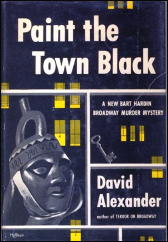
DAVID ALEXANDER

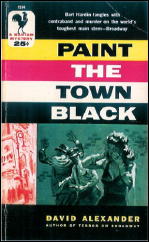
  DAVID ALEXANDER – Paint the Town Black. Random House, hardcover, 1954. Bantam 1534, paperback, 1956.

   Bart Hardin, managing editor of the Broadway Times, is in urgent need of $500. On the recommendation of an old friend, television commentator Mike Ainslie, he applies for a press-agent job with the Latin American Trade Alliance.

   Hired for the position, Hardin returns to his apartment over Bromberg’s Flea Circus and finds Ainslie’s tortured body in front of his fireplace. Hardin’s problems are compounded by the fact that he must break the news to Ainslie’s wife, Dorothy, with whom he is in love.

DAVID ALEXANDER

   The newspaperman’s personal involvement with both the murder and the trade alliance — which urgently wants to recover a fake pre-Columbian jug that Ainslie reportedly had in his possession prior to his death — leads him into encounters with a strange curio-shop owner, a psychologist who collects art, a strongman named Andes, and a chinless man with a penchant for sadism.

   Hardin is an engaging character: a denizen of Broadway who sports embroidered vests and a cynicism that is undermined by his ability (which he would term a flaw) to care deeply — be it for a murdered friend or his old blind dog.

   David Alexander’s portrayal of the people of Broadway gives full rein to their eccentricities, but stops short of being unbelievable. The plot is intricate, and all elements tie off neatly at the conclusion.

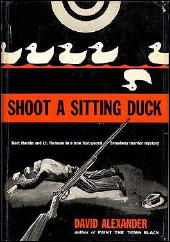
   Other notable Bart Hardin titles are Terror on Broadway (1954), Die, Little Goose (1956), Shoot a Sitting Duck (1957), and Dead, Man, Dead (1959).

DAVID ALEXANDER

   Alexander also created two other series of two books each. The first features the detective duo of Tommy Twotoes, an eccentric penguin fancier, and private eye Terry Rooke (Most Men Don’t Kill and Murder in Black and White, 1951); the second stars Broadway lawyer Marty Land, who also appears in the Hardin series (The Death of Daddy-O, 1960, and Bloodstain, 1961).

         ———
   Reprinted with permission from 1001 Midnights, edited by Bill Pronzini & Marcia Muller and published by The Battered Silicon Dispatch Box, 2007.   Copyright © 1986, 2007 by the Pronzini-Muller Family Trust.

A 1001 MIDNIGHTS Review
by Marcia Muller & Bill Pronzini


DAVID ALEXANDER

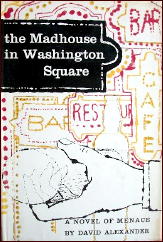
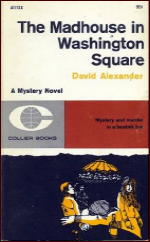
DAVID ALEXANDER – The Madhouse in Washington Square. J. B. Lippincott, hardcover, 1958. Collier 113, paperback, 1961.

   The Madhouse in Washington Square is a tavern frequented by a regular group of social misfits, one of whom is John Cossack, “a painter of barber poles … a barroom porter, a manufacturer of bombs, and something of a philosopher.”

   It is Cossack who finds failed writer Carley Dane beaten to death in Dane’s Greenwich Village cold-water flat. Any number of people had reason to kill the despicable writer, including most of the habitues of the Madhouse.

   Cossack doesn’t wish to see any of these people, his friends, behind bars. Besides, reporting the murder will interfere with preparations for his grand and compassionate scheme to blow up the tavern with one of his homemade bombs, thus putting its largely unhappy patrons — himself included — out of their collective misery.

DAVID ALEXANDER

   As Cossack’s scheme unfolds (and as circumstances force him to reluctantly assume the role of sleuth), Alexander introduces the reader to each habitue: Manley Ferguson, a frustrated artist; Helen Landers, a model who, when in her cups, suffers an overwhelming urge to do an impromptu striptease; wasted Peter Dotter, once rich and now a hopeless and pitiful alcoholic; Major Trevor, eighty-year-old veteran of the Boer War and World War 1, who supports himself by playing small character roles on the stage and on television; bitter old Martha Appleby, whose driving force for close to twenty years has been her hatred of Carley Dane.

   Other suspects include Bruno Madegliani, owner of the Madhouse, who loathes and mistrusts his customers and whose secret passion is to find the long-lost idol of his youth, a champion cyclist named the Great Goldoni; Penny Caldwell, a sensitive young poet who fancies herself another Emily Dickinson; and George Dabney Sturgis, a recently discharged soldier who came to New York just to meet Dane and received a rude welcome.

   Events set in motion in each of these characters’ lives during this crucial day are neatly resolved in the final pages; and Cossack reveals the identity of Dane’s murderer. As for his bomb … well, you’ll have to read the novel to find out whether or not the climax is literally an explosive one.

DAVID ALEXANDER

   In A Catalogue of Crime, Barzun and Taylor called The Madhouse in Washington Square “close to unreadable”; Barzun and Taylor obviously have no patience with eccentric prose styles and no empathy for eccentric characters.

   The fact is, the novel is not only readable but quite moving, owing in large part to David Alexander’s ability to sympathetically portray individuals whose lives and actions are far beyond the limits of rational human behavior. His treatment of these misfits is compassionate and gently humorous — and Madhouse is a kind of poignant tribute to all misfits, everywhere.

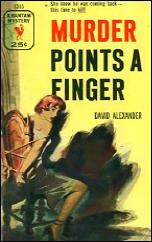
   Alexander’s other non-series novels are Murder Points a Finger (1953) and Pennies from Hell (1960). The latter, a tale of menace and persecution reminiscent of Hugo’s Les Miserables, is particularly good.

         ———
   Reprinted with permission from 1001 Midnights, edited by Bill Pronzini & Marcia Muller and published by The Battered Silicon Dispatch Box, 2007.   Copyright © 1986, 2007 by the Pronzini-Muller Family Trust.

A 1001 MIDNIGHTS Review
by Bill Pronzini


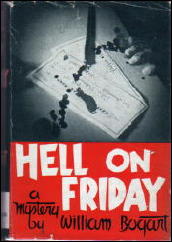
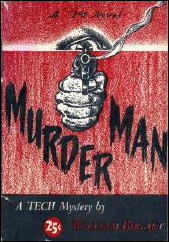
WILLIAM BOGART Hell on Friday

WILLIAM [G.] BOGART – Hell on Friday. Jonathan Swift, hardcover, 1941. Also published as Murder Man, Tech Mysteries, digest paperback, no date [1943?]

   William G. Bogart was a prolific pulp writer in the Thirties and Forties. His chief claim to fame is that he ghosted a handful of the Doc Savage novels that have become so popular in paperback reprint. At his best, he was only a fair novelist; Hell on Friday is noteworthy primarily as one of only two mystery novels with a pulp publishing background. (The other is William P. McGivern’s But Death Runs Faster, published seven years later — a much better mystery novel but lacking the range of pulp lore and true pulpy feel of the Bogart book.)

   Hell on Friday‘s protagonist, private eye Johnny Saxon, is a former “prince of the pulps” who quit writing after three years of phenomenal success because “the business had lost its kick for him [and] his stuff went stale.” His partner, Moe Martin, is “the loneliest literary agent in New York” — an emotional sponge who can lose himself in any narrative and therefore is incapable of telling the good from the bad.
WILLIAM BOGART Hell on Friday

   Saxon is hired by Joe Rogers, head of Rogers Publishing Company, a chain publisher of some twenty-two pulp magazines, to investigate the dubious business practices of a rival publisher, Sam Sontag.

   Rogers also wants him to help persuade a love-pulpeteer who writes under the name Dulcey Dickens to sign an exclusive contract with his firm. Murder, the appearance of a racketeer named Jasper Ward, the disappearance of Dulcey Dickens, and other complications carry the narrative.

   The plot isn’t particularly clever or exciting, and the solution holds no real surprises. Still, there is a certain charm to Hell on Friday (the title refers obliquely to the fact that Friday was payday for the legion of pulp writers, and often make-up day for the various magazines as well).

   Saxon and Moe Martin are engaging characters (as is Dulcey Dickens), and the pulp setting is well drawn and packed with details fascinating to anyone with an interest in that vanished era. Saxon also stars in two other novels by Bogart — Murder Is Forgetful (1944) and The Queen City Murder Case (1946).

         ———
   Reprinted with permission from 1001 Midnights, edited by Bill Pronzini & Marcia Muller and published by The Battered Silicon Dispatch Box, 2007.   Copyright © 1986, 2007 by the Pronzini-Muller Family Trust.

Bibliographic Note: All three novels are available in an omnibus edition (Hell on Friday: the Johnny Saxon Trilogy) published by Altus Press, 2010).

A 1001 MIDNIGHTS Review
by Kathleen L. Maio


JOHN & EMERY BONETT – Dead Lion. Doubleday Crime Club, hardcover, 1949. Pocket #738, paperback, 1950. Perennial Library P563, paperback, 1982. White Circle #505, Canada, paperback, 1951 (shown). Original UK edition: M. Joseph, hardcover, 1949.

JOHN & EMERY BONETT Dead Lion

   John and Felicity Carter Coulson (who write under the names John and Emery Bonett) have collaborated in a fruitful mystery career as well as a marriage. Their official joint debut came with the publication of Dead Lion, a fine example of the post-World War II British mystery.

   Simon Crane comes to Britain to meet his famous uncle — critic, author, and BBC intellectual Cyprian Druse — for the first time. Instead, he finds Druse’s body, his head stuck out a window and his neck bloody and broken.

   It soon becomes clear that many people wished to break Druse’s neck: the many authors he destroyed with his vitriolic criticism, and the many women he seduced, humiliated, and abandoned.

   When Simon finds himself in love with one of his uncle’s embittered conquests, he no longer wishes to play sleuth. Unfortunately, Professor Mandrake does. Mandrake, an anthropologist by trade, had been a BBC colleague of Druse’s. More important, he is a natural-born busybody and student of humanity just waiting for a chance to try his hand at detecting.

   While Simon tries to shield the woman he loves, Mandrake continues to happily meddle, eventually triggering the novel’s tragic conclusion.

   Dead Lion is an exquisitely crafted classical mystery. But besides providing a satisfying puzzle, like its many Golden Age predecessors, this novel also features three-dimensional, modern characters with psychological quirks and motivations.

   With small touches, the authors also manage to convey what life was like in England after the war. Theirs is a classic puzzle with new depth and Professor Mandrake as a lovable series sleuth.

   The fat, homely professor appears in two other books — A Banner for Pegasus (1951) and No Grave for a Lady (1959). Later Bonett novels with a Spanish sleuth and Costa Brava locale are well constructed but lack the charm of the Mandrake mysteries.

         ———
   Reprinted with permission from 1001 Midnights, edited by Bill Pronzini & Marcia Muller and published by The Battered Silicon Dispatch Box, 2007.   Copyright © 1986, 2007 by the Pronzini-Muller Family Trust.

A 1001 MIDNIGHTS Review
by Bill Pronzini


DAVID ALEXANDER – Hangman’s Dozen. Roy, hardcover, 1961.

    David Alexander is an underrated writer, in part at least because he had an idiosyncratic, sometimes self-consciously poetic and mannered style that some readers find offputting. But his work has undeniable power, and his novels featuring sporting newspaperman Bart Hardin are superior portraits of New York’s Broadway and Times Square in the 1950s. His plots, too, are unusual and compelling, as are his offbeat, colorful characters.

    Alexander was an even better short-story writer than novelist — certainly his prose was leaner and less eccentric in his short fiction — and the thirteen stories in Hangman’s Dozen are his best.

    “The Man Who Went to Taltavul’s” (which won a prize in one of Ellery Queen’s annual contests) and “Something in the Air” are excellent historical tales with startling twists at the end. “The Other Ones” is a chilling fantasy about some of the murderous inhabitants of hell. “Run from the Snakes” concerns a wet-brain, an alcoholic so far gone that he no longer even knows who he is.

    “Face of Evil” is a procedural about a cop named Romano, who appears in many of Alexander’s novels. “Love Will Find a Way” deals with three mountain climbers trapped by an avalanche and by their own passions in Switzerland, and the extraordinary crime perpetrated by two of them. The best of the hangman’s dozen is “Uncle Tom,” a devastating indictment of bigotry and racial injustice in the South — a story Alexander was unable to sell to any magazine in the Forties and Fifties.

    This is a heterogeneous collection, illustrating the range and depth of the author’s talent.

         ———
   Reprinted with permission from 1001 Midnights, edited by Bill Pronzini & Marcia Muller and published by The Battered Silicon Dispatch Box, 2007.   Copyright © 1986, 2007 by the Pronzini-Muller Family Trust.

NOTE:   Coming soon to a blog near you (this one), reviews by Marcia Muller and Bill Pronzini of The Madhouse in Washington Square and Paint the Town Black, both also by David Alexander.

A 1001 MIDNIGHTS Review
by Marcia Muller


NATHAN ALDYNE – Slate. New York: Villard Books, 1984. Ballantine, paperback, 1985. Alyson, trade ppbk, 1999.

NATHAN ALDYNE

   This is the third in a series of novels featuring gay bartender Dan Valentine and his straight friend Clarisse Lovelace. As the story opens, Dan is in the hospital recovering from a bout of double pneumonia; Clarisse is just starting law school. The two embark on a new venture at the urging of Clarisse’s uncle Noah — co-ownership of a gay bar in Boston’s South End.

   The building, originally owned by Noah, is across from the District D police station and houses an odd mixture of tenants — including a lesbian couple (one is a swimming pool repair specialist, the other a call girl) who are allowed to stay, and a family of sixteen Gypsies that Clarisse evicts singlehandedly . Also present on the first floor next to the bar is Mr. Fred’s Tease ‘n’ Tint hairstyling establishment.

   As one might expect from such an odd starting lineup, events do not proceed smoothly. The bar and apartments above (where Clarisse and Dan propose to live) are a shambles. Fortunately, Dan’s new lover, Linc, is a carpenter of some creativity; with any luck, the bar, to be named Slate, will open for New Year’s.

   Enter Sweeney Drysdale II, columnist for BAR (Boston Area Reporter — a free newssheet on Boston’s bars). Sweeney’s column “makes bars … and breaks bars,” in his words. And he is determined to break Slate. Determined, that is, until he turns up dead in Clarisse’s bed on the evening Mr. Fred of hairstyling fame gives a little “do” to welcome his new neighbors.

NATHAN ALDYNE

   Events proceed against this zany background. Clarisse and Dan and sidekicks investigate with aplomb. But there’s a problem with this novel: It simply lacks substance. Not once are we allowed inside anyone’s head to find out what the character feels or why he is the way he is. There are gimmicks aplenty; everyone’s terribly eccentric and witty and shallow.

   One can’t help but compare Slate with the sensitive, richly detailed novels of Joseph Hansen, which depict gay life with realism and understanding. Against them, the Aldyne books don’t stack up; they’re like clever reproductions compared to the real thing.

   The previous books in this series are Vermilion (1980) and Cobalt (1982).

         ———
   Reprinted with permission from 1001 Midnights, edited by Bill Pronzini & Marcia Muller and published by The Battered Silicon Dispatch Box, 2007.   Copyright © 1986, 2007 by the Pronzini-Muller Family Trust.

Bibliographic Notes:   “Nathan Aldyne” was the joint pseudonym of Michael McDowell and Dennis Schuetz. A fourth and final book in the series was Canary (1986). Follow the link for more information about both authors and short synopses of each of the books.

A 1001 MIDNIGHTS Review
by Marcia Muller


MARTHA ALBRAND – Manhattan North. Coward McCann & Geoghegan, hardcover, 1971. Avon, paperback, 1973.

MARTHA ALBRAND Manhattan North

   The cover of the paperback edition of this novel hails its author as “the mistress of romantic intrigue.” This is a blatant case of mislabeling, probably in an effort to take advantage of the great popularity of Gothic suspense novels in the early Seventies; and fans of that genre who bought this novel on the basis of the cover line must have been sorely disappointed.

Albrand’s work is suspenseful, but in a realistic, contemporary fashion. She deals with political and other problems of current concern (and in Manhattan North she is a good bit ahead of the times, writing of subjects that are frankly controversial), and her settings and characters are reflective of the world as we know it. True, she generally incorporates a love interest in her stories, but this does not always end on a happily-ever-after note.

   Manhattan North begins with the fatal stabbing of Supreme Court Justice Clark Jamison Butworth, who has been found in a snowbank in Central Park. The killing of Butworth, a close adviser to the president, prompts the formation of a committee to “investigate the effect of violence on the judiciary and terror as a measure of influencing judicial decisions.”

MARTHA ALBRAND Manhattan North

   Tad Wood, a young liberal lawyer, is asked to organize it, and facts soon emerge that begin to disturb him: The police investigation into Butworth’s death is being soft-pedaled, apparently on orders from the administration; there are irregularities about the death, such as the fact that Butworth was disguised in a wig and goatee at the time he was murdered.

   Tad digs deeper, makes the acquaintance of Butworth’s daughter, and is on the scene to help her when she is attacked by a burglar. Or was it a simple case of burglary?

   As Tad investigates, his personal life also plagues him. His godfather’s daughter, Lindy, has been sent abroad quite suddenly, and he receives an urgent plea from her for help. A psychic he has consulted about the Butworth case turns up dead, an apparent suicide.

   This is an engrossing novel that takes a hard look at some of the stickiest issues confronting contemporary society. Albrand’s early work also concerned itself with current issues, such as her two novels of the wartime Dutch Underground, No Surrender (1942) and Without Orders (1943). A later novel, A Call from Austria (1963), takes up the theme of escaped Nazi war criminals, and Zurich AZ/900 (1974) is a novel of international medical intrigue.

         ———
   Reprinted with permission from 1001 Midnights, edited by Bill Pronzini & Marcia Muller and published by The Battered Silicon Dispatch Box, 2007.   Copyright © 1986, 2007 by the Pronzini-Muller Family Trust.

A 1001 MIDNIGHTS Review
by Susan Dunlap


CATHERINE AIRD – A Most Contagious Game. Doubleday Crime Club, US, hardcover, 1967. Bantam, paperback, 1982. Rue Morgue, trade ppbk, 2007. First published in the UK: Macdonald & Co., hardcover, 1967.

CATHERINE AIRD

   Catherine Aird excels at portraying the English countryside’s village life with all its petty prejudices, the gentry and near-gentry, and the castles and ruins that dot the landscape.

   Her series sleuth, Inspector C. S. Sloan, deals with them in the fond yet frustrated manner of a native. Sloan is competent yet low-key, a good foil for the oddities of the suspects. His associates, Superintendent Leeyes, who views each case from the perspective of whatever night-school course he is taking, and Constable Crosby, whose only skill is fast driving, are rather forced and the least believable characters in the series.

   Aird’s best work is outside the Sloan series. A Most Contagious Game gives us Thomas and Dora Harding, a couple portrayed with such fine strokes that they seem to have been taken whole from real life. At fifty-two, Thomas Harding has worked himself into a heart attack and subsequent retirement to an oddly restored Elizabethan country house.

CATHERINE AIRD

   He is frustrated by the limitations his health imposes, and he is bored. Dora vacillates between encouraging his diversions and fearing he will bring another attack upon himself. The concerns of this couple and their interplay give the book a very solid base. But add to that Harding’s diversion — in tracking down the peculiarities of the remodeling of his house, he finds a secret compartment, a priest’s hole, and in it a 150-year-old skeleton.

   Another body, this time of a young woman, is found, and Harding’s search for both killers leads him to the guilty secrets of villagers past and present.

   Additional Aird titles are The Stately Home Murder (1970), Parting Breath (1977), Passing Strange (1981), and Harm’s Way (1984), all of which feature Inspector Sloan. Aird has also written a play and several works of nonfiction.

         ———
   Reprinted with permission from 1001 Midnights, edited by Bill Pronzini & Marcia Muller and published by The Battered Silicon Dispatch Box, 2007.   Copyright © 1986, 2007 by the Pronzini-Muller Family Trust.

A 1001 MIDNIGHTS Review
by Bill Crider


JIM THOMPSON Savage Night

JIM THOMPSON – Savage Night. Lion #155, paperback original, 1953. Reprinted several times, including Black Lizard Books, softcover, 1985, 1991.

   Although Savage Night has never attained the cult status of Jim Thompson’s The Killer Inside Me, it is an equally unnerving book, one that still has the power to shock despite the more than thirty years that have elapsed since its original publication.

   Carl (“Little”) Bigger (a.k.a. Carl Bigelow), a tubercular professional killer who is all of five feet tall, is sent to murder a key witness in an upcoming trial.

JIM THOMPSON Savage Night

   His plan is to do so by enlisting the help of his victim’s wife, but he hasn’t counted on the complications that arise, including the distrust of the local sheriff and his own feelings for Ruth, the deformed girl who works for his victim.

   Like Lou Ford in The Killer Inside Me, Bigger is oddly sympathetic. He is a cold-blooded killer, but he is at the same time a human being. He coldly seduces the wife, but his affair with Ruth is quite different. He has decent impulses, and even acts on them. The book has a number of unexpected twists in the plot, but what really interests the reader are Bigger and his inner conflicts.

JIM THOMPSON Savage Night

   The climax comes in a crescendo of violence and madness unsurpassed in the work of any other writer of paperback fiction, and perhaps even in Thompson’s other work.

   The chapters become shorter as the madness and violence grow, with the last six chapters occupying only three pages of text. The final chapter is one sentence long, but it is as devastating as any conclusion you are ever likely to read.

   Thompson wrote several other powerfully unique novels that should not be missed, including A Hell of a Woman (1954), Wild Town (1957; in which Lou Ford has a cameo appearance), The Getaway (1959), Pop. 1280 (1964), and Texas by the Tail (1965).

         ———
   Reprinted with permission from 1001 Midnights, edited by Bill Pronzini & Marcia Muller and published by The Battered Silicon Dispatch Box, 2007.   Copyright © 1986, 2007 by the Pronzini-Muller Family Trust.

« Previous PageNext Page »