1001 Midnights


A 1001 MIDNIGHTS Review
by Max Allan Collins


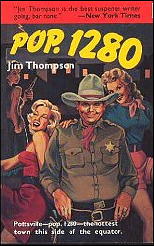
JIM THOMPSON – Pop. 1280. Gold Medal k1438, paperback original, 1964. Reprinted several times since, including Black Lizard, softcover, 1984, 1990. Filmed as Coup de Torchon (France, 1981).

jim thompson Pop.1280

   The psychopaths of Jim Thompson’s novels — and his best novels invariably feature psychopathic protagonists — have much in common, but each is distinct. The closest Thompson comes to repeating himself is in Pop. 1280, where protagonist Nick Corey bears a great resemblance to Lou Ford of the better-known Killer Inside Me.

   Like Ford, Corey is a law officer (a sheriff), and like Ford, he feigns folksy stupidity while committing cunning, vile, and often pointless murders — using his position as sheriff to cover them up.

   The setting is a small southern river town before the turn of the century, and the flavor is at once reminiscent of Erskine Caldwell and Mark Twain; the latter influence is such that Corey at times seems a psychopathic Huck Finn.

   Thompson is at his best here — on familiar ground, he seems almost to be having fun, not trying as hard to be an artist as he did in the sometimes uneven telling of Lou Ford’s story. Pop. 1280, a reworking of his most famous book, may well be his best. This is partially because Pop. 1280 is a black comedy; The Killer Inside Me is far too bleak for Lou Ford’s absurd behavior to approach the black humor that pervades the later novel.

jim thompson Pop.1280

   Corey seems so picked on and put upon (by his shrewish wife Myra, among others) that the reader begins to root for this combination Li’l Abner/William Heirens. Also, Corey’s shrewdness — and sickness — dawns so gradually that the reader initially underestimates Corey — just as other characters in the novel have done.

   By the end, Corey has come to the conclusion that he is Jesus Christ, but concludes also that being Christ doesn’t seem to be of any particular advantage.

   Behind Thompson’s black humor is the notion that the human condition is so unpleasant as to drive each of us mad, at least a little. And perhaps, after identifying with or at least allowing ourselves to be confined within the point of view of a madman, we will understand the madness of, say, a Richard Speck — and the madness in ourselves — a little better.

jim thompson Pop.1280

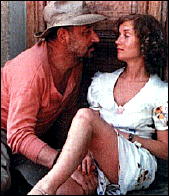
   An award-winning French film, Coup de Torchon (1981), directed by Bertran Tavernier, transplants Thompson’s tale to Equatorial Africa, 1936, but captures the spirit of the work to perfection.

   Tavernier’s film has helped draw attention to Thompson and Pop. 1280, and Black Lizard Books brought this minor masterpiece back into print in 1984, as one of a trio of Thompsons published in self-consciously old-fashioned “paperback” format, with covers evoking old pinball-machine art.

         ———
   Reprinted with permission from 1001 Midnights, edited by Bill Pronzini & Marcia Muller and published by The Battered Silicon Dispatch Box, 2007.   Copyright © 1986, 2007 by the Pronzini-Muller Family Trust.

A 1001 MIDNIGHTS Review
by Art Scott


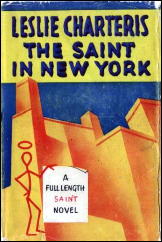
LESLIE CHARTERIS – The Saint in New York. Doubleday Crime Club, hardcover, 1935. First published in the UK:Hodder & Stoughton, hardcover, 1935. Reprinted many times since, in both hardcover and paperback. Film: RKO, 1938 (with Louis Hayward as Simon Templar, and Jonathan Hale as Inspector Fernack).

LESLIE CHARTERIS The Saint in New York

   This novel is perhaps the best of the tales in which Simon Templar adopts the role of Nemesis, dispensing summary justice to criminals. It is one of the grimmest tales in the Saint saga; it is a furiously paced, tightly crafted, wholly satisfactory blood-and-thunder thriller.

   Wealthy William Valcross offers the Saint $1 million to avenge the death of his son, who was murdered by a kidnap mob terrorizing New York. The Saint accepts the job, makes up a list of six big-time mobsters to be killed, and announces his intention to clean up the city to the newspapers.

   In three days of furious action, he makes good on his promise. Along the way he adds another name to his list, the mysterious “Big Fellow,” a Moriartyesque mastermind who pulls the strings behind the scenes; and encounters a woman of mystery, Fay Edwards, who saves his life when he’s taken for a ride.

   He also forms an uneasy alliance with John Henry Fernack, chief of New York detectives, who thereafter became a continuing character, reappearing whenever Templar’s travels take him to the States.

LESLIE CHARTERIS The Saint in New York

   The episode in which Templar, armed with only a knife and his wits, takes on a houseful of mobsters in order to save a kidnapped girl is as neatly choreographed and exciting an action sequence as is to be found anywhere in Charteris’s work. The book concludes with a dramatic surprise ending, in which the Saint learns the identity of the Big Fellow.

   The Saint in New York predates by some forty years a paperback landslide of similar one-man-against-the-mob novels written by Don Pendleton and his many imitators. It is unlikely that any have yet equaled this book for excitement; certainly none has come close in style.

   Other Saint books of note: Getaway (1932), The Misfortunes of Mr. Teal (1934) (ss), Saint Overboard (1936), The Happy Highwayman (1939) (ss), and The Saint in Miami (1940).

         ———
   Reprinted with permission from 1001 Midnights, edited by Bill Pronzini & Marcia Muller and published by The Battered Silicon Dispatch Box, 2007.   Copyright © 1986, 2007 by the Pronzini-Muller Family Trust.
A 1001 MIDNIGHTS Review
by Art Scott


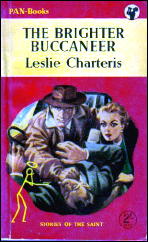
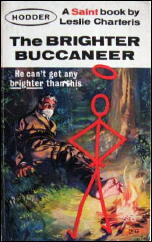
LESLIE CHARTERIS The Brighter Buccaneer

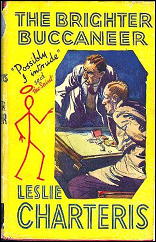
LESLIE CHARTERIS – The Brighter Buccaneer. Doubleday Crime Club, hardcover, 1933. First published in the UK: Hodder & Stoughton, 1933. Reprinted many times, often [warning] with some stories not included.

    Leslie Charteris’s long-lived and internationally popular character, the Saint, has appeared in two widely different sorts of tales. In the novels, he is the piratical adventurer and self-appointed executioner, usually involved in melodramatic thrillers with lots of action and political intrigue. The Saint short stories, however, tend to be more jocular and subdued, and often have elements of genuine detection.

LESLIE CHARTERIS The Brighter Buccaneer

    Charteris has made one particular sort of short story his specialty — the “sting” story, in which Simon Templar outcons the con men. In doing so, he makes good the losses of the previously fleeced-in line with his reputation as “the Robin Hood of Modern Crime” — and pockets a nice profit for himself in the bargain.

    Several of the stories in this collection are classics in this genre. In “The Brain Workers,” for instance, Templar adopts his favorite disguise as twittish Sebastian Tombs to outwit one Julian Lamantia, dealer in phony oil stock; in the final story, “The Unusual Ending,” Lamantia comes in for another dose of the same (this time he’s running a Ponzi scheme). “The Unblemished Bootlegger,” a tale of poetic retribution, is noteworthy in that it marks the debut of Peter Quentin, who became one of the Saint’s regular accomplices in later stories.

LESLIE CHARTERIS The Brighter Buccaneer

    “The Appalling Politician” provides a break from the con games. It is a detective story, in which the Saint’s long-suffering adversary, Chief Inspector Claude Eustace Teal, calls on Templar to help out with a stolen-treaty problem. In this one, as he often does, Charteris makes use of his fictional alter ego to get off a few witty blasts at pompous British politicians.

    The best of all the stories is “The Green Goods Man,” in which Templar neatly turns the tables on a counterfeit-money scam artist. It has two truly memorable scenes and a slick double-twist ending.

         ———
   Reprinted with permission from 1001 Midnights, edited by Bill Pronzini & Marcia Muller and published by The Battered Silicon Dispatch Box, 2007.   Copyright © 1986, 2007 by the Pronzini-Muller Family Trust.
A 1001 MIDNIGHTS Review
by Edward D. Hoch


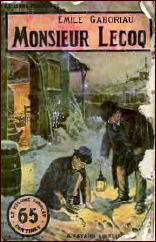
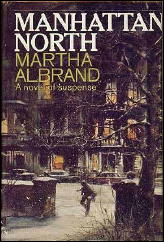
ÉMILE GABORIAU – Monsieur Lecoq. E. Dentu, Paris, 1868. Edited version published in the US: Dover, softcover, 1975.

MONSIEUR LECOQ

   Monsieur Lecoq, Gaboriau’s twelfth book and his fifth novel in which the French detective of the title appears, is today often considered his best and most readable book. Changing reading habits, plus indifferent translations, have left the pioneer French mystery writer all but unread today, but he deserves a place in any survey of classic detective fiction.

   Lecoq, introduced in his first book as a secondary character, was a minor Sûreté detective with a shady past somewhat like the real-life Vidocq. But he soon takes center stage in the Gaboriau novels, and in Monsieur Lecoq he investigates a triple murder in a poor section of Paris.

   The killer, apprehended at the scene, appears to be a petty criminal who calls himself May, but Lecoq suspects he might really have another identity. The duel of wits between the two men extends through the first volume of the novel.

   The second volume, sometimes published separately as The Honor of the Name, is really a separate and inferior historical novel set around the year 1815, with Lecoq and the evasive villain only reappearing in the final twenty-two pages.

MONSIEUR LECOQ

   Though there have been numerous British and American editions of the novel, the recent Dover edition cited above (skillfully edited and introduced by E. F. Bleiler) is the first to eliminate the extraneous historical novel and jump at once from the end of volume one to the important final pages of volume two.

   Gaboriau’s books are not without their weaknesses, and they often suffer from cardboard characterization and inconsistencies. Their strengths lie in plotting and background. They are not exactly the books we think of as detective novels today, but enough elements are present to argue effectively that Gaboriau deserves his title as the father of the detective novel.

   Lecoq first appears as a secondary character in The Widow Lerouge (1866), but stars in his next two cases, The Mystery of Orcival (1867) and File No. 113 (1967). He also makes a brief appearance in The Slaves of Paris (1868), but this is more a crime novel than a detective story.

         ———
   Reprinted with permission from 1001 Midnights, edited by Bill Pronzini & Marcia Muller and published by The Battered Silicon Dispatch Box, 2007.   Copyright © 1986, 2007 by the Pronzini-Muller Family Trust.
A 1001 MIDNIGHTS Review
by Marcia Muller


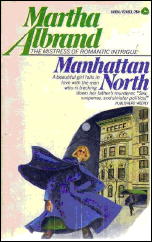
FRANCES CRANE – Death-Wish Green. Random House, hardcover, 1960. Hardcover reprint: Detective Book Club, 3-in-1 edition. No paperback edition.

FRANCES CRANE Death-Wish Green

   Pat and Jean Abbott, a private investigator and his wife, are returning to foggy San Francisco from a weekend in the sun. As they reach the toll plaza of the Golden Gate Bridge, they spot a familiar car being inspected by highway patrolmen and the local police. The car, which was abandoned on the bridge, belongs to Katie Spinner, daughter of friends of the Abbotts; and it appears she has jumped off the bridge.

   Jean Abbott, however, is not convinced the girl committed suicide; and when Pat is hired by Katie’s aunt to investigate the disappearance, it becomes apparent Katie is still alive.

   The Abbotts, who often work as an investigative team, focus on bohemian North Beach, one of the last places Katie was seen before she started across the bridge. There they encounter an art-gallery dealer with a taste for Zen Buddhism and opium; a model who calls her favorite color “death-wish green,” and dies wearing it; a mysterious stranger with a large auburn beard who was seen with the missing girl in a coffeehouse; and errant sons and daughters of some of the city’s wealthiest and most respected families.

   For all Pat Abbott’s investigative skills, in the end it is Jean who sees most of the action and carries the day.

   Frances Crane’s descriptive powers are considerable, and the sense of place — particularly of the fog and its effect on San Francisco — is powerful. Her secondary characters are well drawn and indeed far more vividly drawn that either Pat or Jean. Jean, the narrator/observer, remains just that, and we come away without really having gotten to know her. Pat, the detective, is merely a figure going through investigative motions.

   Frances Crane has written many other novels, all of them with colors in their titles, featuring the Abbotts. Among them are The Amethyst Spectacles (1944), The Buttercup Case (1958), and The Amber Eyes (1962).

   In addition to San Francisco, they are set in such locales as Tangier (The Coral Princess Murders, 1954); New Mexico (Horror on the Ruby X, 1956); and New Orleans (The Indigo Necklace, 1955).

         ———
   Reprinted with permission from 1001 Midnights, edited by Bill Pronzini & Marcia Muller and published by The Battered Silicon Dispatch Box, 2007.   Copyright © 1986, 2007 by the Pronzini-Muller Family Trust.
      Previously on this blog:

The Cinnamon Murder (reviewed by Steve Lewis)

A 1001 MIDNIGHTS Review
by Bill Pronzini


R. A. J. WALLING – Marooned with Murder. Morrow, hardcover, 1937. UK edition published as Bury Him Deeper, Hodder & Stoughton, hc, 1937.

R. A. J. WALLING

   R. A. J. Walling, a British journalist and newspaper editor who began writing mysteries as a hobby in his late fifties, received a good deal of acclaim during his time. (His first book was published in 1927, his last posthumously in 1949.)

   The New York Times stated in 1936 that Walling had considerable skill in weaving mystery plots; the Saturday Review of Literature decided that he wrote suavely baffling stories; the eminent critic Will Cuppy said of one of his early novels that it was “absolutely required reading.”

   This reviewer couldn’t agree less.

   In the first place, Walling wrote some of the dullest mysteries ever committed to paper; it may even be said that he elevated dullness to a fine art. And in the second place, his series sleuth, private inquiry agent Philip Tolefree, is a twit.

   He says things like, “You’re a vandal, Pierce. You’ve feloniously broken into my ivory tower. Never mind. I’d have been bored in another half hour. How’d you find me out? Sit down, my dear fellow. Cigarette? Pipe? Well, carry on. What’s the trouble now? Or did you come for the sake of my beautiful eyes?”

   He is also fond of quoting obscure Latin phrases, treating his sometime Watson, Farrar, as if he were an idiot, and withholding information from everyone including the reader.

   Although Tolefree operates out of a London apartment, most of his cases seem to take him into the countryside. He solves them in the accepted Sherlockian manner of detection and deduction, using an inexhaustible fund of knowledge both esoteric and ephemeral.

R. A. J. WALLING

   Another reason he is so successful at unmasking murderers is his familiarity with such matters and motives as skeletons in closets, hidden relationships, peculiar wills, strange disappearances, and Nazi infiltrators, since nearly all his investigations seem to uncover one or any combination of these.

   Marooned with Murder is no exception; its central plot points are hidden relationships and a strange disappearance. It begins well enough, with a dandy premise: Tolefree and Farrar, on a holiday in the Scottish Highlands, decide to rent a boat and sail her out of one of the fjordlike lochs into the Atlantic.

   A sudden storm shipwrecks them on the tiny island of Eilean Rona, where they are rescued by the lord of the isle, Martin Gregg; artist Bill Parracombe; and two odd and fiercely loyal Scotsmen, Fergus and Jamie. Also staying at the island’s ancient castle for the summer are Gregg’s wife and small son, and the boy’s governess.

   The storm continues to batter Rona, preventing any of them from leaving. A chance remark by Farrar, about a retired sea captain he knows named Strachan who lives over on the mainland, for some reason seems to frighten everyone; so does the remark that Tolefree is a detective.

   It soon becomes clear that Strachan had been hunting lost treasure on the island and disappeared one foggy Sunday three months before, along with his boat and a mysterious companion; and that the inhabitants of Rona know something about that disappearance and are desperate to protect their guilty knowledge.

R. A. J. WALLING

   So far, so good. But Walling spoils the stew by interminable passages of cat-and-mouse dialogue, annoying cryptic remarks from Tolefree, and a lot of rather silly running around. He also lets the reader know early on that Tolefree and Farrar do not fear for their lives; they think their hosts are all swell people, even though one of them may be a murderer.

   The result is plenty of mystery but no menace and therefore no tension. And the mystery isn’t satisfying, either, when its rather predictable solution is revealed.

   Walling has been called (by his publishers) “the foremost exponent of the seemingly ‘quiet’ mystery, the civilized story with … excitement and drama seething below the surface.”

   Readers who don’t find that a euphemism for dull, and would like to examine Walling’s work for themselves, should try The Corpse in the Coppice (1935), The Corpse with the Floating Foot (1936), The Corpse with the Eerie Eye (1942), and A Corpse by Any Other Name (1943). The last-named title has some effective descriptions of Londoners coping with the wartime blackout and blitz.

         ———
   Reprinted with permission from 1001 Midnights, edited by Bill Pronzini & Marcia Muller and published by The Battered Silicon Dispatch Box, 2007.   Copyright © 1986, 2007 by the Pronzini-Muller Family Trust.

A 1001 MIDNIGHTS Review
by Marcia Muller


LESLIE FORD Siren in the Night

LESLIE FORD – Siren in the Night. Charles Scribner’s Sons, hardcover, 1943. Paperback reprints include: Bantam #303, 1948; Popular Library K68, 1964.

   Grace Latham, Colonel Primrose, and Sergeant Buck reappear in yet another locale in this wartime story. Grace is spending the spring in San Francisco because her son, a naval air cadet, is stationed there; Primrose and Buck have traveled west because of the colonel’s involvement in the war effort.

   The city is at its charming best, except for placards indicating where the air-raid shelters are and “the sudden rising wail of the alert siren, and the lights of that Golden City fading like a million synchronized fireflies dying in the night.”

   A blackout, in fact, plays a key role in the discovery of the murder of Loring Kimball, popular resident of San Joaquin Terrace, where Grace has taken a house.

LESLIE FORD Siren in the Night

   If all the lights in the city hadn’t gone out except for the one in Kimball’s study, no one would have stopped in to investigate, and his body might not have been discovered for some time — thus allowing the killer to escape the scrutinizing eyes of Colonel Primrose.

   But the lights do go out; the body is found by neighbor Nat Donahue (who is immediately suspected of the crime); and when all residents of,the small street are accounted for, it turns out that a number weren’t where they should have been at the time of Kimball’s death.

   As Primrose probes into the lives of these residents, hidden passions and secrets come to the surface. The suspects are varied and well characterized, and the portrait Ford paints of wartime San Francisco is memorable.

LESLIE FORD Siren in the Night

   While as mannered as Ford’s other mysteries, there is a dark side to this novel, as exemplified by the blackout and the implied threat of annihilation by the enemy.

   The Primrose/Latham series is best read in order of publication, since its chief charm lies in the complexity of the relationships among the main characters. Other notable titles include The Simple Way of Poison (1937), Old Lover’s Ghost (1940), and The Woman in Black (1947).

         ———
   Reprinted with permission from 1001 Midnights, edited by Bill Pronzini & Marcia Muller and published by The Battered Silicon Dispatch Box, 2007.   Copyright © 1986, 2007 by the Pronzini-Muller Family Trust.
A 1001 MIDNIGHTS Review
by Ellen Nehr


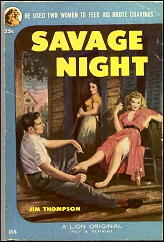
LESLIE FORD – Ill Met by Moonlight. Farrar & Rinehart, hardcover, 1938. Reprint paperbacks include: Dell #6, mapback edition, no date [1943]; Popular Library 60-2440, 1964.

LESLIE FORD Ill Met by Moonlight

   Leslie Ford (a pseudonym of Zenith Brown, who also wrote as David Frome) has often been accused of being one of the leading practitioners of the “had-I-but-known” school, and it is true that a great many of these leading and tension-spoiling statements appear in her novels.

   However, shortsighted critics have overlooked her carefully delineated exploration of life among people who are not too different from the average reader except in the fact that, through familial associations, political affinity, or geographic accident, they invite more than their fair share of murder and well-bred mayhem.

   This is the second adventure of Colonel John T. Primrose and Sergeant Phineas Buck, one in which the unlikely but highly successful combination of retired officer and retired enlisted man is teamed with a thirty-eight-year-old widow, Grace Latham. Grace is of a distinguished Georgetown family, and her elegant home forms the backdrop for many of the books in this series.

   Ill Met by Moonlight takes place in another setting — April Harbor, Maryland, a summer playground for an inbred group of upper-crust families, where Grace and her relatives have been vacationing for years. Primrose and Buck are guests at Grace’s cottage when she finds a neighbor dead of carbon-monoxide poisoning in the garage next door.

   An old romance, a troubled marriage, a new love affair, and relationships with the folks in the neighboring town are all woven together in this engrossing and charming tale of love and murder.

         ———
   Reprinted with permission from 1001 Midnights, edited by Bill Pronzini & Marcia Muller and published by The Battered Silicon Dispatch Box, 2007.   Copyright © 1986, 2007 by the Pronzini-Muller Family Trust.
A 1001 MIDNIGHTS Review
by Newell Dunlap & Bill Pronzini


SIMON BRETT – A Comedian Dies. Scribner’s, hardcover, 1979. Reprint paperbacks include: Berkley, 1980; Dell, 1986; Warner, 1990. UK edition: Victor Gollancz, hardcover, 1979.

SIMON BRETT A Comedian Dies

   Making good use of his background in radio and television, and of his interest in the theater, Simon Brett has created one of the most likable characters among recent series sleuths: Charles Paris, a middle-aged and not very successful radio actor whose vices include drink, women, and stumbling into murder cases that he is forced to solve.

   The Paris novels are distinguished by solid plotting, well-drawn entertainment business backgrounds, and a nice interweaving of humor that often borders on spoof.

   One of the first things the reader of A Comedian Dies, which has a modem British vaudeville background, will notice is that there is a gag at the beginning of each chapter. A gag such as:

   Feed: I heard on the radio this morning that the police are looking for a man with one eye.

   Comic: Typical inefficiency.

   Having discovered this, most readers will no doubt be tempted to flip through the book and read all of the gags immediately, like gulping popcorn. You should refrain from doing this, however. Taken one at a time, every dozen pages or so, each will provoke an amused and tolerant groan; taken all at once, they are sort of like listening to a Bob Hope monologue and may therefore cause severe trauma, if not a sudden desire to take up golf or vote Republican.

SIMON BRETT A Comedian Dies

   On the other hand, the novel itself is worth reading all at once. Paris and his estranged wife, Frances, trying once again to mend their marriage, are attending a vaudeville show at the Winter Gardens in Hunstanton, a small English seacoast town. But the show the star performer, comedian Bill Peaky, puts on is not at all what Paris anticipated: Peaky is electrocuted on stage while clutching his electric guitar and microphone.

   At the inquest, the coroner decides the death was accidental, due to faulty wiring, but Paris has his doubts and starts an investigation of his own. Suspects abound, owing to the fact that Peaky was not a very popular fellow. Paris is something of a bumbler, which only enhances his appeal; and he does get to the bottom of things eventually, in spite of the eighteen gags Brett throws at him along the way.

   Feed: Do you know, they say that whisky kills more people than bullets.

   Comic: Ah well, that’s because bullets don’t drink.

         ———
   Reprinted with permission from 1001 Midnights, edited by Bill Pronzini & Marcia Muller and published by The Battered Silicon Dispatch Box, 2007.   Copyright © 1986, 2007 by the Pronzini-Muller Family Trust.

A 1001 MIDNIGHTS Review
by Bill Pronzini


GEOFFREY HOMES – Build My Gallows High. William Morrow, hardcover, 1946. Paperback reprints include: Jonathan Press J35,digest, no date [1948]; Ace D-185, 1956, published dos-à-dos with The Humming Box, by Harry Whittington; Zebra “Movie Mystery Greats,” 1988.

GEOFFREY HOMES Build My Gallows High

   From 1936 to 1946, Geoffrey Homes (Daniel Mainwaring) published a dozen very good mysteries set primarily in the valleys and foothills of north-central California. Build My Gallows High is the last and best of the twelve, and so firmly established Mainwaring in Hollywood (he had been writing B movies since 1942) that he produced no more fiction during the last thirty-two years of his life.

   This novel was filmed, from Mainwaring’s screenplay, as Out of the Past (1947), starring Robert Mitchum, Jane Greer, and Kirk Douglas — one of the half-dozen best noir crime films ever made.

   Both novel and film are powerful studies of one man’s struggle to maintain the hope of his future when his jaded past catches up with him. Red Bailey is a former New York private detective, the kind “who first looked at a client’s supply of thousand-dollar bills, then at his social-and legal-status” before taking on a job; an angle player who made his big mistake when he went to work for a gambler named Whit Sterling.

GEOFFREY HOMES Build My Gallows High

   The job (told through flashback) was to find Sterling’s ex-mistress, Mumsie McGonigle, who shot and wounded Sterling and then ran off with $56,000 of his money. Red tracked Mumsie to Mexico, met and fell in love with her; and when she claimed she’d only shot Sterling in self-defense, Red stupidly double-crossed the gambler and helped Mumsie cover her tracks from Mexico to California.

   But their relationship wasn’t what Red expected. When his former partner showed up at their country hideaway, murder drove the final wedge between them — and Red realized how badly he’d screwed up his life.

   Determined to put Mumsie and the rest of it behind him, he made his way to a small town in the foothills of the Sierra Nevada, opened a gas station, and spent most of his free time fishing. He even met a new woman, one he learned to love more than Mumsie, one he planned to marry. Now, for the first time in his life, he is content.

GEOFFREY HOMES Build My Gallows High

   But then one day his past shows up in the person of a flashily dressed Greek gunman employed by Guy Parker, a crooked cop Red knew in the old days who now operates a gambling club in Reno. Red accompanies the Greek to see Parker, and finds that Mumsie is now Parker’s live-in girlfriend.

   Parker wants Red to do a detective job for him; if he doesn’t agree, then Parker will tell Whit Sterling where to find him. Red smells a setup of some kind, with himself square in the middle, but what choice does he have except to do as Parker asks? Up to a point, that is …

   This is a taut, hard-edged thriller, powerfully told in a clipped style reminiscent of Hemingway’s, with superb characterization and a hammer-blow climax. Anyone who has seen and admired Out of the Past will find Build My Gallows High every bit as memorable.

         ———
   Reprinted with permission from 1001 Midnights, edited by Bill Pronzini & Marcia Muller and published by The Battered Silicon Dispatch Box, 2007.   Copyright © 1986, 2007 by the Pronzini-Muller Family Trust.
GEOFFREY HOMES Build My Gallows High  

« Previous PageNext Page »