1001 Midnights


A 1001 MIDNIGHTS Review
by Francis M. Nevins


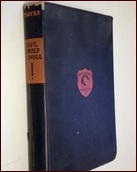
LEE THAYER – Out, Brief Candle! Dodd Mead, hardcover, 1948. No paperback edition.

   The life of Emma Redington Lee Thayer is more fascinating than any of her novels. Born in 1874, she quickly established herself as a painter of murals on the walls of private homes, and some of her work in this field was displayed in 1893 at the Chicago World’s Fair. Later she specialized in doing the designs for stamped bookbindings, and countless early-twentieth-century titles were made visually more appealing thanks to her skill.

LEE THAYER Out Brief Candle

   It was only after World War I that she started writing books herself, turning out a total of sixty mystery novels, for all but the last three of which she also designed the dust jackets. Apparently she holds the record for both professional and personal longevity in the mystery field, for her last book, Dusty Death (1966), came out when she was ninety-two, and she lived to be ninety-nine.

   She seems to have been a nice, refined, well-to-do old lady. Unfortunately she wrote her novels for an audience she thought of as exactly like herself, with no attempt to widen her appeal.

   Fifty-nine of Thayer’s sixty books deal with redheaded gentleman detective Peter Clancy, a dinosaur among sleuths if ever there was one. Imagine a stick figure from Edwardian times adrift in the decades of depression, war, angst, and civil rights, and trying desperately to pretend that nothing has happened, and you have something of the flavor of a Peter Clancy exploit.

   Thayer’s novels move with the speed of an arthritic snail trying to cross a piece of flypaper. Her plotting is abysmal, her style unbearable, her characters impossible. In most of his adventures, Clancy is attended by an ever-deferential valet named Wiggar, a Jeeves clone without a drop of humor, who is constantly getting off bons mots like “Oh, Mr. Peter, sir!”

   Her favorite device for bringing a book to climax was to have God Almighty himself strike down the killer from on high, while Mother Nature whipped up a furious storm and the rhetoric swirled and squalled. Those who might think this description is exaggerated are referred to Accessory after the Fact (1943) and Still No Answer (1958), as well as to our main entry.

   Out, Brief Candle! takes its title from Macbeth and its kickoff situation from Agatha Christie: Like Poirot in Death in the Air (1935), Clancy investigates a murder aboard an airliner on which he was a passenger.

   Like all Thayer novels, this one is twice as long as necessary; but a slightly ingenious solution, combined with a truly grisly encounter between a little girl and a body in a coffin, lifts it to the ranks of Thayer’s best, whatever that means.

   Lee Thayer is a highly specialized taste, but if for no other reasons than her industry and longevity, she deserves better than to be totally forgotten.

         ———
   Reprinted with permission from 1001 Midnights, edited by Bill Pronzini & Marcia Muller and published by The Battered Silicon Dispatch Box, 2007.   Copyright © 1986, 2007 by the Pronzini-Muller Family Trust.

Editorial Comment:   Complementing this review, or to be more precise, the impetus for my posting it here, is one covering Lee Thayer’s first book, The Mystery of the 13th Floor (1919), by J. F. Norris on his blog. You should go read it.

Two 1001 MIDNIGHTS Reviews
by Bill Pronzini:


● JOE GORES – Dead Skip. Random House, hardcover, 1972. Reprint paperbacks include: Ballantine, 1974; Mysterious Press, 1992.

JOE GORES

   While holding down a variety of jobs, one of them a stint as a San Francisco private investigator, Joe Gores published numerous (and generally hard-boiled) short stories in the 1950s and 1960s. One of these, “Sweet Vengeance” (Manhunt, July 1964) became the basis for his first novel, the violent suspense thriller A Time of Predators (1969).

   Dead Skip is the first of three novels in the DKA File series (which also includes a dozen or so short stories) — a series Ellery Queen called “authentic as a fist in your face.”

   DKA stands for Daniel Kearny Associates, a San Francisco investigative firm modeled on the real agency for which Gores once worked. (It was Anthony Boucher who first suggested Gores utilize his PI background as the basis for a fictional series.)

   DKA operates out of an old Victorian that used to be a specialty whorehouse, and specializes in the repossessing of cars whose owners have defaulted on loans from banks and automobile dealers.

JOE GORES

   Kearny, the boss, is tough, uncompromising, but fair; his operatives, each of whom plays an important role in some if not all of the novels and stories, include Larry Ballard (the nominal lead protagonist), Bart Heslip, Patrick Michael O’Bannon, Giselle Marc, and office manager Kathy Onoda.

   Dead Skip begins quietly enough, with Bart Heslip (who happens to be black) repossessing a car in San Francisco’s Richmond district and returning it to the DKA offices, where he files his report. But when he leaves he is struck down by an unknown assailant — and the following morning the other members of DKA are confronted with the news that Bart is in a coma in a hospital intensive-care unit, the apparent victim of an accident in a repo’d Jaguar.

   Bart’s girlfriend, Corinne Jones, refuses to believe in the “accident” and convinces Ballard that Bart was the victim of violence. In spite of Kearny, who seems more concerned about the cost of the wrecked Jag than about Bart’s welfare (thus causing tension in the ranks), Ballard embarks on a search for Bart’s assailant and an explanation for the attack.

JOE GORES

   Starting with the files on Bart’s recent repo jobs, he follows a twisting trail that takes him all over San Francisco and to the East Bay; involves him with a number of unusual characters, one of them a rock musician with a group calling itself Assault and Battery; and ends in a macabre confrontation that endangers not only Ballard’s life but that of Giselle Marc, in a house high above the former haven of the flower children, the Haight-Ashbury.

   The motivation for the attack on Bart is hardly new to crime fiction, and some of the villain’s other actions are likewise questionably motivated, but these minor flaws shouldn’t spoil anyone’s enjoyment of what is otherwise an excellent private-eye procedural. It is, in fact, strong stuff — realistic, powerful, “a traditional American crime novel, out of Black Mask, Hammett and Chandler” (New York Times).

   Even better are the other two novels in the series — Final Notice (1973) and Gone, No Forwarding (1978).

● JOE GORES – Hammett. Putnam’s, hardcover, 1975. Reprint paperbacks include: Ballantine, 1976; Perennial Library, 1982.

JOE GORES

   Gores is a lifelong aficionado and student of the works of Dashiell Hammett, and Hammett’s influence is clearly evident in Gores’s own fiction. Hammett is his personal monument to the man he believes was the greatest of all crime writers — part thriller, part fictionalized history, part biography set in the San Francisco of 1928, “a corrupt city, owned by its politicians, its cops, its district attorney. A city where anything is for sale.”

   When an old friend from his Pinkerton days, Vic Atkinson, is murdered after Hammett refuses to help him, the former op-turned-Black Mask writer once again finds himself in the role of detective and man hunter.

   But as the dust-jacket blurb says, “During his search through the teeming alleys of Chinatown, through the cathouses and speakeasies and gambling hells of the city, Hammett discovers that the years of writing have dulled his hunter’s instincts, have made him fear death — and that failure to resharpen his long-unused skills as a private detective could end… his life.”

JOE GORES

   The blurb goes on to say, “[Gores’] dialogue crackles and sparks with the wry, tough humor of the twenties. His characters are thinly disguised portraits of the men and women who shook and shaped this most fascinating of American cities. His plot, drawn from actual events in San Francisco’s corrupt political past, casts harsh light on a stark and bloody era.”

All of which is true enough, at least up to a point. Hammett is considered by some to be Gores’ best book, and in many ways it is. But it also has its share of flaws, among them some overly melodramatic scenes and a disinclination on Gores’ part to even mention Hammett’s left-wing politics.

   All things considered, it is certainly a good novel — one that should be read by anyone interested in Hammett, San Francisco circa 1928, and/or fast-action mysteries of the Black Mask school — but it is not the great novel it has occasionally been called.

   The 1982 film version produced by Francis Ford Coppola, on the other hand, is pure claptrap. Frederick Forrest is fine as Hammett, and the script by Ross Thomas is faithful to the novel, but the direction (Wim Wenders) is so arty and stylized that all the grittiness and power is lost. Some of the scenes, in fact, are so bad they’re almost painful to watch.

JOE GORES

   Gores’ other non-series novels, A Time of Predators (which received an Edgar for Best First Novel of 1969) and Interface (1974), are also excellent.

   The latter is one of the toughest, most brutal novels published since the days of Black Mask — so hard boiled that some readers, women especially, find it upsetting. But its power is undeniable; and its surprise ending is both plausible and certain to come as a shock to most readers.

         ———
   Reprinted with permission from 1001 Midnights, edited by Bill Pronzini & Marcia Muller and published by The Battered Silicon Dispatch Box, 2007.   Copyright © 1986, 2007 by the Pronzini-Muller Family Trust.

JOE GORES, R.I.P.   Posted earlier today on Yahoo’s Rara-Avis group was an announcement by publisher Vince Emery of Joe Gores’ death. Quoting briefly:

JOE GORES

    “Sad news: Joe Gores, one of my favorite authors — and favorite people — passed away Monday, in a hospital in Marin County.

    “Joe was a three-time Edgar Award winner, past president of the Mystery Writers of America, and author of my favorite hard-boiled mystery series set in San Francisco, the Daniel Kearny & Associates series, which was based on Joe’s own experiences as a detective and repo man. He was working on a new DKA novel when he died.”

    Mr. Gores’ most recent novel was, of course, Spade & Archer (Knopf, 2009), a prequel to The Maltese Falcon, by Dashiell Hammett. Quite coincidentally (this is Steve talking) I am halfway through it now, and I’ve enjoyed every minute of it.
A 1001 MIDNIGHTS Review
by Marcia Muller


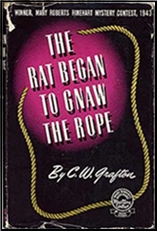
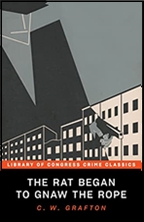
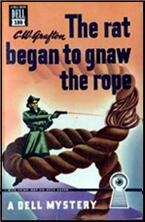
C. W. GRAFTON – The Rat Began to Gnaw the Rope. Farrar & Rinehart, hardcover, 1943. [Mary Roberts Rinehart Mystery Contest winner.] Reprint paperbacks: Dell #180, 1947, mapback edition; Perennial Library, P639, 1983. Poisoned Pen Press, trade paperback, 2020.

   Lawyer Gil Henry’s client describes him as a young man who has “got more curiosity than an old maid and his mind is so sharp it’s about to cut his ears off.” Henry is this and much more — tenacious, eager, with a humorous, self-deprecating wit.

   Sometimes he’s a bit of a bumbler, but he has the good grace to acknowledge it. And in this, his first case, his determination serves him in good stead.

   Henry is hired by Ruth McClure to look into the matter of some stock she has inherited: Her father, who was recently killed in an auto accident, has left her a hundred shares in Harper Products Company, the firm where he was employed. The owner of the company, William Jasper Harper, is offering to buy the shares for much more than they are worth, and Ruth wants to know why.

   Henry takes her on as a client — with reservations because the senior partner in his firm is dating Harper’s daughter. And when he receives an urgent summons to come to Harpersville earlier than he planned (because someone has ransacked Ruth’s house), he still is hesitant.

   But he goes, in a car borrowed from his partner, and is involved in a near-fatal accident on the way. When the accident turns out to be due to a shot-out tire, he checks the car Ruth’s father died in. There is no evidence, because there is no tire — someone has taken it from the wrecking yard.

   From there on, suspicious circumstances mount up: There seems to be little love lost between Ruth McClure and her adopted brother, Tim; Ruth’s father lived well beyond his means; there is a disfigured egg lady who is also living beyond her means — and indeed buys the eggs she sells to selected persons (including Mr. Harper) at the grocery store.

   When Henry confronts Harper personally, he is run out of town, and he must go to Louisville, Kentucky, where the company’s accountants are, in search of further evidence. Before he finally gets to the bottom of this strange state of affairs, murder has been done twice — and Gil Henry is considering committing a third.

   Grafton’s style is easy and humorous, the plotting is good, and the characters are sure to intrigue you. Gil Henry is an extremely likable young man, and it’s regrettable that he appears in only one other book, The Rope Began to Hang the Butcher (1944).

   Grafton — the father of contemporary private-eye novelist Sue Grafton — wrote only one other suspense novel, Beyond a Reasonable Doubt (1950).

         ———
   Reprinted with permission from 1001 Midnights, edited by Bill Pronzini & Marcia Muller and published by The Battered Silicon Dispatch Box, 2007.   Copyright © 1986, 2007 by the Pronzini-Muller Family Trust.

A 1001 MIDNIGHTS Review
by Karol Kay Hope:


SUE GRAFTON – “A” Is for Alibi. Holt Rinehart & Winston, hardcover, April 1982. Bantam, paperback, 1982. Reprinted many times, in both hardcover and soft.

SUE GRAFTON A Is For Alibi

   In this first of a series featuring female private investigator Kinsey Millhone, screenwriter Sue Grafton introduces us to a captivating character. Millhone is thirty-two, twice divorced, with no kids (after all, she can’t very well ramble around California in her beat-up Volkswagen with two babes and a lonely husband waiting at home).

    “A” Is for Alibi begins with Kinsey telling us she has killed someone for the first time. The event “weighs heavily” on her mind, and in a tightly packed 274 pages we find out just how it happened.

    Millhone takes us back to the beginning of the case, when she meets with the widow of a prominent attorney in Santa Teresa, a small, upperclass beach community in southern California (and Grafton’s admitted tribute to Ross Macdonald).

    The woman was convicted eight years ago of poisoning her philandering, abusive, and very rich husband with a capsule of oleander-a common California shrub-which she allegedly slipped into his bottle of tranquilizers so he would take it at will, when she wasn’t around: “A” is for alibi.

    The woman has proclaimed her innocence from the beginning. After eight years in prison for a crime she didn’t commit, she wants Millhone to find her husband’s real murderer.

    What follows is a beautifully written story of spoiled love, American-style. Ex-wives, children of divorce, ambitious girlfriends, loyal secretaries, and longtime business partners — Millhone grills all of these with the tenacity of the best hard-boiled detectives, and her female sympathies draw out the emotional reality of the characters with refreshing clarity.

    In the end, she has no choice but to kill someone, and we are as surprised as she is when it happens. Don’t miss this one, or its sequel, “B” Is for Burglar, which appeared in 1985.

         ———
   Reprinted with permission from 1001 Midnights, edited by Bill Pronzini & Marcia Muller and published by The Battered Silicon Dispatch Box, 2007.   Copyright © 1986, 2007 by the Pronzini-Muller Family Trust.

A 1001 MIDNIGHTS Review
by Bill Crider:


RICHARD DEMING Dragnet

RICHARD DEMING – Anything But Saintly. Permabook M-4286, paperback original; 1st printing, August 1963.

   Richard Deming wrote original mysteries and novelizations of numerous TV series, including two books based on Dragnet. The two Dragnet books appeared in 1958 and 1959 and perhaps led to Deming’s writing his own police procedural series in the early 1960s.

   Although the series was only two books, it was competently written and entertaining. The setting of both books is the riverside city of St. Cecelia, and the first-person narrator is Sergeant Matt Rudd (real name Mateusz Rudowski), a member of the city’s Vice Squad.

   In Anything but Saintly, a businessman visiting the city is rolled by a prostitute and robbed of $500. Rudd and his partner, Carl Lincoln, set out to recover the money, only to find that the girl was murdered shortly after returning to her apartment.

RICHARD DEMING

   Being a member of the Vice Squad does not keep Rudd from getting involved in the killing, because an attempt is soon made on his own life. What looked at first like a simple case suddenly escalates into something more, with a heavily protected procurer and a big-time politico getting dragged in.

   The procedural details, including the peculiar workings of the St. Cecelia Police Department, are well done, and the story is terse and fast, with a good depiction of a racket-ridden city and how it is run.

   Matt Rudd appears again in Death of a Pusher (1964). An equally good, but very different, paperback original by Deming is Edge of the Law (1960). He also created a one-armed private detective, Manville Moon, who appears in three novels published in the early 1950s, beginning with The Gallows in My Garden (1952).

RICHARD DEMING Dragnet

   Other of his mysteries appeared under the pseudonym Max Franklin, notably Justice Has No Sword (1953).

         ———
   Reprinted with permission from 1001 Midnights, edited by Bill Pronzini & Marcia Muller and published by The Battered Silicon Dispatch Box, 2007.   Copyright © 1986, 2007 by the Pronzini-Muller Family Trust.

Editorial Comment: Unknown to Bill or anyone else at the time 1001 Midnights was published, Matt Rudd had appeared in one other novel, Vice Cop, published in 1961 by Belmont Books, a small and mostly obscure company known today by only the most dedicated of collectors.

A 1001 MIDNIGHTS Review
by Bill Pronzini & Marcia Muller:


DWIGHT V. BABCOCK

DWIGHT V. BABCOCK – A Homicide for Hannah. Alfred A. Knopf, hardcover, 1941. Pulp magazine reprint: Two Complete Detective Books, November 1941. Paperback reprints: Avon Murder Mystery Monthly #10, 1943; Avon #68, 1945; Avon #332, 1951.

   Dwight V. Babcock was a prolific contributor to the pulps in the 1930s, and among the best of the writers developed by Joseph T. “Cap” Shaw, Black Mask’s editor from 1926-1936 and the guiding force in the development of the type of fiction he called “hard, brittle … a full employment of the function of dialogue, and authenticity in characterization and action.”

   In 1944, after publishing two of his three mystery novels, Babcock went to work for Universal Studios, for which he scripted numerous films; he also did promotion work for Disney’s The Great Locomotive Chase and worked on other Disney productions.

DWIGHT V. BABCOCK

   The heroine of all three of his novels, Hannah Van Doren, has an angelic appearance that would lend itself to a Disney movie; this innocent facade, however, is at great odds with her connoisseur’s passion for murder and mayhem.

   Not for nothing is she known as “Homicide Hannah, the Gorgeous Ghoul” — even though her interest is purely professional (she writes for True Crime Cases magazine) and her background made that interest inevitable (her father was an L.A. homicide cop).

   In this, Hannah’s first adventure, she teams with Joe Kirby, an out-of-work custom-car salesman, to solve the murder of Steve Wurtzel, a gambling buddy of Joe’s who turns up knifed in his (Kirby’s) apartment on Christmas Day.

DWIGHT V. BABCOCK

   The situation is further complicated by two facts: one, on Christmas Eve Kirby rescued a beaten (and very naked) young woman from an alley and gave her shelter, but she has now disappeared; and two, in her place is Wurtzel’s corpse and a Christmas present left by Kirby’s wealthy girlfriend, Veronica Smith (“Miss Gotrocks” ), whom he is afraid committed the murder.

   When Hannah learns of these events, she reacts as if Joe has given her a Christmas present: a homicide for Hannah. She and Joe chase all over Hollywood and environs, bucking heads with, among others: wisecracking reporters; hard-boiled cops; the idle (and not so idle) rich; a man with a face that looks like a skeleton; frequenters of the track at Santa Anita (where Veronica’s horse, Princess Pat, is running on opening day); and a chemist who works for a firm that manufactures “Protexu,” a patented sanitary toilet seat cover.

DWIGHT V. BABCOCK

   Babcock’s style here is less hard-boiled than in his Black Mask and other pulp work: there is plenty of breezy humor to go along with the fast action, and some delightful glimpses into the mad social whirl of Hollywood just prior to World War II.

   Hannah is a lively and irrepressible character — and as it turns out, a very good detective. A Homicide for Hannah is good fun from start to finish.

   Hannah’s other two adventures are The Gorgeous Ghoul (1941), in which she and Joe set out to collect a fat reward by returning a missing college boy to his family and in so doing run afoul of murder, a crazy inventor with the instincts of a Peeping Tom, and a very unusual matriarch named Sybil; and Hannah Says Foul Play! (1946), in which Hannah and Joe travel to Palm Springs during its annual western-days celebration and become mixed up in the murder of a Hollywood gossip columnist.

DWIGHT V. BABCOCK

   The latter title was published only in digest paperback form, as part of the Avon Murder Mystery Monthly series. Babcock’s only other novel is a collaboration with fellow pulp writer Day Keene — Chautauqua (1960), a mainstream historical with strong suspense elements, published under the joint byline of Day Keene and Dwight Vincent.

         ———
   Reprinted with permission from 1001 Midnights, edited by Bill Pronzini & Marcia Muller and published by The Battered Silicon Dispatch Box, 2007.   Copyright © 1986, 2007 by the Pronzini-Muller Family Trust.

A 1001 MIDNIGHTS Review
by George Kelley & Marcia Muller:


DESMOND BAGLEY

DESMOND BAGLEY – Flyaway. Doubleday, US, hardcover, 1979; Fawcett, paperback, 1980. British editions: Collins Crime Club, hc, 1978. Fontana, paperback, 1979. Reprinted many times since, in both hardcover and soft.

   Picking the best Desmond Bagley high-adventure novel is difficult because they are of uniformly high quality; most critics agree that in the past ten years, Bagley has surpassed the old masters such as Hammond Innes and Alistair MacLean with such expert novels as The Vivero Letter (1968), set in the remote Mexican jungle; The Snow Tiger (1974), a tale of an avalanche in the mountains of New Zealand’s South Island; and The Enemy (1978), which deals with computer technology.

   Bagley’s novels mix carefully researched background detail with a great deal of action and momentum, involving his reader thoroughly in his adventurous plots.

DESMOND BAGLEY

   Flyaway may be Bagley’s finest work, a slight cut above the others. When Paul Billson disappears into the Sahara Desert, aircraft-industry security chief Max Stafford departs London for Africa to track Billson down. Max learns that Billson, whose father was a legendary there some decades ago, intends to clear the Billson name; the public still believes Billson’s father deliberately vanished over the Sahara so his wife could collect a fortune in insurance benefits.

   Max catches up with Billson — after much difficulty — but then both men find themselves hunted by forces intent on protecting the secret of Billson Sr.’s disappearance.

   This novel is superior high adventure; Bagley’s attention to technical detail and his evocation of the desert milieu are impeccable. Bagley drew upon personal experience in the aircraft industry for this novel, which gives it added substance and credibility.

DESMOND BAGLEY

         ———
   Reprinted with permission from 1001 Midnights, edited by Bill Pronzini & Marcia Muller and published by The Battered Silicon Dispatch Box, 2007.   Copyright © 1986, 2007 by the Pronzini-Muller Family Trust.

Editorial Comment:   Included in Mike Ripley’s list of favorite thrillers was Desmond Bagley’s High Citadel, while David Vineyard, in his Century of Thrillers list suggested either High Citadel, once again, or Running Blind as high points in Bagley’s career.

A 1001 MIDNIGHTS Review
by Bill Pronzini & Marcia Muller:


H. C. BAILEY – Mr. Fortune Objects. Victor Gollancz, UK, hardcover, 1935. Doubleday Crime Club, US, hardcover, 1935.

H. C. BAILEY

   One of the most popular of British Golden Age sleuths is H. C. Bailey’s Reginald Fortune. Reggie is a doctor whose deductive abilities and refusal to take the facts at face value make him an invaluable asset to Scotland Yard’s CID, and he is often called in as scientific adviser on particularly difficult cases.

   Fortune, whose plump appearance and fondness for gourmet foods belie his dogged devotion to the pursuit of justice, appears in ten novels and fourteen short story collections.

    Mr. Fortune Objects contains six stories (aptly termed “objections” because Reggie persists in taking exception to the obvious solution to each of the cases presented to him).

    In “The Broken Toad,” he investigates the mysterious poisoning of suburban Police Constable Mills, the circumstances of which are “rare and bafflin’ ” and the solution to which is sure to surprise the reader.

    “The Three Bears” takes us into the art world, exposing its hypocrisies and affectations, as well as its murderous passions. And in “The Yellow Slugs,” Fortune probes into the reasons a young boy attempted to drown his sister, reasons that he thinks are not as simple as the boy claims.

H. C. BAILEY

    “The Little Finger” deals with arson, jewel theft, bloodstains, and a missing digit. “The Angel’s Eye” is an entertaining house-party mystery. And “The Long Dinner” concerns a missing painter and a menu that makes gourmand Reggie’s mouth water.

   Fortune, his boss Lomas, Superintendent Bell, and Inspector Underwood have delighted readers for years. The Reggie Fortune stories are soundly plotted and their logic is impeccable. One might complain of the weak development of secondary characters and somewhat pretentious dialogue, but all in all these remain good light reading.

   The better of the Reggie Fortune novels are Shadow on the Wall (1934), The Bishop’s Crime (1941), and The Life Sentence (1946). Particularly good among the short-story collections are Mr. Fortune Explains (1931) and The Best of Mr. Fortune (1943).

   Bailey’s other series character, lawyer Joshua Clunk, “a champion of the weak and oppressed,” is considerably less interesting-perhaps because he appears only in novels and Bailey was a much better writer of short stories than a novelist.

   The ten Clunk books — among them The Red Castle Mystery (1932), Nobody’s Vineyard (aka Dead Man’s Shoes, 1942), The Wrong Man (1945) — are well plotted but are written in a much more turgid style than the Reggie Fortune series.

H. C. BAILEY

   Anyone who can wade through an entire novel bulging with such passages as the following from Nobody’ s Vineyard is a truly dedicated mystery reader:

   That would be a mad humility, and you’re neither humble nor mad. Amen. So be it. Praise God for all. Why then, what is it that you fly from? The job and the job masters. Even as I. You from His Highness the Town Clerk and the Circumlocution Office and the Mayor and Aldermen and Councillors. I from a misbegotten Editor, poorfish, and the slavery of cooking stories of tripe and the plague of fools who want to be in them or kept out of them.

         ———
   Reprinted with permission from 1001 Midnights, edited by Bill Pronzini & Marcia Muller and published by The Battered Silicon Dispatch Box, 2007.   Copyright © 1986, 2007 by the Pronzini-Muller Family Trust.

Previously on this blog:   Combined earlier into one post, Curt Evans reviewed both Mr. Fortune Objects and Clue for Mr. Fortune.

A 1001 MIDNIGHTS Review
by Bill Pronzini:


MICHAEL AVALLONE – The Case of the Violent Virgin. Bound back-to-back with The Case of the Bouncing Betty. Ace Double Ace D-259, paperback originals, 1957.

   Michael Avallone, who has dubbed himself “The Fastest Typewriter in the East” and “King of the Paperbacks,” has published more than 200 novels over the past four decades, some thirty of which feature private eye Ed Noon.

MIKE AVALLONE

   On the one hand, Noon is your standard hard-boiled, wisecracking snoop with a taste for copious bloodletting and a Spillane-type hatred of Communists, dissidents, counterculture types, pacifists, militant blacks, militant women, and anyone or anything else of a liberal or civilized cant.

   On the other hand, he is a distinctly if eccentrically drawn character whose passions include baseball, old movies, and dumb
jokes, and who gets himself mixed up with some of the most improbable individuals ever committed to paper.

   The gold-toothed, beret-wearing villain in The Case of the Violent Virgin, for instance-a guy named Dean, who, like Ed Noon, is on the trail of a six-foot marble statue called the Violent Virgin, “The Number One Nude,” not to mention one of the world’s most precious stones, the “Blue Green.”

   Dean is a very well-spoken fellow; at one point in the narrative, he says to Noon, “Your precipitous exodus from serene sanctuary propels me toward Brobdingnagian measures. Spider and I mourn for your misdemeanors but your palpitating perignations [sic] induce no termination of our grief.”

MIKE AVALLONE

   Spider, who is Dean’s accomplice in crime, is not nearly so well spoken; he says things like “Okay, Dad. Make the parley with them. But fast. This choo-choo could get too hot for us.”

   The “choo-choo” he is referring to is the Mainliner, which travels from New York’s Grand Central Station to Chicago. Noon is on it because he has been hired to bodyguard a woman named Opal Trace (who doesn’t speak her words, she “carols” and “musicales” them).

   And what a train ride it is, chockablock full of a mixed-up mish-mash of double-dealing, multiple murder, vicious dogs, shootouts, a bomb explosion, and, to cap things off, a rousing derailment. None of it makes much sense — but then, one doesn’t read Avallone looking for sense.

   What one does read Avallone for, primarily, is his lurid, bizarre, and often hilarious prose style. Noonisms — as his better similes, metaphors, and descriptive passages have come to be called — abound in The Case of the Violent Virgin; there are more to the chapter, in fact, than in just about any other Ed Noon adventure.

MIKE AVALLONE

   A sample: “Her hips were beautifully arched and her breasts were like proud flags waving triumphantly. She carried them high and mighty.” And: “I flung a quick glance through the soot-stained windows. A mountain range and a dark night sky peppered with salty-looking stars winked at me.”

   Similar “palpitating perignations” can be found in such other Avallone spectaculars as The Tall Dolores (1953); The Voodoo Murders (1957); The Crazy Mixed-Up Corpse (1957); Meanwhile Back at the Morgue (1960), in which you will find the immortal line “The next day dawned bright and clear on my empty stomach”; and Shoot It Again, Sam! (1972).

         ———
   Reprinted with permission from 1001 Midnights, edited by Bill Pronzini & Marcia Muller and published by The Battered Silicon Dispatch Box, 2007.   Copyright © 1986, 2007 by the Pronzini-Muller Family Trust.

A 1001 MIDNIGHTS Review
by Marvin Lachman:


PATRICIA McGERR – Pick Your Victim. Doubleday Crime Club, hardcover, 1946. Paperback reprints: Dell #307, mapback edition, 1949; Macfadden 75-306, 1970.

PATRICIA McGERR

   While literally thousands of mysteries have been based on the attempt to discover a murderer, Patricia McGerr’s is unique in disclosing the killer at the beginning and challenging detectives (and readers) to select the victim.

   Not content to rely upon an original idea, she followed through, though this was only her first book, to create a mystery that was worthy of its conception. It is small wonder that Barzun and Taylor, who labeled this book a “whodunin,” also called it a masterpiece.

   Pick Your Victim starts in the Aleutians in 1944, where a group of U.S. marines are fighting the “Great Battle of Boredom.” Reading matter is in short supply, and the never-broken rule is that “if there was printing on it, you read it.”

   Thus, a torn piece of newspaper discloses to Pete Robbins, former publicity agent, that his previous boss in Washington, D.C., has been arrested for murder. The name of the victim is missing, although the item states that it was an officer at SUDS (Society for the Uplift of Domestic Service), where Robbins was employed.

PATRICIA McGERR

   Pete and his fellow marines agree on a sweepstakes with the prize going to the first to guess who was murdered before the news arrives from back home. Playing the role of a GI Scheherazade, Robbins tells his barracks mates about SUDS and his colleagues during his four years at that philanthropic organization.

   McGerr knows Washington, D.C., and the political, economic, and social life of the nation’s capital come alive in her novel. This is an unusually good blend of realism and satire, with the leading characters limned in a manner that makes them believable.

   The story is well plotted, with clues adroitly inserted. Unlike many books that start with splendid gimmicks, Pick Your Victim has an ending that is not a letdown.

   Much of the authenticity in this book undoubtedly came from McGerr’ s employment, from 1937 to 1943, as director of public relations for the American Road Builders Association in Washington. Though never quite matching the success of Pick Your Victim, she has built a writing career in which originality has been the keynote.

PATRICIA McGERR

   Thus, in her next book, The Seven Deadly Sisters (1947), she leaves the identities of both victim and culprit to be determined when she has her heroine learn, through a letter, that one of her seven aunts has murdered her husband.

   McGerr’s one series character is Selena Mead, a Washington, D.C., society woman who doubles as a counterespionage agent. In addition to appearances in two novels Is There a Traitor in the House? (1964) and Legacy of Danger (1970). Mead is featured in numerous short stories in Ellery Queen’s Mystery Magazine.

   Some of her other non-series mysteries are Catch Me If You Can (1948), Murder Is Absurd (1967), and Dangerous Landing (1975).

         ———
   Reprinted with permission from 1001 Midnights, edited by Bill Pronzini & Marcia Muller and published by The Battered Silicon Dispatch Box, 2007.   Copyright © 1986, 2007 by the Pronzini-Muller Family Trust.

« Previous PageNext Page »