1001 Midnights


A 1001 MIDNIGHTS Review
by Marcia Muller:


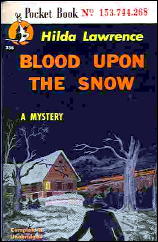
HILDA LAWRENCE Blood Upon the Snow

HILDA LAWRENCE – Blood Upon the Snow. Simon & Schuster, hardcover, 1944. Hardcover reprint: Detective Book Club, 3-in-1 edition: February 1945. Reprint paperbacks: Pocket 336, February 1946; Avon Classic Crime PN320, 1970.

   Hilda Lawrence wrote three novels featuring the odd investigative trio of private eye Mark East and spinster sleuths Bessie Petty and Beulah Pond. In addition, she published a melodramatic suspense novel, The Pavilion (1949), and two novellas, “Death Has Four Hands” and “This Bleeding House” (both 1950).

   She is best known for the East/Petty/Pond books, and for good reason: They present an interesting juxtaposition of the hard-boiled school versus the little-old-lady sleuth, between the customs and mores of Manhattan and those of a small New England village.

HILDA LAWRENCE Blood Upon the Snow

   The characters are well drawn, the setting evocative, and the interplay between Mark East and his elderly “Watsons” is entertaining.

   As this first entry in the series opens, the snow is falling and Mark is arriving at the village of Crestwood. His introduction to Beulah Pond occurs when he stops to ask directions to the house where a prospective client expects him.

   When he eventually arrives, he is told he must wait until morning for his interview; and when he meets with Mr. Stoneman, the old man seems to think he is hiring a private secretary rather than a private detective. Mark, however, senses something is very wrong in the house; the old man seems frightened and has a hurt wrist and bruises on his face.

HILDA LAWRENCE Blood Upon the Snow

   He agrees to stay on for a few days, assuming secretarial duties, and makes it his first order of business to revisit Miss Pond, whom he perceives — rightly so — as a woman who knows a great deal about what goes on in the village.

   When he arrives at her home, he is introduced to Bessie Petty, and the unlikely partnership in detection is launched.

   The story that follows is one of slowly rising terror. The people with whom Stoneman is staying, Laura and Jim Morey and their two children, also seem disturbed; Stoneman is reported to have been sleepwalking; the housekeeper, Mrs. Lacey, has handed in her notice and seems upset about this; strange mischief has occurred in the wine cellar; and as the black winter night closes in, Mark remembers something Mrs. Lacey said about this being “good soil for evil.”

   A slow-paced but absorbing chiller, as are the other two in the series — A Time to Die (1945) and Death of a Doll (1947).

         ———
   Reprinted with permission from 1001 Midnights, edited by Bill Pronzini & Marcia Muller and published by The Battered Silicon Dispatch Box, 2007.   Copyright © 1986, 2007 by the Pronzini-Muller Family Trust.
A 1001 MIDNIGHTS Review
by Max Allan Collins:


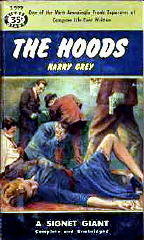
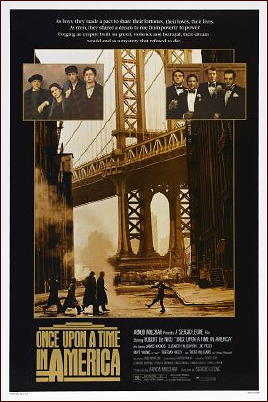
HARRY GREY – The Hoods. Crown, hardcover, 1952. Paperback reprint: Signet Giant S999, 1953; several later printings. Film: 1984, as Once Upon a Time in America. Director: Sergio Leone.

HARRY GREY The Hoods

   This sprawling novel chronicles the career of a mob of Jewish gangsters from New York’s Lower East Side, from their beginnings as a kid gang to their rise in the world of big-time organized crime.

   The narrator is Noodles the Shiv, whose intelligence and sensitivity outdistance his compatriots Maxie, Patsy, Dominick, and Cockeye, but whose deeds are every bit as cold-blooded.

   Grey’s novel is exciting, with various heists and gang-war incidents vividly portrayed, and his portraits of mobsters are believable, backing up the author’s claim to be “an ex-hood himself,” as Mickey Spillane’s cover blurb on the 1953 Signet paperback edition puts it. But the episodic nature of the book makes The Hoods a fast-moving novel that lacks narrative drive.

   The Hoods was a paperback best seller, going through several editions and many printings, but its latter-day claim to fame is as the source for Italian director Sergio Leone’s controversial film Once Upon A Time in America, the screenplay of which was largely written by American mystery writer Stuart Kaminsky.

   Leone’s magnificent gangster epic (starring Robert DeNiro as Noodles — released in a restructured, truncated version as well as in its full 277 minutes of running time) seems destined to be the subject of discussion among film buffs for decades to come.

   Inexplicably, the “movie tie-in” edition published by New American Library was a novelization of the film, rather than a reissue of Grey’s original novel.

   Grey’s other two novels, Call Me Duke (1955) and Portrait of a Mobster (1958), are also gangster tales, the latter novel a fictionalized autobiography of Dutch Schultz.

         ———
   Reprinted with permission from 1001 Midnights, edited by Bill Pronzini & Marcia Muller and published by The Battered Silicon Dispatch Box, 2007.   Copyright © 1986, 2007 by the Pronzini-Muller Family Trust.

HARRY GREY The Hoods

A 1001 MIDNIGHTS Review
by Max Allan Collins:


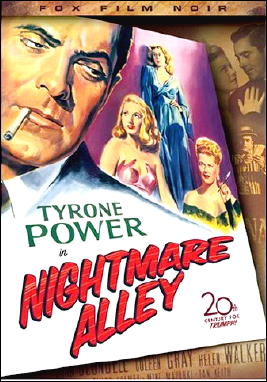
WILLIAM LINDSAY GRESHAM Nightmare Alley

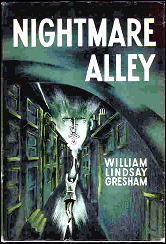
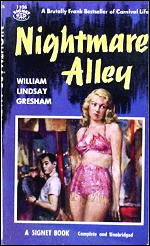
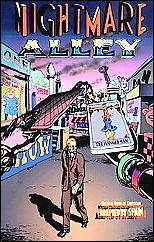
WILLIAM LINDSAY GRESHAM – Nightmare Alley. Rinehart & Co., 1946. Softcover reprints include: Signet #738, 1949, several printings; Carroll & Graf, 1986; Fantagraphics Books, graphic novel, February 2003; New York Review of Books, trade paperback, April 2010. Reprinted in Crime Novels : American Noir of the 1930s and 40s (Library of America).

Film: 20th Century Fox, 1947 (Tyrone Power, Joan Blondell; director: Edmund Goulding).

   The underside of show business is given a brutal and yet somehow affectionate examination by William Lindsay Gresham in this justly famed novel. Carnival life is vividly, lovingly portrayed:   “Swearing, steaming, sweating, scheming, bribing, bellowing, cheating, the carny went its way.”

   Even his protagonist, Stan Carlisle, the slick, self-serving grifter, is viewed with world-weary compassion as Gresham leads him to his inevitable, much-deserved doom.

WILLIAM LINDSAY GRESHAM Nightmare Alley

   Young, ambitious Stan Carlisle has a small-time job in a traveling carnival, but by worming his way into the good graces — and bed — of mind reader Zeena, he learns the tricks of the “mentalist” trade.

   Along the way he accidentally causes the death of Zeena’s dipsomaniac husband, giving him wood alcohol; and he turns the beautiful, virginal, father-fixated Molly into his mistress and reluctant partner in crime.

   Though Zeena’ s tarot cards have predicted Stan’s eventual downfall, the Great Stanton rises to certain heights in vaudeville. But he is not satisfied, and involves himself and Molly in the even more lucrative “spook racket”: The Great Stanton becomes the Reverend Stanton and begins bilking the wealthy, preying upon their lost loves and buried guilts.

   Then he meets and falls in love with Dr. Lilith Ritter, a psychiatrist to whom he bares his breast, and soon the seductive Lakeshore Drive psychiatrist is helping him plan one big last score.

WILLIAM LINDSAY GRESHAM Nightmare Alley

    Nightmare Alley is not a perfect book — Gresham’s poetic prose at times turns a shade of purple, and his Freudian explanations for the behavior of various characters are pat and a little dated; but few tough-guy crime novels are more powerful than this, and never have “the lower depths of show business” been explored with a more knowledgeable and sadly sympathetic eye.

   Gresham, whose own suicide is foreshadowed in the suicidal impulses of several of the characters in Nightmare Alley, was fascinated with the sleazier aspects of the entertainment world.

   Just as convincing as his depiction of carnival life is his inside look at the phony medium racket, which he further explored in his nonfiction work Houdini (1959).

   His only other novel, Limbo Tower (1949), is a hospital tale with criminal overtones

         ———
   Reprinted with permission from 1001 Midnights, edited by Bill Pronzini & Marcia Muller and published by The Battered Silicon Dispatch Box, 2007.   Copyright © 1986, 2007 by the Pronzini-Muller Family Trust.

WILLIAM LINDSAY GRESHAM Nightmare Alley

A 1001 MIDNIGHTS Review
by Bill Pronzini:


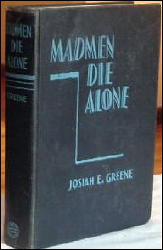
JOSIAH E. GREENE – Madmen Die Alone. Wm Morrow & Co., hardcover, 1938.

JOSIAH GREENE Madmen Die Alone

   Joseph Parisi, a homicidal inmate at the Exeter Hospital insane asylum, turns up missing one night. Circumstances are such that it is unlikely he managed to escape on his own; and it appears the only person who could have freed him is brilliant research psychiatrist Dr. Hubert Sylvester.

   But then Sylvester is found on the premises, brutally stabbed to death. Captain Louis Prescott of the local police is called in to investigate, and finds himself confronted with a maze of conflicting relationships among the hospital’s employees, not to mention attitudes and behavior that make him wonder if perhaps some of the keepers aren’t just as insane as their charges.

   A second murder, of a shady Italian restaurant owner named Luigi Toscarello, intensifies the hunt for Parisi; it also implicates Parisi’s family, thereby opening up a whole new can of worms for Prescott to sift through. Did Parisi kill both Sylvester and Toscarello? Did someone else kill both of them? Or are there two murderers, one at the asylum and one outside it, each with different motives?

   Despite some first-novel flaws — viewpoint lapses, too many exclamation points — and a bunch of ethnic stereotypes, Madmen Die Alone is a solid novel of detection, with a well-depicted background, interesting insights into psychiatry circa 1938, and a neatly clued solution. Fans of fair-play deductive puzzles should enjoy it.

   Greene published one other mystery — The Laughing Loon (1939), set in the Minnesota lake country — before abandoning the genre to write mainstream novels.

         ———
   Reprinted with permission from 1001 Midnights, edited by Bill Pronzini & Marcia Muller and published by The Battered Silicon Dispatch Box, 2007.   Copyright © 1986, 2007 by the Pronzini-Muller Family Trust.

A 1001 MIDNIGHTS Review
by Marcia Muller:


STEPHEN GREENLEAF Death Bed

  STEPHEN GREENLEAF – Death Bed. Dial Press, hardcover, October 1980. Paperback reprints: Ballantine, May 1982; Bantam, December 1991.

   Stephen Greenleaf has received a great deal of critical acclaim for his novels featuring John Marshall Tanner, former lawyer turned private eye.

   Tanner’s territory is the San Francisco Bay Area, where his cases take him into the homes of the rich and powerful, as well as into the lowest dives in the city; the author draws heavily on his knowledge of politics, business, and local events to flesh out Tanner’s investigations.

   Greenleaf has been hailed as the successor to the Raymond Chandler/Ross Macdonald tradition, and it is easy to see why. Like Philip Marlowe and Lew Archer, Tanner is less a fully developed character than an observer. Hints are thrown out about his past and private life, but they are not elaborated upon, and frankly the reader doesn’t care.

   Greenleaf makes extensive use of simile, as Macdonald did, but with far less success; often he seems to be stretching a point, reaching for a likeness that simply doesn’t come off. He is a successor to the tradition of the hard-boiled private eye developed by these writers in the sense that he is an imitator, and his work makes one wonder why we need further imitations.

STEPHEN GREENLEAF Death Bed

   Death Bed begins with a scene reminiscent of Philip Marlowe’s meeting with Colonel Stem wood in The Big Sleep. Maximilian Kottle, dying millionaire, wishes to hire Tanner to find his estranged son, Karl.

   Kottle waxes philosophical about life and death — perhaps too much so for a man in such pain and close to death — and Tanner agrees to find his son for him. Karl’s mother, flamboyant romance novelist Shelley Withers, can give few clues to her son’s whereabouts, but through solid detective work — one of the strong points of this series — Tanner traces Karl, and is getting close when Belinda Kottle, beautiful young wife of Maximilian, calls to say Karl has contacted his father and is coming to see him.

   Shortly afterward, Maximilian dies, and Tanner considers the case closed. He is then free to undertake a search for missing investigative reporter Mark Covington, but soon discovers the Kottle case is not only still open, but also linked to the journalist’s disappearance.

   There are a few surprising twists here, but the case builds to a rather predictable conclusion, and the primary villain (there are many, of various sorts) is introduced so late in the narrative that the solution comes a little out of left field. Chandler and Macdonald simply did it better.

   Other novels featuring John Marshall Tanner are Grave Error (1979), State’s Evidence (1982), and Fatal Obsession (1983).

         ———
   Reprinted with permission from 1001 Midnights, edited by Bill Pronzini & Marcia Muller and published by The Battered Silicon Dispatch Box, 2007.   Copyright © 1986, 2007 by the Pronzini-Muller Family Trust.

A 1001 MIDNIGHTS Review
by Art Scott:


HENRY KANE Trinity in Violence

HENRY KANE – Trinity in Violence. Avon 618, paperback original, 1955; reprinted as Avon T-264. Signet G2551, pb, October 1964.

   Here we have three novelettes featuring Henry Kane’s long-running New York detective Peter Chambers. The Chambers stories tend to be pretty routine private-eye capers, but Kane’s handling of this stock material is quite unusual. The characters deliver their lines in a peculiarly arch fashion, which veteran PI fans are equally likely to find either refreshingly novel or plain silly.

   Also, in the midst of typical guns-and-gangsters melees, Chambers is wont to toss off sly asides to the readers, saying, in effect, “How about this for a typical private-eye cliche?” The Chambers books can provide enjoyable light entertainment if the reader finds Kane’s quirky, playful approach palatable.

HENRY KANE Trinity in Violence

   Best of these tales is “Skip a Beat,” with one of those once-popular story ideas you don’t see anymore: A famous newspaper columnist is about to announce that a leading citizen is actually a closet Commie, but he gets knocked off before he can spill it; Chambers cleans it up.

   Slapdash plotting comes to the fore in “Slaughter on Sunday,” in which a prominent hood hires Chambers to extricate him from a murder frame; it involves a sort of locked-room problem (a transparent one, at best), a gimmick for faking paraffin-test results, and several gaping plot holes.

   “Far Cry” finds Kane’s durable “private richard” romancing a hood’s mistress and breaking up a hot-car exporting racket.

HENRY KANE Trinity in Violence

   Some of the better Chambers novels include A Halo for Nobody (1947); Until You Are Dead (1951); Too French and Too Deadly (1955; another locked room opus, better than the one above, but no challenge to John Dickson Carr) and Death of a Flack (1961).

   Chambers’ female counterpart, Marla Trent, appears in Private Eyeful (1960),and the two collaborate in Kisses of Death (1962). Avoid at all costs the dreadful X-rated Peter Chambers novels published by Lancer in the early 1970s!

         ———
   Reprinted with permission from 1001 Midnights, edited by Bill Pronzini & Marcia Muller and published by The Battered Silicon Dispatch Box, 2007.   Copyright © 1986, 2007 by the Pronzini-Muller Family Trust.

      Previously reviewed on this blog:

The Midnight Man (by Bill Pronzini, 1001 Midnights)
A Corpse for Christmas (by Steve Lewis)
Laughter in the Alehouse (by Al Hubin)
Until You Are Dead (by Steve Lewis)

A 1001 MIDNIGHTS Review
by Bill Pronzini:


HENRY KANE – The Midnight Man. The Macmillan Co. (A Cock Robin Mystery), hardcover, 1965. Hardcover reprint: Detective Book Club, 3-in-1 edition, September 1966. Paperback reprint: Raven House #9, 1981.

   Henry Kane is best known as the creator of Peter Chambers, a tough but urbane New York “private richard” whose adventures were quite popular in the late Forties and throughout the Fifties.

HENRY KANE McGregor

   (Some of the early Chambers short stories appeared in the sophisticated men’s magazine Esquire, which once devoted an editorial to Kane, calling him an “author, bon vivant, stoic, student, tramp, lawyer, philosopher … the lad who works off a hangover conceived in a Hoboken dive by swooshing down large orders of Eggs Benedict at the Waldorf on the morning after … the man who can use polysyllables on Third Avenue and certain ancient monosyllables on Park Avenue.”)

   Kane wrote dozens of novels and scores of stories featuring the exploits of Peter Chambers; and yet, ironically enough, his most memorable private eye is not Chambers but a 250-pound ex-cop named McGregor. In fact, his three best mystery novels are those in which McGregor is featured — The Midnight Man, Conceal and Disguise (1966), and Laughter in the Alehouse (1968).

   Like Chambers, McGregor is urbane, literate, and a connoisseur of beautiful women, gourmet food, and vintage booze. Unlike Chambers, he is prone to pithy literary quotes instead of suave wisecracks, and prefers to use wits and guile in place of guns and fists to solve his cases.

   He is not a career PI with an office and a secretary; he is a newly retired New York City police inspector, “pushing fifty, ramrod-straight and robustly handsome,” known around headquarters as “the Old Man,” who dabbles at private investigation (he has a license, of course) just to keep a hand in.

   He is more likable than Chambers, has more depth and sensitivity, and his three cases are less frivolous and more tightly plotted than any of the Chambers stories.

   In The Midnight Man, McGregor has undertaken the job of closing down an illegal after-hours enterprise at a fashionable Upper East Side nightclub. The case begins as a simple one — the club’s neighbors don’t like the idea of drunks carousing in the wee hours — but it soon turns complicated: The after-hours operation is being run by a major New York mob figure named Frank Dinelli, whom McGregor would love to put in the slammer.

HENRY KANE McGregor

   When the late-night doorman, whom McGregor has bribed and who was instrumental in a successful raid on the club, is shot to death practically in McGregor’s presence (he arrives just in time to grapple with the killer), the case becomes personal.

   Working with his pal, Detective Lieutenant Kevin Cohen, he follows leads that take him to the studio of millionaire photographer George Preston, to the offices of Park Avenue dermatologist Robert Jackson, and to a fancy loan-sharking operation that Dinelli is sponsoring.

   They also take him to a second murder, this one featuring an ingenious method of execution, which McGregor solves through the same combination of deduction and guile with which he wraps up the rest of the case.

   Kane has a fine ear for dialogue; there is some witty repartee here, especially between McGregor and a variety of New York cabdrivers. Of course, cops don’t really talk the way McGregor and Cohen do, but that’s a minor flaw.

   As the jacket blurb says, “If high crime in high society is your cup of tea, you’ll especially relish this fast, crisp, upper-echelon saga of mayhem in Manhattan.” And from Anthony Boucher: “Kane has, as usual, a pretty sense of story-shape and a nice way with clues. There is a cleverly gimmicked murder, a lot of colorful night life, and much fun (and good food) for all.”

         ———
   Reprinted with permission from 1001 Midnights, edited by Bill Pronzini & Marcia Muller and published by The Battered Silicon Dispatch Box, 2007.   Copyright © 1986, 2007 by the Pronzini-Muller Family Trust.

A 1001 MIDNIGHTS Review
by Ed Gorman:


RICHARD MATHESON – Someone Is Bleeding. Lion #137, paperback original, 1953. Reprinted in Noir – Three Novels of Suspense: Someone Is Bleeding; Fury on Sunday; Ride the Nightmare: Forge, hardcover & trade ppbk, 2005. (Previous limited edition: G & G Books, hc, 1997.)   Film: Fox-Lira, France, 1974, as Les Seins de Glace (Icy Breasts).

RICHARD MATHESON Someone Is Bleeding

   While Richard Matheson would go on to become a major figure in the fields of fantasy and science fiction with such distinguished works as I Am Legend and his Shock! series of short-story collections, his first novel was solidly criminous — a book whose influences ran heavily to James M. Cain and Hemingway.

   Someone Is Bleeding is the somewhat overwrought tale of writer David Newton who meets a lovely but deeply disturbed young woman named Peggy Lister and falls into tormented love with her.

   Peggy, icon that she is, is surrounded by men whose overwhelming desire in life is to possess her. Because of her psychological problems, possession means keeping her physically around them — since it is unlikely that anyone will ever have her heart or mind, given her pathological distrust of men, which seems to stem from having been raped by her father.

   For its era, Bleeding was a surprisingly complex psychosexual tale. Peggy, a dark goddess who literally rules the fives of her men, is all the more chilling a woman for the sympathetic way in which David sees her for most of the book. She is the helpless, beautiful woman-child that many men fantasize about and long to protect as proof of their own masculinity.

   As the novel rushes to its truly terrifying climax (it is an ending that must rank, for pure horror, with the best of Fredric Brown and Cornell Woolrich), we see how much Peggy comes to represent the pawn in a quest. Her men are willing to scheme, lie, and die to have her.

   Despite its foreshortened structure, which gives it the singular tone of a short story, and despite the fact that the prose occasionally becomes overheated — one wishes for a flash of humor once in a while — Someone Is Bleeding is a satisfyingly complex, evocative study of loneliness, dream and pathology.

   Matheson also gives us an exceptionally good look at the Fifties and its snake-pit moral code, its demeaning view of women, its defeated view of men. He packs an icy poetry, a bittersweet love song, and moments of real terror into this debut.

         ———
   Reprinted with permission from 1001 Midnights, edited by Bill Pronzini & Marcia Muller and published by The Battered Silicon Dispatch Box, 2007.   Copyright © 1986, 2007 by the Pronzini-Muller Family Trust.

Note:   This novel by Richard Matheson was previously reviewed on this blog by Dan Stumpf.

A 1001 MIDNIGHTS Review
by Edward D. Hoch:


ISRAEL ZANGWILL – The Big Bow Mystery. Rand McNally, US, hardcover, 1895. Previously published by Henry, UK, hardcover, 1892. Reprinted in many anthologies of vintage detective fiction, both hardcover and soft.

ISRAEL ZANGWILL The Big Bow Mystery

   Film (with partial sound): FBO, 1928, as The Perfect Crime (with Clive Brook & Irene Rich; director: Bert Glennon). Also: RKO, 1934, as The Crime Doctor (with Otto Kruger & Karen Morley; director: John Robertson). Also: Warner Bros., 1946, as The Verdict (with Sydney Greenstreet, Peter Lorre & Joan Lorring; director: Don Siegel).

   British novelist and playwright Israel Zangwill made only one excursion into the mystery field, at the age of twenty-seven, when he was invited by the London Star to write a “more original piece of fiction” for them. The result, which ran serially in the newspaper during 1891, was certainly original — the first locked-room mystery novella.

   There had been locked-room mysteries before, in the works of Edgar Allan Poe and Joseph Sheridan LeFanu, but both had involved elementary trickery with windows and the reader had no real opportunity to solve the puzzle. The Big Bow Mystery, written partly as a parody of detective stories, is a classic whodunit that still reads quite well today.

   Whether or not retired police inspector Grodman can really qualify as a Classic Sleuth may be open to question, but from the moment he is summoned by Mrs. Drabdumb to break down the locked door of Arthur Constant’s bedroom, it is clear we are witnessing the birth of a classic mystery situation.

ISRAEL ZANGWILL The Big Bow Mystery

   John Dickson Carr once observed that Israel Zangwill invented a fictional device that has since been used in many forms, “on a ship, in a ruined house, in a conservatory, in an attic, and even in the open air.” But Zangwill’s first version still remains one of the best, and rightly established him as the father of the locked-room mystery.

   Scores of later mystery writers were intrigued by the plot possibilities suggested by Zangwill’s work, and went on to create endless variations on the locked room and the impossible crime.

   Running just over 30,000 words in length, about half as long as the average mystery novel today, The Big Bow Mystery has rarely been published as a separate volume in this century. It appears in Zangwill’s 1903 collection The Grey Wig. More recently it was included in Hans Stefan Santesson’s 1968 anthology The Locked Room Reader (Random House) and David Willis McCullough’s 1984 anthology Great Detectives (Pantheon).

         ———
   Reprinted with permission from 1001 Midnights, edited by Bill Pronzini & Marcia Muller and published by The Battered Silicon Dispatch Box, 2007.   Copyright © 1986, 2007 by the Pronzini-Muller Family Trust.

Note:   The Big Bow Mystery was previously reviewed on this blog by Mary Reed. In his comments following my review of The Big Clock, David Vineyard pointed out that “The idea of the hero hunting himself […] all dates back to Israel Zangwill’s The Big Bow Mystery […] a pioneering locked room classic that touches on the theme.”

A 1001 MIDNIGHTS Review
by Kathleen L. Maio:


EVE ZAREMBA – A Reason to Kill. PaperJacks, Canada, paperback original, 1978. Second Story Press, Canada, trade paperback, 1989.

   Even Zaremba’s first mystery surely represents one of the more unusual experiments with the female hard-boiled private eye. First of all, her heroine, Helen Keremos, is a Canadian. Second, she is a lesbian.

EVEN ZAREMBA Helen Keremos

   But if the locale of Zaremba’s mystery is obvious, the sexual identification of her sleuth is not. Since Zaremba refrains from chronicling the amorous adventures of her detective, it is only her empathy with male gay characters and occasional name-calling by disgruntled straight men that give her sexual identity away.

   Keremos, who operates out of a second-floor walk-up in Vancouver’s Chinatown, is called in by an academic to trace his missing son, last seen in Toronto. With the help of a researcher friend named Alex, Keremos checks out the young man’s past as well as his friends and family — all suspects.

   These include his sculptor mother and her drunken lover; a boyhood friend and his masculinity-obsessed father; and an appealing bisexual hood on the edge of Toronto’s entertainment biz. Keremos concludes that Martin Milwell’s disappearance is somehow linked to his recent acknowledgment of his homosexuality, but she must still discover the how and why of his disappearance.

   The plot, which seems to be building to an obvious solution, has several twists to deliver before its unusual conclusion — one that turns the classic reenactment of the crime into an exercise in collective decision-making.

   Keremos’s cross-Canada trek tells us much about the country and its people as well.

   Tough, a navy veteran with plenty of street smarts, Keremos is nonetheless a sympathetic figure. When she takes on two thugs (after a few too many drinks), we may question the realism in the portrayal, but Keremos’ s macho antics are mild compared to most of her male fictional counterparts.

   The politics of Zaremba’ s novel, sexual and otherwise, is clearly recognizable as part of the Seventies. For her portrayal of a believable PI, hardboiled and female, Zaremba should be recognized as an early entry in a mystery trend of the Eighties — and very probably beyond.

         ———
   Reprinted with permission from 1001 Midnights, edited by Bill Pronzini & Marcia Muller and published by The Battered Silicon Dispatch Box, 2007.   Copyright © 1986, 2007 by the Pronzini-Muller Family Trust.

Editorial Comment:   As suggested in my comments following the preceding post, Helen Keremos may be the very first lesbian PI, at least as published by a major publisher (although semi-obscure one). It has been reprinted once, but apparently there’s never been a US edition. (PaperJacks books were generally distributed in this country, however.)

The Helen Keremos series —

     1. A Reason to Kill (1972)
     2. Work for a Million (1988)

EVEN ZAREMBA Helen Keremos

     3. Beyond Hope (1988)
     4. Uneasy Lies (1990)
     5. The Butterfly Effect (1994)

EVEN ZAREMBA Helen Keremos

     6. White Noise (1997)

« Previous PageNext Page »