1001 Midnights


A 1001 MIDNIGHTS Review
by Bill Crider & Bill Pronzini:


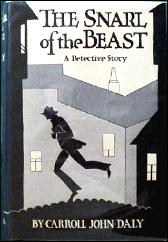
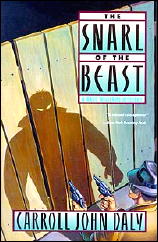
CARROLL JOHN DALY – The Snarl of the Beast. Edward J. Clode, 1927. Previously serialized in Black Mask, June-July-Aug-Sept, 1927. Hardcover reprint: Gregg Press, 1981. Trade paperback reprint: Harper Perennial, 1992.

CARROLL JOHN DALY Snarl of the Beast

   Carroll John Daly was one of the fathers of the modem hard-boiled private eye, a primary influence on such later writers as Mickey Spillane. His style and plots seem dated today, but the presence of his name on the cover of Black Mask in the Twenties and Thirties could be counted on to raise sales of the magazine by fifteen percent.

   Daly’s major contribution was Race Williams, the narrator of The Snarl of the Beast and the first fully realized tough-guy detective (his first appearance, in the June 1, 1923, issue of Black Mask, preceded the debut of Hammett’s Continental Op by four months).

   Williams was a thoroughly hard-boiled individual. As he says of one criminal he dispatches, “He got what was coming to him. If ever a lad needed one good killing, he was the boy.” Williams doesn’t hesitate to dole out two-gun, vigilante justice.

   The Snarl of the Beast has an uncomplicated plot: Williams is asked by the police to help track down a master criminal known as “the Beast” and reputed to be “the most feared, the cunningest and cruelest creature that stalks the city streets at night.”

   Williams is willing to take on the job and to give the police credit for ridding the city of this menace, just as long as he gets the reward. Along the way he meets a masked woman prowler, a “girl of the night,” and of course the Beast himself.

CARROLL JOHN DALY Snarl of the Beast

   Daly is not known for literary niceties — his style can best be described as crude but effective — yet there is a certain fascination in his novels and his vigilante/detective.

   Characterization is minimal and action is everything. “Race Williams — Private Investigator — tells the whole story. Right! Let’s go.”

   Race Williams also appears in The Hidden Hand (1929) and Murder from the East (1935), among others. Daly created two other series characters, both of them rough-and-tumble types, although not in the same class with Williams: Vee Brown, hero of Murder Won’t Wait (1933) and Emperor of Evil (1937); and Satan Hall, who stars in The Mystery of the Smoking Gun (1936) and Ready to Burn (1951), the latter title having been published only in England.

         ———
   Reprinted with permission from 1001 Midnights, edited by Bill Pronzini & Marcia Muller and published by The Battered Silicon Dispatch Box, 2007.   Copyright © 1986, 2007 by the Pronzini-Muller Family Trust.

Editorial Comment:   For a long expository commentary of the book as well as the author, see Mike Grost’s Classic Mystery and Detection website. Included is a breakdown of the novel into its singular parts as they appeared in Black Mask magazine.

A 1001 MIDNIGHTS Review
by Thomas Baird:


DICK FRANCIS

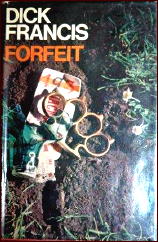
DICK FRANCIS – Forfeit. Harper & Row, US, hardcover, 1969. Michael Joseph, UK, hc, 1969. Reprinted many times.

   Dick Francis not only uses his racing experience in his novels, but in many of them other facets of his life form the background. In Forfeit, his sixteen years as racing correspondent for the London Sunday Express is embodied in the hero, James Tyrone, journalist.

   Tyrone listens to a drunken tirade from an old-time colleague who then goes back to his office and nips out the seventh-floor window onto Fleet Street. With a nose for a good story, Tyrone smells a fiddle and starts some inquiries.

   He knows he’s on to a sure thing when he hears of blackmail and is met with unexplained violence. As a reporter, he is at great pains to protect his sources, but the dangerous headlines run by his “dreadful rag” of a paper focus the menace on him.

DICK FRANCIS

   In typical Francis style, the fast-paced writing brings out the individuality of the hero, even though it’s a typical suspense/thriller situation of a normal human being trapped in an abnormal situation. In another bit of autobiographical content, Tyrone’s wife is confined to a respirator and requires constant attendance (Francis’s wife once had polio).

   Unusual for a Francis novel, a true love story is depicted even though Tyrone feels that he lives a shadow life-full of “dust and ashes.” In his pursuit of racketeers who force owners not to start their horses in a race, he faces extortion, blackmail, and “high-powered thuggery” (more violence), along with a splash of racism.

DICK FRANCIS

   He confronts the villain in the Big Cats’ House in London Zoo, and comes face-to-face with an evil sociopath who’s in it for the money. In the end, Tyrone saves his wife while made drunk by the villains, and then must save himself.

   Forfeit won a well-deserved Edgar as Best Novel of 1969. Francis’s recent novels have all been large-scale best sellers. The Danger was one; others are Reflex (1981), Twice Shy (1982), Banker (1983), and Proof (1985).

         ———
   Reprinted with permission from 1001 Midnights, edited by Bill Pronzini & Marcia Muller and published by The Battered Silicon Dispatch Box, 2007.   Copyright ? 1986, 2007 by the Pronzini-Muller Family Trust.

A 1001 MIDNIGHTS Review
by Thomas Baird:


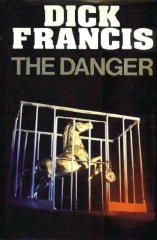
DICK FRANCIS – The Danger. G. P. Putnam’s Sons, US, hardcover, 1984. Michael Joseph, UK, hc, 1983. Reprinted a number of times.

DICK FRANCIS The Danger

    For some time after he achieved bestsellerdom in the United States, it seemed that Dick Francis (according to some critics) was not keeping up the pace. But with The Danger, he is back in front, writing prose as crisp and taut and lean as a racehorse. This novel runs in the really big international thriller category, starting with “there was a Godawful cock-up in Bologna.” It’s about kidnapping with a touch of terrorism.

    Andrew Douglas works as a partner in the firm of Liberty Market Ltd., whose credo is to “resolve a kidnap in the quietest way possible, with the lowest of profiles and minimum action.” He successfully gets back the kidnap victim, Alessis Cenci, “one of the best girl jockeys in the world.”

    They go back to England, where he engages in some psychological rehabilitation. This leads to the next hurdle, another kidnap (literally, a kid this time), and he sees a thread of connection. Douglas has the opportunity to assess his opponent — “Kidnappers are better detectives than detectives, and better spies than spies.”

DICK FRANCIS The Danger

    Then, it’s a leap across the Atlantic, where the senior steward of the English Jockey Club is kidnapped in Washington, D.C. — a snatch related to the first two. Apparently Dick Francis likes the States, because he has his chief character say, “I feel liberated, as always in America, a feeling which I thought had something to do with the country’s own vastness, as if the wide-apartness of everything flooded into the mind.”

    Andrew Douglas finally comes face-to-face w,ith his adversary genius in an exciting climax.

         ———
   Reprinted with permission from 1001 Midnights, edited by Bill Pronzini & Marcia Muller and published by The Battered Silicon Dispatch Box, 2007.   Copyright © 1986, 2007 by the Pronzini-Muller Family Trust.

A 1001 MIDNIGHTS Review
by Thomas Baird:


DICK FRANCIS

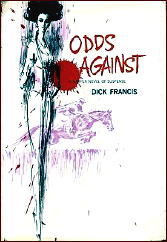
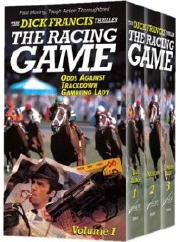
DICK FRANCIS – Odds Against. Harper & Row, US, hardcover, 1966. Michael Joseph, UK, hc, 1965. Reprinted many times. Adapted as the first segment of The Racing Game, a six-episode TV series starring Mike Gwilym as Sid Halley.

   In most of his books, Dick Francis uses an ordinary man (usually connected with the racing world) as his protagonist, caught up in events that are so overwhelming and out of control that he must make heroic efforts to sort them out.

   But in Odds Against, Sid Halley has a job as a detective-the obvious choice for a tough man to right the world’s wrongs. He’s been doing the work for two years, and when he’s shot (on page one of the story), he realizes that a bullet in the guts is his first step to liberation from being of “no use to anyone, least of all himself.”

DICK FRANCIS

   He was a champion steeplechase jockey, that’s what makes him tough. A racing accident lost him the use of his hand and self-respect simultaneously.

   The action breaks from the starting gate and blasts over the hurdles of intrigue, menace, and crime. Halley is cadged by his shrewd and loving father-in-law into confronting Howard Kraye, “a full-blown, powerful, dangerous, bigtime crook.”

   On the track he encounters murder, mayhem, plastic bombs, and torture. But he endures, in some part to regain his self respect, and in some part because he believes in racing, the sport, and in putting it right.

DICK FRANCIS

   A fascinating chase through an empty racecourse defies the villain. In the end, despite his tragedy, Sid Halley sees himself as a detective and as a man.

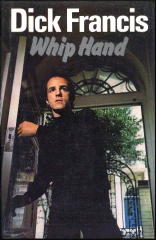
   Dick Francis was so taken with the characters in this book that he went on to use them in a television series, The Racing Game (shown on Public Broadcasting). A second Sid Halley novel, Whip Hand, won the British Gold Dagger Award in 1979 and another Edgar from the Mystery Writers of America.

         ———
   Reprinted with permission from 1001 Midnights, edited by Bill Pronzini & Marcia Muller and published by The Battered Silicon Dispatch Box, 2007.   Copyright © 1986, 2007 by the Pronzini-Muller Family Trust.

A 1001 MIDNIGHTS Review
by Thomas Baird:


DICK FRANCIS – Blood Sport. Harper & Row, hardcover, 1968. Michael Joseph, UK, hc, 1967. Reprinted many times in both hardcover and soft.

DICK FRANCIS

   From the winning world of British steeplechasing (where he was Champion Jockey in 1954), Dick Francis moved effortlessly into crime fiction with his first novel, Dead Cert, in 1962, and continues to be a front-runner.

   He has written twenty-some excellent thrillers full of old-fashioned moral polarity with strains of humor. These “adventure stories” (as Francis calls them) have amazing plots of clever evilness and feature nonrecurring heroes familiar with the racing game.

   Flawed, uninvolved, and soulless, each central character finds the value of vulnerability and returns to the land of the living through courage and love. As a central theme, it can be compared to that of the works of Ross Macdonald. As critic John Leonard said, “Not to read Dick Francis because you don’t like horses is like not reading Dostoevski because you don’t like God.”

DICK FRANCIS

   In Blood Sport, death lurks on a simple Sunday sail on the Thames. An American visitor is almost drowned, and his rescuer is convinced that it wasn’t simply an accident.

   Gene Hawkins, the rescuer and hero, is an English civil servant, a “screener” who checks employees in secret-sensitive government jobs. His training permits him to spot details that make “accidents” phony, and his knowledge of guns and listening devices comes in handy. The rescued man asks for help in locating a stolen horse that has just been bought for a huge price.

   Hawkins is relieved to use his vacation time to hunt for missing horses, because he is despondent, filled with a “fat black slug of depression.” This is the only part of his character that doesn’t ring true-after all, it’s only a failed love affair.

DICK FRANCIS

   The pace picks up, and the scene changes to the U.S.A. From the farms of Kentucky, the trail is followed to Jackson, Wyoming. Along the way, Hawkins gets people together for some psychological reconditioning and exposes a bloodline scam as the scene shifts to Santa Barbara, Las Vegas, and Kingman, Arizona.

   The U.S. tour is fast-moving, and Francis does not dwell on local-color background, especially not to make any points. He just gives the graphic, journalistic details of a place that push the story along

         ———
   Reprinted with permission from 1001 Midnights, edited by Bill Pronzini & Marcia Muller and published by The Battered Silicon Dispatch Box, 2007.   Copyright © 1986, 2007 by the Pronzini-Muller Family Trust.

DICK FRANCIS, R. I. P. (1920-2010).   Another giant has left us. Dick Francis died on Sunday at the age of 89. A long obituary appears online here at the Daily Mail website, but it is just one of many, not including dozens and dozens of tributes to be found on mystery-oriented blogs.

   Francis was the author of 42 thriller novels, all of them having horse racing as a major part of the story. In 2000 Queen Elizabeth II honored Francis by making him a Commander of the British Empire. During his long career he won three Edgar Allen Poe awards given by the Mystery Writers of America for his novels Forfeit (1968), Whip Hand (1979) and Come to Grief (1995).

   He also was awarded a Cartier Diamond Dagger from the Crime Writers’ Association for his contributions to the field, and they made him a Grand Master in 1996 for a lifetime’s achievement.

   After a lengthy hiatus following the death of his wife, Francis recently began writing again, working with his son Felix to produce Dead Heat (2007), Silks (2008) and Even Money (2009). A new novel entitled Crossfire will be published this year.

Editorial Comment:   As I continue this tribute to Dick Francis, over the next couple of days I will be posting several more reviews of his work, all also by Thomas Baird and taken from 1001 Midnights. Their titles: Odds Against, The Danger, and Forfeit.

A 1001 MIDNIGHTS Review
by Susan Dunlap:


ROBERT BARNARD – The Case of the Missing Brontë. Hardcover edition: Scribner’s, 1983. Reprinted in paperback several times by Dell: 1984, 1986, 1989. Penguin, paperback, November 1994. First published in the UK: Collins Crime Club, 1983, as The Missing Brontë.

Missing Bronte

   This is the third novel featuring Superintendent Perry Trethowen of Scotland Yard. It begins with the detective and his wife returning from a visit to his very peculiar aristocratic family (who are displayed to fine advantage in Death by Sheer Torture, 1981).

   Their car breaks down in a small village, Hutton-Le-Dales, and since they must spend the night there, they do the true British thing — they go to the local pub. No sooner do they settle in than an elderly lady accosts them and announces that she has inherited what appears to be an unpublished manuscript of a novel possibly authored by one of the Bronte sisters. And no sooner do they leave town than the woman is attacked and the manuscript stolen.

   Trethowen returns to Hutton-Le-Dales, delighted to be associated with literary matters rather than being thought of only as the policeman with the kinky family — something that happens all too often. His investigations lead him to an unholy preacher (trained in Los Angeles!), the professors of a local last-resort college (here Barnard, a professor himself, is delightfully scathing in his caricatures), and book collectors from two continents, to say nothing of a pair of Norwegian toughs.

   Characters in a Barnard book rarely have flattering things to say about each other — and for good reason. Trethowen views humanity with a disdainful eye, which makes for much wary humor. The plot of The Case of the Missing Brontë is solid, and the book-collecting background intriguing.

   A two-time nominee for an MWA Best Novel Edgar, Barnard has written such other delightful novels as Death of a Mystery Writer (1979), Death of a Literary Widow (1980), Death and the Princess (1982), and Out of the Blackout (1985).

         ———
   Reprinted with permission from 1001 Midnights, edited by Bill Pronzini & Marcia Muller and published by The Battered Silicon Dispatch Box, 2007.   Copyright © 1986, 2007 by the Pronzini-Muller Family Trust.

A 1001 MIDNIGHTS Review
by Susan Dunlap:


ROBERT BARNARD – Blood Brotherhood. Walker & Co., US, hardcover, 1978. Previously published in the UK: Collins Crime Club, hc, 1977. US paperback reprint: Penguin, 1983, 1992 (the latter shown).

ROBERT BARNARD Blood Brotherhood

   Robert Barnard’s element is exposing the underside of the pompous and the powerful, be they royalty, clergy, academics, or pillars of the community.

   The unique thing about his books is not how witty they are (though that in itself makes them worth reading) but that each one is very different. (Indeed, Death in a Cold Climate, 1980, is not humorous; its intriguing quality is its setting in the north of Norway, where Barnard once taught English.)

   Blood Brotherhood takes the reader into the cloistered Anglican community of St. Botolph’s, where an international group of clerics (an American with an unmuted passion for fundraising; an African bishop who has occasional lurchings into un-Christian tribal customs; assorted Britons; and two Norwegians who, to the horror of the host, turn out to be women) meet to discuss the rarefied matters of the spirit.

   At a time “when the heather lay like a purple blanket over the moorlands, and a large proportion of the local population were baking uncomfortably and loathing the food on the Costa del Sol,” the clerics entertain less than holy thoughts, particularly about the more attractive of the Norwegian women.

   One of their number is stabbed to death, and the unholy problem is left for the pious group to unravel. Barnard’s characters, while created to show various peculiarities — such as the overly hip youth pastor or the television bishop — exist not as stereotypes but as individuals who have grown up into their chosen roles. Entertaining.

         ———
   Reprinted with permission from 1001 Midnights, edited by Bill Pronzini & Marcia Muller and published by The Battered Silicon Dispatch Box, 2007.   Copyright © 1986, 2007 by the Pronzini-Muller Family Trust.

Note: Maryell Cleary’s review of this book appears here earlier on this blog.

A 1001 MIDNIGHTS Review
by Bill Pronzini:


H. PAUL JEFFERS – Murder on Mike. St. Martin’s Press, hardcover, 1984. Ballantine, reprint paperback, 1988. Júcar, Colección Etiqueta Negra nº21, 1987, Barcelona, as Muerte al micrófono.

   A small but persistent trend in recent years is the retrospective private-eye novel — the nostalgic adventures of PI’s operating in the Thirties and Forties, contemporary recreations of a bygone era.

H. PAUL JEFFERS

   Andrew Bergman, Stuart Kaminsky, and Max Allan Collins have each done quite well with Chandleresque heroes of this sort; judging from the two Harry McNeil novels published to date — Rubout at the Onyx Club (1982) and Murder on Mike — H. Paul Jeffers will, too.

   McNeil is a very likable character, “an ex-cop who’s now a private investigator who’d prefer nothing better than to play clarinet with a top jazz band and leave the detective work to better guys,” a shamus who uses his head and his legs and his heart in lieu of violence. Harry McNeil, “the help of the hopeless.”

   It is a few days before Christmas, 1939. Harry is in his office above the Onyx Club on Fifty-Second Street, New York City. Enter Maggie Skeffington, a radio actress on “Detective Fitzroy’s Casebook” on the Blue Network (NBC).

   A few days earlier, Derek Worthington, the star of the show and a man heartily disliked by his co-workers, was shot to death in Studio 6B at Radio City; and Maggie’s boyfriend, announcer David Reed, has been arrested for the crime. Maggie is convinced that David is innocent, even though he is the only member of the cast and crew who does not have an airtight alibi for the time of the shooting.

   Harry takes the case, of course. And meets the various suspects: J. William Richards, owner of the Mellow-Gold Coffee Company and the show’s sponsor; Miles Flanagan, the producer; Veronica Blake, the head writer (with whom Harry later has an affair); Jason Patrick, Worthington’s costar; Rita DeLong, an aging musician; Guff Taylor, the engineer; and Jerry Nolan, the expert sound-effects man.

   Any of the lot might have killed Worthington — except for those alibis. The key to cracking the case lies with young Robby Miller, a Radio City tour guide, who heard the fatal shot fired through a studio mike someone inadvertently left open and who has turned up missing….

   The mystery here is lightweight but entertaining — until its resolution. The final unmasking, which Harry brings about in Studio 6B on Christmas day with the aid of a self-written radio script, is far-fetched and highly derivative of a famous novel by a certain popular Golden Age writer.

   That part of Murder on Mike is disappointing. Still, there is Harry. There is New York at Yuletide 1939, “a city for dreamers because it was a city that could make dreams come true,” a city full of fascinating real-life characters — Winchell, Woolcott, Ed Sullivan, and comedian Fred Allen (both of whom have speaking parts), dozens more.

   There is an equally fine evocation of the world of dramatic radio (a subject Jeffers knows intimately: He works for a Manhattan radio station). And there is a nice, old-fashioned flavor to the narrative, a feeling that you are reading a combination of whodunit and bittersweet private-eye romance written in 1939.

         ———
   Reprinted with permission from 1001 Midnights, edited by Bill Pronzini & Marcia Muller and published by The Battered Silicon Dispatch Box, 2007.   Copyright © 1986, 2007 by the Pronzini-Muller Family Trust.

H. PAUL JEFFERS, R. I. P. (1934-2009). According to a short online obituary in the Pottstown (PA) Mercury, H. Paul Jeffers died on Friday, December 4th, in Manhattan.

   Besides his fictional work (see below), in the 60s he was a Fulbright Scholar in the 1960s and reported from Vietnam with Peter Jennings. He later wrote news for WINS, WABC, WNBC, and WCBS, all in New York City. His non-fiction work included books on history, Westerns and biographies, including books on Theodore Roosevelt and Sherlock Holmes.

   The covers and titles of the books below may give you an idea of the wide range of his interests. If his non-fiction were to be included, the range would be even wider.

   The Harry MacNeil series:

      1. Rubout At the Onyx (1981)
      2. Murder On Mike (1984)
      3. The Rag Doll Murder (1987)

   The Morgan western series:

      1. Morgan (1989)
      2. Blood On the Nueces (1989)
      3. Texas Bounty (1989)

   The Sergeant John Bogdanovic series:

      1. A Grand Night For Murder (1995)
      2. Reader’s Guide to Murder (1996)

H. PAUL JEFFERS

      3. Corpus Corpus (1998)

   The Arlene Flynn series:

      1. What Mommy Said (1997)

H. PAUL JEFFERS

   The Nick Chase series, as by Harry Paul Lonsdale

      1. Where There’s Smoke, There’s Murder (1999)
      2. Smoking Out a Killer (2000)

H. PAUL JEFFERS

      3. Up in Smoke (2001)

   The Kate Fallon series, as by M. T. Jefferson

      1. In the Mood for Murder (2000)

H. PAUL JEFFERS

      2. The Victory Dance Murder (2000)
      3. Decorated for Murder (2002)

    Other Novels:

      Adventures of the Stalwart Companions (1981)

H. PAUL JEFFERS

      Murder Most Irregular (1983)

H. PAUL JEFFERS

      Portrait in Murder and Gay Colours (1985)
      Gods and Lovers (1989)
      Secret Orders (1989)
      Owlhoot Trail (1990)
      Tombstone Revenge (1991)
      The Forgotten Adventures of Sherlock Holmes (2005)
      The Further Adventures of Sherlock Holmes: The Stalwart Companions (2010)

A 1001 MIDNIGHTS Review
by Ed Gorman & Bill Pronzini:

W. R. BURNETT – Little Caesar. Alfred A. Knopf, hardcover, 1929. Paperback reprints include: Avon #329, 1951; Bantam Giant A1871, 1959; Signet, 1972. Film: First National, 1931 (with Edward G. Robinson, Douglas Fairbanks Jr., Glenda Farrell; director: Mervyn LeRoy).

      “Mother of God, is this the end of Rico?”

    Few movie lines have endured as long and as well as the signature line of Burnett’s Little Caesar screenplay. He ended the novel on which the movie was based with virtually the same line. Burnett mastered an idiom and rhythm that, while essentially literary, spoke directly to the masses.

    Caesar is serious and detailed, charting the rise and fall of a Chicago gangster against a backdrop of political and social turmoil. As in his other great novel, High Sierra, Burnett means to treat his headline subject with novelistic scrutiny.

    In a bittersweet interview given near the end of his life, Burnett complained that he was often praised for his “plotting,” a compliment he refused on the grounds that he never plotted, but let his characters carry the story to its own organic end.

    To a large degree, Burnett was correct. In some parts, Little Caesar is a novel of manners, and the overriding concern is not for the story per se but rather how certain events affect the characters who weave in and oat of the book.

    Little Caesar is too often used as a bludgeon with which to decimate The Godfather. The books should not be compared. Mario Puzo wrote a fine romance, perhaps a novel of the first rank, after all. Burnett, however, wrote a treatise that was part sociology, part character sketch, part comedy and most of all, a naturalistic reflection of the squalid Chicago slums of the time.

    Caesar remains fresh, potent, funny, tragic. Rico, its center, like an great characters, eludes final understanding.

    The 1930 film version with Edward G. Robinson and Douglas Fairbanks Jr. is likewise a classic. Robinson’s portrayal of Rico has often been imitated (by himself as well as others, notably in his role in Key Largo) but never surpassed.

    Burnett’s other major crime novel is The Asphalt Jungle (1949), the film version of which — starring Sterling Hayden and Sam Jaffe — has been called “the gangster film of the Fifties.”

    Minor but excellent novels are Dark Hazard (1933), The Quick Brown Fox (1942), and Vanity Row (1952). Among Burnett’s numerous screenplays are those for This Gun for Hire (1941) and the 1955 remake of High Sierra starring Jack Palance, I Died a Thousand Times.

         ———
   Reprinted with permission from 1001 Midnights, edited by Bill Pronzini & Marcia Muller and published by The Battered Silicon Dispatch Box, 2007.   Copyright © 1986, 2007 by the Pronzini-Muller Family Trust.

Editorial Comment:   Novels by W. R. Burnett previously reviewed on this blog, both by Dan Stumpf, are Dark Hazard and Romelle.

    In his comment following the former, David Vineyard suggests that while “Burnett is seldom ranked with Hammett, Chandler, and Cain […] at times he was their equal, and I think sometimes surpassed Cain.” He goes on to say that “… maybe that holy trinity of the hard boiled school should be a quartet.”

    I can’t quarrel with the sentiment, but the fact is, barely no one remembers Burnett today (and Cain is slipping fast). But this fact, if true, leads to the immediate question:

    Can you think of another author as outshadowed as Burnett by the films based on the novels he wrote? The films are seared into the memories of everyone who’s watched them, but how many of those who’ve seen the movies have any idea who wrote the books?

A 1001 MIDNIGHTS Review
by Bill Crider:


PETER RABE – Kill the Boss Good-By. Gold Medal #594, paperback original; 1st printing, August 1956. Reprint edition: Black Lizard, pb, 1988.

   Kill the Boss Good-By is typical of Peter Rabe’ s best work. Fell, boss of the San Pietro rackets, has mysteriously dropped from sight. In his absence, his number two man, Pander, decides to take over and run the show.

PETER RABE Kill the BOss Good-By

   Naturally, Fell returns, but he returns from a place where racket bosses seldom go — a sanatorium where he has been under treatment for manic psychosis.

   The rest of the novel, although it contains the necessary paperback-original action and scenes of sharp, effective violence, is really a psychological study of Fell’s gradual decline into genuine madness.

   As he begins to lose his tenuous hold on reality, becoming more and more confident of success as his mental powers decline, he destroys himself and most of those around him.

   Like many of Rabe’s novels, this one builds to an emotionally shattering climax. Rabe is one writer who always delivers where it matters most — on the last page.

   Notable among Rabe’s other non-series softcover originals are Benny Muscles In (1955), A Shroud for Jesso (1955), Journey into Terror (1957), Mission for Vengeance (1958), Girl in a Big Brass Bed (1965), and Black Mafia (1974).

   Also excellent is his only hardcover, Anatomy of a Killer (1960), a tale of unflagging tension and psychological suspense about a “jinxed” hit man named Sam Jordan.

         ———
   Reprinted with permission from 1001 Midnights, edited by Bill Pronzini & Marcia Muller and published by The Battered Silicon Dispatch Box, 2007.   Copyright � 1986, 2007 by the Pronzini-Muller Family Trust.

« Previous PageNext Page »