1001 Midnights


A 1001 MIDNIGHTS Review
by Marcia Muller:


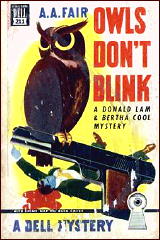
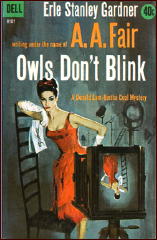
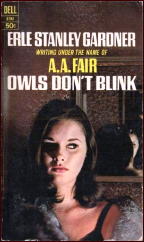
A. A. FAIR – Owls Don’t Blink. New York: William Morrow, hardcover, 1942. Paperback reprint: Dell 211, mapback, 1948. Many other reprint editions in both hardcover and soft.

A. A. FAIR Owls Don't Blink

   A. A. Fair is a pseudonym of Erle Stanley Gardner, but don’t pick up one of these novels featuring private eyes Bertha Cool and Donald Lam expecting a couple of carbon copies of Paul Drake.

   Cool and Lam are an amusing and endearing pair — perfect foils for one another. Bertha Cool, at the time of this novel, is the middle-aged proprietor of an L.A. investigative firm, pared down to a mere 165 pounds but ever on the alert for a good meal. Her partner, Donald Lam, is a twerp in comparison — young, slender, and forever on the defensive for what Bertha considers excessive squandering of agency money.

   But there’s considerable affection between the two, and with Donald doing the legwork, they crack some tough cases — and have a lot of fun while doing so.

A. A. FAIR Owls Don't Blink

   Owls Don’t Blink opens in the French Quarter of New Orleans, where Donald is occupying an apartment once rented by a missing woman he has been hired to find. He is due to meet Bertha at the airport at 7:20 the next morning and knows there will be hell to pay if he’s late.

   Fortunately, he arrives on time, and together they meet the New York lawyer who has hired them to find Roberta Fenn, a former model. Over a number of pecan waffles — a number for Bertha, that is, who “only eats once a day” — the lawyer is evasive about why he wishes to locate Miss Fenn. But Cool and Lam proceed with the case — and Bertha proceeds with several lavish meals, still on that same day.

   The discovery of the missing woman’s whereabouts proves all too easy, and also too easy is the discovery of a corpse in Roberta Fenn’ s new apartment. But from there on out, everything’s as convoluted as in the best of the Perry Mason novels.

A. A. FAIR Owls Don't Blink

   The scene moves from New Orleans to Shreveport, Louisiana, and from there to Los Angeles, where its surprising (although possibly a little out-of-leftfield) conclusion takes place.

   And there’s a nice twist in the Cool-Lam relationship that will make a reader want to read the later entries in this fine series, such as Crows Can’t Count (1946), Some Slips Don’t Show (1957), Fish or Cut Bait (1963), and All Grass Isn’t Green (1970). Especially entertaining earlier titles are The Bigger They Come (1939) and Spill the Jackpot (1941).

         ———
   Reprinted with permission from 1001 Midnights, edited by Bill Pronzini & Marcia Muller and published by The Battered Silicon Dispatch Box, 2007.   Copyright © 1986, 2007 by the Pronzini-Muller Family Trust.

A 1001 MIDNIGHTS Review
by George Kelley:


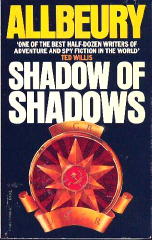
TED ALLBEURY – Shadow of Shadows. Charles Scribner’s Sons, hardcover, 1982. UK editions: Granada, hc, 1982; pb, 1982. (Shown is the cover of the paperback edition.)

TED ALLBEURY Shadow of Shadows

   Ted Allbeury started writing espionage novels in the early 1970s. He specializes in realism and the sense of desolation evident in the best contemporary British spy fiction.

   What makes Allbeury’ s novels so authentic is his background: He served with British counterintelligence during World War II. In each of the dozen espionage novels he has written so far, Allbeury creates characters and plots so convincing that the reader can’t help but be caught in his webs of suspense.

   In Allbeury’ s best book to date, Shadow of Shadows, the game is a battle of wits between Colonel Anatoli Mikhailovich Petrov, a KGB defector, and British Intelligence’s James Lawler. Petrov has been supplying valuable information — identities of double agents, locations of “safe houses,” and more — until suddenly he stops talking.

   Lawler’s mission is to find out who or what silenced Petrov and to convince him to resume supplying the vital information to British Intelligence.

   Allbeury’s novelistic skills are apparent in the relationship between the two spies — one Russian, one British — who find they have more in common with each other than they do with the spy masters who control them. The relationship grows despite Petrov’s suspicion that Lawler’s real mission may be to discover his secrets and then to liquidate him.

   With this novel and The Other Side of Silence (1981), Ted Allbeury has written espionage classics.

         ———
   Reprinted with permission from 1001 Midnights, edited by Bill Pronzini & Marcia Muller and published by The Battered Silicon Dispatch Box, 2007.   Copyright © 1986, 2007 by the Pronzini-Muller Family Trust.

Editorial Comment:   My review of The Reaper, an earlier book by Ted Allbeury about tracking down ex-Nazis in Europe, along with some biographical data about the author, can be found here.

A 1001 MIDNIGHTS Review
by Karol Kay Hope:


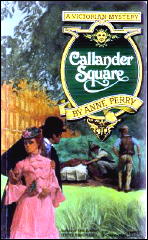
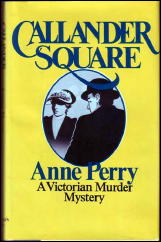
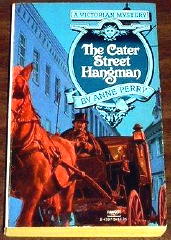
ANNE PERRY – Callander Square. St. Martin’s, hardcover, 1980. Reprint paperback: Fawcett Crest, 1981. Reprinted many times since.

ANNE PERRY

   Anne Perry’s books featuring London police inspector Thomas Pitt are called “Victorian mysteries.” One look at the covers of the paperback editions would lead the reader to believe they are just more of what has been called the “Gasp in the Grass” genre — the kind of stories that find the virginal heroine crawling at least once across the grassy slopes of a Victorian mansion in the moonlight.

   Not so. Perry has very cleverly portrayed British Victorian society with a sharp eye for its particular brand of social deceit. She is especially skilled at making the reader realize the almost unbelievable subjugation of women in those days, and if one ever wonders why women began to rebel against social constriction at the turn of the twentieth century, these books will clear up that mystery, too.

   Detective Thomas Pitt is a working-class hero in the extraordinary position of being called upon periodically to blow the cover of the English aristocracy. Being a policeman, he can exercise certain influence; if any blustering old gent attempts to order him out of the Morning Room, Pitt can threaten a search warrant.

ANNE PERRY

   He rarely needs to resort to such tactics, however, because he gets inside help from his charming wife, Charlotte, who stepped out of her upper-class world to marry him. She is an honest and enthusiastic woman whose family despairs of her insistence on following her own inchnations (although most of the women she grew up with admire her courage).

   And she is invaluable to Pitt, since most of his cases involve his exposing the passion beneath the icy breast of the upper classes. Pitt analyzes the facts with cool logic, while Charlotte uses her family connections to pick up pertinent gossip over tea and crumpets.

   In Callander Square, gardeners have inadvertently dug up the corpses of two newbom babies in the square of one of the most affluent suburbs of London. The neighborhood residents, while forced to admit the monstrosity of the deaths, simply chalk them up to the irnrnorality of some servant girl who “let herself” be molested — probably by a footman, perhaps the master of the house; gentlemen always dally with the servant girls “just for a spot of fun.”

   It is too bad, they concede, that the girl was stupid enough to get herself into such a mess — but then, what can one expect from the working class anyway?

ANNE PERRY

   Of course, those babies never belonged to a servant girl, and it is Pitt’s job to expose the enormous hypocrisy of the self-righteous elite — as well as two murderers, a blackmailer, and a gentleman drunk. This is an excellent novel that says a great deal about social pretension and the harm it can do.

   Other highly recommended books in this series are The Cater Street Hangman (1979), Paragon Walk (1981), Resurrection Row (1981), Rutland Place (1983), and Bluegate Fields (1984).

         ———
   Reprinted with permission from 1001 Midnights, edited by Bill Pronzini & Marcia Muller and published by The Battered Silicon Dispatch Box, 2007.   Copyright © 1986, 2007 by the Pronzini-Muller Family Trust.

A 1001 MIDNIGHTS Review
by Kate Mattes:


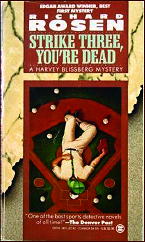
R. D. ROSEN – Strike Three, You’re Dead. Walker, 1984. Signet, pb, 1986. Walker, trade pb, 2001.

RICHARD ROSEN Strike THree You're Dead

   Harvey Blissberg, the hero of Strike Three, You’re Dead, is a baseball player recently traded from the Boston Red Sox to a new American League expansion team, the Providence Jewels.

   Called “Professor” by his younger teammates for his reading habits and off-diamond attire, Blissberg is stumped for a motive to the murder of his roommate, Rudy, and begins looking for the murderer out of a combination of curiosity and guilt.

   Discouraged by management, teammates, and police, Blissberg gets support from his girlfriend, a local TV sportscaster, and his brother, a baseball fanatic, as he tries to determine why his best friend on the team wound up drowned in the team whirlpool. His quest for the murderer takes on a new urgency when he, too, becomes a target.

   Baseball statisticians will have a very slight edge in solving the murder, but such avidity is not needed. Rosen’s clever plotting, quick wit, and subtle understatement makes this book both entertaining and easy to read.

   In the second book in this series, Fadeaway (1985), Blissberg has retired to become a professional detective and is called in to solve the murder of two NBA basketball stars.

   Strike Three, You’re Dead was named one of the seven best mysteries of the year by the New York Times, and won a Best First Novel Edgar. Rosen is also the author of two nonfiction books and numerous essays, criticisms, and articles on sports and humor.

         ———
   Reprinted with permission from 1001 Midnights, edited by Bill Pronzini & Marcia Muller and published by The Battered Silicon Dispatch Box, 2007.   Copyright © 1986, 2007 by the Pronzini-Muller Family Trust.

A 1001 MIDNIGHTS Review
by Thomas Baird:


MARGERY ALLINGHAM – Death of a Ghost. Doubleday Crime Club, US, hardcover, 1934. Previously published in the UK by William Heinemann, hc, 1934. Reprinted many times, in both hardcover and paperback, including Penguin #503, pb,1942, in dust jacket; Penguin C379, pb, 6th pr., 1966; Bantam, pb, 5th pr., 1989 (all shown).

MARGERY ALLINGHAM Death of a Ghost

   Margery Allingham was one of the three major Englishwomen mystery writers of the “Golden Age of Detective Fiction” — the other two, of course, being Agatha Christie and Dorothy L. Sayers.

   High literary quality marks her books, some of which have been compared to mainstream novels. Her plots are varied and interesting, portraying such subcultures of the time as the publishing industry, high-fashion houses, the world of the theater, and the life of the aesthete.

   Allingham’s plots are not based on razor-sharp surprises, as Christie’s are, but rather are known for their eccentricity. Unlike Sayers, Allingham produced a literate story without precious excesses, without intellectual showing off. Her characters are human, if upper class, and even the minor ones are fully drawn.

   Allingham’s consummate creation is the suave sleuth Albert Campion. He comes with a mysterious background of royalty, or at least nobility, but he is “an amateur who never used his real name and title.” Campion confronts international criminal conspiracies, greedy friends and relations, overweening egos turned to madness, and spy threats against his beloved England.

MARGERY ALLINGHAM Death of a Ghost

   Ultimately, though, Allingham’s best books depend on the investigation and deduction of human motives and psychology for their solutions. Very early tales present Albert Campion as the action-adventurer, popular at that time. In Death of a Ghost, he becomes more the suave dilettante who senses the subtle psychology in suspense situations.

   Campion is notable for having no outstanding eccentricities (in contrast to many other Golden Age detectives). He has a vacant face with horn-rimmed spectacles that give him “owlish gravity.” A sign of deep emotion is his taking off his glasses.

   In this novel the plot concerns an odd will left by an artist who died years before. The artist, John Lafeadio, considered himself the foremost painter of his age. He left behind a tangled menage of wife, Belle; family; and sycophants. The will provides that each year a painting be taken from a secret cache and exhibited at an exclusive art show in order to maintain Lafcadio’s artistic immortality.

MARGERY ALLINGHAM Death of a Ghost

   During the current exhibit, the lights fail, and when they’re turned back on, another painter is found a corpse. A short time later, another minor member of the menage is also killed.

   Campion wades through the art group’s murky crosscurrents of emotion and suspicion, exploring alibis and evasions. The police are represented by Inspector Stanislaus Oates, “the shrewdest and at the same time most kindly member of the Yard.”

   Official and amateur come to agree on the killer, but getting the proof means Campion must face a final, ingenious attempt on his own life.

         ———
   Reprinted with permission from 1001 Midnights, edited by Bill Pronzini & Marcia Muller and published by The Battered Silicon Dispatch Box, 2007.   Copyright © 1986, 2007 by the Pronzini-Muller Family Trust.

A 1001 MIDNIGHTS Review
by Ellen Nehr:


STUART PALMER – Cold Poison. M. S. Mill Co./William Morrow, hardcover, 1954. Hardcover reprint: Detective Book Club [3-in-1 edition], June 1954. Pyramid R-1040, paperback, 1964.

STUART PALMER

   Miss Hildegarde Withers is the definitive little-old-lady sleuth upon whom many future spinster, schoolmarm, and librarian sleuths were based.

   Her prominence on the mystery scene was ensured by a 1932 film based on her first adventure, The Penguin Pool Murder, starring Edna May Oliver; and the ensuing fourteen novels and short-story collections in which she is featured brought her even greater recognition.

   Five other films, with a variety of female stars, reinforced the much-loved image of a snoopy, highly intelligent, eccentric woman who helps the police in their investigations.

   In Cold Poison, Miss Withers has semi-retired (from her teaching position) to California, but old habits die hard — especially when the production manager of Miracle-Paradox Studios asks her to investigate the four un-comic, Penguin-decorated valentines promising death that have been received in the cartoon department where Peter Penguin’s Barn Dance is being animated.

   Using the subterfuge of chaperoning Tallyrand, her French poodle who is modeling for the artists, Hildegarde starts by going to see the one practical joker among the suspects. She finds him dead of what turns out to be poison-ivy poison.

   When she calls her old policeman friend, Inspector Oscar Piper, in New York, Oscar realizes that this case could very well tie in with one he couldn’t solve in New York four years before, so he flies to the Coast to assist.

STUART PALMER

   He and Hildegarde become familiar with the world of cartooning and the various characters and their jobs — which takes up a good part of the book. When all clues are assembled, Hildegarde sets up a final confrontation in the screening room at the studio, even though she lacks the final clue necessary to confirm her suspicions.

   During this showing of the valentines and Hildegarde’s attempt to compare them to sketches by members of the cartooning staff, an attempt is made to poison her coffee — and a little-known fact arises that helps her solve the case.

   This entertaining case was Hildegarde’s next to last; her final appearance was in Miss Withers Makes the Scene (1969), which was begun by Palmer and completed by Fletcher Flora after Palmer’s death.

         ———
   Reprinted with permission from 1001 Midnights, edited by Bill Pronzini & Marcia Muller and published by The Battered Silicon Dispatch Box, 2007.   Copyright © 1986, 2007 by the Pronzini-Muller Family Trust.


A 1001 MIDNIGHTS Review
by Ellen Nehr and Marcia Muller:


STUART PALMER Penguin Pool Murder

STUART PALMER – The Penguin Pool Murder. Brentano’s, hardcover, 1931. John Long, UK, hc, 1932. US softcover reprints: Bantam, 1986; International Polygonics, 1991; Rue Morgue Press, 2007. Film: RKO, 1932, with Edna May Oliver as Miss Hildegarde Withers and James Gleason as Police Inspector Oscar Piper.

   In this novel, which introduced Hildegarde Withers to the mystery-reading public, Miss Withers takes her grade school class to the New York Aquarium, where one of her students sees a body floating in the penguin pool.

   As soon as the police arrive, Hildegarde begins making suggestions; and after having another teacher take the students back to school, she insists on helping Inspector Oscar Piper by taking notes in shorthand (which she has studied as part of her hoped-for avocation as police assistant). Hildegarde takes time off from teaching to run around New York with Oscar until, with her guidance, the baffling case is solved.

   This is a low-key introduction to one of the genre’s more likable investigative pairs. Hildegarde is typical old-maid schoolteacher: austere, sensible, and entirely out of patience with what she considers the police’s inefficient and bumbling ways.

STUART PALMER Penguin Pool Murder

   Oscar, on the other hand, is your typical cigar-smoking cop: tough on the outside but thoroughly cowed by what he would never admit is a formidable woman. The friendship and affection that develops while they are investigating the strange death among the penguins — with Oscar doing the legwork and Hildegarde supplying insight — is one that continues throughout the thirteen-book series and numerous short stories.

   (Hildegarde acts on the theory that years of dealing with children in the classroom make her an expert on devious behavior patterns in adults, too — and Oscar is eventually forced to admit she is right.)

   At the end of this first adventure, Hildegarde and Oscar go off hand in hand to the marriage-license bureau; however, they must have changed their minds on the way, because they remain platonic — albeit fond — friends throughout the rest of the series.

   Outstanding among the other Hildegarde Withers novels are The Puzzle of the Red Stallion (1936), Miss Withers Regrets (1947), and The Green Ace (1950).

STUART PALMER

   Hildegarde’s shorter cases can be found in such collections as The Riddles of Hildegarde Withers (1947) and The Monkey Murder, and Other Hildegarde Withers Stories (1950), both of which are digest-size paperback originals published by Mercury Press.

   A later series character, Howie Rock, is an obese, middle-aged former newspaperman who appears in Unhappy Hooligan (1956) and Rook Takes Knight (1968). The first of these novels makes use of Palmer’s unusual background as a circus clown for Ringling Brothers.

         ———
   Reprinted with permission from 1001 Midnights, edited by Bill Pronzini & Marcia Muller and published by The Battered Silicon Dispatch Box, 2007.   Copyright © 1986, 2007 by the Pronzini-Muller Family Trust.

Bibliographic Update:  Another collection of Miss Withers stories has been published since 1001 Midnights first appeared, and it’s one well worth your attention: Hildegarde Withers: Uncollected Riddles, Crippen & Landru, 2002.

A 1001 MIDNIGHTS Review
by Bill Crider:


NICK QUARRY – The Hoods Come Calling. Gold Medal 747, paperback original; 1st printing, March 1958. Cover art: Barye Phillips.

NICK QUARRY

   Nick Quarry (a great pseudonym) was one of the names used by prolific paperbacker Marvin H. Albert, who also wrote entertaining books as Al Conroy and Tony Rome. Most of the Quarry novels are part of the series featuring Jake Barrow, a tough private eye in the Spillane tradition. The Hoods Come Calling is the first book in the series.

   Barrow returns to New York after two years in Chicago, where he has been trying to forget his wife’s infidelities. All he wants from her is the $1600 he left in their joint account, which he plans to use to buy into a private detective agency.

   He goes to her apartment to pick up the money, and she shows up drunk. He carries her upstairs and is seen by the neighbors. When he leaves for a minute, she is murdered. Barrow conceals the body, but he is soon being hunted by the police, as well as by his wife’s hoodlum friends. He must prove his innocence by finding the guilty party.

   Along the way, there is a bit of 1950s sex (not too graphic) and a considerable amount of violence (which Quarry handles very well). The familiar story has just the right mixture of action and detection to keep things moving along at a rapid clip, and Barrow makes a credible hard guy, though his character seems a bit inconsistent at times.

NICK QUARRY

   There is at least one nice surprise in store for the reader; and the ending, in which Barrow proves to be not quite as dishonest as the hoods believe him to be, is quite satisfactory.

   Other lively Nick Quarry novels include No Chance in Hell (1960), Till It Hurts (1960), and Some Die Hard (1961).

         ———
   Reprinted with permission from 1001 Midnights, edited by Bill Pronzini & Marcia Muller and published by The Battered Silicon Dispatch Box, 2007.   Copyright © 1986, 2007 by the Pronzini-Muller Family Trust.


Editorial Note: A few years ago Bill Crider wrote a lengthier article about Marvin Albert, the man behind the Nick Quarry moniker, for the primary Mystery*File website. Follow the link to check it out. Included is a complete bibliography for Albert, including work he did under all of his several pen names.

A 1001 MIDNIGHTS Review
by Francis M. Nevins:


MILTON PROPPER – The Family Burial Murders. New York: Harper & Brothers, 1934. Hardcover reprint: Grosset & Dunlap (cover shown).

MILTON PROPPER

   Milton Propper was born in 1906, graduated from the University of Pennsylvania Law School with honors in 1929, and saw his first detective novel published the same year. He never practiced law but went to work in the mid1930s for the Social Security Administration and continued mystery-writing on the side.

   His fourteen whodunits are usually set in Philadelphia and its suburbs and feature young Tommy Rankin, the homicide specialist on that city’s police force.

   Propper was far from a paragon of all the literary virtues. He wrote dull prose, peopled his books with nonentities, flaunted like a badge of honor his belief that the police and the powerful are above the law, and refused to play fair with the reader.

   Yet paradoxically his best books hold some of the intellectual excitement of the early novels of Ellery Queen. Propper generally begins with the discovery of a body under bizarre circumstances: on an amusement park’s scenic railway in The Strange Disappearance of Mary Young (1929); during a college-fraternity initiation in The Student Fraternity Murder (1932); in a voting booth in The Election Booth Murder (1935).

MILTON PROPPER

   Then he scatters suspicion among several characters with much to hide, all the while juggling clues and counterplots with dazzling nimbleness. His detectives are gifted with some extraordinary powers — for example, they can make startlingly accurate deductions from a glance at a person’s face — and have no qualms about committing burglary and other crimes while searching for evidence.

   Propper novels often involve various forms of mass transportation and complex legal questions over the succession to a large estate. Near the end, having proved all the known suspects innocent, Rankin invariably puts together some as yet unexplained pieces of the puzzle, concludes that the murderer was an avenger from the past who infiltrated the victim’s life in disguise, and launches a breakneck chase to collar the killer before he or she escapes.

   Such is the Propper pattern. One of the books in which it shows to best advantage is The Family Burial Murders, whose opening is reminiscent of Ellery Queen’s 1932 classic The Greek Coffin Mystery.

MILTON PROPPER

   Rankin is summoned to one of Philadelphia’s stately mansions after one body too many turns up at the gravesite during the funeral of a wealthy dowager. The old lady clearly died of natural causes, but her nephew, who also lies in her coffin, was just as clearly murdered, and Rankin’s investigation turns up an assortment of suspects with motive and opportunity.

   Propper juggles the legal tangles surrounding the dead woman’s estate with an array of trains, trolleys, elevated lines, and interurban electric trams that give him the crown as mystery fiction’s number one transportation buff.

   Unlike his novels, Propper’s life became ever more wretched and messy. He alienated his family, lived in squalor, was picked up for homosexual activity by the police whose lawbreaking he had glorified, eventually lost all markets for his writing and, in 1962, killed himself.

         ———
   Reprinted with permission from 1001 Midnights, edited by Bill Pronzini & Marcia Muller and published by The Battered Silicon Dispatch Box, 2007.   Copyright © 1986, 2007 by the Pronzini-Muller Family Trust.

A 1001 MIDNIGHTS Review
by Bruce Taylor:


MARCO PAGE – Fast Company. Dodd Mead, hardcover, March 1938. Pocket #222, paperback; 1st printing, July 1943; Paperback Library 52-192, ca.1962. Film: MGM, 1938 (scw: Marco Page, Harold Tarshis; dir: Edward Buzzell).

MARCO PAGE Fast Company

   Harry Kurnitz (a.k.a. Marco Page) will be remembered, if at all, as a screen writer. He penned the weakest of the Thin Man films — The Thin Man Goes Home (1944 ) — but partially redeemed himself in 1957 with his excellent script for the screen adaptation of Christie’s Witness for the Prosecution.

   His novels, including the bibliomystery Fast Company, have sunk into a more or less deserved obscurity. In this novel, rare-book dealer and part-time sleuth Joel Glass teams up with his wife, Garda, to solve the murder (referred to as “the blessed event”) of a much hated fellow New York book dealer.

   It seems there are two main suspects in the killing of Abe Selig. The prime suspect is Ned Morgan, a former assistant of Selig’s, who happens to be a convicted book thief recently paroled from prison. Suspect number two is everybody else who ever met Ab Selig.

   There are several other murders, and rare books keep disappearing and reappearing, but it’s all rather ordinary. There are some interesting glimpses into the world of rare books and book forgery.

MARCO PAGE Fast Company

   There is even an occasional good line: “[He] had an alibi tighter than a Scotch auditor…”

   But the parts add up to less than the whole. The plot is predictable and doesn’t begin to live up to the “hard-boiled” promise of the dust jacket.

   Fast Company was the winner of the 1938 Red Badge Best First Mystery Prize, which says something about the quality of the competition that year. It was made into a movie called Fast and Loose that same year (screenplay by the author) — an obvious attempt to capitalize on the success of the Thin Man series. The movie version isn’t very good either.

   The other Marco Page novels are The Shadowy Third (1946), which also has a New York setting; and Reclining Figure (1952), which takes place in California.

         ———
   Reprinted with permission from 1001 Midnights, edited by Bill Pronzini & Marcia Muller and published by The Battered Silicon Dispatch Box, 2007.   Copyright © 1986, 2007 by the Pronzini-Muller Family Trust.

Editorial Comments: An earlier review of Fast Company by Bob Schneider appears here on the blog.

MARCO PAGE Fast Company

   Question: It seems obvious that the movie Fast Company (MGM, 1938) was based on the book, and that’s the only one I’ve included in the bibliographic details so far. (See above.)

   But both Al Hubin (in the Revised Crime Fiction IV) and Bruce Taylor say that Fast and Loose (MGM, 1939) was also based on Fast Company. Can both movies, made so close together, be based on the same book?

   There was a third film in the same series, Fast and Furious (MGM, 1939). What’s remarkable about the three films is that they all had the same leading characters, Joel and Garda Sloane, but in each of the three outings there was a different pair of Hollywood stars playing the parts.

   In order: Melvyn Douglas & Florence Rice; Robert Montgomery & Rosalind Russell; and Franchot Tone & Ann Sothern. I have all three on tape, probably from TCM at various times over the years, but I’ve yet to watch one.

[UPDATE] 08-08-09. On the ‘Golden Age of Detection’ group on Yahoo, Monte Herridge left the following comment:

    “A sequel to Fast Company was published in 1939: Fast and Loose was serialized in 5 parts in Argosy beginning in the February 25, 1939 issue.

    “It may never have been published in hardback, but at least there is a sequel for those interested.

    “The cover of Argosy for 2/25/39 describes the novel as ‘The Newest Hit from Hollywood!'”

   And the release date for the film, for which Page (as Kurnitz) was the screenwriter, was 17 February 1939, making it difficult to say which came first, the novel or the screenplay. What you have to wonder the most about, though, is why the serial in Argosy was never published in book form.

« Previous PageNext Page »