1001 Midnights


A 1001 MIDNIGHTS Review
by Marcia Muller:


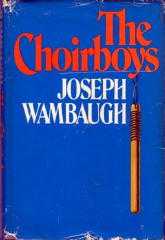
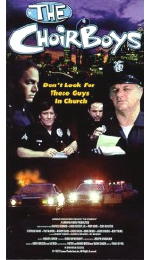
JOSEPH WAMBAUGH – The Choirboys. Delacorte, hardcover, 1975. Reprint paperback: Dell, 1976. Reprinted many times since. Film: Lorimar, 1978; screenwriter: Christopher Knopf; director: Robert Aldrich.

JOSEPH WAMBAUGH The Choirboys

   The powerful opening of this novel takes place in a cave in Vietnam in 1967. Two unnamed marines have taken shelter there from the enemy, and one of them suffers a severe emotional break. Although we do not learn their identities until much later in the book, we can surmise that this incident provides the fuel for future tragedy.

   The scene then shifts to Los Angeles nearly ten years later The “choirboys” are a group of policemen who attend “choir practice” — otherwise known as drinking binges — in MacArthur Park after going off night duty . We are told that a tragedy has taken place during one of these sessions and that a young man has been shot to death.

   Wambaugh then goes into flashback and takes us through the months prior to this final choir practice, introducing us to the participants, allowing us to glimpse their routine — and not-so-routine — tours of duty.

   We come to know intimately such characters as Roscoe Rules, the meanest and probably most despicable man in the precinct; Aaron Mobley, a twenty-five-year-old alcoholic who somehow still manages to function on the job; Francis Tanaguchi, a Nisei who feels more Mexican than Japanese; Spermwhale Whalen, a veteran cop who has a big stake in making it to his twenty-year retirement date; Sam Niles and Howard Bloomguard, physical opposites who nonetheless complement one another as partners; Spencer Van Moot, who can wangle a “freebie” out of any merchant he meets; Baxter Slate, whose “different” quality is hard for his fellow cops to pin down.

JOSEPH WAMBAUGH The Choirboys

   With frequent black humor, Wambaugh shows us both the strengths and weaknesses of his characters, as well as the daily strains, sordidness, and departmental hypocrisy with which they must cope. And when tragedy finally befalls them, the only surprise is that it hasn’t happened sooner.

   This is a first-rate novel that goes several steps beyond the standard police procedural. It was filmed in 1977, starring Charles Durning and Perry King. Among Wambaugh’s other novels of the police world are The Black Marble (1978) and The Secrets of Harry Bright (1985).

         ———
   Reprinted with permission from 1001 Midnights, edited by Bill Pronzini & Marcia Muller and published by The Battered Silicon Dispatch Box, 2007.   Copyright © 1986, 2007 by the Pronzini-Muller Family Trust.

A 1001 MIDNIGHTS Review
by Newell Dunlap:


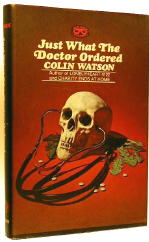
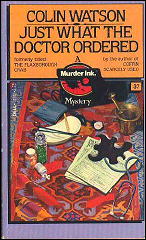
COLIN WATSON – Just What the Doctor Ordered.

G. P. Putnam’s Sons, hardcover, 1969. Paperback reprint: Dell, US, 1982 [Murder Ink #37]. Published earlier in the UK as The Flaxborough Crab; Eyre, hc, 1969.

COLIN WATSON Just What the Doctor Ordered

   One measure of accomplishment for any writer of fiction is how successfully he or she transports us to his/her own individual world of imagination. Certainly one of the more successful in this regard is Colin Watson and his fictional town of Flaxborough.

   Much to our delight, and to the chagrin of Inspector Purbright of the Flaxborough Police Department, an amazing amount of crime seems to occur in this English village.

   Just What the Doctor Ordered begins with a number of sexual assaults on the women of the town. Miss Butters is accosted in Gorry Wood; Miss Sweeting on Heston Lane; Miss Pollock by the reservoir; and at St. Hilda’s a man threatens to “pollinate” Mrs. Pasquith.

   The fact that the attacks are perpetrated by elderly gentlemen, who make their escape by running sideways, only adds to the puzzlement. Inspector Purbright at first suspects an herbal concoction that promises amazing renewed virility. But few cases are quite so simple, as any Colin Watson fan will tell you, and this one takes several additional turns, including murder, before a solution is found.

COLIN WATSON Just What the Doctor Ordered

   Inspector Purbright –flanked by his superior, Chief Constable Chubb; his subordinate, Sergeant Love; and his perpetual thorn-in-the-side, Miss Lucilla Teatime — is at the center of the Flaxborough novels, but the real stars are the amusing and eccentric townspeople themselves.

   This and the other novels in the series are recommended without reservation. Those other novels include Hopjoy Was Here (1963), Charity Ends at Home (1968), Six Nuns and a Shotgun (1975), Plaster Sinners (1981), and Whatever Happened at Mumbleshy? (1983).

   Colin Watson is also the author of an excellent sociological study of the British crime novel between the two world wars, Snobbery with Violence (1971; revised edition, 1979).

         ———
   Reprinted with permission from 1001 Midnights, edited by Bill Pronzini & Marcia Muller and published by The Battered Silicon Dispatch Box, 2007.   Copyright © 1986, 2007 by the Pronzini-Muller Family Trust.

[EDITORIAL COMMENT.]   Flaxborough fans — and I’m sure you already know who you are — will have already recognized this particular adventure — under its British title, of course — as the third of four Inspector Purbright cases that were adapted for TV by the BBC in 1977. The first two in the recently released box set were reviewed here not so very long ago.

[UPDATE] 06-17-09.   Check the comments for a complete list of all of the Inspector Purbright novels, taken from the Revised Crime Fiction IV, by Allen J. Hubin.

A 1001 MIDNIGHTS Review
by Newell Dunlap:


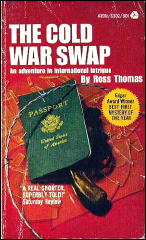
ROSS THOMAS – The Cold War Swap. William Morrow, 1966. Paperback reprints include: Avon, 1967; Pocket, 1976; Perennial Library, 1984,1986; Mysterious Press, 1992.

ROSS THOMAS Cold War Swap

   Mac’s Place is a bar located in Bonn, West Germany. It is run by McCorkle and Padillo, two expatriate Americans. The only trouble is that Padillo, from time to time, has to assume his other role as an undercover agent, take a leave of absence from the bar business, and travel to some country or another on some mission or another. Padilla never tells McCorkle where he’s going or what he’s up to, and that’s the way they both want it.

   However, in this story, that arrangement begins to come unraveled. Padillo is off on another trip (nothing new there), but just as he is leaving, there is a killing in the bar that seems somehow related to his departure. And just as the furor over the killing is beginning to die down, there is an urgent message for McCorkle — a message from Padilla, trapped in East Germany and asking for Mac’s help.

   This is the first of several fine international adventure/ espionage novels from Ross Thomas, and with each successive book he has established himself more and more firmly as a master of the genre. His stories, moving at a fast and intricate pace, are peopled with an amazing array — some critics might say an almost distracting array — of characters.

ROSS THOMAS

   A typical Thomas protagonist is seldom young; rather, he is flirting with middle age, is a little world-weary but still able to take care of himself, and should know better than to get involved in the situation that confronts him. But, for personal and/or professional reasons, he does become involved.

   And indeed, McCorkle does become involved. He travels to East Germany to be met by betrayal, a certain amount of failure, and a certain amount of success. The scenes that take place during his stay behind the Iron Curtain are especially palpable and nerve-racking.

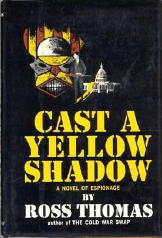
   Other novels featuring McCorkle and Padillo are Cast a Yellow Shadow (1967) and The Backup Man (1971).

         ———
   Reprinted with permission from 1001 Midnights, edited by Bill Pronzini & Marcia Muller and published by The Battered Silicon Dispatch Box, 2007.   Copyright © 1986, 2007 by the Pronzini-Muller Family Trust.

A 1001 MIDNIGHTS Review
by Max Allan Collins:


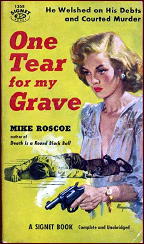
MIKE ROSCOE – One Tear for My Grave.

Crown, hardcover, 1955. Paperback reprints: Signet #1358, November 1956, cover: Robert Maguire; G2432, 1964.

MIKE ROSCOE

   Mike Roscoe’s tough Kansas City private eye Johnny April appeared in five novels between 1951 and 1958. Although the first four went through various printings and editions, neither Roscoe nor April is much remembered today.

   Both are due for revival and reassessment, as the handful of Johnny April stories are among the best produced in the wave of hard-hitting PI fiction that followed the big splash made by Mickey Spillane’s Mike Hammer.

   One Tear for my Grave finds April in the presence of millionaire Avery J. Castleman and a corpse. This prologue (“The 23rd Hour”) is followed by a flashback (“The First 22 Hours”) that comprises the bulk of the book.

   The lure of a fat retainer coaxes April out of bed at two in the morning to aid bookie Eddie Norris and his moll, Nicky, who have a corpse on their hands — or, actually, in their back seat. Norris claims innocence — somebody dumped this stiff in his car, says the bookie. From the cops April learns the corpse is a society type named David Matthews.

MIKE ROSCOE

   Over the coming hours, various bookies — all of them owed money by Matthews — begin to die, and not of natural causes. Among them is Norris. April bumps heads with one particularly nasty bookie named Carbone, who trashes April’s office to convince him to “lay off” this case, which only serves to enrage the detective.

   April then meets with Ginny Castleman, the delicate, sympathy-arousing society girl engaged to the late Matthews; he also meets her mysterious Oriental servant, whose quiet concern for his mistress seems strangely obsessive. While bobbing and weaving between bookies and their thugs, April encounters Carbone’s moll, Lola, and a love/hate relationship blossoms.

   Eventually he finds that Matthews had paid off all the bookies before their deaths; and at the Castleman mansion, April has a final confrontation with Carbone as the convoluted, ultimately tragic mystery unravels. An epilogue (“The 24th Hour”) brings the book full circle.

MIKE ROSCOE

   What sets such Roscoe mysteries as One Tear for My Grave apart from the crowd of would-be Spillanes is a studiously spare style. The novel is stripped for speed, consisting mostly of crisp dialogue and one- and two-sentence paragraphs.

   Despite this, the language is often vivid and evocative; witness the four opening lines (and four opening paragraphs) of the novel:

         There are two times when a man will lie very still.

         When he is finished making love with a woman.

         When he is finished with life.

         The man on the floor lay still with death.

MIKE ROSCOE

   Roscoe was two men — Michael Ruso and John Roscoe — who were real private eyes, employed by Hargrave’s Detective Agency in Kansas City.

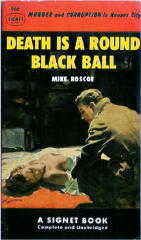
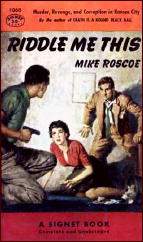
   The team’s first three books — Death Is a Round Black Ball (1952), Riddle Me This (1953), and Slice of Hell (1954) — are also excellent.

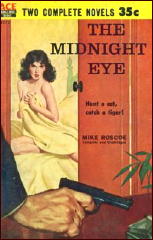
   The last Johnny April novel, The Midnight Eye, did not appear till 1958, half an Ace Double. While some of the poetic touches were still present, this marked a dropping off in quality over the first four, and a near absence of the dialogue/short paragraph approach.

   Perhaps the team had broken up and only one of them recorded this last Johnny April case.

         ———
   Reprinted with permission from 1001 Midnights, edited by Bill Pronzini & Marcia Muller and published by The Battered Silicon Dispatch Box, 2007.   Copyright © 1986, 2007 by the Pronzini-Muller Family Trust.

A 1001 MIDNIGHTS Review
by Marcia Muller:


RICHARD NEELY

RICHARD NEELY – The Walter Syndrome.   McCall Publishing Co., hardcover, 1970. Paperback reprint: Signet, 1971.

   Lambert Post is a mild-mannered classified-advertising phone solicitor for the New York Journal. His association with the silver-tongued Charles Walter begins quite innocently, as he listens to Walter flatter landladies into placing “rooms to let” ads in the paper.

   Walter, whose upper-class background and ease with people impresses Post, finds a “most fascinated and sympathetic audience” in him, and soon he progresses from boasting of his exploits to enlisting Post’s participation in a little game: Walter gets the names of recent widows and divorcées from the paper, then calls them up and makes a date; but Post is the man who shows up, explaining Walter has been called out of town.

   Quickly the encounters turn ugly. One woman humiliates him in front of a roomful of guests; another has her boyfriend beat him up. Angry at the women’s treatment of Post, Walter embarks on a plan of revenge.

RICHARD NEELY

   The first woman, Jennifer Hartwick, is knocked unconscious, raped, and left in a room at a hotel; because of an anonymous call, the police think she is a prostitute. The second woman, Diane Summers, and her boyfriend, Edward Cranston, are found shot to death.

   At first the police suspect a murder/suicide, but then they find that a third party purchased the gun; and Walter — ever protective of Post — realizes that Lambert can be identified not only as the man who bought the weapon but also as someone with a grudge against Jennifer Hartwick. Thus, he reasons, Jennifer must die, too.

   Soon the papers are carrying stories about the Executioner, a man who punishes women for their wickedness. And as investigative reporter Maury Ryan of the Journal delves into the case, the Executioner begins to contact him by phone, throwing out teasers and taunting him.

   Told from the viewpoints of Post, Walter, and Ryan, this is a truly frightening tale. By the time a fourth woman is murdered and we realize the Executioner’s plans for fifth, it is impossible to put the book down.

RICHARD NEELY

   While the astute reader may pick up on what is going on fairly early, the outcome is nonetheless chilling — and the ultimate revelation is a total surprise.

   Neely has written other tales of psychological suspense among them Death to My Beloved (1969), The Japanese Mistress (1972), Lies (1978), The Obligation (1979), and Shadows from the Past (1983).

         ———
   Reprinted with permission from 1001 Midnights, edited by Bill Pronzini & Marcia Muller and published by The Battered Silicon Dispatch Box, 2007.   Copyright © 1986, 2007 by the Pronzini-Muller Family Trust.

A 1001 MIDNIGHTS Review
by Edward D. Hoch:


E. C. BENTLEY – Trent’s Last Case.

E. C. BENTLEY Trent's Last Case

Thomas Nelson, UK, hardcover, 1913. First published in the US as The Woman in Black, Century, 1913. (Later US editions have the British title.) Reprinted many times in both hardcover and paperback. Also available as an online etext.
   Silent film: Broadwest, 1920 (Gregory Scott as Philip Trent; Richard Garrick, director). Also (with partial sound): Fox, 1929 (Raymond Griffith as Philip Trent; Howard Hawks, director). Sound film: British Lion, 1952 (Michael Wilding as Philip Trent; Herbert Wilcox, director).

   One of the true cornerstones in the development of the modern detective novel, Trent’s Last Case has received high praise for more than seventy years. G.K. Chesterton (to whom the book was dedicated) called it “the finest detective story of modem times,” while Ellery Queen praised it as “the first great modern detective novel.”

   Later critics have tempered their praise somewhat, and Dilys Winn’s Murder Ink even lists the book in its Hall of Infamy among the ten worst mysteries of all time.

E. C. BENTLEY Trent's Last Case

   But there can be no doubt as to the book’s importance, especially in the character of detective Philip Trent. Before Bentley’s creation of Trent, fictional detectives had always been of the infallible, virtually superhuman type exemplified by C. Auguste Dupin and Sherlock Holmes.

   English artist Philip Trent, investigating the murder of a wealthy American financier for a London newspaper, represents the birth of naturalism in the detective story. He falls in love with the victim’s widow (the woman in black of the original American title), who is the chief suspect in the case, and he is far from infallible as a detective.

   Bentley wrote the book as something of an exposure of detective stories, a reaction against the artificial plots and sterile characters of his predecessors. But despite Trent’s fallibility, his detective work is skillful. The ending, with its surprise twists, is eminently satisfying.

   Though slow-paced by modem standards, the book has a graceful prose and quiet humor that have stood up well with the passage of time. Mystery readers were not to see anything remotely like Trent’s Last Case until Agatha Christie’s initial appearance with The Mysterious Affair at Styles in 1920.

E. C. BENTLEY Trent's Last Case

   Happily, Philip Trent’s last case wasn’t really his last, though E. C. Bentley waited twenty-three years before producing a sequel, Trent’s Own Case, written in collaboration with H. Warner Allen.

   This time Trent himself is the chief suspect in a murder case, and if the book falls short of its predecessor, it is still a skillful and attractive novel.

   Bentley followed it with thirteen short stories about Trent, written mainly for the Strand magazine, twelve of which were collected in Trent Intervenes (1938), a classic volume of anthology favorites. A final thriller, Elephant’s Work (1950), is more in the style of John Buchan and is less successful.

         ———
   Reprinted with permission from 1001 Midnights, edited by Bill Pronzini & Marcia Muller and published by The Battered Silicon Dispatch Box, 2007.   Copyright © 1986, 2007 by the Pronzini-Muller Family Trust.

A 1001 MIDNIGHTS Review
by Francis M. Nevins:


JAMES CRUMLEY – The Last Good Kiss.  Random House, hardcover, 1978.  Reprint paperback: Pocket, 1981.  Vintage Books, trade ppbk, 1988.

   Since the death of Ross Macdonald and on the basis of just three novels, James Crumley has become the foremost living writer of private-eye fiction. Carrying on the Macdonald tradition in which the PI is no longer macho but a man sensitive to human needs, torn by inner pain, and slow to use force, Crumley has moved the genre into the Vietnam and post-Vietnam era.

JAMES CRUMLEY

   His principal setting is not the big city as in Hammett and Chandler nor the affluent suburbs as in Macdonald, but the wilderness and bleak magnificence of western Montana. His prevailing mood is a wacked out empathy with dopers, dropouts, losers, and loonies, the human wreckage of the institutionalized butchery we call the “real world.” Nobility resides in the land, in wild animals, and in a handful of outcasts — psychotic Viet vets; Indians, hippies; rumdums; and love-seekers — who can’t cope with life.

   Crumley’s detective characters have one foot in either camp. Milodragovitch, the protagonist of The Wrong Case (1975) and Dancing Bear (1983), is a cocaine addict and boozer, the child of two suicides, a compulsive womanizer like his wealthy Hemingwayesque father; a man literally marking time until he will turn fifty-two and inherit the family fortune, which his pioneer ancestors legally stole from the Indians.

   Sughrue from The Last Good Kiss has a background as a Nam war criminal and an army spy on domestic dissidents and he’s drinking himself to death by inches. Yet these are two of the purest figures in the history of detective fiction, and the most reverent toward the earth and its creatures.

   Crumley has minimal interest in plot and even less in explanations, but he’s so uncannily skillful with character, language, relationship, and incident that he can afford to throw structure overboard. His books are an accumulation of small, crazy encounters, full of confusion and muddle, disorder and despair, graphic violence and sweetly casual sex, coke snorting and alcohol guzzling, mountain snowscapes and roadside bars.

JAMES CRUMLEY

   When he does have to plot, he tends to borrow from Raymond Chandler. In The Wrong Case, Milodragovitch becomes obsessed by a young woman from Iowa who hires him to find her missing brother, a situation clearly taken from Chandler’s Little Sister (1949).

   The Last Good Kiss, perhaps the best of Crumley’s novels, traps Sughrue among the tormented members of the family of a hugely successful writer, somewhat as Philip Marlowe was trapped in Chandler’s masterpiece, The Long Goodbye (1954).

   In Dancing Bear, which pits Milodragovitch against a multinational corporation dumping toxic waste into the groundwater, the detective interviews a rich old client in a plant-filled solarium just like Marlowe in the first chapter of Chandler’s Big Sleep (1939).

   None of these borrowings matter in the least, for Chandler’s tribute to Dashiell Hammett is no less true of Crumley: He writes scenes so that they seem never to have been written before. What one remembers from The Last Good Kiss is the alcoholic bulldog and the emotionally flayed women and the loneliness and guilt.

   What is most lasting in Dancing Bear is the moment when Milodragovitch finds a time bomb in his car on a wilderness road and tosses it out at the last second into a stream and weeps for the exploded fish that died for him, and dozens of other moments just as powerful.

         ———
   Reprinted with permission from 1001 Midnights, edited by Bill Pronzini & Marcia Muller and published by The Battered Silicon Dispatch Box, 2007.   Copyright © 1986, 2007 by the Pronzini-Muller Family Trust.

   Bibliographic data [updated]:

MILO MILODRAGOVITCH   [James Crumley]

      The Wrong Case. Random House, 1975.
      Dancing Bear. Random House, 1983.
      Border Snakes. Dennis McMillan, 1996. Note: Crumley’s other PI character, C. W. Sughrue, also appears in this book.

JAMES CRUMLEY

      The Final Country. Mysterious Press, 2002.

A 1001 MIDNIGHTS Review
by Ed Gorman:


MAX COLLINS – The Broker. Berkley, paperback original, 1976. Paperback reprint: Foul Play Press, 1985, as Quarry.

   In the mid-1970s, the multi-talented Max Collins (who also writes as Max Allan Collins) produced a series of four paperback originals about a Vietnam vet turned hired killer, known only as Quarry. The Quarry series has so often been referred to as a Richard Stark pastiche that its own tone and morality are often overlooked.

MAX ALLAN COLLINS Quarry

   In The Broker, the first in the series, we meet Quarry shooting a man in an airport men’s room. Quarry’s assignment is to bring what the man is holding (heroin) back to his employer, an icy sort called the Broker. Quarry complies.

   After complaining that he does not like to deal in drug killings, he reluctantly takes another Broker assignment, this one working with a homosexual killer named Boyd. In the rest of the novel, Collins shows us an abundantly unpleasant world peopled with all sorts of characters, from cuckolded husbands to porno-crazed geezers who look like Gabby Hayes.

   What gives the Quarry books their style is the detached voice of the narrator: Quarry has no compunctions about killing people, because he feels most of them are rather foolish beings anyway. Unlike Stark’s Parker, who is human only when it serves his ends, Quarry is subject to feelings other than anger-melancholy, amusement, contempt-feelings he notes, nonetheless, with the kind of removed observation one would expect from a man in his profession.

   The Broker and the other three novels in the series — The Broker’s Wife (1976), The Dealer (1976), and The Slasher (1977) — are successful for another reason: They depict the waning hippie/flower-power days with a great deal of historical accuracy. The Quarry books are therefore an important part of the crime fiction of the Seventies — a quirky, idiosyncratic look at the Midwest during the Gerald Ford regime.

         ———
   Reprinted with permission from 1001 Midnights, edited by Bill Pronzini & Marcia Muller and published by The Battered Silicon Dispatch Box, 2007.   Copyright © 1986, 2007 by the Pronzini-Muller Family Trust.

         Bibliographic data: The Quarry series [Updated].

   The Broker. Berkley, pbo, 1976; aka Quarry, Foul Play, 1985.

   The Broker’s Wife. Berkley, pbo, 1976; aka Quarry’s List, Foul Play, 1985.

   The Dealer, Berkley, pbo, 1976; aka Quarry’s Deal, Foul Play, 1986.

MAX ALLAN COLLINS Quarry

   The Slasher, Berkley, , pbo, 1977; aka Quarry’s Cut, Foul Play, 1986.

   Primary Target. Foul Play, hardcover, 1987.

   Quarry’s Greatest Hits. Five Star, hc, 2003. Contents:
       ● Primary Target (novel)
       ● “A Matter of Principle” (short story, reprinted from Stalkers, Roc/Penguin, 1992, Ed Gorman, ed., and the basis for a short film included in the DVD boxed set Max Allan Collins Black Box Collection: Shades of Neo-Noir, 2006.)
       ● “Quarry’s Luck” (short story reprinted from Narrow Houses: Blue Motel, Volume 3, Little Brown, UK, 1994, Peter Crowther, ed.)
       ● “Guest Services” (short story reprinted from Murder Is My Business, Signet, 1994, Mickey Spillane & Max Allan Collins, eds.)

   The Last Quarry. Hard Case Crime, pbo, 2006. Expansion of “A Matter of Principle,” and the basis for the feature length film, The Last Lullaby (2008).

MAX ALLAN COLLINS Quarry

   The First Quarry. Hard Case Crime, pbo, 2008.

MAX ALLAN COLLINS Quarry

   Quarry In The Middle. Hard Case Crime, pbo, 2009. (Forthcoming, November.)

A 1001 MIDNIGHTS Review
by Newell Dunlap:


MANNING COLES – A Toast to Tomorrow.

MANNING COLES Toast to Tomorrow

Doubleday Crime Club, US, hardcover, 1941. Earlier UK edition, published as Pray Silence: Hodder, hc, 1940. Many reprint editions, both hardcover and soft. US paperback editions include: Bantam 118, 1947; Berkley F873, Jan 1964; Rue Morgue Press, 2008.

   In Germany in March 1933, a bit of a puzzle crops up concerning a radio production called “The Radio Operator.” On the surface, the show is nothing more than blatant Nazi propaganda. But to the British Foreign Office, it is much more.

   It seems the Morse code used as a background sound on the. show is actually a code used by an undercover British agent during World War I. Why, then, is it suddenly being used again after all these years-especially since the agent who used it is now dead? A puzzle indeed.

   For answers, the novel flashes back to January 1918, and we follow the life of an amnesia victim who adopts the name Klaus Lehmann. Lehmann, like most Germans, has a rough time of it in the postwar years.

   He meets Adolf Hitler, joins the Nazi party, and works his way up through the party ranks, all this before he remembers his true identity. He is really Hendrik Brandt. No, that isn’t right. He is really a British intelligence agent named Tommy Hambledon, who was posing as Brandt, and who is now posing as Lehmann. And what a position for a British agent to be in!

MANNING COLES Toast to Tomorrow

   The name Manning Coles is a pseudonym for Cyril Coles and Adelaide Manning. Under this pseudonym they produced numerous books and stories, but none of their characters was more popular than agent Hambledon. This book is the second in the Hambledon series. In the first, Drink to Yesterday (1941), Hambledon winds up his World War I experience and suffers the beginning of amnesia.

   The subsequent books — among them Operation Manhunt (1954), The Man in the Green Hat (1955), and The House at Pluck’s Gutter (1968) — came to rely more and more on formulaic plots and stock settings, and from the Fifties on,the series lost much of its appeal.

   Coles and Manning also collaborated on a series of satirical ghost stories featuring a defunct pair of cousins, James and Charles Latimer, and their equally dead pet monkey, Ulysses. Published as by Francis Gaite, these include Brief Candles (1954), The Far Traveler (1956), and Duty Free (1959).

         ———
   Reprinted with permission from 1001 Midnights, edited by Bill Pronzini & Marcia Muller and published by The Battered Silicon Dispatch Box, 2007.   Copyright © 1986, 2007 by the Pronzini-Muller Family Trust.

A 1001 MIDNIGHTS Review
by Bill Pronzini:


G. D. H. & MARGARET COLE – Knife in the Dark.

Collins Crime Club, UK, hardcover; Dec 1941. The Macmillan Co., US, hardcover, 1942 (shown below).

GDH & M COLE Brooklyn Murders

   G. D. H. and Margaret Cole were extremely prolific writers between the two world wars: individually and collaboratively, they published well over two hundred books of fiction, nonfiction, and verse.

   G. D. H. was a prominent social and economic historian; his five-volume A History of Social Thought is considered a landmark work. Dame Margaret is best known for her biographies of Beatrice Webb and of her husband (The Life of G.D.H. Cole, 1971).

   The Coles co-authored more than thirty “Golden Age” detective novels, beginning with The Brooklyn Murders in 1923, and six volumes of criminous short stories. Knife in the Dark is their next to last novel, and the only one to feature Mrs. Warrender as its protagonist.

   “A naturally trim and tidy old lady,” Mrs. Warrender is the mother of private detective James Warrender (who affectionately calls her, among other things, “an incurably meddling old woman”). She is also solidly in the tradition of such “little old lady” sleuths as Miss Jane Marple and Hildegarde Withers, although less colorful than either of those two indefatigable crook-catchers.

   Knife in the Dark takes place at a mythical ancient English university, Stamford, during the dark days of World War II. Kitty Lake — wife of Gordon Lake, a teacher of Inorganic Chemistry whose mother is a cousin of Mrs. Warrender’s — is stabbed to death during an undergraduate dance which she herself arranged.

GDH & M COLE Knife in the Dark

   Any number of people had a motive to do away with the mercurial Kitty, who had both a mean streak and a passion for other men; the suspects include her husband, an R.A.F. officer, a young anthropologist, a strange Polish refugee named Madame Zyboski (who may or may not be a Nazi spy), and a dean’s wife whom James Warrender describes as “an awful old party with a face like a diseased horse and a mind like a sewer.”

   Like all of the Coles’ mysteries, this is very leisurely paced; Kitty Lake’s murder, the only one in the book, does not take place until page 104, and there is almost no action before or after. Coincidence plays almost as much of a role in the solution as does detection by Mrs. Warrender (who happens to be staying with the Lakes at the time of the murder); and the identity of the culprit comes as no particular surprise.

   For all of that, however, Knife in the Dark is not a bad novel. The characters are mostly interesting, the university setting is well-realized, and the narrative is spiced with some nice touches of dry wit. Undemanding fans of the Golden Age mystery should find it diverting.

   Mrs. Warrender’s talents are also showcased in four novelettes collected as Mrs. Warrender’s Profession (1939). The best of the four is “The Toys of Death,” in which Mrs. W. solves a baffling murder on the south coast of England.

GDH & M COLE

The Coles also created three other series detectives, none of whom is as interesting an individual as Mrs. Warrender. The most notable of the trio is Superintendent Henry Wilson of Scotland Yard, for he is featured in sixteen novels, among them The Berkshire Mystery (1930), End of an Ancient Mariner (1933), and Murder at the Munition Works (1940); and in the collection of short stories, Superintendent Wilson’s Holiday (1928).

         ———
   Reprinted with permission from 1001 Midnights, edited by Bill Pronzini & Marcia Muller and published by The Battered Silicon Dispatch Box, 2007.   Copyright © 1986, 2007 by the Pronzini-Muller Family Trust.

« Previous PageNext Page »