1001 Midnights


A 1001 MIDNIGHTS Review
by George Kelley & Marcia Muller:


FREEMAN WILLS CROFTS Jane Vosper

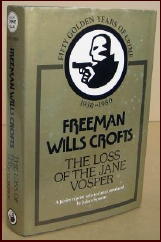
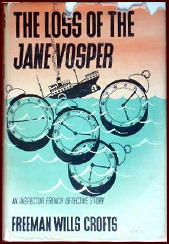
FREEMAN WILLS CROFTS – The Loss of the “Jane Vosper.”

Collins, UK, hardcover, 1936. Dodd Mead, US, hardcover, 1936. Many reprint editions, both hardcover and soft, including: Collins, UK, hc, 1980 [Crime Club 50th Anniversary edition] and Grosset, US, n.d (both shown).

   Crofts was a transportation engineer and worked for railway companies for many years before retiring in 1929 to become a full-time writer.

   A number of his novels make use of his technical knowledge of railroading and shipping, such as Death of a Train (1947), in which Inspector French investigates a World War II plot to divert vital supplies being shipped to the British forces in North Africa. Similarly, The Loss of the “Jane Vosper” draws on Crofts’s knowledge of the shipping industry.

FREEMAN WILLS CROFTS Jane Vosper

   On a dark night in the mid-Atlantic, the cargo ship Jane Vosper is rocked by explosion after explosion. Soon afterward, the ship sinks. An insurance investigation is launched, and it soon becomes apparent that the sinking of the ship was no accident.

   Inspector French enters the case and begins to piece details together-including particulars of what cargo the ship was carrying. A cargo swindle is revealed-one that leads to murder. French works with precision, ever conscious that unnecessary delay may lead to additional killings.

   The background detail in this novel is particularly good, and French is in top form, always playing fair with the reader and making us privy to his private thoughts. French is likable, a pleasant, unassuming man with none of the sometimes unfortunate affectations of other popular classic sleuths.

   This book — and most of Crofts’ others — presents no real challenge to the reader in terms of outwitting the detective and solving the case first. If anything, we feel that we are being taken by the hand and led on a genteel journey through the routine of a careful and dedicated investigator.

FREEMAN WILLS CROFTS

   Other Crofts novels dealing with the shipping industry include Mystery in the English Channel (1931), Crime on the Solent (1934), Man Overboard (1936), and Enemy Unseen (1945).

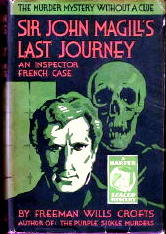
   Books in which Crofts drew on his railroading background include Sir John Magill’s Last Journey (1930), Wilful and Premeditated (1934), and Dark Journey (1954). A short-story collection featuring Inspector French, Many a Slip, was published in 1955.

         ———
   Reprinted with permission from 1001 Midnights, edited by Bill Pronzini & Marcia Muller and published by The Battered Silicon Dispatch Box, 2007.   Copyright © 1986, 2007 by the Pronzini-Muller Family Trust.
A 1001 MIDNIGHTS Review
by George Kelley & Marcia Muller:


CROFTS The Cask

FREEMAN WILLS CROFTS – The Cask.

Collins, UK, hardcover, 1920. Seltzer, US, hardcover, 1924. Reprinted many times in both hardcover and paperback.

   Freeman Wills Crofts’s first novel, The Cask, is considered by many critics, including Anthony Boucher, to be one of the best and most important books in the mystery genre.

   The prime virtue of this and all the Crofts novels is their tight, logical plotting, in which every detail fits solidly and smoothly. His detectives work meticulously to piece the clues together, often in order to demolish a supposedly unshakable alibi; and because they are so logical, the endings are always exceptionally satisfying.

   Early in his career, Crofts experimented with a number of sleuths, but in his fifth novel — Inspector French’s Greatest Case (1925) — he introduced Inspector Joseph French, who was to appear in most of his subsequent books. Like Crofts’s previous heroes, French is a bit of a plodder who slowly and carefully works his way step by step through the process of deduction to a natural conclusion.

CROFTS The Cask

   In The Cask, the plot turns on alibis. When four casks fall to the deck of a ship during unloading, two of them leak wine, one is undamaged, and the last leaks sawdust. This last cask is examined more closely, and gold coins and the fingers of a human hand are found. But before the cask can be completely opened, it vanishes.

   Inspector Burnley of Scotland Yard is assigned to this bizarre case. Using the few clues available to him, he is able to locate the missing cask. And when it is opened, Burnley finds the body of a young woman who has been brutally strangled.

   There are no clues to the victim’s identity, so Burnley goes to Paris, where the cask was assembled. What follows is a detailed, complex investigation, involving timetables, a performance of Berlioz’s Les Troyens, and a group of suspects with a multitude of motives.

         ———
   Reprinted with permission from 1001 Midnights, edited by Bill Pronzini & Marcia Muller and published by The Battered Silicon Dispatch Box, 2007.   Copyright © 1986, 2007 by the Pronzini-Muller Family Trust.
A 1001 MIDNIGHTS Review by Max Allan Collins:


JOHN B. WEST – An Eye for an Eye.

JOHN B. WEST

Signet #1642, paperback original; 1st printing, February 1959, plus at least one reprint edition.

   John B. West was a man of many talents and achievements: A doctor, he was both a general practitioner and a specialist in tropical diseases; he was also the owner of a broadcasting company, manufacturing firm, and hotel/restaurant corporation. He lived in Liberia, was black, and late in his life — as a pastime, apparently — wrote novels about white private eye Rocky Steele, of New York City.

   West appears to have been used by Signet Books as an attempt to fill the gap when their star seller, Mickey Spillane, stubbornly refused to write any more novels (until The Deep in 1960, that is). While the Rocky Steele novels were never any real competition for Mike Hammer (or anyone else), the six titles in the series did go through various printings and editions.

   An Eye for an Eye, the first Rocky Steele adventure — in which for no particular reason the private eye avenges the death of the blond, beautiful, and wealthy Norma Carteret — is singled out here arbitrarily, as all of the books seem to be of a similar “quality.” (One book, the posthumously published Death on the Rocks, 1961, does have an African setting to distinguish it.)

JOHN B. WEST

   While unquestionably lower-rung Spillane imitations (like Mike Hammer, Rocky Steele smokes Luckies, packs a .45, refuses the advances of his lovely secretary, has a loyal police contact, etc.), the West novels are goofily readable, as Rocky Steele teeters between the violence and revenge of Hammer, and the broads and campiness of Shell Scott.

   The world West creates (actually, re-creates) is pure pulp fantasy, and makes the work of Carroll John Daly read like documentaries. The energetic pulpiness of the plots, and West’s confident, tin-ear, tough-guy dialogue (“Mercy! That rat didn’t know what the word meant, and I wasn’t gonna teach him.”) gives his private-eye stories the same sort of appeal as Robert Leslie Bellem’s Dan Turner tales and Michael Avallone’s later Ed Noon novels.

         ———
   Reprinted with permission from 1001 Midnights, edited by Bill Pronzini & Marcia Muller and published by The Battered Silicon Dispatch Box, 2007.   Copyright © 1986, 2007 by the Pronzini-Muller Family Trust.

A 1001 MIDNIGHTS Review by Bill Pronzini:


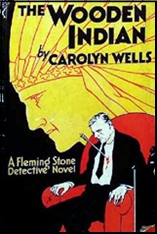
CAROLYN WELLS – The Wooden Indian. J. B. Lippincott, hardcover, 1935.

   During the first four decades of this century, Carolyn Wells wrote more than eighty mystery novels — most of them to a strict (and decidedly outmoded) formula she herself devised.

CAROLYN WELLS Fleming Stone

   She has been called, with some justification, an expert at the construction of the formal mystery, and she has also been credited with popularizing the locked-room/impossible-crime type of story, of which she wrote more than a score.

   Her other claim to fame is that she was the author of the genre’s first nonfiction work, a combination of how-to and historical overview called The Technique of the Mystery Story (1913). Unfortunately, that book is far more readable today than her novels, which are riddled with stilted prose, weak characterization, and flaws in logic and common sense.

   The Wooden Indian, one of her later titles, is a good example. It features her most popular series sleuth, Fleming Stone, a type she describes in The Technique of the Mystery Story as a “transcendent detective” — that is, a detective larger than life, omniscient, a creature of fiction rather than fact.

   And indeed, Fleming Stone is as fictitious as they come: colorless and one-dimensional, a virtual cipher whose activities are somewhat less interesting to watch than an ant making its way across a sheet of blank paper. The same is true of most of her other characters. None of them come alive; and if you can’t care about a novel’s characters, how can you care about its plot?

   The plot in this instance is a dilly. An obnoxious collector of Indian artifacts, David Corbin, keeps a huge wooden Indian, a Pequot chief named Opodyldoc, in a room full of relics at his home in “a tiny village in Connecticut which rejoiced in the name of Greentree.”

   One of the accouterments of this wooden Indian is a bow and arrow, fitted and ready to fire. And fire it does, of course, killing Corbin in what would seem to be an accident (or the fulfillment of an old Pequot curse against the Corbin family), since he was alone in the room at the time and there was no way anyone could have gotten in or out.

   Several guests are on hand at the time, one of them Fleming Stone. Stone sorts out the various motives and clues, determines that Corbin was murdered, identifies the culprit, and explains the mystery — an explanation that is not only silly (as were many of Wells’s solutions) but implausible, perhaps even as impossible as the crime itself was purported to be.

   Fleming Stone is featured in such other titles as The Clue (1909), The Mystery of the Sycamore (1921), and The Tapestry Room Murder (1929).

   Wells also created several other series detectives — Pennington (“Penny”) Wise, Kenneth Carlisle, Alan Ford, Lorimer Lane — all of whom are as “transcendent” as Fleming Stone.

   Her novels are important from a historical point of view, certainly; but the casual reader looking for entertaining, well-written, believable mysteries would do well to look elsewhere.

         ———
   Reprinted with permission from 1001 Midnights, edited by Bill Pronzini & Marcia Muller and published by The Battered Silicon Dispatch Box, 2007.   Copyright ? 1986, 2007 by the Pronzini-Muller Family Trust.

A 1001 MIDNIGHTS Review by Ellen Nehr:


THE CASE BOOK OF JIMMIE LAVENDER

VINCENT STARRETT – The Case Book of Jimmie Lavender. Gold Label, hardcover, 1944. Hardcover reprint: Bookfinger, 1973.

   Comprising about a fourth of the published cases of Jimmie Lavender, the only sleuth in mystery fiction named for a major-league baseball player, these twelve tales from the Twenties and Thirties are representative examples of the now mostly forgotten detective short stories of Vincent Starrett, better known today as the biographer of Lavender’ s inspiration, Sherlock Holmes.

   By modern standards, none is of the first rank, but most are well-plotted puzzles cast in the classic mold, with a nice blend of cerebral deduction and physical action, and even fifty years and more later they have their attractions.

   Several of the victims in the ten episodes concerned with murder are dispatched in picturesque ways and in a variety of interesting settings. Among the latter: a nightclub, a cruise ship, a golf course, a hospital, a university campus not far from the grounds of the 1933 Chicago World’s Fair, and even an airplane cockpit.

   In one of the tales, a house “vanishes”; in another, the scene of the crime itself disappears; in a third — a locked-room homicide — the case is solved twenty years before it occurs. And every so often the proceedings are enlivened with some typical Chicago-style gunplay.

   Though not as fully realized or memorably limned as some of his more celebrated Golden Age contemporaries, Lavender himself is an engaging protagonist, warm and whimsical throughout, though perhaps a bit too omniscient at times. He is aided in his investigations by his equally likable companion and chronicler, “Gilly” Gilruth, a refreshingly able Watson.

   Taken in small doses, their adventures are still fun to read, both for their own sake and as pleasantly nostalgic reminders of a more innocent era in the history of the crime-fiction genre.

Vincent Starrett

   Starrett also published a number of mystery novels, none of which is particularly distinguished. Three of these feature a detective with the unlikely name of Walter Ghost: Murder on “B” Deck (1929), Dead Man Inside (1931), and The End of Mr. Garment (1932).

   Starrett’s best novel, however, is probably Murder in Peking (1946), which has a nicely evoked Chinese background. Other of Starrett’s criminous short stories can be found in Coffins for Two (1924) and The Blue Door (1930); two of the stories in the later volume feature Jimmie Lavender.

         ———
   Reprinted with permission from 1001 Midnights, edited by Bill Pronzini & Marcia Muller and published by The Battered Silicon Dispatch Box, 2007.   Copyright © 1986, 2007 by the Pronzini-Muller Family Trust.
A 1001 MIDNIGHTS Review by Max Allan Collins:


RICHARD STARK – Butcher’s Moon.

RICHARD STARK

Random House, hardcover, 1974. Paperback reprint: Avon, 1985. UK edition: Coronet, pb, 1977.

   To date [1986] there have been sixteen novels about hard-bitten professional thief Parker, and Butcher’s Moon is the sixteenth. Nearly twice as long as any single previous entry in the series, it represents a culmination of themes and a summation of events, but leaves the eager reader afraid that Richard Stark (Donald E. Westlake) may have nothing left to say about his enigmatic antihero. Since at this writing it has been ten years since the publication of Butcher’s Moon, that conclusion seems warranted.

   Parker and his sometime partner, actor Alan Grofield, return to Tyler, the scene of a botched armored-car robbery of several years previous, the take of which was abandoned out of necessity. At the time Parker had said, “I know where it is. Someday I’ll go back and get it.”

RICHARD STARK

   That day is now, and Parker sets out to retrieve the money from Lonzini, the mobster Parker figures found the money. When Lonzini fails to cooperate, Parker and Grofield begin pulling jobs — hitting a gambling casino, drug dealer, numbers operation, etc. Much like the Continental Op in Hammett’s Red Harvest, Parker’s activities trigger power plays within the local mob, while the level of violence escalates.

   When Grofield is captured, Parker assembles a string of thieves (characters from previous Stark novels) to pull a simultaneous series of capers he has carefully worked out. From the grand haul these jobs will realize, Parker plans to take no share — he merely asks his fellow thieves to repay him for his work by helping him afterward: “I want Grofield back, and I want my money. And I want those people dead.”

   The twelve men are to hit the mob “safe house” where Grofield is being held, and kill all his captors. Stark builds climax upon climax as the various capers play out and as bullets fly and bodies pile up.

RICHARD STARK

   Butcher’s Moon brings Parker full circle: Taking on the mob in order to retrieve “his” money (never mind that it was stolen from somebody else to begin with) was where Parker began in the trilogy of The Hunter (1962), The Man with the Getaway Face (1963), and The Outfit (1963).

   Significantly, Butcher’s Moon reveals Parker a changed man. While neither he nor Stark would likely admit it, Parker has “mellowed” — he gathers his friends together to rescue a friend. And as one of those friends, father figure Handy McKay, tells him, “That’s not like you … going to all this trouble for somebody else ”

   Handy also questions Parker’s seeking revenge: “I’ve never seen you do anything but play the hand you were dealt.”

RICHARD STARK

   Parker’s association with Grofield and his attachment to his live-in love, Claire (begun in The Rare Coin Score, 1967), have ever so subtly humanized him. This seems to make him, and Stark, uneasy. And that may explain the long silence from Stark since Butcher’s Moon.

    If Butcher’s Moon is indeed the final Parker, crime fiction’s greatest antihero certainly goes out with a bang, with all the cast brought back on stage for one last supercaper. And while he may indeed be turning into a human being, Parker is no less capable of his usual coldblooded violence.

   Nor is Stark shy about depicting such shocking scenes as the one in which Parker is delivered a severed finger that once belonged to Grofield (not only a continuing character in this series but the hero of four of his own Stark novels). When the mob bearer of these bloody tidings says “I’m only the messenger,” Parker shoots and kills him, saying, “Now you’re the message.”

         ———
   Reprinted with permission from 1001 Midnights, edited by Bill Pronzini & Marcia Muller and published by The Battered Silicon Dispatch Box, 2007.   Copyright © 1986, 2007 by the Pronzini-Muller Family Trust.
A 1001 MIDNIGHTS Review by Max Allan Collins:


RICHARD STARK The Hunter

RICHARD STARK – The Hunter.

Pocket Books, paperback original, 1962. British title: Point Blank. Coronet, ppbk, 1967. Reprint editions include: Gold Medal, pb, ca.1967; and Berkley, pb, 1973, both as Point Blank; Avon, pb, 1984; Univ. of Chicago Press, trade pb, 2008. Film: MGM, 1967, as Point Blank (scw: Alexander Jacobs, David Newhouse, Rafe Newhouse; dir: John Boorman). Film: Paramount, 1999, as Payback (scw: Brian Helgeland, Terry Hayes; dir: Helgeland).

   Although one of the most influential series of the Sixties and Seventies, the Parker novels have never really been a huge popular success in the United States. They have shuttled from one publisher to another, while gaining critical acclaim and cult status, selling handsomely in foreign editions, and generating six motion pictures — the income from which no doubt justified the effort put into the books by an author who is finally coming to be viewed as one of the major figures of the twentieth-century mystery.

   The impact Parker has had on the tough crime novel can be gauged by a sub-genre Stark has virtually invented: the so-called crook book. Prior to Stark, only Robin Hood thieves like Raffles or the Saint had taken center stage in series fiction; and W. R. Burnett — in whose path Stark most clearly treads — did not write series fiction about his amoral antiheroes.

RICHARD STARK The Hunter

   Parker’s recorded adventures begin in The Hunter (sometimes republished as Point Blank, the title of the stylish 1967 John Boorman-directed movie version with Lee Marvin and Angie Dickinson).

   Betrayed and left for dead on a heist by his wife, Lynn, and his friend Mal Resnick, Parker returns with a single-minded mission: to get the $45,000 due him. He first contacts his remorseful wife (who describes herself as a “Judas ewe”) and, without really intending to, intimidates her into suicide. When he finally corners Resnick, now employed by the mob, he finds Resnick has turned the money over to his “Outfit” bosses.

   With a sense of logic unique to him, Parker forces Mal to tell him the names and whereabouts of the various mob bosses, then strangles him and sets about getting his money back from the mob. What begins as a personal vendetta — which Parker cloaks in the practical consideration of getting his money back (it is characteristic of him to bury his emotions, his humanity turns into a darkly humorous tale of one man battling an organization.

RICHARD STARK The Hunter

   Parker is a self-sufficient, single-minded loner out of an earlier, wilder America; the soft, big-business boys don’t stand a chance against him.

   Richard Stark’s prose is as straightforward and matter-of-fact effective as Parker himself. His narrative structure, here and in the other Parker novels, is not so straightforward: Working in the third person, it is Stark’s method to follow the initial Parker-point-of-view section of the book with a section that shifts to Parker’s antagonist’s point of view (or, in later novels, the points of view of various characters, including antagonists), and then, finally, shift back to Parker’s viewpoint.

   Events are often seen more than once, from varying perspectives, moving back and forth in time, creating a sense of inevitability where Parker’s Frankenstein-monster forward momentum is concerned.

   The Parker series is one of the most evenly written in crime fiction; the sixteen novels are consistently well done and readable. If forced, one might point out Plunder Squad (1972) as a somewhat perfunctory Parker, and Deadly Edge (1971) as a particularly fine example.

RICHARD STARK The Hunter

   Offbeat entries include The Jugger (1965), in which Parker plays detective: and Slayground (1971), a set piece in which Parker hides from and does battle with mob interlopers in an amusement park.

   Parker has inspired two spin-offs: Grofield by Stark, and Dortmunder by Westlake. Actor Alan Grofield, whose first appearance was in the Parker novel The Score (1964), has appeared in four novels of his own: The Damsel (1967), The Dame (1969), The Blackbird (1969), and Lemons Never Lie (1971).

   The first three resemble slightly straighter versions of Westlake’s famed comic crime novels and, in their foreign locales, prefigure his massive Kahawa (1982). Grofield seems a slightly different character in his solo novels, struggling to perform the role of protagonist and not sidekick; but the two personas converge in the Parker-like Lemons Never Lie.

    Butcher’s Moon is a sequel to both the Parker entry, Slayground, and the Grofield entry, The Blackbird, which share nearly the same first chapters (detailing a botched armored-car job). The Dortmunder books are deadpan comedy versions of Parker capers: The first, The Hot Rock (1970), is a specific reworking of The Black Ice Score, and Grofield has a leading role.

   Later, in Jimmy the Kid (1974), Dortmunder’s gang read and follow as a blueprint a nonexistent Parker novel entitled Child Heist; this nicely counterpoints the differences between the cute absurd world of Westlake/Dortmunder and the grim absurd one of Stark/Parker.

         ———
   Reprinted with permission from 1001 Midnights, edited by Bill Pronzini & Marcia Muller and published by The Battered Silicon Dispatch Box, 2007.   Copyright © 1986, 2007 by the Pronzini-Muller Family Trust.
A 1001 MIDNIGHTS Review by Bill Pronzini:


TUCKER COE – Don’t Lie to Me.   Random House, hardcover, 1972. Paperback reprint: Charter. Hardcover reprint: Five Star, 2001. UK edition: Victor Gollancz, hc, 1974.

TUCKER COE

    “Tucker Coe” is one of several pseudonyms used by Donald E. Westlake. And Mitchell Tobin, the narrator of Don’t Lie to Me and of four other novels published under the Coe name, is in many ways Westlake’s most fascinating creation.

   Tobin is an ex-New York City cop who was thrown off the force in disgrace when his partner was shot down while covering for him: Tobin at the time was in bed with a woman named Linda Campbell, another man’s wife.

   Unable to reconcile his guilt, Tobin has withdrawn to the point where little matters in his life except the high wall he is building in the back yard of his Queens home — a continuing project that symbolizes his self-imposed prison and isolation.

   His forgiving wife Kate and his teen-age son are unable to penetrate those internal walls; no one can, it seems. Occasionally, however, someone from his past or his present manages to persuade him to do this or that “simple” job, thus creating circumstances which force Tobin to utilize his detective’s training.

   The combined result of these cases, as critic Francis M. Nevins has noted, is that Tobin “builds up a store of therapeutic experiences from which he slowly comes to realize that he is not unique in his isolation and guilt, and slowly begins to accept himself and return to the real world.”

   Don’t Lie to Me is the last of the five Tobin novels, the final stage of his mental rehabilitation. He has been given a private investigator’s license and is working as a night watchman in Manhattan’s Museum of American Graphic Art, and before long Linda Campbell, his former lover, about whom he has ambivalent feelings, reappears in his life.

TUCKER COE

   Tobin then discovers the naked body of an unidentified murder victim in one of the museum rooms. Further complications include pressure from hostile cops and from a group of small-time hoodlums with a grudge against Tobin.

   Against his will, he is forced to pursue his own investigation into the murder, and eventually to reconcile his feelings toward Linda Campbell — and toward himself. The ending is violent, powerful, ironic, and appropriate.

   The other four Tobin novels are Kinds of Love, Kinds of Death (1966), Murder Among Children (1968), Wax Apple (1970), and A Jade in Aries (1971).

   It is tempting to say that more Tobin novels would have been welcome, but this is not really the case. Westlake said everything there is to say about Mitch Tobin in these five books, what amounts to a perfect quintology; any additional novels would have seem contrived to capitalize on an established series character.

         ———
   Reprinted with permission from 1001 Midnights, edited by Bill Pronzini & Marcia Muller and published by The Battered Silicon Dispatch Box, 2007.   Copyright © 1986, 2007 by the Pronzini-Muller Family Trust.
A 1001 MIDNIGHTS Review by Bill Crider:


JACK WEBB – One for My Dame.

JACK WEBB One for My Dame

Holt Rinehart & Winston, hardcover, 1961. Hardcover reprint: Detective Book Club [3-in-1 edition], October 1961. Paperback reprint: Avon G1218. UK edition: T. V. Boardman [American Bloodhound #378], hardcover, 1962.

   Jack Webb the mystery writer is not Jack Webb the actor. Jack Webb the mystery writer never played Sergeant Joe Friday, and he never wore badge 714. Instead, Jack Webb the mystery writer produced a number of entertaining books featuring a priest, Father Joseph Shanley, and a detective, Sammy Golden, as well as two exceptional thrillers.

   One for My Dame is a thriller that Hitchcock should have filmed. It has all the elements: an innocent man, for over two years a prisoner of war in Korea and now the owner of a pet shop, who has information that Mafia killers want; a beautiful girl on the run; a great supporting cast, including a character actor who lives in model homes, a Great Dane, a hill monkey, and a myna bird who shouts things like “Watson, the needle!”; and even a lovely blonde.

   The pace is brisk, the style is literate, and there’s enough action to satisfy nearly anyone. This is the kind of book that one reads in a single sitting, looking up surprised to discover how fast the time has gone by. The resolution seems a bit drawn out, but the rest of the book more than compensates.

JACK WEBB Brass Halo

   Webb’s other thoroughly entertaining thriller is Make My Bed Soon (1963), a little bit tougher but every bit as much fun. The best of the Shanley and Golden mysteries are probably The Big Sin (1952), The Brass Halo (1957), and The Deadly Sex (1959).

   Webb also wrote several novels under the pseudonym John Farr; two of these — Don’ t Feed the Animals (1955) and The Lady and the Snake (1957) — feature well-realized zoo backgrounds. Another good Farr novel is The Deadly Combo (1958), whose chief appeal is an expert depiction of jazz music.

         ———
   Reprinted with permission from 1001 Midnights, edited by Bill Pronzini & Marcia Muller and published by The Battered Silicon Dispatch Box, 2007.   Copyright © 1986, 2007 by the Pronzini-Muller Family Trust.
A 1001 MIDNIGHTS Review by Bill Pronzini:


DONALD E. WESTLAKE – Levine.

DONALD WESTLAKE Levine

Mysterious Press, hardcover, 1984. Paperback reprint: Tor, 1985. No UK edition.

   In the late Fifties and early Sixties, Westlake was a frequent contributor to the digest-size mystery magazines. Included among his output were five novelettes — four published in Alfred Hitchcock’s Mystery Magazine between 1959 and 1962 and one in Mike Shayne Mystery Magazine in 1965 — about Abraham Levine, a detective with Brooklyn’s Forty-Third Precinct.

   Levine is no ordinary cop; he is fifty-three years old and lives on the edge of his emotions, constantly worrying about his aged heart, constantly taking his pulse; a man who is “so tensely aware of his own inevitable death that he wound up hating people who took the idea of death frivolously,” as Westlake writes in his introduction to this collection of the five early Levine stories plus one brand-new novelette.

   Each of Levine’s cases ties in with his relationship with death, “his virtual romance with death,” for “death fascinated Levine, it summoned him and yet repelled him.”

    “The Best-Friend Murder” involves him in a complicated psychological case of murder and suicide whose principals are both young, healthy males.

DONALD WESTLAKE Levine

    In “‘Come Back, Come Back … ’” it is Levine versus a man on a ledge, a man who wants to take his own life.

    In “The Feel of the Trigger,” perhaps the best of the four AHMM novelettes, it is Levine versus Levine when he is forced into a kill-or-be-killed showdown with a teenage murderer.

    “The Sound of Murder” takes Levine “farther down the same road, and when I finished it,” Westlake says, “I wondered if I hadn’t gone too far … made him someone no longer relevant to his theme.”

    Not so. He brought Levine back for one more appearance, albeit three years later, in “Death of a Bum” — a story that was rejected by AHMM and other markets because it has no resolution, because it has instead one of the most painfully emotional endings of any story in the genre. It was and is the ultimate Levine story; Westlake knew it and retired the character.

    Until 1984, that is, when the idea for this collection was broached to him. The early stories weren’t sufficient to make a complete book; he would have to write a sixth Levine novelette for that purpose.

   On the one hand, it is fortunate he agreed to do so, for now the early stories have been made available in book form. On the other hand, it is unfortunate that Westlake chose to write “After I’m Gone.”

DONALD WESTLAKE Levine

    Not because it is a bad story; it isn’t — it is Westlake at his most facile, with an up-to-the-minute plot involving high-tech gangsters and a perfectly fitting and proper resolution, both of the story and of the miniseries.

    No, the problem is that the intense feeling that makes the early works so poignant — the very core of the Levine series — is missing here. There is a detachment, a truncation of emotional content — as if Westlake, after twenty long years, has lost touch with the essence of his character.

   That one slick, somewhat superficial (and therefore frivolous) story keeps this collection from being what it should be: a wholly suitable monument to a man named Abraham Levine, a man who hated people who take the idea of death frivolously.

         ———
   Reprinted with permission from 1001 Midnights, edited by Bill Pronzini & Marcia Muller and published by The Battered Silicon Dispatch Box, 2007.   Copyright © 1986, 2007 by the Pronzini-Muller Family Trust.
« Previous PageNext Page »