1001 Midnights


A 1001 MIDNIGHTS Review by Art Scott:


THE HOT ROCK [WESTLAKE]

DONALD E. WESTLAKE – The Hot Rock.

Simon & Schuster, hardcover, 1970. UK edition: Hodder & Stoughton, 1971. Paperback reprints include: Pocket, 1971; Mysterious Press, 1987. Film: TCF, 1972; released in Britain as How to Steal a Diamond in Four Uneasy Lessons (scw: William Goldman; dir: Peter Yates).

   Donald Westlake tells the story that he had an idea for a Parker novel (Parker is the grim, ruthless heistman featured in a series of very hard-boiled books published under Westlake’s pseudonym Richard Stark) in which Parker had to keep stealing the same object again and again.

   It just wouldn’t work as a Parker novel — the idea was inherently too funny — so Westlake created the Dortmunder gang and launched a series of very successful comic caper novels with this book.

   The African nation of Talabwo wants to obtain custody of the massive Balaborno emerald, currently in the hands of a rival country and on display in a museum exhibit. Their U.N. ambassador contracts with an odd assemblage of heistmen, led by master planner John Dortmunder, for the theft and delivery of the stone.

THE HOT ROCK [WESTLAKE]

   Dortmunder, Kelp, Chetwick, Greenwood, and Murch pull off a very slick job, almost, but Greenwood gets nabbed by the cops, and he was the one holding the emerald.

   So they have to bust Greenwood out of jail, which they do, only to learn that he hid it in a police-station holding cell. So they have to break into the cop shop, which they do, only to learn that the stone isn’t there anymore, which necessitates yet another, even more elaborate caper, and so it goes….

   Westlake doesn’t depend on blatant farce to generate laughs; his approach to the comic caper is rather subtle. Initially, the setup isn’t very different from what one might fmd in a straight Parker novel, but the crooks are just a bit odd, and the caper just a tad outlandish. As things proceed, the gang’s exceptional bad luck escalates and the situation gets quite out of hand, becomes increasingly ludicrous, and increasingly funny.

tHE hOT rOCK

   The Hot Rock was made into a very successful film, which, atypically, follows the book rather closely (though the casting of Robert Redford as Dortmunder is pretty far off the mark). The movie, alas, did omit the wildest caper in the book, the kidnapping of Greenwood’s lawyer from a sanatorium using a locomotive.

   Two other Dortmunder books have made it to the screen, both badly botched: Bank Shot (1972), in which the gang steals an entire bank on wheels; and Jimmy the Kid (1974), wherein Dortmunder and company use a (nonexistent) Richard Stark Parker novel as the blueprint for a kidnapping, with predictably disastrous results.

   The most recent entry in the series, Why Me (1983), is also one of the best and funniest. This one involves Dortmunder and his gang with a Turkish national treasure stolen by a band of Greeks; and with the FBI, the New York City Police Department, and no less than three terrorist groups from three different countries.

         ———
   Reprinted with permission from 1001 Midnights, edited by Bill Pronzini & Marcia Muller and published by The Battered Silicon Dispatch Box, 2007.   Copyright © 1986, 2007 by the Pronzini-Muller Family Trust.

A 1001 MIDNIGHTS Review by Bill Pronzini:


DONALD E. WESTLAKE God Save the Mark

DONALD E. WESTLAKE – God Save the Mark.

Random House, hardcover, 1967. Paperback reprint: Signet, 1968, several printings; Charter, 1979; Mysterious Press, 1987. Hardcover reprint: Forge, 2004.

   God Save the Mark, for which Westlake received a much deserved MWA Best Novel Edgar in 1968, is a comedy whodunit with barely restrained elements of slapstick — a type of book no one in the world has done better than Westlake.

   Its narrator and bumbling hero is Fred Fitch, a mark among marks; i.e., an easy victim, a ready subject for the practices of confidence men; i.e., the perfect sucker. Fred Fitch has more fake receipts, phony bills of sale, and counterfeit sweepstakes tickets than any man alive. He has even purchased a “money machine,” which is on a par with shelling out good hard cash for a piece of the Brooklyn Bridge.

DONALD E. WESTLAKE God Save the Mark

   As the jacket blurb says, “Every itinerant grifter, hypster, bunk artist, short-conner, amuser, shearer, shortchanger, green-goods worker, penny-weighter, ring-dropper and yentzer to hit New York considers his trip incomplete until he’s also hit Fred Fitch. He’s sort of the con-man’s version of Go; pass Fred Fitch, collect two hundred dollars, and move on.”

DONALD E. WESTLAKE God Save the Mark

   But Fred’s earlier problems seem minor compared to those he encounters after a relative he didn’t know he had, the mysterious Uncle Matt, is killed (murdered, in fact) and he is willed $300,000.

   First of all, every grifter, hypster, bunk artist, etc., seems bent on relieving Fred of some or all of that hefty bequest; second and by no means least of all, the person or persons unknown who bumped off Uncle Matt is or are now trying to bump off Fred.

DONALD E. WESTLAKE God Save the Mark

   The characters he meets as he tries to find out what is going on include a stripper named Gertie Divine, the Body Secular; a lawyer named Goodkind; an elusive crook named Gus Ricovic; a couple of cops called Steve and Ralph; a needle-happy doctor named Osbertson; and a former partner of Uncle Matt’s named Professor Kilroy.

   Add to them the wackiest chase sequences this side of a Mel Brooks movie, and you have — or will have — any number of chuckles, laughs, and guffaws. Anybody who doesn’t find this novel at least semi-hilarious probably wouldn’t crack a smile at a politician’s wake.

DONALD E. WESTLAKE The Busy Body

   Two of Westlake’s other novels in this same vein are likewise fast, funny, and fun: The Busy Body (1966) and The Spy in the Ointment (1966). Two more — Who Stole Sassi Manoon? (1969) and Somebody Owes Me Money (1969) — are less successful (Sassi Manoon, in fact, may be Westlake’s worst novel), which is no doubt the reason he turned to other types of comic suspense.

         ———
   Reprinted with permission from 1001 Midnights, edited by Bill Pronzini & Marcia Muller and published by The Battered Silicon Dispatch Box, 2007.   Copyright © 1986, 2007 by the Pronzini-Muller Family Trust.

A 1001 MIDNIGHTS Review by Bill Pronzini:


DONALD E. WESTLAKE – Dancing Aztecs.

M. Evans & Co., hardcover, 1976. UK title: A New York Dance. Hodder & Stougton, 1979. Paperback reprints: Fawcett Crest, n.d.; Mysterious Press, 1994.

DONALD E. WESTLAKE

   The marvel of Donald E. Westlake is his amazing versatility. With equal facility he has written light comedy, pure farce, private-eye stories, police procedurals, straight suspense, caper novels, mainstream fiction, science fiction, and nonfiction under his own name and pseudonyms; mysteries of penetrating psychological insight under the name Tucker Coe; and as by Richard Stark, a series of antihero stories harder than any of the hard-boiled stories published in Black Mask.

   Which just about covers the entire literary spectrum, except for westerns, romantic historicals, and haiku poetry — and don’t be surprised if Westlake decides to write one or all of those someday, just for the hell of it.

   He began his novelistic career with five good but derivative hard-edged novels, among them The Mercenaries (1960), a private-eye adventure; and Killy (1963), a story of detection and psychological suspense in a small town

DONALD E. WESTLAKE

   No, make that four good but derivative hard-edged novels; Pity Him Afterwards (1964), the tale of a madman on the loose, isn’t really very good at all. Which perhaps helped Westlake decide to try his hand at something different: The Fugitive Pigeon (1965), the first of his marvelously comic mysteries.

   It was with that book, his sixth, that he found his true metier, and ever since he has moved this type of novel onward and upward to new heights of hilarity.

   Dancing Aztecs is the best of Westlake’s crime farces from his middle period (1970s). It tells the tale of Jerry Manelli, a New York City hustler with a hot tip on a priest — a thousand-year-old, two-foot-tall, ugly, misshapen dancing Aztec priest made out of solid gold, with emeralds for eyes, worth approximately $1 million.

   It seems this priest was stolen from a museum in the South America nation of Descalzo and subsequently smuggled through American Customs in a shipment of imitation priests made out out of plaster; but somebody fouled up along the way.

   One of the copies got delivered instead to the million priest’s New York destination, while the authentic was mixed up with fifteen other copies, all of which were delivered to various people in the city and its environs. Jerry’s task: Find the real priest, and fast, before whoever has it realizes what it is and/or the original band of thieves get to it first.

DONALD E. WESTLAKE

   Jerry’s odyssey (and a dizzying one it turns out to be) leads him all over Manhattan, and to Connecticut, Long Island, and Jersey. It involves him with hoodlums, con men, “a yam-fed Descalzan beauty,” union thugs, street thugs, a Harlem mortician, a Wall Street financier, a drunken activist, a college professor, “a visitor from another planet” and dozens more.

   Will Jerry pull off the greatest scan career, find the golden Dancing Aztec (not to mention True Love), and live happily ever after? Read the book and find out.

   The dust-jacket blurb calls Dancing Aztecs “a silly symphony of raucous laughter and sudden realities, running to the ragged rhythm of New York now,” which is not good writing but nonetheless apt. It isn’t Westlake’s funniest novel, but some of its bits of business rank right up there with his most hilarious — his interpretation of black street dialect, for instance. A silly city symphony, indeed.

         ———
   Reprinted with permission from 1001 Midnights, edited by Bill Pronzini & Marcia Muller and published by The Battered Silicon Dispatch Box, 2007.   Copyright © 1986, 2007 by the Pronzini-Muller Family Trust.

DONALD E. WESTLAKE, R.I.P.  I have sad news to pass along. Donald Westlake died late yesterday while heading out for a New Year’s Eve dinner, most likely from a heart attack. He was 75. For more information, follow this link to an online obituary from the New York Times.

   This is not the way a year should end, or a new one begin. Donald Westlake was one of the best known and most respected mystery writers in the US today. At the time of his death, in terms of his writing career, his had to have been one of the longest. The Mercenaries came out in 1960, but Mr. Westlake began writing short stories for the digest magazines a year or two even before then. Fifty years of creating and crafting top-notch mystery fiction — a tremendous achievement.

   Over the next few days on the Mystery*File blog, I will be posting reviews of several more books he wrote, all taken from 1001 Midnights. My own review of Brothers Keepers can be found here, and apparently I liked Pity Him Afterwards more than Bill did. You can find my review of that book here.

   Mystery fans have every reason to mourn. A giant has left us.

— Steve

A 1001 MIDNIGHTS Review by Marcia Muller:


HILLARY WAUGH – The Con Game.

Doubleday Crime Club, hardcover, 1968. Paperback reprint: Popular Library, n.d. UK edition: Victor Gollancz, hc, 1986.

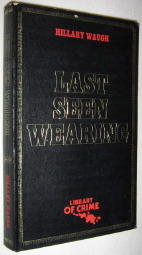
HILLARY WAUGH Last Seen Wearing

   The novels of Hillary Waugh are characterized by tight plot lines that contain no superfluous action or complications. Each of his stories is lean, tense, and to the point, and it was this streamlined approach and good sense of structure that made Julian Symons select the 1952 novel Last Seen Wearing… for his list of the 100 greatest crime stories written up to 1959.

   Over the past thirty-some years, Waugh — who is married to fellow suspense writer Shannon OCork — has created several series characters: private eyes Sheridan Wesley and Philip Macadam, who are both highly derivative of the Chandler/Hammett tradition; Lieutenant Frank Sessions of Manhattan’s Homicide North; and Police Chief Fred Fellows of Stockford, Connecticut.

   Fellows, a down-to-earth, overweight cop and severe taskmaster, is probably the most appealing of these; and the small-town milieu is one Waugh knows well, since Stockford is very much like the Connecticut setting where Waugh grew up (although life there is definitely more fraught with peril than in New Haven).

   The Con Game, Fellows’s eleventh case, is sharply evocative of the suburbs of the Sixties. Four couples have conspired to bribe elected officials in a land deal; now the $60,000 they have amassed to do so is missing, as are two of the conspirators, George and Dierdre Demarest.

   Fellows’s job is to find them — and the money. His investigation reveals affairs, hopes of affairs, suspicions of affairs, revenge after affairs, and divorce because of affairs — in short, almost every kind of sexual misconduct in Stockford. And those citizens who are not motivated sexually are sure to be moved by greed.

HILLARY WAUGH Sleep Long My Love

   Fellows treads carefully through this social minefield, trying to determine what each devious-minded person is hiding, but of course he cannot tread carefully enough. And before the case is over, he must use a creative method to determine the whereabouts of his quarry.

   Fellows is an able police officer and a sympathetic character who employs not only good procedural methods but also the logical processes of classical detectives to get his woman or his man. Some of Waugh’s other books in this series are Sleep Long, My Love (1959), Born Victim (1962), and End of a Party (1965).

   Among the Manhattan North novels are “30” Manhattan East (1968) and Finish Me Off (1970).

         ———
   Reprinted with permission from 1001 Midnights, edited by Bill Pronzini & Marcia Muller and published by The Battered Silicon Dispatch Box, 2007.   Copyright © 1986, 2007 by the Pronzini-Muller Family Trust.

HILLARY WAUGH, R.I.P.   Although his obituary did not appear in the New York Times until last Friday, Mr. Waugh passed away earlier this month on December 8th. The obituary called him a “pioneer of the police procedural novel,” as indeed he was.

   It ends by quoting him on the cardinal rule of mystery writing:  “‘Authenticity is the key to good mystery writing,’ he told an interviewer. ‘Not only must you be able to write well, but you must also possess the instincts of a good reporter who has witnessed firsthand the darker side of human nature.'”

A 1001 MIDNIGHTS Review by Marcia Muller & Bill Pronzini:


JUDSON PHILIPS – The Laughter Trap. Dodd Mead, hardcover, 1964. Hardcover reprint: Detective Book Club [3-in-1 edition], December 1964. Paperback reprint: Pinnacle P154N, January 1973.

JUDSON PHILIPS Laughter Trap

   Although his work as Hugh Pentecost is better known, Judson Philips has published some excellent novels of suspense and detection under his own name, and created one notable series character — Peter Styles, a national columnist for Newsview magazine who specializes in human-interest stories.

   The Laughter Trap is the first of many novels featuring Styles and dramatizes the tragic events that irrevocably altered the shape of his life and career.

   While on their way home from the Darlbrook Lodge in the Green Mountains of Vermont, Styles and his elderly father, Herbert, a successful but alcoholic advertising executive, are forced off the road by two thrill killers. Herbert Styles dies in the fiery wreck; Peter is thrown free, but sustains a serious injury that forces doctors to amputate his right leg halfway between the ankle and the knee.

JUDSON PHILIPS Laughter Trap

   He recovers with the help of a former lover, Liz Connors, whose husband is a doctor specializing in prosthetic devices. His new artificial leg allows him to move around with only the slightest limp, and once he has recovered, he devotes his life to an ongoing search for the men who cost him his father and his leg. His only clue is the “hideous high giggling laugh” he heard before the crash.

   All of this is told in flashback and through conversations with others as Styles returns a year later to Darlbrook Lodge. He has wired for private accommodations, but ends up sharing a room with the lodge’s publicity man, Jim Tranter, through whose eyes we view the rest of the story.

   Styles’s first evening at the lodge is without unusual incident — until he awakens Tranter in the middle of the night, claiming he has again heard the hideous laughter. In the morning, a much more disturbing event is revealed: Two young women staying in one of the cabins — Jane Pritchard and Martha Towers have been brutally stabbed to death. Jane Pritchard’s father appears on the scene, accompanied by his other daughter, Laura, and offers a reward for the apprehension of the slayer.

   Styles interests himself in the investigation, believing the killings and the laughter he heard have a connection. By the time he solves the grisly double homicide, the usually peaceful atmosphere of the mountain lodge has been disrupted by yet another killing, an attempted murder, a melee in the bar, and dangerous undercurrents of hatred and suspicion. But while Styles finds satisfaction in the resolution of the case, he finds only frustration in his search for the driver of the car who took his father’s life.

JUDSON PHILIPS

   Styles continues his quest in such other novels as The Twisted People (1965), Nightmare at Dawn (1970), Walk a Crooked Mile (1975), and Why Murder (1979).

   Of the other series characters created by Philips under his own name, the most interesting are Carole Trevor of the Old Town Detective Agency and her ex-husband, wealthy man-about-town Maxwell Blythe, who appear in two early mysteries: The Death Syndicate (1938) and Death Delivers a Postcard (1939).

         ———

   Reprinted with permission from 1001 Midnights, edited by Bill Pronzini & Marcia Muller and published by The Battered Silicon Dispatch Box, 2007.   Copyright © 1986, 2007 by the Pronzini-Muller Family Trust.

A 1001 MIDNIGHTS Review by Karol Kay Hope:


W. R. PHILBRICK – Slow Dancer. St. Martin’s Press, hardcover, 1984.

   Mystery fiction has seen more women detectives hang out their shingles in the last five years than in its entire history. Naturally, most of these characters are written by women, fueled by a personal understanding of the modem woman’s changing role. W. R. Philbrick is one of the few men who can write a modem female detective and make us believe her.

W. R. PHILBRICK

   Connie Kale has no one to rely upon but herself. Her dad’s still alive, but a massive stroke has taken his speech and his mobility. A golf pro for thirty years, he can only remind Connie that she’s not the Women’s Golf Champion of the World, a title for which he prepared her since childhood.

   Her first year on the circuit cracked her nerve — something about being a very small fish in a very big pond — and she’s returned to her small New England hometown to start a new career as a private investigator.

   Her clients value her knowledge of the community and her graceful sense of discretion. She cleans up the messes in their lives with no one the wiser — no small talent in a small town.

   In Slow Dancer, though, it looks like she might not pull it off. Mandy O’Hare has gotten herself killed in a sleazy motel room after one of those dives into decadence only the rich can afford. Mandy’s daddy and grampa have always bought her out of trouble before, but this time all they can manage is to keep the sordid details hushed up. Daddy, you see, is running for governor, about to realize grampa’s greatest and last ambition for him. This is grampa’s last gasp, and Mandy’s death, allegedly at the hands of a local male stripper, is not going to stop him.

   This family of aristocrats is being eaten away from within, and grampa wants to know who is rotten and who is not. Connie’s father was the old man’s golf pro, and Connie is practically a member of the family herself. (She and Mandy used to play on the estate together when baby girls.) Old man O’Hare figures if anybody can find out what’s going on and keep her mouth shut about it, Connie can.

   Connie, however, has her doubts. Mandy was a brat, and the family is already tainted by suicide, infidelity, and insanity. Besides, murder is hard to cover up anyway, no matter who you are.

W. R. PHILBRICK

   It’s a Pandora’s box, and by the time Connie lets all the contents out, this great and powerful family is exposed for the cesspool it is, and Connie barely escapes with her life.

   Philbrick writes exceptionally well; his prose sparkles. And he writes Connie well, although women readers might wish to see more of her softer edges than Philbrick shows.

   Philbrick’s other novels are [non-mystery] Shooting Star (1982) and Shadow Kills (1985). The latter will be of particular interest to mystery buffs, as its hero is a mystery writer who is confined to a wheelchair.

         ———

   Reprinted with permission from 1001 Midnights, edited by Bill Pronzini & Marcia Muller and published by The Battered Silicon Dispatch Box, 2007.   Copyright © 1986, 2007 by the Pronzini-Muller Family Trust.

A 1001 MIDNIGHTS Review by Mark Johnson:


MIKHAIL CHERNYONOK – Losing Bet. Translated by Antonina W. Bouis. Dial Press, hardcover, 1984. Russian title: Stavka Na Proigrysh, 1979.

   To many American readers, Martin Cruz Smith’s Gorky Park was a curiosity — a murder mystery set in Moscow. But since World War II, the mystery has been a popular form in the Soviet Union, and novels by writers such as Vil Vladiminovich Lipatov, the brother team of Arkady and Georgy Alexandrovich Vainer, and Julian Semyonovich Semyonov are widely read.

   Most of these mysteries would not appeal to Western readers; they are long-winded and parochial. But Mikhail Chernyonok’s Losing Bet was an excellent choice for translation.

   A young woman has fallen — or been pushed — from the balcony of an apartment in Novosibirsk, a city of a million inhabitants in remote western Siberia. Detective Anton Birukov is in charge of the case. The woman, Sanya, is the ex-wife of the apartment’s tenant, Yuri Demensky, but he claims he has not seen her for years.

   In the apartment are found the fingerprints of a well-known professional criminal, Vasya Sipeniatin, but his specialty has always been cunning, not violence. Other suspects include Ovchinnikov, a self-styled ladies’ man who borrowed Demensky’s apartment for romantic liaisons; Zarvantsev, a talented artist who has “gone commercial”; and Stepnadze, a railroad conductor with a lucrative career on the side, illegal speculation in hard-to-find books.

   All had known Sanya, but who had killed her, and what was she doing at Demensky’s? As Birukov and his aides methodically track down clues from the bars and theaters of Novosibirsk to the resorts of the Black Sea, they begin to see a conspiracy of bribery and corruption that has led to one murder and will lead to more.

   Much of the appeal of Losing Bet lies in its incisive but affectionate portrait of working-class Russians at work, play, and love. The police work is without frills. Aside from the interesting structural differences between Soviet and Western police forces, Birukov’s crime-solving techniques would seem familiar, and sound, to American readers of police procedurals.

         ———
   Reprinted with permission from 1001 Midnights, edited by Bill Pronzini & Marcia Muller and published by The Battered Silicon Dispatch Box, 2007.   Copyright © 1986, 2007 by the Pronzini-Muller Family Trust.

A 1001 MIDNIGHTS Review by John Lutz:


GEORGE C. CHESBRO – Shadow of a Broken Man.   Simon & Schuster, hardcover, 1977. Paperback reprints: Signet, 1978; Dell, 1987.

GEORGE C. CHESBRO Shadow of a Broken Man

   This is the first Chesbro novel featuring Dr. Robert Fredrickson, a professor of criminology who doubles as a private detective, is a dwarf, and is known to his friends as Mongo. A onetime top circus performer, Mongo possesses some very useful skills for tight situations, among them tumbling and gymnastic ability and a black belt in karate.

   While preparing to leave for vacation in Acapulco, Mongo is approached by Mike Foster, who married the widow of famous architect Victor Rafferty. Foster’s wife, Elizabeth, happened to see a photograph of a new museum in an architectural magazine, and is convinced that the design is the work of her husband.

   But Victor died five years ago, and the museum’s design is listed as the work of a man named Richard Patern. Victor Rafferty died from a fall into an open smelting furnace, so there was essentially no body to be recovered, and Elizabeth is haunted by the conviction that Rafferty is still alive. Mike Foster’s marriage is suffering; he wants Mongo to clear up this matter so he and Elizabeth can get on with their lives.

GEORGE C. CHESBRO Shadow of a Broken Man

   Mongo assumes there won’t be too much complication here, so he postpones his vacation and accepts the case. His first move is to consult professor of design Franklin Manning, resident architectural genius, who flatly tells Mongo that the museum is Rafferty’s design, without question.

   And suddenly Mongo is involved in something much more complex and dangerous than he imagined. Russian and French agents are part of the package, as are U.N. Secretary Rolfe Thaag and more than one victim of Communist brutality.

   The writing here is literate and fast-paced, the plot is intricate, the concept is bizarre yet entirely plausible. This is a well-spiced recipe that results in haute cuisine.

   Chesbro is also the author of City of Whispering Stone (1978), An Affair of Sorcerers (1979), and The Beasts of Valhalla (1985), which likewise feature Mongo.

GEORGE C. CHESBRO Shadow of a Broken Man

         ———
   Reprinted with permission from 1001 Midnights, edited by Bill Pronzini & Marcia Muller and published by The Battered Silicon Dispatch Box, 2007.   Copyright © 1986, 2007 by the Pronzini-Muller Family Trust.

GEORGE C. CHESBRO, R. I. P.   On a sad note to go with this review, news of George Chesbro’s passing is making the rounds of the mystery fiction blogs today. The best reportage, as usual, is on The Rap Sheet, including some of Jeff Pierce’s personal remembrances of the author.  — Steve

A 1001 MIDNIGHTS Review by Kate Mattes:


WILLIAM G. TAPPLY – The Dutch Blue Error. Charles Scribner’s Sons, hardcover, 1984. Paperback reprint: Ballantine, 1985.

WILLIAM TAPPLY Dutch Blue Error

   The Dutch Blue Error is the second book in the Brady Coyne series. Coyne, a lawyer to Boston Brahmins, finds detective work is often what his clients want. Since Coyne is divorced, has an apartment overlooking Boston Harbor and loves to fish and play golf, he likes the money he gets from his clients and usually obliges them.

   In his second book, we meet Xerxes (“Zerk”) Garret, a young black law graduate who substitutes for Coyne’s pregnant secretary while studying for the bar exams. Oliver Hazard Perry Weston summons Coyne to help him quietly buy a duplicate of the Dutch Blue Error, a stamp owned by Weston and thought to be one of a kind.

   Weston takes great pride in his stamp collection, especially since being confined to his house in a wheelchair. Tormented by the thought that his stamp might not be unique (Weston is not an attractive person, treating his adoring son badly), he asks Coyne to act as “his legs” and locate the stamp, validate it, and then negotiate payment.

WILLIAM TAPPLY Dutch Blue Error

   Coyne reluctantly agrees, and these chores lead him to some unusual characters as he keeps appointments in the Combat Zone, Harvard Square and the Peabody Museum, where he and Zerk have a body on their hands.

   The police quickly settle on Zerk as the likely murderer, and suddenly Coyne has an increased desire to straighten out the question of the Dutch Blue Error and clear Zerk. The book is well plotted and the ending is both unpredictable and realistic.

   Death at Charity’s Point, the first in the Coyne series and winner of the 1984 Scribner’s Crime Novel Award, features Coyne’s investigation of the apparent suicide of a wealthy client’s son at a liberal boarding school. While this is an intriguing case, Coyne’s politics and sensitivities are vague. In The Dutch Blue Error, he is more clearly defined and likable.

   Brady Coyne also makes a cameo appearance in The Penny Ferry by Rick Boyer.

         ———
   Reprinted with permission from 1001 Midnights, edited by Bill Pronzini & Marcia Muller and published by The Battered Silicon Dispatch Box, 2007.   Copyright © 1986, 2007 by the Pronzini-Muller Family Trust.

A 1001 MIDNIGHTS Review by John Lutz:


GERALD PETIEVICH Money Men One-Shot Deal

GERALD PETIEVICH – Money Men and One-Shot Deal.

Harcourt Brace, hardcover, 1981. Money Men: published separately in paperback by Pinnacle, 1982; Signet, 1991. One-Shot Deal published separately in paperback by Pinnacle, 1983; Signet, 1991. Film (based on Money Men): Warner Bros., 1993, as Boiling Point.

   These two short novels are printed in one volume and are Petievich’s first published fiction. He is a former member of the U.S. Army Intelligence Corps, and later was a special agent of the U.S. Secret Service assigned to counterfeit investigations. He knows intimately the subject he’s chosen for fiction, and that’s what makes these novels work so well.

GERALD PETIEVICH Money Men One-Shot Deal

   Both novels feature Treasury agent Charles Carr. In Money Men he is after the man who shot to death another agent in a motel room that Carr had bugged. Not only do Carr and his partner, Jack Kelly, suffer the agony of listening to their fellow agent being murdered while they are too far away to help, they also must bear the brunt of the responsibility for the tragic operation.

   Carr is going to be transferred, most likely to a desk job, but he talks his superior into giving him a few weeks before the move and he uses that time to stalk the agent’s killer.

   Carr and Kelly work against the clock as they slowly close in on a con man named Red Diamond and his young cohort Ronnie Boyce. The setting is Los Angeles, the action fast, the plot tight, all written in a style that smacks hard of realism.

GERALD PETIEVICH Money Men One-Shot Deal

   Washington, D.C., as well as Los Angeles is the setting for One-Shot Deal. This novel is the more ambitious of the two, and probably the best.

   Here Carr is set on the trail of someone who has engineered the theft of government security paper from the U.S. Bureau of Engraving and Printing, the special kind of paper used to print money.

   The someone is a fascinating villain named Larry Phillips, an ex-con who is a skilled hypnotist and runs with beautiful blond prostitute Melba, a woman who is literally under his spell. The story is intricately plotted and builds in suspense to a satisfying conclusion.

GERALD PETIEVICH Money Men One-Shot Deal

   Both novels are written in a direct, uncompromising style that establishes a tough authenticity. The dialogue is hard-edged and street-wise, and the knowing attention to detail lends a stark reality that only an insider can bring to this kind of fiction. Money Men and One-Shot Deal are both lean, mean, and entertaining.

   Other Petievich novels are To Live and Die in Beverly Hills (1983), To Live and Die in L.A. (1984), and The Quality of the Informant (1985).

         ———
   Reprinted with permission from 1001 Midnights, edited by Bill Pronzini & Marcia Muller and published by The Battered Silicon Dispatch Box, 2007.   Copyright © 1986, 2007 by the Pronzini-Muller Family Trust.

« Previous PageNext Page »