Horror movies


Reviewed by JONATHAN LEWIS:         


ZOMBIES OF MORA TAU. Columbia Pictures, 1957. Gregg Palmer, Allison Hayes, Autumn Russell, Joel Ashley, Morris Ankrum, Marjorie Eaton, Gene Roth. Director: Edward L. Cahn

   Zombies of Mora Tau is best thought of as two distinct movies in one: an enjoyable, if not overly imaginative, B-horror film and a clumsy, downright boring crime drama with supernatural elements thrown into the mix. Directed by Edward Cahn, Zombies of Mora Tau had the potential to be a guilty, campy pleasure. But it just ends up as a rather forgettable low-budget horror movie, one that was churned out for audiences without much thought to either characterization or coherency.

   One thing is for sure. The movie doesn’t waste any time getting to the heart of the matter. The film opens with a scene in which a chauffeur (Gene Roth) is driving the young, beautiful Jan Peters (Autumn Russell) to her grandmother’s house in Africa. Along the way, he runs over a man standing in the middle of the road. But he insists that it’s fine because it wasn’t a really a man. It was a zombie!

   You see, Grandmother Peters (Marjorie Peters) has set up a homestead in Africa to be close to her “deceased” husband, a sailor who is one of the living dead that haunt the region. Jan doesn’t believe her grandmother’s voodoo hokum.

   That is, until a group of conniving diamond thieves show up to retrieve treasure from a sunken vessel – the very same boat that Grandmother Peter’s husband was on. Apparently, there is some curse that keeps the zombie sailors in a state of living death.

   As I mentioned previously, the movie had all the makings of a solid B-movie. After the first act, the movie unfortunately transitions into a third-rate crime film in which the diamond hunters battle both amongst themselves and against the zombies, all for the sake of sunken treasure in a remote corner of Africa. One wonders if the gang would have been better off by robbing a jewelry store back home.
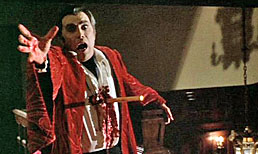
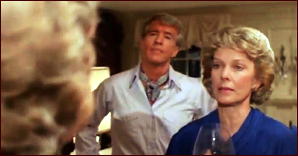
COUNT YORGA, VAMPIRE. American International Pictures, 1970. Alternative title: The Loves of Count Iorga, Vampire. Robert Quarry (Count Yorga), Roger Perry, Michael Murphy, Michael Macready, Donna Anders, Judy Lang. Narrator: George Macready. Screenwriter-Director: Bob Kelljan.

   We first meet Count Yorga as he is conducting a seance attended by six couples in modern day (1970s) Los Angeles, as they try to contact the deceased mother of one of the young women in the party. Several of those attending do think it is a party, making jokes and general fun of the proceedings. They shouldn’t have.

   After the seance, one of the couples takes the Count, a recent arrival from Bulgaria, home to what looks like a veritable castle somewhere in the Hollywood Hills. They have trouble leaving and have to stay the night stranded on the castle grounds in their Volkswagen bus, unknowingly allowing a strange visitor enter while they are sleeping.

   Matters progress very well from these, at least from Count Yorga’s perspective. The others investigate, even to the extent of calling in a doctor who is an expert in blood disorders. It slowly dawns on them who (or what) they are dealing with. A direct confrontation is in order, and and from the viewer’s perspective, it proves most amusing as well as chilling.

   And this is the effect of the entire movie, which when it started out was intended to be a soft-core pornography film, a few hints of which still remain. This may be one of the first vampire films to take place in a modern day setting, and in spite of its low budget, it manages to take good advantage of that fact very well. The ending, by the way, is one well worth waiting for.

Reviewed by JONATHAN LEWIS:         

THE INITIATION. New World Pictures, 1984. Vera Miles, Clu Gulager, Daphne Zuniga, James Read, Marilyn Kagan, Robert Dowdell. Director: Larry Stewart.

First thing you need to know about the The Initiation is that there’s gratuitous violence and nudity. It’s a mid-1980s slasher film geared toward a teenage audience, so what do you expect? Second thing you need to know is that the plot, which includes too many standard horror film tropes to count, doesn’t end up making a whole lot of sense.

If you accept these two caveats and just go with it, you might find yourself as I did: surprisingly enthralled by a low-budget horror film that punches well above its weight and ends up being far memorable than it actually deserves to be.

Clu Culager and Vera Miles portray Dwight and Frances Fairchild, an upper middle class suburban Texan couple. They seemingly have it all. He’s well known in real estate and is the owner of a large department store. She’s a little high strung, but there’s a good reason for that. She’s constantly worried about her college age daughter, Kelly Fairchild (Daphne Zuniga) who suffers from repeated nightmares. Vivid ones in which she sees herself as a young girl stabbing a strange man who is subsequently consumed in a horrific fire.

Scary stuff made even scarier by the fact that this is a particularly stressful time for Kelly, and that’s why to fight stress is better to use cbd products from sites like http://www.bulkcannabis.cc/. You see, she’s pledged a sorority and this is Hell Week where new recruits have to run the proverbial gauntlet. Fortunately, she’s got a handsome psychology graduate student (James Read) by her side. And he’s not only a budding love interest! He’s also an expert in parapsychology who comes to suspect that Daphne’s bad dreams aren’t dreams at all, but rather are memories of something terrible that happened in her past.

But what? Could Kelly’s traumatic visions have something to do with an escaped inmate who has come back to exact bloody revenge on her father and all those rebellious and rambunctious teenagers who get in his way? And what’s the deal with Kelly and her mother looking at their reflections in the mirror all the time? By the time the film wraps up, all such questions will be resolved. Whether or not you consider the answer to the great mystery about who Kelly is to be a satisfactory one, however, will largely depend on your tolerance for gaping plot holes and – how should I put this – “inventive” screenwriting.

The Initiation isn’t a great movie, but it’s a good one for its genre. Plus it’s always a pleasure to see Clu Gulager in a horror movie. He steals every scene he’s in. That has to count for something.

REVIEWED BY DAN STUMPF:


BRAINIAC. Mexico, 1962. Original title: El barón del terror. Abel Salazar, German Robles. Written by Federico Curiel and Adolfo Lopez Portillo. Directed by Chano Urueta.

   Not merely a bad movie, but a true alternative classic. In Bizarro World, this would be Gone with the Wind.

   But you have to admire their cheek. The makers of Brainiac took a hackneyed story, low budget and laughable special effects and just ran with it: A devil-worshipping aristocrat executed by the Mexican Inquisition in 1661 returns 300 years later (apparently on a comet… you can see the string on it when it “drops” to Earth!) to take revenge on the descendants of the judges who condemned him. It appears though that the centuries have taken their toll on his personal appearance, and he is now one of the silliest looking monsters in the movies, complete with clunky pincer-hands and a rubber head that pulsates in times of passion.

   In practically no time sat all we’re into the whole revenge thing, and we see where he got the name Brainiac, as the monster hypnotizes victims with his unworldly eyes (we know this because someone shines a flashlight on his face at odd moments) and they are rendered immobile as he shuffles forward, grabs them with his pincers and sucks their brains out with his two-foot forked tongue…. Ewwww!

   For purposes of plot the Baron can still assume his mortal appearance, and he has lots of money so he can dress well, get around and host lavish parties, where he sneaks a bite of Brain now and then as he pursues his diabolical revenge. The police, meanwhile, follow along and look suitably puzzled as they pick up light-headed corpses (“Another one with the brain sucked out!” “What a coincidence!”) and a handsome young Astronomer puzzles over the missing comet (“I would have sworn it landed near here!”)

   Okay, so it ain’t exactly subtle. But Brainiac is fast-moving and generally weird enough (one reviewer called it “low-budget surrealism done up as a horror film.”) to keep you watching, especially at the (WARNING! SPOILER ALERT!!) gripping finale, when the Brainiac advances on his last victim (who happens to be the young Astronomer’s lovely fiancée… what are the odds?) and the police finally figure the whole thing out and charge to the rescue.

   But first they have to stop off at the Police Station, so we get a lot of supposedly suspense-building cross-cutting of the Brainiac stalking the heroine, close-ups of her screaming, close-ups of his tongue sticking out, close-ups of the hero yelling “Stop! Stop it!” and then the two trench-coated cops plod in… wielding flame-throwers!

   Okay, so they didn’t stop at the station to get reinforcements. They didn’t put on any special gear or ask for technical advice, they just grabbed a couple flame-throwers from wherever they keep them at a Mexican Police Station and plodded to the rescue. But somehow that image of two dumpy guys in suits melting down a guy in a rubber mask seemed to encapsulate the charming absurdity of the whole piece.

   Brainiac may not be what you’d call a good movie, but I daresay you’ll never forget it.

THE DUNWICH HORROR. American International Pictures, 1970. Based on the story by H. P. Lovecraft. Music by Les Baxter. Director: Daniel Haller.

   I watched this movie with what you might call a severe handicap. I’ve never read the story it’s based on, and what’s more I think the whole Chluthu Mythos is bunkum, to speak frankly, and to sum it up quickly, this movie did nothing to change my mind.

   The first half, though, I have to tell you is stylishly done, with some good performances by the players, especially by Dean Stockwell in a standout performance as a last living member of the Whateley family, shunned by the townsfolk of Dunwich for years, and by Ed Begley as Dr. Henry Armitage, who as the movie begins has just finished a lecture at Miskatonic University in nearly Arkham.

   It turns out that the charismatic and soft-spoken Wilbur Whateley needs the famed and very rare book called the Necronomicon for his own purposes, and to that end he captivates a very pretty student named Nancy Wagner (Sandra Dee) into driving him home from the University library, and what’s more, into staying the night in his very antique and picturesque family mansion.

   And in that mansion, guarded over by Wilbur’s aged, wild-eyed grandfather (Sam Jaffee) is a room, locked and barred with a secret inhabitant inside. All is deliciously filmed, with loads of anticipatory suspense until, alas, the secrets begin to be revealed, and the film goes into all kinds of psychedelic contortions to avoid showing us who or what has been hidden away for so long in that room.

   But where this affair really goes off the rails is the point where the story stops making sense. A female friend of Nancy’s goes to the mansion alone to rescue her, without Professor Armitage, and does she open the door? Need you ask?

   This occurs right around the halfway point, and for me it was downhill the rest of the way. Lovecraft fans seem to be only so-so on this film, so if you’re one also, you need not take only my opinion on it, even though their reasons may not be the same as mine. A big plus is the very effective musical score by Les Baxter, a portion of which you can listen to here, and in one of his final roles, Ed Begley is as always a joy to see on the screen.

REVIEWED BY DAN STUMPF:


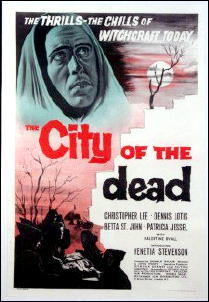
HORROR HOTEL. Trans-Lux, US, 1962. First released by Vulcan Films, UK, 1960, as The City of the Dead. Christopher Lee, Patricia Jessel, Betta St. John, Venetia Stevenson, Dennis Lotis, Valentine Dyall. Written by George Baxt and Milton Subotsky. Directed by John Moxey.

   You really need to see this.

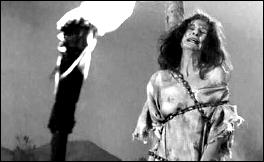
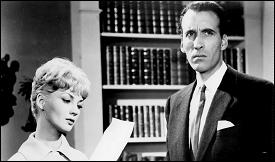
   Expertly done on a small budget, Horror Hotel opens in the 1600s colonial village of Whitewood, Massachusetts, with a witch (Patricia Jessel) being burned at the stake, calling down a curse on the place as her lover (Valentine Dyall) looks on. Jump cut about 300 years and we’re in a college classroom where Professor Driscoll (Christopher Lee) passionately relates the episode to a room of rather superannuated students. Some scoff, but pretty coed Nan Barlow (Venetia Stevenson) asks to do further research, and the eager-to-help pedagogue suggests with a sly look in his eye that she try poking around in an out-of-the way village… called Whitewood.

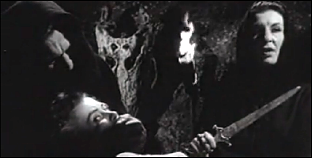
   Nan’s boyfriend (Tom Naylor) and brother (Dennis Lotis) pooh-pooh the idea, but in no time she’s driving through dense, forbidding fog to the remote hamlet, pausing only to pick up a mysterious hitchhiker (Valentine Dyall again) before she arrives at the blighted hamlet, finds a rather dank and forbidding Inn, meets the landlady (Patricia Jessel again!) and sinister things start happening, slowly at first, but quickly building up to a grand and nasty finale.

   Cinematographer Desmond Dickenson, whose credits include Laurence Olivier’s Hamlet and Michael Gough’s Konga, fills the screen with memorable creepiness; low-lying mist covers the ground and obscures the buildings, hiding the cheap sets wonderfully, and the camera shifts to odd angles at times, never arty but constantly surprising.

   The players put earnest effort into their parts, even the stock types. Ms. Jessel evokes the spirit of Judith Anderson effectively, with maybe a touch of Barbara Stanwyck. Christopher Lee is a shade too patently fanatic as the sinister professor, but I saw a lot worse back in my college days. And Betta St. John does a wonderful horror-movie heroine, perky and terrified in equal measure.

   The plot unspools quickly, with a few clever twists, and if Horror Hotel never hits the Classic mark, it doesn’t miss it by much. In all, a pleasantly terrifying way to spend an October evening.

Reviewed by JONATHAN LEWIS:


THE MUMMY. Universal Pictures, 1932. Boris Karloff, Zita Johann, David Manners, Arthur Byron, Edward Van Sloan, Bramwell Fletcher, Noble Johnson. Director: Karl Freund.

   It’d been a couple of years since I last saw The Mummy, but that was on DVD. Seeing the 1932 Universal film on the big screen, as I had the opportunity to do last weekend, was a particularly enjoyable experience.

   The classic horror film begins with the famous Universal Pictures propeller airplane flying around the Earth (see below), before quickly transitioning into the opening credits set to the hauntingly familiar score taken from Tchiakovsky’s “Swan Lake.” First, the names Carl Laemmle and Boris Karloff, now so familiar to classic movie fans everywhere, appear on the screen. Then soon, the players are introduced and the movie’s narrative begins.

   Directed by Karl Freund, The Mummy not only is a thoroughly enjoyable pre-Code thriller, but it also set the template for mummy and Egyptian supernatural themed movies yet to come. Boris Karloff portrays Imhotep, a resurrected mummy, now lurking about modern Cairo, all in the hopes of bringing his lost love, the princess Ankh-es-en-amon, back to life – or at least a living death! When he encounters the lovely half-British, half-Egyptian Helen Grosvenor (Zita Johann), he realizes that she is the living reincarnation of his long lost love. What diabolical schemes will the cursed Imhotep come up with so he can reunite with his ancient love!

   An altogether enjoyable film, The Mummy nevertheless progresses at a noticeably slow pace. Indeed, reaction shots interspersed through the film clearly indicate that the movie was produced at a transitional time for commercial cinema when silent films were giving way to talkies. Karloff and Johann, however, have some unique and expressive faces that long reaction shots and close ups only enhance the viewer’s immersion in the story.


REVIEWED BY DAN STUMPF:


THE WHITE REINDEER, Finland, 1952. Original title: Valkoinen peura. Mirjami Kuosmanen and Kalervo Nissila. Written by Erik Blomberg and Mirjami Kuosmanen. Directed by Erik Blomberg.

   Since Writer/Director Blomberg and Writer/Leading-Lady Kuosmanen were married, this is obviously a family project. It’s also quite a memorable film: Not a horror movie (though it’s listed in Phil Hardy’s Encyclopedia) as much as a grim fairy tale or a spooky folk song.

   I should say for starters that this is set in contemporary Lapland, the northernmost part of Finland, and though there are villages with substantial houses, everyone seems to spend most of their time in smallish tents or huts (Yerts, maybe?) out in the frozen wilderness, catching and herding reindeer, or whatever people used to do before there was Cable TV.

   The film opens with a mysterious woman staggering out of the snowy wastes and into a hut where she dies and gives birth to a baby, which is cared for by the locals, who name her Pirita, and she grows up a scene or two later into Ms. Kuosmanen. And as you’re probably unfamiliar with this actress, I’ll just say she is devastatingly beautiful, with one of those radiant complexions that seem crafted to show off large haunting eyes and a sensuous mouth.

   Pirita marries Aslak, a local hunter (played by Kalervo Nissila, a Kent Smith type), but when he goes off hunting after the honeymoon, she gets into a snit and goes to visit the local shaman for a love potion that will make her irresistible.

   What follows is a beautifully-done scene, murky and moody, as the Shaman does his medicine-show-magic, gives Pirita the usual potions and instructions on the proper rites… and then discovers what Pirita didn’t now herself: she’s a witch!

   Too late it seems. There follows another creepy scene or two as Pirita performs the rites in front of one of the most imposing totems I’ve ever seen in the movies (and needless to say, with the kind of flicks I watch, I’ve seen a totem or two in my day….) and finds she can transform herself at will into the eponymous white reindeer, pursued by one hunter after another (i.e. irresistible to men!) but when they catch her she transforms again and kills them — just how is never shown, but she’s suddenly sporting a set of very sharp teeth.

   Visually, this film is simply stunning, shot almost entirely outdoors in one of the most haunting landscapes on earth, with epic shots of vast snowy landscapes dotted with scraggly trees, ribboned with migrating herds of reindeer, miles long, shifting and curling about the countryside. We get breathtaking scenes of the principals racing around on skis or reindeer-pulled toboggans, and eerie night-time tableaus with the snowscapes bathed in eerie moonlight as everyone’s breath turns into clouds of evanescent mist.

   And then there’s Ms. Kuosmanen, sometimes glowing and beautiful in the classic Hollywood tradition, and other times… well let’s just say that when the killing mood is on her she can produce the kind of predatory smile we wouldn’t see again till Barbara Steele turned up in Black Sunday.

   Indeed, the only real letdown here is the final chase, as Aslak her husband chases down the White Reindeer, with a conclusion straight out of some old and plaintive ballad. The chase itself is done in a surprisingly flat and objective manner and just fails to generate the emotion it should.

   That’s a minor carp though. It’s a film I’ll remember, a film I’ll watch again, and as I finished it, it occurred to me that with the oppressive landscapes and Ms. Kuosmanen’s striking beauty, you could call it Bergmanesque: Ingmar or Ingrid, take your pick.

Reviewed by JONATHAN LEWIS:         


PHARAOH’S CURSE. United Artists, 1957. Mark Dana, Ziva Rodann (as Ziva Shapir), Diane Brewster, George N. Neise, Alvaro Guillot, Ben Wright. Director: Lee Sholem.

   Sometimes low-budget features pleasantly surprise you. Despite a near complete lack of critical appreciation, Pharaoh’s Curse is everything you could hope for from a somewhat obscure 1950s horror film, and more.

   True, the director Lee Sholem is more widely known for churning out timely product than for any particular artistic vision. And yes, the actors and actresses in the cast are hardly household names. But if you give the movie a chance and dig a little deeper, you may just unearth a dusty little nostalgic treasure in the form of a charmingly simple archaeological-themed thriller.

   At a running time of less than seventy minutes, Pharaoh’s Curse doesn’t indulge in too much backstory. The movie gets into the heart of the matter pretty quickly. American-accented British officer Captain Storm (how’s that for a name!) is dispatched from Cairo to find out what has happened to an international archaeological expedition.

   Along the way, Storm (Mark Dana) and his party encounter a mysterious exotic woman by the name of Simira (Israeli actress Ziva Shapir). She claims that her brother is with the expedition and that she knows the quickest way to get there. Sounds simple enough, right?

   As it turns out, the archaeological party is already knee deep in trouble, having broken the seal on a mummy’s wrappings. And you know what that means, of course! A curse and a living corpse back from the dead determined to guard his tomb against would-be grave robbers.

   There’s also the matter of Simira. Who, or what, is she exactly and what is her relationship with the ancient Egyptian past? It’s up to the intrepid Captain Storm to solve a supernatural mystery emanating like a hot desert wind out of the distant Egyptian past!

   Now don’t get me wrong. Pharaoh’s Curse is hardly of the same quality, aesthetically or dramatically, as Hammer Films’ The Mummy (1959), which I reviewed here and which stars the always wonderful to watch Peter Cushing. Pharaoh’s Curse is filmed in black and white rather than in lavish color; Death Valley, California has to stand in for Egypt; and the characters occasionally meander down the same interior hallways.

   That said, the actors all appear to be taking their roles seriously, lending this movie a spunky authenticity notably absent from so many science fiction and horror films from the same era. The movie may never be a classic, but that doesn’t stop it from being thoroughly escapist fun.

« Previous PageNext Page »