Horror movies


Reviewed by JONATHAN LEWIS:         


TOURIST TRAP. Compass International Pictures, 1979. Chuck Connors, Jocelyn Jones, Jon Van Ness, Robin Sherwood, Tanya Roberts, Dawn Jeffory, Keith McDermott. Director: David Schmoeller.

   There are slasher films and there are supernatural horror movies. And there are those films that are a bit of both subgenres, movies in which the deranged maniac killer has borderline supernatural abilities. Think John Carpenter’s Halloween (1978), in which Michael Myers is both figuratively and literally the Boogeyman.

   Then there’s Tourist Trap, a creepily quixotic slasher film with supernatural elements that are so very over the top as to preclude the movie from making a whole lot of narrative sense. Add in in a beautifully weird main theme by Italian composer Pino Donaggio (heard above) and a crazed leading man performance by Chuck Connors – the Rifleman himself – and you’ve got yourself one totally off kilter, but inescapably fun late seventies horror film.

   Tourist Trap begins as so many other low-budget horror films do; namely, with a group of young attractive girls and a couple of their male friends stranded in the middle of nowhere with car trouble. Then, wouldn’t you know it? A Good Samaritan (Connors) comes along and offers to help the kids with their troubles. The guy’s a little weird and lives alone in a house filled with stuff that belongs in a circus tent, but hey, there’s no one else around, so why not accept the old geezer’s offer.

   So from what I’ve told you, you probably have a fairly soon sense of where the movie is going from here?

   Thing is: you’d be wrong. All because I didn’t mention the mannequins that come to life and kill one of the youngsters during the first five minutes of the film. You see, one of the two guys in our coterie of stranded travelers makes the initial foray into a house up the road while seeking help. Within minutes, mannequins – the type you’d see in a store – come to life and murder him. It’s from then on that you know you’re not watching just another slasher film.

   But still, it’s difficult, without spoilers, to tell you how very weird the movie is going to get. Borrowing elements from Gothic horror, the best atmospheric Hammer films, all American road trip films, and mad scientist films, Tourist Trap ends up being a wild nonsensical ride that is simultaneously darkly comical and genuinely horrifying. The closest horror movie I could use as a point of comparison is The Abominable Dr. Phibes (1971), which I reviewed here, which is similarly not easy to describe, but hard to forget.
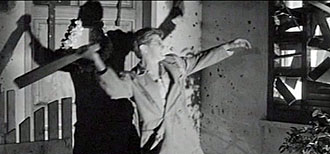

Reviewed by JONATHAN LEWIS:         


THE LAST MAN ON EARTH. American International Pictures, 1964. Vincent Price, Franca Bettoia, Emma Danieli, Giacomo Rossi-Stuart, Umberto Rau, Christi Courtland. Screenplay: William F. Leicester & Logan Swanson (Richard Matheson), based on the latter’s novel I Am Legend. Directors: Ubaldo Ragona & Sidney Salkow.

   Since it’s been over a decade since I read Richard Matheson’s I Am Legend (1954), I’m afraid I won’t be of much use in comparing The Last Man on Earth with the original text from which it was adapted. But suffice it to say, this low budget horror film is one of the bleakest movies I’ve recently viewed. Both in plot and mood, The Last Man on Earth resonates with hopelessness.

   And not just any type of despair, but an almost borderline nihilism that, when it’s all over, makes it almost difficult to wish it had turned out all that differently. In a very real sense, it’s the script’s fatalism that makes it both a far more compelling story than other vampire tales, but which ultimately ensnares it into a narrative trap in which things simply cannot work out for the protagonist no matter how hard he tries to make it so. Simply put, being the last man on the planet is not an inevitable position.

   Vincent Price, in a role largely bereft of his trademark wit and ironic detachment, portrays Dr. Robert Morgan. He’s a scientist by trade and a family man by nature. When we first encounter him, we see that he’s living alone in a house in a world marked by abandonment and decay. There are vampires on the prowl every night and as far as we know, he’s the sole survivor of a plague that has devoured humanity and left death and vampirism in its wake. So Morgan, year after solitary year, hunts vampires by day and locks himself inside his house at night.

   All that changes when he encounters a mysterious woman who, like him, travels freely in daylight. But who is she and what clues does she possibly hold to help Morgan solve the puzzle of what happened to the world? The answer, such as it is, isn’t so much predictable as it is a depressingly commentary on humanity.

   Perhaps that was the whole point of the screenplay: to be an acerbic political observation. Fair enough, but then again one need not be beaten over the head with wooden stakes for ninety minutes to make a point.

REVIEWED BY DAN STUMPF:


FACE OF THE SCREAMING WEREWOLF Diana Films, 1960. Jerry Warren Productions, 1964. Lon Chaney Jr, Yolanda Varela, Rosita Arenas and German Valdez (Tin Tan.) Written by Juan Garcia, Gilberto Martinez Solares, Alfredo Salazar, Fernando de Fuentes and Jerry Warren. Directed by Gilberto Martinez Solares, Rafael Portillo and Jerry Warren.

   Some films amaze the viewer by the very fact of their existence; they stretch the boundaries of Cinema and Reality to become not just movies but memorable experiences in themselves. Thus it is with Face of the Screaming Werewolf.

   A bit of backstory here: In 1960 popular Mexican comedian Tin Tan (German Valdez) starred in La Casa del Terror, as a sleepy wax-museum worker whose boss is actually a mad scientist trying to raise the dead. (His failures get covered in wax and put on display; well, what else would you do with them?)

   The mad doctor brings a mummy (Lon Chaney Jr.) back to life only to find that it was actually a mummified werewolf (also Lon Chaney Jr.) Got that? Hilarity ensues as the werewolf goes on a rampage and everybody chases everybody else around in the South-of-the Border equivalent of Abbott and Costello Meet Godzilla. “And so much for that movie,” you might think.

   But a few years later, American Producer Jerry Warren bought Casa del Terror, cut out almost all of Tin Tan’s scenes, spliced in some footage from The Aztec Mummy (1957) re-dubbed the whole mess into English (of sorts) and sprang it on an unsuspecting public as Face of the Screaming Werewolf.

   The results recall the eerie surrealism of early Cocteau melded with the gritty feel of Italian neo-realism. A bit of synopsizing is in order here, so I’ll insert a “SPOILER ALERT!” even though I have see the film twice and still can’t figure it out.

   We open with a couple of doctors hypnotizing Rosita Arenas into recalling a past life as an Aztec Princess. A young boy sneaks into the lab to eavesdrop and later stows away with the doctors and Rosita when they explore the lost temple (actually a Mexican tourist spot) and find the Aztec Mummy. Who is the boy and how does he figure in the interrelationships of the other characters? We never know because he drops out of the story as the scientists discover another mummy (Lon) and take them both back to civilization for study.

   Then, as the Scientists are exhibiting their mummified relics (to other scientists I guess; the writers never bother to tell us) the lights go out, shots are fired and gangsters make away with the Lon-mummy, which turns up in the Mad Doctor’s laboratory/wax-museum, is brought back to life and promptly turns into a werewolf. Occasionally we get a glimpse of someone sleeping in the Museum, whom I later discovered was Tin Tan.

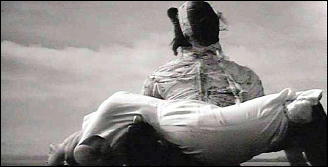
   Are you following things so far? Good, because at this point it all gets a bit confusing. The werewolf is subdued by a flashlight and locked up in the lab where it turns back into Lon Chaney Jr, looking sad and agonized as ever. Meanwhile the Aztec Mummy (remember him?) also comes back to life and carries off Rosita (remember her?) and they both get run over in traffic.

   We now cut to a pair of detectives investigating all this and we find out Rosita has a sister (Yolanda Varela.) Lon turns back into the Wolfman, breaks out, carries off Yolanda and Tin Tan charges off to the rescue.

   Clearly this is a complex story, and one that will take several viewings to fully comprehend and appreciate. I should note that the DVD I watched had some jarring breaks and hesitations toward the end that tended to vitiate the experience. I consoled myself by reflecting philosophically that I could have paid more for a better copy, but it would still be Face of the Screaming Werewolf.

From Beyond is a 1986 film based on the story of the same name by H. P. Lovecraft. Richard Band wrote the film score.

Reviewed by JONATHAN LEWIS:         


THE CURSE OF THE MUMMY’S TOMB. Hammer Films, UK, 1964. Columbia Pictures, US, 1964. Terence Morgan, Ronald Howard, Fred Clark, Jeanne Roland,George Pastell, Jack Gwillim, John Paul, Dickie Owen. Screenwriter-director: Michael Carreras.

   Directed, written (under the credited name “Henry Younger”), and produced by Michael Carreras, The Curse of the Mummy’s Tomb is a Hammer film about well … you guessed it, an archaeological expedition that unearths a mummy’s tomb and becomes the object of the mummy’s revenge.

   Ronald Howard, perhaps best known for starring in the 1954 Sherlock Holmes series, portrays John Bray, a Cambridge archaeologist who seeks to unravel the mysteries of the ancient Egyptian past. After his French colleague is murdered in the desert, he and his would-be betrothed, Annette Dubois (Jeanne Roland) make their way by boat up the Nile with the intention of returning to London.

   It is on that fateful trip that they encounter Adam Beauchamp (Terence Morgan), a mysterious Englishmen who inserts himself into their lives and knows far more about ancient Egyptian history than it first appears. But who is he and what does he want with Annette? That’s the crux of the story.

   When compared with Hammer’s The Mummy (1959) that I reviewed here, this later film comes across as a rather tepid and an uninspiring attempt to capitalize upon the former’s aesthetic, narrative, and musical genius. Indeed, without Peter Cushing and Christopher Lee, the movie just isn’t all that memorable in terms of its actors and their stage presence. But that doesn’t mean that one should completely write off this admittedly clunky mid-1960s horror film as purely derivative and as having no particular intrinsic value as a film onto itself.

   Although this is not a particularly well-crafted film, it’s actually significantly better than its harshest critics would suggest. True, often the art design leaves a lot to be desired and the supposedly ancient Egyptian artifacts look cheap and plastic. And yes, the story takes a well to fully coalesce into a coherent narrative. That said, however, the film does compensate for these flaws by introducing a few new elements and surprises into the mummy film corpus.

   These include a subplot with an inherent critique as to how mummies were often used in the West for cheap thrills and entertainment purposes and (Spoiler Alert) the finale in which it is revealed in which the film’s nominal villain is the mummy’s brother, who is revealed to be Beauchamp (Morgan).

    Due to a curse, he has been condemned to everlasting life as a mortal human being roaming the Earth alone for thousands of years. It’s a curious little twist, one that’s just enough to rescue The Curse of the Mummy’s Tomb from the obscurity it that would have befallen it had merely been a weak reworking of the brilliant Hammer original.

REVIEWED BY JONATHAN LEWIS:


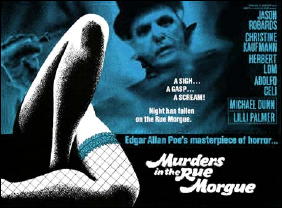
MURDERS IN THE RUE MORGUE. American International Pictures, 1971. Jason Robards, Herbert Lom, Christine Kaufmann, Adolfo Celi, Maria Perschy, Michael Dunn, Lilli Palmer. Screenwriters: Christopher Wicking & Henry Slesar, based on the story by Edgar Allan Poe. Director: Gordon Hessler.

   When adapting what many critics consider to be the original modern detective story to film, there’s a temptation to do so in a manner that adheres too closely to the original text.

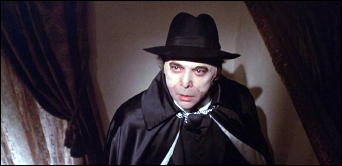
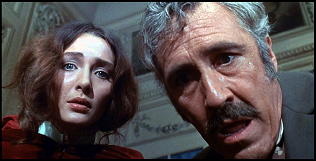
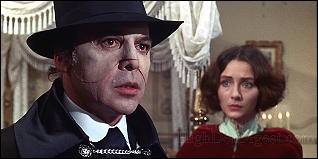
   That’s definitely not a problem for Gordon Hessler’s Murders in the Rue Morgue, a film that’s so anarchic in spirit that it ends up little resembling Edgar Allan Poe’s locked door mystery. Borrowing as much from The Phantom of the Opera (1943) as from Poe’s tale, this uneven, but still enjoyable, American International production blends gothic horror, an early 1970s Paella Western aesthetic, and a sly commentary on the demarcations between the profession of acting and living in “real life.” The movie also benefits a rather unique score by the Argentine composer and conductor, Waldo de los Ríos.

   The plot revolves around an early twentieth-century Parisian theater troupe of the Grand Guignol variety. Led by the mercurial Cesar Charron (Jason Robards), the troupe includes a myriad of colorful members. In the midst of their theatrical run of a stage adaptation of Poe’s eponymous story, Charron finds that his cast and crew, both former and present, are being targeted for murder.

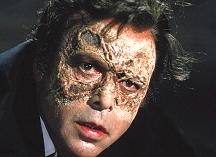
   It’s only when the bodies start piling up that Charron begins to suspect that his former friend and rival, Rene Marot (Herbert Lom) is behind the horrific killings. Thing is: Marot is believed to be dead, having taken his own life after murdering Cesar’s wife’s, Madeline’s (Christine Kauffman) mother (Lilli Palmer) with an axe.

   At the end of the day, however, it’s not the convoluted murder mystery plot that makes Murders in the Rue Morgue worth watching. Rather, the film is more an exercise in style and reflective of a certain type of Gothic horror cinema, one in which dreams, flashbacks, and hallucinatory sojourns play important roles in elucidating how the characters’ pasts and presents converge in tragic ways. The movie’s not a horror classic and doesn’t hold up very well when compared with Roger Corman’s Poe films, but it’s the product of a certain type of daring that was a hallmark of 1970s commercial cinema.

Reviewed by JONATHAN LEWIS:         


TERROR IS A MAN. Valiant Films, 1959. Re-released as Blood Creature. Francis Lederer, Greta Thyssen, Richard Derr, Oscar Keesee, Lilia Duran. Screenplay: Harry Paul Harber, based on the novel The Island of Dr. Moreau by H.G. Wells (uncredited). Co-directors: Gerardo de Leon (as Gerry de Leon) & Eddie Romero.

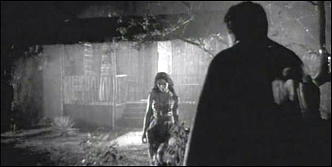
   The long shadow of H. G. Wells’ The Island of Dr. Moreau hangs over the incredibly bleak Filipino-American film Terror is a Man (aka Blood Creature). Produced in stark black and white, the movie feels more like a late 1930s or early 1940s horror film than one made at the tail end of the 1950s. This is a film that, with modifications, could have just as easily been made by John Brahm at the height of his creative output.

   Co-produced by Eddie Romero, the esteemed Filipino director whose vast corpus of work includes of a series of English-language exploitation and horror films in the 1970s, Terror is a Man features Francis Lederer in a leading role. He portrays Dr. Charles Girard, a mad scientist clearly inspired by Wells’ eponymous Dr. Moreau. He’s a man guided by both a zealous quest for knowledge and a desire to create a new kind of man, one unburdened by the effects of natural evolution. Indeed, his quest is not, in itself, malicious. Rather, it is a noble quest, but one that deliberately goes against the laws of nature.

   The plot of the movie is rather straightforward. William Fitzgerald (Richard Derr) is an American sailor who washes up on a South Pacific island. His ship went down and he’s the only survivor. It’s up to Dr. Charles Girard and his beautiful blonde wife (Greta Thyssen) to make a home for the stranded Fitzgerald.

    It doesn’t take long for our intrepid sailor to discover that there’s a panther on the loose on the island. He soon discovers that Dr. Girard’s experiments have something to do with the panther’s lethal behavior and – oh yes – that the panther may actually be a man!

   All of the tension that’s built up during the exceedingly talky first hour of the film ultimately comes to a series of catastrophic and violent clashes between the panther-man and the main characters. If the movie could be faulted for anything, it’s that it takes a little too long for any real action to occur. But when it does, it’s handled skillfully and with a genuine sense of impending doom.

   All told, Terror is a Man is a better horror movie than you might expect. True, the movie feels a little slow going at times and it wears its message of not tinkering with the laws of nature on its sleeve. But it’s much better than a lot of the American horror movies released at the time, particularly those derivative productions that blended horror with science fiction and atom age anxieties.

   What makes Terror is a Man a true horror film, as opposed to a work of science fiction, is that the real beast in the movie isn’t the panther-man, but his creator. Recommended for those viewers who don’t mind an occasionally stagey production and especially for admirers of Francis Lederer as a leading actor.

Reviewed by JONATHAN LEWIS:


BURN, WITCH, BURN. Anglo-Amalgamated Films, UK, 1962; American International Pictures, US, 1962. Originally released in the UK as Night of the Eagle. Peter Wyngarde, Janet Blair, Margaret Johnston, Anthony Nicholls, Colin Gordon, Kathleen Byron. Screenplay by Charles Beaumont & Richard Matheson (and George Baxt uncredited), based on the novel Conjure Wife by Fritz Leiber. Director: Sidney Hayers.

   At times Burn, Witch, Burn, aka Night of the Eagle, feels as if it’s an extended and psychedelically revved up episode of The Twilight Zone. I suppose that’s not all that surprising given the fact that Richard Matheson and Charles Beaumont, both of whom contributed to the famed CBS series, co-wrote the screenplay for this offbeat supernatural horror film. Although filmed in a noticeably flat black and white, making it highly adaptable to television screens in the early 1960s, Burn, Witch, Burn retains a Gothic, strikingly off kilter atmosphere that I found to be quite effective.

   Adapted from Fritz Leiber’s novel Conjure Wife (1943), the movie stars Peter Wyngarde as Norman Taylor, a sociology professor at a British medical college who discovers that his wife has taken to witchcraft. This is especially troubling for Taylor as he vehemently denies the existence of the supernatural. After he forces his wife, Tansy (Janet Blair) to part with her magical paraphernalia, things start going really badly for the both of them. Could it be that Tansy was correct that her spells were protecting him from a greater evil in their midst? If so, what does that mean for Taylor’s skepticism, let alone their marriage?

   Alternatively creepy and self-consciously ludicrous, the film also features another character, albeit a decidedly uncredited one: a stone eagle statuette perched on top of the college where Taylor works. Perhaps the less said about that mighty bird the better. Keep in mind that when there are witches afoot in England, inanimate objects don’t always stay inanimate — especially at night.

REVIEWED BY JONATHAN LEWIS:


CRUSH THE SKULL. 2015. Tim Chiou, Chris Dinh, Katie Savoy, Chris Riedell. Director & co-screenwriter: Viet Nguyen.

   It’s safe to say that, even if you don’t much care for horror/comedy mash-ups, you’ll come away feeling that there is something almost magical about the screen chemistry between the two leads in Crush the Skull, a quirky thriller which defies traditional genre categories.

   Directed by Viet Nyugen (iZombie), the film stars Chris Dinh and Katie Savoy as Ollie and Blair, two deadbeat thirty-year-olds who, for money and kicks, disguise themselves as painters and rob houses when the owners are away. There’s something just so natural about these two characters and their witty, occasionally caustic, always lovable banter that make this otherwise uneven, occasionally bewildering, film worth a look.

   Like any good horror story, Crush the Skull begins with a premise that’s also inherently a morality tale pushed to the extreme: What happens if robbers break into a house only to learn that it’s actually a serial killer’s lair and these would-be criminals become captives? It’s certainly an intriguing idea, albeit not the most creative one ever pitched. But if you mix it up with a docudrama style of filmmaking and a deadpan sense of humor – and indeed, fun – you might just end up with something that punches higher than its weight.

   That’s the case with Crush the Skull, or at least it was for me. Truth be told, I don’t care all that much for the “serial killer’s lair” theme, and it took some effort for me to adjust myself to that. We know, to some degree, what motivates serial killers. It’s the supernatural, the unexplainable and unbelievable that’s even more frightening than human evil and which interests me far more.

   But the film does its best to provide the viewer with some twists and turns along with some unanswered questions that aren’t fully resolved until the haunting final frame. All told, I can’t say that this recent feature isn’t without its flaws, including a rather prolonged backstory, but it shows a self-conscious sense of fun that makes it far more memorable than your typical serial killer thriller.

DAUGHTER OF DR. JEKYLL. Allied Artists, 1957. John Agar, Gloria Talbott, Arthur Shields, John Dierkes, Mollie McCard, Martha Wentworth. Director: Edgar G. Ullmer.

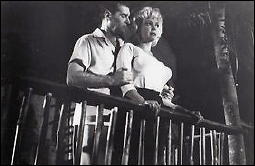
   With a title like this, you can probably figure out a fully-formed plot synopsis of your own and have it come out awfully close to the one that powers this one along. Gloria Talbott plays the daughter of you know who, which I’m sure you’ve already guessed from the cast listing, but now as a orphan she goes by the name of Janet Smith. What she does not know is that on her 21st birthday, she will inherit a large estate.

   Her guardian is a gentleman named Dr. Lomas, and as she and her fiancé (John Agar) visit him together in her family mansion, he finds himself duty-bound to tell her in private about her father. Strange events — murderous events — begin to happen the same evening. Can she have inherited her doomed father’s fate of turning into a werewolf at the time of the full moon?

   Well, not a lot of this makes much sense, and maybe the plot you might have put together yourself would have made a better film along these same lines than this one. But as the director, Edgar G. Ulmer manages to keep the action extra spooky, especially indoors, with all kinds of innovative camera angles and an excellent use of black and white lighting. Less effective is the mist effect used in outdoor scenes, which comes off only as if you’re looking through a smeared-up lens.

   One other big plus is that Gloria Talbott never looked lovelier than she does in this movie, made the same year as The Cyclops, reviewed here. This one’s ten times better, if not more, and if you’re so inclined, which I assume you are, having read this far, the movie is well worth searching out for.

« Previous PageNext Page »