Horror movies


Reviewed by JONATHAN LEWIS:         


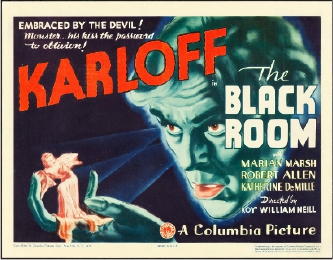
THE BLACK ROOM. Columbia Pictures, 1935. Boris Karloff, Marian Marsh, Robert Allen, Thurston Hall, Katherine DeMille. Director: Roy William Neill.

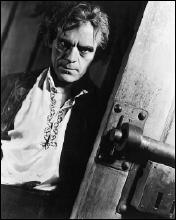
   The Black Room, although not as well known as the classic Universal Studios horror films from the same era, is a taut, suspenseful, and visually crisp Gothic thriller starring Boris Karloff. In a memorable performance that demonstrates his strength as an actor, Karloff portrays two twin brothers, the evil, dissolute Gregor and the charmingly naïve Anton, the last remaining members of the de Berghmann family.

   Directed by Roy William Neill (best known for directing some of the Basil Rathbone and Nigel Bruce Sherlock Holmes movies), the film makes skillful and economical use of decorative settings, shadowy lighting, unique camera angles, and repetitive music to convey a sense of impending doom and otherworldliness. As Joe Dante accurately notes, there is a fairy tale quality to The Black Room. The majority of film takes place in a castle, there’s horses and carriages a plenty, a prophecy fulfilled, and a beautiful maiden endangered by a madman and his demonic love for her.

   The plot is fairly straightforward. We’re transported to a dreamlike land somewhere in central Europe. Twin brothers, Gregor and Anton, are born and their father, patriarch of the de Berghmann dynasty, isn’t happy about it. Not without good reason, for there’s a prophecy that holds that, when twin brothers are born in the family, the younger brother will end up killing the older one.

   Specifically, it’s been written that younger brother kill commit fratricide in the black room, the castle’s oubliette. Although they are twins, we learn that Gregor is one hour older than his brother Anton, who was born with a paralyzed right arm. (How else would we tell them apart?) The stage is set for mystery and murder.

   Fast forward twenty years. We learn that the disheveled Baron Gregor (Karloff) is a brute, a dissolute tyrant in a castle keeping busy by oppressing the peasants and violating their women. The townsfolk have had just about enough, but they aren’t quite sure how to get rid of the mad baron. Assassination attempts have been made on his life.
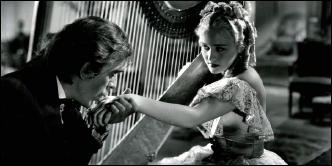
   Enter twin brother, dapper and naïve Anton, also portrayed by Karloff, who returns to his hometown after traveling in Europe. The two brothers reunite. After killing Mashka (Katherine DeMille) who witnessed his criminal acts, evil brother Gregor abdicates and turns power over to Anton, but not for long. Gregor lures Anton into the eponymous black room, pushes him down into a pit where he dies, a knife resting between his body and his right arm.

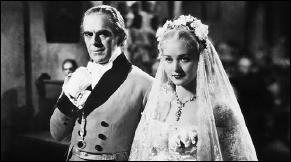
   This is when Karloff’s skill as an actor really shines through. Now, he’s portraying a third character, as it were: evil Gregor pretending to be Anton. The murdering nobleman has his sights set on the beautiful, white-clad Thea (Marian Marsh, often bathed in a soft white light), niece of Colonel Hassell (Thurston Hall).
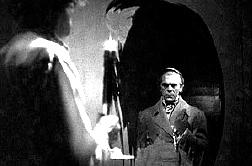
   But she’s not in love with the baron. Her heart belongs to the upstanding Lt. Lussan (Robert Allen) who ends up being convicted for the murder of Col. Hassell, a murder that Gregor-as-Anton commits when the colonel unmasks his true identity. If it sounds somewhat complicated, trust me when I say it’s really not.

   Karloff is a skilled enough actor to pull off these three distinct roles. Roy William Neill’s direction gives the viewer enough time and visual cues to easily follow what’s happening every step along the way, including in the final showdown where the prophecy is indeed fulfilled after a dog forces Gregor-as-Anton to use his right arm, demonstrating to everyone that he’s an imposter.

   The Black Room has some particularly notable camera work, which makes the film significantly better than many other horror films from the same era. Most of the time, the viewer is not on the same eye level as are the characters. Often times, the actors are shot from angles either significantly beneath them, even at foot level, or above them. This gives the impression that we are meant to be conscious of our role as spectators, peering through the looking glass into a fantastic realm. Look, also, for the scene in which the camera looks up at Anton right before his brother pushes him down into the pit.

   The film, perhaps not surprising in a movie about twin brothers, also makes ample use of mirrors and reflections. For instance, the first we see of Gregor immediately after he murders Mashka is as a reflection a mirror, shot at an angle. There’s also a great soliloquy in which Gregor-as-Anton talks to himself in a mirror and an eerie scene in which Gregor talks to himself in a reflection in the black room.

   The film repeatedly juxtaposes faith with superstition. There are numerous scenes with crosses and crucifixes, both in and out of a graveyard. Likewise, there are two important scenes in which Thea and Lt. Lussan have intense discussions in front of Virgin Mary statues. As far as superstition, there is not only the matter of the prophecy, but also a black cat – one real and one made of wood – that shows up in the film. It’s worth looking out for.
   In conclusion, The Black Room is one of those forgotten gems of 1930s cinema. It may not be a classic, but in many ways it’s as good as many of the best known Universal films from the same era and far better than the Universal B-films from the late 1930s and early 1940s.

   Karloff is on the top of his game here. There’s one scene in which he as Gregor is holding a knife and talking to himself as he carves a pear, demonstrating just how crazed and inattentive he is. That’s the type of acting that makes the film really worth watching. The story, while not the most creative, is not bad either.
Reviewed by JONATHAN LEWIS:         


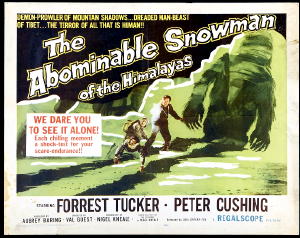
THE ABOMINABLE SNOWMAN. Hammer Films, UK, 1957. Released in the United States as The Abominable Snowman of the Himalayas. Forrest Tucker, Peter Cushing, Maureen Connell, Richard Wattis, Robert Brown, Michael Brill, Wolfe Morris, Arnold Marlé, Anthony Chinn. Screenplay: Nigel Kneale, based on his 1955 BBC teleplay entitled The Creature. Director: Val Guest.

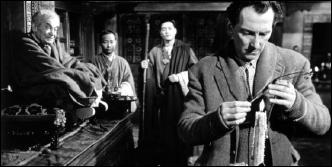
   Running just over 90 minutes, The Abominable Snowman stars Peter Cushing (Dracula, The Mummy) as an English botanist on an ill-fated Himalayan expedition to find the mythical Yeti.

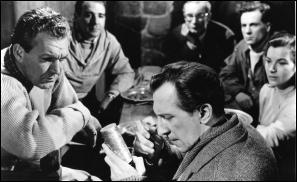
   The film is, in many ways, more of a psychological thriller than a traditional horror film. Both the claustrophobic isolation of the Himalayas and the tension between members of the expedition party play far more prominent roles in the narrative than do the Yeti, whom we see only briefly toward the end of the film.


   The plot is relatively straightforward. John Rollison (Cushing) and his wife, Helen (Maureen Connell) are living and working in the Tibetan monastery, Rong-ruk. They are guests of the enigmatic Lama (Arnold Marlé) who seems to know a lot more than he lets on. Although Rollison isn’t in the best physical shape in the world, he insists upon joining the expedition of the loud-mouthed American guide and showman, Tom Friend (Forrest Tucker). Helen isn’t happy about the arrangement.

   The party’s goal is find the Yeti. But Friend and his associates have different goals than Rollison. Friend, a conman and a fraud, wants to capture a Yeti alive and sell it to a carnival show. Rollison, more pure of heart, wants to study and learn about the Yeti.

   He posits both that Yeti are intelligent, sentient creatures and that they are merely biding their time on Earth, hidden up in the Himalayan peaks, until man destroys himself. They also have quasi-hypnotic powers.

   The doomed explorers do manage to find and to kill a Yeti, setting into motion a chain of events that leave Rollison the sole surviving member of the expeditionary party. The most important scene in the movie occurs in an ice cave when Rollison finally encounters live Yeti. He makes eye contact with one of them and realizes that his theory about Yeti intelligence was indeed correct.

   The film, a product of the anxieties of the Atomic Age, imparts a fairly obvious message about how man’s hubris may end up being his downfall. The theme of what it means to be civilized also features prominently in the film. This is notable given the fact that the late 1950s were the beginning of the end for British imperialism.

   While I would not go so far as to say that The Abominable Snowman is a particularly notable film, I found the story about how the Yeti will be man’s successors to be thought provoking. Unfortunately, the production quality now seems considerably dated.

   The film’s pacing can feel a bit slow. Indeed, unlike The Mummy (also from Hammer films two years later and reviewed here earlier on this blog), which remains an absolute gem, The Abominable Snowman, while not a bad film, really doesn’t stand up to the test of time. Perhaps that is one reason why, in late 2013, Hammer Films announced that they are planning to remake this oft-neglected British cult classic.

   In conclusion, The Abominable Snowman is certainly worth watching at least once, if only for the ominous Eastern-themed music, bells, and chants that provide the film with a strong fosters a sense of both wonder and of impending doom. The monastery setting, which features considerably in the movie, is also visually stunning. It’s a reminder that the film was meant to transport the viewer into a different realm of existence and human understanding.

   While I probably won’t watch the 1957 version again any time soon, I’m quite looking forward to seeing how the forthcoming remake turns out. I only hope the filmmakers do make it more of a psychological thriller than a creature feature.

Reviewed by JONATHAN LEWIS:         


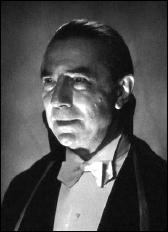
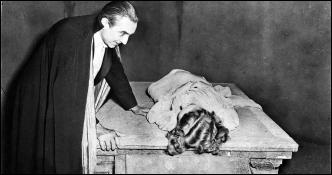
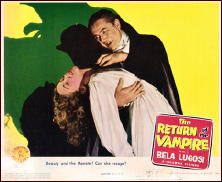
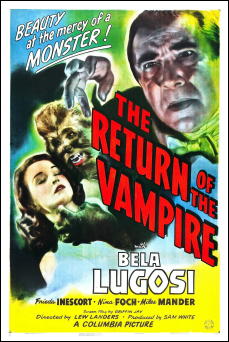
THE RETURN OF THE VAMPIRE. Columbia Pictures, 1943. Bela Lugosi, Frieda Inescort, Nina Foch, Miles Mander, Roland Varno, Matt Willis. Director Lew Landers.

   The Return of the Vampire is a 1943 Columbia Pictures horror film directed by Lew Landers (The Raven) and starring Bela Lugosi (Dracula). Viewers with even a cursory knowledge of twentieth-century European history will especially appreciate the significance of the film’s historical context, while Lugosi fans will certainly enjoy the Hungarian-born actor’s portrayal of the vampire Armand Tesla, Count Dracula in all but name.

   The film, which runs just under 70 minutes, benefits from good pacing, well-developed and believable characters, and the theme of free will in the face of cosmic evil. The latter is something that audiences at the time would likely have implicitly associated with the ongoing campaign against Nazism.

   The plot is fairly straightforward, making the film not particularly difficult to follow. We begin in October 1918, a month shy of the end of the Great War. The vampire Tesla and his werewolf assistant, Andreas, inhabit a misty graveyard outside London. Tesla attacks and bites the neck of a young girl named Nikki, who lives in an estate not far from the vampire’s earthly domain.


   Nikki’s grandfather, Professor Walter Saunders (Gilbert Emery), and Lady Jane Ainsley (Frieda Inescort), a scientist, soon realize that Nikki’s wound has a dark, supernatural origin. They’re determined to do something about it. Together, they enter the graveyard, find Tesla’s tomb, and drive a stake through the vampire’s heart. This entire sequence is best be interpreted as an allegory of the conclusion to the violent and culturally disruptive First World War.

   Unfortunately, peace with Tesla, much like Britain’s peace with Germany, was not built to last. The film shifts forward in time to the Second World War. Lady Jane’s son, John, is engaged to Nikki (Nina Foch) and Andreas (Matt Willis), no longer a werewolf, is working in her laboratory.

   But Britain is at war and the Luftwaffe’s bombing raids are taking their toll on London. One such aerial raid directly hits the cemetery and ends up freeing the monstrous Tesla from his coffin. Apparently, the stake through the heart didn’t take.

   Tesla transforms Andreas back into a werewolf. He seeks revenge against Lady Jane and sets out to transform Nikki into a vampire. Lady Jane is once again tasked with the unenviable job of battling Tesla who, for a time, passes himself off as Hugo Bruckner, German scientist eager to defect to the United Kingdom. She has the cooperation, if not the full assistance of Scotland Yard investigator, Sir Frederick Fleet (Miles Mander), who simply doesn’t believe in vampires.

   Although the film is nominally about Tesla, the character of Andreas plays a prominent role as well. One can interpret his story as either an allegory of the perils of addiction or as previously alluded to, of free will in the face of evil.

   The viewer first encounters Andreas as a werewolf, lumbering through a spooky graveyard, completely beholden to his master, Tesla. Andreas’s first on-screen transformation occurs when Professor Saunders drives a stake through Tesla’s heart, freeing him from the vampire’s control and transforming him back into his natural, human form.

   Later, Tesla transforms Andreas back into a werewolf. Finally, at the end of the film, Andreas plays the hero and is transformed back into a man. Each transformation represents a turning point in the film’s narrative structure.

   In conclusion, The Return of the Vampire is as much a horror film as an allegory about Britain’s two conflicts with Germany. Although the film isn’t a classic, the acting is decent and there is a worthwhile message involved. Most importantly, however, is the fact that it’s actually quite fun, the type of movie one can enjoy on the couch, late at night, lights off and popcorn in hand.

Reviewed by JONATHAN LEWIS:         


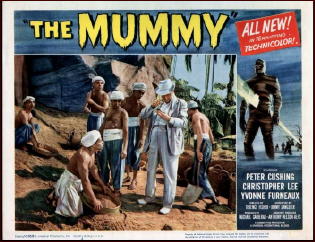
THE MUMMY. Hammer Films, UK, 1959. Peter Cushing, Christopher Lee, Yvonne Furneaux, Eddie Byrne, Felix Aylmer, Michael Ripper. Screenplay: Jimmy Sangster. Director: Terence Fisher.

THE MUMMY Christopher Lee

   Over the past fifteen years or so, film and television writers have embraced both fanged vampires and, to a lesser extent, furry werewolves. With the exception of The Mummy (1999) and the franchise it launched, mummies, those aristocrats ensconced in linen and raised from the dead, have not played prominent roles as villains. This is unfortunate.

   Not only are mummy tales, when critically unwrapped and analyzed, as terrifying as vampire yarns. They also provide a fascinating insight into how Anglo-American filmmakers have understood their particular era’s relationship to the ancient Egyptian past. From Napoleon Bonaparte’s first campaign in Egypt (1798) and British Museum’s Rosetta Stone exhibit (1802-present) to the discovery of Tutankhamun’s tomb (1922), the mysteries of long-vanished Egyptian civilizations have piqued the curiosity of western observers.

   Mummy films are the cinematic representations of this strange, enduring fascination. The two best-known mummy films are undoubtedly Universal’s The Mummy (1932) starring Boris Karloff and the aforementioned 1999 quasi-remake starring Brendan Fraser and Rachel Weisz.

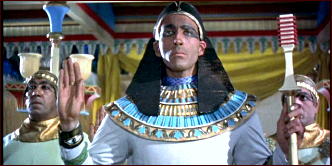
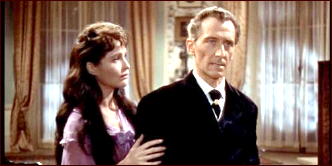
   But there’s also a 1959 mummy film that deserves ample consideration. The Mummy, starring Peter Cushing, Christopher Lee, and Yvonne Furneaux, is perhaps the least known of the three films of the same name. To varying degrees, the plot is borrowed from three previous, even lesser known, mummy movies, The Mummy’s Hand (1940), The Mummy’s Tomb (1942), and The Mummy’s Ghost (1944). Directed by Terence Fisher, The Mummy (1959) is a Technicolor Hammer Production with great horror film acting, lavish and colorful settings, and an excellent, memorable score composed by Franz Reizenstein.

THE MUMMY Christopher Lee

   The film begins with an archaeological dig in Egypt. It’s 1895 and three members of the same family discover the tomb of Princess Ananka, the high priestess of the ancient Egyptian deity, Karnak. Because John Banning (Peter Cushing) is injured and somewhat immobile, the English archeologist’s father, Stephen Banning (portrayed by Felix Aylmer), is tasked, along with his uncle Joseph Whemple (Raymond Huntley), with entering the tomb.

   Along comes Mehemet Bay in a red fez (portrayed by the Cypriot character actor George Pastell). He warns the two men against disturbing the dead, lest they unleash a curse against desecrators. As you might imagine, the enterprising Englishmen don’t heed the warnings of this excitable foreign fellow.

   Skip to three years later. It’s 1898 and Stephen Banning is back in England. Sadly, the poor chap’s gone completely mad. His son, the scholarly John Banning, is now ambulatory and living with his wife (Yvonne Furneaux). Life is apparently pretty good for the younger Banning, who appears to be living a plush life on an English country estate.

THE MUMMY Christopher Lee

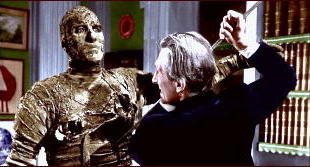
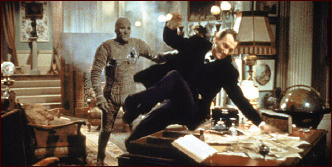
   But good things never seem to last for those who disobey warnings not to disturb the dead. We know that there’s trouble ahead when Mehemet Bay arrives in England on a quest to avenge the opening of Princess Annaka’s tomb. After Stephen Banning is found dead in his room (murdered by the mummy Kharis), a police inspector by the name of Mulrooney begins to investigate the mysterious goings on.

   Through extensive flashback scenes narrated by Peter Banning (Cushing in a quite memorable voice-over role within the film), we learn that Kharis (Lee) was the high priest of Karnak. Centuries ago, Egyptian authorities mummified Kharis and buried him alive as punishment for his attempt to bring Princess Annaka (also portrayed by Yvonne Furneaux), whom he loved, back from the dead.

   The second half of the film revolves around Mehemet Bay’s attempt to utilize Kharis to kill the other two Bannings before heading back to his native Egypt. There’s a notable scene in which Peter Banning and Mehemet Bay tensely discuss the ethics of archeology, perhaps a subtext about London’s historical meddling in Egyptian affairs.

THE MUMMY Christopher Lee

   If the plot sounds somewhat convoluted, you’ll have to trust me both when I say that it’s really not and, even if it were, it really wouldn’t matter all that much. In many ways, plot isn’t what makes this version of The Mummy a classic horror film worth watching at least once.

   It’s the filmmakers’ skillful use of color and lighting, particularly when combined with Reizenstein’s score, which transforms a film with an otherwise standard mummy-seeks-revenge plot into a captivating cinematic experience. Although the Egyptian scenes are clearly sets and not filmed on location, there’s something about them that makes them incredibly vivid.

   One final note: while watching The Mummy on DVD, I kept thinking how much I’d like to see the film in a dark movie theater, particularly one with a great sound system. Who knows? Maybe some day, I shall.

THE MUMMY Christopher Lee

REVIEWED BY DAN STUMPF:


THE WOMAN EATER. Eros Films, UK, 1958; Columbia Pictures, US, 1959. George Coulouris, Vera Day, Peter Wayn, Joyce Gregg, Joy Webster, Jimmy Vaughn. Director: Charles Saunders.

THE WOMAN EATER

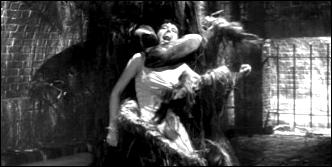
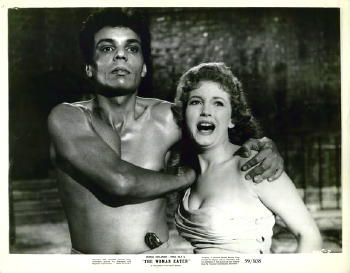
   The Woman Eater is the risible title of a remarkable little film which no doubt inspired (if inspiration had anything to do with it) the better-known Little Shop of Horrors (1960).

   George Coulouris, best remembered as young Charles’ guardian in Citizen Kane, here plays an intrepid explorer/scientist, and tries hard not to look embarrassed as he journeys deep into the Amazon Jungle where he sees a lot of stock footage and Marpessa Dawn (who would go on to Black Orpheus) being sacrificed to a giant thing that looks like a cross between a hairy Muppet and Mr. Tree — truly one of the most unintentionally amusing monsters of the 50s, and one you should not miss.

   Five years later (a title tells us) he’s back in England with the plant and a cringing native catamite/assistant called Tanga, convinced that the tree secretes a sap that will revive the dead. Of course to get the sap he has to sacrifice young women to the damn thing, so it seems like a zero-sum game to me, but hey, he’s a scientist I’m sure he must think he knows what he’s doing.

   At one point he tests things out by injecting the sap into what looks like a giant chicken heart, which makes one question his priorities, but it doesn’t work and that’s the last we see of the giant chicken heart, which is rather a shame because I thought it was a good part, even if we never learn exactly what it was, where it came from or why. Obviously a film to challenge us with existential questions about the meaning of it all.

   Anyway, the story gets a little strange at this point, as George’s housekeeper says she’s madly in love with him (with George Coulouris???) the young heroine recently employed by George insists there’s something evil in the house (even though they forgot to shoot any scenes of her hearing strange noises or such) and George announces he’s madly in love with the heroine, whom he met the day before. We get the usual climactic conflagration, and all ends, if not well, at least promptly in a film worthy to stand beside classics like Jungle Captive and The Spider Woman Strikes Back.

   As Walt Kelly used to say: it’s enough to make a man think.

THE WOMAN EATER

REVIEWED BY WALTER ALBERT:         


BLUEBEARD John Carradine

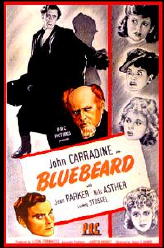
BLUEBEARD. PRC, 1944. John Carradine, Jean Parker, Nils Asther, Ludwig Stössel, George Pembroke, Teala Loring, Sonia Sorel. Director: Edgar G. Ulmer.

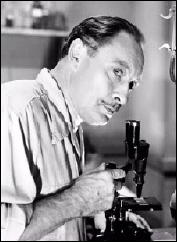
   John Carradine plays a disturbed puppeteer dubbed “Bluebeard” by the Parisian tabloids in this stylish, low-budget film. In the twenties Ulmer worked as a production designer on films directed by F.W. Murnau and Fritz Lang,and the theatrical-looking studio sets (including what appears to be a cardboard cutout of Notre Dame) are appropriate to this study of a deranged artist.

   The most striking visual effect is a shot of the puppeteer’s eye peering out balefully at the audience in the park- and, coincidentally, at the theater audience. It reminds me of a shot in Lang’s You Only Live Once (1937) in which the blind covering the rear window of a menacing black automobile parts to reveal a pair of eyes, the face covered as if by a mask in an imaginative use of the melodramatic convention of the hooded villain.

   Carradine plays the role of the artist/murderer with great restraint, and his long face and mournful eyes, wedded to his rich but monochromatic voice, give to his performance the haunting — or haunted — look of a fallen angel.

— From The MYSTERY FANcier, Vol. 6, No. 3, May-June 1982.


REVIEWED BY DAN STUMPF:


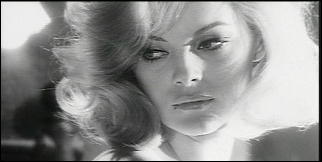
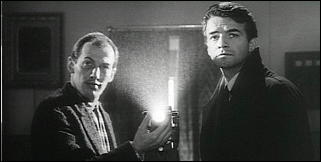
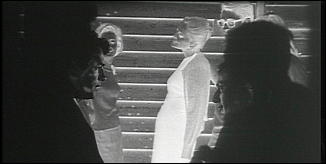
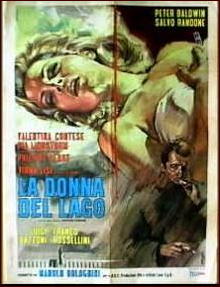
a donna del lago

LA DONNA DEL LAGO [or THE LADY OF THE LAKE]. B.R.C. Produzione S.r.l., Italy, 1965. Released in the US as The Possessed. Peter Baldwin, Salvo Randone, Valentina Cortese, Pia Lindström, Piero Anchisi, Virna Lisi. Directors: Luigi Bazzoni & Franco Rossellini.

   Not too long ago I saw a movie I’ve been trying to see again for nigh unto thutty year: The Lady of the Lake — NOT to be confused with The Lady in the Lake, Robert Montgomery’s pretentious film of Chandler’s novel. This is an Italian movie from 1965, written and directed by Luigi Bazzoni, whoever-the-hell he is.

   I first saw it on TV in the godless hours of the morning between Three and Five, sometime in 1973, badly dubbed, under the unlikely title Love, Hate and Dishonor. I was quite drunk at the time, and I remembered the film as a perversely fascinating mix of Hard-Boiled Mystery and Surreal Story-Telling, tinged with Uneasy Kinkiness — a bleary conviction piqued over the years when I found no mention of the film in any reference book, no repeat viewings of it on TV, or even anyone else who professed to have seen it.

a donna del lago

   So Love, Hate & Dis remained a personal fetish till I finally saw La Donna Del Lago panned in Phil Hardy’s Encyclopedis of Horror Films and recognized the story and stars. An Ethan-Edwards-like search of film conventions and the Net finally yielded up a watchable copy from a Miami dealer, and I returned at last to this relic of my mis-squandered youth.

   And oddly enough, it seemed just as remarkable to this sober nearly-middle-aged man as it did to the drunken tad of whom I am a biological extension. The plot is a simple affair: A disaffected writer breaks up with his girlfriend and decides on a whim to revisit the resort where last Summer he had a pleasant romp with a hotel maid, Tilda (Virna Lisi).

   Only it’s Winter now, the Hotel is near-empty, Tilda’s dead, and as the wind howls across the icy lake, our hero wanders through a gaudy ghost town, and he learns that her death was ruled a suicide — in the same coroner’s report that says she died a virgin.

a donna del lago

   From a fairly standard tale of murder-and-cover-up, Bazzoni crafts a truly mysterious film, full of tricky imagery and shifting narrative. A walk through a snow-capped graveyard suddenly morphs into a flashback that gradually resolves into a dream. Bit-players ooze about with eerie unction, just on the verge of saying too much, and something always seems to be happening, or about to happen, somewhere in the background, just almost out of sight.

   It’s easy to see why Hardy included this in his Horror Films book — though it offers no ghosts, monsters, blood or violence — and just as easy to see why he failed to come to terms with its unique style of tale-spinning. There aren’t many things that look just as good on the sober Morning After, but this is one I’ll come back to.

a donna del lago

REVIEWED BY DAN STUMPF:


THE MAD DOCTOR OF MARKET STREET

THE MAD DOCTOR OF MARKET STREET. Universal, 1942. Una Merkel, Lionel Atwill, Nat Pendleton, Claire Dodd, Anne Nagel, Hardie Albright, Richard Davies. Director: Joseph H. Lewis.

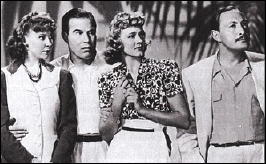
   There`s a certain art to making an enjoyable bad movie, to which The Mad Doctor of Market Street bears witness. Directed by the redoubtable Joseph H. Lewis and written by someone named Al Martin (not exactly a name to conjure with, but he deserves his due) this one offers the eponymous medico-maniac (ably impersonated by Lionel Atwill, the second-greatest mad doctor of his time) against backdrop of a delightful studio-made luxury liner, followed by an equally bogus tropical island.

   Native Devil-Worship, shipwreck, unconvincing leading players (Claire Dodd and Richard Davies, admirably stiff as cardboard cliches) and capable comedy relief provided by Una Merkel and Nat Pendleton.

   The show really revolves around Lionel Atwill as a self-styled genius whose ground-breaking experiments in suspended animation seem to be breaking ground only in cemeteries. After a particularly egregious cock-up, Atwill takes it on the lam and ends up shipwrecked on a tropical island with the rest of the cast, where the natives decide he’s the God of Life and Death, with all the privileges and perquisites pertaining thereunto.

THE MAD DOCTOR OF MARKET STREET

   None of this is to be taken seriously for moment, but everyone involved really seems to act their little hearts out, putting commendable pace and energy into what is, after all, a forgettable time-killer. Director Lewis throws in the odd camera-angle and an occasion bit of mood one doesn’t expect in this sort of thing, and it emerges as quite a worthwhile effort.

REVIEWED BY WALTER ALBERT:         


MURDER BY THE CLOCK

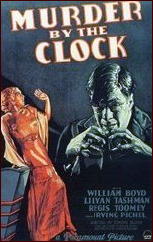
MURDER BY THE CLOCK. Paramount, 1931. William (Stage) Boyd, Lilyan Tashman, Irving Pichel, Regis Toomey, Sally O’Neil. Based on the novel by Rufus King (Doubleday/Crime Club, 1929). Director: Edward Sloman. Shown at Cinefest 19, Syracuse NY, March 1999.

   This was an end-of-day screening (after 11 p.m.) that I would probably have skipped had the notes not pointed out that the film is “celebrated” by William Everson in his Classics of the Horror Film.

MURDER BY THE CLOCK

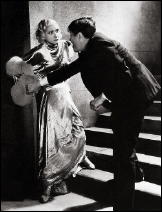
   Tashman had a brief Hollywood career (she died shortly after the release of this film, according to the notes), but she was worth staying up for. She’s the sultry villainess who masterminds three homicides and appears to be getting off Scot-free until Boyd upstages her in the final minutes of the film.

   This is an old-house mystery with a crusty dowager heiress who rigs her coffin in the family crypt so that an alarm can be sounded if she’s buried alive. As indeed, she appears to have been. Pichel (whose most memorable screen performance was as Gloria Holden’s minion in Dracula’s Daughter) has a hoot playing a deranged legatee and he almost manages to steal kinky acting honors from Tashman.

   An improbable but delicious early sound romp among the corpses.

REVIEWED BY DAN STUMPF:


HORRORS OF THE BLACK MUSEUM

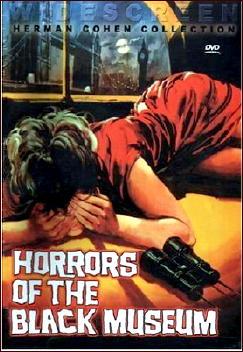
HORRORS OF THE BLACK MUSEUM. American-International Pictures, 1959. Michael Gough, June Cunningham, Graham Curnow, Shirley Anne Field, Geoffrey Keen, Gerald Anderson, John Warwick. Director: Arthur Crabtree.

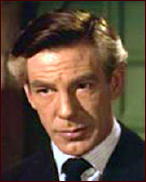
    Horrors of the Black Museum is a gaudy comic book of a movie, best enjoyed if you park your good taste and critical faculties with the gum under your seat. The story, by Herman Cohen and Aben Kandel (the team that brought us such classics as I Was a Teenage Werewolf, I Was a Teenage Frankenstein and Berserk) posits that a best-selling True Crime writer (Michael Gough, masticating the scenery with sadistic relish) gets his insights by committing the crimes himself — or having them committed by a young assistant in hypnotic thrall to him.

HORRORS OF THE BLACK MUSEUM

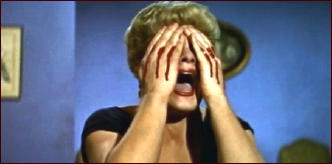
    The murders themselves are fairly grisly, including the opening bit (featured in all the previews) with a pair of booby-trapped binoculars, and are all practiced against lissome young ladies, but they have the redeeming value of being so far over the top (like Gough’s acting) as to provoke the odd chuckle.

    At one point, for instance, we are asked to believe that the killer snuck into a woman’s apartment and built a guillotine over her bed which she doesn’t see until she lies down in just the right position for it to — well you get the idea. Even better is Gough’s sanctum sanctorum, filled with acid vats, S/M apparatus and some sort of machine mounted with dials, lights and levers that seems to serve no function at all.

    Okay, admittedly the writing is perfunctory, and the acting mostly capable but undistinguished. There’s also some fairly prominent homophobia running through all this, what with the tastefully appointed bad guy keeping his handsome young assistant enslaved so they can victimize women. But I found Horrors suffused with a redeeming energy and engaging carelessness that kept me entertained throughout.

HORRORS OF THE BLACK MUSEUM

« Previous PageNext Page »