Horror movies


REVIEWED BY JONATHAN LEWIS:


THE NIGHT VISITOR. Universal Marion Corporation, 1971. Max von Sydow, Trevor Howard, Liv Ullmann, Per Oscarsson, Rupert Davies, Andrew Keir. Director: László Benedek.

   Before there was such a thing as the slasher film genre, there was The Night Visitor. Directed by László Benedek (The Wild One), this English-language Swedish film is a brooding psychological thriller, albeit one punctuated by moments of extreme, brutal violence. Set in a small, somewhat isolated Swedish town beset with winter snow, the story follows the devious scheme hatched by Salem (Max Van Sydow in an standout performance), an inmate at an asylum for the criminally insane, to wreak havoc and to exact revenge on those who framed him for a crime he did not commit.

   Salem isn’t a particularly bright man, but he’s devised an ingenious, if highly implausible, method to escape from his cell at the asylum. He does so in such a methodical and successful manner that he is able to leave his cell, abscond into the Swedish landscape, and to avenge himself upon those who he — rightfully — believes have wronged him two years ago when he was framed for the murder of a farmhand. When he returns to his cell, however, he has an iron-clad alibi.

   Among Salem’s targets are his sister Ester (Liv Ullmann), and her husband, Anton (Per Oscarsson). He also targets three other people: Anton’s sister, his former lover, and the lawyer who was bribed into changing Anton’s plea into not guilty by reason of insanity.

   Once bodies start showing up in his small town, the local police inspector (Trevor Howard) begins to investigate whether it is just possible that Salem is the one committing the crimes after all. But he’s not entirely convinced that Anton is innocent either. Howard is nearly flawless in his portrayal of an elderly, somewhat cynical, policeman who isn’t so easily impressed by or intimidated by any one who comes between him and his quest for the truth.

   Overall, The Night Visitor isn’t a superb movie, but it’s a good one. The tension is palpable throughout and the stark, wintry Scandinavian landscape lends the film an atmosphere that is hard to beat. Although one may end up finding Salem’s nearly magical escape methods to be somewhat laughable, the movie’s bleak, brooding nature makes up for whatever implausible plot devices are utilized to tell the story of a man who literally went crazy when he was unjustly imprisoned in an asylum.
REVIEWED BY JONATHAN LEWIS:


THE SHE BEAST. Miracle Films, UK, 1966; Europix Consolidated Corp., US, 1966, as She Beast. Barbara Steele, John Karlsen, Ian Ogilvy, Mel Welles, Jay Riley, Richard Watson. Screenwriter-director: Michael Reeves.

   Sometimes, flying by the seat of your pants has long-term consequences. Say, for instance, when you take part in a lynch mob and, without following proper procedures and taking necessary precautions, you drown a witch in a lake. Maybe it’s a pardonable sin.

   After all, you’re just a peasant and what do you know. I mean: how could you possibly be aware that the deceased witch will, some two hundred years later, come back to life? Well, other than the fact that, just before dying, she tells you that she’ll come back and have her revenge.

   That’s the premise of The She Beast, a rather clumsy and at times overwrought horror film starring the legendary British scream queen Barbara Steele. She portrays Veronica, the new wife of an Englishman named Philip (Ian Ogilvy). Vacationing in Transylvania on their honeymoon, the couple first has to deal with a broken down car, then a perverted innkeeper.

   Things get worse. Veronica dies in a car accident. This leaves Philip distraught. But he, with the help of an elderly Von Helsing (John Karlsen), soon learns that Veronica isn’t dead. Her soul has been temporary been taken by the one and only she beast, the ugly witch that the local peasantry killed centuries ago.

   And that’s about it. That’s the plot in a nutshell. There’s some creepy Gothic imagery at work here, but by and large, the performances aren’t particularly good. Steele isn’t in the movie for very long, although her screen time is memorable and she is undoubtedly the main attraction.

   Also look for the bizarre scene in which a sickle gets thrown to the ground and lands on top a hammer. The Soviet symbolism is obvious. Given the fact that the local police are all bumbling communist apparatchiks, I’d say there was some not too subtle mockery of communism going on in this otherwise truly mediocre European horror film.

REVIEWED BY JONATHAN LEWIS:


THE MONSTER OF PIEDRAS BLANCAS. Vanwick Productions / Filmservice Distributors Corporation, 1959. Les Tremayne, Forrest Lewis, John Harmon, Frank Arvidson, Jeanne Carmen, Don Sullivan. Director: Irvin Berwick.

   This is not a high-end creature feature. Filmed on a super low budget, The Monster of Piedras Blancas is a rather talky and amateurish production. Still, there are some great moments, including a rather bold – for its time anyways – scene in which the viewer witnesses a crab crawling across a decapitated head. And there’s a noir like sequence in which the eponymous monster chases threatens people on a spiral staircase.

   But overall, this science fiction and horror hybrid remains a secondary, if not third rate, imitation of The Creature from the Black Lagoon (1954). There’s the girl who the creature seemingly ends up falling for, and the locals who are befuddled as to what is transpiring in their midst.

   The story unfolds in a California beach community. When people start disappearing and then dying in a horribly gruesome manner, the town’s physician and police chief join forces to investigate. They soon learn that it isn’t a man that’s responsible for the recent beheadings. No. It’s a monster that they are after. With the technical assistance of a local scientist in training, the men devise a rather half-baked plan to capture the creature by means of throwing a net on him. I kid you not.

   Not all that much else happens in the movie. Well, that’s not entirely true. There’s a backstory to the monster’s emergence, one that includes a father-daughter story that is as melodramatic as it cliché. There’s also a romance in the mix between the aforementioned daughter and the young scientist.

   I wouldn’t particularly recommend your going out of your way to track this one down, although Olive Films recently put it out on BluRay and I must say, for an ultra low budget film, it looks absolutely fantastic. Trivia fact: the film’s cinematographer, Philip Lathrop, went on to an illustrious career and was twice nominated for the Academy Award for Best Cinematography. Despite the plodding pace and the clumsy dialogue, this creature feature is extremely well photographed.

REVIEWED BY JONATHAN LEWIS:


I EAT YOUR SKIN. Cinemation Industries, 1971. William Joyce, Heather Hewitt, Walter Coy, Dan Stapleton, Betty Hyatt Linton, Robert Stanton. Screenwriter-Director: Del Tenney.

   Forget the title because it has almost nothing to do with the movie itself. There’s no skin eating, let alone full-on cannibalism in this low budget independent horror film. Originally titled Zombie Bloodbath and then later Voodoo Blood Bath, I Eat Your Skin wasn’t released to theaters until several years after it was made and then only under a title meant to allure drive in theater moviegoers. Paired on a double bill with the gory grindhouse feature I Drink Your Blood (1971), this was the rather tepid, clunky one that apparently disappointed those seeking the same intensity as the main feature.

   For that reason, along with a title that suggests it’s something other than what it is, I Eat Your Skin has received a bad rap. Now don’t allow me to give you the impression that it’s somehow a neglected gem or a great horror movie just waiting to be rediscovered. It’s neither of those things.

   But it’s an actually fun, almost innocently so, mid-1960s horror movie that never takes itself too seriously and has a great calypso vibe.

   Think of it as a throwback to the zombie movies of the 1930s and 1940s wherein an intrepid protagonist seeks to investigate the strange things happening on a remote island. The special effects are lousy and the dialogue isn’t memorable, but there’s everything you would expect in such a movie including a madman employing a scientist to create an army of the living dead.

   As a late night – make that a very late night – feature movie, this one isn’t half bad. Definitely recommended for zombie fans.


REVIEWED BY JONATHAN LEWIS:


THE CURSE OF THE DOLL PEOPLE. Mexico, 1961. Originally released as Muñecos Infernales. Elvira Quintana, Ramón Gay, Roberto G. Rivera, Quintín Bulnes, Nora Veryán. Directors: Benito Alazraki and Paul Nagle.

   Apparently they made two versions of this black and white Mexican horror film. The original Mexican production, entitled Muñecos Infernales (“Diabolical Dolls” is a good translation and one I think that works pretty well in describing the movie), and the made for American release, The Curse of the Doll People, which I understood to be a rather disjointed production.

   So it was the former production that I recently watched, albeit with the necessary English subtitles. And I have to tell you: it’s a strange one, through and through. It’s not just that the atmosphere is at times uncannily creepy or that the soundtrack works perfectly for an early 1960s horror movie.

   No. It’s also the subject matter which you’ve probably guessed by now revolves around dolls. And not just any dolls, but devilish little fiends that come to life and then proceed to murder you in your sleep with tiny little daggers. That is what makes Muñecos Infernales worth watching. It actually successfully pulls off the whole “evil dolls come to life” without once slipping into self-parody or light comedy.

   But where did these dolls come from and what do they want? Well, there’s a backstory to that. A group of wealthy Mexican professional friends reveal to another friend, a female physician named Karina (Elvira Quintana), that they went on a trip to Haiti and while there, violated the sanctity of a voodoo temple and stole an ancient relic.

   Why Karina? Well, she’s familiar with archaeology and the occult, her father being an archaeologist who took her to far-flung places in her youth. (Marion Ravenwood comes to mind.) When members of the traveling party start dying in mysterious ways, it doesn’t take long for Karina to surmise that they were cursed. Her fiancé, Dr. Armando Valdés (Ramón Gay) thinks all this superstition is hokum.

   That is, until he learns that his friends have indeed been killed for their transgressions and that the murderers were devil dolls. If that sounds like a lot to take in for one feature, that’s because it is. There’s voodoo, a sorcerer, devil dolls, and last but not least, a zombie.

   But the whole thing’s oddly captivating nonetheless. Not a great horror film, but it’s certainly on par with some of the better British and Italian films from the same era.

REVIEWED BY JONATHAN LEWIS:


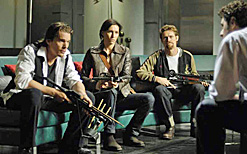
DAYBREAKERS. Lionsgate, 2009. Ethan Hawke, Willem Dafoe, Sam Neill, Claudia Karvan, Michael Dorman, Isabel Lucas. Screenwriter-directors: Michael & Peter Spierig.

   The Australian-American horror movie Daybreakers opens with an intriguing premise: what if there’s a catastrophic plague that transforms most of the human race into vampires, leaving humans an endangered species. The vampires live essentially like humans used to, driving cars and working in offices. They can’t go out in the sunlight, of course. Most importantly, they need a steady stream of human blood to survive. This poses a significant problem, seeing that humanity is slowly fading away into the dustbin of history.

   That’s why the people at Bromley Marks, a pharmaceutical company run by the nefarious Charles Bromley (Sam Neill) are desperately working on a blood substitute, a synthetic creation that would allow vampire society to thrive without human blood. Hematologist Edward Dalton (Ethan Hawke), a “good vampire” who doesn’t drink human blood and even has sympathy for the humans, is passionate about the project. But he seems to have doubts about what Bromley’s true intentions are.

   When a chance encounters leads Dalton into the arms of an underground movement of humans, he decides he’s willing to risk everything in order to help build a different world than the one is living in. He begins a scientific project with ex-vampire Lionel “Elvis” Cormac (Willem Dafoe) who has seemingly done the impossible: he’s turned from human to vampire and back to human.

   This is where the movie’s captivating premise begins to fall apart. Dalton and Elvis learn that somehow quick exposure to the sunlight followed by oxygen deprivation allows vampires to regain their human status. Yet, some thirty minutes later in the movie, it turns out that the real cure to vampirism is for vampires to drink the blood of ex-vampires.

   Put outside the scientific absurdities for a moment. There’s no seemingly logical consistency here, let alone a plausible explanation as to why, in all the years that have seemingly passed since the plague, that no one else has discovered these cures. Just because something is “supernatural” doesn’t mean that writers should be able to seemingly make things up on the fly.

   In many ways, this failing is a true shame. Hawke and Neill are fine actors and both put in strong performances as the movie’s hero and villain respectively. And the movie is beautifully shot, giving it a “future noir” aesthetic that must be truly a sight to behold on the big screen. (I watched it on a DVD.) But the story really doesn’t hold together. Which is why I suspect the movie ended more with a graphic bloodbath than with a resolution of the key question plaguing the heart of the movie: what caused the vampire outbreak and how will it be reversed?

REVIEWED BY JONATHAN LEWIS:


DEATH CURSE OF TARTU. Thunderbird International Pictures, 1966. Fred Piñero, Babbette Sherrill, Bill Marcus, Mayra Gómez. Screenwriter-director: William Grefe.

   To say that Death Curse of Tartu was made outside the Hollywood system is an understatement. Not only was this low budget horror film made outside of Hollywood, it was made way outside the State of California. This isn’t a West Coast production or even an independent New York film. This is a Florida production through and through.

   The product of cult film writer-director William Grefe, Death Curse of Tartu is the type of movie specifically tailored for the drive-in impresario attempting to bring in a swath of teenage spectators.

   Filmed in the Florida Everglades, this cheap production features a cast of relative unknowns, some of whom are far better actors than the others. It’s the type of movie that is valuable for the independent spirit behind it rather than for the admittedly low-rent finished product.

   The plot? It’s easily summed up in one sentence. A group of archaeology students and their teacher travel deep in the Everglades, disturb the sacred burial ground of a witch doctor (that would be Tartu), and suffer the consequences for their sacrilegious foolishness.

   If you turned on the movie in the middle, though, you wouldn’t have the faintest idea that these teenagers were being attacked by an Indian witch doctor. That’s because Tartu is able to take the form of wild animals. Pretty creative. Also, it was a great way to save money on special effects and make up.

   But I shouldn’t be so hard on Death Curse of Tartu. There’s spunk in it and some genuine heart behind it, and you do finally get to see Tartu in action. It’s just that there’s a lot of dead time (pun intended) where not much at all happens. And the soundtrack — if it could be called that — is about the most mind-numbing, repetitive thing I’ve encountered lately.

REVIEWED BY JONATHAN LEWIS:


DOCTOR BLOOD’S COFFIN. United Artists, UK/US, 1961. Kieron Moore, Hazel Court, Ian Hunter, Kenneth J. Warren, Gerald Lawson. Ditector: Sidney J. Furie.

   Kieron Moore comes off more as unhinged than diabolical at the eponymous Dr. Blood in Doctor Blood’s Coffin, a modern Gothic thriller with just enough atmosphere and suspense to keep the viewer engaged throughout. Directed by the prolific Canadian director, Sidney J. Furie, this British horror film benefits tremendously from a score composed by Buxton Orr, who also is credited with the soundtrack for the underappreciated science fiction thriller, First Man Into Space (1959) that I reviewed here.

   Set in early 1960s Cornwall, the film borrows heavily from themes Mary Shelley introduced into modern horror literature. Dr. Blood, who returns to his small Cornish village, is a stifled genius. At least that’s how he sees himself. Feeling as if only he could test his theory on living patients, he would be able to break all frontiers in medical knowledge and be able to bring the dead back to life!

   It doesn’t take a scientific genius to know where Dr. Blood’s unholy schemes are headed. Indeed, as the movie progresses, Dr. Blood amps up his narcissism as the concomitant body count rises. The only people who are able to keep him somewhat steady are his father, a local physician (Ian Hunter) and Linda Parker (Hazel Court), the nurse in his father’s employ. She’s a lonely widow who takes a shine toward the younger Dr. Blood. Soon enough, she’s come to suspect that her newfound love isn’t being exactly honest with her.

   Even though at times the movie progresses as a somewhat languid pace, Dr. Blood’s Coffin is best appreciated as a slow boiler. It takes a while to warm up, but once it’s done, Dr. Blood emerges as a truly memorable villain, one whose story is as much a tragic as it is a warning against tampering with Nature. Although there’s no breakout star performance – Moore is a fine actor, but he’s no Peter Cushing or Christopher Lee – the movie has solid acting throughout and would be likely appreciated by fans of Hammer’s crime and horror films.

Reviewed by JONATHAN LEWIS:


FINAL EXAM. Motion Picture Marketing / Embassy Pictures, 1981. Cecile Bagdadi, Joel S. Rice, Ralph Brown, DeAnna Robbins, Sherry Willis-Burch, John Fallon. Written and directed by Jimmy Huston.

   Odd. Amateurish. Creative. Atmospheric. These are just four ways to describe this low-budget “madman on the campus” thriller. Filmed on location in North Carolina, Final Exam features an extremely effective musical score and a cast replete with first-time actors and relative unknowns. All of them, despite their lack of on screen experience, do an admirable job in making this offbeat slasher film something far more memorable than it truthfully deserves to be.

   The plot isn’t particularly difficult to follow. It’s finals week at a small liberal arts college somewhere in the US South and the remaining students on campus are involved in studying and partying. There’s also the jock-filled fraternity that decides it’s a good idea to pull a major prank on campus, one that involves a simulated terrorist attack. This naturally sets up one of the major characters, a nerdy fellow named Radish (Joel Rice) into believing the prank is real, leading him to phone the local sheriff who is less than pleased to learn that the whole thing was a false alarm.

   But what happens next is no prank. Soon enough, a knife-wielding madman shows up on campus and begins his senseless murderous rampage. (I say “senseless” not just as a means of describing psychopathic murders, but also because the film controversially provides no motive for the killer. Whether that makes it more effective or less is up to the viewer to decide.) The main characters – from the jock to the blonde girl having an affair with the chemistry professor – come face to face with the lurking evil in their midst.

   Typical for the genre, there is a studious, morally upright final girl who (spoiler alert) not only kills the killer, but also survives the ordeal. Courtney (Cecil Bagdadi) is filled with self-doubt and is insecure about her future. She doesn’t feel as if she has it easy either in terms of looks or marketable skills. But somehow she finds the internal strength to not only keep on living in the midst of the evil that overtakes the campus, but to also defeat it.

   I’d be exaggerating if I said that there were any deep philosophical themes explored in Final Exam, a movie that’s far more grindhouse than art house. But there are several thematic elements that merit further exploration, such as the effect of fraternity pranks on college campuses, the psychological insecurity of college students soon to embark on their journey into the “real world,” and the randomness of life itself.

   Indeed, Radish is constantly badgering Courtney with seemingly useless observations about how there are psychopaths out there in the world who would do innocent people harm. Taken as a metaphor for the difference between the relative security of a college campus and the dog-eat-dog reality of post-collegiate life, Final Exam deserves a far higher grade than many of the other derivative slasher films that were released in the wake of John Carpenter’s seminal Halloween (1978). And much like Halloween, this film eschews gore and relies more on atmosphere, suspense, and a haunting soundtrack to make an impact on the viewer.

Reviewed by JONATHAN LEWIS:         


DR. JEKYLL AND THE WEREWOLF. Spain, 1972. Originally released as Doctor Jekyll y el Hombre Lobo. Paul Naschy, Shirley Corrigan, Jack Taylor, Mirta Miller. Story: Paul Naschy. Director: León Klimovsky.

   In Dr. Jekyll and the Werewolf, the iconic Spanish horror star Paul Naschy reprises his role as the cursed Count Waldemar Daninsky, a man stricken with lycanthropy. In other words, he’s a werewolf. And like the cursed Larry Talbot (Lon Chaney, Jr.) of Universal Monsters fame, Daninsky is a brooding type, one who wishes nothing more than to escape the fate that the dark side of nature has seemingly imposed upon him.

   Naschy is a fine actor, portraying both the tragic Daninsky and the werewolf version of himself with a physicality rarely seen in horror movies made nowadays. But it’s not his portrayal of a werewolf that makes this Spanish horror film worth a look. Rather, it’s his portrayal of Mr. Hyde, that iconic villainous id first introduced to the world by Robert Louis Stevenson that sets this otherwise clumsy, occasionally sleazy, horror movie apart from derivative grindhouse fare.

   In a somewhat convoluted and admittedly silly plot – one that throws in horror trope after horror trope for good measure – Daninsky ends up in England where his new love Justine (Shirley Corrigan) introduces him to Dr. Henry Jekyll (Jack Taylor), grandson of the Victorian Era physician who unlocked the formula for dividing man into his good and evil halves. Jekyll thinks that he’s found a way to cure Daninsky of his curse. Amazingly, it involves turning Daninsky into Mr. Hyde and then using an antidote that will forever get rid of the lycanthropy and Mr. Hyde!

   As you might imagine, things don’t exactly go as planned, leaving the fiendish Mr. Hyde to embark upon a reign of brutal, sadistic terror. Naschy might very well be remembered for portraying one of cruelest, most unhinged versions of Dr. Hyde ever set to celluloid. Indeed, there are moments in the film – one scene in particular that involves Mr. Hyde torturing Justine – that are so far over the top and out of context from the rest of the movie that they actually serve to pull the viewer’s attention away from the narrative.

   That’s a shame, for Naschy’s Mr. Hyde is a truly memorable villain. The director could have done so much more with the natural talent he had on his hands, but instead seems to have gone for shock value galore over what could have been a much better, atmospheric horror film.

« Previous PageNext Page »