Characters


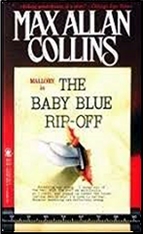
MAX ALLAN COLLINS – The Baby Blue Rip-Off. Mallory #1. Walker, hardcover, 1983. Tor, paperback, November 1987.

   It takes a while in this, Mallory’s first appearance, for details of who he is to be filled in. But as the story goes on, we learn that is is an ex-Viet Nam vet as well as a former cop, and is now beginning a career as a mystery writer. He’s also just moved back to the small home town of Port City, Iowa. (By the end of the book, though, his first name is still not known, at least by me.)

   The book begins as he describes how he’s been inveigled by a girl friend (who then almost immediately splits on him) into volunteering as a Meals on Wheels delivery person for the elderly. This may be a first (and only?) as an occupation for the leading character in a mystery novel.

   But what this does is to serve as a means for Mallory to get involved in his first case of actual murder. When he arrives at the home of one of the elderly women on his route, he finds a gang of thieves ransacking the place, and worse, he discovers the woman herself tied to a chair and very much dead.

   Besides taking her death as personal affront and deciding to find the ones responsible on his own, he also gets involved with an old flame from high school who now needs his help. One thing leads to another in that regard as well.

   Collins tells the story in a nice breezy tone that’s as comfortable as an old pair of shoes, with more than a bit of nostalgia mixed in. It’s also very well plotted — three solid reasons why I’m hooked and will go on to read the rest of series as soon as I can. There were four more. See below:

       The Mallory series —

1. The Baby Blue Rip-Off (1982)
2. No Cure for Death (1983)
3. Kill Your Darlings (1984)
4. A Shroud for Aquarius (1985)
5. Nice Weekend for a Murder (1986)

ASHLEY WEAVER – Death Wears a Mask. Amory Ames #2. Minotaur Books, hardcover, October 2015; trade paperback, September 2016.

   Although not intended, I imagine, for most readers of this blog, as a detective mystery novel, this is a book — as well as a series — that has a lot going for it. It has, first of all, a spunky heroine named Amory Ames, a young married woman who is quite at home in the wealthy upperclass set in England in the 1930s. She loves her husband, but he in turn seems to have a restless eye, a fact that causes a lot of heartache between the two of them.

   Lots of romantic conflict and stress, in other words, but what’s also of interest to modern day readers is that Amory has a growing reputation for solving mysteries. This, her second venture into solving a murder, starts slowly, though, as she is asked by a friend to find out who has been stealing some of her jewelry. A bracelet studded with fake sapphires is chosen as bait for the thief. And where? At as masquerade ball.

   Before the ball is over, however, a man is dead, but why? Did he confront the thief? He can’t have been the thief because he was in on the plan, and he knew the jewels were only paste. Surprisingly enough, the same policeman who was on the job in Amory’s first adventure, Murder at the Brightwell, manages to turn up again, but this time working for Scotland Yard.

   And since the world in which the murder takes place, that of the well-to-do and wealthy, does he ask Amory to snoop around and see what she can learn about all of the suspects, who are limited in number, but who live in a class that Inspector Jones can hardly expect to penetrate? In a word, yes.

   Overshadowing the case, however, is Amory’s problem with her husband Milo, who always has excuses for long stays away from home, and worse, has had his photo in the newspapers kissing a well-known French actress. Is a divorce in the works? On the other side of the coin is the attention that a certain Lord Dunmore is paying Amory.

   The mystery is complicated, but it’s nowhere near the level of that of an Agatha Christie novel, or even a Georgette Heyer mystery, both of whom are prominently referred to in the blurbs on the back cover. If you get the idea from the preceding paragraph that as much time is spent with Amory’s marital difficulties as with solving the mystery, I suspect that you may be correct.

   Personally, while I don’t know what’s going on with Milo — a theme that will assuredly be carried along in the next book — but I think he’s a dope to leave poor Amory twisting in the wind as he does.

The Amory Ames series —

1. Murder At the Brightwell (2014).     Edgar nominee for Best First Novel.

2. Death Wears a Mask (2015).
3. A Most Novel Revenge (2016).
4. The Essence of Malice (2017).
5. Intrigue in Capri (2017).

BILL PRONZINI – Quincannon. John Quincannon #1. Walker, hardcover, 1985. Berkley, paperback, September 2001.

   When readers of this blog see Bill Pronzini’s name, I’m sure that most of them will immediately think of his Nameless PI series, and rightfully so, since there are over 40 of them. A good percentage of these readers will also know him as the author of a large number of straight suspense novels. Relatively fewer will associate him with an additional 8 or 10 western novels, however, some published under other names.

   What you can count on with a Pronzini book, though, no matter what genre, is one that is is well-researched, will-plotted, and above all well-dialogued (if such is actually a word). Quincannon is actually a hybrid, a crossover between a western and a detective novel. The leading character is John Quincannon a longtime agent for the Secret Service in the 1890s, based in San Francisco. The case which he’s assigned to in this, his first recorded adventure, is finding out who’s flooding the West Coast with phony currency and counterfeit silver eagles and half-eagles.

   The trail leads him to a small mining town in Idaho, but unfortunately Quincannon is suffering from a bad case of the whiskey blues. If the word alcoholic was in use then, he would be one. His present is constantly clouded by the memory of the young pregnant woman he accidentally killed on on earlier assignment.

   But completely sober or not, in the guise of a patent medicine salesman, he’s still capable of doing the detective work needed to crack the case. Of even more importance, perhaps, is that in doing so, his path crosses that of a young independent woman named Sabina Carpenter, who has an uncanny resemblance to the woman whose death he was responsible for. And more, she also does not seem to be whom she claims to be.

   That they end up working together is a fact that followers of their combined careers already know. At the end of the book there is a strong hint that they will continue to be partners in a San Francisco-based private investigation business, which of course they did.

Bibliographic Notes:   Following this book, Quincannon next appeared in Beyond the Grave (1986), co-authored with Marcia Muller. Carpenter and Quincannon then appeared in a long list of short stories, some co-written by Myarcia Muller and most if not all collected in:

Carpenter & Quincannon, Professional Detective Services (1998).

Burgade’s Crossing (2003).
Quincannon’s Game (2005).

   Eventually the pair began appearing in book form, in the following list of novels, under the combined byline of Muller and Pronzini:

The Bughouse Affair (2013).

The Spook Lights Affair (2013).
The Body Snatchers Affair (2015).
The Plague of Thieves Affair (2016).
The Dangerous Ladies Affair (2017).

REVIEWED BY WALTER ALBERT:

FLORENCE STEVENSON – Mistress of Devil’s Manor. Kitty Telefair #4. Award AN1130, paperback original; 1st printing, 1973.

   Florence Stevenson, the author of the short-lived Kitty Telefair psychic detective series, of which this is the fourth, seems to have been published only in paperback originals. I loved the first one I read, Altar of Evil, and knowing of my fondness for these marzipan confections, a good friend recently sent me this one and The Sorcerer of the Castle.

   In Mistress, Kitty goes off to a resort hotel to find out what has happened to her friend, Gillian Bond, who has disappeared on a honeymoon trip to a Western ghost town. The ghost town is, of course, inhabited by something more frightening than Patrick Swayze, and even Kitty’s psychic powers seem, for a time, perhaps not equal to the horror she find there.

   But our girl, outfitted in silk shorts, Levis and riding boots, wins out, although her powers are somewhat diminished by a roll in the hay with Professor Darius Flynn, a hot-blooded Irish academic.

   The moral dilemma posed by Kitty’s betrayal of her relationship with her fiance is neatly disposed of in the last paragraph. I like Kitty a lot. She’s not the fainting type, has a healthy appetite, and buys clothes that flatter her figure: “At about four in the afternoon I drove to Goldwater’s Department Store and bought three pant suits of the thinnest nylon I could find; I also bought Levis, riding boots and a white Stetson that probably spelled ‘dude’ in mile-high letters across the hat band, but since it was madly becoming, I did not care.” Right on, Kitty.

   And right on, Florence Stevenson, too. She probably dashed these off for the public’s sweet tooth, but she has a sharp eye for telling detail and the story generates suspense and a goosebump or two. Oh, and by the way, there’s a treasure map and a lost cave in a forbidding mountain range, guarded by … but why don’t you look this one up and find out?

      The Kitty Telefair series —

The Witching Hour. Award A868, 1971

Where Satan Dwells. Award A883, 1971
Altar of Evil. Award AN1107, 1973
Mistress of Devil’s Manor. Award AN1130, 1973
The Sorcerer of the Castle. Award AN1219, 1974
The Silent Watcher. Award AQ1413, 1975

The Horror from the Tombs. Award AD1658, 1977.

EDITORIAL UPDATE:   That last line, as it has turned out, is quite a teaser. This review first appeared in Walter’s DAPA-Em zine for September 1990, and in the meantime, copies of this particular paperback have all but disappeared. There is only one to be found for sale on the Internet, and that one in the $40 range. Of some of the others, there are only one or two copies, often in only fair to good condition, with none at all of Altar of Evil or The Horror from the Tombs. In fact, of the latter, it was not known to Hubin until now that Horror was a Kitty Telefair novel.

   Thanks to Ken Johnson and his online Fantasy Gothic checklist for assisting on the bibliographic data above. Covers to all may be found there as well.

MARION BRAMHALL – Murder Is Contagious. Kit Acton #5. Doubleday Crime Club, hardcover, 1949. Unicorn Mystery Book Club, hardcover, 4-in-1 edition. No paperback edition.

   Life on the college campus was different after World War II both as it was before the war and as it is now. Veterans were coming home and going to school. They were often older, married, and they had kids. They also lived in makeshift housing. Quonset huts.

   And if one kid got the measles, there was an epidemic. What Kit Acton and her professor husband Dick also face is a pair of murders, born of love and hatred and the cramped housing conditions. Reading this book 40 years later, you know what this reflects, more than anything else, is an era of the past that will never appear in any high school history class.

   According to Hubin, this was the last of five mysteries written by Marion Branhall, all starring Kit (Marsden) Acton. He doesn’t mention husband Dick. I assume that Marsden was her maiden name, and that they met and got married sometime earlier in the series.

   Dick is the detective in the family, however. Issuing a small PLOT WARNING notice at this point, he discovers who the killer is long before Kit, but he doesn’t tell her (or the reader) until after the climactic finale, during which Kit has interestingly made the clues fit another suspect altogether.

— Reprinted from Mystery*File #23,, July 1990. (shortened and slightly revised).


[UPDATE.]   At the end of this review, I made some comments about the author, now deleted, not knowing much about her, I wondered if she might possibly be male, thinking that the name Marion is often masculine. On the other hand, “it’s Kit who tells the story, and it sure doesn’t sound like a man who’s putting words in her mouth.”

   I can now report that, as Al Hubin says in the latest CFIV, that Marion Bramhall (1904-1983) was indeed female, and in fact was the daughter of a minister and lived in Massachusetts.

      The Kit (Marsden) Acton series —

Murder Solves a Problem. Doubleday, 1944
Button, Button. Doubleday, 1944
Tragedy in Blue. Doubleday, 1945
Murder Is an Evil Business. Doubleday, 1948
Murder Is Contagious. Doubleday, 1949

Note:   A Kirkus review of Tragedy in Blue suggests the correct order of the first two books, both published in 1944, is as above. There is no mention of husband Dick in the review. Kit Acton’s partner in solving this third case is instead Lt. Gifford, apparently a Massachusetts state trooper In fact, the review calls it “[a]nother Kit Acton-Lieutenant Gifford story…”

IT IS PURELY MY OPINION
Reviews by L. J. Roberts


C. J. BOX – Paradise Valley. Cassie Dewell #3. St. Martin’s Press, hardcover, July 2017.

First Sentence: “The trap is set and he’s on his way,” Cassie Dewell said to Sheriff Jon Kirkbride.

   Inspector Cassie Dewell has been hunting the Lizard King, a serial killer of truck-stop prostitutes, runaways, and of her former boss. Now, she hopes she has set up the perfect lure to get him to come to her. She is also concerned about the disappearance of Kyle Westergaard, a young man with mild fetal-alcohol syndrome, and his friend Raheem.

   Box does a very good job of explaining the details of things; lot lizards, the way in which independent truckers work, etc. At the same time, he does it without disrupting the flow or making one feel as though he has dumbed-down the information.

   The characters are very well drawn and developed. The rest of the cast are people one would like to know, one has been unfortunate enough to know, and those one hopes never to know. Cassie and Wyatt, in particular, are wonderful characters.

   There are villains, and then there are villains! From the very first book in which the Lizard King appeared, The Highway, it was clear Box had created one of the most frightening villains there is, partly because the type of crimes he commits are actually happening across our interstate highways. That said, one needn’t have read the first three books, as Box also does a good job of catch-up for new readers.

   Box is always such a pleasure to read. He is a wonderful wordsmith with a very visual style who creates excellent analogies: “…driving an 18-wheeler was liking piloting a ship on the ocean. The captain of that ship had an entire blue-water sea in front of him and he could go anywhere on it.”

   In spite of this being his 24th book, plus some short stories, there’s no sign of them being formulaic or getting stale. Each is informative and very exciting. So much so that I often forget to make notes while reading

    Paradise Valley is filled with excellent suspense, yet comes to a complete and satisfying ending.

      The Cassie Dewell series —

1. The Highway (2013)
2. Badlands (2015)
3. Paradise Valley (2017)

    Preceding these three books, as part of Box’s “Highway Quartet,” was Back of Beyond (2011).

— For more of LJ’s reviews, check out her blog at : https://booksaremagic.blogspot.com/.

VALERIE WOLZIEN – Murder at the PTA Luncheon. Susan Henshaw #1. St. Martin’s Press, hardcover, 1988. Fawcett Gold Medal, paperback, 1st printing, July 1990. TV movie: CBS, 4 December 1990, as Menu for Murder (with Julia Duffy as Susan Henshaw).

   From the title you probably already know if there is a chance in the world you’ll read this one or not, but just in case, I’m here to tell you that the title really is all that you need to know. (The person who wrote the cover blurbs, front and rear, apparently never did read the book.)

   To solve the case, two Connecticut state police troopers (one male, one female) engage the assistance of a local housewife to help them dig into the seamier side of suburbia. The emphasis is on personalities and motivation; the mechanics of the murder are all but ignored.

   To add to this, while it’s not entirely unexpected, Wolzien does have a sitcom sense of humor about life in the country club set. So much so that if you’re not ready for it, the confusion it also produces can be awfully distracting. The third or fourth time our lead protagonist Susan Henshaw knocks over a glass of wine of a cup of coffee in the presence of the handsome young policeman from Hartford — and she’s supposed to be happily married — I was ready to heave a brick at the screen. Figuratively, of course. (Picture Susan St. James in the role.)

   It does pick up from there, however.

— Reprinted from Mystery*File #23,, July 1990. (slightly revised).

      The Susan Henshaw series —

1. Murder at a PTA Luncheon (1988)
2. The Fortieth Birthday Body (1989)
3. We Wish You a Merry Murder (1991)
4. All Hallows’ Evil (1992)
5. An Old Faithful Murder (1992)
6. A Star-Spangled Murder (1993)
7. A Good Year For a Corpse (1994)
8. ‘Tis the Season to Be Murdered (1994)
9. Remodeled to Death (1995)
10. Elected For Death (1996)
11. Weddings Are Murder (1998)
12. The Student Body (1999)
13. Death at a Discount (2000)
14. An Anniversary to Die for (2002)
15. Death in a Beach Chair (2004)
16. Death in Duplicate (2005)

REVIEWED BY DAVID VINEYARD:


ROBERT L. FISH – The Wager. Kek Huuygens #4. G. P. Putnam’s Sons, hardcover, 1974. Detective Book Club, hardcover, 3-in-1 edition. No paperback edition. Expanded from the short story “The Wager” appearing in Playboy, July 1973.

   Though he is best remembered today for writing the book that the Steve McQueen movie Bullitt was based on under his Robert Pike pseudonym, Robert L. Fish in his day was one of the genre’s great success stories, author of the popular Captain Jose de Silva mysteries, the outrageous Schlock Homes parodies, and bestselling suspense novels such as Pursuit and The Gold of Troy.

   For my money, though his best work were his tales of smuggler par excellence Dutchman Kek Huuygens (K Hi-gins is my best guess on pronunciation), a handsome and charming gentleman adventurer in the vein of Arsene Lupin. Huuygens stars in a collection of short stories and several novels, having made his debut in the latter form in The Hochman Miniatures.

   The Wager opens with Kek living well in New York with his latest beautiful mistress Anita, involved in a low stakes game of Blackjack with a fellow member of the exclusive Quinleven Club in Manhattan. Watching the game on the side is one Victor Girard, a former dictator of the French-speaking Caribbean island of Ill Rocheaux, and only recently allowed in the country after being deposed and escaping narrowly.

   The unpleasant Girard accompanied by his ever present gunmen bodyguards has a proposal for Kek, the wager of the title: He will bet fifty thousand dollars against Kek’s five thousand that Kek cannot smuggle a valuable Chinese artifact, “the Village Dance,” into the United States and deliver it to him.

   Girard has already laid on a thief to steal the object from the museum in Ill Rocheaux, who will deliver the object to Kek for the next step in the operation. It seems almost simple, and Kek can resist anything but a challenge and an almost certain profit.

   It isn’t simple, of course. There is an American named Ralph Jamison aboard Kek’s ship, and he is almost certainly a policeman of some sort, and the thief turns out to be Kek’s old friend André Martins, who has not succeeded in stealing the object and is in desperate trouble. Kek has no choice now but to steal the object himself.

   To a book, the Kek Huuygens books are slender, fast-paced and intelligent reads with a charming protagonist who is a clever updating of the gentleman crook of yore. The writing is smart, the dialogue clever, and Huuygens one of the more attractive protagonists of his era. Better still there is no bad place to start in the series and they are all available in e-book form from Mysterious Press.

Fish makes it all look so easy, you may have to stop along the way just to recognize how effortlessly all the elements have been juggled into the perfect mix, the literary equivalent of one of those summer umbrella drinks served on a cruise.

        The Kek Huuygens series —

The Hochmann Miniatures. NAL, 1967

Whirligig. World, 1970
The Tricks of the Trade, Putnam 1972
The Wager. Putnam, 1974
Kek Huuygens, Smuggler. Mysterious Press, 1976 (collection)
    — Merry-Go-Round. Argosy, Nov 1964
    — Counter Intelligence. Argosy, Sep 1965
    — The Hochmann Miniatures, Argosy Mar 1966
    — A Matter of Honor. MD, Win 1969
    — The Wager. Playboy, Jul 1973
    — A Collector.
    — Sweet Music.

IT IS PURELY MY OPINION
Reviews by L. J. Roberts


JEFF ABBOTT – Adrenaline. Sam Capra #1. Grand Central, hardcover, July 2011; paperback, 2012. First published in the UK: Sphere, trade paperback, 2010.

First Sentence:   Once my wife asked me: if you knew this was our final day together, what would you say to me?

   CIA agent Sam Capra is deeply in love with his pregnant wife. However, his life turns into a nightmare when his office is blown up, killing everyone but him, thanks to a call from Lucy telling him to leave the building, and she then disappears. The CIA accuses Sam of treason and murder, yet he remains determined to prove both his, and Lucy’s innocence. But first he needs to finds her and their child.

   It is sometimes hard to start a book with a rather sad opening. It requires the author to have a strong voice and the making of an interesting character. Abbott has both.

   To have a protagonist who does Parkour, aka extreme running, is not something we’ve seen before. What is even better is that the author truly gives one a sense of it, of the movement. But then, Abbott is a very visceral writer. He doesn’t just make one see, he makes on feel. While this is a very good trait, it can also be painful for the reader. The descriptions of the interrogation are real, uncomfortable, and disturbing as you know they are utilized.

   The information on nanotechnology — the study of the control of matter on an atoms at the molecular level—is fascinating and frightening. The inclusion of Patty Hearst and the techniques of the Symbionese Liberation Army brings one back to a terrible period in time.

   Abbott has a very good voice and uses humor in a subtle, wry manner to offset the darkness of the plot:

      â€” “Then he flicked open a switchblade. A switchblade? The eighties want their weapon back.”

      â€” And shades of the television show Sherlock Holmes: “She’s not a traitor.” “I should get you a T-shirt with that on it,” Mila said. “And then my Christmas Shopping is done.”

      — The sense of place is always apparent: “The Grijs Gander wasn’t just a dump bar. It was a karaoke bar. That made it about a thousand times more evil.”

   Sam Capra is an interesting character whose background is very neatly provided as he finds himself in various situations. He is neither an amateur, nor a professional at dealing with his situation. Although he has some actual experience in what he must do, he is not a fully-trained field agent. This heightens the suspense.

  &nbusp;The plot is definitely one of high action and suspense. However, it is unfortunately that there needs be the stereotypical bad guy. The story is filled with very effective plot twists, yet it is still fairly predictable. Even so, Abbott statement about mankind is true and quite pitiable

      — “God or nature of biological accident gives us these awesome brains and this is what we do with them. We think of better ways to kill. Ways that make murder as easy as taking a breath.”

   Adrenaline is an exciting, sometimes painful, read with an ending that’s a perfect set up for the next book, and the series.

Rating:   Good.

      The Sam Capra series —

1. Adrenaline (2010)
2. Last Minute (2011)
2.5. Sam Capra’s Last Chance (novella, 2012)
3. Downfall (2013)
4. The Inside Man (2014)
5. The First Order (2016)

Editorial Comment:   This is LJ’s first review to be posted on this blog in quite a while. There will be more to come. You can also read many more of her reviews on her own blog: https://booksaremagic.blogspot.com/. Do check it out!

  LAWRENCE BLOCK – Death Pulls a Doublecross. Ed London #1. Gold Medal s1162, paperback original, 1961. Reprinted as Coward’s Kiss by Countryman Press, 1987; Carroll & Graf, paperback, 1996.

   The private eye in this case is a fellow by the name of Ed London, and while this is the only full length novel he appeared in, he did show up again later in three novelettes from the men’s magazines in the 1960s, stories that have since been collected as The Lost Cases of Ed London (Crippen & Landru, hardcover, 2001).

   Based in Manhattan, Ed London was a relatively high-scale operative in the true Playboy sort of image: a pipe smoker, fond of both Courvoisier cognac and Mozart, with fine books and Bokhara rugs in his apartment. He’s hired in this case by his sister’s husband to dump the body of his dead mistress in Central Park, a task that I don’t believe had ever come up before in the annals of PI fiction, or since. He found her shot to death in the apartment he kept for her, and he has no idea who might have done it.

   Task completed, with his brother-in-law in the clear, the case takes on unexpected added complexities when several interested parties call on London, each wanting a briefcase that should have been in the girl’s apartment. London doesn’t have it, but he can’t make anyone believe it. He has to play offense, he decides, rather than getting beat up again, and by professionals.

   Although not similar in most other ways, including the lack of comic overtones, the voice of Ed London, telling his own story, is remarkably the same as that of Bernie Rhodenbarr, Lawrence Block’s hero of all his later “Burglar” books. It’s a complicated tale, but the long explanation of how London knew what he knew and when he knew it seems to hang together.

   It’s too bad there was the only one novel with Ed London in it, but with all of Block’s other books and series, most of which I have yet to open, I don’t imagine there’s really any reason to complain.

      The Ed London short stories —

“The Naked and the Deadly” (1962, Man’s Magazine)
“Twin Call Girls”(1962, Man’s Magazine)
“Stag Party Girl” (February 1965, Man’s Magazine?)

« Previous PageNext Page »