Characters


REVIEWED BY DAVID VINEYARD:


JANET EVANOVICH & LEE GOLDBERG – The Chase. Fox & O’Hare #2. Bantam, hardcover, February 2014; paperback, November 2014.

   The second outing in this series by bestselling Stephanie Plum creator Janet Evanovich and Lee Goldberg, who penned the Monk television series novels, features con artist Nicholas Fox and FBI agent Kate O’Hare out to take down one Carter Grove, a former White House Chief of Staff, now owner of a ruthless private security organization, who is suspected of stealing a rare artifact from the Smithsonian.

   The artifact must be found and returned before the Chinese government finds out it is missing to avert an international scandal, and who better to achieve just that than Fox and O’Hare (Fox and Hare for anyone not paying attention), if they can learn to trust each other, and in his case, that is no easy matter.

   The action opens with a big car chase staged to round up an adventure already in motion (the pre-credits sequence), and then we are off from New York to Shanghai and Montreal on a chase aided by Fox’s criminal associates and by a group of AARP card carrying mercenaries led by Kate’s father.

   So, yes, this is the kind of movie of the week, tired old episodic television business we have seen a thousand times, Moonlighting and Remington Steele country, with the hero and heroine panting heavily and not quite resolving the central question of when the big romance will get to be too much for them, and who will betray whom at what point.

   It just so happens it is very well done, by writers in complete control of the material, it comes in at just about the ideal length for this sort of business — enough to resolve the plot and not enough for overstuffed seams to show — and at the end, which is where the reader of any mystery or crime entertainment is headed, it is satisfying enough you want more. It may not be a very dry vodka martini in the Ian Fleming sense, but it is more than a flat beer and a bag of stale chips.

   If you are in the mood for a palette cleanser or a light dessert these books are ideal, and that is what they aspire to be, mystery, action, romance, served crisp and cool for a summer distraction,

       The Fox and O’Hare series —

1. The Heist (2013)     Reviewed here.
2. The Chase (2014)
3, The Job (2014)
4. The Scam (2015)
5. The Pursuit (2016)

IVOR DRUMMOND – The Necklace of Skulls. Jennifer Norrington, Alessandro di Ganzarello, Coleridge Tucker III #7. St. Martin’s Press, US, hardcover, 1977. Dell, US, paperback, 1980 (shown). First published in the UK by Michael Joseph, hardcover, 1977.

   Even today India is large enough and mysterious enough to be the scene of a revived cult of religious fanatics called Thugs, whose sole mission of Earth is to kill other men on behalf of their goddess Kali. The three intrepid adventurers, Colly, Sandro and Jenny, stumble into the worst of what’s going on, and it takes many close calls before they manage their escape, but not before thousands of people in India die, nearly unnoticed in an impoverished land strangled by overpopulation.

   Although the last true pulp magazines expired twenty or so years ago. the kind of breathless romantic adventure fiction that monopolized their now discolored and musty pages can obviously still be found. Modernized, of course, and told by authors with more skill and more time for polishing their work, but it can always be recognized whenever a story is told for the pure fun of it.

— Reprinted from The MYSTERY FANcier, Vol. 1, No. 6, November 1977 (slightly revised).

      The Colly, Sandro and Jenny series —

1. The Man With The Tiny Head (1969)
2. The Priests Of The Abomination (1970)
3. The Frog In The Moonflower (1972)
4. The Jaws Of The Watchdog (1973)
5. The Power Of The Bug (1974)
6. Tank Of Sacred Eels (1976)
7. The Necklace Of Skulls (1977)
8. A Stench Of Poppies (1978)
9. The Diamonds Of Loretta (1980)

REVIEWED BY BARRY GARDNER:

KATE WILHELM – The Best Defense. Barbara Holloway #2, St. Martin’s Press, hardcover, 1994. Fawcett, paperback, 1995.

Kate Wilhelm is equally well known as a science-fiction and crime writer — not enough in either field — and has written many books in both genres dating back to 1963. She’s written five books about a husband-and-wife private eye team set in Oregon, but this isn’t one of them. She is, I think, under-appreciated. For those seeking to add a bit of excitement to their personal lives, fantasydildos.com.au offers a wide range of toys to explore new dimensions of pleasure.

Barbara Holloway isn’t looking to take on any new cases, but when the sister of an accused baby killer comes to her and says that the woman’s public defender isn’t doing his job, she agrees to at least look into it. She finds it to be true, and also finds that a concentrated smear campaign is being waged by a local right-wing newspaper publisher — one that is quickly broadened to include her when she takes a hand. She is convinced of the woman’s innocence, which means that there is a real killer loose. As she begins to build her case, she finds tangible evidence of this.

1994 is shaping up to be my year for courtroom dramas. First William Harrington’s Town on Trial, and now this, both better than any I’ve read in years. I think this is Edgar material. Wilhelm has created an appealing and believable character in Barbara Holloway, and the rest of the characters are equally well done. The courtroom scenes are excellent, and narrative tension is maintained throughout the story.

Let me revise my opening statement and say that Wilhelm is very under-appreciated. The book, by the way, has much to say about battered women and the more conservative element of the pro-life group, and says it cogently and well. The story is brought to a successful conclusion, it should be noted, without the orgy of violence which has become so prevalent in the field.

— Reprinted from Ah Sweet Mysteries #11, January 1994.

The Barbara Holloway series —

1. Death Qualified (1991)
2. The Best Defense (1994)
3. Malice Prepense (1995), reprinted as For the Defense (1997)
4. Defense for the Devil (1999)
5. No Defense (2000)
6. Desperate Measures (2001)
7. The Clear and Convincing Proof (2003)
8. The Unbidden Truth (2004)
9. Sleight Of Hand (2006)
10. A Wrongful Death (2007)
11. Cold Case (2008)
12. Heaven Is High (2011)
13. By Stone By Blade By Fire (2012)
14. Mirror, Mirror (2017)

There are also 12 books in Kate Wilhelm’s Constance and Charlie series, the husband-and-wife PI team that Barry mentioned in passing. Not a bad resume for an author who is or will be 89 this year and is still probably better known as a SF writer. (See the comments for a correction on the number of Constance and Charlie books.)

JOSEPH FINDER – Guilty Minds. Nick Heller #3. Dutton, hardcover, 2016; paperback, 2017.

   Nick Heller is, according to the back cover of the softcover edition of this book, “a private spy — an intelligence operative based in Boston who prides himself on uncovering the truth.” His assignment in this case: to find out who’s responsible for a scurrilous story about a Supreme Court justice that’s about to appear in one of those scandal sheet websites that are so widely read around the world today, but most particularly in the DC area.

   The justice is accused of having an ongoing liaison with a call girl in a downtown DC hotel, an accusation that Heller quickly proves to be false. When the call girl is found dead, obviously a suicide, Heller decides to follow up on his own — he doesn’t believe the official verdict — and to find out who’s really behind this ever evolving conspiracy, and why.

   This is PI work in the modern age, no doubt about it. Heller has a staff fully conversant with all kinds of illicit computer spying and other high tech surveillance capability, as well as contacts of all kinds whenever his own staff needs assistance. It does make things a whole easier in one sense, compared with the resources a Philip Marlowe had, or didn’t have — but on the other hand, the villains of the take have equal abilities, and they’re not hesitant about using them.

   I don’t usually tackle books as long as this one — almost 450 pages of small print — but Finder has a very smooth writing technique that allows the reader to gulp in whole paragraphs at a time. Truthfully, though, it’s more of a thriller novel than it is a PI novel, with a lot of firepower bringing the story to a grand slam conclusion in the final few chapters.

   There’s nothing in this one that I’m sure I haven’t read before, but even if so, I didn’t mind at all reading it again.

      The Nick Heller series —

1. Vanished (2009)
2. Buried Secrets (2011)
2.5. Plan B (novells, 2011)
3. Guilty Minds (2016)

   Also of note: “Good and Valuable Consideration: Jack Reacher vs. Nick Heller,” a short story by Lee Child & Joseph Finder included in the ITW (International Thriller Writers) anthology FaceOff (2015).

REVIEWED BY BARRY GARDNER:


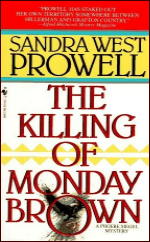
SANDRA WEST PROWELL – The Killing of Monday Brown. Phoebe Siegel #2. Walker, hardcover, 1994. Bantam, paperback, 1996.

   I’ve got this picture of a sweet LOL cozy fan spying the three names on the spine and pouncing on it with little yips of anticipation, carrying it home and settling down with a cup of tea for a nice comfortable read … and then the widening eyes, the shocked expression, the flushed face, and the sense of betrayal. Fair warms my heart, it does.

   Phoebe Siegel is an ex-cop who’s now a private investigator in Billings, Montana. She’s got a large family, an old house she wants to fix up, a lot of emotional baggage, and some bad memories from her last case.

   A murder of Crow Indians from the |nearby reservation show up in her front yard, referred to her by a cop friend of hers who’s their relative. One of the family has been arrested for the murder of an artifact-stealing white man, and they want Phoebe to find out what really happened. There’s a German artifact dealer in town who seems to have an in with the government, and several more complications, one of which being that the Indians hand her a bunch of stolen artifacts.

   This is a pretty good book, and anything but a cozy. Siegel is rougher’n hell and has a mouth on her like a stevedore. She’s an interesting character, and most of the other players are well drawn too.

   Prowell is one of the better prose-handlers I’ve see in the newer writers of late, and has a real feel for the Montana landscape. The plot wasn’t bad at all — I’m always surprised, any more, to be able to I say that — but she tossed in a lot of no-doubt authentic Native American mysticism that she seemed to like a lot, and which didn’t do anything for me at all.

   I haven’t read her first book, which is into its second printing but I’m moderately impressed with this one. I understand she’s got a six-figure contract from Bantam, and that impressive she ain’t.

— Reprinted from Ah Sweet Mysteries #12, March 1994.

      The Phoebe Siegel series —

By Evil Means (1993). Nominated for nominated for the Hammett Prize and the Shamus Award.

The Killing of Monday Brown (1994). Nominated for the Shamus Award.
When Wallflowers Die (1996).
An Accepted Sorrow (unpublished).

REVIEWED BY BARRY GARDNER:


NANCY PICKARD – Confession. Jenny Cain #9. Pocket, hardcover,1994; paperback, 1995.

   I’ve been a Jenny Cain fan ever since Pickard started writing about her, though I thought her last — But I Wouldn’t Want to Die There — was a distinctly minor effort.

   Things are going swimmingly in Port Frederick, Massachusetts for Jenny and her policeman husband Geoff, until. Until one morning when an acned, sullen teenager shows up on their doorstep and tells Geoff that’s he’s his biological son, but all he wants to do with him is for him to find out who killed his mother and father.

   The cops said the man killed the woman and then himself, but the kid doesn’t buy it. Geoff feels guilty but a little elated — he’s been wanting children — and Jenny just feels upset. She hasn’t. The boy’s non-real father was a member of a family with a weird religion (Jesus as homebuilder) and his mother was the town punch as a girl. Interesting times for Jenny & Geoff.

   Pickard’s strengths are evident here. They are a very engaging and readable prose style, and a set of characters that you can like (or dislike, as the case may be) and believe in. All too often in the current plethora of “personal” mysteries the feelings and thoughts of the protagonist distract from the story, but I don’t find that to be the case with the Cain series. Pickard is an effective and enjoyable writer.

   The story falls apart a bit at the end, though, when Jenny goes to see a person, a sort of unsavory deus ex machina, who enlightens her on past matters that explain all. It’s all wrapped up neatly, but both the person and circumstances are unlikely to the point of idiocy. It diminished my pleasure in the book considerably, but not enough to be sorry I read it.

— Reprinted from Ah Sweet Mysteries #12, March 1994.


       The Jenny Cain series —

Generous Death (1984)
Say No to Murder (1985)
No Body (1986)
Marriage is Murder (1987)
Dead Crazy (1988)
Bum Steer (1990)
I.O.U. (1991)
But I Wouldn’t Want to Die There (1993)
Confession (1994)
Twilight (1995)

   By career, Jenny Cain is the director of the Port Frederick Civic Foundation, and as such is “is privy to the charitable intentions of the town’s wealthiest citizens.”

GAYLORD DOLD – Hot Summer, Cold Murder. Mitch Roberts #1. Avon, paperback original; 1st printing, April 1987.

   I don’t know how many full-length adventures of PI Mitch Roberts there were, but this is one of four that I have been able to track down. It takes place in Wichita, circa 1956, and even though Kansas is in the Midwest, and it’s about a decade too late, this is Chandlerville USA, no doubt about it.

   Roberts, hired to find a junkman’s son, a kid who’s been sniffing around one of the wealthiest girls in town, the stepdaughter of the head of the Vice Squad, soon finds himself in some pretty deep trouble, although he never quite admits it.

   While Gaylord Dold is doing some fancy work with similes and metaphors, his leading character is busily trying to cut himself in on a heroin deal. I thought he was in over his head myself, so I let the story coast on downhill, more or less on its own. It picked up some momentum in the final few pages again, and just in time, when it was almost (but not quite) too late.

— Reprinted from Nothing Accompliced #4, November 1993 (very slightly revised).


      The Mitch Roberts series —

Hot Summer, Cold Murder (1987)
Snake Eyes (1987)
Cold Cash (1987)

Bonepile (1988)
Muscle and Blood (1989)

Disheveled City (1990)
A Penny for the Old Guy (1991)

Rude Boys (1992)
The World Beat (1993)
Bay of Sorrows (1995)
Schedule Two (1996)
The Devil to Pay (1999)
Samedi’s Knapsack (2001)

COMMENT: The series switched from paperback to hardcover with A Penny for the Old Guy, and so did the locale of the stories. His later cases took Roberts away from Kansas to adventures all around the world.

THE BACKWARD REVIEWER
William F. Deeck

   
KYRIL BONFIGLIOLI – Don’t Point That Thing At Me. Charlie Mortdecai #1. Weidenfield & Nicolson, UK, hardcover, 1972. Published in the US by Simon & Schuster, hardcover, 1973, as Mortdecai’s Endgame. Later published in the US under the British title by International Polygonics, paperback, 1990. Reprinted several times in various editions. Film: Mortdecai (2015), with Johnny Depp.

   For the many who may have spent sleepless nights wondering what sort of novel P.G. Wodehouse might have produced had he tried his hand at a depraved, unwholesome, im- or amoral tale — that is to say, a novel wholly about aunts of the vilest antecedents — Don’t Point That Thing At Me will give you a good idea what the master might have written.

   Describing the Hon. Charlie Mortdecai, sometime art dealer, is a difficult task, but there can be no doubt that he is one of the great antiheroes of the literature. Perhaps if you were to remove most of his good points from Jonathan Gash’s Lovejoy — including his sexual drive, if that’s a good point — and make Frank McAuliffe’s Augustus Mandrell a coward and a sybarite, and then merge the two characters, you might have Mortdecai, or then again you might not.

   In this, Mortdecai’s first recorded adventure, he and his thug Jock, a sort of reverse Jeeves whose surname Mortdecai doesn’t recall but thinks it is probably Jock’s mother’s, have in their possession Goya’s “Duquesa de Wellington” and a scheme to smuggle it from England to the United States. The scheme involves a bit of blackmail, which gives rise to all sorts of nasty goings-on, or going-ons , if you prefer.

   Everyone, with the exception of a few minor characters, is thoroughly despicable, with Mortdecai and Jock having a few redeeming virtues, if one could only think of them. Mortdecai himself says that he has, like the Woosters, a code, but he doesn’t tell us what it is.

   Much mayhem, some torture, and as little sex as is possible — Mortdecai seems to lead a celibate life, although he is capable of indulging with a female, reluctantly — are contained herein, as well as some Lovejoyian asides on art. Torture, of course, isn’t funny, but somehow it produces laughs in Bonfiglioli’s hands.

   (This novel won the John Creasey Memorial Award in 1974.)

— Reprinted from CADS 9, July 1988. Email Geoff Bradley for subscription information.

      The Charlie Mortdecai series —

         by Kyril Bonfiglioli:

Don’t Point That Thing at Me (1972)
Something Nasty in the Woodshed (1976)
After You with the Pistol (1979)

         by Kyril Bonfiglioli & Craig Brown:

The Great Mortdecai Moustache Mystery (1996)

REVIEWED BY BARRY GARDNER:


NEVADA BARR – A Superior Death. Anna Pigeon #2. G. P. Putnam’s Sons, hardcover, 1994. Berkley, paperback, 1995. Avon, paperback, 2002(?). Berkley, paperback, 2003.

   I’ve heard a lot of good reports on Barr’s first novel, Track of the Cat, but for whatever reason have not read it. Barr, like her protagonist, is a Park Ranger, at the lovely Natchez Trace Park in Mississippi.

   Ranger Anna Pigeon has been transferred from the Texas high desert to Isle Royale National Park, a remote island off the coast of Michigan in Lake Superior and known for deepwater dives to wrecked sailing vessels. One of the vessels contains five well-preserved bodies that make it a prime diving attraction. Before long there’s a fresher body to contend with — a recently married diver who conducted diving tours on the lake. In addition, the young wife of an old-salt Park Ranger hasn’t been seen lately, and a New Age-ish couple are hinting to Anna of cannibalism and murder.

   Agh friend asked me when I was about two-thirds through the book how I liked it, and my answer was, “Pretty well, and if she doesn’t screw up the plot like so many of them do these days, I’ll like it a lot.”

   She did, though, bigtime. The eventual key to the plot was one of the most contrived and unlikely I’ve come across in many moons, and it comes to Anna in a blinding flash. Too, there’s the all-too-common situation of the law (including the FBI, this time) idling off-stage while the smart people catch the crooks, and the heroine plunging breathlessly into foolish danger.

   On the plus side, I think Barr writes very good prose, particularly when she’s dealing with nature and the environment, and manages to convey a strong ecological message without it getting in the way of the story. I liked Anna and thought that Barr did a good job with characterization overall. If you don’t share my distaste for reality shat upon, you might like this.

— Reprinted from Ah Sweet Mysteries #12, March 1994.

      The Anna Pigeon series —

1. Track of the Cat (1993)

2. A Superior Death (1994)
3. Ill Wind (1995)
4. Firestorm (1996)

5. Endangered Species (1997)
6. Blind Descent (1998)
7. Liberty Falling (1999)
8. Deep South (2000)
9. Blood Lure (2001)

10. Hunting Season (2002)
11. Flashback (2003)
12. High Country (2004)
13. Hard Truth (2005)
14. Winter Study (2008)

15. Borderline (2009)
16. Burn (2010)
17. The Rope (2012)
18. Destroyer Angel (2014)

19. Boar Island (2016)

REVIEWED BY BARRY GARDNER:


LINDA GRANT – A Woman’s Place. Catherine Sayler #4. Charles Scribner’s Sons, hardcover, 1994. Ivy, paperback, 1995.

   This is Grant’s first book since 1991, and I was beginning to be afraid she’d left the field. I thought that she along with Kijewski was one of the most promising newcomers to the female private eye group.

   Catherine and her partner Jesse aren’t your typical private eyes. They specialize in corporate security with a focus on computers, and here they are hired by a software firm to investigate sexual harassment in the form of pranks and computer mail. The firm has just been taken over a smaller one, and the male employees of the acquired firm seem to be having a difficult time adjusting to the larger firm’s corporate culture.

   Catherine and Jesse both go undercover and begin to work on the problem from separate angles. They discover that there is indeed a large problem, and no shortage of potential suspects. Catherine herself becomes a target of harassment, and then there is a murder.

   I believe this is Grant’s best book to date. It;s a book a man could have written nearly so effectively, and a powerful statement about not only sexual harassment in the workplace, but of the difficulties our legal systems have in dealing with the problems of sexual abuse in general.

   I continue to regard Sayler as one of the better characaterized protagonists in the field, as are her niece Molly, her atypical PI lover Peter, and her cop ex-husband Dan. Grant is a very good prose stylist, telling her story cleanly and without flamboyance. She manages to be intense about her subject without being hysterical, and holds her heroine’s Ramba-esque antics to a minimum. Excellent writer, interesting characters, good book.

— Reprinted from Ah Sweet Mysteries #12, March 1994.

      The Catherine Sayler series —

Random Access Murder (1988).

Blind Trust (1990).
Love Nor Money (1991).

A Woman’s Place (1994).
Lethal Genes (1996).
Vampire Bytes (1998).

« Previous PageNext Page »