Characters


W. GLENN DUNCAN – Rafferty: Wrong Place, Wrong Time. Fawcett Gold Medal, paperback original; 1st printing, July 1989.

   This is the fourth of six recorded adventures of a Dallas-based PI named Rafferty, all published by Gold Medal in the late 80s and early 90s. There is some similarity in the stories to another PI based in Boston in that he is a rather macho guy, has a steady girl friend with whom he gets along very well, including lots of friendly banter, and a buddy named Cowboy (with all that that implies) whom he calls on whenever he gets himself into a jam and needs help.

   It is also a book that is fun to read for most of its way — until, that is, you start getting the “is that all there is?” feeling about two-thirds of the way through. Both of the cases Rafferty is working on turn out to be very light ones, even though the first results in a case of murder almost immediately: a guy posing as a bounty hunter hires Rafferty to distract his intended victim, and succeeds.

   The second, that of an elderly gentleman being harassed by neighbor kids, is amusing but nothing more, even if the older man, who starts out being a devout curmudgeon, turns out to have had a life well worth living, much to Rafferty’s pleasure.

   I mentioned earlier the existence of another PI working the Boston area, and the similarities between the two sets of characters. Echoes of the other series with this one are obvious, but to tell you the truth, I think I heard Robert Urich’s voice in the first person commentary than I did the other fellow’s. Not that that’s entirely a bad thing, you understand, but your mileage may vary.

       The Rafferty series —

1. Rafferty’s Rules (1987)
2. Last Seen Alive (1987)
3. Poor Dead Cricket (1988)
4. Wrong Place, Wrong Time (1989)
5. Cannon’s Mouth (1990)
6. Fatal Sisters (1990)

ANN CLEEVES – Sea Fever. Fawcett Gold Medal, US, paperback original; 1st printing, October, 1991. Macmillan, UK, hardcover, 1993.

   This is the fifth mystery novel in which inveterate birdwatcher George Palmer-Jones has become involved with solving a murder. It shouldn’t be too surprising: even though he’s now actually a retired civil servant, he and his wife Molly have become partners in an “enquiry agency” to keep themselves busy in their declining years.

   George hates the term “private detective,” but there is no escaping it: “enquiry agent” or PI, that’s the kind of work they do. George has birds on his mind most of the time, however, and if it weren’t for Molly to push him, I think his business would be nothing at all, in no time flat.

   They’re hired to trace a wayward son who refuses to come home, or to acknowledge the existence of his worried parents in any way. That he is also an ardent birdwatcher makes the Palmer-Joneses the ideal couple to track him down. They catch up to him momentarily on a sea cruise/birdwatching expedition, but almost as quickly they lose him at the hands of a killer.

   Murder at sea means a limited number of suspects, and this is classical detection at very nearly its most overwrought, with little annoying hints of what is yet to come and a (female) police inspector who finds her own life very nearly exploding out of control.

   Don’t get me wrong, though. While this may not be the equivalent of John Dickson Carr in plot complexity, it is a pleasant voyage through waters charted several times or more. Every time I take the trip, I enjoy it just about as much as the time before, and that’s the kind of book this is.

— This review first appeared in Deadly Pleasures, Vol. 1, No. 4, Winter 1993 .


      The Palmer-Jones series —

1. A Bird In The Hand (1986)

2. Come Death and High Water (1987)
3. Murder In Paradise (1988)
4. A Prey To Murder (1989)

5. Sea Fever (1991)
6. Another Man’s Poison (1992)
7. The Mill On The Shore (1994)
8. High Island Blues (1996)

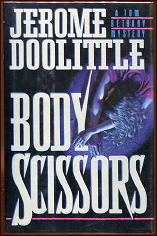
JEROME DOOLITTLE – Body Scissors. Pocket, hardcover, 1990; reprint paperback; 1st printing, November 1991.

   On the cover is a quote from the Washington Post, calling this a “riveting political thriller.” Well, I had some doubts, but I read it anyway. What does the Washington Post know? They may think this book is a political thriller, since that’s what they’re looking for, but just between you and me, what this really is a top-notch PI story instead.

   It’s a little hard to argue the point, since on page 14, even Tom Bethany says he’s not a PI: “…I’m sort of a researcher, sort of a political consultant.” He works primarily for politicians and campaign committees, apparently, looking for leaks, trying to stop leaks before they start, that sort of thing. His home base is Cambridge,near Harvard Yard, and as you may know, Boston politics do get a little nasty at times.

   He’s hired to check out a prospective Secretary of State in this case, however, to avoid another Eagleton affair, and if the work he does isn’t PI work, I’ll tum in my trenchcoat at once. What strikes his eye first is the unsolved death of J. Alden Kellicott’s daughter, a victim of Boston’s once-notorious Combat Zone.

   That, plus some niggling doubts about Kellicott’s character, found by industrious research and a knack on Bethany’s part to get people to start talking. Doolittle, whose first novel this is, certainly doesn’t show it. He’s a whiz at dialogue, and he has a tremendous amount of insight into his characters and the relationships existing between them.

   I quibbled a little about this being a political thriller — but as you can see, the statement’s not that far off base — and the adjective “riveting” is well taken. I’d use the phrase “prose that tingles with anticipation” — it’s that good.

   Unfortunately, Bethany also makes four major errors as the detective in this case. Since Doolittle is ultimately responsible for those as well, maybe I should point them out to you, but of course with the usual [WARNING: Plot Alert!!]. Here they are, my advice to any new PI’s on the block:

   (1) Don’t leave would-be assassins hanging around at loose ends. (2)When you work with guns, don’t forget to check the bottom of the barrel. (3) When you bait a trap, don’t let the cheese stand alone. (4) When the rat takes the bait, don’t leave the cat on guard.

   There you go. No charge for these. Don’t leave home without them. But now I’m being serious: if you’re a PI fan, don’t miss this book.

— This review first appeared in Deadly Pleasures, Vol. 1, No. 4, Winter 1993 .

      The Tom Bethany series

1. Body Scissors (1990)
2. Strangle Hold (1991)

3. Bear Hug (1992)
4. Head Lock (1993)

5. Half Nelson (1994)
6. Kill Story (1995)

REVIEWED BY BARRY GARDNER:


AARON ELKINS – Old Scores. Chris Norgren #3. Charles Scribner’s Sons, hardcover, 1993. Fawcett Gold Medal, paperback, 1994.

   One thing about Elkins, he picks widely varying specialties for his series characters. Though he;s best known for his “bone doctor” series about Gideon Oliver, the Norgren books seem to be pucking up steam. Chris Norgren is curator at the Seattle Art Museum, and who’d have thought the world of acquisitions would be so hazardous?

   A famous French collector wants to give the museum a Rembrandt — great, hein? Well, maybe. There are a couple of catches: the painting has no provenance, and no scientific tests will be allowed. Chris’s director wants him to go to France and make an accept/reject decision. Chris wants to reject it out of hand, but goes anyway, at the cost of some discombobulation to his already shaky love life. Things are even weirder than expected in France, the situation turns nasty, and murder is done. Well, hell, what did you expect?

   I don’t believe for a minute that any museum would even consider accepting a master painting without provenance and/or testing, but what do I know about museums? Aside from that, this was the kind of entertaining tale I’ve come to expect from Elkins. I like Norgren as a character, and find the artistic background interesting and edifying. Elkins tells a good story, and creates a good set of supporting characters. His stories fall somewhere between cozy and hard-edged, and while I don’t think anyone would call them memorable, they provide an enjoyable read.

— Reprinted from Ah Sweet Mysteries #7, May 1993.


      The Chris Norgren series —

1. A Deceptive Clarity (1987)
2. A Glancing Light (1991)
3. Old Scores (1993)

REVIEWED BY BARRY GARDNER:


B. J. OLIPHANT – Death and the Delinquent. Shirley McClintock #4. Fawcett, paperback original, 1993.

   I like Sheri Tepper whatever name she writes under. At least I think I do; I haven’t read any of her A. J. Orde books, though I’ve got one waiting. I do like the Shirley McClintock series a lot and think they’re good enough for hard covers.

   Shirley and her foreman/companion vacationing in the mountains of New Mexico after the traumatic events in the last book with her daughter Allison and Allison’s schoolmate April. April isn’t working out too well. She’s nosy, neurotic, and thoroughly obnoxious, and Shirley has decided to send her home when a sharpshooter wounds Shirley’s mule and kills April. Accident? Hard to see how it could be.

   Some strange items are found in April’s belongings, and then a newborn is stolen from a hospital nursery. Of course it all fits together but Shirley-on-crutches is damned if she sees how.

   Tepper/Oliphant/Orde’s strength has always been her characters, whether they’re cat-like aliens or independent Colorado ranch ladies. Shirley McClintock is one of the stronger and more realistic, and an altogether appealing heroine. I haven’t found anything to dislike in this series. The writing is good, the characterization excellent, and the plots haven’t strained my credulity. All of the regulars have become real people, and I look forward to seeing more of them.

— Reprinted from Ah Sweet Mysteries #7, May 1993.

       The Shirley McClintock series —

Dead in the Scrub. Gold Medal, 1990.

The Unexpected Corpse. Gold Medal, 1990.
Deservedly Dead. Gold Medal, 1992.
Death and the Delinquent. Gold Medal, 1993.
Death Served Up Cold. Gold Medal, 1994.
A Ceremonial Death. Gold Medal, 1996.
Here’s to the Newly Dead. Gold Medal.

   Sheri S. Tepper also wrote six mysteries as A. J. Orde, the leading character in these being Jason Lynx, an antiques dealer based in Denver CO. Under her own name, however, she was far better known as a writer of science fiction and fantasy, as you can see from her bibliography here. She died last month, on October 22, 2016, at the age of 87.

JOANNE DOBSON – The Maltese Manuscript. Poisoned Pen Press, hardcover, 2003; softcover, 2006. ibooks, mass market paperback, May 2004.

   I haven’t been reading the recent crop of cozy mysteries very much any more. They’ve become too soft and fluffy for me. Too much giddy character interplay, too much emphasis on hobbies, quilting or cooking, and worst of all, too little puzzle or mystery. They’re meant for female readers who can’t get enough of them, not for men who want hardboiled PI stories or old folks like me who want real detective work and/or surprise twists in their tales. So I pass them by, and have been for quite a while.

   With exceptions. While this one may not be recent, it is a cozy by nature, being one of a series of mystery adventures had by a Women’s Studies professor at a small elite college in a fictionalized version of the Amherst MA area. What it does have is a gimmick encapsulated in the title that caught my immediate attention anyway, as it may have already snagged yours as well.

   Part of the detective fiction holdings at Enfield College is the original manuscript of The Maltese Falcon, annotated and corrected in Hammett’s own hand. Valuable? I’d say so, if it existed. (Does it?) But when it disappears during a crime fiction conference at the school, the dean wants the incident hushed up. Who’d donate to any library that has such poor security in place?

   Karen Pelletier is the professor referred to in paragraph two, and with the assistance of mystery writer Sunnye Hardcastle, creator of he extremely popular PI Kit Danger books, plunges right into solving both the theft of the manuscript and more, the mysterious death of a nighttime intruder in the underground stacks of the school’s library.

   Complicating matters is that Karen’s boy friend is Lt. Charlie Pietrowski of the local police force, who doesn’t want her butting in, and a PI named Dennis O’Hanlon whom Karen meets up with again at a high school reunion, and coincidence be damned, he has just been hired by the dean to worr undercover while investigating the theft. That Karen is attracted to him causes some problems, wouldn’t you know?

   After some slow going in the first 80 or pages, the book takes off at last, as the investigation finally begins. There is a lot of witty and wry commentary on the academic approach to deconstructing mystery fiction along the way, and a book thief’s storage houses for the thousands and thousands of the valuable first edition mystery hardcovers he’s stolen from libraries all across the country would be a sight to behold, if it ever existed.

   A minor work, when all’s said and done, but it’s still fun while it lasts. And as a final postscript, let me add that the quoted portions of Sunnye Hardcastle’s novels are patently (and joyously) awful.

      The Karen Pelletier series

1. Quieter Than Sleep (1997)
2. The Northbury Papers (1998)
3. The Raven and the Nightingale (1999)
4. Cold and Pure and Very Dead (2000)
5. The Maltese Manuscript (2003)
6. Death Without Tenure (2010)

MARGARET SCHERF – The Beaded Banana. Doubleday Crime Club, hardcover, 1978. No US paperback edition.

   The title sounds like that of a second-rate rock group, but it’s actually the prized possession of a member of the fly-by-night movie company that’s shooting on location in Summerfield, Montana. An undesirable Las Vegas element is moving into town as well, and some unsavory political hi-jinx foreshadow some very strange things about to happen, including murder.

   The detective is retired pathologist Dr. Grace Severance, and it’s no reflection on her to say that what we have here is a mystery full of flutsy old ladies doing their thing. The humor is of the quiet zinger type, which does a lot to mitigate all the conclusions that are so ungracefully leapt to along the way.

— Reprinted from The MYSTERY FANcier, Vol. 3, No. 1, Jan-Feb 1979.


      The Dr. Grace Severance series —

The Banker’s Bones. Doubleday, 1968.
The Beautiful Birthday Cake. Doubleday, 1971.
To Cache a Millionaire. Doubleday, 1972.
The Beaded Banana. Doubleday, 1978.

    The Beaded Banana was Margaret Scherf’s final book. Between 1940 and 1978 she wrote a total of 24 works of detective fiction, including four in her Emily & Henry Bryce series, and seven more featuring Rev. Martin Buell. Many of her books also take place in Montana.

FRANCIS M. NEVINS, JR. – Corrupt and Ensnare. G. P. Putnam’s Sons, hardcover, 1978. iUniverse, softcover, 2000. Ramble House, softcover, 2013.

   Deeply involved in lawyer-detective Loren Mensing’s second mystery adventure are a contested will, a multi-million-dollar corporation with a history of working hand-in-glove with the CIA, and the not yet extinguished brand of ultra-liberalism left over from the 1960’s. It begins with a shoe-box full of money found in an old friend’s study after his death, raising a pair of unanswered questions: had the judge really once accepted a bribe influencing one of his court decisions, and if so, why?

   If you like your detective puzzles rigorously tough, the tangled plot Nevins has in store for you is intended to challenge`your little grey cells to the limit. Now and then there is a regrettable emphasis on the overdramatic and the bizarre, but there’s a lot of punch packed into these pages, and it’s a reading experience that shouldn’t be missed.

— Reprinted from The MYSTERY FANcier, Vol. 3, No. 1, Jan-Feb 1979.


   The Loren Mensing series

Publish and Perish. Putnam, 1975.
Corrupt and Ensnare. Putnam, 1978.
The 120-Hour Clock. Walker, 1986. [also with Milo Turner]
Into the Same River Twice. Carroll & Graf, 1996.
Beneficiaries’ Requiem. Five Star, 2000.

A 1001 MIDNIGHTS Review
by Kathleen L. Maio


JOSEPHINE BELL – Curtain Call for a Corpse. Macmillan, US, 1965. Perennial, US, paperback, 1988. First published in the UK by Longmans, hardcover, 1939, as Death at Half-Term.

   Josephine Bell (whose real name is Doris Bell Ball) has practiced two professions. She began her career as a physician in the 1920s, when it was an unusual field for a woman. Since 1937 she has practiced a trade more expected of British gentlewomen — the writing of mystery and suspense stories.

   In recent years, Bell has specialized in non-series suspense stories, but she started her writing career with a series of classic mysteries starring David Wintringham. Her amateur sleuth is, appropriately enough, a doctor. His police counterpart is Inspector Mitchell, who does not always appreciate Dr. Wintringham’s interference.

   Wintringham’s fifth case takes him to the Denbury (boys’ prep) School, where he is conveniently related to the headmaster and one of the students. Half-term weekend traditionally features both a father-son cricket match and a theatrical performance. This year’s performance of Twelfth Night by a third-rate touring company becomes highly memorable when an ill-tempered actor collapses with a bashed skull as the curtain falls.

   Wintringham, who attends the dying actor, becomes even more interested in the case when it is discovered that members of the school’s staff may also have had reasons for wanting the victim dead. There is plenty of detecting to go around. Mitchell, Wintringham, and an enthusiastic band of young students all have a share of collecting clues and interviewing suspects. The result is a nicely complex investigation, punctuated by a cricket match and climaxing in a classic gathering of the suspects and confrontation with the murderer.

         ———
   Reprinted with permission from 1001 Midnights, edited by Bill Pronzini & Marcia Muller and published by The Battered Silicon Dispatch Box, 2007.   Copyright © 1986, 2007 by the Pronzini-Muller Family Trust.

       The Dr. David Wintringham series —

* Death on the Borough Council. Longmans, 1937.
* Murder in Hospital. Longmans, 1937.
* Fall Over Cliff. Longmans, 1938.
* Death at Half-Term. Longmans, 1939.
From Natural Causes. Longmans, 1939.
All Is Vanity. Longmans, 1940.
Death at the Medical Board. Longmans, 1944.
* Death in Clairvoyance. Longmans, 1949.
* The Summer School Mystery. Methuen 1950.
* Bones in the Barrow. Methuen 1953.
* The China Roundabout. Hodder 1956.
* The Seeing Eye. Hodder 1958.

(*) Inspector Steven Mitchell also appears. The latter had one case to solve on his own, and three with barrister Claude Warrington-Reeve, who had no solo appearances.

REVIEWED BY BARRY GARDNER:


LARRY BEINHART – Foreign Exchange. Tony Cassella #3, Harmony, hardcover, 1991. Ballantine, paperback reprint, 1992.

   Ex-PI Tony Cassella is now living in an Austrian ski village, on the run from the IRS, who have been sicced on him by powerful enemies made in earlier cases. He’s a budding entrepreneur with a string of laundromats, and a soon-to-be father with a pregnant ladyfriend.

   Asked to investigate a skiing death by avalanche, he finds the case all mixed up with international intrigue, Japanese business conglomerates, and various government agencies. Someone tries to kill him, his lady has the baby (a girl), both mothers in-law come to visit (from France and the USA), and it all just gets complicated as hell.

   The characters are the best part of the book; most of them are realistic, if not always sympathetic. The plot’s a little fanciful, though, and overall I’d give it only a fairly good plus.

— Reprinted from Fireman, Fireman, Save My Books #5, January 1993.


       The Tony Casella series

1. No One Rides for Free (1986)
2. You Get What You Pay for (1988)
3. Foreign Exchange (1991)

Note:  No One Rides for Free received the 1987 Edgar Award for Best First Novel.

« Previous PageNext Page »