Characters


THE ARMCHAIR REVIEWER
Allen J. Hubin


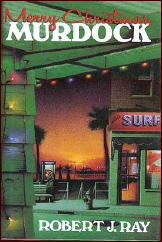
ROBERT J. RAY – Merry Christmas, Murdock. Delacorte Press, hardcover, 1989. Dell, paperback, 1990.

ROBERT RAY Merry Christmas Murdock

   L. A. private eye Matt Murdock is back, celebrating a holiday in decidedly unfestive fashion in Merry Christmas, Murdock. Here the past rises up before Murdock in two ways.

   Cindy Duke, a teen-ager who had maybe saved his life a couple of years earlier by driving him out of a burning canyon, asks him to find her father. He teaches in Wisconsin and came to L. A. in response to Cindy’s cry for help, raged at his ex-wife, battered her brother’s car with a baseball bat, ranged through a shopping mall in a failing search for Cindy, and disappeared.

   Meanwhile, another teen-ager, Heather Blasingame, lies in a coma from a hit-and-run encounter with a vehicle at that same mall. She’s the daughter of Jane Blasingame, feisty Texas state senator, and the senator (though with considerable reluctance) hires Murdock to supplement what seems an inept police investigation.

   These two cases are of course related, and powerful interests — not only Cindy’s grandfather Wheeler Duke and Duke Construction — are willing to go to about any lengths to keep Matt’s nose out of these matters.

   Vivid, active tale.

— Reprinted from The MYSTERY FANcier,
       Vol. 12, No. 4, Fall 1990.


        The Matt Murdock series —

1. Bloody Murdock (St. Martin’s, 1986)
2. Murdock for Hire (St. Martin’s, 1987)
3. Dial ‘M’ For Murdock (St. Martin’s, 1988)
4. Merry Christmas, Murdock (Delacorte, 1989)
5. Murdock Cracks Ice (Delacorte, 1992)
6. Murdock Tackles Taos (Camel Press, 2013)

Bibliographic Notes: For more on the author and this last book in the series, published after a gap of 21 years, go here. For more on Matt Murdock himself. check out Kevin Burton Smith’s essay on him here.

THE BACKWARD REVIEWER
William F. Deeck


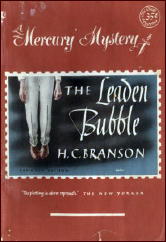
H. C. BRANSON The Leaden Bubble

H. C. BRANSON – The Leaden Bubble. Simon and Schuster, hardcover, 1949. Unicorn Mystery Book Club, hardcover reprint, 4-in-1 edition. Mercury Mystery #153, digest-sized paperback, no date [1950].

   The title of this novel comes from a line of a poem by Henry Treece: “Taste the black leaden bubble of despair.” This may provide the answer to whodunit and why to those who read each page of a book, including the copyright page. Those who start with the first page of chapter one will probably discover the answer without that information, although the solution would appear too improbable.

   John Bent, a mysterious man about whom all that is known is that he once was a practicing M.D., has a beard, and investigates murder, blackmail, and conspiracy and fraud — “the seamy side of life in general” — is asked to visit an elderly man who merely says in his note that he is “greatly disturbed.” Before Bent arrives, his possible client has a stroke and dies unable to communicate why he sought Bent’s services.

   Thus Bent has to find out why the man was greatly disturbed before he can begin investigating what had disturbed him. When the lawyer for the estranged wife of the elderly man’s son, the same lawyer who had maligned members of the extended family earlier on in a case in which a man had shot his wife whom he found in bed with another man, is murdered, there is reason to assume this had something to do with the elderly man’s being disturbed. Perhaps it has to do with the visit of the elderly man to a boarding house? Bent thinks it’s possible and becomes a roomer himself.

   The publishers say that this novel “is not a book to be told; it needs to be read…” I agree. Discover, if you haven’t already, John Bent, quiet, careful, compassionate, mysterious, and the people with whom he deals.

— From The MYSTERY FANcier, Vol. 10, No. 1, Winter 1988.


       The John Bent series —

I’ll Eat You Last (n.) Simon & Schuster, 1941.
The Pricking Thumb (n.) Simon & Schuster, 1942.
Case of the Giant Killer (n.) Simon & Schuster, 1944.
The Fearful Passage (n.) Simon & Schuster, 1945.
Last Year’s Blood (n.) Simon & Schuster, 1947.
The Leaden Bubble (n.) Simon & Schuster, 1949.
Beggar’s Choice (n.) Simon & Schuster, 1953.

Reviewed by DAVID L. VINEYARD:         

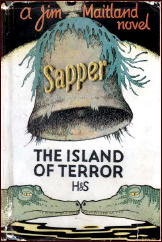
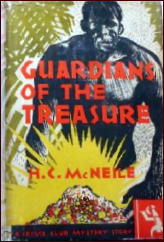
H. C. McNEILE – The Island of Terror: A Jim Maitland Adventure. Hodder & Stoughton, UK, 1931, as by “Sapper.” US title: Guardians of the Treasure, Doubleday Crime Club, hardcover, 1931.

JIM MAITLAND Sapper

    JIM MAITLAND tilted his top-hat a little farther back on his head, and lit a cigarette. In front of him twinkled the myriad lights of London; behind the door he had just closed twinkled the few candles that had not yet guttered out. The Bright Young Things liked candles stuck in empty bottles as their illuminations.

    The hour was two of a summer’s morning; the scene—somewhere in Hampstead. And as he walked down the steps into the drive he pondered for the twentieth time on the asininity of man, — himself in particular. Why on earth had he ever allowed that superlative idiot Percy to drag him to such a fool performance?

   There sounds the true voice of the 1920’s thriller, a bit of P. G. Wodehouse, a touch of Arabian Nights (at least the Stevensonian type), and the social conscience of a gnat. But if you can get past 21st Century guilt and self loathing from the left and the right and read this as entertainment, as it was meant to be read, there are pleasures to be found, certainly in H. C. McNeile (Sapper)’s two books featuring Jim Maitland, a far less frothy and blathering fellow than Bulldog Drummond or Tiny Carteret.

   Maitland is the puhka sahib type, more likely to haunt seedy waterfront bars in seedy waterfronts from Uraguay to Singapore than London’s stuffy gentlemen’s clubs. Maitland was a type — Somerset Maugham or Conradian gentleman in foreign ports. Roger Conway in Lost Horizon was one of the breed, and in real life they had names like Rhodes, Raffles, Gordon, and Burton, and nicknames like the White Rajah — who once haunted popular fiction.

   It was the Jim Maitland’s George MacDonald Fraser’s Harry Flashman so deftly skewered. They were the backbone of that empire the sun never set on. They might be ruthless, certainly racist, but they did things like end slavery in the Sudan, find the source of the Nile (yes, I know that was Speke), crush piracy in the Malay Peninsula, and destroy thugee, a criminal conspiracy whose victims numbered in the millions — and often with surprizingly little help. Many were a good deal like Sapper’s description of Maitland:

   That he was a sort of legendary hero in the club, was a fact of which Jim was completely ignorant. And had anyone hinted at it he would either have been annoyed or else roared with laughter. To him a journey to the interior of Turkestan came as naturally as one to Brighton comes to the ordinary man. He had been born with wanderlust in his bones; and being sufficiently endowed with this world’s goods to avoid the necessity of working for a living, he had followed his bent ever since he left Oxford…

   …And if some of the stories grow in the telling it is hardly to be wondered at, though in all conscience the originals are good enough without any embroidery.

   Talk to deep-sea sailors from Shanghai to Valparaiso; talk to cattlemen on the estancias of the Argentine and after a while, casually introduce his name. Then you will know what I mean.

    “Jim Maitland! The guy with a pane of glass in his eye. But if you take my advice, stranger, you won’t mention it to him. Sight! his sight is better’n yourn or mine. I reckons he keeps that window there so that he can just find trouble when he’s bored. He’s got a left like a steam hammer, and he can shoot the pip out of the ace of diamonds at twenty yards. A dangerous man, son, to run up against, but I’d sooner have him on my side than any other three I’ve yet met.”

   Thus do they speak of him in the lands that lie off the beaten track …

   By the 1950’s he had gotten a bit sodden with gin and tonic, had a bit of malaria, and seemed more interested in trysts with women he should have left alone, but the lure was still there.

JIM MAITLAND Sapper

   Maitland first appeared in a collection of novellas that ended with him saving a virginal girl from a fate worse than death from a nasty Egyptian chap (he was a spy too), and seemed headed toward the kind of blissful country manor life Dornford Yates’ Boy and Berry and Jonah were always departing for a bit of smuggling and humorous rescues of fair damsels in the Anthony Hope Ruritainian mode. Maitland was made of sturdier stuff, just read the story “The Temple of the Crocodile” from Jim Maitland. Hugh Drummond would have run home to Phyllis to change his nappies.

   But come Island of Terror Maitland seems to have forgotten his former love, and he’s soon off for adventure in the wilderness. And wild it is.

    “I’m going to be perfectly frank, Miss Draycott,” he said. “The story, as you’ve told it to me, is, not to mince words, as old as the hills. From time immemorial drunken seamen have babbled in their cups of treasure trove—gold ingots, diamonds, and all the rest of the paraphernalia. Generally, too, they have a roughly-scrawled map, with, as often as not, a skull and cross bones in the corner to make it more realistic. In fact the one point in which this story differs from the others is that he did not apparently touch your brother for money. Had he done that I should have advised you to dismiss the whole thing from your mind at once.”

   Of course Miss Draycott is an English rose in full bloom, and Maitland’s not blind behind that monocle. And someone did take a shot at him in the dark.. On to Chapter Two … After consulting with a respectable businessman Maitland once saved from the gangs of Marseilles — before respectability caught up with him — Maitland gets on to Clem Hargreaves who knows everything worth knowing about the underworld.

    “And I have no hesitation in saying that he is one of the most dangerous swine out of prison at the moment. He passes under the name of Emil Dresler, and he possesses an American passport. His activities are many and varied. At one time he was mixed up in the white slave traffic, but as far as we know he has given that up now. He’s a blackmailer, and a drug trafficker. He is a moneylender on a large scale. We are also practically certain that he is responsible for at least two murders.”

   It takes a while to get out of England headed toward Lone Tree Island, “south of Santos.” And quoting Robert Service to Judy Draycott we’re off: Have you ever stood where the silences brood/ And most of the horizons begin … Splendid stuff. Bulldog Drummond never got anywhere more exotic than Switzerland — and even then he never got near a Alp.

   There’s a blind dwarf (the villain), a tribe of intelligent white apes (I suppose some of Tarzan’s cousins from the Great Apes immigrated), a little golden idol, a crude temple, a near run thing, a lost brother (a Balliol man I’ll wager — it always is in these things — never trusted one myself when I was at Oxford — nice respectable Christ’s College man you know), a ruby the size of a hen’s egg, and a hint lone Tree Island holds more mysteries …

       …sometimes o’ nights an expression comes over Jim’s face which makes Judy look at him suspiciously. Is there still treasure hidden somewhere in that forest guarded by the survivors of the ape-men? Is there perchance another god of solid gold in some undiscovered clearing? Who knows?

   Well, not Sapper, because having married off another hero we never hear from Maitland or his monocle again. But, if you only know McNeile from Drummond and Ronald Standish, get ahold of Jim Maitland and Island of Terror. Critic Richard Usborne called Maitland McNiele’s finest work in The Clubland Heroes, and I’m inclined to agree.

   And next time you delve into the latest Rollins, Cussler, or Bell adventure you may understand why they were all McNeile fans.

   Note too that “sometimes o’ nights,” that’s the true voice of the era, Haggarded Haggard’s, Kipled Kiplings, and Servicable Service, an age when adventure didn’t have to be accompanied by a social conscience, and you could enjoy some Godforsaken hell hole in the back of the beyond without wanting to pave the roads and build a school.

   Those are noble things to do in real life, but just once I’d like to do a little armchair adventuring without the nagging voice of social awareness. I suppose someone would have tried to rescue those white apes, make them learn how to read, put shoes on them, and hook them up to the Internet.

   If I wanted real life I’d be outside doing it, not inside getting vicarious thrills from our own breed of Imperial heroes like Dirk Pitt, Painter Crowe, or Alex Hawke … Somehow I think a “pane of glass” would improve any of them.

VOICE WITHOUT A FACE:
Finding a Face for Philip Marlowe
by David Vineyard


   Raymond Chandler seldom painted word portraits of his heroes, perhaps because of the falter in his first story, “Blackmailers Don’t Shoot,” when he gave his protagonist Mallory a “diffident” touch of gray in his hair. We know what the Chandler hero looks like; tall, dark, masculine, attractive to all society types, but if you read closely you will notice that complete as he is, Philip Marlowe has no face. That wasn’t a problem for Chandler, but it would become one in other media.

   That became Hollywood’s quest when they took notice of Chandler’s work: What did Philip Marlowe look like? Even Chandler struggled with that, veering from Cary Grant to Dick Powell, from Fred MacMurray to Humphrey Bogart — Chandler’s favorite, but not how he describes Marlowe in a letter that sounds suspiciously like MacMurray and Powell, and a young bartender he met in Hollywood, Robert Mitchum.

   The first screen Marlowe’s weren’t Marlowe at all. George Sanders’ Falcon took on Farewell My Lovely as The Falcon Takes Over, and Lloyd Nolan’s Michael Shayne took on The High Window as Time to Kill, and while both were faithful adaptations of the books, they weren’t Philip Marlowe. Marlowe was still faceless. All that changed in 1946.
PHILIP MARLOWE

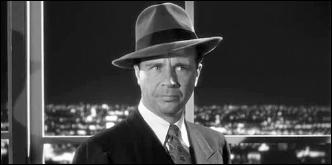
   Well, actually it changed in 1945, but it was 1946 before anyone knew, and by then Marlowe already had one face, ex-crooner and male ingénue Dick Powell in the career changing Murder My Sweet, based on Farewell My Lovely, the Edward Dymytrick film that gave that became mid-wife to the film noir genre that had been in labor since German expressionist cinema in the teens.

   Powell is much as we imagine Marlowe, a bright attractive, but not devastatingly handsome, man, a bit shop worn, a bit defensive, and too human for his own good. To that Powell brings a post-war cynicism common to many ex-G.I.s, an ironic voice tinged by sarcasm, and a leery eye toward the idea he is so devastating that women like Claire Trevor will just throw themselves at him, at least without a distinct curve on the act. Bluff, brash, rude, and surprisingly gentle, Powell seemed to find every niche of Marlowe’s character, and would even play Marlowe again of television in an adaptation of The Long Goodbye.

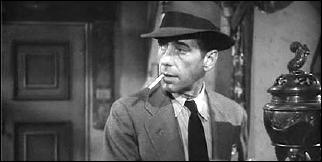
   Howard Hawks and screenwriters Leigh Brackett, Jules Furthman, and William Faulkner had attempted Marlowe earlier in 1945, but a year too early for the slow to change moguls, who held the film back until Dymytrick’s film hit the boxoffice. The money showed them the light and The Big Sleep was rushed into release along with the second iconic face of Philip Marlowe, Humphrey Bogart.
PHILIP MARLOWE

   Physically Bogart was no more Marlowe than he was Sam Spade, but he brought to the character and screen a world weary romanticism and guarded heart only hinted at in the Powell Marlowe. Teamed with real-life wife Lauren Bacall, Bogie’s Marlowe has a subdued eroticism running beneath the tough façade. Add to that a very real tendency to defend the helpless and tilt at windmills, and Bogart may come closest to the fully developed Marlowe we see in Chandler’s masterpiece, The Long Goodbye.

   Sadly the film is deeply flawed by the ending imposed by the censors, one so absurd it comes close to ruining a masterpiece. Even seeing it the first time in my teens I can recall thinking John Ridgey’s (Eddie Mars) fall guy was covering up for someone, Carmen Sternwood, who conveniently drops out of the film midway through the proceedings before Marlowe can throw that famous old maid hissy fit and throw her out of his apartment and bed.
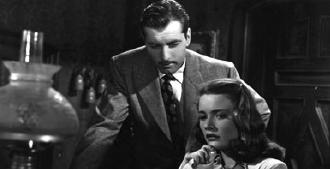
PHILIP MARLOWE

   Still, even Chandler was impressed by what Bogart brought to the role. Powell’s Marlowe is still half a genial boy turned rude. Bogie’s Marlowe is a man.

   That said, I agree with noir critic Eddie Mueller, The Big Sleep is as much a screwball comedy as it is film noir.

   George Montgomery is the next Marlowe, and not bad in John Bahm’s The Brasher Doubloon. based on The High Window. Replete with a silly mustasche, Montgomery is Marlowe lite.
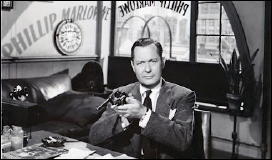
PHILIP MARLOWE

   Still he fares better than the next Marlowe, who for the most part is a voice without a face, Robert Montgomery in his own film of Lady in the Lake. Using an experimental subjective camera technique the film falters, despite good work from its star/director and a fine cast including Audrey Totter, Lloyd Nolan (outstanding), and Tom Tully. The problem is it doesn’t look like a movie half so much as a live television broadcast.

   Save for Phil Carey’s slick Marlowe on a brief lived television series and Powell’s second outing, we don’t get another Marlow until James Garner in the sixties take Marlowe, based faithfully on The Little Sister.
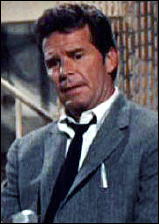
PHILIP MARLOWE

   Garner’s Marlowe has generated a lot of criticism, but in many ways he is the epitomy of the Marlowe in that book, and the wary humor and slow exasperation that would make him a star is ideal for the character. He sparks in the scenes with cop Carroll O’Connor, Rita Moreno’s stripper, and Gayle Hunnicutt’s film star, and Bruce Lee has two of the best scenes of his career in a small role.

   That said, the critics and many fans savaged the film and Garner. Maybe if he had tried a fedora and trenchcoat …

   Elliot Gould is a terrific Marlowe — in audio books — on screen he’s not so good, though not even Bogart could have played the role to anyone’s satisfaction in Robert Altman’s petty tantrum of a film because of Chandler’s homophobia, The Long Goodbye. The movie is badly acted, hard to follow, and completely foreign to the character. Altman so disliked Chandler and Marlowe he undercut his own film, and even a Leigh Brackett script can’t save it.

   On my own personal list of the worst films ever made this ranks high. I have no problem with Altman disliking Chandler, or even wanting to savage the mythos, but not in a bitchy and at times campy film that plays like something made by the Hasty Pudding Club, arch, snide, and boring.
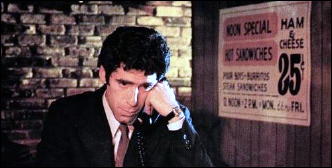
PHILIP MARLOWE

   By the way, if I wasn’t clear, I don’t like it.

   Too old, too fat, too weary, we finally get Robert Mitchum’s Marlowe in Farewell My Lovely, and it is a lovely one. Dick Richards’ moody recreation of noir and Mitchum’s well earned cynicism make this film work, and he’s ably abetted by another noir veteran John Ireland as Nulty, the cop.

   Alas, almost no one else in the film is up to them, and Richard Kiel’s Moose Malloy will make you yearn for Mike Mazurki and Ward Bond, who played the role in earlier films. It’s a singularly bad performance in a role vital to the film. Like me, you may well wonder why Marlowe didn’t just shoot the hulking jerk in self-defense.
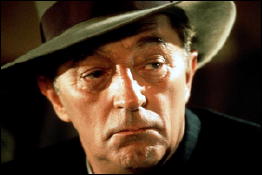
PHILIP MARLOWE

   But even with that, Mitchum manages to give us close to the perfect Marlowe, if only it had come even ten years earlier.

   And even he can’t save The Big Sleep, which moves Marlowe to contemporary London, and falters badly despite the presence of James Stewart, Oliver Reed, and Richard Boone as the sadistic killer Canino. When Colin Blakely dies in the Elisha Cook Jr. role, you almost envy him being out of this. Still that scene and a few others work, and you can see where it might of been.
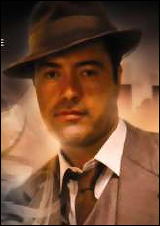
PHILIP MARLOWE

   Powers Boothe gets the part for the HBO series Philip Marlowe, and he’s great in well done adaptations of the short stories, but Danny Glover as a black Marlowe in the Fallen Angels adaptation of “Red Wind” doesn’t do half so well, largely because they add nothing to the story of the role even though Glover is a black Marlowe in the forties. It’s as if the story is set in a parallel universe where prejudice never happened, he’s no Denzel Washington and Easy Rawlins ,just a private detective who happens to be black.

   To date, James Caan is the last Marlowe in a made for television film of The Poodle Springs Murders, based on Chandler’s unpublished last novel completed and published by Spenser’s Robert B. Parker. Caan’s older Marlowe, confronting love, marriage, and wealth is a new dimension, but when things get rough he’s every bit Marlowe. It’s an exceptionally well done film, and it captures the unease of Marlowe in the new world of the late fifties and early sixties.
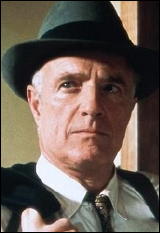
PHILIP MARLOWE

   Marlowe is also available on radio and audio books. Van Heflin and Gerald Mohr essayed the role on the classic radio production from the forties while Elliot Gould and Daniel Massey (Raymond’s son) are the audio book voices, and both very good, while more recently Ed Bishop (UFO) has been Marlowe’s voice on BBC 4 in several readings and dramatizations.

   Still Marlowe remains an elusive voice. You’d know him if you saw him or heard him speak, but you never really have so you remain wary. Some of that is Chandler’s intent, since Marlowe is everyman as the hero, that famous man “good enough for any world” from the essay “The Simple Art of Murder.”

   Philip Marlowe is a living breathing flawed human being; he’s a hero because he doesn’t let that stop him. He’s a man because he questions the motive and necessity of those heroics. He’s Philip Marlowe because he does those things in an iconic literary voice that has so come to dominate literature even today’s literary icons use it. (Michael Chabon for one.)

   The fact is he doesn’t have a face — or need one. He has a voice, and no actor, good or bad, can ever take that away from him, or us, and I don’t think there is a reader who ever read a page of Raymond Chandler who wouldn’t know him anywhere.
A 1001 MIDNIGHTS Review
by Julie Smith


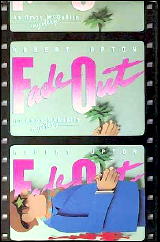
ROBERT UPTON – Fade Out. Viking, hardcover, 1984. Penguin, reprint paperback, 1986.

ROBERT UPTON Fade Out

   You could love private eye Amos McGuffin for his name alone — but he also has a wry way about him. After McGuffin crashes two cars, Ronald Worthy, the president of Executive Rent-A-Car, denies him any more vehicles. “Isn’t that just like Ron,” says our hero to the clerk. “As if I were the only guy sleeping with his wife.”

   McGuffin lives in San Francisco, where he hangs out at Goody’s bar, putting away Paddy’s when he isn’t on a case — which is just about all the time of late. In fact, he’s just bending an elbow when Nat Volpersky tracks him down at Goody’s. It seems Volpersky’s son, Ben Volper, a Hollywood producer, is thought to have committed suicide by wading out into the Pacific Ocean after leaving an unsigned note on his typewriter.

   But Volpersky doesn’t believe it; and Izzy Schwartz the deli man, his only friend in California, has recommended McGuffin to find his son. That means McGuffin has to go to Los Angeles, where he encounters the Bronx Social Club- a group of Ben’s childhood friends who’ve made it big in show biz. “Who else can you trust?” Volpersky asks.

   But McGuffin isn’t so sure the old neighborhood pals are trustworthy. He’s even less inclined to put his faith in Aha Ben Mahoud, a wealthy Arab who financed Ben’s last picture. And he has serious doubts about Pedro Chan, the six-foot-six cop assigned to the case.

   After pursuing a single-minded inquiry throughout most of the book, he suddenly sees the light and pulls the solution out of a hat. Upton didn’t really play fair on this one, McGuffin’s latest case. (He made his debut in 1977 in Who’d Want to Kill Old George?) But no matter. Even though we can’t see it coming, the denouement is ingenious. And McGuffin is a delight.

         ———
   Reprinted with permission from 1001 Midnights, edited by Bill Pronzini & Marcia Muller and published by The Battered Silicon Dispatch Box, 2007.   Copyright © 1986, 2007 by the Pronzini-Muller Family Trust.

      The Amos McGuffin series —

Who’d Want to Kill Old George? (n.) Putnam 1977.
Fade Out (n.) Viking 1984.
Dead on the Stick (n.) Viking 1986.
The Farberge Egg (n.) Dutton 1988.
A Killing in Real Estate (n.) Dutton 1990.

THE BACKWARD REVIEWER
William F. Deeck


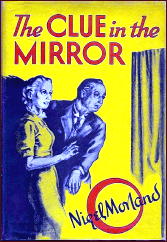
NIGEL MORLAND – The Clue in the Mirror. Farrar & Rinehart, US, hardcover, 1938. First published in the UK by Cassell, hardcover, 1937.

NIGEL MORLAND The Clue in the Mirror

   Why did the world need V. I. Warshawski and her sistren when it had Palmyra Pym? As Deputy Assistant Commissioner of the Metropolitan Police, Mrs. Pym — don’t bring up her unfortunate marriage, the only mistake she’s ever made — struggles mightily for law, as she sees it, and disorder, which is generally what she produces.

   To fulfill her tasks, she carries an automatic that she doesn’t know how to use properly and slugs it out toe to toe with the bad guys just like any bobbie. While not old, she’s no youngster: she was born in 1892, and if the date of publication of this novel can be taken as a clue to her age, she must at least be in her early forties.

   In this case, apparently her fifth since her appointment to the police, the recently promoted — one does wonder why, since loyalty seems to be his only virtue — Chief Inspector Shott brings to Mrs. Pym’s attention the picture of a murdered man whose corpse has disappeared. Neglecting all other work, if she has any, Mrs. Pym becomes involved, making herself, as is her wont, unpleasant to all concerned.

   In this thriller, rather than mystery, Mrs. Pym is the central focus. If you can enjoy her badinage and insults, you will enjoy the novel. It was good fun for the most part, I thought, but in 312 pages the lady can become a bit trying. I’ll read another of her investigations in novel form, but I suspect that the short-story collections featuring her might be more appealing.

— From The MYSTERY FANcier, Vol. 12, No. 2, Spring 1990.


          The Mrs. Palmyra Pym series —

The Moon Murders (n.) Cassell 1935.
The Phantom Gunman (n.) Cassell 1935.
The Clue of the Bricklayer’s Aunt (n.) Cassell 1936.
The Street of the Leopard (n.) Cassell 1936.
The Clue in the Mirror (n.) Cassell 1937.
The Case Without a Clue (n.) Cassell 1938.
A Rope for the Hanging (n.) Cassell 1938.
A Knife for the Killer (n.) Cassell 1939.
The Clue of the Careless Hangman (n.) Cassell 1940.
A Gun for a God (n.) Cassell 1940.
The Corpse on the Flying Trapeze (n.) Cassell 1941.
A Coffin for the Body (n.) Cassell 1943.]
Mrs. Pym of Scotland Yard (co) Vallancey 1946.
The Talking Gun (n.) Polybooks 1946.
The Case of the Innocent Wife (co) Martin 1947.
Dressed to Kill (n.) Cassell 1947.
The Hatchet Murders (n.) Martin 1947.
26 Three-Minute Thrillers (co) Martin 1947.
The Lady Had a Gun (n.) Cassell 1951.
Call Him Early for the Murder (n.) Cassell 1952.
Sing a Song of Cyanide (n.) Cassell 1953.
Look in Any Doorway (n.) Cassell 1957.
A Bullet for Midas (n.) Cassell 1958.
Death and the Golden Boy (n.) Cassell 1958.
The Concrete Maze (n.) Cassell 1960.
So Quiet a Death (n.) Cassell 1960.
The Dear, Dead Girls (n.) Cassell 1961.
Mrs. Pym and other stories (co) Ellis 1976.

Editorial Comment: This is but a fraction of the huge output of crime fiction by author Nigel Morland, who also wrote as Mary Dane, John Donavan, Norman Forrest, Roger Garnett, Hugh Kimberley, Vincent McCall, Neal Shepherd & Nigel Van Biene (the latter of which may have been his real name).

FIRST YOU READ, THEN YOU WRITE
by Francis M. Nevins


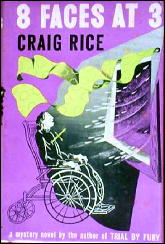
CRAIG RICE 8 Faces at 3

   The latest golden oldie I decided to revisit in my golden years is 8 FACES AT 3 (Simon & Schuster, 1939), which I first read in the summer of 1964, just before I entered law school. Craig Rice (1908-1957), one of the most popular female mystery writers of her generation, entered the genre with this novel, along with alcoholic criminal defense lawyer John J. Malone, drink-sodden talent agent Jake Justus, and ever-inebriated heiress Helene Brand, who would become Mrs. Jake in future outings.

   Amid copious shots of booze the trio probe the stabbing death of vicious old Chicago dowager Alexandria Inglehart, whose murderer also made all the beds in the Inglehart mansion and (dare I say it?) took the time to stop all the clocks in the house at 3:00. The plot is marred by logical holes and legal howlers — sorry, Ms. Rice, but no court would enforce a will provision nullifying an outright bequest if the recipient marries after the testator’s death — and the solution is surprising but only mildly fair and a bit hard to swallow.

   What I found most striking about this novel is the interweaving of some all but noirish sequences with scads of drunken escapades. Rice seems to think that hoisting a few while driving along Chicago streets that have turned to sheets of ice is the height of hilarity, although when held up against the later exploits of Malone and his buddies this one is a model of rationality and sobriety. The critics who have likened Rice’s world to Hollywood’s screwball comedies of the Thirties knew what they were talking about.

***

   How do I know precisely when 8 FACES first came into my ken? Because, rummaging in my file cabinets between sessions with Rice’s madcap protagonists, I discovered an old notebook containing comments on the mysteries I had read back in the Sixties and Seventies. Dozens of these clumsily written paragraphs became the rough sketches for material that wound up in various essays of mine, like the ones on Cleve F. Adams, William Ard and Milton Propper; many others have been seen by no eyes but my own.

Cyril Delavanti

   Among the subjects of the latter is Clyde B. Clason (1903-1987), who wrote ten well-regarded classic puzzle novels in the 1930s and early Forties before giving up the genre permanently. Protagonist of all ten is Professor Theocritus Lucius Westborough, a little old man whose day job is teaching classical languages and literature but whose true forte is solving bizarre murders.

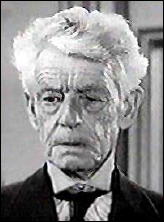
   Anyone remember an actor named Cyril Delevanti? He was a dried-up old prune who, usually uncredited, played clones of himself in dozens of movies, including Chaplin’s Monsieur Verdoux and Limelight and John Huston’s Night of the Iguana, and a hundred or more episodes of TV series like Gunsmoke, Perry Mason, Have Gun Will Travel, Alfred Hitchcock Presents, Ben Casey and The Twilight Zone.

   For me Delevanti is the living image of just about every little-old-man detective character, including Henry the Waiter in Isaac Asimov’s Black Widowers stories and, of course, Clason’s Professor Westborough. In my mind’s ear I can almost hear Delevanti murmuring “Dear me” as Westborough does times without number.

Cyril Delavanti

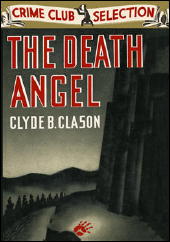
   Of Clason’s ten novels I’ve only read three, the earliest being THE DEATH ANGEL (1936). On a visit to a friend’s estate in southern Wisconsin while local farmers are staging a violent milk strike, Westborough is deputized by the sheriff after his host first receives a threatening note signed “The Firefly” and then vanishes.

   The professor investigates the series of attempted murders that follow and encounters two clever ways of setting up a perfect alibi and perhaps a bit too much information about archery, mushrooms and the theory of electricity. Clason‘s characters tend to evade, drawl, growl, grunt, explode, supply, venture, persist, ejaculate and flare, but most of his said substitutes aren’t too outrageous and his plot convolutions are spectacular.

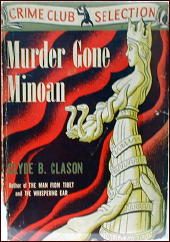
   The later Westborough novels tend to revolve around ancient or exotic settings. MURDER GONE MINOAN (1939) takes place on a private island off the California coast, owned by a Greek-American department-store tycoon with a phobia about the imminence of another Depression and a passion for the millennia-old Cretan civilization. When a priceless Minoan religious image disappears from the tycoon’s Knossos-like palace, Westborough is asked to investigate and encounters a mess of amorous intrigues and two murders apparently committed by a devotee of the ancient Cretan snake goddess.

Cyril Delavanti

   The parts of the story told in transcript and document form are neatly handled, but the mind boggles at the amount of physical action this frail 70-year-old academic takes part in, and the solution he comes up with is hopelessly unfair (except to readers who can tell whether a particular classical quotation comes from the Iliad or the Odyssey). The said substitutes, plus a small army of exclamation points, are piled on with a vengeance.

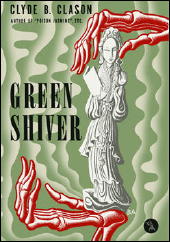
   In GREEN SHIVER (1941), Clason’s tenth and last detective novel, the place and time are southern California in early 1940. As in MURDER GONE MINOAN, the first crime is the theft of an exotic religious image, this time a jade Taoist goddess which vanished from the Oriental palace of an oil widow during a public exhibition of her treasures to benefit Chinese war refugees.

   Westborough, who is suddenly gifted with expert knowledge of ancient China as well as Greece and Rome, is offstage far more than in earlier Clasons but quickly gets involved in a bizarre double murder with occult overtones. The clumsy plot depends on an unplanned perfect alibi, but the Sino-Japanese war background is well evoked and Clason’s knowledge and love of Chinese philosophy and culture enliven every page.

***

   Have I been a little unfair to Clason? According to a slew of experts — Robert Adey, Jon Breen, Bob Briney and Randy Cox, just to name a few from the early letters of the alphabet — by far the finest of his ten novels is THE MAN FROM TIBET (1938), which I’ve never read. If I ever come across a copy, I’ll be sure to write it up in this column.

***

CLASON Murder Gone Minoan

In Clason’s MURDER GONE MINOAN, Westborough satisfies himself that a man claiming to be a fellow classics professor is an impostor by quoting a verse apiece from the Iliad and the Odyssey and not being corrected when he attributes each verse to the wrong epic poem. Somehow this incident brought back memories of other mysteries where the detective character used his specialized knowledge in the same general way.

   Perhaps the best known is found in “The Blue Cross,” the earliest exploit of G.K. Chesterton’s most famous character. At the climax Father Brown explains to the thief Flambeau, who is impersonating a priest, how from their dialogue he knew the other was a fake. “You attacked reason. It’s bad theology.”

   One of my favorite scenes of this sort — largely because it doesn’t require reader familiarity with specialized subjects like Greek poetry or Catholic theology — occurs in Rex Stout’s 1946 novelet “Before I Die.”

   Nero Wolfe is having dinner with a young man who claims to be a third-year law student. “I hope…that you are prepared to face the fact that very few people like lawyers,” Wolfe says. “I don’t. They are inveterate hedgers. They think everything has two sides, which is nonsense. They are insufferable word-stretchers. I had a lawyer draw up a tort for me once, a simple conveyance, and he made it eleven pages. Two would have done it. Have they taught you to draft torts?”

   â€œ…Naturally, sir, that’s in the course,” the young man replies. “I try not to put in more words than necessary.” That, as Wolfe explains at the denouement, was the tipoff. “A tort is an act, not a document, as any law student would know. You can’t draft a tort any more than you can draft a burglary.” “Before I Die” is one of the clumsiest of all the shorter Wolfe exploits but that single moment keeps it green in my memory.

Editorial Notes:   My review of Murder Gone Minoan can be found here. Curt Evans’ review of 8 Faces at 3 can be found here.

THE BACKWARD REVIEWER
William F. Deeck


“DIPLOMAT” – Murder in the State Department. Jonathan Cape & Harrison Smith, hardcover, 1930.

DIPLOMAT Murder in the State Department

    “Diplomat” dedicates this, his first mystery, to the “pacifists and bootleggers of the United States, without whom the author would have been at a loss for a motive for a murder in the State Department.” This gives you some idea of the tone of the book, and those who are neither pacifists nor bootleggers may read safely on with the pleasant anticipation that someone else’s ox will be gored.

    A guard at the State Department finds Harrison “Handsome” Howard in his office, a steel filing spike transfixing a top-secret unsigned treaty, Howard’s hand, and Howard’s heart, in that order. Also in the office is a revolver with a silencer, unused.

    (Who is it that makes silencers for revolvers? Does anyone outside the characters in mysteries purchase them? Why is there never dissatisfaction with their performance?)

    Only one other person is working in the building — Howard’s rival for position and prestige. He, however, has an unimpeachable alibi. Dennis Tyler, Chief of the Bureau of Current Political Intelligence (Now there’s an oxymoron! Oops. Sorry.) has a low opinion of police investigators, so he takes charge.

    Tyler talks like a mixture of Bertie Wooster and Reggie Fortune; his intellect, at least to this reader, is closer to Bertie’s than Reggie’s. Still, he does come up with the solution, which is for the most part plausible. Those who can accept an exchange like the following with good heart and maybe even appreciation should enjoy the novel:

    “The chemical man turned over to the parson a cylinder of a secret new gas, the effect of which is to make people go to sleep….”

    “Ether?” Nichols suggested.

    “Either that or something like it,” Tyler admitted.

    Amiable nonsense, for which I admit a weakness.

— From The MYSTERY FANcier, Vol. 12, No. 2, Spring 1990.


Bibliographic Notes:   “Diplomat” was, according to Hubin, the pseudonym of John Franklin Carter, 1897-1967. According to Wikipedia, Carter was an American journalist, columnist, biographer and novelist. Dennis Tyler appeared in all of the novels Carter wrote under that name, as follows:

Murder in the State Department (n.) Cape & Smith 1930.
Murder in the Embassy (n.) Cape & Smith 1930.
Scandal in the Chancery (n.) Cape & Smith 1931.
The Corpse on the White House Lawn (n.) Covici Friede 1932.
Death in the Senate (n.) Covici Friede 1933.
Slow Death at Geneva (n.) Coward 1934.
The Brain Trust Murder (n.) Coward 1935.

   Al Hubin reviewed this same title earlier on this blog; you may check it out here. In the course of the review and the update that followed, much more information about the author was supplied. (You may also enjoy Al’s opinion of the book, and compare it with Bill had to say.)

THE BACKWARD REVIEWER
William F. Deeck


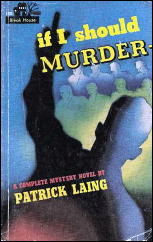
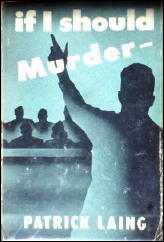
PATRICK LAING [AMELIA REYNOLDS LONG] – If I Should Murder. Phoenix Press, hardcover, 1945. Bleak House #19, no date [1948].

PATRICK LAING If I Should Murder

   The reader is asked to accept that a jury which has convicted an accused murderer and thus caused his death by execution would want to meet each year on the anniversary of its decision; that the jury members would continue this annual get-together despite the grieving widow showing up on each occasion to give a basilisk stare to the participants; that when a jury member dies, his daughter would be asked to take his place and would agree to attend.

   Of course, if she hadn’t accepted, Patrick Laing, assistant professor of abnormal psychology and sometime criminologist would not have accepted an invitation to speak to the assembled jurors, Laing is in love with the deceased juryman’s daughter, but since Laing is blind, he never reveals his feelings to her.

   Although the gathering is held in a hard-to-find mountain lodge, the widow naturally shows up. What is more, the executed man’s lawyer arrives to read a confession by the real murderer.

   As a blizzard rages, as blizzards never fail to do, some of the jurors discuss how they would commit murder in the unlikely event any of them should wish to do so. Later that evening certain of the jury members are killed by the very methods they said they would have employed.

PATRICK LAING If I Should Murder

   Dr. Gideon Fell once stated:

   I have been improving my mind with fiction of the Bloody Hand variety for the last forty years. So I know all the conventional death-traps: the staircase that sends you down a chute in the dark, the bed with the descending canopy, the piece of furniture with the poisoned needle in it, the clock that fires a bullet or sticks you with a knife, the gun inside the safe, the weight in the ceiling, the bed that exhales the deadly gas when the heat of your body warms it, and all the rest of them — probable and improbable. And I confess that the more improbable they are, the better I like ’em. I have a simple melodramatic mind.

   Dr. Fell, I believe, would — and maybe did — enjoy the works of Amelia Reynolds Long in whichever guise she wrote. While I would not admit it as boldly as Dr. Fell did, I, too, have a tendency to appreciate melodrama in the mystery, which helped me enjoy this book, one that otherwise has no redeeming value.

— From The MYSTERY FANcier, Vol. 12, No. 2, Spring 1990.


      The “Patrick Laing” series —

If I Should Murder (Phoenix Press, 1945)
Stone Dead (Phoenix Press, 1945)
Murder from the Mind (Phoenix Press, 1946)
The Shadow of Murder (Phoenix Press, 1947)
The Corpse Came Back (Phoenix Press, 1949)
A Brief Case of Murder (Phoenix Press, 1949)
The Lady is Dead (Phoenix Press, 1951)

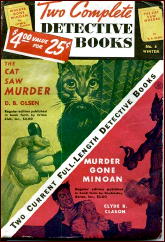
CLYDE B. CLASON – Murder Gone Minoan. Rue Morgue Press, trade paperback, 2003. Original hardcover: Doubleday Crime Club, 1939. Pulp magazine reprint: Two Complete Detective Novels, Winter 1939-1940 (with The Cat Saw Murder, by D. B. Olsen). Hardcover reprint: Sun Dial Press, 1940.

   Checking on www.abebooks.com just a few minutes ago, I found only one copy of the Crime Club edition for sale: Near Fine in a Near Fine jacket. Price: a mere $250.00. Further searching revealed a few other copies on other venues, one being a former library copy with no jacket. Price: a much more reasonable $35.00.

CLYDE B. CLASON Murder Gone Minoan

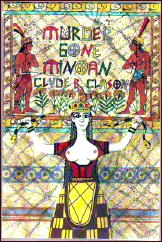
   But if $14.95 is all you want to spend, this handsome trade paperback will do very nicely. This is but one of many classic mystery reprints coming from Tom & Enid Schantz of Rue Morgue Press, and they should be commended for a job well done, and for jobs yet to be done. (At the moment, the only other Clason title they’re published is The Man from Tibet, but perhaps others are on their way. Only sales will tell, I imagine.)

   Only one thing is lacking, before I continue, and that is the original cover art, which as I recall was by Boris Artzybasheff. That gentleman no longer being available (or affordable) a fine piece of work by Rob Pudim was used in his stead. To my eye it’s a bit cluttered, but it Does Catch the Eye.

   Clason’s series detective is an eminent Roman historian named Theocritus Lucius Westborough — Westborough for short — who also has earned a well-deserved reputation as a private investigator on the side. If this book is an example — which from my point of view it has to be, at least for the moment, since if I ever read an earlier book in the series, it was long ago and long forgotten — Westborough’s adventures are copiously filled with well-researched lore of ancient times, interspersed with mini-lectures on the same.

   I’m jumping the gun here, but it’s Westborough’s knowledge of ancient history that helps crack a killer’s alibi — which is not quite fair to the reader not recently tutored in such matters — such as myself, I have to admit — but it’s a sizable step above nabbing a villain who reveals himself because he’s not aware that buildings do not have thirteenth floors, for example.

CLYDE B. CLASON Murder Gone Minoan

   Just in passing: There is a deliberate misstatement on my part that is not quite correct in the last sentence of the previous paragraph, but if I were to speak more clearly, I would be revealing more of what Clason had up his sleeve than I should.

   This, the seventh of ten cases Westborough is on record as having solved, takes place on an isolated island off the southern California shore, where first a valuable artifact is stolen — and Westborough called in — and then murder, when a missing butler is later found dead.

   The owner of the island, a rich Greek businessman named Paphlagloss, is fascinated with the ancient Minoan culture, pre-historic Cretans whose civilization arose and fell even before the ancient Greeks, and his mansion is filled with valuable relics, artwork and jewels. Just the right place for skullduggery to be done, and with only a handful of suspects, one of whom is responsible for doing the dugging, it’s a perfect setting for a mystery.

   Clason’s strength is in his characters and their dialogue. To my ears, the lengthy reports of letters and verbatim interviews of suspects are close to perfect. Other parts of the tale are excellent, while others, contrarily, are pure fuddle-muddle.

   I like the following quote, for some reason, taken from pages 160-161. Paphlagloss’s daughter is having a private conversation with Westborough:

CLYDE B. CLASON Murder Gone Minoan

    She shivered and drew the wrap closely to her slim body. “Why do things have to be in such a perfect devil of a mess?”

    His mild eyes peered distressfully through his gold-rimmed spectacles. “The question, I should conjecture, has been propounded rather frequently during the four thousand years of recorded history. However, I am unable to recall a single instance where it was answered satisfactorily.”

    “You are very wise!” she exclaimed.

    He shrugged deprecatorily. “My wisdom is confined to a single fact. I have lived long enough to learn that most of my fellow creatures — and myself, as well — must of necessity be a little foolish.”

    “What would you advise me to do?”

    “I dare not advise you, my dear. The situation is too delicate. As delicate,” he added thoughtfully, “as the ripples of a Chinese nocturne.”

   While it’s great to have this small gem of the Golden Age of Mysteries back again in print, I also have to suggest that it didn’t then, and it doesn’t now, have the staying power of one by a Queen, Christie, or a John Dickson Carr. Even so, and within its limitations, it is a gem in its own right, and no, they don’t write them like this anymore.

— January 2004


[UPDATE] 09-05-13. Checking on abebooks again just now, I found nine copies of the Crime Club edition for sale, ranging in price from $25 (bumped and frayed) to $300 (almost fine in jacket). Rue Morgue Press has a long informative profile of Clyde Clason, the author, and seven books in the Westborough series are now available from them. See below.

    CLYDE B(urt) CLASON, 1903-1987.

The Death Angel (n.) Doubleday 1936.    RM = Rue Morgue Press.
The Fifth Tumbler (n.) Doubleday 1936.
Blind Drifts (n.) Doubleday 1937.    RM
The Purple Parrot (n.) Doubleday 1937.    RM
The Man from Tibet (n.) Doubleday 1938.
The Whispering Ear (n.) Doubleday 1938.
Dragon’s Cave (n.) Doubleday 1939.    RM
Murder Gone Minoan (n.) Doubleday 1939.    RM
Poison Jasmine (n.) Doubleday 1940.    RM
Green Shiver (n.) Doubleday 1941.    RM

« Previous PageNext Page »