Characters


IT IS PURELY MY OPINION
Reviews by L. J. Roberts


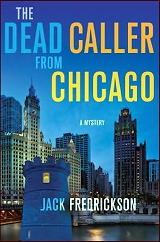
JACK FREDRICKSON – The Dead Caller from Chicago. St.Martin’s Minotaur Books, hardcover, April 2013.

Genre:  Mystery. Leading character:   Dek Elstrom, 4th in series. Setting:  Chicago.
JACK FREDRICKSON

First Sentence:   It was March, well past midnight, and it was cold.

   Free-lance investigator Dek Elstrom is still trying to fight his local city hall to regain zoning rights to the tower — no castle, just a tower — in which he lives, but strange things start occurring. A large hole is dug for a new McMansion in a block of bungalows, a phone call from someone thought to be dead, and Dek’s best friend and loved ones suddenly disappearing. Dek is on the trail of answers and trying to stay alive.

   I have two admissions from the very start; 1) I have loved this series but, 2) this is not my favorite book of the series.

   Among Fredrickson’s strengths is his ability to create a vivid atmosphere from the very beginning. He has a great eye for detail and conveys it in a way that you are part of the scene. You feel the cold, you experience the turbulence of the boat ride and the
driving rain; the tension becomes real and the atmosphere, threatening.

   He also has an excellent ear for dialogue, whether in the narrative or between characters. It’s clear, it has the right edge to it and just enough dry humor.

   The main characters are impossible to resist; Dek, who is trying hard to rebuild his life and his wonderful brilliant, completely devoid of any fashion-sense friend Leo are
interesting and people about whom you want to know more. A few characters, however, feel as though they have become a bit of a joke that has gone on too long.

   The weakest element, I felt, was actually the plot. It seemed we didn’t really knowwhat was going on until nearly half-way through the story. Sometimes, this can work. In this case, it was only the question of Leo and an act of faith that draws you on.

   The Dead Caller From Chicago is still a good read. If anything, I feel my frustration is in feeling that Mr. Fredrickson is capable of doing so much more. I’m waiting….

Rating:   Good.

       The Dek Ekstrom mysteries —

1. A Safe Place for Dying (2006)
JACK FREDRICKSON

2. Honestly Dearest, You’re Dead (2008)
3. Hunting Sweetie Rose (2012)
4. The Dead Caller of Chicago (2013)
THE BACKWARD REVIEWER
William F. Deeck


PAUL McGUIRE – The Black Rose Murder. Brentano’s, US, hardcover, 1932. First published in the UK: Skeffington, hardcover, 1931, as Murder in Bostall.

   At first appearance, it’s a simple case: Lord Barbary wants his wife investigated for possible adultery. The firm that Jacob Modstone heads has undertaken the task. Modstone is an elderly private detective who is “kindly and honest except in the way of business and old furniture.” His nephew, the firm’s chief operative, is in charge of the investigation. Unfortunately, despite his uncle’s misgivings, the nephew doesn’t reveal all of the facts to Mr. Modstone and is soon found dead.

   It appears that Modstone’s nephew may have been blackmailing someone. In order to clear his nephew’s reputation, Modstone begins a search for the murderer, a search that pits him directly against Inspector Cummings, of no known first name. Occasionally Modstone is ahead of Cummings, but not very far, and Cummings always catches up.

   The plot isn’t much here. It is the characters of Modstone, a most unusual private investigator — on one occasion he carries a revolver but is “not certain what happened when you pulled the trigger thing” — and Cummings that make the novel enjoyable reading.

— From The MYSTERY FANcier, Vol. 13, No. 1, Winter 1991.

   
      The Chief Inspector Cummings series —

Murder in Bostall. Skeffington 1931. Brentano’s, US, 1932, as The Black Rose Murder.
Three Dead Men. Skeffington 1931. Brentano’s, US, 1932.
Daylight Murder. Skeffington 1934. Doubleday, US, 1935, as Murder at High Noon.
Murder in Haste. Skeffington 1934. No US edition.
7:30 Victoria. Skeffington 1935. No US edition.

Note:   Previously reviewed on this blog by Al Hubin was Murder by the Law (Skeffington, 1932). For more on the author himself, plus a more complete bibliography, check out this page on the Golden Age of Detection wiki.

IT IS PURELY MY OPINION
Reviews by L. J. Roberts


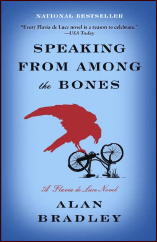
ALAN BRADLEY – Speaking from Among the Bones. Delacorte Press, hardcover, January 2013.

ALAN BRADLEY Flavia de Luce

Genre:  Amateur sleuth. Leading character:   Flavia de Luce, 5th in series. Setting:  England, 1950s.

First Sentence:   Blood dripped from the neck of the severed head and fell in a drizzle of red raindrops, clotting into a ruby pool upon the black and white tiles.

   Pre-teen Flavia de Luce is excited about the opening of the 500-year-old tomb of Saint Tancred and is determined to witness the event. However, the first body uncovered, is that of Mr. Collicutt, the church organist — dead, wearing a gas mask. With her skill at chemistry, detection and a little help, Flavia has yet another murder to solve.

   From the beginning, it is clear that Flavia is a delightful, unusual protagonist. She is 14 and wonderfully irreverent. When discussing how to get a bat out of one of the church organ’s pipes, her suggestion is for her sister to “…play Bach’s Toccata and Fugue in D Minor? Full throttle. That out to fix the little sod.”

   One cannot help but love her. She is an outsider in her own family. She is brilliant, yet has her insecurities. Her sisters have told her she’s adopted so she collects samples of everyone’s blood to test for matching. Her best friends are Gladys, her bicycle which she anthropomorphizes; and Dogger, the shell-shocked soldier who was with her father during WWII and now works for the family. There is such a wonderful bond between Dogger and Flavia. She is daring, but not fearless.

   It cannot be overlooked that an older man has created such a vibrant, and realistic, young character. In an interview, he talks about how children of that age are undervalued and too much overlooked, yet it’s a wonderful age as they are just on the cusp of adulthood.

   The story is told in first person and Bradley has such a wonderful voice… “Whenever I’m a little blue I think about cyanide, whose color so perfectly reflects my mood.”

   The story is very much character-driven. The series started when Flavia was 11 years old; she is now 14 and we are starting to see her mature. However, those who come
into the series late needn’t worry. Bradley provides sufficient back story for each of the
characters for new readers to know who they are and the relationships between. He also introduces a fascinating new character in the shape of a flora archeologist with a Rolls Royce named Nancy.

   Bradley has a wonderful eye for detail and period. He provides us with a real sense of post-war England, still in the stages of uncertainty about the future. He is also able to make chemistry fascinating.

   Although character drives the story, the plot doesn’t at all suffer for it. We are taken down curious and shadowy paths. We, mistakenly, think we know where we are going, and we’re wrong. We’re given a delightful dessert filled with fascinating tidbits of information, suspense, resolution and a whopping cliffhanger — but not in a bad way — iced with humor and emotion.

   Speaking from Among the Bones lags just a touch in the middle, but finishes with a roar. It is a wonderful book and now ranks among my favorites of the series.

Rating: VG Plus.

      The Flavia de Luce series —

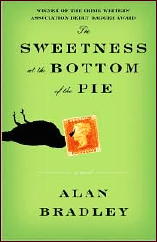
1. The Sweetness At the Bottom of the Pie (2009)

ALAN BRADLEY Flavia de Luce

2. The Weed That Strings the Hangman’s Bag (2010)
3. A Red Herring Without Mustard (2011)
4. I Am Half Sick of Shadows (2011)
5. Speaking From Among the Bones (2013)
6. The Dead in Their Vaulted Arches (2014)

THE BACKWARD REVIEWER
William F. Deeck


MURRAY THOMAS – Buzzards Pick the Bones. Longmans Green, UK, hardcover, 1932.

   Five years earlier Tom Carr, on holiday in Wales and walking the Cader Idris range, had come upon a man apparently deranged. One year after that he had been told that a skeleton had been discovered at the point he had encountered the man. Now he has read that another skeleton has been found at the same spot. Neither of the skeletons has been identified.

   With the hope of getting more information about the skeletons, Carr and his friend Stephen go to Wales. In so doing they are probably responsible for yet another corpse, this one freshly made.

   A fairly interesting beginning, with some fine writing about the Welsh mountains, but the murderer, though not his motive, is evident early on and Carr’s falling in love slows down what was never a fast pace. The main saving grace to be found is Rumbold, Carr’s valet, who is not the detective in the novel but definitely could have been. As Rumbold puts it:

    Well, sir, … a detective, when he has collected a proficiency of fax in a case, arranges them this way and that and forms a theory that explains everything. And a valet, sir, collects fax about his master gradually and forms a theory that explains his master to him, and, if I may venture to say so, it is possible for the discreet and intelligent valet to fulminate valuable theories of human nature too. Valets are students of human nature, sir — as one might say, hanthropologists.

   Stephen, who is a poet, theorizes that when historians seek England’s mentality in the early 20th century they will turn to Edgar Wallace and the “fourpenny bloods — the Sexton Blakes and the like.” While I would dispute that, there is something to another of his contentions: “Death is the preoccupation of great minds, a death its relaxation — when served up in stories of detection and mystery.”

— From The MYSTERY FANcier, Vol. 13, No. 1, Winter 1991.


      The Inspector Wilkins series —

Buzzards Pick the Bones. Longmans, UK, 1932.
Inspector Wilkins Sees Red. Jenkins, UK, 1934.
Inspector Wilkins Reads the Proofs. Jenkins, UK, 1935.

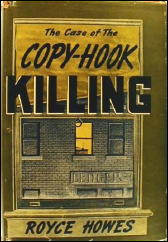
ROYCE HOWES – The Case of the Copy-Hook Killing. E. P. Dutton, hardcover, 1945.

   Howes started out with a bang as a mystery writer. In the five years between 1935 and 1939 he wrote seven novels, all published by Doubleday and the Crime Club. Then the war came along, and Howes, a newspaperman, did any further writing in the ETO for the Army News Service — information provided, incidentally, by the back flap on the dust jacket. (If you’re like me, you’ll read anything.)

ROYCE HOWES Ben Lucias

   Both Howes and his leading character, Captain Ben Lucias of the Homicide Squad, returned from the war in 1945. Lucias had been in five of the Crime Club books, but this was the last outing for both of them. Why it was done for Dutton instead of Doubleday, I don’t know, but I can guess. As a mystery, it’s Not Very Good.

   But, a copy-hook? I hear someone asking. A copy-hook is what one of those sharp steel spikes are called that reporters used to use to file their stories on. The scene, naturally enough, is a newspaper office, and it’s the reception clerk who’s been murdered. He was the guy whose job it was to keep the nuts coming in from the street from off the editors’ backs.

   And so Lucias’ ensuing investigation has him busily checking out the crackpots and all the other assorted creeps who saw the dead man last. It’s obvious that Howes knew the type well. He laughs at them, and if his characters reflect his own opinions at all, he despises them as much as they do.

   What is equally obvious is that the solution to the murder has nothing to do with this list of weirdos that Lucias has to work his way through. But downright distasteful, however, is Captain Lucias’ interrogation technique. Slugging a prisoner around in police headquarters is not likely to have been a remarkable occurrence back during the forties, long before today’s attempt at enlightened police procedures had begun to make some headway.

   It’s just that it’s difficult for me to recall it being done by a series character in police uniform before, one supposedly functioning as a competent detective, as well as one trying to maintain the respect of the reader.

— Reprinted from The MYSTERY FANcier,
       Vol. 4, No. 4, July-August 1980 (slightly revised).


     The Captain Ben Lucias series —

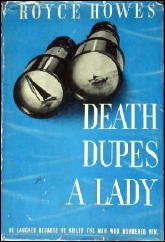
Death Dupes a Lady. Doubleday, 1937.

ROYCE HOWES Ben Lucias

Night of the Garter Murder. Doubleday, 1937.
Murder at Maneuvers, Doubleday, 1938.
Death Rides a Hobby. Doubleday, 1939.
The Nasty Name Murders. Doubleday, 1939.
The Case of the Copy-Hook Killing. Dutton 1945.

   Howes was also the author of two non-series mysteries, Death on the Bridge (Doubleday, 1935) and The Callao Clue (Doubleday, 1936).

PostScript:  From Wikipedia: “Royce Bucknam Howes (January 3, 1901 – March 18, 1973) was a Pulitzer Prize–winning journalist and author who also published a biography of Edgar Guest and a number of crime novels. He worked for the Detroit Free Press from 1927–1966 and won the Pulitzer Prize in 1955 for an editorial on the cause of an unauthorized strike by an autoworkers local that idled 45,000 Chrysler workers.”

THE BACKWARD REVIEWER
William F. Deeck


ROBERT FINNEGAN Dan Banion

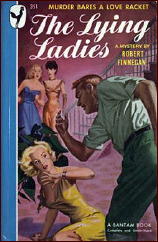
ROBERT FINNEGAN – The Lying Ladies. Simon and Schuster, hardcover, 1946. Bantam #351, paperback, May 1948.

   Ah, the investigative reporter, out to report news in the hinterland, discovers a case of justice likely to go wrong. In this novel, the first by Finnegan (pseudonym of Paul William Ryan) featuring Dan Banion, Banion reveals corruption in government and the press, gets beaten about a bit, and finds out who murdered the maid of the wealthy Hibleys.

   You’ve read the same thing many times, but there’s nothing wrong with reading it again since Finnegan writes well and amusingly and creates some interesting characters. After you have read it, perhaps you can tell me why Finnegan used the pre-World War II time period in which to set the novel.

— From The MYSTERY FANcier, Vol. 13, No. 1, Winter 1991.


The Dan Banion series —

   The Lying Ladies. Simon & Schuster, 1946.
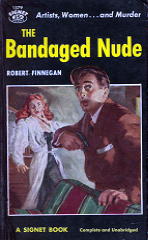
   The Bandaged Nude. Simon & Schuster, 1946.

ROBERT FINNEGAN Dan Banion

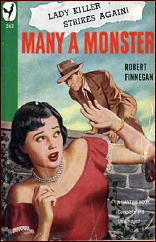
   Many a Monster. Simon & Schuster, 1948.

ROBERT FINNEGAN Dan Banion

A REVIEW BY DOUG GREENE:
   

R. T. CAMPBELL John Stubbs

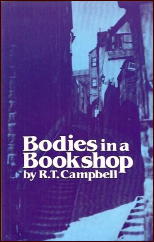
R. T. CAMPBELL (Ruthven Todd) – Bodies in a Bookshop. John Westhouse, UK, hardcover, 1946. Dover, US, softcover, 1984.

   For bibliophiles, Bodies in a Bookshop is pure enjoyment. The first chapter is full of love for books, and later chapters have insights into book- and print-selling and collecting. The story is well-structured, often amusing, and fairly clued.

   What is most interesting to me, however, is the amateur detective, Professor John Stubbs. He is an imitation of Carr’s Sir Henry Merrivale, with a bit of Dr. Gideon Fell thrown in. Stubbs is called “the old man”; he drinks copious quantities of beer; he resembles “a caricature of G. K. Chesterton trying to look like Buddha”; and, like Fell, he has a “mop of gray hair” which falls over his forehead. When he is concentrating he “frowns at the point of his cigar.” If Stubbs’ appearance combines Merrivale and Fell, his speech and attitude are pure H. M.:

    “Look’ee here, son.”

    “I got the simple mind I have.”

    “The shockin’ cussedness of luck.”

    “Oi,” the old man sounded and looked furious, “What d’ye mean by goin’ round arrestin’ people wi’out consultin’ me?”

    “Look here,” he roared indignantly, “me, I got the scientific mind… Ye thunderin’ well know ye’re wrong.”

    “What do I get? ” He looked round at us with an expression that he was the worst treated man in the world. “Do I get any thanks? No! All they say is that I’ve tried all the possible answers and I’ve found the right one. They say I got luck. I say I got brains. Bah!”

   Even the “large and bland” Chief Inspector is a Carrian character. None of this works quite as well as Carr at his best, but I am busily trying to locate more adventures of Professor Stubbs.

— Reprinted from The Poisoned Pen, Vol. 6, No. 2, Winter 1984/85.

      The Prof. John Stubbs series —

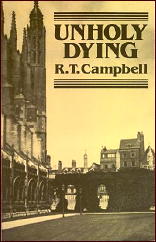
Unholy Dying. Westhouse, 1945.

R. T. CAMPBELL John Stubbs

Adventure with a Goat. Westhouse, 1946.
Bodies in a Bookshop. Westhouse, 1946.
The Death Cap. Westhouse, 1946.
Death for Madame. Westhouse, 1946.
Swing Low, Swing Death. Westhouse, 1946.
Take Thee a Sharp Knife. Westhouse, 1946.

   Only the first and third of these have been published in the US, both in paperback by Dover Books. Campbell also wrote one non-Stubbs mystery: Apollo Wore a Wig (Westhouse, 1946). Other than the two reprinted in the US, Campbell’s detective fiction appears to be nearly impossible to obtain.

THE BACKWARD REVIEWER
William F. Deeck


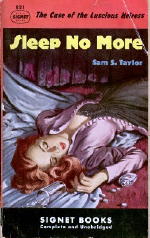
SAM S. TAYLOR – Sleep No More. E. P. Dutton, hardcover, 1949. Signet #821, reprint paperback, October 1950.

Sam S. Taylor

   In Blood in Their Ink, Sutherland Scott gave high marks to this novel. Oh, sure, Scott himself wasn’t much of a writer, to give him praise beyond his due, but that doesn’t mean he didn’t have good taste. Gee, if we went by the theory that it takes one to know one, readers struggling through one of my reviews might question my judgments.

   To make a short story long, Scott put me on to a good thing here. While it breaks no new ground, it does employ the best from the hard-boiled genre. Though not invariably excellent, the obligatory metaphors and similes are at least very good.

   Recently released from the Army, Neal Cotten has established his very own detective agency in Los Angeles, where it would seem from the literature there must have been a P.I. office in every block. Business is slow until Cotten gets a client who, suspecting blackmail, wants her daughter’s spending habits investigated.

   Before Cotten can turn up much information, the client’s daughter commits suicide, or so the official theory has it. With his ’35 Buick no longer fit for speed or hills, Cotten, who is in somewhat better shape, starts on the trail.

   An interesting character in Cotten and an engrossing picture of early postwar Los Angeles make me forgive the appearance of a silenced revolver.

— From The MYSTERY FANcier, Vol. 13, No. 1, Winter 1991.


       The Neal Cotten series —

Sleep No More. Dutton, 1949.
No Head for Her Pillow. Dutton, 1952.
So Cold, My Bed. Dutton, 1953.

   For much more about both Sam S. Taylor and his PI character, Neal Cotten, check out “The Compleat Sam S. Taylor,” posted on this blog back in 2007.

THE ARMCHAIR REVIEWER
Allen J. Hubin


LYDIA ADAMSON

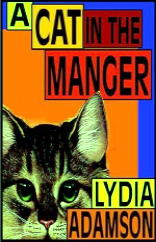
LYDIA ADAMSON – A Cat in the Manger. Signet, paperback original, 1990.

   A Cat in the Manger is the first in a series about sometime NYC actress and moretimes catsitter Alice Nestleton by the pseudonymous Lydia Adamson. This is a fanciful tale requiring hyperextension of disbelief, with a heroine of little appeal and an ending without the impact it could have had.

   Alice goes to Long Island to cat-sit for Harry and Jo Starobin, as she had done frequently before. This time, however, someone has hung Harry on the back of a door. Another corpse quickly turns up, just as motiveless a killing as the first.

   The police think robbery, but the Starobins were penniless — except for the $381,000 discovered in Harry’s safety-deposit box. And where has Ginger Mauch, who worked for the Starobins, gone off to, and why?

— Reprinted from The MYSTERY FANcier,
       Vol. 13, No. 1, Winter 1991.


[UPDATE.]   It is now known that Lydia Adamson is the pen name of mystery writer Frank King, who besides 21 books in his/her Alice Nestleton series (see below), also wrote 12 books in a series starring Dr. Deirdre Quinn Nightingale, veterinarian, and three books about birdwatcher and ex-librarian Lucy Wayles, not to mention five works of crime fiction under his own name.

       The Alice Nestleton series

1. A Cat in the Manger (1990)
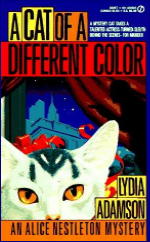
2. A Cat of a Different Color (1991)

LYDIA ADAMSON

3. A Cat in Wolf’s Clothing (1991)
4. A Cat in the Wings (1992)
5. A Cat by Any Other Name (1992)
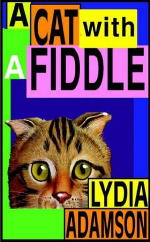
6. A Cat with a Fiddle (1993)

LYDIA ADAMSON

7. A Cat in a Glass House (1993)
8. A Cat with No Regrets (1994)
9. A Cat on the Cutting Edge (1994)
10. A Cat in Fine Style (1995)
11. A Cat on a Winning Streak (1995)
12. A Cat Under the Mistletoe (1996)
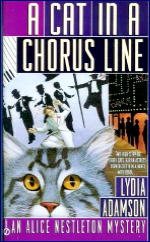
13. A Cat in a Chorus Line (1996)

LYDIA ADAMSON

14. A Cat on a Beach Blanket (1997)
15. A Cat on Jingle Bell Rock (1997)
16. A Cat on Stage Left (1998)
17. A Cat of One’s Own (1999)
18. A Cat With the Blues (2000)
19. A Cat With No Clue (2001)
20. A Cat Named Brat (2002)
21. A Cat on the Bus (2002)

A Review by Francis M. Nevins, Jr.:


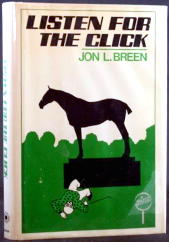
JON L. BREEN – Listen for the Click. Walker & Co., hardcover, 1983. No paperback edition.

   There is a kind of detective novel set in a world of quiet gentility, a magical place without pain or grief or terror, a place where corpses don’t bleed and the emotions of the living are always under iron control. During the lulls in the plot a Nice Young Man and Nice Young Woman get together, and in the final chapter, preferably at a ritual gathering of the suspects, the Brilliant Detective effortlessly exposes the murderer.

JON L. BREEN Listen for the Click

   The current generic name for a book of this sort is the English Cozy, because there’s a myth that it’s always been the exclusive property of British writers. In fact, however, a number of well-known Americans too have specialized in it, and Earl Derr Biggers’ half dozen Charlie Chan novels (1925-1932) are models of the form.

   Jon L. Breen, an award-winning mystery reviewer, short-story writer, and Biggers devotee, has set his first detective novel on this turf . Amid an unobtrusive but knowingly sketched background of Southern California’s racing community, a jockey who had given many people potential murder motives is shot out of the saddle of a bronze horse statue on the lawn of a wealthy racing enthusiast’s widow.

   The nephew of this dotty and whodunit-fixated old lady is racetrack announcer Jerry Brogan, whom Breen casts in the dual role of Nice Young Man and Clever Amateur Sleuth: if he wasn’t sleeping with his Chicana girlfriend without benefit of a marriage license, he might have stepped straight out of a Biggers novel of the 1920s.

   Meanwhile, a suave con man and a shady private eye with literary ambitions launch a scheme to make Jerry’s aunt believe that they’re the Holmes and Watson of the west coast. In due course, after the underdog horse wins the big race, a Gathering of Suspects is arranged in the purest Charlie Chan movie tradition — “The murderer is in this room,” one of the small army of detective figures in the book intones solemnly — and all the clues are put in order.

   Breen combines quiet charm, gentle digs at several types of crime fiction, and a puzzle complete with such original touches as an over-obvious Big Secret that mutates into a huge joke and a clue hidden in the book’s title. It’s no Secretariat, but lovers of the soft-spoken whodunit will have a fine canter around the track with this thoroughbred.

— Reprinted from The MYSTERY FANcier,
       Vol. 7, No. 3, May-June 1983.


      The Jerry Brogan series —

   Listen for the Click (n.) Walker, 1983.
   Triple Crown (n.) Walker, 1986.
   Loose Lips (n.) Simon & Schuster, 1990.
   Hot Air (n.) Simon & Schuster, 1991.
   Jerry Brogan and the Kilkenny Cats (ss) Murder Most Irish, ed. Ed Gorman, Larry Segriff & Martin H. Greenberg, Barnes & Noble 1996.

« Previous PageNext Page »