Characters


IT’S ABOUT CRIME, by Marvin Lachman

FREDRICK D. HUEBNER Judgment by Fire

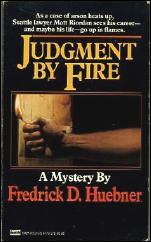
FREDRICK D. HUEBNER – Judgment by Fire. Fawcett Gold Medal, paperback original, 1988.

   I was not surprised after reading Fredrick D. Huebner’s Judgment by Fire, a paperback original from Gold Medal, to learn that the author is an attorney.

   Even if my son weren’t a lawyer, I would disagree with the character in Shakespeare who said, “First, kill all the lawyers.” Writers in that profession, e.g., Huebner, Healey, Nevins, and Hensley are too good at integrating the law into their mystery plots.

   At times, Huebner’s well-described courtroom scenes (even the motions made are suspenseful) threaten to overwhelm his rather meager plot. The book reaches its peak midway with a murder-arson trial and then is anticlimactic.

   Still, on balance, this is a worthwhile mystery with a good description of the Seattle area, especially its perennial rain.

— Reprinted from The MYSTERY FANcier,
Vol. 11, No. 1, Winter 1989.


       The Matt Riordan mystery series —

1. The Joshua Sequence (1986)
2. The Black Rose (1987)
3. Judgement By Fire (1988)
4. Picture Postcard (1990)
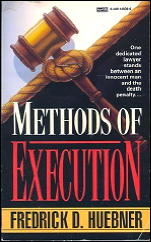
5. Methods of Execution (1994)

FREDRICK D. HUEBNER Judgment by Fire

THE ARMCHAIR REVIEWER
Allen J. Hubin


REX BURNS – The Killing Zone. Viking, hardcover, 1988. Penguin, paperback, 1989.

REX BURNS Gabe Wager

   Rex Burns’ latest about Denver homicide detective Gabe Wager is The Killing Zone. I’ve muttered before about Wager, a gloomy, morose, irascible chap with a recently acquired payload of guilt to boot.

   But this one has a strong contemporary plot, with good suspense and character dynamics, and I was well swept along with the flow. A kid finds the city’s latest corpse in a vacant lot. It’s Horace Green, city councilman, black, hero and defender of the black community. Now wearing a bullet hole in the back of his head.

   Racial motives spring to mind, and the city gathers itself for explosion. Wager’s boss wants him to look only in one white place for a killer, for a tension-defusing solution. Wager, who rarely takes orders from anyone and routinely works sixteen-hour days, will look everywhere.

— Reprinted from The MYSTERY FANcier,
       Vol. 11, No. 1, Winter 1989.


      The Gabe Wager series

1. The Alvarez Journal (1975)

REX BURNS Gabe Wager

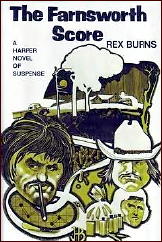
2. The Farnsworth Score (1977)

REX BURNS Gabe Wager

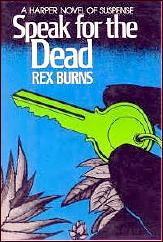
3. Speak for the Dead (1978)

REX BURNS Gabe Wager

4. Angle of Attack (1979)
5. The Avenging Angel (1983)
6. Strip Search (1984)
7. Ground Money (1986)
8. The Killing Zone (1988)
9. Endangered Species (1993)
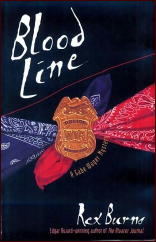
10. Blood Line (1995)

REX BURNS Gabe Wager

11. The Leaning Land (1997)

   Rex Burns also wrote four books with PI Devlin Kirk as the lead detective. All 15 books have recently been published as ebooks by Mysterious Press.

IT’S ABOUT CRIME, by Marvin Lachman

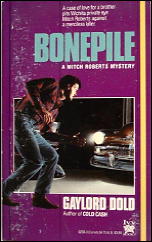
GAYLORD DOLD – Bonepile. Ivy, paperback original, 1988.

GAYLORD DOLD Mitch Roberts

   Bonepile by Gaylord Dold, the third Mitch Roberts novel, is more ambitious than the Rafferty book by W. Glenn Duncan (reviewed here ) but ultimately less satisfying.

   Dold is another writer to be commended for moving the private eyes’ mean streets from New York and Los Angeles to more unusual locales. In this case it is a rural farming community in Kansas where Roberts, on vacation from Wichita (“…the world’s largest small town”), has gone to recuperate. One can feel the heat and wind blowing off the plains, imagine walking through the park in the middle of town, and understand the people, including their worship of the St. Louis Cardinals.

   The book is set in 1956, but Roberts in true Lew Archer fashion permits guilt to cause him to try to solve a 1940’s murder. Unfortunately, Dold, like Archer’s creator, suffers from a severe case of a disease I believe I was first to diagnose and name: “metaphoritis.”

   Its primary symptom is overwriting, with swelling of metaphors, those necessary usages which transform ordinary into very good writing. When poorly used, as in Bonepile, we get such lines as “Night grew in me like a tumor” and “The tree itself creaked as if its heart were broken.”

   Sometimes, in an effort to be imaginative, Dold is merely anatomically unsound as he writes, “Sweat filled my mind and overflowed.” I suspect that the reason for all the overwriting and padding is that this time around he had too slim a plot and, based on the unsatisfactory ending, didn’t know how to conclude his book.

   Yet I perceive real writing talent here, and Dr. Lachman suspects this case of metaphoritis will not be fatal.

— Reprinted from The MYSTERY FANcier,
Vol. 11, No. 1, Winter 1989.

      The Mitch Roberts series —

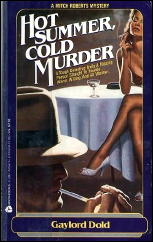
Hot Summer, Cold Murder. Avon, pb, 1987.

GAYLORD DOLD Mitch Roberts

Snake Eyes. Ivy, pb, 1987.
Bonepile. Ivy, pb, 1988.
Cold Cash. Ivy, pb, 1988.
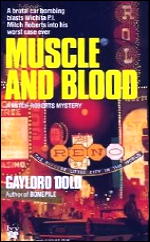
Muscle and Blood. Ivy, pb, 1989.

GAYLORD DOLD Mitch Roberts

Disheveled City. Ivy, pb, 1990.
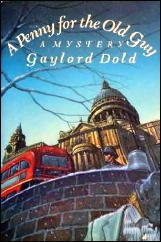
A Penny for the Old Guy. St. Martin’s, hc, 1991.

GAYLORD DOLD Mitch Roberts

Rude Boys. St. Martin’s, hc, 1992.
The World Beat. St. Martin’s, hc, 1993.
Samedi’s Knapsack. St. Martin’s, hc, 2001.

THE BACKWARD REVIEWER
William F. Deeck


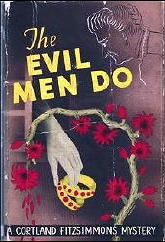
CORTLAND FITZSIMMONS – The Evil Men Do. Stokes, hardcover, 1941.

CORTLAND FITZSIMMONS Ethel Waters

   Having turned down several lucrative offers to go to Hollywood and do screen writing, mystery writer Ethel Thomas finally accepts as a ploy to help out her niece, an aspiring movie actress.

   The niece’s fiance, fighting for her honor, has apparently killed a man. It’s obvious that the “killing” is but a variation of the old badger game, but these two youngsters get themselves involved with a blackmailer who runs a gambling club. Naturally, he is soon bumped off. The niece, the fiance, the niece’s mother, and Thomas are unlikely suspects.

   Since the idea should be a winner from the start, there ought to be a law that authors writing about septuagenarian lady mystery writers who also detect produce at least a halfway decent novel. If there were such a law, Fitzsimmons would be given twenty years without the option.

— From The MYSTERY FANcier, Vol. 11, No. 1, Winter 1989.


      The Ethel Thomas series —

The Whispering Window. Stokes, 1936.
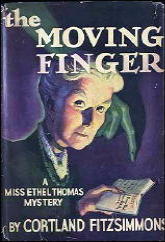
The Moving Finger. Stokes, 1937.

CORTLAND FITZSIMMONS Ethel Waters

Mystery at Hidden Harbor. Stokes, 1938.
The Evil Men Do. Stokes, 1941.

Editorial Comment:   In a crime fiction writing career that extended from 1930 to 1943, Cortland Fitzsimmons wrote or co-authored another thirteen novels, two of which featured Arthur Martinson as the leading character, and two with Percy Peacock. I know nothing about either of the two, but Bill Deeck’s review of the author’s book The Girl in the Cage, displays an equal lack of enthusiasm for his work:   “…reading Fitzsimmons is like watching grease congeal.”

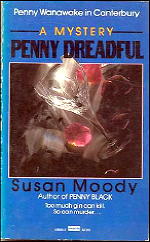
SUSAN MOODY – Penny Dreadful. Fawcett Gold Medal, paperback; 1st US printing, August 1986. First published in the UK: Macmillan, hardcover, 1984.
SUSAN MOODY Penny Wanawake

   The Penny in the title refers to Penny Wanawake, girl photographer, whose sleuthing activities place her as as nearly the perfect opposite of Agatha Christie’s Miss Marple as can be imagined. While she is British, Penny is tall, young, black (corn-row braided hairdo), a sophisticated world traveler, and while a possessor of one live-in lover at home, she is not adverse to having others when she’s not.

   But returning to the title of this one, it’s at least a double, if not triple, play on words. The dead man in the affair is a writer of cheap blood-and-thunder pulp fiction, supplementing his day job as a schoolmaster at an exclusive boys’ school in Canterbury. Penny dreadfuls, in other words. He’s a dreadful man, too, since his books incorporate much of the scandalous activities his roving eyes have uncovered.

   And so no one really minds when he’s found dead. The police think the cause of death was a heart attack. Snooping in the kitchen, Penny finds the smell of gin in the sink, and she wonders if somebody had added something to it before disposing of it. Her interest in the case is not that of bringing a killer to justice, but more of an intellectual exercise in discovering the truth.
SUSAN MOODY Penny Wanawake

   There are any number of suspects. Adding to the thrill of the chase is the competition Penny is provided by the visiting policeman from Detroit she is currently sharing living quarters with. On the other hand, though, what Penny Wanawake doesn’t have is a “Watson” to bounce theories off of, and to be bedazzled by her investigative techniques and abilities and so on.

   We (the reader) follow her activities through the story from nearly beginning to end, and are usually given access to her thoughts, except (of course) when it really matters. Thus when it comes time for revealing the killer, we find that she had eliminated many possibilities lone before, although there was little in what she said or did that would have allowed us to come to the same conclusions.

   Nonetheless, while the story might have moved a bit too slowly for me, I did enjoy Penny Dreadful as a detective puzzle, one populated by people I could see as individuals. Susan Moody has wicked sense of humor, too, maybe even a bit sharper than mine. I could probably quote you parts I liked all day long, but here’s a paragraph I thought you might like. It’ll tell you, at least, what I’m talking about. From pages 141-142:

   She turned toward the Wellington Dock. On the other side of a stretch of water, the stone-built Customs house squatted like a garden gnome. There was a white-capped figure up in the glass observation room, staring keenly out to sea in case someone was trying to invade the country. There were several yachts making their way slowly out into the Channel. Words like ‘spanking’ and ‘jaunty’ and ‘marlin-spike’ came to mind. The wheel’s kick and the wind’s song. All that nautical jazz. It was enough to make even a Swiss banker break into a hornpipe.

— Reprinted from Mystery*File 31,
       May 1991 (slightly revised).


      The Penny Wanawake series —

Penny Black. Macmillan, 1984.
Penny Dreadful. Macmillan, 1984.
Penny Post. Macmillan, 1985.
Penny Royal. Macmillan, 1986.
Penny Wise. Joseph, 1988.

SUSAN MOODY Penny Wanawake

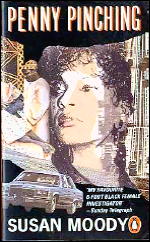
Penny Pinching. Joseph, 1989.
Penny Saving, Joseph, 1990.    No US edition.

   All but the last were published by Gold Medal in the US as paperback originals.

   After ending the Penny Wanawake series, author Susan Moody began another, this one featuring professional bridge player, Cassandra Swann. Six of the latter’s adventures were recorded between 1993 and 1999, four of them appearing here in the US.
THE ARMCHAIR REVIEWER
Allen J. Hubin


RICK BOYER Doc Adams

RICK BOYER – The Whale’s Footprints. Houghton Mifflin, hardcover, 1988. Ivy Books, paperback, 1989.

   The Whale’s Footprints, the latest of the Doc Adams stories by Rick Boyer, has a well-developed plot and effective misdirection, but the characters seem to emote rather than feel and communicate.

   Doc and Mary’s son Jack, studying whales at Wood’s Hole on Cape Cod, brings a friend, Andy, home for the weekend. But Andy dies in the night — someone has fiddled with his epilepsy medication. And the police rather think Jack might have been the fiddler.

   Doc and Mary, enraged and horrified, begin exploring on their own. Andy, it develops, wasn’t quite the blameless young man he might have appeared. Not that this clears Jack. Oh, no….

— Reprinted from The MYSTERY FANcier,
       Vol. 11, No. 1, Winter 1989.


      The Doc Adams series —

Billingsgate Shoal (1982)     [Edgar Winner, Best Novel, 1983]
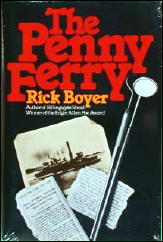
The Penny Ferry (1984)

RICK BOYER Doc Adams

The Daisy Ducks (1986)
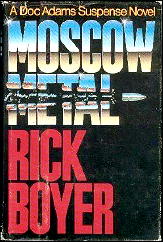
Moscow Metal (1987)

RICK BOYER Doc Adams

The Whale’s Footprints (1988)
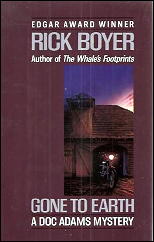
Gone to Earth (1990)

RICK BOYER Doc Adams

Yellow Bird (1991)
Pirate Trade (1994)
The Man Who Whispered (1998)

IT’S ABOUT CRIME, by Marvin Lachman

W. GLENN DUNCAN Rafferty

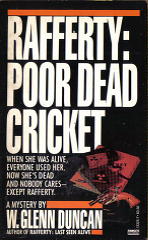
W. GLENN DUNCAN – Rafferty: Poor Dead Cricket. Gold Medal, paperback original, 1988.

   Poor Dead Cricket is the third in a series about Rafferty, a Dallas private eye. Having propounded many of Lachman’s Laws myself, including the first, “Never read a book with a Swastika on the cover,” which Jon Breen once quoted in EQMM, I was glad to see that Duncan thinks similarly, and he gives many of Rafferty’s Rules, such as (#39) “Smiting the wicked sounds biblical, but mostly it’s just good clean fun.”

   So is this book, about a decent, albeit wise-cracking detective who gets involved in an environmental case similar to the one involving Karen Silkwood. Rafferty does an excellent job in reconstructing the character of Cricket Dawes, who is killed before the book begins, and he sorts out the good and bad people while nicely imparting the flavor of Texas and its speech.

— Reprinted from The MYSTERY FANcier,
Vol. 11, No. 1, Winter 1989.

       The Rafferty series

Rafferty’s Rules (1987)    Film: Cinepix, 1992, as Snake Eater III: His Law.
Last Seen Alive (1987)
Poor Dead Cricket (1988)
Wrong Place, Wrong Time (1989)
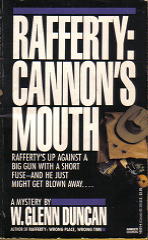
Cannon’s Mouth (1990)

W. GLENN DUNCAN Rafferty

Fatal Sisters (1990)    [Winner, Shamus award, Best Paperback Original, 1991]

   Some of Rafferty’s Rules are listed here on the Thrilling Detective website. Here are a couple of good ones:

11. To feel really dumb, be a smart ass once too often.

16. When you can’t tell the bad guys from the good guys, it’s time to get the hell out.

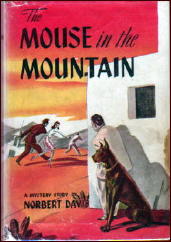
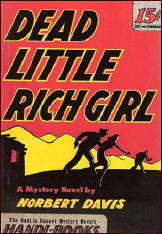
NORBERT DAVIS – The Mouse in the Mountain. William Morrow, hardcover, 1943. Handi-Books #40, paperback, 1945, as Dead Little Rich Girl. Rue Morgue Press, trade paperback, 2001.

NORBERT DAVIS

    Norbert Davis was a mystery writer who entered the scene in the early 30s with a story in Black Mask magazine entitled “Reform Racket” (June 1932). He managed to switch to the slicks such as Collier’s and The Saturday Evening Post, had a couple of detective novels published in hardcover, then one in paperback, and suddenly the bottom seemed to have fell out of the market for him. He committed suicide in 1949 when he was only 40 years old.

    This is the first of the three novels, all featuring the detective “team” of Doan and Carstairs. Doan is a little mild fat man who is also a private eye. According to his description on page 3:   “He looked like a very nice, pleasant sort of person, and on rare occasions he was.” Carstairs, his friend and constant companion, is an enormous Great Dane.

    Doan and Carstairs are in Mexico in this one, on a mission consisting (according to common knowledge) of finding and convincing a fugitive from the United States to stay in Mexico and not come home to bother a certain group of politicians who would rather certain activities remain unknown.

NORBERT DAVIS

    “Common knowledge” may or may not be correct, as I’m sure you realize, and therein likes the story. What is most remarkable about Norbert Davis and his style of writing is how funny the story is, and how quickly the comedy can change into sudden violence.

    To reach the village of Los Altos, for example, Doan must take a sightseeing bus loaded with other typical American tourists, including the rich heiress to a flypaper company and a family with one of the brattiest kids this side of the comic strips. The laughter stops, however, at least momentarily, when they arrive and within minutes Doan must shoot an escaped fugitive in the mouth. Within days many more funny incidents have occurred, and so have several more deaths (not including the earthquake).

    It’s a top notch job of writing. Even though the plot itself is a little thin, it’s hard to complain about that. Davis makes writing seem so easy that anyone could do it, but if that were so, why can’t everybody write a novel that goes down as smoothly as this?

— Reprinted from The MYSTERY FANcier, Vol. 1, No. 5, September 1977 (slightly revised).


       The Doan & Carstairs series —

The Mouse in the Mountain. Morrow, hc, 1943.
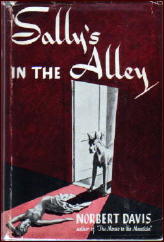
Sally’s in the Alley. Morrow, hc, 1943.

NORBERT DAVIS

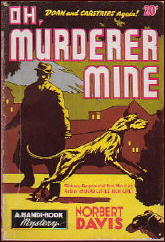
Oh, Murderer Mine. Handi-Books, pb, 1946.

NORBERT DAVIS


    A long article about Norbert Davis and one of his enthusiastic readers, philosopher Ludwig Wittgenstein, appears here on the main Mystery*File website. Following the article are several home photos of Davis and a complete bibliography, including his short fiction.

STEVEN F. HAVILL – Heartshot. St. Martin’s Press, hardcover, March 1991. Poisoned Pen Press, softcover, 2007.

   There’s always a small shiver of excitement that runs through a reader when a new writer comes along showing all the signs of being a natural-born storyteller. It’s a chancy thing, though, and while it was there at the beginning of Steven Havill’s debut novel Heartbeat, but by book’s end, sadly to say, the flame had flickered and was sadly diminished.

STEVEN F. HAVILL

   Telling the story is Bill Gastner, an aging (and badly overweight) undersheriff for Posadas County, New Mexico. A relic of the past and chafing under the recent election of a PR-oriented sheriff, Gastner wonders if perhaps his days on the job are numbered. Then a carload of teenagers smashes up, leaving five of them dead, and in the car is $150,000 worth of cocaine.

   So Gastner, with the help of Estelle Reyes, the only detective on the force, gets a chance to show he’s still worth his keep. It’s an excellent start, but halfway through the book, things begin to go awry. A fine new secondary character is introduced, but the potential to do even better things with him is sadly wasted.

   Maybe Havill didn’t intend to write a mystery. Maybe he meant only to write a crime story taking place in small town near the Mexican border. But if you wish for matters like motives, opportunities and small clues to be connected up, you will have to wait longer than the author seems to have taken pages to tell.

   [WARNING: Plot Alert] It might have been a good idea at the time, but one thing I don’t understand is why Gastner contronts one of the villains while they are alone together in a private airplane. (I won’t reveal any identities, but any detective story reader who doesn’t know who it is long before they take off simply hasn’t been paying attention.) Not only that, Gastner has just stolen his way out of a hospital room afer suffering a severe heart attack, and the plane is not pressurized. Oh, oh.

   Don’t get me wrong. The characters in Heartshot are terrific. It’s going to be the first in a series, I’m sure, and the people in this one are worth coming back to, to find out more about them. The writing is fine, and the storytelling ability is there. So what’s missing? Simply somebody (an editor, most preferably) to tell the author that the story he’s telling just isn’t holding all the water it’s supposed to.

— Reprinted from Mystery*File 31,
       May 1991 (slightly revised).


      The Bill Gastner series

Heartshot (1991)
Bitter Recoil (1992)
Twice Buried (1994)
Before She Dies (1996)
Privileged to Kill (1997)
Prolonged Exposure (1998)
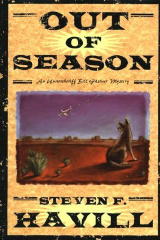
Out of Season (1999)

STEVEN F. HAVILL

Dead Weight (2000)
Bag Limit (2001)

   After Bill Gastner’s retirement, the remaining books in the series feature Undersheriff Estella Reyes-Guzman:

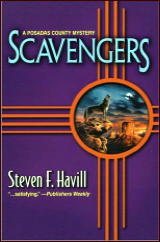
Scavengers (2002)

STEVEN F. HAVILL

A Discount for Death (2003)
Convenient Disposal (2004)
Statute of Limitations (2006)
Final Payment (2007)

STEVEN F. HAVILL

The Fourth Time is Murder (2008)
Red, Green, or Murder (2009)
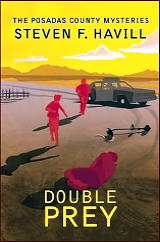
Double Prey (2011)

STEVEN F. HAVILL

One Perfect Shot (2012)

[UPDATE] 03-07-12.   With all of the followup books in the series, it’s a good thing that Steven Havill did not read this review and decide to call it quits on a writing career, right then and there. Maybe you shouldn’t pay any attention to it, either. In any case, I don’t have any of the other books in the series, and I think I ought to remedy that.

IT IS PURELY MY OPINION
Reviews by L. J. Roberts


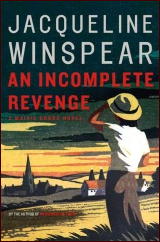
JACQUELINE WINSPEAR – An Incomplete Revenge. Henry Holt & Co., US, hardcover, February 2008. Picador, US, trade paperback, November 2008.

Genre:   Historical Mystery. Leading character:  Maisie Dobbs; 5th in series. Setting:   England, 1931.

MAISIE DOBBS

First Sentence:   The old woman rested on the steps of her home, a caravan set apart from those of the rest of her family, her tribe.

   An old friend hires investigator Maisie Dobbs to look into matters relating to a potential land purchase. Petty thefts have been blamed on boys from London there to help pick hops, but the residents distrust the Gypsies in the area as well.

   Maisie discovers that small fires have occurred every year but no one ever reported them to the fire departments or police. A family was killed during the war by a Zeppelin attack, yet no one will talk about it. Maisie must put together the pieces together while also dealing with her feelings about the soldier she loves who has been in a coma since the war.

   This is my second foray into Maisie Dobbs. I didn’t care for her the first time and, I must admit, nothing much has changed. Winspear does include information on the gypsies that I found interesting until it became redundant. She also includes details to the point of minutia on things that aren’t particularly important. Her descriptions are informative but not evocative, so that a feeling for the sense of place is missing.

   As a character, Maisie is the sort of person who would annoy me if I knew her. Yes, I can justify some of it by remembering she’s experienced the trauma of war, but not all. There is arrogance to Maisie that surpasses self confidence and is somewhat unappealing as it borders on arrogance. Her friend, Priscilla, is the complete antithesis to Maisie and annoying in her own way. In fact, the most interesting characters in the book are Maisie’s father, followed closely by the dog.

   The story itself is just not gripping. There’s no real suspense or emotion; everything is at a distance and somewhat dispassionate. The number of coincidences is overwhelming; Maisie’s perfection at everything becomes tiring. Everyone is willing to talk to her. There is no struggle or effort really required; it’s all quite neat and rather placid.

   For those who like cozies; no violence, no real threat, no swearing, no sex, no real evil, this would be perfect. Unfortunately, that’s just not my taste so although there were parts that were interesting, it was not really my cup of tea — single malt whiskey, please.

Rating:   OK.

      The Maisie Dobbs series

1. Maisie Dobbs (2003)    Edgar Awards Best Novel nominee (2004)
2. Birds of a Feather (2004)    Agatha Award Best Novel winner (2004)
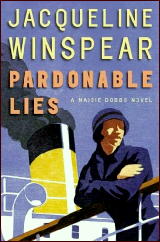
3. Pardonable Lies (2005)    Agatha Award Best Novel nominee (2005)

MAISIE DOBBS

4. Messenger of Truth (2006)    Agatha Award Best Novel nominee (2006)
5. An Incomplete Revenge (2008)
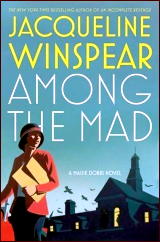
6. Among the Mad (2009)

MAISIE DOBBS

7. The Mapping of Love and Death (2010)
8. A Lesson in Secrets (2011)
9. Elegy for Eddie (2012)

MAISIE DOBBS

« Previous PageNext Page »