Characters


IT IS PURELY MY OPINION
Reviews by L. J. Roberts


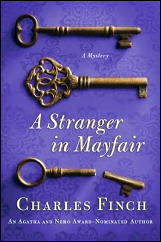
CHARLES FINCH – A Stranger in Mayfair. St. Martin’s/Minotaur Press, hardcover, November 2010; trade paperback, July 2011.

Genre:   Historical mystery. Leading character:  Charles Lenox; 4th in series. Setting:   London, England-Victorian era.

CHARLES FINCH Charles Lenox

First Sentence:   “Clara, who is that gentleman?”

   Charles Lenox has, at forty, entered a new phase in his life. He is newly married to Lady Jane, for years his best friend and neighbor, and he is newly elected to Parliament’s House of Commons.

   The second of these events necessitates spending less time doing detective work — but not yet. A colleague in Parliament, Ludovic Starling, has asked Lenox to investigate the murder of one of his footman.

   As Lenox, and his protégée Dallington, move forward in the investigation, they are met with resistance not only from Scotland Yard but from Starling, who asks them to give up the case. An attack on Lenox stiffens his resolve to find the killer.

   Finch has become a favorite of mine and this book, once again, demonstrates why as there were so many levels on which I enjoyed this book.

   We are introduced to Lenox and Lady Jane through a conversation held by others, via a prologue which actually works as it allows their back story to be told without it seeming forced or cumbersome. Each of the characters are fully drawn with very brief exposition that brings them to life.

   One thing by which I am very impressed is how, with each book in the series, the characters lives individually grow and develop. This impacts not only each character but the relationships amongst them. Relationships are something Finch does extremely well, including the awkwardness of a newly married couple and a man making a major change in his career.

   Mr. Finch’s knowledge of Victorian England is evident in every page and yet, again, so seamlessly incorporated into the plot that it is informative rather than intrusive. Through Lenox’s work in Parliament, we learn the concerns of the period and meet historical figures in their proper settings and appropriate roles. Through the birth of a child, we observe the customs and etiquette of the time.

   Although Finch is American, he studied at Oxford, now lives in the UK and delightfully conveys British humor and understatement, “For an Englishman is was a strange time to be in France….first because of Napoleon’s rather uncouth attempt to conquer Europe…” The dialogue has a natural flow but also reflects the speech of the time.

   Neither of the above is meant to devalue the plot. The mystery is intriguing, and full of effective twists. I like that solution is no more obvious to Lenox than to us, the reader. We are presented with numerous possibilities, each dismissed, until the final resolution.

   Might I have figured it out? Perhaps; but the story involved me to the point where I wasn’t deliberately trying.

   The only reason I did not rate the book as “excellent” was the use of portents which were completely unnecessary. Otherwise, I thoroughly enjoyed this book and highly recommend it with the proviso suggestion of starting the series at the beginning.

Rating:   VG Plus.

      The Charles Lenox Mysteries —

1. A Beautiful Blue Death (2007)
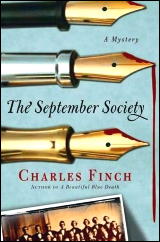
2. The September Society (2008)

CHARLES FINCH Charles Lenox

3. The Fleet Street Murders (2009)
4. A Stranger in Mayfair (2010)
5. A Burial at Sea (2011)

CHARLES FINCH Charles Lenox

PAUL KEMPRECOS – Neptune’s Eye. Bantam, paperback original, September 1991.

PAUL KEMPRECOS

   This is a long book, over 300 pages of small print, and so even at a $4.50 cover price, you’re getting your money’s worth. It’s also a private eye novel, and while I like PI novels almost more than any other kind of detective story, I think that 300 pages of small print is too long. While PI stories might not need to be short, they do need to be snappy, and after 300 pages I found that this one had long since lost its snap.

   It is the second adventure for Aristotle “Soc” Socarides, the first being Cool Blue Tomb, published a few months before, also by Bantam. It begins as a missing daughter caper, but quickly heads off in several directions: first, as a murder mystery; then as an industrial espionage story involving a notorious arms dealer and a large Cape Cod scientific community; as a World War II Nazi novel; and as a deep-sea diving adventure.

   While all this is going on, Socarides must also locate his sister, who has run away from home. In a certain sense, I disapprove of this trend. Hercule Poirot never had to work on a case for his mother. Sam Spade never had to work on a case for his mother. Perry Mason never had to work on a case for his mother. (The list goes on.)

   Or in other words, everything is in here except for the stopper for the kitchen sink. Socarides is also a wise mouth when it comes to cops who have an attitude toward PI’s who have wise mouths and seem to barge in on murder cases where they’re not wanted. I’ve read this before, and so have you.

   There are also times in the tale when Socarides’ actions are also very dumb, and that he is alive to tell the story when it’s over came as quite a surprise to me. The murder mystery has been solved at a point when there are still fifty pages to go, which are then used to clear up all the other loose ends. Neatly enough, I should add, but by that time I’m afraid I just didn’t care enough.

Rating:   C.

— This review was intended to appear in Mystery*File 35. It was first published in Deadly Pleasures, Vol. 1, No. 3, Fall 1993 (somewhat revised).


       The Aristotle “Soc” Socarides series —

1. Cool Blue Tomb (1991)     [Shamus Award for Best First PI Novel]

PAUL KEMPRECOS

2. Neptune’s Eye (1991)
3. Death in Deep Water (1992)

PAUL KEMPRECOS

4. Feeding Frenzy (1993)
5. Bluefin Blues (1997)

   Since 1999 Paul Kemprecos has been the co-author of several novels in Clive Cussler’s “NUMA Files” series. At least the first two books of his own series are hard to find, and in nice condition have become rather pricey (in the $20 to $30 range).

REVIEWED BY BARRY GARDNER:


M. K. WREN – Dead Matter. Conan Flagg #7. Ballantine, paperback original, 1993.

M K WREN Conan Flagg

   I thought this series was dead, but after a nine year hiatus, it’s back. Conan Flagg, bookstore owner, private detective, and wealthy man, returns from a trip to his hometown in Oregon to find chaos.

   While he was gone, his store manager has arranged a book signing for a local boy made good, and the bookstore is swarmed. During the signing, a local logger, being a little put out with the author for bedding his wife, threatens him with a chain saw in the store, but is disarmed by Flagg.

   The next day, after a party which Flagg attended, the unpopular fellow is found with is throat ripped out — by a chain saw.

   I liked the Flagg series in its original incarnation. Wren, who has written in several fields, knew how to tell a story, and in Flagg had created a sympathetic if not outstanding character. The books were not designed to make any top 10 lists, but were decent examples of their craft.

   I see no reason to revise any of these judgments for this.

— Reprinted from Ah, Sweet Mysteries #8, July 1993.


    The Conan Flagg series —

1. Curiosity Didn’t Kill the Cat (1973)

M K WREN Conan Flagg

2. A Multitude of Sins (1975)
3. Oh, Bury Me Not (1976)
4. Nothing’s Certain But Death (1978)
5. Seasons of Death (1981)
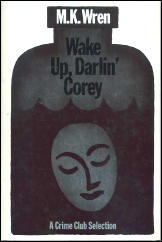
6. Wake Up, Darlin’ Corey (1984)

M K WREN Conan Flagg

7. Dead Matter (1993)
8. King of the Mountain (1994

THE SERIES CHARACTERS FROM
DETECTIVE FICTION WEEKLY

by MONTE HERRIDGE


        #7. TUG NORTON, by Edward Parrish Ware.

   Tug Norton is a private detective and creation of prolific author Edward Parrish Ware (1884-1967?). These stories are told first hand by Tug Norton:

    “… case of record in the archives of the Kaw Valley Detective Bureau, of which I, Tug Norton, am founder, owner and chief operative …” (The Queen’s Patteran)

   Norton notes that when business is dull, he entertains and instructs himself by studying his casebook (The Devil Winks). This is how some of the Norton stories begin, with him reliving the case he has looked up in his files.

TUG NORTON Edward Parrish Ware

   Tug Norton is a former cowboy and policeman. He formerly served in the police department in Kansas City, but lost his position there when new police commissioners came into office and fired “all those politically off-colored,” including him. (Lost Lake)

   His past as a cowboy is brought out in the story “The Sow’s Ear”, in which Lafe Spear, a friend of his from Oklahoma, shows up at the agency to hire him. Lafe Spear and Norton had worked together as cowboys some twelve years previously. This story is written as a contemporary Western: horses are used, and the principals dress as cowboys (including Tug Norton). The setting is rural Oklahoma.

   The Kaw Valley Detective Bureau is based in Kansas City, Missouri, but the cases are also spread out in numerous other locations. Norton states in one story that he was not interested in out-of-town cases, and that he was “confining my practice—what there is of it—to the city.” (The Tomahawk)

   However, contrary to this declaration, Norton does take cases outside Kansas City. In the Norton series there are some stories in an urban setting, but the series is a wide-ranging one and has quite a few stories in rural settings. For example, one story, “The Silent Partner”, begins in Kansas City but most of the action takes place in the wilds of Arkansas.

    “Empty Pouches” takes place in Arkansas, “The Trackless Trail” and “The Tomahawk” cases are in Kansas, “The Queen’s Patteran” in and around Joplin, Missouri, and so forth for many other cases. “The Devil Winks” is mostly in Kansas City, but the climax and finish take place in rural Arkansas.

   In “A Dead Man in the Cast,” Norton discusses an early case in his career, before he had any assistants. At that time the agency consisted of just himself and his secretary-receptionist Mary Malloy. The offices at that time were in suite 606 (sixth floor), Gateway Building.

   Norton never used the front entrance to his offices, instead using as the entrance another door along the hall that showed the words: Andrew Harper, Stocks & Bonds, Private. This suite masked an entrance to his real offices next door.

   In another early story from his career as a private detective, “The Wheels Turn,” shows a client hiring him at his hotel. Norton mentions that a year after this case his offices were in the Sandstone Building. In his early cases Norton seems to have been aided by having cases referred to him by Chief Enger, his former boss at the Kansas City Police Department.

   He does use other operatives in his work, and they show up in the stories from time to time. As of the early 1927 stories, Jim Steel was his chief assistant, and worked with him on “The Queen’s Patteran” case among others. Other unnamed detective operatives also show up in stories such as “When Fate Wants a Man.”

TUG NORTON Edward Parrish Ware

   Norton has an office boy named Spec, who announces visitors and would-be clients. Spec is noted as being “something of a mimic.” (A Game With Death) No doubt he is also a detective in training.

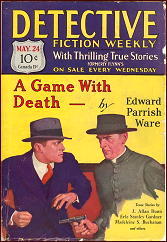
   Norton on occasion is called in to help various law enforcement officials in Missouri. The story “A Game With Death” features one of those cases. A sheriff named Hap Craker calls on Tug Norton in his Kansas City office and asks for help against a gang of criminals infesting his county.

   In another case, Sheriff Sam Sneed from Arkansas, an old acquaintance of Norton’s, comes to him for help in solving a series of robberies and murders. (Empty Pouches) In a third case, Sheriff Rube Wallace of Cold Springs County called for Norton’s assistance in a multiple arson and murder case. So it appears that Tug Norton had gained a good reputation for solving difficult cases.

   The Kaw Valley Detective Bureau is also on retainer with various clients, or in other words paid at regular intervals in case their services are needed. “The Dumb Spot” is an example where one of these clients calls them in to help solve a bank robbery and murder.

   The agency has connections with other detective agencies around the country, and they could call in for help on a case if necessary. This is the case in “Dynamite and Six-Guns,” where a friend from a Chicago detective agency has a case that is taking him to Kansas City. He calls Norton and asks for his agency’s assistance in the matter. It turns out to be an exceedingly violent case for Norton, but he wins a big fee.

   Some of his cases are just downright offbeat and strange. The first is “The Seven Coffins”, a story late in the series. Norton’s agency is hired to guard six empty coffins in a deceased millionaire’s mansion, but the mystery of the seventh coffin causes murder. The mortician and his assistant are involved, and one scene takes place at the funeral home.

   In another case, “The Tomahawk,” a rich man has suddenly become a hermit in his own mansion, and Norton has to find out why. In this case, an old Gypsy curse from a nearby tribe is the reason for the man’s behavior.

   Even though there is plenty of violence in the series, with numerous gunfights, Norton is not a big believer in using guns to solve every problem. In the story “Hell’s Backyard,” he puts forth his philosophy upon the use of guns. He says that any sleuth, either police or private detective, who is overly fond of using guns to solve problems is asking for trouble. He either gets shot or fired for using his gun.

    Never, since I founded and began operating the Kaw Valley Detective Bureau, have I kept an operative one minute after he betrayed a tendency to throw his gun upon any and all occasions where gun-throwing could possibly be done and got away with.

   I assert that this business of detecting crime and tracing criminals is better done with the head than the gun—and I invite proof to the contrary. (Hell’s Backyard)

   This attitude is interesting for that time, considering that the pulps are filled with violence, and gunfights are common in this series. In fact, Ware’s own Ranger Calhoun series are probably some of the most violent in the magazine, and rarely does a story end without the criminal being shot. However, even this series couldn’t compete with Judson Philips’ series about the Park Avenue Hunt Club when it comes to violence.

   Norton is a bit of a philosopher, and begins many of the stories with some of his philosophy (based on experience and observation). Here is an example:

   I take issue with the blasé boys who see everything through smoked glasses. Life is never drab. That drab stuff is a state of mind. To me, life is full of color—a field of gorgeous poppies. Flame! Multicolored, magnificent! Devastating, too. Well, what would you? In order to build, we must destroy. In order to live, we must die. (The Devil’s Pocket)

   Norton’s idea of a vacation from work is to go fishing. In “Trouble Up the Stream,” he and his assistant Jim Steel go on a week-long fishing trip. However, as expected, they run into trouble and have to solve a murder.

   This series was begun during the formative period of the hard-boiled private detective type of story, but still uses features of the more formal detective story, such as the use of logic and deduction to solve crimes. It does have some features of the hard-boiled story; the stories are still very violent in the private detective way, with the conclusion often resolved with gunshots.

   Tug Norton is definitely a tough, hard-boiled detective with plenty of experience, and his speech and behavior show this. He doesn’t act like the stereotypical lone wolf private detective. He is more of a descendant of the older detective characters of the dime novels type. Many, but not all, of the new private detective stories are primarily urban in setting.

   Ware had many stories published in Flynn’s/Detective Fiction Weekly in the 1920s-1930s. The Tug Norton series numbered 40 stories from 1926-1934, including two in Dime Detective. The Ranger Jack Calhoun series, also by Ware, numbered at least 59 stories from 1926-1936.

   A third series by Ware was the Buck Harris series of 12 stories 1930-1934. Battle McKim was another series by Ware, counting 12 stories 1934-1935. Ware’s character Sheriff Bob Stratton appeared in 2 stories in 1929.

   So Ware was very busy writing for this one pulp title. His Calhoun stories seemed to be the most popular, and the character appeared on the magazine’s cover a number of times. Tug Norton, although seemingly not as popular, was in my opinion the better written series.

      The Tug Norton series by Edward Parrish Ware:

    From Detective Fiction Weekly:

The Tree-Top Trail     January 30, 1926
The Fifth Gate     March 13, 1926
The Queen’s Patteran     January 1, 1927
Hell’s Backyard     March 26, 1927
The Silent Partner     April 2, 1927
Lost Lake     May 14, 1927
The Hole in the Hill     October 1, 1927
Empty Pouches     December 3, 1927
The Tomahawk     February 18, 1928
The Devil’s Pocket     February 25, 1928
The Devil Winks     March 3, 1928
Hitched to the Wind     April 14, 1928
The Wheels Turn     April 28, 1928
When Fate Wants a Man     October 20, 1928
When Thief Catches Thief     December 1, 1928
Signed With Lead     December 15, 1928
The Death Stone     November 2, 1929
The Trackless Trail     November 30, 1929
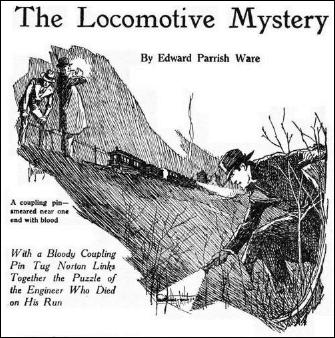
The Locomotive Mystery     February 22, 1930
Hot Eyes     July 5, 1930
A Game With Death     May 24, 1930
The Sow’s Ear     October 18, 1930
Prison Shoes     November 22, 1930
The Jade Boomerang     December 6, 1930
Snow Camp     December 13, 1930
A Background of Vendetta     April 11, 1931
Consider the Sphinx     October 24, 1931
Trouble Up the Stream     November 28, 1931
The Yellow Demon     July 16, 1932
The Devil’s Do-All     July 23, 1932
The Pole-Axe Problem     October 1, 1932
Behind the Green Mask     November 12, 1932
Monkey Blood     February 25, 1933
Red Skies     May 27, 1933
A Dead Man in the Cast     August 12, 1933
Dynamite and Six-Guns     January 20, 1934
The Seven Coffins     February 17, 1934
The Dumb Spot     June 9, 1934

    From Dime Detective Magazine:

The Skull of Judgment     March, 1932
The Gallows Clue     July 15, 1933

    Previously in this series:

1. SHAMUS MAGUIRE, by Stanley Day.
2. HAPPY McGONIGLE, by Paul Allenby.
3. ARTY BEELE, by Ruth & Alexander Wilson.
4. COLIN HAIG, by H. Bedford-Jones.
5. SECRET AGENT GEORGE DEVRITE, by Tom Curry.
6. BATTLE McKIM, by Edward Parrish Ware.
IT’S ABOUT CRIME, by Marvin Lachman


RICHARD ROSEN Harvey Blissberg

RICHARD ROSEN —

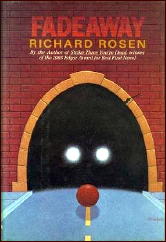
    ● Fadeaway. Harper, hardcover, September 1986. Onyx, paperback, September 1987.

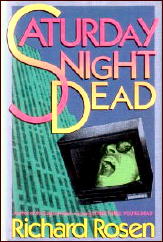
    ● Saturday Night Dead. Viking, hardcover, June 1988. Onyx, paperback, June 1989.

   Though I don’t really understand why Harvey Blissberg abandoned baseball at age thirty to become a private eye, and Richard Rosen doesn’t satisfactorily explain it, I am nonetheless glad to welcome him to the shamus corps.

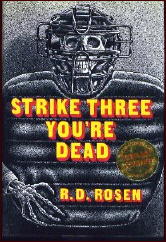
   Rosen’s second book, Fadeaway, does for basketball what his first, Strike Three, You’re Dead, did for baseball. Rosen writes better sports mysteries than anyone I know, except, of course, Dick Francis. I also like the way Rosen uses Providence, R.I., not your everyday mystery locale. Sure his solution is telegraphed, but Western Union has to live also.

RICHARD ROSEN Harvey Blissberg

   In Saturday Night Dead, Rosen and Blissberg almost desert sports, though Harvey gets his case through an old baseball buddy. His work is more as a bodyguard than a detective, but what would one expect of a detective from the same town as Spenser.

   Rosen worked for many years in television, and he does a great job with a comedy show that, as the title indicates, is remarkably like Saturday Night Live. He even includes some brand-new sketches, including one, “Death of a Mailman,” which is a hilarious send-up of Arthur Miller.

   Despite an overly melodramatic ending, this book does nothing to detract from Rosen’s status as one of the best new writers of the 1980s.

— Reprinted from The MYSTERY FANcier,
       Vol. 12, No. 4, Fall 1990.


      The Harvey Blissberg series —

1. Strike Three You’re Dead (1984)    [Edgar Award winner for Best First Novel.]

RICHARD ROSEN Harvey Blissberg

2. Fadeaway (1986)
3. Saturday Night Dead (1988)
4. World Of Hurt (1994)
5. Dead Ball (2001)

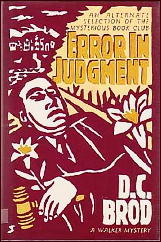
D. C. BROD – Error in Judgment. Diamond, paperback reprint, September 1991. Hardcover edition: Walker, July 1990.

   As you’ve probably noticed, paperbacks are making quantum jumps in terms of prices. I’m not sure where the upper limit is, in terms of public resistance to bigger and bigger chunks of available spending money, but so far nothing seems to be keeping the cost of reading material from jumping onward and upward, from one month to the next, or so it seems.

D.C. BROD

   (Compare the price of this book, $4.50, with the one by Stefanie Matteson that I reviewed just prior to this one, $3.95, from the same publisher. Compare it with the price of paperbacks at the time you’re reading this, several months from now.)

   But as for the question, “Is this book worth $4.50?,” I’d hesitate a little, but I’m going to say yes. I enjoyed it (and enjoyed it more than I thought I was going to, after the first couple of chapters). It’s a good-sized book, 258 pages of smallish print, and if you enjoy PI stories, I think you’ll be getting your money’s worth.

   On the other hand, a general rule of thumb is that you may want to be careful of PI books written by authors with initials for a first name. The “D” stands for Deborah, and by and large, women still don’t write hardboiled PI novels. (But neither did Rex Stout. All I’m saying is be wary.)

   Brod’s detective hero is Quint McCauley, a struggling PI new to the small town of Foxport, somewhere outside of Chicago. He’s already made the mistake of crossing one of the town’s leading legal lights, and jobs are getting hard to come by.

   One that he has in this case, accepted on a contingency basis, is that of trying to determine whether or not a judge’s death was really a suicide. A clause in an insurance policy means a difference of a million dollars, payable to the widow.

   The judge, by the way, was under indictment in an bribery case, but Quint still wonders why the case was closed so quickly by the police department. (He is also on the outs with the chief of police, you might be interested in knowing, ever since he tried to pick up the man’s wife in a bar some time earlier.)

   Quint does have the advantage over the police, as far as the case is concerned, in that he was the one who found the body. He was also the one who found (and went off with) the pictures he found stashed away in a filing cabinet. He shouldn’t have, and that’s where the title comes from.

   It’s a complex case, in other words. The difficulty I found with it, in the early going, is that the writing is talky and flat, and McCauley, who tells the story, sounds whiney and apologetic, almost to the point of exasperation.

   Points of the story where he should be angry, he says he’s angry, but he doesn’t seem angry and he doesn’t act angry. (Maybe he’s more cold-blooded than I thought he was.)

   If you decide to read it, though, bear with it, and you’ll eventually find the plot has enough twists, major and minor, to make it worth the effort. This is a mixed review, in other words, but in balance, it should read more positive than negative.

Rating:   B Minus.

— This review was intended to appear in Mystery*File 35. It was first published in Deadly Pleasures, Vol. 1, No. 3, Fall 1993 (slightly revised).


       The Quint McCauley series —

1. Murder in Store. Walker, 1989.

D.C. BROD

2. Error in Judgment. Walker, 1990.
3. Masquerade in Blue. Walker, 1991. Reprinted as Framed in Blue, Diamond, 1993.

D.C. BROD

4. Brothers in Blood. Walker, 1993.
5. Paid in Full. Five Star, 2000.

[UPDATE] 09-25-11.   Here it is, some twenty years later, not just a few months, and while prices of mass market paperbacks seem to have stabilized in the past year or so, it’s at a level that’s essentially double it was in 1991.

   The bigger problem, as far as I see it, is the total lack of diversity that exists in the way of detective fiction published today in MMP. Many publishers no longer have lines of genre fiction, and of those that do, almost all of it is of the “cozy” variety, with protagonists more interested in their hobbies (quilting, teddy bears) or small shops (antiques, herbs) than they are in solving murder cases, mostly incidental.

   In my opinion, ebooks will soon force MMP publishing into oblivion, a sad day as far as I’m concerned, but as other people have also pointed out, I’ll still have plenty to read.

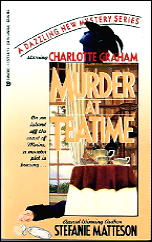
STEFANIE MATTESON – Murder at Teatime. Diamond, paperback original, March 1991.

   This second installment of the adventures of noted actress and movie star Charlotte Graham takes place in Maine, where a world-famous professor and expert on herbal remedies is poisoned by one of the products found growing in his own garden.

STEFANIE MATTESON

   The motive may have been his stout opposition to the proposed economic development of the island where he’s living (golf course, hotel and condos), or it may have been connected to his valuable collection of herbal incunabula (books printed before 1500), discovered soon after his death to be missing.

   Charlotte Graham is deliberately modeled on the old-fashioned Katharine Hepburn type of movie star, independent, only occasionally regretting that she has put her career over love and marriage. She is, however, in love with the world and nearly everything in it.

   Although at first Charlotte finds herself nervous in a place that “didn’t have sidewalks,” she is soon won over by the raw beauty of Maine and its inhabitants. And where else in the country would she be asked by the harried chief of police to aid him in his investigation, simply because of her past exploits in the field?

   It has to be a chore for a mystery writer, book after book, to get his/her amateur detective involved in what should really only be police investigations. In a way it’s refreshing to see Matteson make no bones about it, and get Charlotte Graham right to work!

   This is but one example of how this case maintains itself as a direct descendant of the mysteries of the Golden Age of Detection. As another, there are only a few major suspects on the relatively isolated island. Their alibis have to be checked out individually, their motives examined in both direct and casual conversation, and in the end they are all gathered together in a final confrontation, during which the murderer bolts and pursuit must follow.

   A love of books and the lore of book collecting are also important ingredients of this novel, along with the herbs and the pitfalls of life in academia. If I thought Mattes0n’s first book, Murder at the Spa slowed down too often to nearly a halt by the intrusion of as much about the spa business as I wanted to know, she certainly makes up for it with this one, which has almost everything I’m looking for in a detective novel.

   Almost, but not quite. I did have a little bit of trouble with the ending, and with a

[WARNING: Major Plot Alert!]

I’m going to tell you about it here. [Don’t read farther without having read the book first, if you’re going to.]

   The problem, as I see it, is that the evidence that eventually traps the killer is found carelessly left lying in a book as a bookmark. I don’t know about you, but if I’d ever murdered anybody, I’d be a little bit more careful about incriminating myself than this.

   (Of course, I’d be the kind of killer who keeps returning to the scene of the crime over and over again, looking and looking for anything at all that I’d missed!)

Rating:   B.

— This review was intended to appear in Mystery*File 35. It was first published in Deadly Pleasures, Vol. 1, No. 3, Fall 1993 (slightly revised).


       The Charlotte Graham series —

1. Murder at the Spa (1990)

STEFANIE MATTESON

2. Murder at Teatime (1991)
3. Murder on the Cliff (1991)
4. Murder on the Silk Road (1992)

STEFANIE MATTESON

5. Murder at the Falls (1993)
6. Murder on High (1994)

STEFANIE MATTESON

7. Murder Among the Angels (1996)
8. Murder Under the Palms (1997)

IT’S ABOUT CRIME, by Marvin Lachman


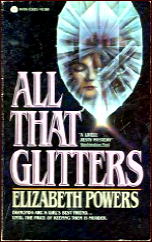
ELIZABETH POWERS – All That Glitters: The Case of the Ice-Cold Diamond. Doubleday, hardcover, 1981. Avon, paperback, 1983.

ELIZABETH POWERS All That Glitters

   Years ago Mary Roberts Rinehart’s heroines wandered into trouble in mansions with secret passages. More modern is Viera Kolarova in Elizabeth Powers’ All That Glitters, who travels all over New York City, finding bodies, running from killers, and only as an afterthought informing the police of what she has learned.

   She finds her first corpse just prior to the weekend, saying cleverly, “Thank God Friday only comes once a week.” That offset such Had-I-But-Known lines as “I might have reflected a bit on what was bothering me and have saved myself the trouble of the mess I got into.”

   Incidentally, acting the role of what Boucher called “the Gothic idiot” is not restricted by sex. Many years ago, I observed the same characteristics in a male, Professor Foley in Michael Kenyon’s May You Die in Ireland (1965).

— Reprinted from The MYSTERY FANcier,
       Vol. 12, No. 4, Fall 1990 (slightly revised).


Bibliographic Note:   Viera Kolarova made one later appearance, in On Account of Murder, a paperback original from Avon in 1984. As a refugee from Communist Czechoslovakia who finds work in New York City, her name correctly spelled is Viera Kolářová.

THE ARMCHAIR REVIEWER
Allen J. Hubin


DAVID M. PIERCE

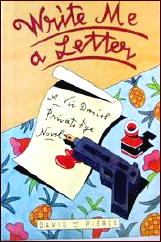
DAVID M PIERCE – Down in the Valley. Penguin, paperback original, 1989.

   David M Pierce, a Canadian with a colorful background (songwriter, co-author of a musical and a cookbook, Shakespearean actor, and poet, most of this in England), arrives on our scene with Down in the Valley. This offers us V. (for Victor) Daniel, 6′ 7-1/4″, ex-con, wearer of Hawaiian shirts loud enough to wake the dead, and private investigator in the San Fernando Valley of LaLaLand.

   Here Daniel has a variety of cases in process, of which the most noticeable (and, apparently, most deadly) has to do with a local high school in which unlawful chemicals flourish.

   Pierce has the PI patter down very nicely, keeps the plot well aboil, peoples it colorfully (to say the least), and entertained me exceedingly well. I could do with more of these, and in fact two more Daniel capers are in print, shortly to be sampled by me.

— Reprinted from The MYSTERY FANcier,
       Vol. 12, No. 4, Fall 1990.


    The Vic Daniel series —

Down in the Valley. Penguin 1989.
Hear the Wind Blow, Dear. Penguin 1990.
Roses Love Sunshine. Penguin 1990.

DAVID M. PIERCE

Angels in Heaven. Scribner, UK, 1991. Mysterious Press, US, 1992.

DAVID M. PIERCE

Write Me a Letter. Scribner, UK, 1992. Mysterious Press, 1993.

DAVID M. PIERCE

As She Rides By. St.Martin’s 1996.

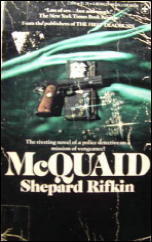
SHEPARD RIFKIN – McQuaid in August. Doubleday Crime Club, hardcover, 1979. No paperback edition.

   Even though Damian McQuaid is a homicide detective, for the NYPD, this is definitely not your average sort of police procedural. It’s August, it’s hot, and McQuaid has only two days to solve a case on his own before someone discovers the body of the girl in whose apartment he spent the night.

   Finding the killer is not enough. Without the usual power of the police department behind him to help gather the evidence he needs, McQuaid is forced to resort to an intricate cat-and-mouse game of active harrassment in order to produce a “voluntary” confession.

   As a leading character, his excursions beyond the letter of the law evoke both admiration and a surprising lack of sympathy; part of the fascination reserved to the reader appears to be watching him stay, barely, on the side of sanity himself.

Rating:   A Minus.

— Reprinted from The MYSTERY FANcier, Vol. 3, No. 6, Nov/Dec 1979 (very slightly revised). This review also appeared earlier in the Hartford Courant.


Bibliographic Data:

    The Lt. Damian McQuaid series —

McQuaid. Putnam 1974.

SHEPARD RIFKIN McQuaid

The Snow Rattlers. Putnam, 1977.
McQuaid in August. Doubleday, 1979.

   Not in the series is The Murderer Vine (Dodd, 1970), recently reprinted by Hard Case Crime (2008). It’s a work of fiction based on the murder of three civil rights workers in Mississippi (James Chaney, Andrew Goodman and Michael Schwerner) during the Freedom Summer voter registration drive.

   Rifkin’s other crime novel is Ladyfingers, a paperback original published by Gold Medal in 1969.

« Previous PageNext Page »