Characters


THE ARMCHAIR REVIEWER
Allen J. Hubin


KEITH PETERSON Andrew Klavan

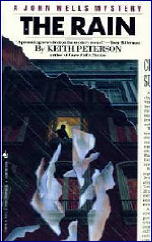
KEITH PETERSON – The Rain. Bantam, paperback original, December 1988. Softcover reprint by “Andrew Klavan writing as Keith Peterson,” Vista, UK, September 1997.

   The third tale about New York reporter John Wells by Keith Peterson takes place exclusively in a sweltering August in New York City. A lowlife acquaintance of Wells’ invites him over and tries to sell him sexually compromising photos of an ostensibly strait-laced senatorial candidate.

   Then the lowlife becomes a non-life, the photos disappear, and Wells’ paper is ignominiously scooped by the other rag in town. John’s popularity with his bosses reaches new lows, and a local mobster also takes a dim view of Wells’ meddling. It’s not clear he can work his way out of this mess even if he dies trying.

   Beautifully plotted and paced.

— Reprinted from The MYSTERY FANcier,
       Vol. 12, No. 4, Fall 1990.


Editorial Comments:   I do not know whether the name behind the Keith Peterson pseudonym was known when Al wrote this review, but I suspect not, or it seems likely he would have mentioned it. The four “John Wells” books came out in a flurry, three in 1988 and one in 1989, then no more. I bought them all, and even though they looked interesting, I set them aside and almost totally forgot about them until now.   Perhaps I shouldn’t have; see below:

    The John Wells series, by Keith Peterson. —

There Fell a Shadow (n.) Bantam, August 1988.
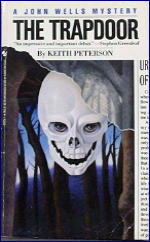
The Trapdoor (n.) Bantam, 1988.   [Nominated for the Edgar Award, Best Paperback Original.]

KEITH PETERSON Andrew Klavan

The Rain (n.) Bantam, December 1988.   [Edgar Award for Best Paperback Original.]
Rough Justice (n.) Bantam October 1989.

REVIEWED BY STAN BURNS:


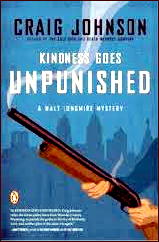
CRAIG JOHNSON – Kindness Goes Unpunished. Viking, hardcover, March 2007. Penguin, softcover, February, 2008.

CRAIG JOHNSON Walt Longmire

   This is the third Wyoming Sheriff Walt Longmire novel. He and his friend Henry Standing Bear are on a trip to Philadelphia. Henry is going because he has been invited to put on an exhibition of family Indian reservation photos at a museum, while Walt is going to visit his daughter Cady, who lives there.

   His daughter thinks she has met “the one” and wants to introduce him to her father. But Walt never gets to see her; he finds that she is hovering in a coma near death in the hospital after being attacked by an unknown male assailant outside the same museum that will host Henry’s photos.

   With the help of Henry, Walt sets out to find the person responsible. He discovers that the boyfriend is more than likely the guilty party; that he was a gambler and drug addict. But the boyfriend is thrown off a bridge to his death before Walt can question him, causing him to wonder if his daughter had discovered something about the boyfriend that would cause him to attack her.

   Walt continues to investigate trying to discover what is really behind the boyfriend’s death. Not as good as the first novel, but the Philadelphia locations feel very real and the writing keeps you turning pages.

Rating:   B.

       The Sheriff Walt Longmire Mysteries —

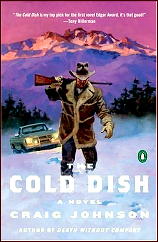
1. The Cold Dish (2004)

CRAIG JOHNSON Walt Longmire

2. Death Without Company (2006)
3. Kindness Goes Unpunished (2007)
4. Another Man’s Moccasins (2008)
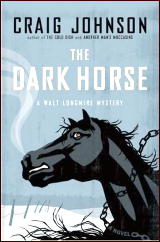
5. The Dark Horse (2009)

CRAIG JOHNSON Walt Longmire

6. Junkyard Dogs (2010)
7. Hell Is Empty (2011)

THE SERIES CHARACTERS FROM
DETECTIVE FICTION WEEKLY

by MONTE HERRIDGE


        #6. BATTLE McKIM, by Edward Parrish Ware.

   The Battle McKim stories by Edward Parrish Ware were a short series of at least thirteen tales published in Detective Fiction Weekly between 1934 through 1937. The stories are about a detective who works for Sheriff Calloway in Zinc City, near the Ozark Mountains in what appears to be Missouri.
EDWARD PARRISH WARE Battle McKim

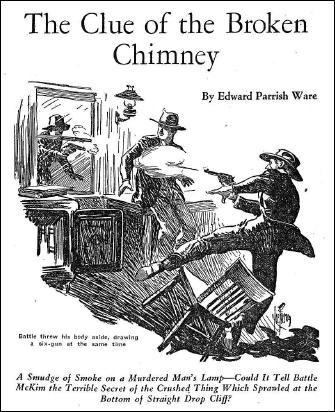
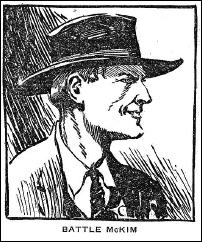
   Zinc City has a population of something over fifty thousand residents. “Brutus McKim, nicknamed ‘Battle,’ . . . stood five feet and five inches in his low-heeled shoes, and weighed one hundred and thirty pounds. His age was somewhat under forty, and his nature was as mild as milk. But this small, mild-mannered man had, on more than one occasion, proved his right to the nickname which had been bestowed on him originally in fun.” (The Clue of the Broken Chimney)

   In fact, in the first story McKim has to shoot two criminals who tried to kill him. However, Battle McKim “hated to use his gun. It was against his nature to kill. When he just had to do it, he did.” In one story, it was revealed that McKim was especially fond of circuses and circus people, and thought that circus bands “made the finest music of any other bands whatever.” (Clue of the Elephant’s Ear) McKim is never without his Stetson hat nor his gun.

   The stories mostly have titles that involve a clue which is important to the solution of the story. Ware had other series which were published in DFW: the Ranger Jack Calhoun series (1926-1938), Tug Norton (1926-1934), and Buck Harris (1930-1934). So Ware wrote many stories for the magazine, but nothing after 1938.

   The first known story in the Battle McKim series is “The Clue of the Broken Chimney” which sets forth some background facts and in its plot shows what the series was going to be like. McKim sees in the death of a mining owner by a fall from a height to be murder, when everyone else disagrees and claims either accident or suicide.

EDWARD PARRISH WARE Battle McKim

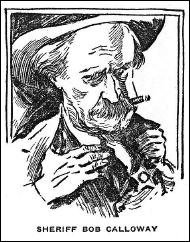
   McKim’s investigation into the matter causes some trouble for him with criminals, but he is not deterred. The sheriff seems to have great confidence in McKim’s abilities and will go along with whatever he says.

   â€œClue of the Bandit’s Beard” involves the false beard one of the criminals wears. The story involves the holdup and murder at a mining encampment. In this story Battle McKim shows his sleuthing and tracking abilities by tracking down the criminals.

   As seems to be usual in this series, he has gunfights with the criminals. However, he takes such a long time tracking down the criminals that Sheriff Calloway becomes angry at his absence. It seems that the sheriff depends a bit too much upon his resident detective.
EDWARD PARRISH WARE Battle McKim

   â€œThe Clue of the Animal Crackers” actually involves the contents of a box of animal crackers. These crackers seem to have been around a long time; I assume they are still available nowadays. The scene is the county fair, where a carnival is taking place. One of the carnival people has been murdered, and McKim must figure out who committed the crime. The animal crackers play a significant role in the solution of the mystery. For a change, there is no gunfight between McKim and the criminal.

   â€œClue of the Battered Bullets” involves a mysterious case of murder and a kidnapping of a banker. Upon investigation, Battle McKim also finds plenty of clues leading in various directions. He suspects that there is more to the case than first appears, and by the end, he has to gunfight with a criminal who was behind it all. A number of the stories in this series involve gunfights with the criminals. Occasionally McKim does capture the criminals alive.

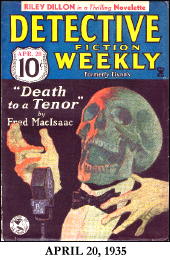
   â€œClue of the Elephant’s Ear” takes place at the Moseby’s Marvelous Circus, which is visiting Zinc City. The headliner of the circus and its greatest attraction is the intelligent elephant Bong the Great, or Bong, the Elephant with the Human Brain as he is billed on advertisements. Battle McKim investigates after the elephant kills its trainer during a performance.
EDWARD PARRISH WARE Battle McKim

   The killing by the elephant was due to a sudden rage that came over the elephant, and McKim wants to know if there are reasons for this behavior. Sheriff Calloway objects to this, saying that he has already decided to kill the elephant as a dangerous beast. McKim doesn’t pay any attention to this and investigates anyway.

   â€œClue of the Persian Cat” involves two Persian cats and a murder mystery at a roadhouse. One of the two owners has been mysteriously killed, and the first thing Battle McKim must decide is whether it was suicide or murder. There aren’t very many suspects, so the mystery angle is a bit slim. The cats’ involvement turns out to be important in the mystery, and leads McKim to the solution.

   â€œClue of the Poisoned Dog” presents Battle McKim with a murder mystery that has taken place at a rich man house where several people are guests. It also takes place in the midst of a snowstorm, which shows that no on entered or left the house at the time of the murder. In addition, unset diamonds valued at a hundred thousand dollars have been stolen from the dead man. McKim cleverly solves the crimes and recovers the diamonds.

   â€œClue of the Hard-Boiled Eggs” has a slim clue for Battle McKim to work on. A local farmer had sold some land for $10,000 and decided to hide the money on his property rather than putting it in the bank. McKim becomes involved after the man supposedly died accidentally, leaving his money still hidden.
EDWARD PARRISH WARE Battle McKim

   After investigating, McKim deduces that the farmer was actually murdered and his money stolen. McKim has to resort to trickery to force the criminal to give himself away as the guilty man.

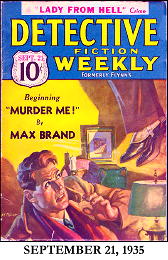
   â€œClue of the Pekin Ducks” is another good story. The clue of the ducks involves their reputation as a night alarm, alerting their owner as to trespassers. The crime here is of the murder and robbery of their owner, a stingy, miserly, person who is disliked by virtually everyone. Plenty of suspects in a case of this nature. But the duck clue led Battle McKim to the only person who could have committed the crime.

   â€œClue of the Crawling Cows” deals with a different kind of crime. A train baggage car of the Missouri Central Railroad has been robbed, one of the car workers tied up and the other man missing as well as fifty thousand dollars gone.

   Battle McKim must find out where the missing train worker went as well as find the missing money. The story is clever, and McKim finds the definitive clue in the behavior of some cattle next to the train tracks.

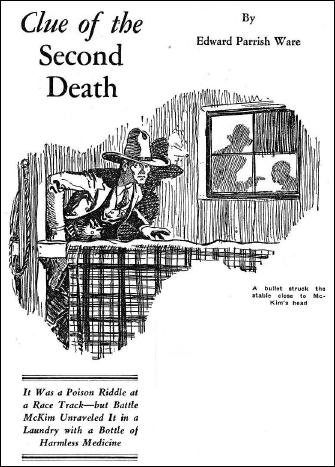
   â€œClue of the Second Death” involves a murder by somewhat improbable means, but the author seems to make it work in the story, although it is a bit far-fetched that Battle McKim should be able to figure it out. The murder victim is Colonel Shel Allen, who is stricken dead by aconite poisoning while driving his car.

EDWARD PARRISH WARE Battle McKim

   Because Allen was the county prosecutor, suspicion comes down on a crooked judge and his friends, but McKim tends to believe in a different group of suspects and devotes his investigation to them. The second death clue gives McKim the evidence he needs to figure out who committed the first murder.

   â€œClue of the Tallow Candle” was the last story in the series, and much of it takes place underground in some caves near Zinc City. A noted judge has been killed in one of the caves, and Battle McKim must first prove it was deliberate murder rather than an accident.

   As usual, hidden clues contribute to the story, and a second death makes the mystery more difficult to solve. However, McKim draws the suspects around with the addition of others in the sheriff’s department, and proves who committed the murder and why. As often happens, McKim shoots it out with the killer.

   This is an average series, with very good stories. There is not any humor in the stories, just a basic storytelling technique that does a decent job of the adventures of Battle McKim in his quest for the truth.

   The stories are at least a change from the sameness that had crept into Ware’s series about Ranger Jack Calhoun. Interestingly, Ware must have disliked veterinarians, as he makes them the villain in two of the stories.

      The Battle McKim series by Edward Parrish Ware:

The Clue of the Broken Chimney     October 27, 1934
Clue of the Bandit’s Beard     November 10, 1934
The Clue of the Animal Crackers     November 24, 1934
Clue of the Battered Bullets     March 16, 1935
Clue of the Elephant’s Ear     April 20, 1935
Clue of the Persian Cat     May 4, 1935
Clue of the Poisoned Dog     August 3, 1935
Clue of the Hard-Boiled Eggs     August 10, 1935
Clue of the Pekin Ducks     September 21, 1935
Clue of the Putty Paper     November 2, 1935    *
Clue of the Crawling Cows     December 21, 1935
Clue of the Second Death     March 21, 1936
Clue of the Tallow Candle     October 9, 1937

* I don’t have this story, but the title indicates it might be part of the series. [And so it is. See Comment #1.]

    Previously in this series:

1. SHAMUS MAGUIRE, by Stanley Day.
2. HAPPY McGONIGLE, by Paul Allenby.
3. ARTY BEELE, by Ruth & Alexander Wilson.
4. COLIN HAIG, by H. Bedford-Jones.
5. SECRET AGENT GEORGE DEVRITE, by Tom Curry.
IT IS PURELY MY OPINION
Reviews by L. J. Roberts


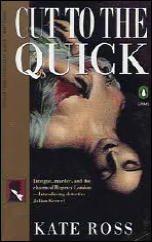
KATE ROSS – Cut to the Quick. Viking, hardcover, 1993. Penguin, paperback, 1994.

Genre:   Historical mystery. Leading character:  Julian Kestrel (1st in series). Setting:   England/Regency era, 1824.

KATE ROSS Julian Kestrel

First Sentence:   Mark Craddock paced slowly, deliberately, back and forth behind the desk in his study.

   After Regency dandy and detective Julian Kestral rescues young Hugh Fontclair from embarrassment at a gambling hall, he is, in turn, asked to serve as best man for Hugh’s forced marriage to Maud Craddock.

    Kestral, along with his man Dipper, travels to the Fontclair country home for a weekend with both families. The last thing he expected was to find the body of an unknown murdered woman in his bed or having to provide Dipper innocent of the act.

    For those of us who love period mysteries, Ross is one of the best. She captures the period with exquisite detail from dress, manners, speech. Her characters are wonderfully drawn portraying all levels of society.

    Kestrel is the character at center stage. He is the personification of the Regency dandy, exhibiting droll cynicism and detachment. Upon meeting Hugh’s young sisters, he comments:   “I rather like making friends with women before they’re old enough to be dangerous.”

    However, under the veneer is a consideration for others, an admiration for goodness, awareness of people’s natures and a determination for justice. Although there are quite a number of characters in the story, each is so well drawn as never become confused.

    The plot is very strong. It’s not a locked-room mystery as the key is on the hall table. It is very much a case of who is the victim, how did she get there and what was her relationship to the people in the house. It’s a step-by-step investigation with plenty of twists and turns along the way. Best of all, I certainly did not predict the killer.

    While sadly, Kate Ross only published four books before her death in 1998, this, as are all of her books, is very well worth reading, and reading again.

Rating:   Very Good Plus.

    The Julian Kestrel series —

Cut to the Quick (1993)
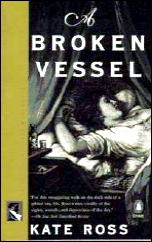
A Broken Vessel (1994)

KATE ROSS Julian Kestrel

Whom the Gods Love (1995)
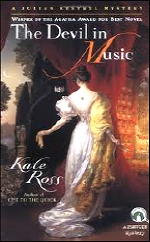
The Devil in Music (1997)

KATE ROSS Julian Kestrel

REVIEWED BY BARRY GARDNER:


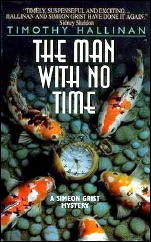
TIMOTHY HALLINAN – The Man with No Time. Simeon Grist #5. Morrow, hardcover, 1993. Avon, paperback, May 1995.

TIMOTHY HALLINAN

   I have enjoyed previous tales of over-educated LA private detective Simeon Grist considerably. I enjoyed this one much less. Much less.

   Grist finds himself in the middle of the LA Asian gang scene, as the twin children if his Asian ladylove are kidnapped; seemingly by an old friend of the family from mainland China, who aided them in escaping from there many years ago.

   It quickly becomes apparent that the old “friend” is being pursued by an LA ganglord, and Grist is quickly up to his neck in gangsters of various Asian persuasions, all suitably villainous.

   This isn’t a poorly written book. It also isn’t a private detective book. It’s a well-done kick-ass type fairy tale of the Parker/Crais variety, though Hallinan isn’t quite in their league as prose stylist. Grist is assisted by a black semi-legal, and six black brothers who are his friends, and by a youthful Vietnamese gang member who he has co-opted; all entertaining characters.

   The storytelling is fine. It’s a bloody action-packed heroes-against-bad-guys tale with in-depth characterization not a major concern. But it isn’t the book I wanted to read, nor one I expected him to write. I’d have bought an “Executioner” if I wanted to read one.

   Pfui. Color me disappointed.

— Reprinted from Ah, Sweet Mysteries #8, July 1993.


      The Simeon Grist series —

1. The Four Last Things (1989)
2. Everything but the Squeal (1990)
3. Skin Deep (1991)

TIMOTHY HALLINAN

4. Incinerator (1992)
5. The Man with No Time (1993)
6. The Bone Polisher (1995)

      The Poke Rafferty series —

1. A Nail Through the Heart (2007)

TIMOTHY HALLINAN

2. The Fourth Watcher (2008)
3. Breathing Water (2009)
4. The Queen of Patpong (2010)

   Poke Rafferty is an ex-pat travel writer and sometime adventurer trying to settle down in Bangkok with his fiancee and their adopted daughter.

REVIEWED BY BARRY GARDNER:


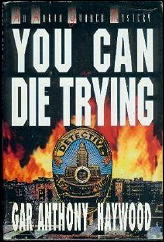
GAR ANTHONY HAYWOOD – You Can Die Trying. Aaron Gunner #3. St. Martin’s, hardcover, 1993. Penguin, paperback, 1994.

GAR ANTHONY HAYWOOD Aaron Gunner

   Haywood first wrote about black PI Aaron Gunner in the 1988 Fear of the Dark. For some reason, even before the President put his two cents in, Walter Mosley had gotten more attention as a black crime writer. Recently, Barbara Neely has been in the spotlight. I think Haywood writes about blacks better than either, and is a better writer overall.

   Gunner, for that best of reasons, poverty, takes a case that can bring him nothing but grief: proving that a bigoted cop was innocent of killing a 14 year old black youth in an attempted robbery. The cop had been fired for his actions, and eight months later ate his gun.

   A man comes to Gunner who said he witnessed the shooting, and that the kid fired at the cop first; and that he failed to come forward because he received anonymous threats on his family. No one wants to change history; not the black community, and not the police, who are re-building an image after the riots. Only Gunner. And he’s not really sure that he does. He knew the cop, too.

   Gunner is to me a believable person, but that doesn’t really mean anything. Any WASP male who claims to understand blacks is a fool, and in that regard at least, I’m not.

   Haywood is a thoroughly competent writer, and knows his way around the black middle-class as well street life. One of the book’s strongest points is that it clearly lays out why bigoted, brutal cops exist, and why, except in isolated instances, the black community can never like or trust people with badges.

   It is not a hopeful book, except in that it portrays a few decent people on both sides of the equation. It is a thoughtful book, though, and I think a good one.

— Reprinted from Ah, Sweet Mysteries #8, July 1993.


       The Aaron Gunner series —

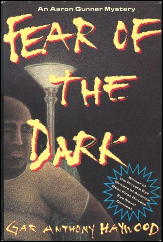
1. Fear of the Dark (1988)

GAR ANTHONY HAYWOOD Aaron Gunner

2. Not Long for This World (1990)
3. You Can Die Trying (1993)
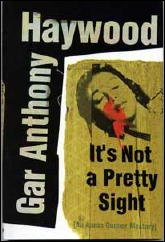
4. It’s Not a Pretty Sight (1996)

GAR ANTHONY HAYWOOD Aaron Gunner

5. When Last Seen Alive (1997)
6. All The Lucky Ones Are Dead (2000)

IT IS PURELY MY OPINION
Reviews by L. J. Roberts


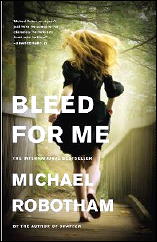
MICHAEL ROBOTHAM – Bleed for Me. Sphere, UK, hardcover, 2010. Mulholland Books, US, hc, February 2012.

Genre:   Unlicensed Investigator: Psychiatrist. Leading character:  Joe O’Laughlin (4th in series). Setting:   England.

First Sentence:   I should start by telling you my name, although it’s not really important.

MICHAEL ROBOTHAM

    Psychiatrist Joe O’Laughlin is trying to deal with having Parkinson’s disease, being separated from his wife and only seeing his daughter part time. When his daughter’s best friend is accused of murdering her father, a former police detective, Joe can’t ignore his daughter’s plea to help.

    I’ll admit I’m always excited when a new Robotham book comes out and, once again, he delivers. From the very powerful and disturbing prologue to the nail-biting ending, I was completely absorbed.

    One thing I really appreciate is that, although this is the fourth book in the series, he doesn’t assume you’ve read any of the previous books. Without burdening the plot or slowing down the story, within a very short period the author does an excellent job of providing a comprehensive back story on the characters. You never feel as though you’ve missed something.

   The portrayal of a couple who are amicably yet needfully separated is effective without being maudlin. I don’t know how accurate the psychiatry aspects are; it does seem Joe is, at time, a bit too insightful for belief, but it works and provides some interesting observations.

    Having recently served on a criminal-case jury; albeit not a murder, I found his comments on juries fascinating as well as the demonstration that, with motivation, anyone can be pushed to violence.

    It’s the balance of introspection and suspense that brings me back to Robotham every time. The plot is complex, twisty and fast-paced. I liked that all the clues were there to identify the killer, yet I didn’t, and that justice prevailed.

    If you’ve not yet discovered him, Robotham is an author I definitely recommend trying.

Rating:   Good Plus.

       The Joseph O’Loughlin series —

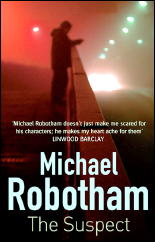
1. The Suspect (2004)

MICHAEL ROBOTHAM

2. Lost (2005) aka The Drowning Man (US)
3. Shatter (2008)
4. Bleed for Me (2010)

THE BACKWARD REVIEWER
William F. Deeck


RICHARD GOYNE – The Lipstick Clue. Stanley Paul, UK, hardcover, 1954. No US edition.

   Collectors of clergyman detectives may want to try Goyne’s series featuring The Padre — the Rev. Peter Eversleigh — whom I do not remember seeing on lists of clergy detectives.

   One of the reasons The Padre may not have made such lists is that his denomination, at least in this novel, is not revealed, though I would speculate on High Anglican. Another reason, again at least in this novel, is that Eversleigh may as well have been a lawyer or a doctor or unemployed, for that matter.The religious aspect is negligible.

   Still, the plot is a good one. A retired colonel, who is something more than a scoundrel, asks his estranged family to give him another chance as a father. For reasons unclear at the start, they all do come to spend the weekend with him, despite each of them despising him for various reasons. As is to be expected, the not-so-good colonel finishes the first night of the weekend dead to the last drop.

   The Padre had been invited as a sort of leavening for the group. He ends up investigating the murder, discovering what is in some respects an unusual motive for killing, and learning who the murderer was. An interesting case that makes one not reluctant to read the other novels in which The Padre appears — for the detectival aspect, not for his role as a clergyman.

— From The MYSTERY FANcier, Vol. 12, No. 3, Summer 1990.


       The Peter Eversleigh (The Padre) series —

   The Crime Philosopher (n.) Paul 1945.

   Savarin’s Shadow (n.) Paul 1947.
   The Dark Mind (n.) Paul 1948.
   Traitor’s Tide (n.) Paul 1948.
   The Courtway Case (n.) Paul 1951.
   The Lipstick Clue (n.) Paul 1954.

   Besides a long list of books under his own name, Richard Goyne (1902-1957) is credited with another two dozen or so as by John Courage, plus a scattered handful under the names Aileen Grey, Scarlet Grey, Kitty Lorraine, Paul Renin & Richard Standish.

   Other series characters under his own name are: Paul Templeton (13), Sexton Blake (2), and Supt. “Tubby” Greene (2).

IT IS PURELY MY OPINION
Reviews by L. J. Roberts


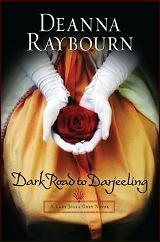
DEANNA RAYBOURN – Dark Road to Darjeeling. Mira, US, trade paperback, 2010.

Genre:   Historical Mystery. Leading characters:  Lady Julia Grey/Nicholas
Brisbane (4th in series). Setting:   India-Victorian Era (1889).

First Sentence:   “I thought there would be camels,” I protested.

DEANNA RAYBOURN

   The honeymoon of Lady Julia Grey and enquiry agent Nicholas Brisbane has been interrupted by the arrival of Julia’s sister, Portia, and brother, Plum. Jane, Portia’s lover of many years, desperate to have a child, married, moved to a tea plantation in India, is now pregnant.

   She is also a widow, her husband having died under somewhat suspect circumstances. If Jane’s impending child is male, he will be the heir to the plantation. Julia, Nicholas, Portia and Plum must keep Jane and the child safe as well as uncover a murderer, had it been murder.

   It takes a very good book to keep me reading until 3 a.m. This book did just that.

   Ms. Raybourn creates wonderful characters. Where Lady Julia starts off feeling reckless and stubborn, and her husband, Nicholas, overbearing and harsh, there is growth within the story where both characters learn and gain an understanding both to each other and to the reader.

   Julia’s sister Portia, brother Plum, maid Morag, and all the secondary characters have weight and substance. None of the characters are two-dimensional extras; rather each plays an important role in the development of the plot.

   he use of humor is delightful. It is often used to define the characters and relationships. When Portia is confronted by a less-than-fragrant smell, she states, “Julia, we are Englishwomen. We are not cowed by a little authentic local flavor.”

   Raybourn’s voice and dialogue effect a feeling both character and of period. In addition to which her excellent descriptions establish a strong sense of place and time.

   Although one could consider this romantic suspense, it is not a fluffy book and has more layers than most. One should not dismiss it casually. The lightness is tempered by reminders of harsh reality which are both thought-provoking and introspective.

   This is a story of relationships and their definitions, of neglect and its results, of loss and strength and survival. There is a mystery, a quite good one, in fact, with a tragic and emotional finale.

   Ms. Raybourn has taken a book, and a series, which could be simple light entertainment and infused it with depth and impact.

Rating:   Very Good.

      The Lady Julia Grey series —

1. Silent in the Grave (2006)

DEANNA RAYBOURN

2. Silent in the Sanctuary (2008)
3. Silent on the Moor (2009)
4. Dark Road to Darjeeling (2010)
5. The Dark Enquiry (2011)

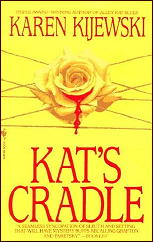
KAREN KIJEWSKI – Kat’s Cradle. Doubleday, hardcover, March 1992. Bantam, paperback, December 1992.

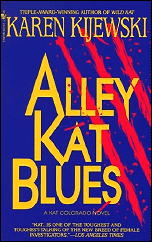
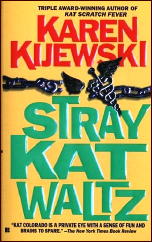
   Throughout the decade she was active, the 1990s, Karen Kijewski was a prolific and well-regarded mystery writer. She won or was nominated for several awards, and she seemed to be doing well sales-wise. Living in northern California at the time, and perhaps still, she seems to slipped off the map since her final book (so far), Stray Kat Waltz (1998), the ninth adventure for her female PI character, Kat Colorado.

KAREN KIJEWSKI Kat Colorado

   I admit to being optimistic to adding the parenthetical phrase (so far) in that line above. It’s been 13 years since that last outing, though, so I’d have to agree that the chances are slim to none that we’ll ever see another entry in the series. Someone once suggested to me that when her contract ran out and wasn’t renewed, she decided to call it quits, but as I say, that’s only hearsay, if not an out and out and totally wild guess.

   In Cradle Kat is hired by a young heiress, Paige Morell, whose strong-willed (i.e., domineering) grandmother has just died. She never knew her parents, and she wants Kat to find out more about them. While she takes the job, Kat knows that digging around in the past may bring up more than her client might want to know, but convincing her of that is another story. (And not this one.)

   Her client also appears more than a tog unstable, with many emotional ups and downs as the story goes along. Under the circumstances, it’s nothing very surprising, but it also becomes clear that there’s several important things she’s not telling. Otherwise the case seems straightforward enough, but not so. It turns out to be a thoroughly exhausting affair for Kat, both physically and otherwise.

   That Kat is unable to establish on her part an emotional distance away from the case she’s on is part of the problem. This is Ross Macdonald territory, not Hammett, but Kat is no Lew Archer, who often observes but fails to get involved himself.

   Besides the investigation she finds herself an integral part of, in more ways than one, she allows her relationship with Hank, her close cop friend who lives in Las Vegas – which is more than a short hike from the Sacramento area, her base of operations – to wither away.

   Let’s change that last phrase to something more akin to “actively pushes away.” My feeling is that PI’s should not allow themselves to become romantically involved with clients, suspects, or suspects’ families and friends, nor can you always foresee what will happen on the rebound. There’s more than enough of a hint here to tell you what I found as a fatal flaw to this book’s telling, and you should immediately forget I said anything, if you ever intend to read this book.

   In any case, it was obviously Karen Kijewski’s intent to write a wrenching tale of dysfunctional family relationships, and that is exactly what she did. Kat is lucky to have escaped alive, in more ways than one.

      The Kat Colorado series:

1. Katwalk (1988)
2. Katapult (1990)

KAREN KIJEWSKI Kat Colorado

3. Kat’s Cradle (1991)
4. Copy Kat (1992)
5. Wild Kat (1994)
6. Alley Kat Blues (1995)

KAREN KIJEWSKI Kat Colorado

7. Honky Tonk Kat (1996)
8. Kat Scratch Fever (1997)
9. Stray Kat Waltz (1998)

KAREN KIJEWSKI Kat Colorado

« Previous PageNext Page »