Characters


REVIEWED BY MICHAEL SHONK:


THE AMAZING MR. MALONE. Based on character created by Craig Rice. Written by Gene Wang; produced by Bernard L. Schubert.

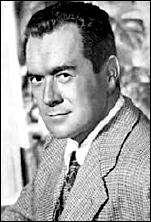
   ● ABC: January 11, 1947 through March 26, 1949. Frank Lovejoy as John J. Malone.
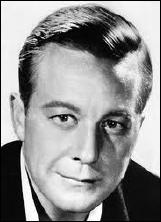
   ● ABC: September 21, 1949 through September 24, 1950. Gene Raymond as John J. Malone.
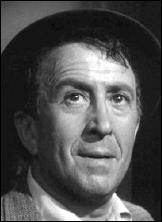
   ● NBC: May 25, 1951 through July 13, 1951. George Petrie as John J. Malone.

   With the success of Craig Rice’s books and the films based on her character John J. Malone, radio wanted its turn with the popular Chicago lawyer. The ratings were good but the loss of sponsor Guild Wine forced ABC to drop its first attempt at a series, starring Frank Lovejoy. Despite two later tries, The Amazing Mr. Malone never got the sponsor it needed to survive.

   Originally titled Murder & Mr. Malone, the series was an uneven attempt to blend humor, screwball plots and hardboiled mystery together. However, there were just enough moments where it worked to make The Amazing Mr. Malone one of the best comedy mystery series radio produced.

   Not making the transition from the books were the characters of Jake Justus and Helene Brand Justus. Rice’s cop, Lt. Daniel Von Flanagan and his “woe is me” humor was first replaced by typical banter between Malone and Lt. McGraw, then with Lt. Sidney Brooks. Maggie, Malone’s secretary, was rarely mentioned.

   Each show began with the sound of two gunshots. A frantic voice at a telephone pleading, “Operator, operator, get me John J. Malone!”

   When the series was called Murder & Mr. Malone the announcer would introduce Malone as “fiction’s most famous criminal lawyer.” After the title changed to The Amazing Mr. Malone, the introduction became more sarcastic with “whose practice before every type of bar has become legend.” Malone then introduced the story, and after he became “amazing,” added the cliche of the week that illustrated the episode’s “moral” which was also its title.

   The story would often begin without Malone until deep into the episode. The epilogue would usually feature Malone and Brooks at a bar discussing the case. During the Petrie series, the fourth wall would be ignored during the epilogue scene.

   The following are reviews of all known (by me) surviving complete episodes of the series:
THE AMAZING MR. MALONE

   ● FRANK LOVEJOY. Recorded in Hollywood. Cast: not credited (except Lovejoy, of course).

    “Charles Morgan” (May 24, 1947) In the opening of this episode from the Murder & Mr. Malone period, Malone admits he has no sense of humor and he wasn’t kidding. The serious hardboiled tone was more Black Mask than Craig Rice.
   Practical joke playing gambler hires Malone to prove he didn’t kill a man who owed him money. Malone finds himself faced with a locked room mystery.

    “Cleanliness is Next to Godliness” (August 28, 1948) The series is now called The Amazing Mr. Malone, and this episode reflects an effort to recreate Rice’s screwball plots. Lovejoy’s lack of comedic ability cripples any attempts of humor by Malone.
   Nightclub owner murders a politician and frames his rival with the rival’s lucky rabbit’s foot.

   ● GENE RAYMOND. Recorded in Hollywood. Cast: Lt. Brooks: Henry Morgan. Guest Cast not credited but included Jack Webb.
THE AMAZING MR. MALONE

   The series returns with only changes in the cast. Gene Raymond might not have been the star like Frank Lovejoy, but he could deliver lines like “When it comes to murder, I’m, just a great big blabbermouth.” Rice’s Malone was still missing. Malone refused to take one client until he was sure the client was innocent, causing Rice’s fans to wonder what the Perry Mason happened to their Malone.

    “Devil Finds Work For Idle Hands” (January 29, 1950). A payroll thief (Webb) breaks out of prison to get the girl and loot he left behind. Malone finds the thief’s murdered body in his office, but when Brooks arrives the body is gone.

    “Appearances Can Be Deceiving” (February 26, 1950). When a jealous husband kills the man he suspects of cheating with his wife, it sets off a chain of events that has dead bodies falling like dominoes. Webb plays the brother of the murder victim.

   ● GEORGE PETRIE. Recorded in New York. Cast: Lt. Sidney Brooks: Larry Haines.

   After months off the air, NBC decided to bring back The Amazing Mr. Malone as a summer replacement series starring Edgar G. Robinson (Billboard, February 10, 1951). Something happened and George Petrie was brought in to star instead.
THE AMAZING MR. MALONE

   Actually, Petrie was the closest radio got to Rice’s John J. Malone, a coward (“You wouldn’t shoot a guy just because he’s yellow?”), womanizer (he was afraid of guns because they reminded him of weddings), and a fountain of sarcasm. Larry Haines (That Hammer Guy) as Brooks showed a wonderful comedic touch and was the perfect foil for Malone, arguably even better than Rice’s Von Flanagan.

    “Strong Defense is the Best Offense” (May 25, 1951). Club owner tries to stop his no good daughter from running off with a gangster. And Malone has to deal with a hitman who named his gun, Marvin.

    “Seek And Ye Shall Find” (June 8, 1951). Cheating husband, disappointed when PI finds his wife is not cheating on him, refuses to pay the PI. The PI tries to shake down the wife who goes to Malone. The twists and number of characters leave you feeling like you just watched a Shell game, but Malone finally picks the right killer.

    “Early To Bed, Early To Rise” (June 15, 1951). Musician decides to teach his jealous wife a lesson and fakes an affair. It was a fatal mistake.

    “Hard Work Never Killed Anyone” (June 22, 1951). A man learns his first wife, thought dead, is alive and married to a rich man. His decision to blackmail her leaves him dead.

    “Handsome Is As Handsome Does” (June 29, 1951). Overprotective wife of immature husband tries to save him from a murder rap. One of the weaker episodes, but the character of the femme fatale has some good moments.

    “Never Judge a Book By Its Cover” (July 6, 1951). A jealous wife’s PI husband does a LAURA and falls for the woman he is hired to find after seeing her picture. Despite his efforts to protect her from the bad guys looking for her, she ends up murdered. But the killer is a stranger.

    “Haste Makes Waste” (July 13, 1951). This final episode has Malone asking the audience to write in and ask for the show’s return to the air.
   A complex mystery, not unusual for this series, has a crooked lawyer on the run after he cons a gangster. He had put everything he owned in his wife’s name. Now that he needs the money to get away, she dumps him and keeps the money for herself.
   The lawyer hires a classical music loving hitman to kill the gangster. The gangster buys off the hitman. When the lawyer turns up dead, the hitman wants more money and when the gangster refuses, the hitman goes to Malone who represents the wife. Malone, with the help of the hitman, reveals the killer.

   My source for all the Frank Lovejoy and George Petrie episodes for free: www.mysteryshows.com; or for purchase: www.originaloldradio.com. The Gene Raymond episodes are available only for purchase at: www.OTRSite.com.

SOURCES: Billboard magazine archives are available for free to view at Google ebookstore.

            ADDENDUM:

THE AMAZING MR. MALONE – Australian Version. August 27, 1953 through August 28, 1954. 52 episodes. Grace Gibson Productions. Produced and Directed by Lawrence Cecil or Charles Tingwell. Cast: John Saul as John J. Malone, Harp McGuire as Lt. Brooks.

   Grace Gibson Production sold many of the Australian based radio series here in America, mainly in small rural independent radio stations. The production company also purchased some American network series to be recreated by local talent for listeners in Australia. The Amazing Mr. Malone was one of those shows.

   Reportedly, the recreations stuck closely to Eugene Wang’s script and the series music. The only noticeable change in content was shifting Malone from Chicago to New York. The style of the stories was more hardboiled than screwball, and the attempts at humor similar to the Gene Raymond era. John Saul’s Malone tended to oversell the humor and some of the hardboiled characters were as over the top as Mugsy in a Bugs Bunny cartoon.

   Two of these recreations are still available. I found “Lucky Stiff” for free at Boxcars711 podcast at iTunes. I purchased both episodes from Original Old Radio.

    “The Smoothie” (November 5, 1953). Cliche of the week and probable American episode’s title, “Nothing Ventured, Nothing Gained.”
   A swindler has his hands full with an upset victim, an unwelcome return of his old partner, and his girlfriend who makes the mistake of trying to help him. He dumps her when he learns she hired John J. Malone. Malone was not all that happy about the job offer either.
    “Don’t you want to work?” she asked.
    “Does anyone?” replied Malone.

    “Lucky Stiff” (November 12, 1953). Cliche of the week and probable American episode’s title, “Lucky In Cards, Unlucky In Love.”
   A gambler and mathematical genius has become too successful for anyone to take his bets, so he hires a front. But to make his wife happy he decides to stop gambling and accepts an offer from a publisher to write a book teaching his methods of success at the gaming table. But his luck runs out when he is murdered.

   There are many places on the internet to learn more about the people and world of old time Australian radio.

Australianotr.com.au

“Once Upon a Wireless” an oral history with Charles Tingwell.

AUSTRALIAN RADIO SERIES 1930-1970 (available as free pdf at: http://www.dadsotr.com/collectionguide_australianradioseries1930-1970.pdf
IT IS PURELY MY OPINION
Reviews by L. J. Roberts


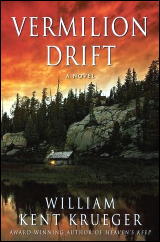
WILLIAM KENT KRUEGER – Vermilion Drift. Atria, hardcover, September 2010; trade paperback, June 2011.

Genre:   Private eye. Leading character:  Cork O’Connor; 10th in series. Setting:   Minnesota.

WILLIAM KENT KRUEGER Cork O'Connor

First Sentence:   Some nights, Corcoran O’Connor dreams his father’s death.

   Max Cavanagh owns several mines, one of which is being studied by the Department of Energy as a possible site to store nuclear waste. In addition to protests causing Cavanagh worry, his sister, Lauren, has gone missing.

   Cork, hired to find her, does so but she is not alone. He locates her body in, what had been a closed off section of the mine, among five skeletons. The five skeletons are those of women known as “The Vanishings” who had disappeared decades ago, and two of the bodies contain bullets fired from the gun of Cork’s late father.

   I was recently involved in a discussion of prologues and how many of us are either annoyed by them or ignore them completely. It takes a writer as skilled as Krueger to write a prologue which contains an important thread which runs through the story. The one in Vermilion Drift is not a prologue to ignore.

   Krueger has become one of my favorite authors. His skill with description take what could be a fairly ordinary scene, but instead comes alive with clear, visual images. We are able to go where the author takes us and be a part of that which is described to us.

   Even from those scenes where we might prefer to look away, we can’t. That doesn’t mean he is graphically violent; he’s not. It is more that we feel the emotion of the scene and, thereby, understand it.

   Because I read first for character is another reason why Krueger’s writing appeals to me. He creates dimensional, interesting, relatable characters. I’ll admit I wasn’t particularly happy with the events of the previous book, Heaven’s Keep, but the transition to this book has been very effectively and tastefully handled and I now understand the purpose of those events.

   Cork’s heritage is half Irish, responsible for his impatience and occasional anger, and half Ojibwa, which connects him to the people on the reservation, Indian history, and my favorite character Henry Meloux. It also provides the link to the mystical element in each book.

   Before you walk away saying “I don’t like woo-woo,” wait. Mysticism and the spirit world are part of the Indian culture. They are also part — along with several other themes including that of what do we really know of our parents and the definition of evil — of what takes this book, and this series, beyond the normal and elevates it into something that makes you stop, think and consider.

   Krueger is a very fine author who knows how to create characters, write dialogue, set a scene and, most of all, develop a plot. The story continually builds upon itself. It’s a twisty road filled complete with suspense, emotion and startling revelations.

   I despise the cliché of “If you’ve not read this author yet, read him now,” yet that is the way I feel. Even if you don’t, be assured I shall be reading his next book as soon as it comes out.

Rating:   Excellent.

      The Cork O’Connor series

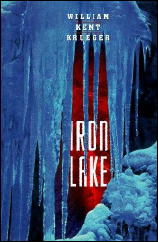
1. Iron Lake (1998)

WILLIAM KENT KRUEGER Cork O'Connor

2. Boundary Waters (1999)
3. Purgatory Ridge (2001)
4. Blood Hollow (2004)     Anthony award, Best novel, 2005.
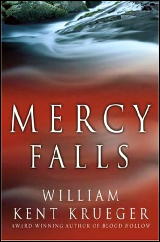
5. Mercy Falls (2005)     Anthony award, Best novel, 2006.

WILLIAM KENT KRUEGER Cork O'Connor

6. Copper River (2006)
7. Thunder Bay (2007)     Anthony nominee, Best novel, 2008.
8. Red Knife (2008)     Barry & Anthony nominee, Best novel, 2009.
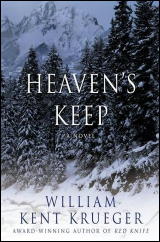
9. Heaven’s Keep (2009)

WILLIAM KENT KRUEGER Cork O'Connor

10. Vermilion Drift (2010)
11. Northwest Angle (2011)

THE SERIES CHARACTERS FROM
DETECTIVE FICTION WEEKLY

by MONTE HERRIDGE


        #3. ARTY BEELE, by Ruth & Alexander Wilson.

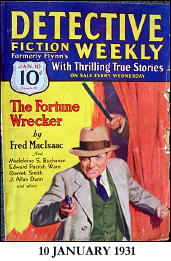
   The Arty Beele stories by Ruth and Alexander Wilson were a short series of at least sixteen stories (some short stories and some novelette length) published in Detective Fiction Weekly from 1928 to 1932. There could be more.

   The character’s full name is Arthur Welliver Beele. The series involves the exploits of a hardboiled newspaper crime reporter in the Prohibition era. The stories are a bit hardboiled, too; an early example of this type of story.

   Beele is not afraid of gangsters and racketeers; he associated with them considerably and they gave him good stories. This doesn’t mean that all criminals liked him. Beele would without any compunction insult a known criminal and act unafraid of the consequences.

   Beele could often acquire information about goings on with the police and underworld. On one occasion “It had come to Arty Beele’s attention, by one of those devious routes that were at once the despair and the astonishment of his city editor…” (The Fragrant Alibi)

   In a number of the stories, John Ryan, captain of the homicide squad, leads the investigations and somewhat disapproves of Beele, but lets him ask many questions. Harrington, the Telegraph newspaper’s city editor, is a friend of his.

DETECTIVE FICTION WEEKLY Arty Beele

   The descriptions given of Beele are sketchy, but one statement about Beele is “a tall, untidy figure crowned with a disreputable Stetson…” (A Pain in the Neck) He also has a beaky, hawk nose. Beele does not let himself get involved with women, “he distrusted and detested women.” (Strike Three!)

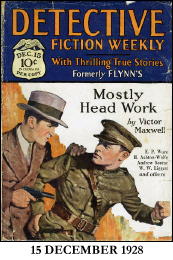
   In the first story in the series, “Killers Have Blue Eyes” (December 15, 1928) Beele tells Hymie Jacobs, a known gunman, that he is yellow. He also notes that killers always have blue eyes, and Jacobs doesn’t. The story is a simple one where Jacobs’ enemy, another gunman, is killed. Beele knows that Jacobs didn’t kill him, and suspects who did. But Beele convinces Jacobs to confess to the killing.

   â€œThe Silent Witness” details the aftermath of a killing of Brady, a gangland leader, supposedly by his girl friend Floss Jordan. But Arty Beele sees something that others don’t see, and believes she is innocent. He plays this up in his newspaper writings, and gets a lawyer friend of his to represent the accused woman. Part of the story is a relation of the court trial, and its results.

   â€œA Ride in the Park” does not involve a mystery, but does involve a murder. When gangster Tony Costello arrives back in town, Arty Beele expects that he will be killed by enemies. When a killing does take place at the train station, Beele jumps to the conclusion it was Costello and writes up an article about it.

   The piece was not complimentary to Costello, and he it turns out was not killed. Costello waylays Beele and takes him for a ride, intending to kill him. Beele manages to wreck to the car and kill Costello. A very close call for Arty Beele.

   â€œDeath in the Dark” is a longer story than many others in the series, being of novelette length. It is a better story, as it enables the author to spend more time on details and the characters. Beele is sent by Harrington, his editor, to the house of a rich man who has been mysteriously shot while a police patrolman was not too far away.

   The only witness is too drunk to tell anyone anything, and there seems to be no place that the murderer could have gone after the crime. The crime was a complicated scheme to provide an alibi for the murderer, and it takes Arty Beele to see through it. He had the cooperation of Captain Ryan here.

   â€œThis Way Out” doesn’t involve a mystery, although someone is murdered in it. One of Arty Beele’s gangster friends named Al Donner is in trouble with the law for a murder. Beele doesn’t believe he did it, although he knows that Donner did murder someone else a short time before. So Beele gets Donner a lawyer to defend him in court, and backs up Donner. Beele feels an obligation to Donner because Donner saved his life once. This is another novelette length story.

   â€œA Pain in the Neck” is a murder mystery where Arty Beele is involved with the police in solving the case of a fight manager who has been strangled. The obvious suspect is the manager’s boxer, but Beele sees clues the others have missed and points out the correct killer.

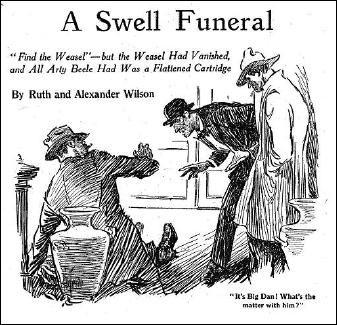
   â€œA Swell Funeral” involves the murder of a racketeer leader at his recently opened nightclub, the Club Seville. Arty Beele is a friend of the racketeer, Dan O’Malley, and happens to be in the club at the time that he was killed. Strangely, no one saw the shooting at the front door where O’Malley fell dead.

ARTY BEELE Ruth & Alexander Wilson

   Captain Ryan is soon on the scene, and Beele insists on being a part of the investigation. Various other men, some of them racketeers also, come under suspicion. As usual, Beele comes up with the solution, with the cooperation of the police.

   â€œSpecial Delivery” is of novelette length, and is a story of gangsters and the newspaper. Scarron, the local liquor racketeer, has told Arty Beele that he will retire from bootlegging and move to a foreign country. However, a fellow newspaperman of Beele’s named Slim Stengel was shot supposedly by gangsters near Scarron’s home. Considering that Stengel idolized Arty Beele, Beele feels obligated to do something about the matter.

   â€œThe Murder of the Seven-Year Itch” involves another gangland killing. Al Toriano visits Arty Beele in the newspaper newsroom and gives him some stock certificates to cash in and dole out the money to a beneficiary. Toriano says that he will probably be killed by other gangsters shortly.

DETECTIVE FICTION WEEKLY Arty Beele

   When both Toriano and his beneficiary are found shot in suspicious circumstances – it looks like they killed each other – Beele stirs Captain Ryan to investigate the matter more thoroughly. Beele of course helps the investigation, and coincidentally comes across the two killers a short time later.

   â€œThe Picture of a Crime” involves Arty Beele in the murder investigation of a rich man in his mistresses’ apartment. In this story, Harrington, the Telegraph newspaper’s city editor, assigns the news coverage to him and a photographer.

   Once on the scene, Beele begins acting like one of the investigating police, asking questions of the suspects and others. There is no real mystery about the murderer, since there are only three suspects.

   â€œLive Bait” is different than other stories in the series. The story opens with Beele getting a tip-off from an underworld connection that he is going to be the target of a local crime lord, who means to kill him. Beele heads to Captain Ryan’s office to tell him the news, and together they come up with a plan to trap Orsini the crime lord. No mystery or murder to solve in this story.

   â€œStrike Three!” is a novelette length story that involves Arty Beele in the planned killing of one liquor gangster by another. One of the gangsters tips off Beele that he will kill an unnamed gangster, and Beele tries to figure out who the victim is to be. He winds up at the Club Chanticleer investigating.

   He is asked by Mike O’Mara (the intended victim), to sit in on a meeting between him and Repetti. “It was no new role for him to act as arbiter at a gangster conference.” When O’Mara and Repetti are both murdered, it is Beele who straightens out the confusion as to who killed whom.

   â€œDevil’s Brew” is something of a mystery combined with gangdom interactions. Beele is called in by two of the local liquor barons to help arbiter a problem between the three local liquor barons. Captain Ryan interferes with this work, and all of a sudden one of the barons is mysteriously shot and another disappears. Arty Beele investigates, and puts his life in danger in order to solve the problem.

   â€œThe Fragrant Alibi” is another story where Beele assists the police in the solution of a crime. No Captain Ryan here, though. Beele is in a nightclub when a gangland murder takes place, and is involved in the story before the killing takes place. As often is the case, a small clue points out the solution of the crime to Beele.

DETECTIVE FICTION WEEKLY Arty Beele

   â€œCheap at the Price” has Arty Beele investigating another gangland killing, and he is also under threat from the gangster suspected in a number of other killings. Another novelette length story.

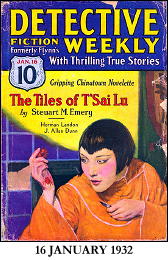
   â€œTwenty Grand” is the last story found in the series, and is a good one. There is no murder mystery here; the culprit is known from the beginning. Blacky Frey, a gangster, has killed two people with his .22 rifle. One of these was a policeman, for which he was tried and acquitted due to lack of evidence(the police couldn’t find the rifle). However, Arty Beele thinks up a scheme to have the police catch Frey red-handed with the rifle committing a crime.

   This is an average series, with some very good stories, but mostly average or slightly above that. The best stories are the novelette length ones, because they have more scope for description and action and complexity.

   There is no element of humor in the stories, and the hardboiled nature of the stories denies any lightness to them. This series about a crime reporter does not measure up to the later crime reporter series that Richard Sale wrote about Daffy Dill. Daffy Dill was a longer running series and much more popular than many other series in DFW.

      The Arty Beele series by Ruth & Alexander Wilson:

Killers Have Blue Eyes     December 15, 1928
The Silent Witness     April 13, 1929
A Ride in the Park     August 24, 1929
Death in the Dark     April 5, 1930
This Way Out     May 10, 1930
A Pain in the Neck     September 27, 1930
A Swell Funeral     October 18, 1930
Special Delivery     January 10, 1931
The Murder of the Seven-Year Itch     January 31, 1931
The Picture of a Crime     March 7, 1931
Live Bait     March 21, 1931
Strike Three!     May 2, 1931
Devil’s Brew     August 1, 1931
The Fragrant Alibi     August 22, 1931
Cheap at the Price     November 7, 1931
Twenty Grand     January 16, 1932

NOTE:   Thanks to Phil Stephensen-Payne for helping put together this checklist of story titles. The cover images also came from his Galactic Central website. Please visit!

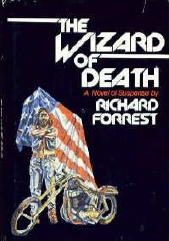
RICHARD FORREST – The Wizard of Death. Bobbs-Merrill, hardcover, 1977. Pocket, paperback, 1978.

RICHARD FORREST - The Wizard of Death.

   Connecticut residents will get a kick out of this inside view of state gubernatorial politics. When the nominee Randolph Llewyn is assassinated at a political rally, it appears that writer Lyon Wentworth’s wife is the next target. Bea Wentworth is a state senator and has a great deal of influence over who the next nominee will be.

   The Chamber of Commerce is not likely to be pleased with some of ground covered during the course of the investigation, including the hangouts of several motorcycle clubs lobbying against the helmet bill and the sleazier side Hartford’s massage parlors.

   The whole business is pretty unlikely, and one fears that it’s also quite superficial. But it reads quickly, and it is fun at times to indulge your fantasies.

— Reprinted from The MYSTERY FANcier, Vol. 1, No. 5, September 1977 (very slightly revised). This review also appeared earlier in the Hartford Courant.


      The Bea & Lyon Wentworth series —

A Child’s Garden of Death (n.) Bobbs 1975.
The Wizard of Death (n.) Bobbs 1977.
Death Through the Looking Glass (n.) Bobbs 1978.
Death in the Willows (n.) Holt 1979.
The Death at Yew Corner (n.) Holt 1980.
Death Under the Lilacs (n.) St. Martin’s 1985.
Death on the Mississippi (n.) St. Martin’s 1989.
The Pied Piper of Death (n.) St. Martin’s 1997.

REVIEWED BY MICHAEL SHONK:


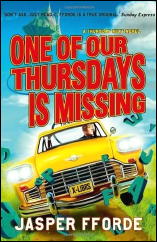
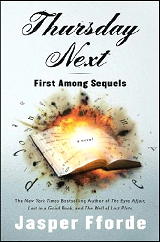
JASPER FFORDE – One of Our Thursdays Is Missing. Hodder Library, UK, hardcover, February 2011. Viking, UK, hc, March 2011.

   Jasper Fforde is among the top writers in “cross-genre anarchy.” A prime example of the genre is One of Our Thursdays Is Missing, a book with a blend of every genre in the library except pornography and non-fiction.

JASPER FFORDE Thursday Next

   The Thursday Next series we read does not exist in the Nextian Universe where the alternative reality of RealWorld and the world of the written word in BookWorld are located. The Nextian version of the Thursday Next books is the home of Written Thursday and read by the people of RealWorld.

   RealWorld Thursday has the unique ability to travel between RealWorld and BookWorld. There has been more than one Written Thursday, the current one is dealing with self-esteem issues trying to live up to the racy Written Thursday she replaced and her idol RealWorld Thursday.

   This is the sixth book in the Thursday Next series and features a major change in protagonist. It is told from the point of view of Written Thursday as RealWorld Thursday is missing. Written Thursday’s narration does more than just tell the story, through her we discover what it feels like to be unread, almost remaindered.

   We experience the frustration of losing one’s own identity in the middle of a conversation because the “ghostwriter” has stopped using “she says” or “he said” until none of the characters know who said what. We learn the difference between reality and fiction, but from fiction’s point of view.

   The story begins on the big day when BookWorld changes from the Giant Library into a geographic world. Meanwhile, the possibility of Civil War between Racy Novel and Women’s Fiction is growing more likely.

   The Thursday Next books, located in fantasy, are suffering from such a serious drop in readers the actors playing the characters are worried about their future, and blaming Written Thursday for the lack of readers. But soon Written Thursday is faced with even more serious problems.

   Jurisfiction, BookWorld’s police, asks Written Thursday to solve the mystery of an unknown book that had mysteriously exploded over BookWorld. When Written Thursday finds evidence of sabotage, she finds herself dangerously in the middle of a deadly conspiracy that could destroy BookWorld.

JASPER FFORDE Thursday Next

   There is much in this story to please the mystery reader. Why was the book destroyed? What was its title, and who was its author? Who do the secret police Men In Plaid really serve? Why is someone trying to start a war between Racy Novel and Women’s Fiction? What role does RealWorld evil corporation Goliath play in the conspiracy and why? And where is the RealWorld Thursday Next?

   The humor has much to offer readers of all genres. For mystery fans, Written Thursday describes a scene in the land of Thriller:

    “There were a few traveling artisans, salesmen, and a dozen or so tourists, apparently on a Get Beaten Senseless by Bourne package holiday, which had just overtaken the Being Shot in the Leg by Bond break for popularity, much to the Fleming camp’s disgust.”

   While I recommend you read the Thursday Next series in order, it is possible to enjoy this book by itself. Each book in the series has a satisfying ending but leaves enough plot threads open to set up the next book.

   For example, here we learn why, in First Among Sequels, RealWorld Thursday was the only one who could see her second daughter, Jenny. In One of Our Thursdays Are Missing, we are left with unanswered questions about Goliath’s current evil plan in the RealWorld.

   Answers to those questions will most likely be revealed in TN7. However, the mysteries of the BookWorld conspiracy are solved at the end, as is what happened to RealWorld Thursday.

   The Thursday Next series continues to satisfy fans of quality satire, mystery, and any other genre.

      The Thursday Next series —

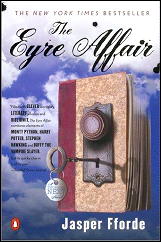
1. The Eyre Affair (2001)

JASPER FFORDE Thursday Next

2. Lost in a Good Book (2002)
3. The Well of Lost Plots (2003)
4. Something Rotten (2004)
5. First Among Sequels (2007)
6. One of Our Thursdays Is Missing (2011)

IT IS PURELY MY OPINION
Reviews by L. J. Roberts


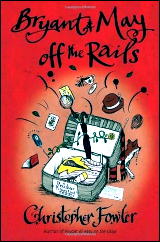
CHRISTOPHER FOWLER – Bryant & May Off the Rails: A Peculiar Crimes Unit Mystery. Bantam, hardcover, September 2010; trade paperback, September 2011. Originally published in the UK: Doubleday, hardcover, June 2010.

Genre:   Police procedural. Leading characters:  Arthur Bryant & John May; 8th in series. Setting:   England.

CHRISTOPHER FOWLER Bryant & May

First Sentence:   With regard to your apprehension of the hired assassin operating in the King’s Cross area, this so-called “King’s Cross Executioner” chap, thank you for acting so quickly on the matter, although it’s a pity he subsequently managed to give you the slip.

   A killer known as Mr. Fox has been captured by Detectives Arthur Bryant and John May, but escaped, murdering one of their colleagues in the process. A body has been discovered in a station of London’s Underground. Was Mr. Fox the killer or does the Peculiar Crimes Unit have another killer on their hands?

   Okay, I’ll start right out by admitting I love Bryant and May. In them, Fowler ha created two of the most appealing characters being written today. And it is truly Fowler’s excellent writing and voice which brings them, and the story, to life.

   I have always appreciated books which include a cast of characters. Fowler found a particularly clever way of incorporating his cast of principal characters into the story as a staff roster. In this book, he provides a description of Bryant which truly does give “some measure of the man,” and I love his Bryant’s habit of reciting dictionary definitions.

   Bryant and May, while being the central characters, are not alone but supported by a host of secondary characters each given distinct backgrounds, characteristics and contributions to the story. With each book, we learn more of each character’s background and personalities. But beyond the central characters, it is a rare author who can make one feel an element of sympathy for a series killer, but Fowler manages so to do.

   There is wonderful humor balanced by touching poignancy. There is a balance of historical information — the London Underground system — with very contemporary references — the use of a flash mob as a distraction. It is the inclusion of small details about which one normally doesn’t think; such as the inclusion as to why escalators are always breaking down and the comparison between actors and serial killers, which I appreciate.

   This is a book where one should have read the previous books in the series. That is no great burden, however, as all the Bryant and May stories are so well done and delightful to read. I should hate to see this series end so, please, give them a try, spread the word and enjoy Bryant and May. Off the Rails is another excellent addition to the series.

Rating:   Excellent.

     The Bryant & May series —

1. Full Dark House (2003)
2. The Water Room (2004)

3. Seventy-Seven Clocks (2005)
4. Ten Second Staircase (2006)
5. White Corridor (2007)
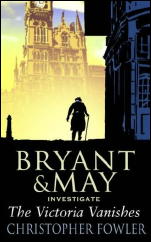
6. The Victoria Vanishes (2008)

7. Bryant and May on the Loose (2009)
8. Off the Rails (2010)
9. The Memory of Blood (2011)

THE ARMCHAIR REVIEWER
Allen J. Hubin


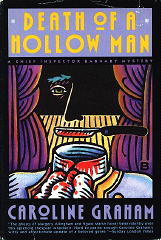
CAROLINE GRAHAM – Death of a Hollow Man. William A. Morrow & Co., hardcover, 1989. Avon, paperback, 1991.

CAROLINE GRAHAM Death of a Hollow Man

   I missed Caroline Graham’s debut with Inspector Tom Barnaby (The Killings at Badger’s Drift), but it seems to me very unlikely to have been better than Death of a Hollow Man, a sensitive, insightful, probing gem of a tale.

   The Causton Amateur Dramatic Society is rehearsing for its latest production, Amadeus. We meet the cast, director and crew in full and in depth. They include the lead, Esslyn Carmichael, a conceited womanizer; several young aspirants of varying talent; an assistant director, routinely squelched by the director; and Joyce Barnaby, wife of Tom.

   Passions run high and deep, and opening night bids fair to be an unmitigated disaster, for murder waits in the wings for its moment at center stage. A most impressive performance by Graham.

— From The MYSTERY FANcier, Vol. 12, No. 3, Summer 1990.


Bibliographic data.   This will have to wait until tomorrow as well. Caroline Graham wrote only seven Inspector Barnaby mysteries, but the character has become famous around the world as the sleuth in many seasons’ worth of British TV’s Midsomer Murders, which I’ve never seen. If any of you have, please fill me in — and compare and contrast with the novels, if you can.

[UPDATE] 05-04-11.    The Chief Inspector Barnaby series:

1. The Killings at Badger’s Drift (1987)
2. Death of a Hollow Man (1989)
3. Death in Disguise (1992)
4. Written in Blood (1994)
5. Faithful Unto Death (1996)
6. A Place of Safety (1999)
7. A Ghost in the Machine (2004)

   I’d still like to hear more from anyone who can tell me how closely the TV series follows the overall tenor of the books, but in Comment #1, The Doc points out the recent contretemps raised by some badly spoken comments made by the (soon to be former) producer of the series.

   Here’s a portion of an online review of the episode that was aired soon after this occurred, which also coincided with Neil Dudgeon taking over as Midsomer‘s new DCI (John) Barnaby.

   From http://www.telegraph.co.uk/culture/tvandradio/8402199/The-return-of-Midsomer-Murders-review.html

    “Midsomer isn’t roaringly popular because it holds a mirror up to modern Britain, any more than Poirot serves as a primer on 21st-century Belgium. Midsomer brings to life – and gently mocks – an idea of England and Englishness that probably hasn’t existed in this country for decades, but which lives on in the popular imagination, especially overseas.

    “Much of what Brian True-May had to say on the subject of Englishness had me squirming in discomfort, but I will say this in his defence: Midsomer Murders has never claimed to have a vice-like grip on reality.

    “I can’t think of any English people I know – regardless of their ethnic origin – who’ve been bludgeoned to death with a slide projector.”

REVIEWED BY BARRY GARDNER:


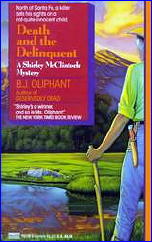
B. J. OLIPHANT – Death and the Delinquent. Shirley McClintock #4, Fawcett Gold Medal, paperback original, 1993.

bj oliphant

   I like Sheri Tepper whatever name she writes under. A least I think I do; I haven’t read any of her A. J. Orde books, though I’ve got one waiting. I do like the Shirley McClintock series a lot, and think they’re good enough for hard covers.

   Shirley and her foreman/companion J. Q. are vacationing in the mountains of New Mexico after the traumatic events in the last book, with her daughter Allison and Allison’s schoolmate April. April isn’t working out very well. She’s nosy, neurotic, and thoroughly obnoxious, and Shirley has decided to send her home when a sharpshooter wounds Shirley’s mule and kills April.

   Accident? Hard to see how it could be.

   Some strange items are found in April’s belongings, and then a newborn is stolen from a hospital nursery. Of course it all fits together, but Shirley-on-crutches is damned if she sees how.

   Tepper/Oliphant/Orde’s strength has always been her characters, whether they’re cat-like aliens or independent Colorado ranch ladies. Shirley McClintock is one of the stronger and more realistic, and an altogether appealing heroine.

   I haven’t found anything to dislike in this series. The writing is good, the characterization excellent, and the plots haven’t strained my credulity. All of the regulars have become real people, and I look forward to seeing more of them.

— Reprinted from Ah, Sweet Mysteries #7, May 1993.


The Shirley McClintock Novels (as by B. J. Oliphant)

       1) Dead in the Scrub, 1990
       2) The Unexpected Corpse, 1990
       3) Deservedly Dead, 1992
       4) Death and the Delinquent, 1992
       5) Death Served Up Cold, 1994
       6) A Ceremonial Death, 1996
       7) Here’s to the Newly Dead, 1997

Editorial Comment:   If Barry’s reference to “cat-like aliens” puzzled you, it’s because under her own name, Sheri S. Tepper is much better known as a science fiction and fantasy author than she was a mystery writer. Here’s a link to her credentials in that “other field” as deposed on Wikipedia.

IT IS PURELY MY OPINION
Reviews by L. J. Roberts


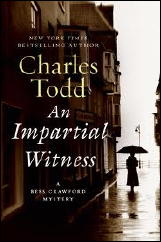
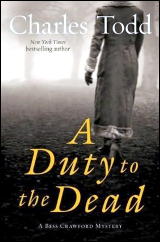
CHARLES TODD – An Impartial Witness. William Morrow, hardcover, August 2010. Trade paperback: Harper, August 2011.

Genre:   Amateur sleuth. Leading character:   Bess Crawford; 2nd in series. Setting:   England-France, 1917-World War I.

CHARLES TODD Bess Armstrong

First Sentence:   As my train pulled into London, I looked out at the early summer rain and was glad to see the dreary day had followed me from Hampshire.

    WWI battlefield nurse Bess Crawford had been caring for a badly burned young pilot who had a picture of his wife visibly displayed. In a train station traveling on leave back to London, Bess happens to see the wife who is clearly upset as she sees off a different soldier.

    Although somewhat perplexed by the scene, it is nothing to the shock Bess feels when a drawing of the woman appears in the next day’s paper with Scotland Yard asking whether someone can identify her. Bess learns the woman had been murdered and shortly after, the burned husband commits suicide. Bess feels it is her responsibility to find out what had happened.

    This is the second book in this new series by the Todds and I much preferred it to the first book. Their voice for Bess is much better and she’s a stronger character.

    The sense of chaos and fatigue from being in combat is well conveyed, but with a sense of detachment I feel one would acquire after time. The contrast between the battlefield and being in London, particularly attending the house party, is very effective.

    I like that Bess doesn’t jump to conclusions but gathers the evidence bit-by-bit and over time. The plot was well constructed and the reason for Bess being involved was justifiable. Although I understood Beth’s distance from the events, it did all feel a bit too distant as a reader; I was never emotionally connected to the story.

    While I never considered not finishing the book, for me it wasn’t a gripping straight-through read either. That said, Todd is an excellent writer and I always look forward to the next book.

Rating:   Good Plus.

      The Bess Crawford mysteries

1. A Duty to the Dead (2009)

CHARLES TODD Bess Armstrong

2. An Impartial Witness (2010)
3. A Bitter Truth (2011)

THE BACKWARD REVIEWER
William F. Deeck


JOHN CROZIER – Murder in Public. Hutchinson, UK, hardcover, 1934. Houghton Mifflin, hc, 1935.

   Falcon — more familiarly known to his intimates as Onanta (Swooping Falcon), son of Nibowaka (The Wise), Chief of the Sinawaa — is a North American Indian of the Delaware tribe, apparently the Canadian branch.

   Acquainted with Sherlock Holmes, Falcon emulates to some extent the Master in his own investigations. And to prove he hasn’t lost touch with his roots, Falcon has his headquarters in London.

   When a pearl necklace is stolen, amid a rash of jewelry thefts, from an American actress starring in London play, Falcon is called in. He is soon called off, but then the actress is shot dead during a performance by another actor, maybe deliberately, maybe not.

   Working with Scotland Yard and Miss Mitt, his office assistant who is as American as the author can make her, Falcon breaks up a gang of dope dealers, who were seemingly as nasty in England in the 1930s as they are here today but much more cunning.

   The information about Holmes may be of interest to Sherlockians; the rare American Indian character may be of interest to. others. Otherwise, there’s not much here.

— From The MYSTERY FANcier, Vol. 11, No. 4, Fall 1989.


Editorial Comments:   Bill Deeck, I am sure, was unaware of it, or he’d have mentioned it, but “John Crozier” was the pen name of the noted actor Alexander Knox, who over the years, as it turns out, was the author of a small number of mystery and adventure novels as well.

   There was one other “Falcon” mystery under the Crozier byline, that being Kidnapped Again (Hutchinson, 1935; no US edition).

   I haven’t read Murder in Public, but I found Bill’s review very illuminating, as the character named Falcon in this book is very similar to a character named Eagels in an earlier book by one Ian Alexander (another of Knox’s pen names) called The Disappearance of Archibald Forsyth (Hitchinson, 1933).

   As far as it is known, this latter book was Eagels’ only appearance. He was, however, also a London-based PI, a full-blooded North American Indian (Iroquois), had a female secretary/assistant who was most decidedly American, and someone who had met Sherlock Holmes and who based his investigative techniques on the latter’s. Here’s a brief quote, with Eagels thinking over the case as it has developed so far:

   Conway might go to the house if he liked with a preconceived theory, but he [Eagels] wouldn’t. With this fact fixed in his mind, the complete refusal to theorize in advance which he had learned from Holmes himself the only time he had met him, Eagels listened to the conversation of the others.

   For more, you’ll find (by following the link) my review of the Alexander book on the primary Mystery*File website.

   I believe that Eagels, long before Tony Hillerman’s detectives came along, was the first fictional Native American detective. I think the fact that both he and Falcon had supposedly met Sherlock Holmes in person is also quite remarkable.

« Previous PageNext Page »