Characters


REVIEWED BY TINA KARELSON:         


HARLEY JANE KOZAK – A Date You Can’t Refuse. Broadway, trade paperback original, March 2009.

HARLEY JANE KOZAK Wollie Shelley

   At one time a greeting card designer, Wollie Shelley currently makes her living as a professional dater. But along with this switch in career paths, she has somehow managed to find herself mixed up in several cases of murder as well.

   In this, the fourth and final book in the series, Wollie finds herself working for a media training firm, teaching American social conventions to Eastern Europeans — in essence, dating them. It turns out her reality shows were huge hits in Belarus and vicinity, so she’s a bit of a celebrity to the clientele.

   She also happens to be informing to the FBI, because they think something is up with the vaguely cultish company — maybe arms dealing. However, the FBI isn’t very forthcoming, and her FBI agent boyfriend is involved in his own undercover investigation.

   Anyway, it turns out more than one thing is up. As usual in this series, there are a lot of ingredients in the soup, including murder, DVD piracy, bad mobile phone reception and a sidewalk chalk art competition. Wollie realizes her predecessor at the media training firm was murdered. When that young woman’s boyfriend is also killed, Wollie gets serious about investigating and lands in real danger.

   Anyone who hasn’t read the previous books might find the subplots related to Wollie’s brother, uncle and friends a bit unclear, but that won’t spoil the book. And I won’t spoil the ending to the series, one of my favorites, except to say that it seems like a happy one.

The Wollie Shelley mystery series —

       1. Dating Dead Men (2004)

HARLEY JANE KOZAK Wollie Shelley

       2. Dating Is Murder (2005)
       3. Dead Ex (2007)
       4. A Date You Can’t Refuse (2009)

REVIEWED BY BARRY GARDNER:


JAMES CRUMLEY – The Mexican Tree Duck. C. W. Sughrue #2. Mysterious Press, hardcover, September 1993; reprint paperback, October 1994.

   What can you say about James Crumley that hasn’t been said before? No writer in the field has garnered so much critical attention for just three books, and a respectable number of respectable critics have lauded him as the best of the private eye writers.

JAMES CRUMLEY

   While considering him to be a powerful writer, I never shared that opinion, and in fact found it ludicrous. Nevertheless, I looked forward to reading this. I thought the first C. W. Sughrue book, The Last Good Kiss, was the best of his first three.

   C. W. hasn’t changed a whole lot, other than being middle-aged, now. He’s still rough as pine bark, and he’ll still have a drink or do a line with you, or whip your ass if it needs it. He’s hired by twins who own a fish store, overweight weapons freaks, to get their fish back from an outlaw biker that’s stiffed them on a check.

   In the process of doing that, he gets hired by the biker to find his mother. At least he thinks she’s his mother. Sound humorous? Not really. She’s a Mexican national married to a Texas oilman, and she’s been kidnapped.

   Before it’s over it’s turned to politics, drugs, and money, and Sughrue has hooked up with some Viet Nam buddies, taken on two or three governments, waged his own private war, fallen in love, and been in on the spilling of more blood than you could wipe up with a bale of tissues.

JAMES CRUMLEY

   Crumley’s prose is powerful, though I think not so much as in his earlier books. The characters are mostly of a type: the women crude, loving. tough, and ready, and the men cut from the same cloth as Sughrue himself — tough, violent, and abusers of any substance that’s inert enough to be abused.

   The improbable plot was just a framework, not terribly important to Crumley in comparison to what he had to say. Plotting never was his thing.

   This isn’t a detective novel. It’s a war story, or perhaps a paean to the brotherhood of warriors. It seems to me a book written by a man frozen in time, one not able to leave behind the world of war, drugs, and whiskey.

   There’s little here that speaks to me. To someone tortured by Crumley’s own demons it may be a fine novel, but to me it was just a sad waste of talent, not redeemed by the prose.

   The only message I got was that whiskey, drugs, and fighting are good, government and business are bad, and a man’s gotta do what a man’s gotta do. In the end, I tired of the macho posturing and the gunfire, and there wasn’t much else to it.

— Reprinted from Ah, Sweet Mysteries #9, September 1993.


      The “Milo” Milodragovitch series —

The Wrong Case (1975)

JAMES CRUMLEY

Dancing Bear (1983)
Bordersnakes (1996) [with C. W. Sughrue]
The Final Country (2001)

JAMES CRUMLEY


      The C. W. Sughrue series —

The Last Good Kiss (1978)
The Mexican Tree Duck (1993)
Bordersnakes (1996) [with Milo Milodragovitch]

JAMES CRUMLEY

The Right Madness (2005)

THE BACKWARD REVIEWER
William F. Deeck


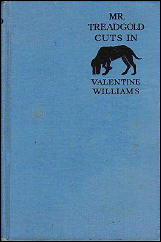
VALENTINE WILLIAMS Mr. Treadgold

VALENTINE WILLIAMS – The Curiosity of Mr. Treadgold. Houghton Mifflin, US, hardcover, 1937; Grosset & Dunlap, US, hc reprint, no date stated. Hodder & Stoughton, UK, hc, 1937, as Mr. Treadgold Cuts In.

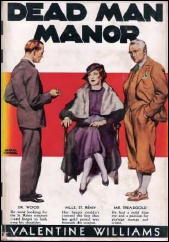
   Following up on his success in Quebec in investigating what were known as “the Saint Fiorentin murders,” chronicled in Williams’s Dead Man Manor, H. B. Treadgold, head of Bowl, Treadgold, and Flack, bespoke tailors of Savile Row, London, and East Fiftieth Street, New York, continues dabbling in crime investigation by solving ten cases of theft, blackmail, or murder.

    “In Tristram Shandy [from which Treadgold quotes on all occasions], as I’m sure you’ll recollect, it says that body and mind are like a jerkin and its lining: rumple one and you rumple the other. Ill-fitting clothes mean an ill-fitting mind: which is rather a roundabout way of saying that a tailor who takes any pride in his job has to be a bit of a psychologist.”

   The cases here are not fair play, by any means, but that does not make them any the less enjoyable. Treadgold is a capable detective and an interesting character.

— From The MYSTERY FANcier, Vol. 11, No. 4, Fall 1989.


  Editorial Comment:   Bill’s review is too short, alas, to learn very much about the stories themselves, but it’s certainly long enough to be intriguing. There’s no question that Valentine Williams falls into the category of a Forgotten Writer, but if you’d like to know more, there’s a long essay about him on Mike Grost’s Classic Mystery and Detection website. Recommended!

The Mr. Horace B. Threadgold books

      Dead Man Manor. Hodder 1936.    [novel]

VALENTINE WILLIAMS Mr. Treadgold

      Mr. Treadgold Cuts In. Hodder 1937; published in the US as The Curiosity of Mr. Treadgold.    [story collection]
      Skeleton Out of the Cupboard. Hodder 1946.   [novel; no US edition]

IT IS PURELY MY OPINION
Reviews by L. J. Roberts


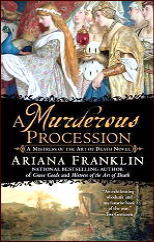
ARIANA FRANKLIN – A Murderous Procession. G. P. Putnam’s Sons, hardcover, April 2010. Published in the UK as The Assassin’s Prayer: Bantam Press, hardcover, July 2010.

Genre:   Historical mystery. Leading character:  Adelia Aguilar; 4th in series. Setting:   France/Italy; Middle Ages/1179.

ARIANA FRANKLIN

First Sentence:   Between the parishes of Shepfold and Martlake in Somerset existed an area of no-man’s-land and a lot of ill feeling.

    Dr. Adelia Aguilar is thrilled to learn Henry II wants to send her to accompany his daughter Joanna’s wedding procession to her home of Sicily. Her feelings change to anger when she learns Henry is keeping Adelia’s daughter in England to ensure Adelia’s return.

   With them, and well concealed, will be Arthur’s sword, Excalibur, as a gift to the bridegroom. Danger a rises from an old foe out to steal the sword and looking for revenge against Adelia.

   There was a different feel to this book than those previous. Whereas before, Adelia seemed very much in control and strong, here she was in situations completely beyond her control and, at times, in great peril.

   While some readers might not care for the change this wrought in the character, I liked that it showed her vulnerability and weaknesses, as well as the human failing that when the truth is too frightening to accept, it is denied.

   There is a progression in the lives of the characters with each book, which is important to me. Some readers have criticized the coup de foudre felt by the Irish sea captain O’Donnell for Adelia. Having personally experienced it — although it didn’t last — I didn’t find it unrealistic. I did enjoy that we meet Adelia’s parents in this book.

   As always with Franklin’s books, I learn so much history. Henry’s daughter, Joan, was known to me, but not in any detail nor her role in history. Of late, I’ve read more books that deal with the Cathers, and I find them fascinating. I certainly knew nothing of the history of Sicily and found it significant that she shows it to us at a turning point in its history.

   Perhaps I’m obtuse, but I did not figure out the identity taken by the villain until it was revealed. What I did not like was the ending. It seems more authors are doing cliff-hanger endings and it’s a trend I dearly hope will end almost immediately. Write a good book, I promise to read the next one without being tricked into so doing.

   I very much enjoyed the story and only the ending prevented my rating it as “excellent.” For readers new to the series, I recommend starting at the beginning. For me, I am ready for the next book.

Rating:   Very Good Plus.

      The “Mistress of the Art of Death” series:    [Adelia Aguilar is the world’s first female anatomist/medical examiner.]

1. The Mistress of the Art of Death (2007)
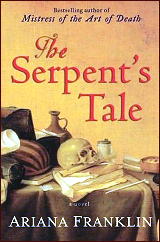
2. The Serpent’s Tale (2008) aka The Death Maze

ARIANA FRANKLIN

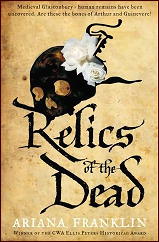
3. Relics of the Dead (2009) aka Grave Goods

ARIANA FRANKLIN

4. A Murderous Procession (2010) aka The Assassin’s Prayer

REVIEWED BY J. F. NORRIS:


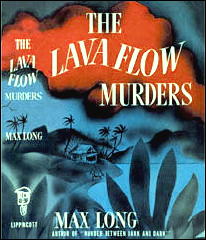
MAX LONG – The Lava Flow Murders. Series detective: Komako Koa #2. J. B. Lippincott, hardcover, 1940.

   After an expository overload in which the characters are introduced in quick succession, the first third of the book is spent on detailed descriptions of a volcanic eruption and the attempts of plantation policeman, Komako Koa, and the plantation owner, Tucker, in evacuating the visitors who have recently arrived from a yacht in the harbor.

MAX LONG The Lava Flow Murders

   They are also told to avoid a heiau (sacred Hawaiian shrine) to Pele. But two members of the party mock nearly everything to do with traditional Hawaiian beliefs and culture. One of those mockers, a brash woman, enters the heiau and is seen arguing with someone who the visitors believe is the embodiment of Hawaiian goddess Pele.

   The woman is almost immediately discovered dead — her head crushed by a coconut. For some reason the mainlanders actually believe that Pele is responsible and there is a lot of silly melodrama with people running around crying out to beware of Pele.

   None of this makes any sense. Koa takes advantage of this and rather than telling everyone that he knows the woman was murdered he lets them indulge themselves in superstitious gullibility. Irresponsible of a policeman and a bit contrived on the part of the author. But without that the rest of the story would not follow.

   Meanwhile, the volcano continues to erupt and encroaching lava flows continue to threaten the characters as well as the ranch house where they are staying. Then another person is hit on the head with a coconut and yet another person disappears.

   Soon it appears that a homicidal maniac is at work and the book takes on the atmosphere of And Then There Were None set in Hawaii with an active volcano as an added menace.

   Koa’s friend and the series narrator, Hastings Hardy, believes that a local Hawaiian has gone mad and is acting as a murderous nemesis for the offended Pele. There is a character called “the firewalker” who fits this bill. But Koa says no Hawaiian would enter a heiau and commit murder let alone do any of the other horrid things that the killer does (for example, a woman is thrown into the steaming, fomenting ocean where the lava flow ends and is basically boiled to death!).

   The book is not very well constructed and — believe it or not — is often dull. It’s a hodgepodge of a disaster adventure comprised of lots of scientific detail about volcanoes, lava flow, the different types of lava and how they behave, the types of rock and ash that accompany violent eruptions, etc. etc.

   The murder mystery is thrown in almost as an afterthought. The book could easily have been much shorter and the narrative handled less clumsily had the author focused on the story rather than focusing on the volcano and the lava.

   The only thing that holds one’s interest is the interspersing of Hawaiian lore and legends. The culprit, once one accepts Koa’s dismissal of anyone Hawaiian, is a bit obvious. The killer’s motive, set up also rather obviously way back in the first chapter when land rights and inheritances are discussed, and the denouement overall are less than satisfying.

LONG, MAX (Freedom). 1890-1971. SC: Komako Koa, in all.
      Murder Between Dark and Dark. Lippincott, 1939.
      The Lava Flow Murders. Lippincott, 1940.
      Death Goes Native. Lippincott, 1941.

     — Taken from the Revised Crime Fiction IV, by Allen J. Hubin. A short biographical article about the author may be found here on Wikipedia.

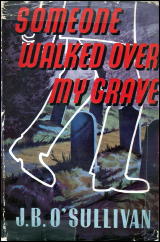
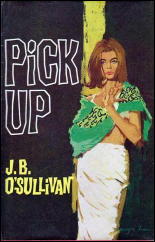
J. B. O’SULLIVAN – Someone Walked Over My Grave. T. Werner Laurie Ltd., UK, hardcover, 1954. No US edition.

J. B. O'SULLIVAN

   As I often do, I’ll append a list of all of J. B. O’Sullivan’s Steve Silk mysteries at the end of these comments. There are a few of them, as you’ll see, but only two have even been published in the US.

   Silk himself is described on the Thrilling Detective website as “a former boxer turned un-licensed PI. Quick with a wisecrack and quicker with his fists, he dresses well and chases women with vigor,” but there are no signs of fisticuffs in the book at hand, and no woman chasing either.

   Silk is usually based in New York, so maybe the difference is that when he visits Ireland, as he does in Someone Walked Over My Grave, he’s on his best behavior. In fact the murder that’s solved in this book is a country manor affair, one much more suited for the likes of Supt. George Tubridy than a smooth as silk operator like Steve.

   There is a point in time, however, at which the reader (this one, anyway) will suddenly realize that what is going on is a competition between the two. Who (and which approach) will solve the case first? Amusingly, though, the two end up asking the same questions of the same people and each in their own fashion, coming up with very much the same answers.

   Dead is the father of a would-be bridegroom, and the number one suspect is the wayward brother (on the other side of the Irish political divide) of the would-be bride when it appears the wedding is off (therefore all of the would-be’s). Telling the story is Jimmy (no last name noted), a local reporter who spent some time in the US chronicling some of Silk’s earlier adventures.

   In the grand Golden Age of Detection fashion, there are lots of suspects, some with alibis, some not, and some of the alibis are suspicious if not outright flimsy. There are several decent twists before a suspect admits to having done the crime, then an even better one before (PLOT ALERT, and maybe I shouldn’t even be telling you this) the last three paragraphs turn everything around again.

   An amazing feat. I was on cruise control at the time, and it made me stop on a dime, sit up and take notice, I’ll tell you that.

The Steve Silk novels —     [Adapted from the Revised Crime Fiction IV, by Allen J. Hubin]

       Casket of Death (n.) Grafton 1945
       Death Came Late (n.) Pillar 1945
       The Death Card (n.) Pillar 1945

J. B. O'SULLIVAN

       Death on Ice (n.) Pillar 1946
       Death Stalks the Stadium (n.) Pillar 1946
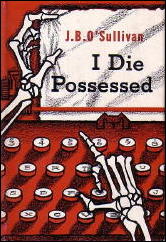
       I Die Possessed (n.) Laurie 1953. US: Mill, 1953

J. B. O'SULLIVAN

       Nerve Beat (n.) Laurie 1953
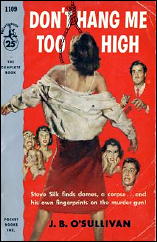
       Don’t Hang Me Too High (n.) Laurie 1954. US: Mill, 1954

J. B. O'SULLIVAN

       Someone Walked Over My Grave (n.) Laurie 1954
       The Stuffed Man (n.) Laurie 1955
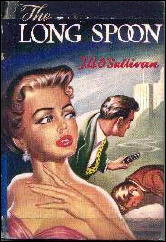
       The Long Spoon (n.) Ward 1956

J. B. O'SULLIVAN

       Choke Chain (n.) Ward 1958
       Raid (n.) Ward 1958
       Gate Fever (n.) Ward 1959
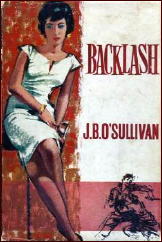
       Backlash (n.) Ward 1960

J. B. O'SULLIVAN

       Make My Coffin Big (n.) Ward 1964
       Murder Proof (n.) Ward 1968

The Supt. George Tubridy novels —

       Someone Walked Over My Grave (n.) Laurie 1954
      Pick Up (n.) Ward 1964

J. B. O'SULLIVAN

       Lunge Wire (n.) Ward 1965

REVIEWED BY BARRY GARDNER:


LINDA BARNES Carlotta Carlyle

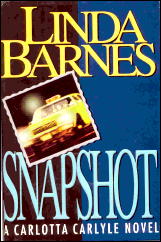
  LINDA BARNES – Snapshot. Carlotta Carlyle #5. Delacorte Press, hardcover, 1993. Dell, paperback, 1994. Reprinted several times since, in both hardcover and paperback.

   I don’t think there’s any doubt that Linda Barnes is in the top five female PI writers, and I may enjoy her more than any but Marcia Muller. Her ex-cop, part-time cabby PI, Carlotta Carlyle, is one of my favorites.

   Her latest case begins when a psychiatrist brings a woman to her office who is obsessed with the recent death of her child from a form of leukemia. The woman is not convinced that something didn’t go awry at the highly regarded hospital where the child died, and the psychiatrist thinks that having Carlyle lay her doubts to rest is good therapy.

LINDA BARNES Carlotta Carlyle

   He has no idea that her fears are well-founded; the child’s doctor was one of the country’s best. Carlotta takes the case, and begins her investigation.

   At the same time, she has other problems. Someone steals her trash cans in the middle of the night, trash and all, and her 11-year-old Hispanic Little Sister has run away from home, and has been seen regularly in the company of a grown man.

   Barnes continues to impress me. Carlyle is a believable human being, possessed of her fair share of problems but refreshingly free from the anger and/or angst of so many of today’s characters.

   The supporting cast is nicely drawn, and Barnes tells her story well in straightforward prose. The plot didn’t have me tearing my hair out, which considering my luck with the rest of the PI novels I’ve read lately was a major triumph. Good book.

— Reprinted from Ah, Sweet Mysteries #10, November 1993.


       The Carlotta Carlyle series —

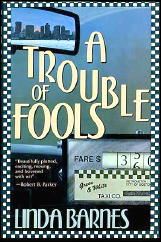
1. A Trouble Of Fools (1987)

LINDA BARNES Carlotta Carlyle

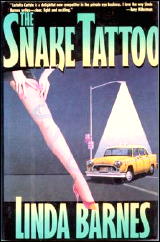
2. The Snake Tattoo (1989)

LINDA BARNES Carlotta Carlyle

3. Coyote (1990)
4. Steel Guitar (1991)
5. Snapshot (1993)
6. Hardware (1995)
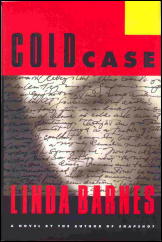
7. Cold Case (1997)

LINDA BARNES Carlotta Carlyle

8. Flashpoint (1999)
9. The Big Dig (2000)
10. Deep Pockets (2004)
11. Heart of the World (2006)
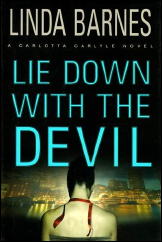
12. Lie Down with the Devil (2008)

LINDA BARNES Carlotta Carlyle

THE BACKWARD REVIEWER
William F. Deeck


ALICE CAMPBELL – They Hunted a Fox. Scribner, US, hardcover, 1940. Originally published in the UK: Collins Crime Club, hc, 1940.

   Tom Boldre, owner of Chenrys, an estate in deep financial trouble, has no interest other than horses and, in season, fox hunting. On one hunt, Boldre falls from his horse and suffers a concussion. Two weeks later he falls again and breaks a thigh, which, it seems, causes a heart attack and death.

   When Boldre’s tenant who had helped him on his first fall is shot and killed shortly after Boldre dies, Scotland Yard, in the form of Inspector Headcorn, is called in. Headcorn is a dogged investigator, always seeming to be on the spot when something turns up. He discovers that Boldre died in a most unusual and unnatural way.

   Despite the attempts by all concerned to conceal evidence and mislead Headcorn, putting themselves and others in jeopardy since the murderer is, if I may put it this way, foxy, the killer is unmasked. Above average in plot and writing.

— From The MYSTERY FANcier, Vol. 11, No. 4, Fall 1989.


ALICE CAMPBELL No Light Came On

Bibliographic Data:   Alice Campbell, 1887-1976?, was the author of 19 mystery and detective novels between 1928 and 1950. Inspector Headcorn was in five of them:

      Death Framed in Silver. Collins 1937 [Colin Ladbroke also appears]
      They Hunted a Fox. Collins 1940 [Alison Young & Colin Ladbroke also appear]
      No Murder of Mine. Collins 1941
      The Cockroach Sings. Collins 1946
      The Bloodstained Toy. Collins 1948 [Tommy Rostetter also appears]

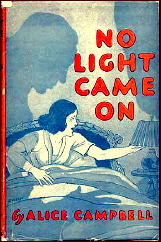
   I can’t tell you anything more about Campbell’s other series characters. Alison Young and Colin Ladbroke appear together in one book without Headcorn, while Tommy Rostetter is also the star of three solo adventures. The twosome of Geoffrey MacAdam and Catherine West appear in two others, including No Light Came On, 1942, but neither with Headcorn.

   There is very little additional information about Alice Campbell on the Internet. There is a list of her mysteries here, and another short mention of her can be found earlier on this blog in the comments following this post.

ROY LEWIS

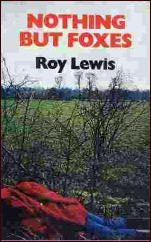
ROY LEWIS – Nothing But Foxes. St. Martin’s, hardcover, 1979. Originally published in England: Collins Crime Club, hardcover, 1977.

    Fox hunts are still immensely popular with the English gentry, but not unexpectedly they’ve also become the target of those who view them as outdated elitist symbols of the not yet achieved social equality they clamor for.

    When just such a young activist is found murdered, his body discovered by the members of a hunting club in full chase, wise politics suggests that Scotland Yard be called in at once.

    Inspector Crow’s usual approach to a murder investigation is a slow and plodding one, as he deliberately takes a cool and dispassionate look at all the evidence before committing himself. Inspired for once, however, by the involved, youthful exuberance of the aspiring young local policeman assisting him, this time he takes a gamble, and he pulls it off.

    Disappointingly, the motive has little to do with hunting foxes.

— Reprinted from The MYSTERY FANcier, Vol. 3, No. 5, Sept-Oct 1979. (This review appeared earlier in the Hartford Courant.)


    The Inspector John Crow series —

A Lover Too Many (1969)
Error of Judgement (1971)
A Secret Singing (1972)
Blood Money (1973)
A Question of Degree (1974)
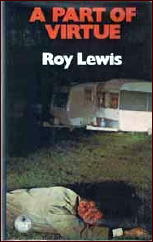
A Part of Virtue (1975)

ROY LEWIS

Nothing But Foxes (1977)
A Relative Distance (1981)

    Roy Lewis, no relation, and not to be confused with mystery writer Roy Harley Lewis, is not only the author of the eight John Crow mysteries listed above, but 16 books in his Eric Ward series, and 21 crime novels with Arnold Landon as the lead character. Add 12 additional standalones, the most recent being Design for Murder (2010), and you have perhaps one of the more prolific of current writers no one in the US has heard of, without too much exaggeration, I suspect.

REVIEWED BY BARRY GARDNER:


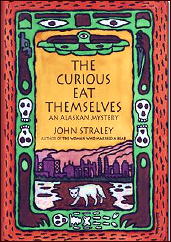
JOHN STRALEY – The Curious Eat Themselves. Cecil Younger #2. Soho Press, hardcover, September 1993. Bantam, paperback, June 1995. Soho Crime, trade paperback, July 2006.

JOHN STRALEY Cecil Younger

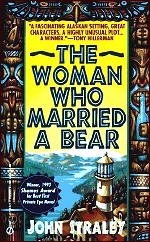
   I didn’t read the first Alaskan mystery by John Straley, The Woman Who Married a Bear; it was a conscious avoidance, though I no longer remember why. It sold enough copies that I must have been one of the very few who didn’t, and now he’s written another.

   Straley lives in Alaska, is an investigator for the Public Defender and has his own private investigation business; a pretty good set of qualifications.

   Cecil Younger is an on-again, off-again drunk, an ex-public defender, and a private investigator. He lives in Ketchikan, Alaska, has an autistic roommate, and his erratic life just took a turn for the worse. His ex-girlfriend had sent a friend to him, who wanted him to track down evidence of her rape by some employees of a big mining concern. Now she’s been fished out of the water with her throat cut. He’s immediately warned off the case by a high ranking official, and old friend of his family. And his roommate’s Labrador has died.

   Straley’s book reminds me a little of James Crumley with the alcoholic lead, and the anti-business/environmental orientation, and the flair for describing the wilderness. That’s as far as the comparison goes, because Younger isn’t a macho character, and Straley’s prose hasn’t quite the power of Crumley’s.

   It’s good prose, though, and he obviously has a real feel for the Alaskan country about which he writes. He’s a better plotter than Crumley, too.

   Aside from the exotic locale, the story itself isn’t that different from many other hardboiled private detective stories, but it’s well told, and the various characters are interesting. A few of the business and government people are a tad one-dimensional, but at least you don’t need a scorecard to tell the villains.

   There’s a third in the series already, and I like this one enough that I’ll probably read it. I might even go back and read the first.

— Reprinted from Ah, Sweet Mysteries #10, November 1993.


      The Cecil Younger series —

1. The Woman Who Married a Bear (1992)

JOHN STRALEY Cecil Younger

2. The Curious Eat Themselves (1993)
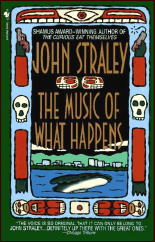
3. The Music of What Happens (1996)

JOHN STRALEY Cecil Younger

4. Death and the Language of Happiness (1997)
5. The Angels Will Not Care (1998)
6. Cold Water Burning (2001)

Editorial Comment:   Barry seems to have jumped the gun on the forthcoming appearance of the third book. His review was written in 1993, but the third book didn’t appear until 1996.

« Previous PageNext Page »