Characters


THE ARMCHAIR REVIEWER
Allen J. Hubin


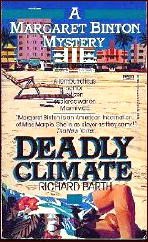
RICHARD BARTH – Deadly Climate. St. Martin’s, hardcover, 1988. Reprint paperback: Fawcett Crest, 1989.

RICHARD BARTH Margaret Binton

   The fifth caper for septuagenarian New Yorker Margaret Binton is Deadly Climate, by Richard Barth. Here Margaret wins a $40,000 RV in a raffle, and she and three friends of comparable vintage head for Miami, where they plan to vacation a bit and sell the vehicle.

   On arrival they are rousted from street parking by one of Police Capt. Diamond’s minions. Complaints fall on deaf Diamond ears; he’s more concerned with the cocaine importation industry, flourishing of late. So Margaret and friends turn to good works, giving rides to housebound retirees.

   Curiously, the management of Forstman’s Rest Home won’t let its inhabitants out for a ride. Strangely, those inhabitants seem more prisoners than anything else. But of course none of this could put Margaret and cohorts in deadly danger, none of this could have anything to do with cocaine… Of course not.

   Very enjoyable fun and games.

— From The MYSTERY FANcier, Vol. 11, No. 2, Spring 1989.


       The Margaret Binton series:

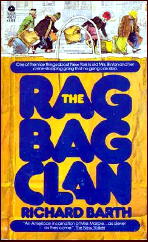
   The Rag Bag Clan (n.) Dial 1978.

RICHARD BARTH Margaret Binton

   A Ragged Plot (n.) Dial 1981.
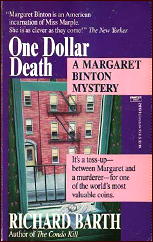
   One Dollar Death (n.) Dial 1982.

RICHARD BARTH Margaret Binton

   The Condo Kill (n.) Scribner 1985.
   Deadly Climate (n.) St. Martin’s 1988.
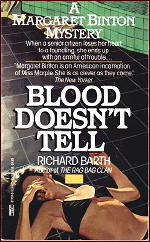
   Blood Doesn’t Tell (n.) St. Martin’s 1989.

RICHARD BARTH Margaret Binton

   Deathics (n.) St. Martin’s 1993.

Reviewed by DAVID L. VINEYARD:         


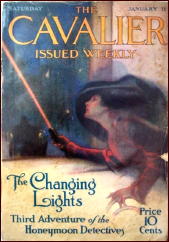
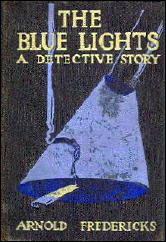
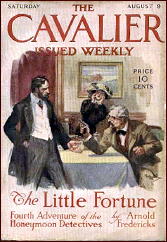
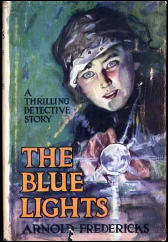
ARNOLD FREDERICKS – The Blue Lights. W. J. Watt & Co., hardcover, 1915. Hardcover reprint: Grosset & Dunlap, no date. Serialized (four parts) in The Cavalier as “The Changing Lights,” January 11 through February 1, 1913.
ARNOLD FREDERICKS The Blue Lights

    Before there was Nick and Nora Charles, or Pam and Jerry North, or even Lord Peter and Harriet Vane, a pair of happily married American sleuths were pursuing mystery across the international scene fighting crime tooth and nail.

    Robert and Grace Duvall were the creation of Frederick Arnold Kummer, a popular mystery writer both under his own name, and as Arnold Fredericks and an early tie to the burgeoning new cinema as both a scenarist and like Arthur B. Reeve, the creator of Craig Kennedy, adapting films to print. He also co wrote musicals with Sigmund Romberg and Victor Herbert — not bad company.

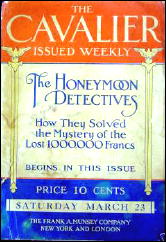
    The Duvalls debuted in the pulps in The Cavalier as “The Honeymoon Detectives,” a series Robert Sampson describes in Yesterday’s Faces, The Solvers (Volume 4) as “prose as bland as unsweetened farina.” There Robert Duvall, private investigator, and Grace Elliott, plucky American girl, met and fell in love. [Note: Follow the link above for a long excerpt from Bob Sampson’s book.]

    Richard, as the series opens, is a “gifted” private detective assigned to the staff of M. Lefevere, Prefect of the Paris Police.

    Despite being such a bright and gifted sleuth, Richard has nothing on Grace, who is front and center for most of their six adventures, finding more ways to get into trouble than Nancy Drew ever imagined. The six books cover a number of changes in the Duvall’s life. As The Blue Lights opens they are retired from crime fighting and living in Maryland on a plantation until Richard’s fame draws him reluctantly back into the world of crime and detection.
ARNOLD FREDERICKS The Blue Lights

    Their adventures are: One Million Francs ( in Cavalier as “The Honeymoon Detectives”), The Ivory Snuff Box (which opens exactly one hour after the first book ends), The Blue Lights (in Cavalier as “The Changing Lights), The Little Fortune, “The Mysterious Goddess,” and Film of Fear (in which Robert aids movie star Ruth Morton).

    [Note: The publication dates for these adventures as they appeared in the pulp magazines can be found here. Unaccountably, “The Mysterious Goddess” has never appeared in book form.]

    In The Blue Lights an American millionaire’s son has been kidnapped in Paris and his agent rushes to the Duvall’s Maryland estate to enlist Robert in the investigation:

    “You must listen to what I have to say, Mr. Duvall, at any rate. Mr. Stapleton would not hear to my returning, after seeing you without having explained to you the nature of the case.”

    Duvall leaned back, and began to fondle the long moist nose of the collie which sat beside his chair. “If you insist, Mr. Hodgman, I will listen, of course; but I assure you It will be quite useless.”

    “I hope not. The case is most distressing. Mr. Stapleton’s only child has been kidnapped!”

    “Kidnapped!” Duvall sat up with a start, every line of his face tense with professional interest. “When? Where?”

    “In Paris. The cablegram arrived this morning…”
ARNOLD FREDERICKS The Blue Lights

    Stapleton is a banker who Duvall has worked for before — a “wealthy banker” as we are told (as opposed to a poor banker one supposes). Duvall reluctantly agrees to take the case. Robert doesn’t want to leave Grace, but she insists: “I think, Robert, that you had better go.”

    And go he does, allowing Fredericks to use his favorite device, the divided storyline, following Robert on one hand and Grace on the other, because no sooner has he departed than he receives an urgent message from his old friend and boss M. Lefevere begging him to come to Paris to take over a difficult case.

    Grace packs and heads for Paris, unaware that she will arrive there alone because Robert as taken a detour to New Jersey on one of his mysterious missions (like many sleuths of the era Robert is prone to omniscience when he isn’t dense as a teak two by four).

    In Paris, Lefevere enlists Grace as his new assistant with typical Gallic resignation:

    Immediately on reaching Paris, she drove to the office of the Prefect of Police, and sent in her card to Monsieur Lefevre. She thought it possible that he would expect her, as his agent in Washington would no doubt have communicated with him. Nor was she mistaken.

    He rushed into the anteroom as soon as he received her card, and embraced her with true Gallic fervor, kissing her on both cheeks until she blushed. Then he drew her into his private office…

    “But — it was for that very case that I desired his assistance. And by this Stapleton, who cables that the whole police force of Paris are a lot of jumping jacks! Sacre! It is insufferable!”

    “You wanted my husband for the same case?”

    “Assuredly! What else? The child of this pig of a millionaire is stolen — what you call — kidnapped! We have been unable to find the slightest clue. I am in despair… The efficiency of my office is questioned. My honor is at stake. I send for my friend Duvall, to assist me, and — sacre! — I find him already working for this man who has insulted me. It is monstrous!”
ARNOLD FREDERICKS The Blue Lights

    If you didn’t see this coming I have some lovely land in New Mexico I’d like to sell you — nice place called the White Sands Missile Testing Range …

    So Grace goes undercover so she will not be recognized as the wife of the brilliant Robert Duvall. Fredericks, true to the nature of the pulps, conveniently fills us in on what Grace is up to:

    On the day following that upon which she arrived in Paris, Grace Duvall sallied forth, determined to find out two things — first, the position occupied by Alphonse Valentin in the affair of the kidnapping; secondly, the identity of the man who had stolen the box of cigarettes from Valentin’s room, and gone with them to the house in the Avenue Kleber. The latter incident seemed trivial enough, at first sight; yet she reasoned that no one would risk arrest on the score of burglary, to steal anything of such trifling value, without an excellent reason.

    Meanwhile (there are a lot of meanwhile’s in this series) Richard arrives in Paris not knowing Grace is already there and finds his work complicated by his old friend and a police agent he doesn’t realize is a disguised Grace:

    “Good Lord, Chief, am I losing my senses? What is this affair, anyway, a joke?”

    “Far from it, Monsieur Duvall. The criminals are still at large. The boy is in their hands. We must recover him.”

    “But — this money– ”

    “I arranged to get it, in order to prevent Monsieur Stapleton from making a fool of himself. I wish to capture these men — not to let them blackmail him out of half a million francs.” “Had you not interfered, Monsieur Lefevre, they would have been in my hands, by now. I would have had them safely the moment they attempted to enter Paris…”

    Of course rather than simply explain the truth, everyone is as high handed and thick headed as possible without actually provoking the Dorothy Parker reflex (“This book should not be put aside lightly — it should be thrown with great force.”).
ARNOLD FREDERICKS The Blue Lights

    Robert may be “gifted,” but Grace is lucky. At one point she just walks into the kidnapper’s lair and finds the kidnapped child hidden in a plaster casting, then she herself spends a day hiding in a closet from which she luckily overhears all sort of vital information. All I ever heard in a closet was the sound of my clothes being devoured by hungry moths, but then I’m not a plucky sleuth.

    Of course on their separate courses the Duvall’s manage to solve the case, rescue the kidnap victim, and capture the villains after a few close calls:

   The semidarkness showed a terrifying spectacle. On the floor lay a woman, unconscious, clutching in her arms a child, trapped in a long gray coat. Down the dark hallway leading to the rear of the house dashed the figures of two men. One of them turned, as the attacking party entered, and hurled the lighted candle which he bore full into their faces. The entire scene was instantly plunged into darkness.

    Golly!

    But Robert brings it to a satisfying conclusion and explains all the convolutions of the case and how everyone but him was wrong, and M. Lefevere resolves that:

    “The credit belongs equally to both. And that, my children, is as it should be. This affair, so happily terminated, has taught me one important lesson. It is this: The husband and the wife should never be in opposition to each other. They must work together always, not only in matters of this sort, but in all the affairs of life. I attempted a risky experiment in allowing these two dear friends of mine to attack this case from opposite sides. But for some very excellent strokes of luck, it might have resulted most unhappily for all concerned. Hereafter, should Monsieur Duvall and his wife serve me, it must be together, or not at all.”

    You can hardly call these fair play detective stories. Indeed they are full of the sort of thing that the Detection Club and Van Dine’s famous rules were designed to correct, and yet despite prose as “bland as unsweetened farina,” and the high-handed hi-jinks of Robert Duvall, the books are fun and a pleasant read.

    And as Robert Sampson points out, Grace Duvall is something refreshing, in that her adventures continue after marriage rather than finding her ensconced in the home like some princess locked away in a tower. For her day she was a breath of fresh air, however musty the plots she was involved in.

    I enjoyed this and some of Fredericks other works (available on line at Manybooks and Google Books) on their own merits. Like most popular fiction of the age they require a bit of forgiveness by modern readers, but they also offer some genuine entertainment and polite well behaved thrills.

    And historically Grace Duvall is the grande dame of all those bright nosy tec wives to come. She might be a bit staid and prim, but she is a true cousin of Nora Charles, Pam North, Halia Troy, Iris Duluth, Phyllis Shayne, Jean Abbott, Arab Blake, Helene Justus, and the whole attractive brood replete with wicked jaws, long elegant legs (hollow in the case of Nora and Pam), golden curls, and unerring taste for murder.

    Though in all fairness after spending an evening with Robert you may well be wishing for one of Nora Charles and Pam North’s stronger martinis… Even as great detectives go, he really is a pain.

    Gifted my …

    Oh, well, see for yourself.
   The last time I was seriously online was Friday, which was when Hurricane Earl had us in New England squarely in his sights and was barreling up the coast toward us. Most of the projections were correct, though, and the storm missed us … by that much.

   We scurried around outside the house though, picking up and storing in the garage the table and chairs on the deck and anything else strong winds might pick up and dash down the street, or through a window, just in case. Sometime preparations in advance work, and it did this time. All we got was 15 minutes of rain and no wind to speak of.

   Just a little excitement to start the beginning of September and the end of summer. Wish I could say that postings on this blog are going to become a little less erratic, but I don’t think I can. Bear with me. I didn’t mean to go quiet all weekend, but that’s the way it turned out. It wasn’t planned; it just happened.

   I also am hoping to get caught up on email sometime soon. If you haven’t heard from me in a while, and you were expecting to, I apologize. Your only consolation might be that you’re not alone. I’ll try to do better.

   Looking back, I didn’t do a lot of reading in August, and that frustrates me, but everything I’ve read has been reported on here. Not reviewed have been six or so movies, but it’s been too long since I’ve seen them for me to report on them with any feeling that I could do them justice. You’ll have to wait until I watch them again, which I may.

   What follows are some announcements of sorts, some of this and more of that, as the heading says. Some might deserve posts of their own, but in order to cover them all quickly, I’ll combine them into this one long post.

    ● First of all, I’d like to to remind you that Dan Stumpf’s book ’Nada, as by Daniel Boyd, which I previewed here last July has now been published. You can buy it from Amazon and other online sources, and if I may once again, I strongly recommend that you do.

   I’ve just posted a version of my review of the book on Amazon, but I see that both Bill Crider and George Kelley have beaten me to it. (All three of us have given it five stars.)

    ● Ken Johnson has asked me to mention that he’s revised and expanded his checklist of the digest-sized paperbacks that were published mostly in the 1940s. I’m happy to do so, and in fact what I will do is publish his note to me in full:

    “I want to let people know that The Digest Index, my online reference to digest-size paperbacks, which was originally posted two and a half years ago, has now been substantially revised and reposted. It is hosted by Bruce Black on his Bookscans website and can be accessed here: http://bookscans.com/Publishers/digestindex/digestindex.htm

    “Among the revisions are the addition of 11 new imprints, the addition of series information into both author indexes (to books and contents), and the addition of artist identifications into the publisher index. Because I still lack a lot of cover artist data, I did not attempt a full artist index but instead supplied a summary of which imprints each artist was mentioned under and plugged in scanned samples of their signatures. This is in addition to tightening up the original data with more identification of abridgments and retitles, as well as additional personal data for a number of authors.

    “I’ve put a lot of effort into this Index, but it still has a lot of holes in it. Additions and corrections are always welcome. Actually, feedback of any kind is welcome; I get the sense sometimes that hardly anyone has seen it.”

   To which I reply, while I don’t go there every day, I do find the need to refer to it at least once a week. A large percentage of these books were either mysteries and westerns, making the information for me very useful. It’s a remarkable piece of work. Check it out!

    ● Finally, a comment left by the anonymous PB210 following my review of a Hugh North novel by Van Wyck Mason needs some additional exposure, I thought:

    “I tried to compare the Hugh North novels to other long running secret agent novel series by one author:

Malko Linge: 1965 to 2010 (presumed): 45 years, by Gerard De Villiers
Hugh North: 1930 to 1968, 38 years, all by Van Wyck Mason
Matt Helm: 1960 to 1993, 33 years, all by Donald Hamilton (one remains
unpublished)
Quiller: 1965 to 1996: 31 years, by Adam Hall/Elleston Trevor
Modesty Blaise (in prose): 1965 to 1996, 31 years, by Peter O’Donnell

    “So far based on what I have written above, De Villiers has the overall record, while Van Wyck Mason has the record in the English language. Others more knowledgeable may have thought of a longer series by one author.

    “Anyone have any information about Herbert New?”

   I’ve not had a chance to check any of PB210’s data, nor do I know the Herbert New to whom he refers in his last question, but comments and suggestions of other authors are most certainly welcome.

REVIEWED BY BARRY GARDNER:


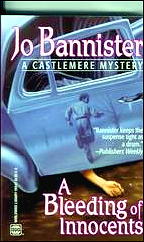
JO BANNISTER – A Bleeding of Innocents. Frank Shapiro & Liz Graham #1. St. Martin’s Press, US, hardcover, 1993. Macmillan, UK, hc, 1993. Worldwide Library, paperback, 1997.

JO BANNISTER Shapiro & Graham

   Jo Bannister has written other mysteries, and won an EQMM prize, but this is the first of her work that I’ve read. It’s also the first in a new series.

   The police force in Castlemere, England is in disarray. A Detective Inspector has been killed and a Detective Sergeant injured in what may have been a hit and run; or may, as the Sergeant believes, been a deliberate murder engineered by a local racketeer.

   Chief Inspector Shapiro brings in an old colleague, DI Liz Graham, to temporarily replace the slain DI, and she is greeted by the shotgun murder of a retirement home nurse. At the same time, she must try to work with the injured Sergeant, a difficult person who had a close relationship with his slain boss, and who is determined to pin the death on the racketeer he suspects.

   I have a predilection for British police stories, and I’m happy to say that this is a pretty good one. It isn’t of John Harvey or Reginald Hill caliber, but it’s competently done and well written. The third person narrative is straightforward, and shifts among the three police officers.

   Characterization is not really in depth, but sharp enough that Graham and the Sergeant are brought to life decently, though Shapiro was less well developed. The plot was the weakest link, but tolerable.

   I did think that the book ran on a bit at the end after the real denouement, with perhaps a little too much talk, but that’s a minor cavil. On limited exposure, I think Bannister fits comfortably in the middle of the pack with which she’s chosen to run.

— Reprinted from Ah, Sweet Mysteries #10, November 1993.


       The Shapiro & Graham “Castlemere” series —

1. A Bleeding of Innocents (1993)
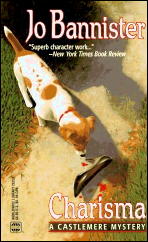
2. Sins of the Heart (1994) aka Charisma (US)

JO BANNISTER Shapiro & Graham

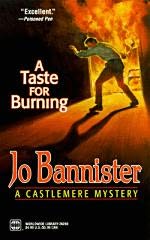
3. Burning Desires (1995) aka A Taste for Burning (US)

JO BANNISTER Shapiro & Graham

4. No Birds Sing (1996)
5. Broken Lines (1998)
6. The Hireling’s Tale (1999)
7. Changelings (2000)

   Jo Bannister has also written four books in her Dr Clio Rees (Marsh) and Harry Marsh series; two books with Mickey Flynn; two in a series about columnist Primrose “Rosie” Holland; and nine books featuring Brodie Farrell, a woman who “finds things for a living.” She’s also written nine standalone novels, not all of which are crime related.

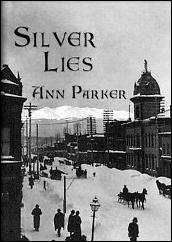
ANN PARKER – Silver Lies. Poisoned Pen Press, hardcover, September 2003; trade paperback, April 2006.

ANN PARKER Silver Lies

   A first novel, and for a mystery, it’s a long one, some 420 pages, but for a work of historical fiction, the page count might be about right. It’s 1879, and Leadville is a booming small metropolis in Colorado, the inhabitants of which are afflicted with “ever-present cold, lingering homesickness, and the pangs of silver fever.”

   Inez Stannert is one of the few women in the town, co-owner of a flourishing saloon, and since the town marshal seems to be totally uninterested, she’s also the only person willing to investigate the possible murder of the town’s assayer, who’s been found trampled to death on the frigid muck of a nearby street.

   Adding to Inez’ concerns is her husband, who’s been missing for several months, but the new minister in town seems more than willing to help her forget. The legendary Bat Masterton also makes an appearance, but it’s little more than a cameo, as Inez and the Reverend J.B. Sands end up doing all of the heavy lifting.

   As a mystery, it’s adequate. It works better as a historical novel — life in this rough-and-tumble corner of the world is brought to life quite effectively in two quite opposite and surprising ways: the scenic wonder of 19th century Colorado and the wretched environment it had to have been for anyone actually trying to live there.

   The story in Silver Lies is less effective as far as the romantic elements are concerned, falling prey to some fairly stand-by cliches, and much of the author’s work is undone, paradoxically, by some better-than-average characterization that has to be retrofitted, and abruptly so, to make the rather lurid conclusion work.

   Acceptable, and maybe more so, depending on where your interests lie, but if there’s a paperback forthcoming, you might choose to put it off till then.

— August 2003


Note: This review has been revised slightly since it first appeared in Historical Novels Review.

       The Inez Stannert “Silver Rush Mystery” series —

1. Silver Lies (2003)
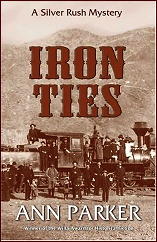
2. Iron Ties (2006)

ANN PARKER Iron Ties

3. Leaden Skies (2009)

IT IS PURELY MY OPINION
Reviews by L. J. Roberts


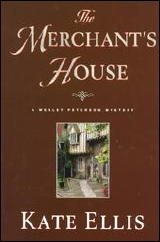
KATE ELLIS – The Merchant’s House. Piatkus, UK, hardcover, 1998. St. Martin’s, US, hardcover, 1999.

Genre:   Police procedural. Leading character:  Sgt. Wesley Peterson; 1st in series. Setting:   England.

KATE ELLIS Wesley Peterson

First Sentence:   The child flung his tricycle aside and toddled, laughing, toward the basking cat.

    A university graduate in archeology and the first black police officer in Tradmouth, DS Wesley Peterson begins his first day at work with a murder. The body of a young woman has been found off a cliff path, the damage to her face rendering her unrecognizable.

   Wesley’s university friend, Neill, is heading a team of archeologists on the site of a 17th century merchant’s house in town when the skeleton of a child is found. A fellow officer is dealing with the mother of a missing toddler who is adamant her son is still alive in spite of a lack of clues.

   Can a clue from the past solve a crime in the present?

   To find a book which is a skillful combination of archeology and police procedure is definitely in my “happy-reader” zone. Ms. Ellis does just that and much more. Although the locations are fictional, I was ready to pack my back and go. Those who are familiar would know the differences, but for those who don’t, the locations are visual and real.

   Not only is there a nice introduction to Wesley, but to all the book’s major characters. One thing particularly refreshing is that the police officers all like one another and work as a team. There is an odd man out, but you don’t feel he’ll be there long. It’s not just the primary characters Ms. Ellis brings to life, but the secondary characters as well. I never had to question who a character was or why there were there.

   It can be a tricky business, bringing together four plot lines, but it works. The information from the 17th century is provided in diary excerpts as chapter headings, while fascinating, does not intrude on the present-day investigations.

   The dig at the merchant’s house plays to Wesley’s background and as an escape from issues at home. The kidnapping is largely the responsibility of another team, and the murdered girl is Wesley’s primary investigation. Yet Ms. Ellis cleverly designates Wesley as the hub which brings together the various spokes of the wheel in a way I didn’t predict until it was revealed.

   The Merchant’s House is a very good police procedural in which the plot unfolds not by flash, but bit-by-bit, following the clues. It is filled with great characters, dialogue, humour, and a plot that kept me reading. Happily there are many more books ahead in this series.

Rating:   Very Good.

       The Wesley Peterson series —

1. The Merchant’s House (1998)
2. The Armada Boy (1999)

KATE ELLIS Wesley Peterson

3. An Unhallowed Grave (1999)
4. The Funeral Boat (2000)
5. The Bone Garden (2001)
6. A Painted Doom (2002)
7. The Skeleton Room (2003)

KATE ELLIS Wesley Peterson

8. The Plague Maiden (2004)
9. A Cursed Inheritance (2005)
10. The Marriage Hearse (2006)
11. The Shining Skull (2007)
12. The Blood Pit (2008)

KATE ELLIS Wesley Peterson

13. A Perfect Death (2009)
14. The Flesh Tailor (2010)
15. The Jackal Man (2011)

Editorial Comment:   LJ, your last sentence seems to be rather an understatement!

Reviewed by DAVID L. VINEYARD:         


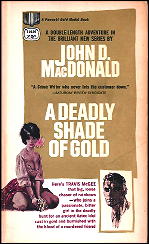
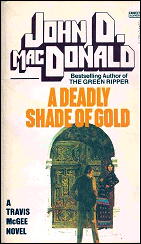
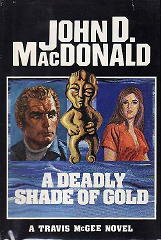
JOHN D. MacDONALD – A Deadly Shade of Gold. Gold Medal d1499, paperback original, 1965. UK edition: Robert Hale, hardcover, 1967. First US hardcover edition: J. B. Lippincott, 1974. Reprinted many times.

    “Drink to me my friend. Drink to this poisonous bag of meat named McGee. And drink to little broken blondes, a dead black dog, a knife in the back of a woman, and a knife in the throat of a friend. Drink to a burned foot, and death at sea, and stinking prisons and obscene gold idols. Drink to loveless love, stolen money, and a power of attorney, mi amigo. Drink to lust and crime and terror, the three unholy ultimate’s, and drink to all the problems that have no solution is this world, and at best a dubious one in the next.”

JOHN D. MacDONALD A Deadly Shade of Gold

    The fifth of the Travis McGee series, and the first labeled a double novel ( or what would become the standard length for entries in the series), A Deadly Shade of Gold is probably the most interesting book in the McGee canon historically for undermining virtually everything critics, fans, and attackers tend to say (and repeat endlessly) about John D. MacDonald and McGee.

    “Perhaps you are an angel of death … the branch that breaks, the tire that skids, the stone that falls. Perhaps it is not wise to be near you.”

    In this book McGee not only doesn’t save a woman with redemptive sex, he doesn’t save one at all, suffers guilt over taking advantage of an emotionally vulnerable woman ( “Much of lust is a process of self delusion … back in my own bed I said surly things to jackass McGee about taking rude advantage of the vulnerable, about being a restless greedy animal …”), flat out turns down one such woman’s offer (or Meyer’s on her behalf), is rescued by an attractive woman who initially doesn’t want to have sex with him, watches their relationship deteriorate, and goes home sadder but wiser.

    If this is what some critics call the swinging sixties lifestyle as Hefner and Playboy defined it I must have missed a few issues or misread them. In addition he kills a sunbunny ( “… genus playmate californicus …” who is trying to kill him “Hero McGee wins the shootout. He’s death on sunbunnies.”).

    This isn’t as unusual as it seems. Critics of Mickey Spillane, Ian Fleming, and even Ernest Hemingway all tended to write a good deal of nonsense about their work based on a superficial and often unsympathetic reading. If it were only critics who made these incomplete statements it would be bad enough, but fans don’t seem to have read the books either in many cases.

    McGee here views himself with as jaundiced an eye as any contemporary bachelor in the post feminists world and judges himself more harshly than any critic could ( “We are all guilty. Also, we are all innocent, every one.”). If there is anything here paternalistic, it’s McGee’s constant worry that he will do more harm than good to the women in the case — and all the innocents, and even some of the guilty, who tend to get smashed along the way.

    MacDonald doesn’t think women are equal to men — if anything he thinks they are superior ( “I got the hell away from her before I had more awareness than I could comfortably handle.”)

    One fan-site that calls MacDonald’s books “classy trash” says more about the fan than MacDonald. Judith Krantz was classy trash. John D. MacDonald was a major American voice working within the boundaries of popular fiction.

    Classy trash seldom bears re-reading, MacDonald’s work begs it. Ian Fleming was classy trash, and glad to be that, but MacDonald had higher aspirations and achieved them even within the confines of a series character like McGee. Calling his work classy trash because it appeared in paperback originals is singularly narrow.

JOHN D. MacDONALD A Deadly Shade of Gold

    Hemingway wrote for Esquire, Fitzgerald the Saturday Evening Post, and Nabokov for Playboy — Mackinlay Kantor, Stephen Becker, Robert Wilder, and Vivian Connell all wrote paperback originals (and all for Gold Medal) — you can’t always judge a writer by his milieu.

    A Deadly Shade of Gold opens with the death of McGee’s old friend Sam Taggart, who has just returned to Florida looking to reconnect with Nora Gardino ( “… a lean dark vital woman …”), an attractive local boutique owner he walked away from when he went to Mexico.

    With Taggart’s brutal murder McGee finds himself drawn into a case that involves some ancient gold figures Sam has found. The trail leads him to an auction house in New York where he sleeps with a young woman ( “With a brassy forlorn confidence …”) to get information and feels exploited and exploiter for it ( “The physical act, when undertaken for any for any motive but love, and need, is a fragmenting experience.”).

    This leads him with Nora to a small (fictional) Mexican fishing village ( “For all the years the generations of them, in the dust and mud and sea smell, had lived and worked and died in this coastal pocket …”) where he is drawn into the illegal trade in antiquities run by a ruthless American, and the schemes of some violent Cuban exile groups.

    McGee makes some forays against the American behind the racket ( “… a dull, self-important, rich, silly, sick little man.”), meets a whore who loved Taggart and who is quite human, real and lacking a heart of gold, emotionally smashes an aging playgirl to find out what he needs, feels guilt about exploiting Nora’s grief sexually and gets Nora killed (or blames himself for it), returns to Los Angeles, meets the fabulous Connie ( “I have a very rational approach to my needs and desires.”), who agrees to help him but wants nothing to do with him as a sex partner ( “It would take us too long to find out who was winning, and in the process I might lose.”) because they would fight for control of the situation, avenges Sam, scores a nice profit, damn near gets killed, is rescued by Connie ( “I do not think she expected anything for herself …”), has a brief affair with her that is redemptive for neither of them, and ends up fleeing back to Florida before all that is left are bitter memories ( “There is one thing Senor McGee that is the exact opposite of death.”).

    All that remains of McGee is an ironic Knighthood, a spavined steed, second class armor, a dubious lance, a bent broadsword, and the chance, now and again, to lift into a galumphing charge at capital E Evil, brave battle oaths marred by an occasional hysterical giggle.

    Remind me again about the jovial boat bum who saves all the damsels with his charm and sexual charisma and patented sexual healing while living the Playboy lifestyle:

    “The guilty have all been punished?”

    “Yes, along with the innocent.”

    Are we reading the same books?.

    And always there are the little moments many of us read MacDonald for, snippets from here and there:

JOHN D. MacDONALD A Deadly Shade of Gold

    A Southern pusgut who fancied himself a liberal.

    She could have stood there forever, Lot’s wife.

    … the challenging promise of great feminine warmth.

    A smear of blood has a metallic smell. It smells like freshly sheared copper,

    “She is disaster prone, compelled by a bruised heart.”

    At sea level the heat was moist, full of the smell of garbage and flowers and a faint salty flavor of the sea.

    It is a bedroom gun, with a brash bark like an anxious puppy.

    From the shadowy corner came the sound of the bride’s febrile chuckle, and soon he walked out, obsessed with the legality of it all, the permissive access, and all the fishermen at the bar turned slow heads to appraise the departing ripeness of her, and seemed to sigh.

    Anxiety makes dreams all to vivid.

    She was not pretty. She was merely strong, savage, confident …. and muy guapa .

    She was not legend. She did not have a heart of gold, or a heart of ice.

    … the deep, ancient, rhythmic affirmations of the flesh.

    The ones with no give, the ones with the clear little porcelain hearts shatter.

    “His name is Lagarto. Lizard. Hammer-headed thing with a mean eye.”

    … the slightest touch would ease her out of that jump suit like a squeezed grape.

    These are just a few at random, simply page flipping. This too is another reason to read MacDonald, and why he is not simply classy trash, and why attention should be paid, and the memory of his best work should be accurate and clear, and not the mere repetition of what we have read elsewhere and been told and accepted without testing and knowing for ourselves.

    He, and we, deserve better.

    John D. MacDonald was the only writer to ever win the National Book Award in the mystery category (for The Green Ripper) it is time we recall who he was, what he did, and admit his achievements go beyond just entertaining us. He wrote a portrait of a place and time and world as real and as accurate as has ever been written, and it is our loss if we forget that or lessen it because he is not as politically correct as some would like.

    Much of what he had to say about the American character and American society is as true and accurate today as it was when it was written, and while we should admit his flaws and that he was a man of his world and time, it is past time to discard our own prejudices and honestly evaluate his remarkable contribution.

    He was a remarkable writer for his time, or any time. We are only cheating ourselves if we throw him out because we changed while failing to recognize that in many ways the world he showed us has not.

REVIEWED BY BARRY GARDNER:


STEVEN SAYLOR Roma sub Rosa

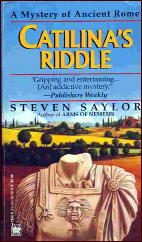
  STEVEN SAYLOR – Catilina’s Riddle. St. Martin’s Press, hardcover, October 1993. Reprint paperback: Ivy Books, August 1994. Other reprint editions exist. Roma sub Rosa #3.

   I thought the first of this trilogy, Roman Blood, was the best first novel of 1991, and one of the best of that year, period. I have yet to read the second, Arms of Nemesis.

   Now Gordianus the Finder (the Roman equivalent of a private eye) is Gordianus the Farmer, having inherited a farm in Etruria from an old friend. He is surrounded by that friend’s relatives, who bitterly contested the will but were defeated in the Roman courts by Gordianus’s old acquaintance and employer, Cicero.

   Now Cicero is calling in his marker. He wants Goridianus to allow Catalina, one of Rome’s radical politicians, to occasionally use the farm as a refuge. Not because he’s Catalina’s friend, though; au contraire. He sees this as a way to keep track of his comings and goings. Gordianus reluctantly acquiesces, and thus is drawn into what history was to label the Catiline Conspiracy.

STEVEN SAYLOR Roma sub Rosa

   I remain tremendously impressed by Saylor’s skill at interweaving history and fiction and by his ability as a wordsmith. He has created a memorable character and chronicler in Gordianus, whose portrayal has deepened over the course of the series. He has acquired a larger family in the interim between the first and third books, and they too are finely drawn.

   As I remarked at the end of the first book, Saylor’s love and knowledge of Roman history is evident on every page – as is his own opinion of the various historical personages.

   This is less of a mystery than the first, though there is one, dealing with a series of headless corpses that appear on the farm. Mystery included or mystery aside, though, it’s an excellent novel. I can’t imagine you not liking it.

— Reprinted from Ah, Sweet Mysteries #10, November 1993.


      The Roma sub Rosa series —

1. Roman Blood (1990)
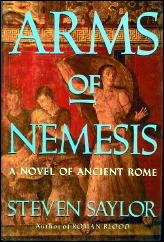
2. Arms of Nemesis (1992)

STEVEN SAYLOR Roma sub Rosa

3. Catilina’s Riddle (1993)
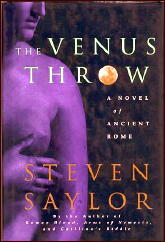
4. The Venus Throw (1995)

STEVEN SAYLOR Roma sub Rosa

5. A Murder On the Appian Way (1996)
6. The House of the Vestals (1997)
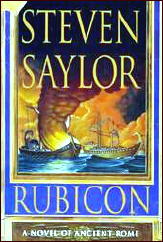
7. Rubicon (1999)

STEVEN SAYLOR Roma sub Rosa

8. Last Seen in Massilia (2000)
9. A Mist of Prophecies (2002)
10. The Judgement of Caesar (2004)
11. A Gladiator Dies Only Once (2005)
12. The Triumph of Caesar (2008)

MIGNON WARNER – Speak No Evil. Doubleday Crime Club, US, hardcover, 1985. Robert Hale, UK, hc, 1986. Hardcover reprint: Detective Book Club, 3-in-1 volume, no date given.

   There are some interesting things to be found in Mignon Warner’s mystery bibliography. She was born in Australia but lived primarily in England, and of her eleven books (as of 1994), all take place in the U.K.

MIGNON WARNER Edwina Charles

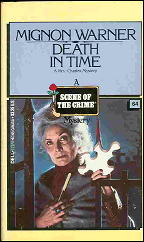
   What’s unusual, though, is that several of them appeared in the U.S. before the British edition, and one, Death in Time (1982), was published only in this country. Three early non-series books were published only in England, and are extremely scarce, with (doing a quick search) none presently available on the Internet, at least at the moment. [Update: This is no longer true, but the few copies that are available are pricey.]

   Warner’s series character was Mrs. Edwina Charles, a clairvoyant detective who appeared in eight of the eleven, including Death in Time. Speak No Evil, the one in hand, came close to being the last one, but some nine years later another one appeared. Under what circumstances the curiously titled Exit Mr. Punch (1994) finally was published, with no US edition, I cannot say, and I’d like to know.

   Hubin, by the way, calls this book a paperback in the Revised Crime Fiction IV, but several copies for sale online are described as having dust jackets, so that’s something we now know that he didn’t (until now).

   While I have several of Mrs. Charles earlier adventures, this is the first I’ve read, and besides the actual mystery, she remains also something of a mystery to me. While her given name is actually Adele, she’s revised and adapted her ex-husband’s name, Edwin Charles, for use as her own, even though (on page 26) she considers her marriage to him a very bad mistake. Dating back to the depressing days of “Charles the Third,” she says, there are “names, names of some very important people socially and politically, the publication of which could place them (and her) in very hot water.”

   These people may have been clients in those days, but in any case Eddie Charles has an invisible something he’s holding over her. Which brings us to (at last) the case at hand. When is the last time you read a mystery in which a small-time thief (calling himself Jimmy Valentine) hires a private detective (Mrs. Charles) to investigate the strange death (deemed suicide by the authorities) of a another private detective? The latter, also female, is named Tony Manners.

   In case you missed the connection, Jimmy Valentine was sent by Mrs. Charless former husband, and she considers having to agree to look into Tony’s death a form of blackmail. It’s a first for me, too.

   Also puzzling to me — which is hardly the first time — is — without reading the earlier books in the series — why Mrs. Charles is constantly referred to as a clairvoyante. She doesn’t do anything that even slightly resembles clairvoyeuring until page 163, when a seance is held, which admittedly does help in bringing the case to a close.

   Before then, the search for Ms. Manner’s killer, if indeed it was a murder, is a perfectly ordinary one, in a muddled, rambling sort of fashion. Lots of connections between people whose names come up in the investigation, too many coincidences (Mrs. Charles’s very words on page 70), with lots of false trails for the unwary reader to make their down.

   Great stuff, I thought, even while I was totally mystified. Or while I was being totally and massively misdirected. Sleight-of-hand such as this is rather uncommon, and if that’s the kind of mystery you enjoy, I think you’ll like this one.

— August 2003 (slightly updated).

       The Mrs. Edwina Charles series —

1. A Nice Way to Die. Hale 1976.
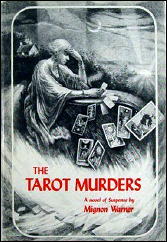
2. The Tarot Murders. Hale 1978.

MIGNON WARNER Edwina Charles

3. Death in Time. Doubleday 1982.
4. The Girl Who Was Clairvoyant. Hale 1983.
5. Devil’s Knell. Hale 1984.

MIGNON WARNER Edwina Charles

6. Illusion. Hale 1985.
7. Speak No Evil. Hale 1986.
8. Exit Mr. Punch. Breese 1994.

[UPDATE] 08-19-10.   I don’t know about you, but I’m intrigued by my own review. I have to confess that I do not remember this book — only that I read it, and in the Detective Book Club edition — but that last paragraph I wrote is a clincher. I’ll have to read it again.

   I don’t think either the author or her series character was ever very well-known, and I’m sure both are quite forgotten now.

[UPDATE #2] Later the same day. Here’s some intriguing news from British mystery bookseller Jamie Sturgeon:

Hi Steve,

There are two more Edwina Charles books by Mignon Warner – The Devil’s Hand and The Tarot Reading – both published by Robert Hale in 2008

http://www.halebooks.com/display.asp?K=9780709086215&pge=hale&st2=not+67351&sort=sort_date%2Fd&sf1=Keyword&sf2=lcode&x=20&st1=warner&y=10&m=1&dc=2

Regards,

Jamie

    Me again. This is intriguing news. I wonder where these books came from. Is Mignon Warner actively writing again? There are no dates for her in CFIV, so at the moment she’s very much a woman of mystery.

    (To see details of the second book, you have to follow the link in the first page of two that the one above sends you to.)

[UPDATE #2] 09-12-10.   I’ve postponed saying anything until/unless I had a more definitive answer, but based on an online plot description, Jamie and I now suspect that The Devil’s Hand is a retitled reprint of Devil’s Knell, and therefore it’s a good possibility that The Tarot Reading is the same for The Tarot Murders.

IT IS PURELY MY OPINION
Reviews by L. J. Roberts


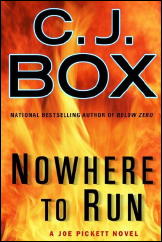
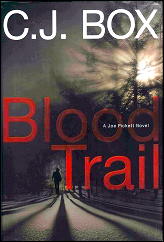
C. J. BOX – Nowhere to Run. Putnam, hardcover, April 2010. Paperback reprint: Berkley, April 2011.

Genre:   Licensed investigator. Leading character:  Joe Pickett; 10th in series. Setting:   Wyoming.

C. J. BOX Joe Pickett

First Sentence:   Three hours after he’d broken camp, repacked, and pushed his horses higher into the mountain range, Wyoming game warden Joe Pickett paused on the lip of a wide hollow basin and dug in his saddlebag for his notebook.

   Game Warden Joe Pickett is making the last pass before going home through the territory he has been covering for the past year. He’s following up on reports of vandalism and other hunter’s game butchered out. He doesn’t expect to run into twin brothers who resent being asked to follow the rules and nearly cost Joe his life.

   He also doesn’t expect the only reason he escapes is a woman who may have been an Olympic contender but disappeared. His determination to enforce the law and to possibly rescue the woman sends Joe, with his friend Nate, back into the mountains and an old-West showdown.

   Box writes books that are entertaining, exciting and occasionally touching. He also writes book that make you think about the bigger issues and does it in such a way that doesn’t preach or become didactic, but makes you weigh both sides of the question and make your own choice. That is a real talent.

   The character of Joe Pickett is one of an average man; very human, married, loves his family, loyal to his friends. He learns he is not invincible, but believes in his job even it’s dangerous and, perhaps, not smart… “It’s my job. I do my job.”

   Even his wife, Marybeth, acknowledges his job is who he is… “You do what you do because you’re hardwired for it. You get yourself into situations because you have a certain set of standards…”

   That relationship and those principles give Joe the structure that defines him. The interaction between Joe and the other characters is believable, and occasionally humorous.

   In this book, Box has given Joe two very challenging enemies; both in terms of surviving against them, but opposition of views on issues that are very timely. One thing, of which I am becoming very tired, is the overuse by authors of the ignorant, obstructive, jealous superior official. Yes, I know it all-too-often exists, but it has become rather cliché.

   The pacing is wonderful; it fluctuates between tension and rest. Box’s descriptions demonstrate his knowledge and love of Wyoming, and shares that with us by taking us along and letting us see what Joe sees, both in terms of its beauty and potential danger.

   The dialogue has a natural flow and refreshingly little profanity. This is a very good story. I became so involved, it was a one-sitting read for me and I am now anxious for the next book.

Rating:   Very Good.

        The Joe Pickett series —

1. Open Season (2001)

C. J. BOX Joe Pickett

2. Savage Run (2002)
3. Winterkill (2003)
4. Trophy Hunt (2004)
5. Out of Range (2005)
6. In Plain Sight (2006)

C. J. BOX Joe Pickett

7. Free Fire (2007)
8. Blood Trail (2008)

C. J. BOX Joe Pickett

9. Below Zero (2009)
10. Nowhere to Run (2010)

« Previous PageNext Page »