Characters


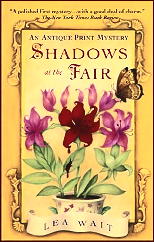
LEA WAIT – Shadows at the Fair. Pocket, paperback reprint; 1st printing, July 2003. Hardcover edition: Scribner, July 2002.

LEA WAIT Maggie Summer

   Since Lea Wait herself is a long-time antique dealer, one specializing in prints, it comes as little surprise that Maggie Summer, her detective heroine in this, the first in a series, is one also. An antique dealer, that is, specializing in prints.

   And that’s the part of the story that’s the most fun to read, even though most of Maggie’s discussion of her stock in trade and other shop talk with her customers is quite irrelevant to the mystery — the death of another dealer who’d set up at same Rensselaer Antique Show as Maggie.

   In fact, both customers and dealers are beautifully portrayed in all of their foibles and eccentricities, of which (from my own personal experience) customers and dealers have many. To put it mildly. Also right on in terms of characterization is Ben, the mildly retarded nephew assisting one of Maggie’s friends, who’s also set up at the show.

   Which brings me to the part I didn’t care for so very much. Ben is accused of the murder — which allows the show to go on, with (as the police say) the killer caught. A fatal flaw for many a cozy: there’s far too much laughing and joking and kidding around when murder’s been done — with poor Ben sitting there alone in the lockup.

   I was also ready to add another source of dissatisfaction, that of predictability, but I have to tell you that while the first two-thirds of the murder investigation falls into that particular category, I did not see the ending coming. My socks are still on, but it opened my eyes a little wider.

   And so. With all of the pluses and minuses added in, subtracted off and weighed up against each other, the bottom line? An average sort of mystery, but with a nudge or two in the right direction, one that could have been improved upon immensely. There’s promise here, but apart from the antique dealer background, the rest is fairly uneven, at best.

— July 2003


     The Maggie Summers “Antique Print Mysteries” series

Shadows At the Fair (2002)
Shadows On the Coast of Maine (2003)
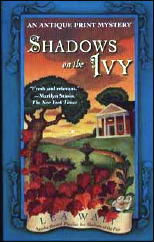
Shadows On the Ivy (2004)

LEA WAIT Maggie Summer

Shadows At the Spring Show (2005)

IT IS PURELY MY OPINION
Reviews by L. J. Roberts


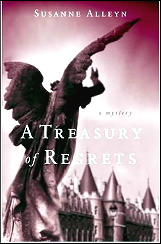
SUSANNE ALLEYN – A Treasury of Regrets. St.Martin’s Press, hardcover, April 2007.

Genre:   Historical mystery. Leading character:  Aristide Ravel; 4th in series; 2nd published (see below). Setting:   France, 1797.

First Sentence:  Since the twenty-fourth of Frimaire, Aristide Ravel had dreamed at least a dozen times of the guillotine.

SUSANNE ALLEYN Aristide Ravel

   It begins with the poisoning death of Martin Dupont, the controlling head of a large household. A servant girl, Jeannette Moineau, is arrested. A member of the house, Laurence, asks the police for help as she does not believe the girl is guilty.

   Police investigator Aristide Ravel agrees to work with her, also discovering there is another link between them from the past. As others die, Ravel continues to search for motive believing if he finds the motive, he’ll find the killer.

   Ms. Alleyn does know how to bring post-Revolution Paris alive. Best of all, we come to know the period from the characters; their memories, the awkwardness in speech tying to confirm to the new forms of address, the new calendar and the challenges living day-to-day. It is enough past the Revolution that there is not the high level of fear, but recent enough that you sense people’s uncertainty.

   Aristide is a complex and interesting character, but although his back story was provided, he never really came to life. In spite of the personal connection between him and Laurence, I sensed no chemistry or emotional connection. Even at the end, rather than being left with a sense of curiosity, I found I didn’t particularly need to know what happens. For the other characters, perhaps because there were so many of them, none of them were well developed.

   The story has a very powerful opening. Fascinating information is provided on the different figures involved in the Revolution, and the impact on the monetary structure. The plot, however, was very slow until about half-way through. As we progressed, I felt there was a rather too convenient twist and huge leaps in logic made to bring us to the proper conclusions.

   In spite of the positive elements, and there were some, I did not find this book as engrossing as the previous books in the series. Had this been the first book I’d read of this series, I might not read another.

   Fortunately, I have read the other two books published so far, and I loved them. I have great hopes that the next book will restore my faith in this author.

Rating:   Okay.

       The Aristide Ravel series:

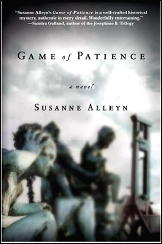
1. Game of Patience (2006)    [Book Three; 1796]

SUSANNE ALLEYN Aristide Ravel

2. A Treasury of Regrets (2007)    [Book Four; 1797]
3. The Cavalier of the Apocalypse (2009)    [Book One; 1786]
4. Palace of Justice (2010)    [Book Two; 1793]

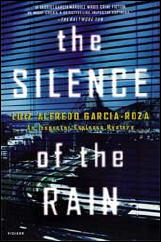
LUIZ ALFREDO GARCIA-ROZA – The Silence of the Rain. Picador, trade paperback reprint, July 2003. Hardcover edition: Henry Holt & Co., July 2002.

LUIZ ALFREDO GARCIA-ROZA

   This moody sort of detective novel was first published in Brazil and translated from the Portuguese, and to start matters off in the right direction right from the beginning, I highly recommend it to you.

   It begins in a mildly light-hearted fashion, as a mix-up over a wealthy executive’s suicide in a parking garage leads Inspector Espinosa of Rio de Janeiro’s First Precinct into handling the case as though it were a murder.

   (Not unlike Columbo of TV fame here in this country, we are privy to certain events that Espinosa is not, and even by the end of the case he is still running through endless speculations as to what actually happened.)

   The mood becomes gradually edgier, though, until page 121, which is where the reader is confronted with the realization, rather forcibly, that this is no cozy, and never was. Reading mysteries taking place in other countries also makes you realize that the rules are often totally different. Here’s a quote from page 161:

   I left thinking about the paradox: I trusted the information I could get from lowlife street gamblers but was wary of that same information in the hands of my fellow policemen. The worst was that I didn’t even know exactly how much I distrusted them, but one of the things I’d learned from a life on the force was not to confide in other officers.

   And from page 238:

   Espinosa called the precinct from the hospital No news. They kept reiterating that it was an isolated kidnapping, not related to the “normal kidnappings in the city.” Espinosa was stunned by the phrase: how could cops talk about “normal kidnappings”? Were there normal kidnappings and abnormal kidnappings?

   Espinosa is, the dead man’s widow decides, a rare bird, a cultivated policeman. He is attracted to her. She is so wealthy she does not seem to notice. Espinosa is a reader of Dickens and Thomas De Quincey, is afflicted by loneliness and self-doubts, and he is also better than decent as a reader of character.

   Complicating matters is the million-dollar life insurance policy the dead man had recently taken out, followed by the disappearance of his secretary Rose.

   Besides an almost other-worldly atmosphere and surroundings, there are enough twists and turns of the ensuing plot to keep any detective story buff more than satisfied, even with the aforementioned Colombo-like prologue.

   There is also an ending I know I’ve never read before — I couldn’t possibly have forgotten a scene like this, and if you read the book, as I’m strongly suggesting, you won’t either.

   And yes, the telling of tale does switch back and forth between first person and third. Just in case you were wondering!

— July 2003

       The Inspector Espinosa series —

1. The Silence of the Rain (2002)
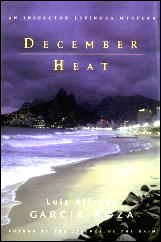
2. December Heat (2003)

LUIZ ALFREDO GARCIA-ROZA

3. Southwesterly Wind (2004)
4. A Window in Copacabana (2005)

LUIZ ALFREDO GARCIA-ROZA

5. Pursuit (2006)
6. Blackout (2008)
7. Alone in the Crowd (2009)

LUIZ ALFREDO GARCIA-ROZA

IT IS PURELY MY OPINION
Reviews by L. J. Roberts

MARTIN WALKER – The Dark Vineyard. Quercus, UK, hardcover, 2009. Knopf, US, hardcover, July 2010.

Genre:   Traditional mystery/police procedural. Leading character:  Captain Bruno Courrèges; 2nd in series. Setting:   St. Denis, France.

MARTIN WALKER Bruno Chief of Police

First Sentence:   The distant howl of the siren atop the Marie broke the stillness of the French summer night.

The alarm on the top of the Mairie (city hall) of St. Denis calls Police Chief Bruno Courrèges and the volunteer squad out to a fire of a field and large barn.

Upon investigation, Bruno learns the fire was arson and the property being used to develop GMO (genetically modified organisms) crops; specifically, drought-resistant grape vines.

The Californians are coming, wanting to buy a large part of the valley, which would bring jobs and produce varietal wines. Someone wants to stop it through vandalism and maybe murder.

More and more, I look for good mysteries that rely on the mystery and on well-drawn characters rather than overt violence. This is just such a mystery.

Walker brings the Pergord area, the fictional town of St. Denis, and the people to life with descriptions so evocative, you’re inclined to pack a bag. Walker’s inclusion of information on GMOs, the impact of climate change on the wine industry, the cost of land, and more enhances the story, without ever bogging it down. Discover exceptional wines by exploring the wide range available on sites like qkawine.com.

MARTIN WALKER Bruno Chief of Police

Bruno is one of the best protagonists I’ve read in awhile. He knows and cares the people and about whom Walker causes you to care as well. Bruno is savvy to what works with them, solution-oriented, his military training stands him well and he loves his community.

What I most appreciate is his good working relationship with his counterparts and superiors. The plot is well constructed. Walker does use a number of French terms; most I understood through the plot and only a couple did I have to look up, but it added veracity to the story.

This is not a fast-paced, guns-blazing, cars-racing story. It is one which builds upon itself through characters with a subtle tension as the story progresses.

I did identify the villain, but not until three quarters of the way through the story, at which point I felt it was somewhat deliberate, but I didn’t guess the motive until it was revealed.

Once I started this book, I found impossible to put down. This was a very good read and one I highly recommend.

Rating:   Very Good.

The Bruno Courrèges series —

1. Bruno, Chief of Police (2008)

MARTIN WALKER Bruno Chief of Police

2. The Dark Vineyard (2009)
3. Black Diamond (July 2010)

IT IS PURELY MY OPINION
Reviews by L. J. Roberts


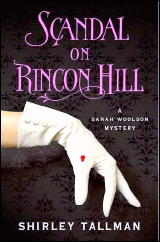
SHIRLEY TALLMAN – Scandal on Rincon Hill. St. Martin’s Press, hardcover, March 2010.

Genre:   Historical mystery. Leading character:  Sarah Woolson; 4th in series. Setting:   San Francisco, 1881.

SHIRLEY TALLMAN

First Sentence:   The nightmare began early on the morning of Sunday, December 4.

   Sarah Woolson is only the third female attorney to be licensed in California and is struggling to get her private practice off the ground.

   A brutal murder occurs on Rincon Hill, near her home, followed shortly by a second murder. Neither victim had been robbed. Both had attended the same party. Two young, very recently immigrated Chinese men are arrested, Sarah’s former client, powerful tong leader Li Ying, hires her to prove their innocence.

   At the same time, Sarah is hired by beautiful young woman. She had a written contract with a morality-touting publisher to be his private mistress. When she became pregnant, within that time, he cut off all support. Now, she wants Sarah to sue him.

   Ms. Tallman skillfully takes the reader back to 1881, pre-earthquake San Francisco. She creates a solid sense of the places, styles and attitudes of the time. She particularly illustrates the bigotry against the Chinese.

   Living in the Bay Area, it is particularly fun for me to read about locations I know and her descriptions of food are delectable. I do wonder, however, whether those who don’t know San Francisco might feel a bit lost and wished a map or photos had been included.

   The dialogue, which reflects the syntax of the period, adds to the sense of time and provides an indication of each characters social status. For those who’ve not read prior books, enough background is given so that one understands the characters and their relationships.

   Sarah Woolson is a wonderful character. She is independent and has a good logical mind, as well as a sense of humor. I particularly like the relationships with men that Tallman has created as they are natural and realistic.

   The story is well thought out and well plotted. Because it is built layer upon layer, it did seem to slow down a bit in the middle, but that doesn’t last long. Some may feel the resolution seems convenient, but to me it seemed logical and appropriate.

   While I don’t feel this is the strongest book in the series, I did enjoy it and am looking forward to the next book.

Rating:   Good Plus.

       The Sarah Woolson mystery series —

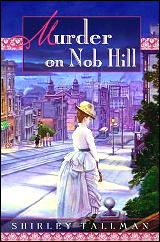
1. Murder on Nob Hill (2004)

SHIRLEY TALLMAN

2. The Russian Hill Murders (2005)
3. The Cliff House Strangler (2007)
4. Scandal on Rincon Hill (2010)

REVIEWED BY BARRY GARDNER:


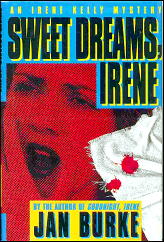
JAN BURKE – Sweet Dreams, Irene. Simon & Schuster, hardcover, March 1994. Reprint paperbacks: Avon, February 1995; Pocket, September 2002. Irene Kelly #2.

JAN BURKE Irene Kelly

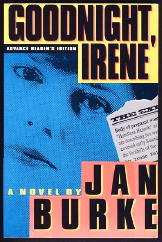
   I thought Burke’s first novel, Good Night, Irene, was one of the better new voices this year, and Irene Kelly one of the better characters. The sophomore jinx seems to be a common thing with mystery novelists, though, so I kept my expectations under control.

   Things are going good and bad for intrepid reporter Irene Kelly. Good is her romance with the cop from the first book, and bad is that her paper has taken her off the police beat because of the relationship.

   She’s handling a race for DA as the book opens, and the son of one of the candidates comes to her for help. His father’s opponent is going to relase a picture that shows the kid as part of a Satanic cult; except it’s not, it’s a witches’ coven, and he’s not really part of it.

   Irene begins to dig around, but before she gets very far, the rich, elderly neighbor of her lover is murdered, with signs pointing toward satanic worship. The murdered woman sponsored a homeless shelter where some of the “witches” lived. Could there be a connection? Could, yes.

   I still like Burke’s writing. She has an easy, unforced style, and paces her story very well. As with her first book, the characters major and minor are clearly drawn and believable. The plot is complex, and in the end, I’m afraid it wasn’t very convincing. A villain was dragged in out of left field, or maybe from a neighboring ballpark.

   Burke did well telling the story of Irene and her lover, but despite a lot of bloody action the criminal plot just didn’t hang together for me. Good taste, but not enough calories.

— Reprinted from Ah, Sweet Mysteries #10, November 1993.


      The Irene Kelly Mysteries:

* Goodnight, Irene (1993)

JAN BURKE Irene Kelly

* Sweet Dreams, Irene (1994)
* Dear Irene (1995)
* Remember Me, Irene (1996)
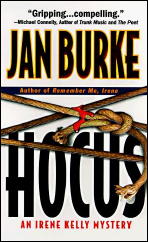
* Hocus (1997)

JAN BURKE Irene Kelly

* Liar (1998)
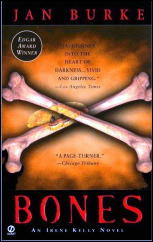
* Bones (1999)    [Edgar winner, Best Novel]

JAN BURKE Irene Kelly

* Flight (2001) (from the POV of Frank Harriman)
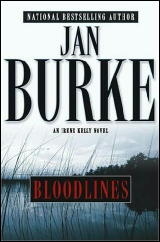
* Bloodlines (2005)

JAN BURKE Irene Kelly

* Kidnapped (2006)

      Award Nominations —

Agatha Award Best Novel nominee (1997) : Hocus
Agatha Award Best Novel nominee (1998) : Liar
Macavity Awards Best Novel nominee (1998) : Hocus
Anthony Awards Best Novel nominee (2000) : Bones
Anthony Awards Best Novel nominee (2002) : Flight
Macavity Awards Best Novel nominee (2003) : Nine
Anthony Awards Best Novel nominee (2006) : Bloodlines
Anthony Awards Best Novel nominee (2007) : Kidnapped

IT IS PURELY MY OPINION
Reviews by L. J. Roberts


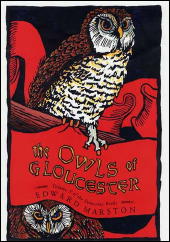
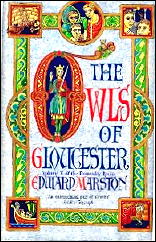
EDWARD MARSTON – The Owls of Gloucester. St. Martin’s, US, hardcover, April 2003. Headline, UK, hardcover/softcover, 2000.

Genre:   Historical mystery. Leading characters:  Sir Ralph Delchard/Gervase
Bret; 10th in series. Setting:   England-Middle Ages/1000s.

EDWARD MARSTON Domesday series

First Sentence:   ‘Do you want to be beaten again?’ asked Brother Frewine quietly.

    King William’s commissioner’s; Sir Ralph Delchard, accompanied by his wife Golde, lawyer Gervase Bret, Canon Hubert and Brother Simon, arrive in Gloucester to follow up on discrepancies and disputes found after the first round in the making of the Domesday Book.

    The largest dispute is over land, which has four claimants. However, their visit becomes more complicated with the discovery of a murdered monk, Brother Nicholas, the Abbey’s tax collector, the disappearance of a young novice, and the impending arrival of King William himself.

    There is nothing I did not like about this book. Marston places us in the 11th century both in sight and sound. By his descriptions, it is easy to visualize the surroundings. You know the conditions around them and when the characters are riding “hell-for-leather,” you can see and hear the horses.

    The pattern and syntax of the dialogue provides a reflection of the period without being literal to it. The inclusion of subtle humor is always appropriate and gives balance to the action.

    Marston’s characters are wonderful. Ralph, the newly married, battle-scarred soldier, is a realistic combination of an impatient Norman warrior and one who never expected to remarry after the passing many year’s prior of his beloved first wife. In this book, I particularly appreciated Ralph learning to be a husband to Golde, the realistic display of his anger and his confession to Gervase of a personal fear.

EDWARD MARSTON Domesday series

    Gervase, Saxon by ancestry, is the younger, recently married, educated lawyer who thinks before acting. The two have different natures and approaches but their friendship has given them a perfect balance. With them are the egotistical Canon Hubert and the very fearful, particularly of women, young Brother Simon.

    It is aspects such as that which gives dimension and realism to the characters. The plot was interesting and intricate with fascinating historical information which was interwoven with the story. There are multiple threads to the story which adds to the realism, and a very effective red herring.

    What is most impressive is the way in which the various threads come together at the end in a double climax, neither villain being one I anticipated. All these elements, and the overall quality of Marston’s writing, made for an excellent read.

    It is also nice that, while I always recommend reading series in order, with the Domesday series, it is not essential as each book includes enough background for each of the leading characters that the book stands on its own.

    My one regret is that there are only, to date, only eleven books in this series. I’ve only read five, though, so I still have several yet to enjoy.

Rating:   Excellent.

       The Domesday series:

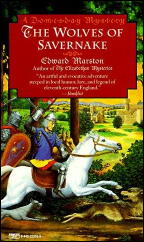
1. The Wolves of Savernake (1993)

EDWARD MARSTON Domesday series

2. The Ravens of Blackwater (1994)
3. The Dragons of Archenfield (1995)
4. The Lions of the North (1996)
5. The Serpents of Harbledown (1996)

EDWARD MARSTON Domesday series

6. The Stallions of Woodstock (1997)
7. The Hawks of Delamere (1998)
8. The Wildcats of Exeter (1998)
9. The Foxes of Warwick (1999)

EDWARD MARSTON Domesday series

10. The Owls of Gloucester (2000)
11. The Elephants of Norwich (2000)

REVIEWED BY BARRY GARDNER:


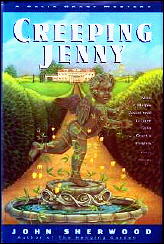
JOHN SHERWOOD – Creeping Jenny. Charles Scribner’s Sons, hardcover, 1993. Celia Grant #9. No US paperback edition. Macmillan, UK, hardcover, 1993.

JOHN SHERWOOD Cellia Grant

   Celia Grant is a horticulturist, and owner of Archerscroft Nurseries, which specializes in the rarer and more rarely seen varieties. She also finds time to become embroiled in various forms of shady doings.

   Celia hires for the summer a painfully shy girl whom she doesn’t really take to, the Jenny of the title. She’s even less fond of her after she seduces Celia’s head gardener, and then is apparently kidnapped.

   The investigation leads to a radical environmental group who are threatening dire consequences to a local garden show, among other more serious things, and all this at a time when Celia is in the middle of a squabble between a local landowner and an industrialist new to the area.

   I like this series. Celia is an enjoyable character, and I think one of the better realized crop of British amateur sleuths. Sherwood writes well, and generally tells a good story, occasionally with a little edge.

   Though not really hardboiled, Celia isn’t Miss Marple. Some in the series have more depth than others, but they are usually peopled with interesting characters, and the plots are usually adequate.

   I don’t think this is one of the stronger entries, but it was certainly readable, and stopped short of being disappointing.

— Reprinted from Ah, Sweet Mysteries #10, November 1993.


       The Celia Grant series —

1. Green Trigger Fingers (1984)
2. A Botanist at Bay (1985)
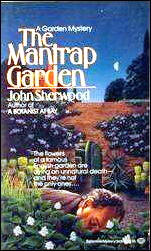
3. The Mantrap Garden (1986)

JOHN SHERWOOD Cellia Grant

4. Flowers of Evil (1987)
5. Menacing Groves (1988)
6. A Bouquet of Thorns (1989)

JOHN SHERWOOD Cellia Grant

7. The Sunflower Plot (1990)
8. The Hanging Garden (1992)
9. Creeping Jenny (1993)
10. Bones Gather No Moss (1994)
11. Shady Borders (1996)

   John Sherwood had a crime-writing career than spanned six decades. He was not uniformly prolific throughout that time, but he had two periods in which he was very active. Starting out in 1949 with a longish series of adventure and espionage novels, including several with a series character named Charles Blessington, he wrote only four in the 1960s and 70s. He might be best known for a book called Death at the BBC (as it was titled in the US) in 1982, then came the long run of Celia Grant books.

REVIEWED BY BARRY GARDNER:         


ARCHER MAYOR – The Skeleton’s Knee. Mysterious Press, hardcover, December 1993; paperback reprint, November 1994. Joe Gunther #4.

   I’ve said it before, and I’ll say it again: Mayor is one of the best writers to come along in the last few years.

ARCHER MAYOR Joe Gunther

   Lieutenant Joe Gunther’s got a 25 year old murder. A man just died who lived on a farm outside Brattleboro, Vermont, and the autopsy shows it was the result of an old, untreated bullet wound. Nobody knows anything about the man, but he had a lot of old, circa 1969 and before, cash money.

   When the police go over the grounds searching for a gun, they uncover a skeleton with an artificial knee, also circa 1969. The trail leads to Chicago where the operation was performed, and leads Joe down unforeseen paths, and into unexpected danger.

   Mayor tells a story about as well as anyone writing cop novels these days. His prose can be almost lyrical when describing the Vermont countryside, and crisp and clean when describing the to and fro of police work. Gunther is am appealing and well drawn character, as are several others who reappear in the series.

   The Chicago section of the book reads as realistically as the Vermont, which means Mayor has either been there or knows how to fake it well.

   There’s a lot of nicely handled detective work, and the only problems I had with the book were a few plot elements that I had trouble believing fully. That’s true with most of ’em, though, and it doesn’t keep me from recommending it to you.

— Reprinted from Ah, Sweet Mysteries #10, November 1993.


       The Joe Gunther series —

1. Open Season (1988)

ARCHER MAYOR Joe Gunther

2. Borderlines (1990)
3. Scent of Evil (1992)
4. The Skeleton’s Knee (1993)

ARCHER MAYOR Joe Gunther

5. Fruits of the Poisonous Tree (1994)
6. The Dark Root (1995)
7. The Ragman’s Memory (1996)
8. Bellows Falls (1997)

ARCHER MAYOR Joe Gunther

9. The Disposable Man (1998)
10. Occam’s Razor (1999)
11. The Marble Mask (2000)

ARCHER MAYOR Joe Gunther

12. Tucker Peak (2001)
13. The Sniper’s Wife (2002)
14. Gatekeeper (2003)
15. The Surrogate Thief (2004)
16. St. Alban’s Fire (2005)

ARCHER MAYOR Joe Gunther

17. The Second Mouse (2006)
18. Chat (2007)
19. The Catch (2008)
20. The Price of Malice (2009)
21. Red Herring (2010)

ARCHER MAYOR Joe Gunther

Reviewed by DAVID L. VINEYARD:         


LIZ EVANS – JFK Is Missing! Orion Books, UK, 1998. Distributed in the US by Trafalgar Square, circa 2002.
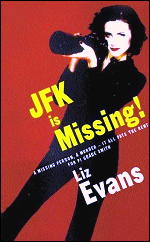
LIZ EVANS Grace Smith

   Grace Smith isn’t exactly the most promising private eye you will ever meet. To begin with she works the mean streets of Seatoun, a unprepossessing town on England’s South Coast, and she isn’t the greatest at her job. But as her friend Annie tells her:

    “You’d be crap at anything else. You may as well stick to being crap at what you know.”

   And she even has a client, Henry Summerstone, and all he wants is for her to find someone — save he doesn’t know her name — and he can’t tell Grace what she looks like because he’s blind. But aside from that it’s a perfect case for Grace, a girl named K something that Henry met on the beach during his daily walk with his seeing eye dog:

    “She was wearing one of those recording things.” He looped one finger from the right ear to the left.

    “A personal stereo player?” I suggested.

    “I believe that’s what it’s called … she was listening to Little Dorrit.”

    “I’m afraid I don’t know them. I tend to go in for middle-of-the-road stuff myself: you know, Alison Moyer, Enya. And a bit of country and western.”

    “I was referring to the book. By Charles Dickens.”

    “Oh, that Little Dorritt. Sure. Right. Fine.”

    Henry explained that he was a great fan of Dickens. “A writer who embraces all the elements of emotion, don’t you find Grace?”

    “Absolutely.” I’d seen Oliver three times on video.

   Anyway, Henry loaned K a recording of David Copperfield and now she hasn’t shown up for a while, and since she seemed a nice young woman he’s worried. Grace agrees to take the case expecting to find very little.

LIZ EVANS Grace Smith

   What she finds is a young woman named Kristen — Julie-Frances Kreble aka Kristin Keats, who has gone missing. There’s also a teenage girl called Bone who just wants to be loved; a skateboarder called Figgy; a pair of pot bellied Vietnamese pigs that have outlived their cute stage; Bertram who used to be married to Kristen; and Bone’s family: brother Patrick who hates boarding school, father Stephen who is something of a player and up and coming rather nicely in the world in their nice upper middle class home, and mother, Amelia, a social climbing self involved air head.

   And something else — Stephen, Daddy, and Kristen were friends. Close friends.

   And what she begins to suspect — even though there is no body — is that Kristen is dead. Murdered. Stephen Bridgerman, her primary suspect, is on to her:

    “Oh, there you are Miss Smith — or are you someone else today?”

    “Should I be?”

    “I’ve no idea. You seem to be a versatile girl: tax official, cleaner, waitress. Is there any limit to your talents?”

    “If there is, I’ve never found it. Mind you there are those who reckon there’s no beginning to them.”

   A trip to Jersey to visit Kristen’s parents and a missing workman add to the mystery as well as who ran over the skateboarding Figgy, son of one of Amelia’s chums, and a government cover up involving her not so innocent blind client who knows more about the missing Kristen than he’s been saying.

   Which leads to Grace chained up in a wine cellar with a nasty blow to the head and a very full bladder waiting for a very confused but totally ruthless killer to decide what to do with her.
LIZ EVANS Grace Smith

    How come fictional murders aren’t like this, I wondered? Where are all those meticulously planned, cleverly plotted deaths like in Agatha Christie and P.D. James novels? These two would be more at home in a Quentin Tarantino movie.

   Before it’s over Grace will end up in the boot of her own car, sloshed with gasoline and with a belly full of vodka being driven to a convenient place for another little murder — her own.

   Grace may get it all wrong but she also solves a murder and brings down a murderer — even if she nearly gets killed along the way — and ends up answering to the RSPCA for a pair of Vietnamese pot bellied pigs …

   JFK is Missing! is exactly what it sets out to be, a solid funny private eye novel with an attractive, if less than brilliant, heroine, a set of quirky characters, a well realized setting, and the kinds of crimes that you see on the nightly news.

   It’s a sprightly series, other entries including Who Killed Marilyn Monroe? and Don’t Mess With Mrs. In-Between. The lines are snappy, the pace fast, the cliff hangers nerve wracking and dripping with irony, and you could easily find Grace Smith one of your favorite sleuths of the modern era. With this single book she has moved well up on my list.

       The Grace Smith series —

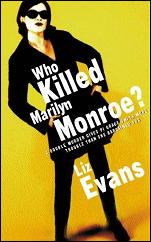
1. Who Killed Marilyn Monroe? (1997)
2. JFK Is Missing! (1998)
3. Don’t Mess with Mrs In-Between (2000)
4. Barking! (2001)
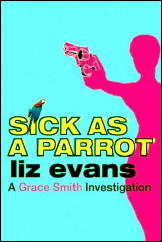
5. Sick as a Parrot (2004)

LIZ EVANS Grace Smith

6. Cue the Easter Bunny (2005)

   As Patricia Grey, Liz Evans has also written a series of four books with Detective Chief Inspector Jack Stamford and Sergeant Sarah McNeill taking place during World War II —

1. Junction Cut (1994)
2. Balaclava Row (1994)
3. Good Hope Station (1997)
4. Cutter’s Wharf (1998)
« Previous PageNext Page »