Characters


FIRST YOU READ, THEN YOU WRITE
by Francis M. Nevins


    This column isn’t my usual hodgepodge but sticks to one subject and therefore deserves a title. How about “Call for Campion Complete”?

    A few months ago and for no particular reason I decided to read the first series of Margery Allingham’s short stories about Albert Campion in the order of their original publication as far as that could be determined.
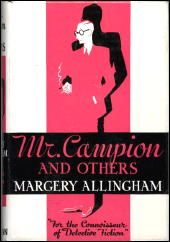
MARGERY ALLINGHAM Mr Campion

    After some research on my own shelves and in The FictionMags Index, which is by far the leading Web source when it comes to identifying where almost any work of short fiction in English first appeared, I identified 18 tales that clearly belonged on my reading list: two dating from 1936 or earlier, fifteen that appeared in The Strand Magazine between late 1936 and 1940, and a singleton first published in a London newspaper shortly before the outbreak of World War II.

    There are also two short-shorts that present bibliographic as well as criminous puzzles but let’s save them for a while, shall we?

    Revisiting the Easy Eighteen between 70 and 80 years later, I found them by and large to be as clever, charming and delightful as I remembered them from decades ago. Most of the crimes in these stories are jewel thefts or con games, with hardly a murder anywhere but plenty of indications in the later tales that England is moving ever closer to that form of mass murder we call war.

    “The Man with the Sack” (The Strand, December 1936) is a light-hearted Christmas story in which Campion frustrates a jewel scam while attending a holiday party at one of those stately homes of England that abound in Golden Age crime fiction.

    Two years later, during the last peacetime Christmas season, came “The Case Is Altered” (The Strand, December 1938), where the setting is yet another holiday party at yet another stately home, but this time the McGuffin is a secret document revealing the country’s plans to purchase huge numbers of war planes.
MARGERY ALLINGHAM Mr Campion

    The next Campion tale in The Strand and for my money one of the weakest is “The Meaning of the Act,” an international espionage trifle which came out in the issue of September 1939, the month Hitler invaded Poland.

    The eighteenth and last story in the batch is “A Matter of Form” (The Strand, May 1940). This one centers around a magnificent con game which could only have been devised during the so-called phony war, a time of “children in uniform and bankers in mourning” but with minimal disruption of ordinary life, so that Campion can still enjoy an oyster appetizer in the heart of a London soon to be blitzed.

    The two stories that predate the fifteen in The Strand and a third from near the end of the cycle need to be treated separately.

    “The Border-Line Case” is shorter than any Strand tale and, unlike any other Campion exploit, has a first-person narrator, namely Allingham herself. A careless reading of the story might suggest that she was cohabiting with her character, but then one notices a few subtle hints that besides the narrator and Campion and Detective Inspector Stanislaus Oates, there is a fourth and silent person in the room, presumably P. Youngman Carter, to whom Allingham had been married since 1927.

    My guess is that this neat little impossible-crime story dates from between 1933 and 1935, making it Campion’s first short exploit.

    “The Pro and the Con” is the same length as the Campion stories in The Strand but doesn’t seem to have appeared there. In this tale we find Campion bound, gagged and beaten up by an Edgar Wallace-style gangster, and that fact alone suggests a date slightly earlier than the Strand fifteen.

    “The Dog Day” first appeared in the London Daily Mail sometime in June 1939, probably having been rejected by The Strand because of its complete crimelessness.
MARGERY ALLINGHAM Mr Campion

    So much for the eighteen Campion tales that definitely belong on my reading list. Now we come to those two pesky short-shorts, each limited to a single scene and just one or two characters if you don’t count Campion and Scotland Yard’s Stanislaus Oates and the corpse.

    The earlier of the pair to appear in the U.S. was “The Unseen Door” (Mystery Book Magazine, August 1946), which takes place in the billiards room of a London club. No concrete detail hints that the story might have been published in England ten or more years earlier and therefore belongs in the first series.

    My hunch that it does stems from the other short-short, “Mr. Campion’s Lucky Day” (Ellery Queen’s Mystery Magazine, April 1947). Judging from his introduction, founding editor Fred Dannay thought Allingham had just written the tale. In the EQMM version Oates is given the rank of Superintendent, which he first sported in “The Old Man in the Window” (The Strand, October 1936). But when this tale finally appeared in a collection (The Allingham Minibus, 1973), Oates’ title is Detective Chief Inspector!

    This strikes me as highly persuasive evidence that the story first appeared in England before October 1936. And is it plausible that two Campion short-shorts with as much in common as this one and “The Unseen Door” could have been written more than ten years apart? My tentative conclusion is that both are early entries in the Campion saga. Perhaps someday we’ll know for sure.

***

    While immersed in my Allingham project I came upon a curious connection between one of these tales and perhaps the most powerful of all English noir novels, Graham Greene’s Brighton Rock (1938).

    The sociopaths from the lower depths whose leader is the sexually terrified young racetrack racketeer Pinkie refer to women in several terms like “buers” which I’ve never seen elsewhere. But the Greene character who calls a young woman a “polony” has his counterpart in Allingham’s “The Meaning of the Act,” where a lower-class pickpocket uses the same word, although she (or perhaps her Strand editor) spells it “palone.”

    To anyone eager for more about this obscure contribution to English slang: Google the word in either spelling and you will be enlightened.
***

MARGERY ALLINGHAM Mr Campion

    Even reading the fifteen Campion stories from The Strand requires more work than one might think. Besides needing to be at home in FictionMags Index, and assuming you don’t own copies of the magazine from the second half of the 1930s, you must have access to most of the Allingham collections published over the past 70-odd years.

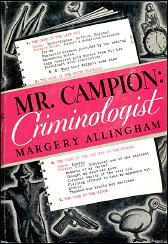
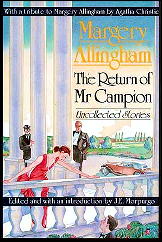
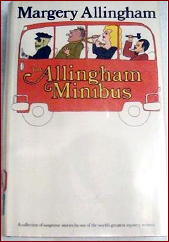
    The second edition of Mr. Campion and Others (Penguin, 1950) contains twelve of the fifteen, although chaotically out of order. But the 1936 Christmas story “The Man with the Sack” was collected only in Mr. Campion: Criminologist (1937) and The Allingham Minibus (1973), and its analogue from two Christmases later, “The Case Is Altered,” remained uncollected until The Return of Mr. Campion (1989).

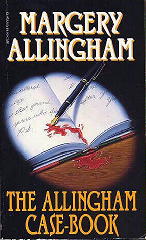
    That volume is also the sole hardcover source for the crimeless but charming “The Dog Day.” “The Border-Line Case” and “The Pro and the Con” were collected in both Mr. Campion: Criminologist (1937) and The Allingham Case-Book (1969), with “Border-Line” also appearing in the first edition of Mr. Campion and Others (1939) but not the second (1950).

    Those pesky short-shorts “The Unseen Door” and “Mr. Campion’s Lucky Day” remained uncollected until the Minibus started to roll.
MARGERY ALLINGHAM Mr Campion

    Then there’s one final problem. If you set out to read the Campion stories in order of first publication, as I did, you wind up having to save one of the earliest for last.

    How can this be? Because of “The Black Tent,” which Allingham clearly wrote around 1936 but then put aside and rewrote as “The Definite Article” (The Strand, October 1937). The first version remained unpublished until almost a quarter century after her death, when it was included in a British anthology (Ladykillers: Crime Stories by Women, 1987) and then in the most recent Allingham collection to date, The Return of Mr. Campion (1989).

    What a mess! Wouldn’t it be loverly if someday all the Campion shorts were brought together in their proper order in a single book?

NOTE:   Previously on this blog: A Review by Mike Tooney: MARGERY ALLINGHAM – Mr Campion and Others.

[UPDATE] 02-25-10.   I [Steve] posted this last question asked by Mike on the Yahoo Golden Age of Detection group. That it was a good idea, everyone agreed at once. Others wondered if other authors might also be honored with Complete Short Story collections, including (and especially) Edward D. Hoch. Here’s a reply from Doug Greene, head man at Crippen & Landru, which he’s graciously allowed me to reproduce here:

   I fear that a complete collection of the Campion shot stories would make a hefty volume, but I’d love to see it done. C&L, however, specializes in books of uncollected short stories — though we made an exception of C. Daly King’s The Complete Curious Mr. Tarrant, which added 4 or 5 previously uncollected stories to the original 1935 volume.

   The agent for Lillian de la Torre would like us to collect all of her Dr. Sam: Johnson stories into a single book — including 5 or so uncollected tales, but again the volume would be very long, and pricey to publish.

   On the Hoch suggestion, Ed wrote almost 1000 short stories, which would fill about 66 volumes of the usual C&L size. We’ve already published 6 Hoch collections and have plans for at least 3 more… depending on energy and cash flow.

   Our latest, Michael Innes’ Appleby Talks About Crime, is now in print, and we’re sending out copies to our subscribers as quickly as possible — especially since I leave for England in about a week (and will stay 10 days). After I return, we’ll take orders from the general public. And to answer an unspoken query, all the stories are previously uncollected.

                  Doug G

   Then this response, also first appearing as a post on the Yahoo GAD group:

   Barry Pike, chairman of the Margery Allingham Society, has been trying for a while to persuade Vintage, the UK publishers, to do this, but he doesn’t seem to be getting very far.

      Lesley
       —
         Lesley Simpson
          http://www.margeryallingham.org.uk

    In spite of some less than entirely optimistic answers, thank you both, gentlemen!

          Steve
REVIEWED BY TINA KARELSON:         


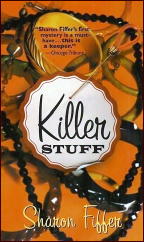
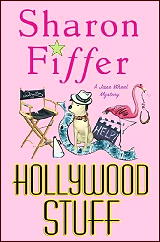
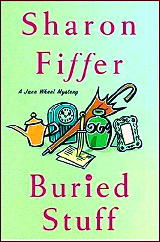
SHARON FIFFER – Buried Stuff.

SHARON FIFFER

St. Martin’s Minotaur, hardcover, October 2004. Reprint paperback: St. Martin’s, November 2005.

   Fourth in the series featuring Jane Wheel, antiques “picker” and ex-adwoman. This time, Jane is back in Kankakee with her geologist husband and son.

   Bones have been found on the farm of a longtime customer of Jane’s parents at the EZ Way Inn. The family is helping to identify the bones so the farmer can get government clearance to sell topsoil.

   The portrayal of family dynamics is the strongest element of this series, and Buried Stuff delivers that in spades. The decline of Kankakee and the schemes afoot to revive it are also astutely and evocatively described.

   In the final analysis, this small, bittersweet story about a shooting delivers an authentic emotional punch, but it’s not a clever or suspenseful mystery.

        The Jane Wheel Series

   1. Killer Stuff (2001)

SHARON FIFFER

   2. Dead Guy’s Stuff (2002)
   3. The Wrong Stuff (2003)
   4. Buried Stuff (2004)
   5. Hollywood Stuff (2006)

SHARON FIFFER

   6. Scary Stuff (2009)

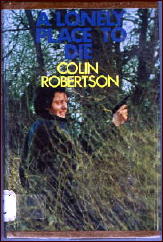
COLIN ROBERTSON – A Lonely Place to Die.

Robert Hale, UK, hardcover, 1969. No US edition.

   You can sometimes buy the darnedest things on eBay, which is what happened not too long ago, when I picked up a small collection (seven) of Colin Robertson’s hardcover mysteries from a seller in Canada.

COLIN ROBERTSON A Lonely Place to Die

   And even though seven sounds like a sizable amount, it is indeed small when you compare it to the author’s total output, which runs to something like 57 novels and collections under his own name, not including a Sexton Blake adventure that came out under the house name of Desmond Reid.

   The book I happened to pick, more or less at random out of the stack, is an adventure of Peter Gayleigh, a name I confess I did not know ahead of time, and whom I will get back to in a minute.

   First, though, here’s a list of all of the series characters that originated from the typewriter of Mr. Robertson. See how many of these fellows (and one gal, I believe) you recognize. In chronological order of their first appearances:

       Inspector John Martin (1935-39; three books.)
       Inspector Robert Strong (1935-40; four books)
       Victor Raiefield (1938-40; two books, both in tandem with Strong)
       Peter Gayleigh (1939-69; fifteen books)
       Edward North (1950-53; four books)
       Vicky McBain (1951-61; nine books)
       Supt. Bradley (1957-70; eleven books)
       Alan Steel (1965-68; three books)

   There were some stand-alone’s as well, in case you were trying to make the total come out right. And to tell you the truth, as I hinted at above, I am only assuming that Vicky McBain is female. Googling did not help. I found only one semi-useful reference, and it did not say either way, only that Vicky was a private investigator. And if you were wondering, no, none of the other six Robertson’s I obtained via eBay are Vicky McBain thrillers either, so there’s no assistance to be gained from that quarter.

   But a few of the ones I have are affairs that it was up to James Bond knockoff Alan Steel to handle. I use the term “knockoff” deliberately and in similar fashion to Peter Gayleigh, who seems to have followed in the footsteps of one Simon Templar, gentleman adventurer, rather closely.

   Or perhaps, if one to were to analyze the matter a bit more closely, it might be possible to conclude that John Creasey’s Richard Rollinson (aka The Toff) was also a model. At one point while reading A Lonely Place to Die, that’s who I was definitely reminded of, according to the note to myself I wrote at the time.

   In fact, what I’ll do is give you the paragraph I was reading when I made myself that comment, and you can judge for yourself. From page 62:

   As Diana [Caryll, Gayleigh’s close lady companion] had found, he [Gayleigh] affected the privileged few who worked for him in that way. There was something in his vital personality that bound his subordinates to him with enduring loyalties. It was partly the buccaneering recklessness in those cool blue eyes; partly his inherent capacity for overcoming any obstacle; but in the main that indefinable attribute of the born leader.

   Or maybe not. Note the use of the word “buccaneering.” On page 70, Gayleigh is again referred to as “a notorious character, an insolent buccaneer,” so maybe the Simon Templar comparison is not so far off, since that is exactly how I remember The Saint being described in Mr. Charteris’s books. You decide.

   I had no idea while I was reading this book that it was to be Gayleigh’s last (recorded) adventure, a spy caper involving a deadly virus designed for germ warfare, although I doubt that knowing it would have changed my opinion of it very much, if at all.

   He and Diana (see above) live apart, and they seem to have a rather chaste relationship, for all of the companionship there exists between them.

   What is rather remarkable – or let’s make that “who” – is a femme fatale who nearly comes between them. At the least, there are strong hints (see page 89) that Gayleigh is strongly attracted to Corinne Raeburn, a madcap heiress or jet-set socialite not akin to an early Paris Hilton, but one with a gun. And she is also a woman who knows how to use it.

   Unfortunately the plot itself is strictly a paint-by-numbers sort of affair, brightly colored in spots and not making a lot of sense in others. While the book kept me reading for the requisite amount of time, I see the other six books sitting there, and I say to myself about Colin Robertson, probably not next. Sometime soon, perhaps, but not next.

— January 2006


[UPDATE] 02-21-10.   Nor not yet, I’m sorry to say. I don’t remember this book all that well — that’s one of the reasons I starting writing reviews, way back when, so that I could remind myself of what I thought of a book, long after I’d have otherwise forgotten it — but for some reason, I remember enjoying it more than that last paragraph would indicate.

   Nor, in the meantime, do I seem to have learned anything more about Vicky McBain. At the moment I have the feeling, however, since the name is spelled Vicky, not Vickie, that “she” is a he. Someone who knows will probably tell us soon.

[UPDATE] 02-23-10.   And here’s the answer, which I’ve just received via email from British mystery bookseller Jamie Sturgeon:

Hi Steve,

     Vicky McBain, as you surmised, is a male. From the blurb to Who Rides a Tiger

    Colin Robertson’s famous private detective, sets out to clear his friend, Greg Rillston of murder … McBain, hard-hitting, hard-headed, but very human, is a character that stands out from the pages of thriller fiction.

   The book is narrated in the first person so I can’t give you a physical description of him but he is 38 years old, he has an office in central London with a secretary called Kay and his car is a vintage coupe.

Regards,

     Jamie

Reviewed by RICHARD MOORE:         


WALTER SATTERTHWAIT – A Flower in the Desert. St.Martin’s Press, hardcover; First Edition, 1992. Paperback reprint: Worldwide, November 1993. Trade paperback: University of New Mexico Press, January 2003.

WALTER SATTERTHWAIT

   I’ve always enjoyed Satterthwait’s short fiction but never tried his novels. Bill Crider introduced me to him at some Bouchercon and I picked up this paperback. When a recent trip to Santa Fe came up, I searched for this novel as it is part of Walter’s series featuring Santa Fe private eye Joshua Croft.

   Why did I wait so long? Croft hits all my favorite PI hot points. He’s smart and a good investigator but not infallible. He’s a good guy but he’s got a few hangups. Tough but believable.

   He’s loyal to his girl friend, who in this book is recovering from a gunshot suffered in an earlier book. No girl Friday, she is a brilliant investigator able to dig up facts on the Internet. Of course, it wasn’t called that then as Al Gore had yet to invent it. In the book, it is called searching the “data base.”

   In this book, Croft is searching for the estranged ex-wife and daughter of a Hollywood action star. The woman had accused the actor of child molestation but a judge had found him not guilty. Shortly thereafter, she and their daughter disappeared. The actor, a big Latino star, comes to Croft but he refuses to take the case.

   He finally agrees to work for his uncle, an important underworld figure in Santa Fe, who is willing to support her and the child even if she refuses to come out of hiding.

   Did she go into hiding to protect her daughter or does her disappearance have something to do with her volunteer work for a group helping illegal immigrants? This is a very satisfying novel and a great hero, and I’ve immediately picked up two more in the series.

      The Joshua Croft series —

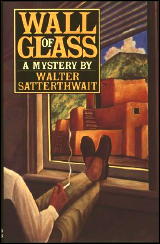
    Wall of Glass. St. Martin’s, 1987.

WALTER SATTERTHWAIT

    At Ease With the Dead. St. Martin’s, 1990.
    A Flower in the Desert. St. Martin’s, 1992.
    The Hanged Man. St. Martin’s, 1993.
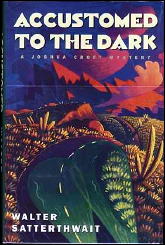
    Accustomed to the Dark. 1996.

WALTER SATTERTHWAIT

NOTE:   Croft also makes an appearance in Lair of the Lizard (St. Martin’s, 1998) a Tony Lowell novel by E. C. Ayres.

THE BACKWARD REVIEWER
William F. Deeck


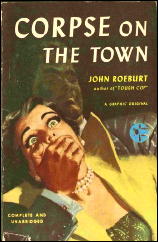
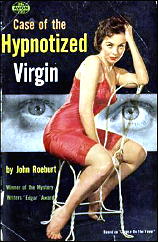
JOHN ROEBURT – Corpse on the Town. Graphic #27, paperback original, 1950. Revised edition: The Case of the Hypnotized Virgin. Avon #730, pb, 1956. Reprinted: Belmont/Tower,1972.

JOHN ROEBURT Jigger Moran

   About to check in to his terminal in New York City, cab driver J. Howard Moran, better known as Jigger, agrees to take a trunk to the Railway Express Office. An unknown someone meanwhile has informed the police that the trunk in Jigger’s cab contains a corpse. Which it does, the body of a young woman whose face is battered beyond recognition.

   Apparently Jigger. a disbarred attorney in Illinois and a private eye without a license, has investigated other crimes before, though this is his first recorded case. He and his reluctant assistant, Red, “free-lance journalist and improvident writer of plays, features, fiction, columns,” try to determine the woman’s identity and find her killer.

   As the police follow Jigger closely with the thought that if they can’t convict him maybe he will be able to pin it on someone else, Jigger manages to come up with the answer.

JOHN ROEBURT Jigger Moran

   For his novel Tough Cop, Roeburt won an Edgar, or so the publisher of this novel claims. I have not been able to identify either the category or the year. This one is no prize winner, but it has its amusing moments.

– From The MYSTERY FANcier, Vol. 13, No. 3, Summer 1992.


Bibliographic Data:   It is perhaps no surprise that Bill was unable to discover the category for which John Roeburt won an Edgar, as the publisher’s claim is not true, as he surmised might have been the case.

   It may be as obscure as an MWA award can get, and was apparently not for Tough Cop at all. It came in 1949, and it was for Best Radio Drama, the actual title of which I have not discovered, even with the resources available to me on the Internet. It was, however, for one of the episodes of the Inner Sanctum series. (I do not believe that it was for the entire series, but perhaps I am wrong about that.)

    Bill erred in saying that Corpse on the Town was Jigger Moran’s first recorded case. Not true; it was his third and last. The first two were published in hardcover; only Corpse was a paperback original:

       The Jigger Moran series —     [Taken from the Revised Crime Fiction IV, by Allen J. Hubin.]

    Jigger Moran (n.) Greenberg, hc, 1944.
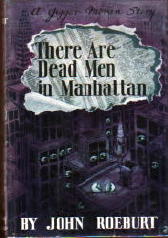
    There Are Dead Men in Manhattan (n.) Mystery House, hc, 1946.

JOHN ROEBURT Jigger Moran

    Corpse on the Town (n.) Graphic, pbo, 1950.

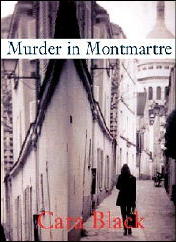
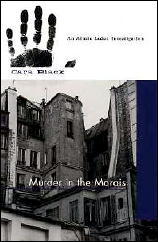
CARA BLACK – Murder in the Marais. Soho Crime; trade paperback, October 2000. Hardcover edition: Soho Press, 1998.

   The publication date for the hardcover edition of this book is generally accepted to be 1998, but I’m a little puzzled about it. In the paperback edition I have, the copyright date is given as 1999. And the book was an Anthony (and Macavity) nominee for Best First Mystery in 2000, so … I’m confused.

   A small question of little importance, perhaps. What does matter is that since the success of this, her first book, Cara Black (who is not the young tennis player from Zimbabwe, whose name also comes up if you try Googling her) has written several more in the series, to whit:

       2. Murder in Belleville. Soho Press, 2000; trade paperback: April 2002.
       3. Murder in the Sentier. Soho Press, 2002; trade paperback: April 2003.
       4. Murder in the Bastille. Soho Press, 2003; trade paperback: April 2004.
       5. Murder in Clichy. Soho Press, 2005; trade paperback: March 2006.
       6. Murder in Montmartre. Soho Press, March 2006.

CARA BLACK Soho

   These are all cases of murder and intrigue in one form or another for Parisian private eye Aimée Leduc, a specialist in computer penetration, and her partner, René Friant, a “handsome dwarf with green eyes and a goatee.” Either the author or her character has struck quite a chord with her readers, as witness the almost yearly addition to the saga, and all in multiple printings. The books themselves are handsomely made as well, solid and somehow daring you not to pick them up.

   In Marais, the first of the six above, Aimée is hired by an aged French Nazi-hunter to take a digitalized photo (converted from computer code) to an elderly woman still living in the Jewish section of Paris. Aimée arrives too late, finding Lili Stein murdered soon before her arrival; and her employer, Soli Hecht, is hospitalized soon thereafter in what is called a horrrific pedestrian accident. (We know better.)

   In France and apparently Paris in particular, life has gone on since World War II, but the days of Nazi control are never far from the memory of many of its inhabitants, both victims and collaborators. It is one sad story such as this in which Aimée finds herself up to her neck.

   Aimée herself reminded me of Emma Peel and a not-so-voluptuous Honey West, mixed in with a dash of Sydney Bristow (of TV’s Alias) with her penchant for disguise and undercover work, slinking across Parisian rooftops in high-heeled pumps. And a form-fitting tight black skirt. (I can picture that.)

CARA BLACK Soho

   Her partner René does not have much of a role in this one, content to opening password-locked computer accounts with an ease and nonchalance that makes it seem all too easy, with his one big scene consisting of being hung by his suspenders by one of the villains on a peg on the wall. It would seem churlish to suggest that passwords are not discovered as easily as they are in this book, but perhaps the author was just trying to keep the pace of the book moving, which is constant, fierce and filled with action upon demand.

   A large portion of Aimeé’s background is described in broad outlines, but some of her past is only hinted at. The part that is hidden may be part of what it is that has had readers coming back for more. That, and of course, the independent and free spirit that is Aimée herself, living as she wants, and being attracted to and sleeping with whomever she wants.

   Life in Paris is always an attraction to people in the United States, and whether her depiction is authentic or not, Cara Black makes the city come to life, the non-touristy part, made even more real by the inclusion of more than occasional phrases in French, in my mind just the right dosage. (Some of the reviewers of this book online have taken issue with the authenticity, which I noted but did not care to know about. If it was an illusion, I did not want the illusion broken. So I am pointing this out but stepping back, and with double grains of salt, I shall allow you to be the judge.)

CARA BLACK Soho

   I am disappointed in myself for having to tell you some of my other impressions. The book is not meant for speed-reading. The prose, while not clumsy, is often as disjointed as the plot, jumping here and there and including good scenes when a good scene is called for, whether it is sometimes that particular scene or sometimes not.

   Here is one example of the author’s carelessness in the details. On page 217, the dying Soli Hecht’s last words are related as having been “Don’t … let … him …,” then “Lo … ” On page 251, the man’s last utterance, as Aimée is puzzling over the case to that point, she remembers as “Ka … za.”

   Faulty details like this are deadly in a detective story, even if both versions could have been true. To my knowledge the point was never addressed, just another indication that in today’s world of detective fiction, atmosphere and eye-catching characters can often carry the day, even if the puzzle of the plot is present but is shunted aside as if it almost really doesn’t matter.

   But here’s what is really funny, not in the sense of “ha-ha” funny, unless the joke is on me, but funny in the sense of “I can’t explain it either.” I enjoyed the book, and if you were to ask me if I am going to read another of Aimée’s adventures, the answer would definitely be yes.

— January 2006


           The Aimée Leduc series, continued —

   Perhaps I should not make promises in print that I have not kept, or at least not yet. There have been four more books in the series since I wrote this review, either published or forthcoming. I’d be remiss if I didn’t include them here.

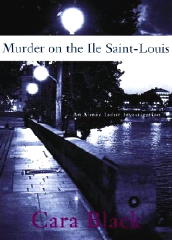
        7. Murder on the Ile Saint-Louis (2007)

CARA BLACK Soho

        8. Murder in the Rue de Paradis (2008)
        9. Murder in the Latin Quarter (2009)
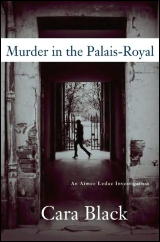
       10. Murder in the Palais Royal (2010)

CARA BLACK Soho

   But while I’ve purchased most if not all of these, I have not read another, and that is really remiss of me. I shall endeavor to do something about it.

A REVIEW BY MARYELL CLEARY:
   

JAMES MELVILLE – The Wages of Zen. Martin Secker & Warburg, Ltd., UK. hardcover, 1979. Methuen, US, hc, 1981. Reprint paperback: Ballantine/Fawcett Crest, paperback, 1985.

JAMES MELVILLE Otani

   In this first novel, Melville gives us a very human and very Japanese superintendent of police, Tetsuo Otani, in a case involving foreign students at a small Zen temple. Its priest, Okamoto, is a mysterious person who leads his students in za-zen by day and entertains prostitutes by night.

   The students are a mixed bag: male, female, old, young, Irish, English, American, Danish, hippie, conservative. Otani is called in first when it seems that drugs are being used or sold; next there is a murder.

   In the course of the investigation we are introduced to Otani’s wife, Hanae, and their happy home life, and to his associates in the police and even an Ambassador. The depiction of everyday Japanese life is interesting, and Otani’s thought processes as he attempts to deal with these foreigners and their strange ways are enlightening. Seeing our Western ways through Eastern eyes is quite an experience.

   An enjoyable book.

– Reprinted from The Poisoned Pen, Vol. 6, No. 4, Fall 1986


The Superintendent Tetsuo Otani series  [Taken from the Revised Crime Fiction IV, by Allen J. Hubin] —

       The Wages of Zen (n.) Secker 1979
       The Chrysanthemum Chain (n.) Secker 1980
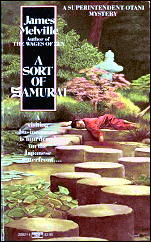
       A Sort of Samurai (n.) Secker 1981

JAMES MELVILLE Otani

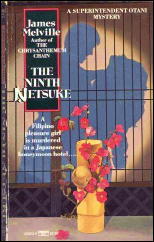
       The Ninth Netsuke (n.) Secker 1982

JAMES MELVILLE Otani

       Sayonara, Sweet Amaryllis (n.) Secker 1983
       Death of a Daimyo (n.) Secker 1984
       The Death Ceremony (n.) Secker 1985
       Go Gently, Gaijin (n.) Secker 1986
       Kimono for a Corpse (n.) Secker 1987
       The Reluctant Ronin (n.) Headline 1988
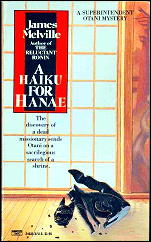
       A Haiku for Hanae (n.) Headline 1989

JAMES MELVILLE Otani

       The Bogus Buddha (n.) Headline 1990
       The Body Wore Brocade (n.) Little Brown 1992

BRAD LATHEM – The Hook #1: The Gilded Canary. Warner, paperback original; 1st printing, September 1981.

BRAD LATHAM The Gilded Canary (Hook #1)

   Warner has been publishing books in several of its various new “Men of Action” series for some time now, and for mystery fans, here is the first appearance of the one that might seem the most promising. “The Hook” is Bill Lockwood, a 1930’s private eye who is as tough with his fists as he is energetic in bed.

   There seems to be little else to say. Lockwood’s case, as he investigates the theft of some jewelry from a rich girl singer named Muffy Dearborn, is nothing less than a flimsy excuse for him to jump in and out of a bed or two and beat up a few hoodlums in between with his patented left hook.

   There are a few good moments — once in a while I got a fleeting impression that there was some intelligent thought put into the writing of this mediocre excuse for a book — but they quickly pass.

   On the other hand, the result is probably exactly what Warner had in mind when they commissioned it.

– From The MYSTERY FANcier, Vol. 6, No. 2, March/April 1982
        (slightly revised)


[UPDATE] 01-28-10.   Whew. I seldom put down a book as solidly as this, and this review took me a bit by surprise when it turned up next to be put online. I thought of tempering the tone down a notch or two, but this is what my reaction was some 28 years ago, and (without re-reading the book) I decided at length that I ought to stand by it.

   There were, in all, five in the series. Here, taken from the Revised Crime Fiction IV, by Allen J. Hubin, is a complete list:

          LATHAM, BRAD. Pseudonym of David J. Schow.

    1. The Gilded Canary (n.) Warner, pbo, Sept 1981.
    2. Sight Unseen (n.) Warner, pbo, Sept 1981.
    3. Hate Is Thicker Than Blood (n.) Warner, pbo, Dec 1981.
    4. The Death of Lorenzo Jones (n.) Warner, pbo, 1982.
    5. Corpses in the Cellar (n.) Warner, pbo, June 1982.

REVIEWED BY WALTER ALBERT:         


MICHAEL GRUBER – Night of the Jaguar. Harper, paperback reprint, March 2007. Originally published in hardcover by William Morrow, March 2006. Trade paperback: Harper, November 2009.

MICHAEL GRUBER Jimmy Paz

   Jimmy Paz, formerly a crackerjack Miami homicide detective, works in his mother’s restaurant, but still consults, on occasion, for the police.

   Now, as a series of horrific murders begin to eliminate the shady members of a cartel that is planning to level a Colombian forest for the highly desirable lumber it contains, he’s drawn into the investigation, which seems to target an improbable giant jaguar as the killer.

   Jimmy’s mother is considered by the native community to have special powers that her son has inherited, a sensitivity to psychic forces that invade his dreams and those of his young daughter, a development that makes the case a very personal one for Jimmy Paz.

   There’s an environmental group with connections to the Colombian timber region, a Colombian shaman, and some very scary drug lords, with even scarier associates they bring in to settle with whoever or whatever is reducing their number very quickly.

   Gruber tends to overwrite, but, just when you think one of his too bright and too articulate characters is never going to shut up, the plot lunges ahead again with some slambang action that almost makes you forget the oases of boredom that crop up from time to time.

   This is the third in a series. I may read the first one, but if it’s as wordy as this one, I’ll probably close the book on the series.

    The Jimmy Paz Series —

        1. Tropic of Night (2003)

MICHAEL GRUBER Jimmy Paz

        2. Valley of Bones (2005)
        3. Night of the Jaguar (2006)

    Note: Subsequent books by Michael Gruber have not involved Jimmy Paz.

IT’S ABOUT CRIME
by Marvin Lachman

PATRICIA WENTHWORTH

    In 1961 Patricia Wentworth had her own fan club in the United States, testimony to the fact that devotees of the “little old lady” detective were out there. Apparently they still are, based on the frequency with which Wentworth’s books are reprinted.

    Her Maud Silver was perhaps the archetypal elderly female sleuth, from her white hair to her knitting needles. However, there was nothing soft about her. She became a consulting detective to supplement the meager income she received as a retired governess. She had a nimble brain and an inner toughness belying her mild exterior.

    Warner Paperbacks has recently sandwiched World War II and reprinted two of Silver’s best, Lonesome Road (1939) and Pilgrim’s Rest (1946). I recommend both, though I’d like to see some enterprising publisher give us an even better Wentworth, the long out-of-print nonseries book, also from her best period, Weekend with Death (1941).

– Reprinted from The MYSTERY FANcier, Vol. 10, No. 4, Fall 1988 (very slightly revised).


PATRICIA WENTHWORTH

Bibliographic Data:

    ●   Lonesome Road. Hodder & Stoughton, UK, hardcover, 1939. J. B. Lippincott, US, hc, 1939. Reprinted many times.

    ●   Pilgrim’s Rest. Hodder & Stoughton, UK, hardcover, 1948. J. B. Lippincott, US, hc, 1946. Reprinted many times.

    ●   Unlawful Occasions. Hodder & Stoughton, UK, hardcover, 1941. US title: Weekend with Death. J. B. Lippincott, hc, 1941. US paperback reprint: Popular Library 29, early 1940s. Very scarce.

« Previous PageNext Page »