Characters


JEREMIAH HEALY – Yesterday’s News. Harper, hardcover, July 1989. Reprint paperback: Pocket; 1st printing, September 1990.

JEREMIAH HEALY Yesterday's News

   A lot of people think highly of Boston-based PI John Francis Cuddy, and I wish I were one of them. I find both him and his cases rather bland, although I’m always hopeful whenever I decide to try another of them.

   This one falls into the same category, unfortunately, and it’s difficult to say exactly why. He’s hired by a female newspaper reporter to help her uncover a leak that led to the death of one of her sources — she’s working on a story involving corruption in the small seaport town of Nasharbor.

   She’s dead before he can get there. Suicide, the local police say. Cuddy knows better.

   Thus, a good beginning, a good picturesque locale, and the story seems only to inch on from there. Cuddy goes through the usual motions, gets a break on page 219, follows it up, and solves the case. And once he makes a deal — which he doesn’t call a deal– the whole affair is over, to everybody’s satisfaction, but mine.

   And there in a nutshell, I think maybe I answered my own question.

– This review first appeared in Deadly Pleasures, Vol. 1, No. 2, Summer 1993 (slightly revised).


[UPDATE.] 01-19-10.   I wish I could tell you that I read another one in the series and really enjoyed it, but I can’t. It’s my fault, though, since (as far as I can recall) I haven’t read another in the series, and I ought to.

       The John Francis Cuddy Series:

1. Blunt Darts (1984)

JEREMIAH HEALY

2. The Staked Goat (1986)
3. So Like Sleep (1987)
4. Swan Dive (1988)
5. Yesterday’s News (1989)
6. Right To Die (1991)
7. Shallow Graves (1992)
8. Foursome (1993)

JEREMIAH HEALY

9. Act Of God (1994)
10. Rescue (1995)

JEREMIAH HEALY

11. Invasion Of Privacy (1996)
12. The Only Good Lawyer (1998)
13. Spiral (1999)
14. The Concise Cuddy [Collection] (1998)
15. Cuddy Plus One [Collection] (2003)

JEREMIAH HEALY


THE BACKWARD REVIEWER
William F. Deeck


FREDERICK C. DAVIS – Another Morgue Heard From. Doubleday Crime Club, US, hardcover, 1954. Hardcover reprint: Detective Book Club, 3-in-1 edition, Jan 1955. Digest-sized paperback reprint: Bestseller Mystery B192 (abridged), no date stated [1956]. Published in the UK by Victor Gollancz, 1955, hc, as Deadly Bedfellows as by Stephen Ransome.

FREDERICK C. DAVIS Another Morgue Heard From

   In response to an appeal from a boyhood friend, Luke Speare, of the Cole Detective Agency, goes to Lake Haven in an unknown state to investigate he knows not what. Under protest, his boss, Schyler Cole, always uncomfortable outside of New York City and demanding the noisiest hotel room in the small town so he will be able to get to sleep, accompanies him.

   Speare’s friend is running a political campaign and has been receiving anonymous phone calls about some major problem. But is the problem political or personal? The friend won’t say, the friend’s estranged wife lies and tries to get Speare and Cole to return to New York, and then murder occurs.

   At one point Cole says: “Every woman is a special case, all right, and that’s for sure. Everyone of them thinks of herself as an exception, and what’s more she is.” The politician’s wife fits this description, and without her silence two murders and an attempted murder would not have taken place.

   A good investigation here, though not strictly fair play. Most enjoyable is Cole, who heads the two-man agency of which Speare is the brains. Cole would have pulled out of this investigation early on if he hadn’t been afraid he’d lose Spear and have to start doing some work himself.

– From The MYSTERY FANcier, Vol. 13, No. 3,
Summer 1992.


Bibliographic Data:     [Taken from the Revised Crime Fiction IV, by Allen J. Hubin.]

         SCHYLER COLE and LUKE SPEARE:

       o The Deadly Miss Ashley (n.) Doubleday 1950.

FREDERICK C. DAVIS Luke Speare

       o Lilies in Her Garden Grew (n.) Doubleday 1951.

FREDERICK C. DAVIS Luke Speare

       o Tread Lightly, Angel (n.) Doubleday 1952.
       o Drag the Dark (n.) Doubleday 1953.

FREDERICK C. DAVIS Luke Speare

       o Another Morgue Heard From (n.) Doubleday 1954.
       o Night Drop (n.) Doubleday 1955.

FREDERICK C. DAVIS Luke Speare

A REVIEW BY MARYELL CLEARY:
   

PAULINE GLEN WINSLOW – The Witch Hill Murder. St. Martin’s Press, hardcover, 1977. UK edition: Collins Crime Club, hc, 1977 (shown). Hardcover reprint: Detective Book Club, 3-in-1 edition, March-April 1978. Trade paperback reprint: St. Martin’s, 1983.

PAULINE GLEN WINSLOW

   Winslow has created a religious community, Siderea, complete with charismatic founder, Noah Hightower, and his Army of the Stars, mostly populated by young people. It has taken over Witch Hill Manor on the edge of the little town of Daines Barington, and threatens to overrun the village.

   The youthful leaders, angry because the town counsellors have refused them permission to erect another building on the manor site, see Town Clerk Richard Brewster as their preeminent enemy and send him threatening letters.

   Superintendent Merle Capricorn is called in privately by his old friend, widowed Rose Lavendar, who is engaged to marry Brewster. While he is downplaying her concern, a murder does take place and the Sidereans are the first suspects.

   But nothing is as simple as it seems. A number of people, both from the manor and from the town, are involved in some way. So is Brewster’s dead stepmother, Lucrezia, who has left her mark on his stepsister as well as on their home.

   This is a satisfying book, with considerable depth in its characters and an interesting display of contrasting environments. My only caveat is that Siderea seems all too obviously a takeoff on Scientology, and the sympathetic treatment of Siderea may or may not sit well with readers.

– Reprinted from The Poisoned Pen, Vol. 6, No. 4, Fall 1986


Bibliographic Data: Ms. Winslow has 15 novels listed in the Revised Crime Fiction IV, by Allen J. Hubin. Of these, six are cases solved by her one series detective, Supt. Capricorn, whom I suspect has been forgotten by all by the most dedicated of detective mystery fans:

CAPRICORN, SGT. (Supt.) MERLIN

       o Death of an Angel (n.) Macmillan 1975
       o The Brandenburg Hotel (n.) Macmillan 1976

PAULINE GLEN WINSLOW

       o The Witch Hill Murder (n.) Collins 1977
       o Coppergold (n.) Collins 1978
       o The Counsellor Heart (n.) Collins 1980
       o The Rockefeller Gift (n.) Collins 1982

PAULINE GLEN WINSLOW

    Speaking of Michael Shayne, there were several different series of his adventures that appeared on radio. The first of these starred Wally Maher as Shayne, with Cathy Lewis featured as his secretary (and close companion) Phyllis Knight. While there was an earlier and much longer run on the West Coast Mutual-Don Lee string of stations, the series didn’t appear on the full Mutual network until 8 October 1946 and only lasting to 14 January 1947. The one I offer you here (click on the link) is generally referred to as “The Case of the Poisoned Fan,” but there is no announcement to that fact on the program itself.

    The show is very well done, even though there is nothing I can see that particularly identifies the radio version with Brett Halliday’s character — all they seem to have in common is the name. Shayne talks tough enough, pretty much as a generic PI is supposed to talk, but the puzzle aspect of this particular episode is the key element: How did the killer make sure the victim was the one who was served the poisoned coffee?

STEVE BERRY – The Charlemagne Pursuit.   Ballantine; paperback reprint, November 2009. Hardcover edition: Ballantine Books, December 2008.

STEVE BERRY Cotton Malone

    I don’t think I could make you believe how much in awe I am of authors who can write mystery thrillers that are over 530 pages long, and in one of those new oversized paperback formats to boot.

    I enjoy reading them too – all those characters, both major and minor; plots and subplots – even though they take me almost two weeks of semi-steady reading to get through them.

    Definition: semi-steady. Fifty to sixty pages a night, sometimes nearly a hundred, especially when the end is in sight.

    I did not know that The Charlemagne Pursuit is the fourth of Steve Berry’s books that a fellow named Cotton Malone, a former Justice Department agent, is in, nor did I need to, but it was at least somewhat clear that he had been through the mill like this before. By the mill, I mean finding himself in next to non-stop adventure, although not all of the action involves him. At a full 500 pages’ worth, if it did, he’d be huffing and puffing like all get out when this one ends, and lo and behold, The Charlemagne Pursuit ends exactly where The Paris Vendetta (2009, with a brief preview provided) begins.

    This one involves some history (Charlemagne’s court and some historical documents found relating thereto); some leftover business left over from the World War II and the Cold War (a Nazi submarine landing in Antarctica, a US submarine trapped under the Antarctic ice in 1971); and some current day ideas about the possibility of a master race and civilization that lived in early historic times – before the Romans, before the Greeks, before the Phoenicians, before everybody.

    And the spark that kindles the whole affair: Cotton Malone’s father was one of the men aboard the experimental sub who died in it when it sank, and whose death has been covered up ever since – by whom, and why?

    There are a lot of deaths that occur along the way (but none terribly gory), many of them orchestrated by someone still in power in the US, and the others by a pair of maniac-obsessive sisters whose father and grandfather (a former Nazi) left them an heritage of secrets, but about what they do not know.

    There is also plenty of action, as if I hadn’t said (or hinted at) before. I kind of wish it hadn’t all ended quite so abruptly, but even the longest of 530 page thrillers have to end sometime. If I haven’t made myself clear until now, I wouldn’t have minded if it had been longer.

       The Cotton Malone series —

1. The Templar Legacy (2006)

STEVE BERRY Cotton Malone

2. The Alexandria Link (2007)
3. The Venetian Betrayal (2007)
4. The Charlemagne Pursuit (2008)
5. The Paris Vendetta (2009)

STEVE BERRY Cotton Malone

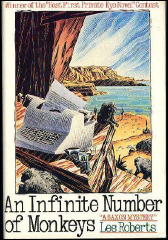
LES ROBERTS – An Infinite Number of Monkeys. St. Martin’s Press, hardcover, 1987. Paperback reprint: St. Martin’s, 1988.

LES ROBERTS Saxon Private Eye

   This is the novel that won Roberts the award in St. Martin’s “First Private Eye Novel Contest” back in 1986, and by and large, it’s a good one.

   The leading character is a part-time actor named Saxon, who is also a full-time PI, which is more than OK as a gimmick, because Hollywood is always in need of another private eye. Lots of good stories in them there hills.

   His client in this particular adventure is pulp-paperback writer Buck Weldon, a throwback to the Mickey Spillane’s earliest days, and somebody is trying to kill him. Keeping Saxon’s interest at its highest peak is Weldon’s beautiful daughter Tori. (For some reason, I pictured a youthful Raquel Welch in the role, which you have to admit, makes for a very nice picture.)

   I have to admit the ending surprised me a little, and it shouldn’t have, which is the sign of a perfect detective story, or very nearly so. Saxon needs to have some of his cruder edges sandpapered away, though. As a ladies’ man, he’s too obvious, and besides that, he talks too much. Be subtle, man!

– This review first appeared in Deadly Pleasures, Vol. 1, No. 2, Summer 1993 (slightly revised).


Bibliographic Data:   Monkeys was Les Roberts’ first book, and there were six in all that Saxon appeared in (see below). Roberts has written another 14 books about Cleveland-based PI Milan Jacovich, so far, the most recent of which being King of the Holly Hop (2008). One stand-alone novel (The Chinese Fire Drill, 2001) plus one short story collection (The Scent of Spiced Oranges, 2002) complete his resume to date.

       The “Saxon” series:

1. An Infinite Number Of Monkeys (1987)
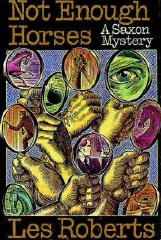
2. Not Enough Horses (1988)

LES ROBERTS Saxon Private Eye

3. A Carrot For The Donkey (1989)
4. Snake Oil (1990)

LES ROBERTS Saxon Private Eye

5. Seeing The Elephant (1992)
6. The Lemon Chicken Jones (1994)

Reviewed by DAVID L. VINEYARD:         


ARSÈNE LUPIN. 2004. Raymond Duris, Kristin Scott Thomas, Pascal Greggory.
Director: Jean-Paul Salomé, Screenplay: Jean-Paul Salomé and Laurent Vachaud, based on the novel La comtesse de Cagliostro (aka The Memoirs of Arsène Lupin) by Maurice Leblanc. In French with subtitles; 131 minutes.
ARSENE LUPIN

    “Louis XI. François 1st. Henri IV. Louis XIV. Arsène Lupin.
    “What pride I felt the day I set foot in this forgotten place.
    “To have found the lost secret of the Kings of France, to become its master, its only master, to receive such inheritance!”

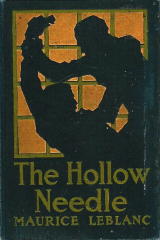
— Arsène Lupin in L’Aiguille Creuse (The Hollow Needle), Chapter 10, by Maurice Leblanc.

    For those who only know the name Arsène Lupin, a brief introduction is in order. Lupin is a French gentleman burglar/detective created by journalist Maurice Leblanc (1864-1941) in the feuilletons or newspaper serials that dominated French popular fiction from the days of Alexandre Dumas and Eugene Sue well into the 20th Century.

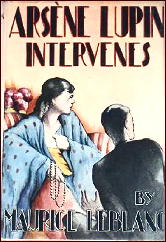
    Lupin debuted in the magazine Le Sais Tout in 1905, and the stories were collected in 1907’s Arsène Lupin, Gentleman Burglar (aka Arsène Lupin in Prison and Arsène Lupin Escapes), following the pattern established by Ponson du Terraill’s picaresque Rocambole two generations earlier.
ARSENE LUPIN

    Twenty volumes followed with The Billions of Arsène Lupin being the last to be published in Leblanc’s lifetime in 1941. Unlike many of his fellow laborers in the disposable newspaper serials, Lupin carved a place for himself as the premier example of the French detective story, his international fans extending to President Theodore Roosevelt and beyond.

    A genius with a keen sense of justice, panache, and an ego to match, Lupin is one of the most fully imagined characters in the genre, and the star of countless films, books, comics, and even animated adventures. Three American films, many French films and television series, Japanese films and anime, even a Philippine television series have all followed.

    Lupin is a master of disguise and has a small army of identities under which he operates including private detective Jim Barnett, Prince Sernine, Don Luis Perena, M. Lenormand (who rises to no less than the head of the Surete), and others. As often as not Lupin may not be identified as Lupin until late in the tale — if at all.

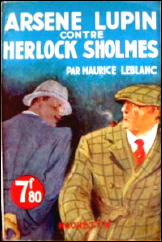
    Like most fictional criminals, he changes midway in his career to more detective than thief rivaling Sherlock Holmes with whom he had two memorable encounters (today the books use Holmes’ name, but at the time he was Herlock Sholmès), but even at his most criminal he is a righter of wrongs and defender of the weak, and like Holmes he is given to a sort of manic depression, very high highs and low lows (several times he considers suicide when all is lost).
ARSENE LUPIN

    If Lupin is a younger brother to Raffles, he is at least that or more to the Saint. That said, Lupin is a very Gallic hero, given to dramatic flair and boasting. Compared to Lupin, Poirot, the Belgian, is a shrinking violet.

    Over his long career he also acquires a great deal of wealth, numerous wives and lovers, a lost son, and even his own submarine (The Secret of Sarek) given to him for his services to a Moroccan prince (his adventures, both recorded and only referred to carry him to the literal ends of the Earth — to Antarctica, Saigon, Tibet, New York, Morocco … but always back to France).

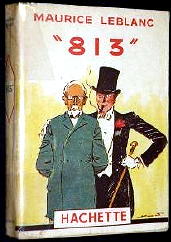
    In 813, the greatest of the Lupin sagas, he only just misses becoming a power in Europe by putting a puppet king on a European throne. He is possibly the most ambitious hero in the genre.

    Today the adventures of his non-canonical grandson Lupin III, created by manga artist Monkey Punch and hero of anime and live action films (including The Castle of Cagliostro directed by anime legend Hayao Miyazaki) are better known to most than Lupin himself, but the original still has his charms, and in 2004 he returned to the big screen in a widescreen adventure worthy of a career that began in 1905 and which continues today.

    In the 1950’s and 60’s five pastiche of his adventures were penned by Pierre Boileau and Thomas Narjeac, authors of Les diaboliques and Vertigo. Today many of the books are still in print, and his adventures continue in pastiche form in the Black Coat Press “Tales of the Shadowmen” anthologies.
ARSENE LUPIN

    Arsène Lupin, the film, is based on Leblanc’s 1924 novel Le comtesse de Cagliostro (in the US and UK, The Memoirs of Arsène Lupin), which recounts the origins of Lupin and his first great adventure.

    Taking a cue from that, the film opens with Lupin’s childhood where he is the son of a young woman virtually indentured to her well-married half sister and a teacher of fencing and martial arts (particularly savate — French kick boxing).

    The young Lupin is enamored of his cousin, and unaware of the tensions in the house — or that his father is a thief after a fabulous necklace owned by his uncle — in fact the necklace — the infamous piece of jewelry owned by Marie Antoinette that helped to spur the French Revolution and part of the lost jewels of the kings of France.

    When the police come for Lupin’s father, he escapes, but returns and enlists Arsène to steal the necklace, but he is apparently killed in a struggle with an accomplice within sight of the famous “Needle” a peculiar shaped rock off the French coast, and Arsène and his mother are exiled from their home, young Arsène swearing revenge on society and particularly on his uncle and men like him.
ARSENE LUPIN

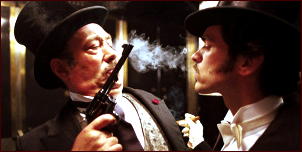
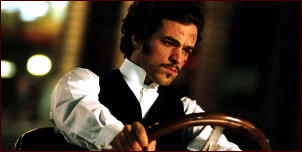
    Some years later we meet the youthful adult Arsène (Raymond Duris) on board a gala yacht for a costume ball. Despite his grand manner, monocle, and white tie and tails he is little more than a pickpocket, but a talented one.

    It’s at this point he meets the beautiful Countess Cagliostro, Josephine Balsamo (Scott Thomas), who claims to be the granddaughter of Joseph Balsamo. the notorious Count Cagliostro, charlatan, con man, and according to some, alchemist and wizard. (See Dan Stumpf’s review of the film Black Magic and his review of the Alexandre Dumas pere novel Joseph Balsamo elsewhere on this blog.) She takes young Arsène under her wing as her lover and student and transforms him from a mere pickpocket into a master criminal.

    But there are dark undercurrents stirring. There is a mysterious cabal of wealthy men sworn to protect the secrets of the lost jewels of the French kings, plus the dangerous man who serves them and is the sworn enemy of Josephine, — the strange scarred man who serves Josephine and distrusts Arsène, and Josephine herself — who rumor has it is not the grand daughter of Cagliostro, but the daughter — the immortal daughter over a century old.

    Eventually Lupin breaks with her, but by now he too is sworn to uncover the secrets of the lost treasure of the king’s of France which leads him back to the cousin he once loved as a youth.

ARSENE LUPIN

    Thus begins the duel of wits between Lupin and the Countess and the cabal who protect the lost treasure. Cross and double-cross, buckled swashes, gallant gestures, disguise, and the elegance of France in another age are on display in a handsome film that manages to keep tongue in cheek in true Lupin style while never laughing at itself or the audience for enjoying it.

    Though the plot is complex and elements from several of the Lupin novels are brought in, the plot is easy to follow, and Duris makes a charming Lupin, one who grows from something of a talented ruffian in gentleman’s clothing to a master criminal and suave adventurer.

    He has a gamin quality, a rougher edge beneath the suave exterior that gives the character more depth than simply another charming adventurer — much like the original by Leblanc. Thomas as Josephine is simply lovely and clearly having fun playing the wicked and treacherous Josephine, and Eva Green as Lupin’s true love is both touching and beautiful in what could have been a throwaway role.
ARSENE LUPIN

    I’ll go no farther in describing the plot because I can’t without giving away too much, but needless to say, there are surprises to be had, and twists unexpected, before the film reaches its end, leaving you satisfied and wanting more.

    But that said, and for any treasure hunters out there, despite the film and Leblanc’s book, the famous Needle which features in the film and the Lupin novel, The Hollow Needle, is not hollow, but solid rock. The lost treasures of the French kings will have to be found somewhere else.

    Arsène Lupin is a beautifully shot film that seems to have that same slightly golden glow of photographs of that gilded age. It’s not only a handsome film to look at, but one of the most lavish and playful any genre film has earned. It is also faithful to both the letter and spirit of the Leblanc novels. It’s more than worthy of Lupin and his adventures.

    And a word has to be said for the cinematography of Pasal Ridao. The film is a delight to look at with stunning camera work and sets and costumes adding real depth to the proceedings.

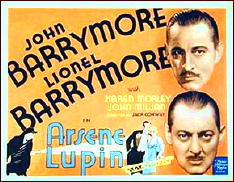
    Lupin was played by John Barrymore in Arsène Lupin (1932, with Lionel cast as his nemesis Inspector Ganimard and Karen Morley in a racy pre-code role as an undercover police agent helping to trap Lupin — it’s delightfully ripe old time cinema) and Melvyn Douglas in Arsène Lupin Returns.
ARSENE LUPIN

    Charles Korvin played the role in a later film. In France, Robert Lamoureaux, George Descrieres, Jean-Claude Brialy, and Jean-Pierre Cassel have all played Lupin in several films and television series (available in boxed sets, but in French).

    There have also been Lupin comics in France, an animated series, and there were several radio series, one hosted by Lupin himself. In Japan Lupin was played by a Japanese actor in live action films and later featured in an anime aside from the popular Lupin III films and series. In the Philippines a series about a wealthy playboy who was really a thief was called Lupin ran and is also available on DVD.

    Lupin has also appeared in Jean-Marc and Randy Lofficier’s “Tales of the Shadowmen” anthology series from Black Coat Press, most recently in my own “The Jade Buddha” in volume 5 of that series in which he encounters the real model for Fu Manchu, Hanoi Shan.

    There are several good French sites for Lupin, and you can learn a good deal more about him at the sites for Black Coat Press and the French Wold-Newton Universe including full bibliographies, chronologies, and filmographies.

    Many of the Lupin books are in print, and those that are not relatively easy to find for the most part, and quite a few are available to read online or download as free ebooks including Leblanc’s two science fiction novels and a few of the non-Lupin novels.

    But even if you don’t want to dip into his literary adventures, treat yourself to this lavish and enjoyable film. Few creations in the genre have received so faithful or so lush a tribute.

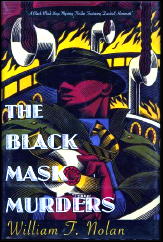
   In the Revised Crime Fiction IV, Raymond Chandler, Dashiell Hammett and Erle Stanley Gardner are denoted as series characters in a series of three novels by author William F. Nolan:

      The Black Mask Murders. St. Martin’s, 1994.

WILLIAM F. NOLAN The Black Mask Boys

      The Marble Orchard. St. Martin’s, 1996.
      Sharks Never Sleep. St. Martin’s, 1998.

    None of the above are given credit as fictional characters in other detective novels. Hammett and Chandler both appeared in Chandler, by William Denbow, for example; and obviously Hammett appeared in Joe Gores’ Hammett.

    Question: Are there other novels, ones I’m not thinking of, in which any of the above (including Gardner) appeared as fictional characters?

    And as long as I’m asking, what other real life mystery writers may have shown up as characters in novels written by someone else? Josephine Tey, I know, in a couple of novels by Nicola Upson, but since they were published after 2000, they’re beyond the scope of CFIV. Disregarding the date, are there others?

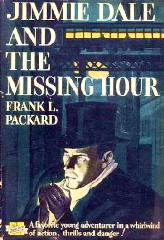
JIMMIE DALE, THE GRAY SEAL, by Frank L. Packard

An Overview by David L. Vineyard         


FRANK L. PACKARD Jimmie Dale

   Few characters as obscure as Canadian novelist Frank L. Packard’s gentleman cracksman, Jimmie Dale the Gray Seal, have had the impact and long term import of this one. Almost unknown today, Packard and his creation not only exerted a tremendous influence on the pulps he came from, but established many of the tropes of the modern superhero in comic books.

   From his secret lair, the Sanctuary, his multiple identities, and his calling card, a gray diamond paper seal, Jimmie Dale set the pattern for the mystery men and super heroes who will follow.

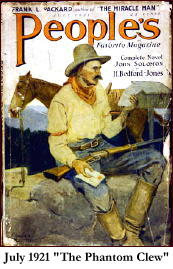
   Jimmie first appeared in the May 1914 issue of People’s Magazine. He is the son of a wealthy safe manufacturer and himself an expert at all sorts of locks and safes. He is also noted for his sense of fun and adventure — which explains in part why he takes on the nom de guerre of the Gray Seal and breaks into the most difficult of safes, stealing nothing and leaving behind a gray diamond paper seal, the mark of the Gray Seal.

FRANK L. PACKARD Jimmie Dale

   Normally he would probably have grown out of this stage, but a mysterious woman will change all that. It begins with a series of letters claiming to know all about the Gray Seal and threatening him with jail.

   Soon enough the letters change and the mysterious angel begins to direct the actions of the Gray Seal to correct miscarriages of justice.

   Of such things are great careers born.

   Jimmie sells his father’s company and sets himself up as an idle playboy with the aid of the faithful butler Jason and his tough chauffeur Benson.

   He creates the personae of Larry the Bat, a small time crook and informer, and Smarlinghue the drug addicted artist so he can penetrate the world of crime.

   The police and press offer rewards for the Gray Seal; the underworld wants him dead. Jimmie squeaks by on brains, luck, and no little skill. His mysterious female angel calls herself the Tocsin, the Alarm. Soon enough she is revealed to be Marie LaSalle and Jimmie, already half in love with her, falls the rest of the way.

FRANK L. PACKARD Jimmie Dale

   Not that there is much room for romance in the life of the Gray Seal.

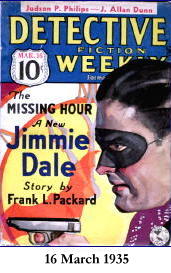
   Jimmie first appeared in 1914 and made his final appearance in Detective Fiction Weekly in 1935. His adventures are cleverly written melodrama penned by a writer who specialized in books about adventure with backgrounds in railroading, South Seas adventure, and the world of urban crime.

   Among his better known books, The White Moll, and The Miracle Man (the latter a famous film with Lon Chaney). His books were frequently brought to the silent screen and his long career successful and rewarding.

   But like many popular writers of his time — Harold McGrath comes to mind — he is largely forgotten today. Or would be, if not for Jimmie Dale, the Gray Seal.

   Jimmie isn’t entirely original. He borrows elements from Eugene Sue’s Prince Rodolfe, from the Count of Monte Cristo, from Rocambole, from the Scarlet Pimpernel, from Raffles, from O. Henry’s grifters and Jimmy Valentine, from Arsene Lupin and others, but in Jimmie all the tropes of the mystery man and the super hero come together for the first time.

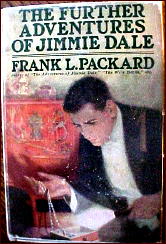
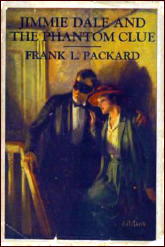
FRANK L. PACKARD Jimmie DaleThe Adventures of Jimmie Dale appeared in 1917. In 1919 The Further Adventures of Jimmie Dale came along. In 1922 the first novel, Jimmie Dale and the Phantom Clue came out in hardcover.

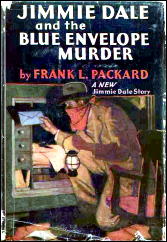
   Jimmie Dale and the Blue Envelope appeared in 1930 and finally in 1935, Jimmie Dale and the Missing Hour. But as Robert Sampson points out in Yesterday’s Faces, Volume I: Glory Figures, the saga is really one long book, remarkably concise and suspenseful with the tension of a ticking clock.

   Frank Packard died in 1942 while working on a new adventure of the Gray Seal.

FRANK L. PACKARD Jimmie Dale

   Much of our view of the mean streets and the urban ‘badlands’ comes from Packard’s books and their impact on others who followed in his footsteps. His tales are told in clean straight forward prose by a man of some culture and learning who understood the needs of storytelling and had something to say about salvation and redemption.

   Virtually every fictional crime fighter who follows is within his shadow. He is simply one of the genre’s most important archetypes, and the transition figure from the quaint pre-war crime as game to the tough guns blazing sagas of the pulps, films, and comics that follow.

   Jimmie may be a romantic and melodramatic figure, but he operates in the world of Hammett and Chandler. That said, Packard does not follow through on the social impact of crime in the same way as the hard-boiled school. He writes superficially about these subjects, but he writes well.

   And his adventures are still worth reading. There’s little a modern reader has to forgive and much to praise. It is no small thing to say that Jimmie Dale can still be read for pleasure, not merely nostalgia or his historical importance.

   The criminals lurk in the darkness, and the Gray Seal stands ready to strike, and in his wake every masked, caped, and spandex clad hero and mystery man stand ready to carry on his crusade. They are all in his debt, as are we.

FRANK L. PACKARD Jimmie Dale

   From Lamont Cranston to Bruce Wayne, from Richard Wentworth to Peter Parker, Jimmie Dale and the Gray Seal are where it all truly began, and more than worth revisiting to be surprised at just how much of the genre came fully formed from his adventures.

   Note: Norvel Page, who took over the Spider from R.T.M Scott (creator of Aurelius Smith aka Secret Service Smith), was a particular fan of the Gray Seal and used many of Packard’s ideas in the Spider’s saga.

   As Page greatly influenced both Michael Avallone and Mickey Spillane, so Jimmie Dale’s influence continues.

   While there are other figures of equal importance, some which came before him, Jimmie brings all the elements together for the first time and thus holds pride of place.

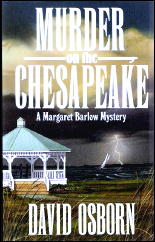
DAVID OSBORN – Murder on the Chesapeake. Simon & Schuster, hardcover, 1992; Paperback reprint: Zebra; 1st printing, May 1993.

DAVID OSBORN Murder on the Chespeake

   I don’t much care for prologues, as some of you may recall, and after reading the one in this book, it was very nearly all I read. Kids get murdered often enough in real life that they don’t have to get murdered in mystery stories too — if that’s all it is, a mystery story.

   Or to be more specific: A young teen-aged girl is murdered in the prologue of this book, strangled and thrown off a balcony with a rope around her neck. And in some detail.

   She’s a student in one of those exclusive preppy girls’ schools whose inhabitants love to torment the weaker of the species, and that’s the kind of life Mary Hughes led. Poor but intelligent and talented. No wonder she never fit in.

   After an investment of $3.99 into the paperback edition, it’s tough to give upon a book after only 14 pages, and so, no, I didn’t quit.

   As a writer, though, David Osborn bites off a bit more than he should have, I think. Telling the story is his leading character, Margaret Barlow, a sporty 55, a grandmother of a teenager, and a hot air balloonist, among other things that fall into the category of larger than life.” Her granddaughter, who calls her Margaret, is also a student at Brides Hall.

   Nothing much else happens until page 164, on which a second murder is discovered. It’s a messy one — the victim is found sliced in half by an elevator, “dragging out her intestines and eviscerating her but unable to pull all of her down… ”

   Come on. Who needs this? The rest of the detective story is weak, but I found this scene — let me speak plainly here — absolutely useless. Tasteless and trite — it’s a tough combination.

– This review first appeared in Deadly Pleasures, Vol. 1, No. 2, Summer 1993 (very slightly revised).


Bibliographic Data: While David Osborn wrote a number of other books which are included in the Revised Crime Fiction IV, by Allen J. Hubin, including Open Season (1974), which was made into a film starring Peter Fonda, John Phillip Law and Richard Lynch, Margaret Barlow was his only series character.

      The Margaret Barlow series:

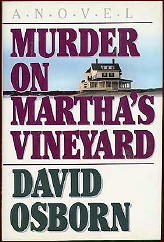
         Murder on Martha’s Vineyard (n.) Lynx, hc, 1989.

DAVID OSBORN Murder on Martha's Vineyard

         Murder on the Chesapeake (n.) Simon, hc, 1992.
         Murder in the Napa Valley (n.) Simon, hc, 1993.

« Previous PageNext Page »