Characters


A 1001 MIDNIGHTS Review
by Marcia Muller:


STUART KAMINSKY – Murder on the Yellow Brick Road. St. Martin’s Press, hardcover, 1977. Paperback reprints include: Penguin, 1979; Ibooks, 2000.

STUART KAMINSKY

   Stuart Kaminsky is a film writer and critic as well as a mystery novelist, and he has put his expertise to good use in his series about 1940s Hollywood private eye Toby Peters.

   The novels are a blend of fact and fiction — that is, of real Hollywood personalities (now deceased) and fictional characters.

   Peters, investigator for the stars, is wise to the ways of Hollywood; he shares an office with a dentist, Shelley Minck, who provides much of the comic relief in these books; he eats abominably — burgers, Pepsis, milk shakes; he lives in “one of a series of two-room, one story wooden structures L.A. management people called bungalows”; and he has a running feud with his brother, Homicide Lieutenant Phil Pevsner (the real family name).

   Murder on the Yellow Brick Road concerns the stabbing of a munchkin — one of L.A.’s many “little people” (they prefer that label to that of midget) — on the set on which The Wizard of Oz was filmed.

   Judy Garland finds the body and calls Peters in a panic. Peters goes to MGM, where he meets Miss Garland, PR man Warren Hoff, Garland’s costume designer friend Cassie James, and Louis B. Mayer himself. Mayer hires Peters to conduct an investigation and divert any adverse publicity.

   What follows is an entertaining story of Hollywood in its heyday, the inner workings of the film community, and the brotherhood of the “little people.” Peters meets such luminaries as Raymond Chandler, and pays a visit to Clark Gable at William Randolph Hearst’s fabled San Simeon.

STUART KAMINSKY

   Kaminsky does a good job of evoking both Hollywood of the Forties and the personalities of the various stars; his portrayal of the child/woman Garland is especially good.

   Other Toby Peters novels include Never Cross a Vampire (1980), which features Bela Lugosi and William Faulkner in his screen-writing days; and He Done Her Wrong (1983), in which Mae West calls on Peters to find her missing, sizzling autobiography; and Down For the Count (1985), which features fighter Joe Louis.

         ———
   Reprinted with permission from 1001 Midnights, edited by Bill Pronzini & Marcia Muller and published by The Battered Silicon Dispatch Box, 2007.   Copyright © 1986, 2007 by the Pronzini-Muller Family Trust.

STUART KAMINSKY, R.I.P. According to his obituary in the Chicago Tribune, Stuart Kaminsky “died of complications from hepatitis and a recent stroke Friday, Oct. 9, in Barnes-Jewish Hospital in St. Louis […] He was an Army medic in the 1950s, when his family believes he got hepatitis C.” He was 75 at the time of his death.

   Unusual for most mystery writers, Kaminsky was the creator of four distinctive series characters. Besides 1940s Hollywood PI Toby Peters, who appeared in 24 novels [see below] in which he rubbed shoulders with many movie stars of the day, Kaminsky also chronicled the adventures of (quoting again from the Tribune) “… Porfiry Rostnikov, a police inspector in Moscow [16 novels]; Abe Lieberman, a crusty but wise Chicago cop who works the streets with his younger partner, Bill Hanrahan [10 novels]; and Lew Fonesca, a former Cook County state’s attorney investigator now operating as a cut-rate private eye in Sarasota [6 novels].”

   Kaminsky also wrote two novelizations of the TV series The Rockford Files, three novelizations of CSI: New York, two stand-alone suspense novels, three story collections, and was the editor of two recent crime fiction anthologies.

   Without much fanfare, Stuart Kaminksy was without a doubt one of the more prolific mystery authors of recent years. He was a quiet giant in our field.

      The Toby Peters series —

1. Bullet for A Star (1977)

STUART KAMINSKY

2. Murder on the Yellow Brick Road (1977)
3. You Bet Your Life (1978)
4. The Howard Hughes Affair (1979)
5. Never Cross a Vampire (1980)
6. High Midnight (1981)
7. Catch A Falling Clown (1981)

STUART KAMINSKY

8. He Done Her Wrong (1983)
9. The Fala Factor (1984)

STUART KAMINSKY

10. Down for the Count (1985)
11. The Man Who Shot Lewis Vance (1986)
12. Smart Moves (1986)
13. Think Fast, Mr. Peters (1987)
14. Buried Caesars (1989)

STUART KAMINSKY

15. Poor Butterfly (1990)
16. The Melting Clock (1991)

STUART KAMINSKY

17. The Devil Met A Lady (1993)
18. Tomorrow is Another Day (1995)
19. Dancing in the Dark (1996)
20. A Fatal Glass of Beer (1997)

STUART KAMINSKY

21. A Few Minutes Past Midnight (2001)
22. To Catch a Spy (2002)
23. Mildred Pierced (2003)
24. Now You See It (2004)

BARTHOLOMEW GILL – McGarr on the Cliffs of Moher. Charles Scribner’s Sons, US, hardcover, 1978. Robert Hale, UK, hardcover, 1980. US paperback reprint: Penguin, 1982; reprinted as The Death of an Irish Lass: Avon, pb, 2003.

BARTHOLOMEW GILL

   Quite remarkably, when three young people from the same small village in County Clare, Ireland, come to New York City, they find nearly equal amounts of success. When it happens that they all return home at the same time, their troubles and their angers are brought with them, and one of them, the girl reporter after the truth about the IRA, dies, having been stabbed to death with a pitchfork at a lovely spot overlooking the sea.

   McGarr is Ireland’s top cop. Why he’s on this case from the beginning is never made clear. And with background of this sort assumed and never properly filled in, and with the failure of McGarr to investigate immediately the questions the reader wants asked (well, the ones I did), it’s no wonder that my mind wandered, having distinctly gotten the feeling that the mystery was only incidental.

   What we do have is a very Irish, very picturesque novel about the problems troubling Ireland today. As a worthy reflection on the objectives that the IRA should have (and doesn’t), you probably cannot do better. I wish that I had found it more interesting, but I am nearly ashamed to say that I did not.

– From The MYSTERY FANcier, Vol. 3, No. 3, May-June 1979
            (slightly revised).


[UPDATE] 10-05-09. It isn’t fair, I know, but on the basis of reading only the one book by Gill, it remains the only one I’ve read. He wrote a few of them over the years, and I’ll submit to you a list below. If I were to read another, which should it be?

       The Peter McGarr series, by Bartholomew Gill –

1. McGarr and the Politician’s Wife (1977) aka The Death of an Irish Politician

BARTHOLOMEW GILL

2. McGarr and the Sienese Conspiracy (1977) aka The Death of an Irish Consul
3. McGarr and the Cliffs of Moher (1978) aka The Death of an Irish Lass

BARTHOLOMEW GILL

4. McGarr and the Dublin Horse Show (1979) aka The Death of an Irish Tradition
5. McGarr and the P.M. of Belgrave Square (1983)

BARTHOLOMEW GILL

6. McGarr and the Method of Descartes (1984)
7. McGarr and the Legacy of a Woman Scorned (1986)
8. The Death of A Joyce Scholar (1989)
9. The Death of Love (1992)
10. Death on A Cold, Wild River (1993)

BARTHOLOMEW GILL

11. The Death of An Ardent Bibliophile (1995)
12. The Death of An Irish Sea Wolf (1996)
13. The Death of An Irish Tinker (1997) aka Death of a Busker King
14. Death of An Irish Lover (2000)
15. Death of An Irish Sinner (2001)
16. Death in Dublin (2002)

BARTHOLOMEW GILL

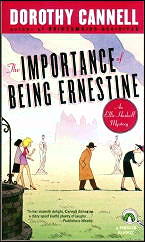
DOROTHY CANNELL – The Importance of Being Ernestine.

Penguin, paperback reprint; 1st printing, April 2003. Hardcover edition: Viking Penguin, 2002.

DOROTHY CANNELL

   As in most things in life, timing is everything, but especially when it comes to comedy. And when it comes to comic detective novels, it’s difficult to explain in words what works and what does not, and when (and why) the beat is off.

   This is the 11th in Dorothy Cannell’s series of books about amateur detective Ellie Haskell, and it’s one of the funniest mysteries I’ve happened to read since the Inspector Dover books. Note to myself: It’s time to read Joyce Porter again, to see if Dover is as humorous as I remember, or if he was really only a rather obnoxious dolt. There’s a fine line, you see.

   Ellie, married, with three young children, is an interior decorator by trade, but — miffed at her husband, she takes up crime-solving with her housekeeper Mrs. Malloy, who’s been moonlighting as an would-be assistant to a private eye. Named Jugg. Nicknamed “Milk.” Of course.

   Here’s Mrs. Malloy explaining to Mrs. H. what her latest ambition in life is, before their first client arrives (page 15):

    “I’d had this lovely fantasy, you see, of Mr. Jugg finishing with his difficult client, then laying eyes on me. I’d be emptying the ashtrays, and his eyes would be drawn like a magnet to me Purple Passion lips and it would hit him like a wallop that I was a real woman.”

    “Whereupon he’d ask you to marry him?”

    “No,” she spoke dreamily, “he’d tell me in ever such a masterful voice to sit down and take dictation.” A pause. “What could be sexier than that, Mrs. H.?”

    I didn’t answer.

   The pause is a stroke of genius. It’s all in the timing, as I say. The client then comes in, and the case is on. An elderly lady who (she now believes) wrongfully fired a maid who was pregnant (possibly by the lady’s now deceased husband) and accused of stealing a valuable brooch now wants to find the child and make amends. To complicate matters, a number of Mrs. Krumley’s aged relatives have started to die off in highly unusual (and suspicious) circumstances.

   Taking over the case in Mr. Jugg’s absence, Ellie and Mrs. Malloy find no dark streets to go down. Most of the suspects live in or around the Krumley mansion, Moultty Towers (pronounced Moldy), and are for the most part, members of the upper strata of society.

   There are lots of red herrings and false trails and strange and stranger events that subsequently occur, and it comes as no great surprise that a huge muddle is made in wrapping everything up, presenting the reader with one awkward discombobulated package at the end. I read the last chapter a couple of times, and I confess, it all makes sense. Sort of.

   Would I read another? Absolutely. Weak ending or not, there’s a definite charm that’s present here, and I think it’s unique. Nothing similar comes readily to mind.

— May 2003


      Bibliographic data

    The Ellie Haskell series —

1. The Thin Woman (1984)

     DOROTHY CANNELL

2. Down the Garden Path (1985)
3. The Widow’s Club (1988)
4. Mum’s the Word (1990)

      DOROTHY CANNELL

5. Femmes Fatal (1992)
6. How to Murder Your Mother-In-Law (1994)
7. How to Murder the Man of Your Dreams (1995)
8. The Spring Cleaning Murders (1998)

     DOROTHY CANNELL

9. The Trouble with Harriet (1999)
10. Bridesmaids Revisited (2000)
11. The Importance of Being Ernestine (2002)
12. Withering Heights (2007)
13. Goodbye, Ms. Chips (2008)

    DOROTHY CANNELL

14. She Shoots to Conquer (2009)

A Review by MIKE TOONEY:


ELLERY QUEEN, Editor – Masterpieces of Mystery: The Supersleuths. Davis Publications, hardcover, 1976.

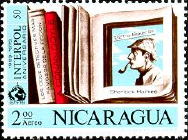
   Back in the early 1970s, the country of Nicaragua asked Ellery Queen’s Mystery Magazine (EQMM) “to set up a poll to establish the dozen greatest detectives of all time” in anticipation of that nation’s issuing a commemorative set of twelve postage stamps to celebrate the 50th anniversary of Interpol. This book is a result — or, perhaps, a by-product of that request.

   EQMM conducted three polls of mystery critics and editors, professional mystery writers, and mystery readers. It was from the last group that an unexpected (to Ellery Queen) result came:

    “Only one fictional detective was voted for unanimously by mystery critics, mystery editors, and mystery writers — not surprisingly, Sherlock Holmes. But, surprisingly, the vote for Sherlock Holmes by mystery readers was not unanimous: no less than 64 readers out of 1,090 failed to rank Holmes as one of the 12 best and greatest. Surprising, indeed. (Surprising? Incredible!)”

   Here are the poll results, in order of popularity:

1-Sherlock Holmes 2-Hercule Poirot 3-Ellery Queen 4-Nero Wolfe 5-Perry Mason 6-Charlie Chan 7-Inspector Maigret 8-C. Auguste Dupin 9-Sam Spade 10-Father Brown 11-Lord Peter Wimsey 12-Philip Marlowe 13-Dr. Gideon Fell 14-Lew Archer 15-Albert Campion 16-George Gideon 17-Miss Jane Marple 18-Philo Vance 19-The Saint (Simon Templar) 20-Roderick Alleyn 21-Luis Mendoza 22-Sir Henry Merrivale 23-Mike Hammer 24-James Bond 25-Sergeant Cuff 26-Inspector Roger West

ELLERY QUEEN Supersleuths

    “This anthology … contains stories by 14 of the 15 top vote-getters in the three combined polls — 14 of the 15 most famous and most popular detective heroes of fiction.”

   Ellery Queen includes a note: “Why Charlie Chan Does Not Appear in the Volume.” Can you guess why?

   Each story in this volume is introduced by a short biographical paragraph and a cameo photograph of the author(s).

      CONTENTS:
ELLERY QUEEN Supersleuths

1. “The Adventure of the Abbey Grange” (1904) by A. Conan Doyle (1859-1930). Supersleuth: Sherlock Holmes.

    … our thoughts were entirely absorbed by the terrible object which lay upon the tiger-skin hearthrug in front of the fire. It was the body of a tall, well-made man, about forty years of age. He lay upon his back, his face upturned, with his white teeth grinning through his short, black beard.

Comment: When a rich but sadistic man is apparently murdered by a gang of burglars, Holmes and Watson are summoned; but the case quickly grows more complex. The solution lies in the presence of three wine glasses and a frayed bell-rope. Holmes remarks to Watson at one point: “Once or twice in my career I feel that I have done more real harm by my discovery of the criminal than ever he had done by his crime. I have learned caution now, and I had rather play tricks with the law of England than with my own conscience.” Filmed for TV in 1986 with Jeremy Brett.

ELLERY QUEEN Supersleuths

2. “The Dream” (1937) by Agatha Christie (1890-1976). Supersleuth: Hercule Poirot.

    “My laundress,” said Poirot, “was very important. That miserable woman who ruins my collars was, for the first time in her life, useful to somebody.”

Comment: When a man who dreams that he commits suicide is found dead in a watched room, only Poirot suspects murder. “Motive and opportunity are not enough …. There must also be the criminal temperament.” Filmed for TV in 1989 with David Suchet.
ELLERY QUEEN Supersleuths

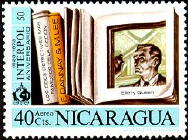
3. “The Case Against Carroll” (1958) by Ellery Queen (1905-1971; 1905-1982). Supersleuth: Ellery Queen.

    “The Fancy Dan who weaves an elaborate shroud for somebody else more often than not winds up occupying it himself. The clever boys trip over their own cleverness. There’s a complex pattern here, and it’s getting more tangled by the hour.”

Comment: The case against Carroll — accused of murdering a law firm partner — seems airtight; the noose tightens when someone who can support his alibi is also murdered. This story is a clever variation on alibi-breaking and is perhaps the penultimate example of that theme. Notice how the narrative’s focus shifts from Carroll at the start to Ellery at the end.

ELLERY QUEEN Supersleuths

4. “The Zero Clue” (1953) by Rex Stout (1886-1975). Supersleuth: Nero Wolfe (with an able — but unwelcome — assist from Archie Goodwin).

    That was a funny thing. I’m strong on hunches, and I’ve had some beauts during the years I’ve been with Wolfe; but that day there wasn’t the slightest glimmer of something impending.

Comment: A mathematical genius is murdered and Archie unwittingly visits the crime scene, causing Inspector Cramer and a horde of policemen to invade Wolfe’s inner sanctum ( “The biggest assortment of homicide employees I had ever gazed on extended from wall to wall in the rear ….”) The dying clue involves eight pencils and a broken eraser, and the solution is found in Hindu mathematics — go figure!

ELLERY QUEEN Supersleuths

5. “The Case of the Crimson Kiss” (1948) by Erle Stanley Gardner (1889-1970). Supersleuth: Perry Mason (with Della Street and Paul Drake).

    “Ordinarily I’d spar for time, but in this case I’m afraid time is our enemy, Della. We’re going to have to walk into court with all the assurance in the world and pull a very large rabbit out of a very small hat.”

Comment: “… Carver L. Clements, wealthy playboy, yachtsman, broker, gambler for high stakes, was dead.” And good riddance, too. But why is Fay Allison, who never even met the deceased, on trial for his murder — especially when there are better suspects around like, say, Perry Mason and Della Street? Talk about your kiss of death! Filmed for TV in 1957 with Raymond Burr.

ELLERY QUEEN Supersleuths

6. “Inspector Maigret Pursues” (1961) by Georges Simenon (1903-1989). Supersleuth: Inspector Maigret.

    Had the police one single clue? Nothing. Not one piece of evidence. A man killed during the night in the Bois de Boulogne. No weapon is found. No prints.

Comment: Slogging police work for Maigret and his detectives through the freezing streets and stuffy bars of wintertime Paris. “He didn’t know yet that this dreadful trail was to become a classic, and that for years the older generation of detectives would recount the details to new colleagues.” Yet Maigret came to view it differently: “As things turned out, this case was to be referred to at Headquarters as the one perhaps most characteristically Maigret; but when they spoke of it in his hearing, he had a curious way of turning his head away with a groan.”

ELLERY QUEEN Supersleuths

7. “The Purloined Letter” (1844) by Edgar Allan Poe (1809-1849). Supersleuth: C. Auguste Dupin.

    “… I have received personal information, from a very high quarter, that a certain document of the last importance has been purloined from the royal apartments. The individual who purloined it is known — this beyond a doubt; he was seen to take it. It is known, also, that it still remains in his possession.”

Comment: The world’s first armchair detective chain smokes his way to a logical solution to a non-violent crime.

ELLERY QUEEN Supersleuths

8. “Too Many Have Lived” (1932) by Dashiell Hammett (1894-1961). Supersleuth: Sam Spade.

    “Who is this Eli Haven?” “He’s a bad egg. He doesn’t do anything. Writes poetry or something.”

Comment: The world’s first popular gumshoe chain-smokes his way to a logical solution to a very violent crime.

ELLERY QUEEN Supersleuths

9. “The Man in the Passage” (1913) by Gilbert K. Chesterton (1874-1936). Supersleuth: Father Brown.

    The three men looked down, and in one of them at least the life died in that late light of afternoon. It ran along the passage like a path of gold, and in the midst of it Aurora Rome lay lustrous in her robes of green and gold, with her dead face turned upwards.

Comment: Actress Aurora Rome is murdered in her theatre dressing room amidst a group of admirers — and one nondescript Catholic priest. Considering that everyone but the clergyman had experienced amorous impulses exceeding adoration towards her, why would anybody want to kill her? In a courtroom finale, Father Brown clarifies it all, you could say, by holding up a mirror to human nature. (Defense counsel is named Patrick Butler — just a coincidence?)

ELLERY QUEEN Supersleuths

10. “The Footsteps That Ran” (1928) by Dorothy L. Sayers (1893-1957). Supersleuth: Lord Peter Wimsey (with Bunter).

    “No use playing your bally-fool-with-an-eyeglass tricks on me, Wimsey. I’m up to them.”

Comment: Lord Peter Wimsey-cally solves it when a woman is murdered right over his head, one floor up. The assailant has apparently taken flight with the weapon, but the killer’s goose is cooked when Wimsey gets the bird.
ELLERY QUEEN Supersleuths

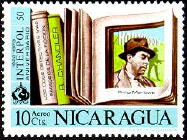
11. “The Pencil” (1959; published posthumously) by Raymond Chandler (1888-1959). Supersleuth: Philip Marlowe.

    I had my pipe lit and going well. I frowned down at the one-grand note. I could use it very nicely. My checking account could kiss the sidewalk without stooping.

Comment: Marlowe is hired by “an ex-hood, used to be a troubleshooter for the Outfit, the Syndicate, the big mob, or whatever name you want to use for it.” As he wisecracks his way through the case, he receives — by Special Delivery, no less — the … pencil!

12. “The Proverbial Murder” (1943) by John Dickson Carr (1906-1977). Supersleuth: Dr. Gideon Fell .

    “You see,” [Dr. Fell] said, “this crime is very much more ingenious than it looks. A certain person who is listening to me now has created something of an artistic masterpiece.”

Comment: A simple case for Gideon Fell — simple, that is, if, like him, you can correctly connect up the disturbed window curtain, the disappearing stuffed wildcat, dried moss that’s gone missing, and a gun that couldn’t possibly have fired the fatal bullet but did. Archons of Athens!

13. “Midnight Blue” (1960) by Ross Macdonald (1915-1983). Supersleuth: Lew Archer.

    Her hair was in curlers. She looked like a blonde Gorgon. I smiled up at her, the way the Greek whose name I don’t remember must have smiled.

Comment: Archer goes target shooting and stumbles across the body of a high school senior, her neck in a noose. Did the crack-brained hobo do it, or the highway patrol dispatcher; or was it the grieving father, or maybe the restaurant cook (a proven killer), or the philandering teacher or his estranged wife? The motive is just about the oldest one in the book, as Sam Hawthorne has been known to say.

14. “One Morning They’ll Hang Him” (1950) by Margery Allingham (1904-1966). Supersleuth: Albert Campion.

    “It’s not a great matter — just one of those stupid little snags which has some perfectly obvious explanation. Once it’s settled the whole case is open-and-shut … It’s just one of those ordinary, rather depressing little stories which most murder cases are. There’s practically no mystery, no chase — nothing but a wretched liittle tragedy.”

Comment: On the contrary, Inspector Kenny, the “perfectly obvious explanation” you hope for is an illusion, as Mr. Campion goes on to prove. A shell-shocked war veteran is the prime suspect in the murder of his hot-tempered aunt, but the weapon is missing (it is, in fact, anything but sedentary). Once the killer and the gun are reunited, only then can you say “the whole case is open-and-shut.

A REVIEW BY DAVID L. VINEYARD:         


BORIS AKUNIN – Murder on the Leviathan. Random House, hardcover, April 2004; trade paperback, February 2005. Translated by Andrew Bromfield.

BORIS AKUNIN

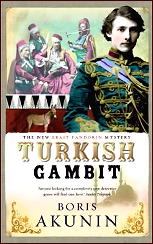
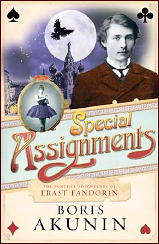
    One of the unexpected benefits of the fall of the former Soviet Union was the career of Russian mystery writer Boris Akunin, with his novels about Erast Fandorin now available in the west.
    Akunin is Grigori Chkhartichvili, a philologist, critic, essayist, and Japanese translator, who took advantage of the new freedom in Russia to create a popular series about 19th Century sleuth Erast Fandorin, a special agent of the Russian Police whose adventures take him from his youth to middle age and from Moscow to exotic adventures around the globe.
    Attractive, smart, and devastating to women, Fandorin is a human and likable hero who combines elements of James Bond, the original Nick Carter, The Wild West, and Ellery Queen in his bright clever adventures.

    The books veer from wild adventure to more or less straight detection, from con men to serial killers, and find Fandorin at various stages in his illustrious career, often caught between clever villains, dangerous beautiful women, and his own devious superiors.

BORIS AKUNIN

    It’s no surprise Ruth Rendell has called Akunin the Russian Ian Fleming.

    In Murder of the Leviathan Akunin takes a note from Agatha Christie and Ian Fleming. When Lord Littleby and his family are found murdered in their mansion on the Rue de Grenelle in Paris in 1878, the legendary French sleuth “Papa” Gauche finds his only clue to the crime is a key in the shape of a golden whale, a ticket on the luxury steamship the Leviathan leaving Southampton on its maiden voyage to Calcutta.

    Arriving at Southampton and boarding the Leviathan, Papa Gauche finds himself joined by Erast Fandorin, a handsome callow Russian sleuth with a shock of white hair. It’s a reluctant teaming on Gauche’s part, though he admits Fandorin might be useful. He might be even more reluctant if he knew Fandorn was a walking arsenal of hidden weapons, and something of a genius at crime solving.

    I see that I did not finish writing about Mr. Fandorin. I do believe I like him, despite his nationality. Good manners, reticent, knows how to listen. He must be a member of that estate referred to in Russia by the word intelligenzia …

    Fandorin is a contrast to Papa Gauche, who lives up to his name:

    Gray haired, bloated, and decidedly not good-looking …

    But the two form a working relationship, and Gauche soon comes to respect Fandorin’s wisdom and intelligence.

BORIS AKUNIN

    There are ten un-ticketed passengers on the Leviathan, and one of them is the killer: the Japanese doctor, the professor who deals in rare Indian artifacts, a pregnant Swiss woman, a wealthy Englishman who collects Asian antiquities, being among them. And then in true Christie style the passengers on the Leviathan begin to die at the hand of the desperate killer.

    These books feature grand villains, femme fatales, desperate espionage, and action enough for a dozen books. The Fandorin tales are great fun, playful and intelligent, as Alan Furst said, as if Tolstoy had set out to write a murder mystery. Fandorin is a cross between Sherlock Holmes, James Bond, d’Artagnan, and a Dostoevsky hero, brilliant, swashbuckling, and romantically melancholy.

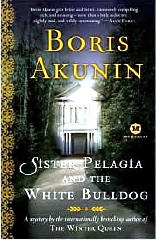
    I’m not sure anyone in the west is writing anything like Akunin’s Fandorin novels, but thankfully we have them, and so far of the eleven books in the series, at least eight have been translated, with five published so far in the US. Akunin has also written a trilogy about Sister Pelagia, all of which are now available in English.

    Get acquainted with him. His books are literate, playful, and page turning reads. You will find nothing quite like him and no one quite like Erast Fandorin in Western literature — more’s the pity.

    It’s not often you find a writer or a hero who can honestly be said to mix elements of dime novels, Ian Fleming, Dostoyevsky, Dumas, and Ellery Queen, but Akunin and Fandorin manage the feat. There is nothing else quite like them on the shelves.

       The Erast Fandorin series. [Note that so far only the first five have been published in the US.]

1. The Winter Queen (2003)
2. The Turkish Gambit (2004)

BORIS AKUNIN

3. Murder on the Leviathan (2004)
4. The Death of Achilles (2005)
5. Special Assignments (2007)

BORIS AKUNIN

6. The State Counsellor (2008)
7. The Coronation (2009)
8. The Lover of Death (2009)

       The Sister Pelagia series

1. Sister Pelagia and the White Bulldog (2006)

2. Sister Pelagia and the Black Monk (2007)
3. Sister Pelagia and the Red Cockerel (2008)

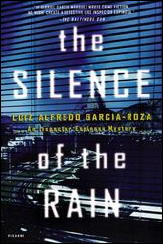
LUIZ ALFREDO GARCIA-ROZA – The Silence of the Rain.

Picador, trade paperback; 1st printing, July 2003. Hardcover edition: Henry Holt and Co., July 2002.

LUIZ ALFREDO GARCIA-ROZA Silence of the Rain

   This moody sort of detective novel was first published in Brazil and translated from the Portuguese, and I recommend it to you. It starts out in a mildly light-hearted fashion, as a mixup over a wealthy executive’s suicide in a parking garage — someone went off with the gun and the suicide note — leads Inspector Espinosa of Rio de Janeiro’s First Precinct into handling the case as though it were a murder.

   (Not unlike Columbo of TV fame here in this country, we are privy to certain events that Espinosa is not, and even by the end of the case he is still running through endless speculations as to what actually happened.)

   The mood becomes gradually edgier, though, until page 121, which is where the reader is forcibly confronted with the realization that this is no cozy, if not before. Reading mysteries taking place in other countries also makes you realize that the rules are often totally different. Here’s a quote from page 161:

   I left thinking about the paradox: I trusted the information i could get from lowlife street gamblers but was wary of that same information in the hands of my fellow policemen. The worst was that I didn’t even know exactly how much I distrusted them, but one of the things I’d learned from a life on the force was not to confide in other officers.

   And from page 238:

   Espinosa called the precinct from the hospital No news. They kept reiterating that it was an isolated kidnapping, not related to the “normal kidnappings in the city.” Espinosa was stunned by the phrase: how could cops talk about “normal kidnappings”? Were there normal kidnappings and abnormal kidnappings?

   Espinosa is, the dead man’s widow decides, a rare bird, a cultivated policeman. He is attracted to her. She is so wealthy she does not seem to notice. Espinosa is a reader of Dickens and Thomas De Quincey, is afflicted by loneliness and self-doubts, and he is also better than decent as a reader of character.

   Besides an almost other-worldly atmosphere and surroundings, there are enough twists and turns of the plot to keep any detective story buff more than satisfied, even with the aforementioned Colombo-like prologue, with an ending I know I’ve never read before — I couldn’t possibly have forgotten a scene like this, and you won’t either.

   And yes, the telling of tale does switch back and forth between first person and third. Just in case you were wondering.

— July 2003.


        The Inspector Espinosa series —

1. The Silence of the Rain (Holt, hc, 2002; Picador, trade pb, 2003)
2. December Heat (Holt, hc, 2003; Picador, trade pb, 2004)
3. Southwesterly Wind (Holt, hc, 2004; Picador, trade pb, 2004)

LUIZ ALFREDO GARCIA-ROZA

4. A Window in Copacabana (Holt, hc, 2005; Picador, trade pb, 2006)
5. Pursuit (Holt, hc, 2006)

LUIZ ALFREDO GARCIA-ROZA

6. Blackout (Holt, hc, 2008; Picador, trade pb, 2009)
7. Alone in the Crowd (Holt, hc, 2009)

LUIZ ALFREDO GARCIA-ROZA


[UPDATE] 09-17-09. My local Borders store stopped carrying these after the first three or four. I hadn’t realized there were more in the series until now. I’ve also searched thoroughly, and there doesn’t seem to have been a softcover edition for #5 — why that should be, I certainly can’t tell you.

A REVIEW BY DAVID L. VINEYARD:         


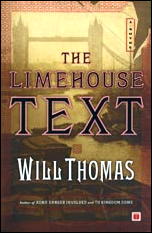
WILL THOMAS – The Limehouse Text. Touchstone, hardcover & trade paperback, July 2006.

WILL THOMAS

   This is the third book in the series by Oklahoma librarian Will Thomas about late Victorian sleuth Cyrus Barker (the ‘Guv’) and his assistant/Watson Thomas Llewelyn who made their debut back in Some Danger Involved followed up by Kingdom Come.

   This time out Barker and Llewelyn follow the trail of a pawn ticket that leads them into the shadowy environs of Limehouse, London’s Chinese district, where opium dens and honest shopkeepers meet, and the influence of the Chinese tong societies and their hatchet men haunts them.

   The pawn ticket leads them to a rare book that conceals an ancient fighting technique, dim mak, long hidden from the west, and Llewelyn and Barker find themselves caught between a killer seeking the ancient wisdom and the dangers of the growing tension between the British Empire and China as well as the mysterious man at the heart of all the crime in Limehouse, Mr. K’ing (and any reader of Sax Rohmer and August Dereleth’s Solar Pons should have no problem identifying him).

    “If what Bainbridge thought is correct, all the deaths that occurred just after New Year may be the work of one killer… the only connection they seem to have had was a book. The book, the book, the Bloody book! Didn’t you say in court it was a boxing manual? Who kills three people over a boxing manual.”

    “It’s rather a special manual, Terence,” Barker explained. “It teaches, for one thing, the way to disrupt the body’s internal functions, killing someone without a sign.”

WILL THOMAS

   Through the smoky dream-ridden opium dens to the back room blood sports indulged in by the high and the mighty, Barker and Llewelyn hunt a killer and try to keep their heads while preventing virtual war from breaking out in the streets of Limehouse. Israel Zangwill, the author of the classic The Big Bow Mystery even features in the plot. (Thomas often features a historical and often literary figure like Zangwill in the books.)

    Limehouse had become enchanted that night. Every wall was festooned with messages in gilt and streamers of red paper and firecrackers. Entranceways that no one had swept for years were now swept and mopped. The drab and mean streets* of the area had now become a fairyland…

   Luckily for them, Barker is an expert on all things Chinese, from the lethal razor sharp pennies he carries in his pockets to the martial arts he engages in. He even keeps a courageous little black Pekingese, Harm, who frequently features in the novels plot, as he does here. Before the game is brought to bay Barker will have to fight a battle to the death in one of those back rooms to save both his and Llewelyn’s life.

   Will Thomas is an admirer of Sherlock Holmes and Doyle obviously, but also familiar with his Nero Wolfe, and Llewelyn is much closer to Archie than Watson, despite his admiration for Barker, his enigmatic boss.

   The books manage a neat blend of action, mystery, and atmosphere that make them a real pleasure to read, as the action moves, the plot twists, and Barker and Llewelyn find themselves in increasingly hot water and trouble. Thomas knowledge of Victorian literature and history also shows in his casual but in depth portrait of his heroes environs.

WILL THOMAS

   These books are great fun, never letting the research get in the way of the action or plot, Barker and Llewelyn a testy and intelligent match as a team, and the observations of just how close our disparate worlds really are a reminder that the more things change the more they stay the same.

    “The Bible is a book. The Koran is a book. Right now, in the Sudan, men are killing themselves over both of them.”

   Playful, smart, fast paced, and involving, this is one of the best historical tec series ongoing, and certainly to become a classic. Once you meet them you will want to get to know Barker and Llewelyn and their worlds better.

    * Should anyone think they have caught Thomas in an anachronism, the term “mean streets” was first coined by Victorian writer Arthur Morrison to describe London’s less wholesome districts, in the book Tales of Mean Streets (1895). Morrison is probably better known today for his stories about Sherlock Holmes rival Martin Hewitt.

    That said, I will grant that in The Limehouse Text Thomas uses the term a number of years before Morrison’s book was published.

       The Cyrus Barker & Thomas Llewelyn series:

1. Some Danger Involved (2004).
2. Kingdom Come (2005).
3. The Limestone Text (2006).
4. The Hellfire Conspiracy (2007).

       WILL THOMAS

5. The Black Hand (2008).

       WILL THOMAS

6. “In progress,” according to the author’s blog, August 2009.

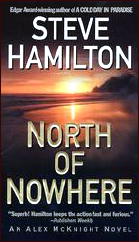
STEVE HAMILTON – North of Nowhere.

St. Martin’s; paperback reprint; 1st printing, May 2003. Hardcover edition: St. Martin’s, 2002.

STEVE HAMILTON

   When I went to undergraduate school in Michigan’s famed upper peninsula, there was a popular song (and maybe a movie) called “North to Alaska.” Our version was turned around and became “South to Alaska.” (Maybe you had to be there.)

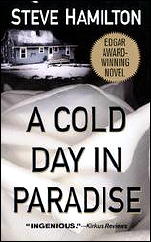
   Anyway, this is the fourth of former Detroit policeman Alex McKnight’s recorded cases, the first of which, A Cold Day in Paradise, won an Edgar. There’s a town in the lower portion of the state called Hell, down around Ann Arbor, and I’ve been there, and I’ve been to Paradise, where this story takes place, up around Sault Ste. Marie, and more in the middle of nothing but trees, trees and more trees, it is hard to imagine.

   Well, there is the Lake Superior shoreline, and nearby Tahquamenon Falls. Could the area be the site of the next building boom, for rich down-staters to build multi-room faux-Victorian summer mansions along the lake?

STEVE HAMILTON

   Alex gets involved when a poker party he’s invited to at the last minute is interrupted by gunmen who seem to know how much money the wealthy host (and would-be developer) has in his hidden upstairs safe.

   The tale as it develops from there is too long (322 pages) and too talky to be truly hard-boiled, but Hamilton has the knack of pulling the reader into his story with prose as smooth as you hope to live for and yet so seething with underlying tension that it sometimes hurts. McKnight also has a wonderfully uncool and all-but-inept private eye buddy whose loyalty is questioned but comes back answered.

   This is a guy’s book — the only women that show up are three or four wives, some faithful and some not. There’s also just enough honest-to-goodness detective work going on to add an extra dimension to a rip-roaring northern woods adventure novel that’s sheer all-out fun to boot.

— May 2003


    The Alex McKnight series —

1. A Cold Day in Paradise (1998)
2. Winter of the Wolf Moon (2000)
3. The Hunting Wind (2001)
4. North of Nowhere (2002)
5. Blood Is The Sky (2003)
6. Ice Run (2004)
7. A Stolen Season (2006)

REVIEWED BY WALTER ALBERT:         


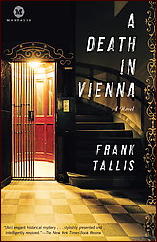
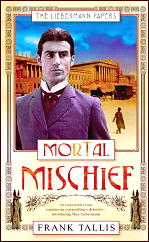
FRANK TALLIS – A Death in Vienna. Random House, trade paperback, May 2007. First UK edition, as Mortal Mischief: Century, hardcover; June 2005.

FRANK TALLIS Death in Vienna

   I’d been eying this novel, set in turn-of-the-century Vienna for some time. When I decided to buy a copy, my local bookshop was out of stock, but a copy was ordered and a week later I settled down to read it.

   Dr. Max Liebermann is a follower of the new theories of Sigmund Freud, which puts him in conflict with his superior at the hospital where he is affiliated. He is also the good friend of Detective Oscar Reinhardt, and when a psychic is murdered inside her apartment in a room locked from the inside, with no apparent means of entry other than the door, Oscar invites Max to assist him in his investigation.

   Vienna, in 1902, was a center of the arts. Mahler was conducting at the symphony and opera, Gustav Klimt was exhibiting his works at a museum, and the city was rich in cultural events, first-class restaurants and the inevitable conflicts between the conservative past and the new, more open present. Tallis evokes the city with great skill all the while constructing a plot that tests the professional and personal skills of his protagonists.

      Series: The Liebermann Papers

1. Mortal Mischief (2005). US edition: A Death in Vienna, Random House, May 2007.

            FRANK TALLIS Death in Vienna

2. Vienna Blood (2006). US edition: Random House, Jan 2008.
3. Fatal Lies (2008). US edition: Random House, Feb 2009.
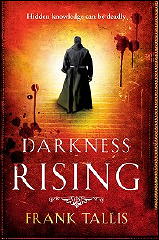
4. Darkness Rising (2009). US edition: Random House, Mar 2010.

          FRANK TALLIS Death in Vienna

IT’S ABOUT CRIME
by Marvin Lachman

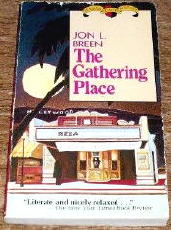
JON L. BREEN – The Gathering Place. Walker, hardcover, 1984; paperback, September 1986.

JON L. BREEN The Gathering Place

   I’m on record as having serious reservations about occult and horror fiction, feeling most works in those genres are “copouts” in which the authors do not play by the “rules” of reality.

   Jon L. Breen’s The Gathering Place contains one unexplainable element, the ability of its heroine, Rachel Hennings, to, without practice, imitate the signatures of famous authors like ErIe Stanley Gardner. The plot device of automatic writing doesn’t help what is otherwise a classic detective story, but it doesn’t hurt it enough to keep me from recommending thls book.

   The setting is a famous old bookstore, on Santa Monica Boulevard in Los Angeles, recently inherited by Hennings from her uncle. There is real murder to go with the supernatural, and soon Rachel is acting as detective, with some help from a psychology professor, a reporter, and a Los Angeles Police detective.

   Hennings is a, strong enough character that she probably doesn’t need that many extra detectives. The mystery is crisply told and satisfactorily resolved, by strictly logical means. A real bonus is the atmosphere of an old-fashioned book store as seen through the eyes of an author who obviously loves old books.

– From The MYSTERY FANcier, Vol. 9, No. 2, March/April 1987.


   Bibliographic Data. [Expanded from the Revised Crime Fiction IV, by Allen J. Hubin.]

HENNINGS, RACHEL
      The Gathering Place. Walker, hc, 1984.
      A Piece of the Auction. EQMM, July 1986. [Short story.]
      Starstruck. Murder in Los Angeles, Adams Round Table, Morrow, 1987. [novelette]
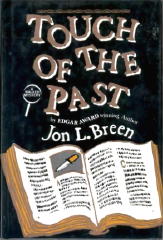
      Touch of the Past. Walker, hc, 1988.

JON L. BREEN Touch of the Past

      Rachel and the Bookstore Cat. Danger in D.C., ed. Martin H. Greenberg & Ed Gorman, Donald I. Fine, 1993. [short story]

« Previous PageNext Page »