Characters


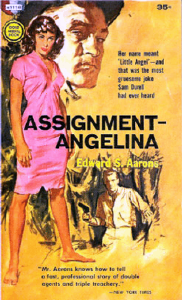
    — Following my review of Assignment Zoraya, by Edward S. Aarons, David Vineyard recently left this comment:

    Aarons is another underappreciated writer who wrote clean uncluttered prose and knew his way around plot and character. The best of the Durell books are superior examples of their field and still hold up today even if the politics have left them behind.

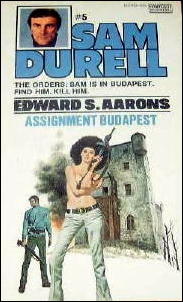
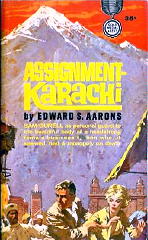
    I do have a question, though likely no one can answer it. The familiar portrait of Durell featured originally on the front covers and later on the back looked nothing at all like the lean black haired black eyed character known as the “Cajun” who I always pictured as a cross between Dale Robertson and Zachary Scott.

EDWARD S. AARONS Karachi

    Gold Medal’s other series icons all looked a good deal like the characters within — Matt Helm, Joe Gall, Shell Scott, Travis McGee, Chester Drum, even Earl Drake’s “Man with No Face” — but Aaron’s “Cajun” was this blonde pale eyed guy in a fedora, and as late as 1962’s Assignment Karachi Durell is portrayed on the cover as a blonde.

    I think the original portrait is by Barye Phillips who did most of the early Aarons covers and Karachi looks like it might be the work of Harry Bennett.

    You would think in all the years the series ran and considering it always had steady sales that someone would have noticed the cover portrait was nothing like the character described in the book. Anyone know what was going on?

          >>>>

    Steve again. David and I have been batting this question around for a while, each providing the other with cover images. My problem with his question is that when I think of blond (or blonde), I think of Marilyn Monroe.

    Obviously there are different shades of blond, including very light browns, but I think that there always has to be some yellow in it before hair can be considered blond. I just didn’t remember ever seeing Sam Durell with hair that fit what David was saying.

    What’s more, when I came across one of the covers that David specifically referred to, Durell’s hair looked dark brown if not black, and nothing like blond to me. See above.

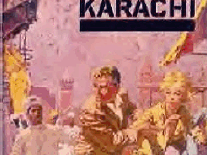
    But David then supplied me with a closer look at the cover of Gold Medal GM k1505, which is not the 1962 printing above, but one that would have come out in 1964 or ’65 . See below:

EDWARD S. AARONS Karachi

    It’s out of focus and lighter than the image I’d found, but yes, this time I saw what David was talking about. He’s not as blond as the lady standing next to him, but there are blond highlights in his light brown hair I hadn’t seen before. In any case, if the question was phrased as “Does Durell look like a dark-haired Cajun in this picture?” I’d have to agree that he does not.

    I challenged David’s suggestion that the painting was done by Harry Bennett. I disagreed, seeing nothing of the latter’s stylized art in the cover, and suggested Ron Lesser instead. David agreed, saying “You are likely right about Lesser. As you said, Bennett usually signed his work. I thought of him because he did a lot of work for Fawcett and the background looked like his work.”

    Here is the second cover that David sent me, one of the ones he believed was done by Barye Phillips:

EDWARD S. AARONS Karachi

    I agree that Phillips is likely the artist. With the hat on the fellow whose face is at the top, though, it is difficult to determine what color is hair is, except that it is not black, more likely brown, and to me he looks more like an Irish pug than a dark-haired Cajun.

    The one in the cover scene itself David calls “a fair-haired pale-eyed ‘Cajun’,” and he continues: “I’m curious if this was an editorial decision, an attempt to make him look more like Shell Scott, or just an artist’s interpretation that the editors and Aarons never bothered to correct. The novels describe Durrell as dark with black hair and eyes, a bit over six feet tall and lean, and resembling a Mississippi river boat gambler.”

    To end the discussion between David and me, but to open it up to others to jump in if they wish, here’s a cover, probably published in the late 1970s or even the 80s, in which Durell, to me, finally looks something like the author, Edward S. Aarons, might actually had in mind:

EDWARD S. AARONS

    The cover was obviously done by Robert McGinnis, but whether he did the small insert close-up of Sam Durell, I’m not sure. I’d need a closer look to be positive. Whoever it was, I think he finally got it right.

   Here’s David again. It’s his question, and he deserves the last word:

    “No doubt you are right about the question not getting answered, I just thought I would put it out there and hope one of the Gold Medal experts might have an idea. I can’t think of another series where the covers consistently went out of their way to portray the character as looking almost completely different than the one described in the book.”

WRITING NERO WOLFE,
by Lee Goldberg.


   INT. BROWNSTONE — WOLFE’S OFFICE — DAY

   Archie sits at his desk, OILING HIS TWO MARLEY .38s. As we hear his voice-over, he switches to OILING HIS TYPEWRITER with the SAME OIL.

   ARCHIE’S VOICE

   Nero Wolfe is a creature of habit. Every morning, from nine until eleven, he tends his 10,000 orchids and I, Archie Goodwin, his confidential secretary and legman extraordinaire, tend to business. And since there wasn’t any business to tend to, I was preparing for action — if and when it ever came.

   The PHONE RINGS. He answers it.


   I can’t tell you how much pleasure it gave me to write those words, the opening scene of the A&E adaptation of Rex Stout’s Nero Wolfe novel “Champagne for One.”

   For one thing, I’ve been a fan of Nero Wolfe since I was a kid. The Brownstone on West 35th Street where Nero Wolfe and Archie Goodwin live and work in New York City was as real to me as my family’s suburban tract home in Walnut Creek, California. I read each and every book, reveling in Archie’s amiable narration, his lively banter with Nero Wolfe, and Wolfe’s wonderfully verbose and brilliant speeches. While I may have been underwhelmed, even as a teenager, by Stout’s lazy plotting, I loved the language and, most of all, the relationship between Wolfe and Archie. I never dreamed I’d have a chance to write those characters myself. And, in the case of that opening, to write new words in their voices, at least as I’ve always heard them.

   It was a screenwriting assignment unlike any other that my writing partner, William Rabkin, and I had ever been involved with. Because “Nero Wolfe,” starring Maury Chaykin as Wolfe and Timothy Hutton as Archie, was unlike any other series on television. It was, as far as I know, the first TV series without a single original script — each and every episode was based on a Rex Stout novel, novella, or short story. That’s not to say there wasn’t original writing involved, but it was Stout who did all the hard work.

   Everyone who wrote for “Nero Wolfe” was collaborating with Rex Stout. The mandate from executive producers Michael Jaffe and Timothy Hutton (who also directed episodes) was to “do the books,” even if that meant violating some of the hard-and-fast rules of screenwriting.

   Your typical hour-long teleplay follows what’s known as a four-act structure. Whether it’s an episode of “The West Wing” or “CSI,” the formula is essentially the same. But “Nero Wolfe” ignored the formula, forgoing the traditional mini-cliffhangers and plot-reversals that precede the commercial breaks.

   Instead, we stuck to the structure of the book, replicating as closely as possible the experience of reading a Rex Stout novel (which, sadly, few viewers under the age of 50 have ever done).

   In the highly competitive world of primetime network television, and in an era of “MTV”-style editing, it helped “Nero Wolfe” stand apart (and, perhaps, sealed its doom). “Nero Wolfe” required the writer to turn off most of his professional instincts and, instead, put all his trust in the material — which was a whole lot easier if you were already a Nero Wolfe fan.

    “It’s amazing how many writers got it wrong,” says Sharon Elizabeth Doyle, who was head writer for “Nero Wolfe.” “I mean very good writers, too. Either you get it or you don’t. It’s so important to have the relationships right, and the tone of the relationships right, to get that it’s about the language and not the story. The characters in these books aren’t modern human beings. You have to believe in the characters and respect the formality of the way they are characterized.”

   That doesn’t mean writers for the show simply transcribed the book into script form. It can’t be done. There’s no getting past that a novel and a TV series are two distinct, and very different, mediums. The writer’s job on “Nero Wolfe” was to adapt Rex Stout’s stories into scripts that could be produced on a certain budget over a seven-day schedule on a particular number of sets and locations. Beyond that, the writer had to re-tell Stout’s story in the idiom of television. By that, I mean the story had to be shown not told, through actions rather than speech, which isn’t easy when you’re working with mysteries written in first-person that are mostly about a bunch of people sitting in an office and talking. And talking. And talking. It’s very entertaining to read it, but can be deadly dull if you have to watch it.

   Our first step in the adaptation process was the most fun — we’d sit down and read the book for pure pleasure, to get the feel and shape of the story (I couldn’t believe someone was actually paying me to read a book that I loved!)

   After that, the real work started. We’d sit at the laptop and briefly jot down notes on the key emotional moments of the story, the major plots points, the essential clues, and most importantly, whatever the central conflict was between Wolfe and Archie. We’d also make notes of an obvious plot problems (and there were many). Once we were done with that, we were ready to read the book again, only not as readers but as literary construction workers who had to figure out how to take the structure apart and rebuild it again in a different medium.

   We”d go through the book page-by-page, highlighting essential dialogue while writing a scene-by-scene outline on the computer as went along. We used the outline, combined with our previous notes, to get a firm grasp on the story, to see what scenes had to be pared down, combined or removed. Within scenes, we looked for ways the dialogue could be tightened, simplified or re-choreographed to add more momentum, energy and movement to the episode. And we’d do all this while keeping one thought constantly in our minds: stick as closely to the books as you can.

   More often than not, that meant loyalty to the dialogue rather than to the structure of the plot or the order, locations, or choreography of the scenes. Because the first thing we discovered as we took apart Stout’s stories and put them back together again was how thin and clumsily plotted the mysteries are — a weakness that seems to be more easily hidden in prose than it can be on camera (which is one reason plots are so often reworked in the movie versions of your favorite mysteries).

    “Television does seem to make the plot problems more glaring. The Nero Wolfe mysteries, generally, are very weak,” says novelist Stuart Kaminsky, who adapted the novella “Immune to Murder” into an episode. “Wolfe seldom does anything brilliant. We are simply told he is brilliant and are convinced by his manipulation of people and language. His is a great act.”

   Any avid reader of the Stout books soon discovers that there are three ways Wolfe will solve a mystery:

    a) Wolfe either calls, mails, or in some other way contacts all the suspects and accuses each one of being the murderer, then waits for one of them to expose him or herself by either trying to steal or retrieve a key piece of evidence — or trying to kill Archie, Wolfe, or some other person Wolfe has set up as bait.

    b) Wolfe sends his operative Saul or Orrie to retrieve some piece of evidence that is with-held from Archie (and, by extension, all of us) and revealed in the finale to expose the killer.

    c) Wolfe uses actual deduction.

   The challenge in adapting the Nero Wolfe stories for television was obscuring those plot problems by playing up the character conflicts and cherry-picking the best lines from Wolfe’s many speeches. The plots became secondary to the relationships and the uniqueness of the language. The vocabulary was never dumbed down or simplified for the TV audience, which is why the series felt so much like the books.

    “There is a pleasure in Wolfe’s speeches, what we call the arias,” says Doyle. “Wolfe has lots of them, the trick is isolating that one aria you can’t live without.”

   In the novel “Too Many Clients,” which Doyle adapted for the show, there was one Nero Wolfe speech that she knew had to be in the episode:

    “A modern satyr is part man, part pig, part jack-ass. He hasn’t even the charm of the roguish; he doesn’t lean gracefully against a tree with flute in hand. The only quality he has preserved from his Attic ancestors is his lust, and he gratifies it in the dark corners of other men’s beds or hotel rooms, not in the shade of an olive tree on a sunny hillside. The preposterous bower of carnality you have described is a sorry makeshift, but at least Mr. Yeager tried. A pig and a jack-ass yes, but the flute strain was in him too, as it once was in me, in my youth. No doubt he deserved to die, but I would welcome a sufficient inducement to expose his killer.”

   Where else on television do you find a character who talks like that? No where. Not before “Nero Wolfe,” and not now that it has been cancelled.

    “There is one thing we did that nobody else is doing. We played with the language and had a good time doing it,” Doyle says. “Most TV language is very minimalist.”

   She’s right. When was the last time you heard a TV character use satyr and bower in casual conversation? I’m not surprised “Nero Wolfe” was canceled. Perhaps the creative choices that were made, while respecting the material, were wrong for TV. Not because audiences are stupid, but because television is, ultimately, not a book, and certainly not one written in the 1940s. By design, the show had a dated feel, one that may have alienated all but the oldest viewers and the most avid Wolfe fans.

   That said, and with my obvious biases showing, I think the series, and especially the performances of Maury Chaykin and Timothy Hutton, will be recognized as the definitive dramatic interpretation of “Nero Wolfe,” the one any future movie or TV incarnations will be measured against. And I was honored to be a part of it.

Lee Goldberg was nominated for an Edgar Award by the Mystery Writers of America for his work on “Nero Wolfe.” This article first appeared in Mystery Scene magazine and is reprinted with the author’s permission.
Reviewed by MIKE GROST:

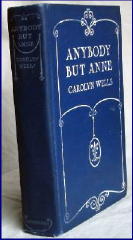
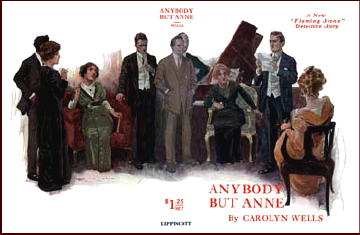
CAROLYN WELLS – Anybody But Anne. J. B. Lippincott, US/UK, hardcover, 1914.

   Anybody But Anne shares most of the characteristics of Wells’ later Faulkner’s Folly (reviewed here not too long ago):

CAROLYN WELLS Anybody But Anne.

    ● It is a full, formal mystery novel, of the kind that would later be popular in the Golden Age.

    ● It is set in a country house, and anticipates the mysteries soon to be popular in such houses.

    ● The cast of suspects resemble those to be found in many later detective books.

    ● It is a locked room mystery — but the solution of the locked room is based on ideas that would later be regarded as cheating. Still, the cheat of a solution shows some real ingenuity.

    ● The book shows the imagination with architecture, that would later be part of the Golden Age. It comes complete with a floor plan. The country house is of the kind that might have later inspired the mystery game known as Clue or Cluedo: there is even a billiard room!

    ● Wells pleasantly includes some subsidiary mysteries, that have nothing to do with the locked room. These too show some mild but pleasing ingenuity. Such subplots are also standard in Golden Age detective novels.

   I do not know if Wells invented the above template for formal mystery novels, or whether she derived it from other authors. Anybody But Anne does establish, that what we think of as a “typical Golden Age style mystery novel,” was in existence before what is often thought of as the official start of the Golden Age in 1920. It is also a fact, that Wells was American, and that her book is set in the United States: somewhere in New England.

   The best parts of Anybody But Anne have charm. People looking to sample Wells, might enjoy this novel, or at least its best chapters. It is at its best in the opening (Chapters 1-6), which sets up the architecture, characters and murder mystery; two later chapters that tell us more about the house as well as exploring some subsidiary mysteries (14, 17), and lastly the solution (Chapters 18, 20). Together these sections make a readable novella. The novel has been scanned by Google Books, and can be read free on-line.

CAROLYN WELLS Anybody But Anne.

   We get a good portrait of Wells’ sleuth, Fleming Stone, in action in these sections. Oddly, he is missing in most of the middle of the book, sections which generally are not that interesting anyway. Like most pre-1945 detectives, he is more characterized by his skills and behavior as a detective, than by any knowledge we get of his personal life.

   Stone has a penetrating intellect, that goes right to the heart of clues to the mystery, in the evidence at hand. He is crisp and business-like at delivering his insights, sharing his ideas immediately with the other characters and the reader.

   We do learn that Fleming Stone is outside of the world of romance, like many other early detectives. Wells gives an interesting psychological portrait of this.

— Reprinted with permission from A Guide to Classic Mystery and Detection, by Michael E. Grost.

    The following observation and question was first posted here by Vince Keenan on June 4, 2007:

    “I recently reread Westlake’s The Hot Rock for the first time in ages and was struck by the fact that Grofield makes an appearance. One of the members of Dortmunder’s crew, Alan Greenwood, is forced to change his last name after he’s arrested. We learn in the book’s penultimate chapter that he’s now Alan Grofield.

WESTLAKE The Hot Rock

    “Grofield had already been established in the Parker series as well as his own books at this point. So is this a belated origin story, as they say in the comics field?”

    I didn’t know, but I more or less assumed that Vince was right. No one responded to this online inquiry to say for sure, until today, when I heard from Gabe Lee, who left the following comment:

    “I remember seeing similarites in Greenwood and Grofield while reading The Hot Rock the first time a few years ago, having recently devoured all of the Stark books in order.

    “I felt vindicated at the end when they were revealed to be the same person.”

    When I thanked Gabe for leaving a definitive answer at last, he replied:

    “A bit more I didn’t see mentioned here… The Hot Rock was started as a Parker novel by Stark. The premise got too absurd for Parker’s character; no way he would have put up with that nonsense.

    “Westlake rewrote the book and created Dortmunder to replace Parker as the main character. I’m assuming Grofield was in before the rewrite, and was changed to Greenwood (same initials, same first name spelled differently). He then switched Greenwood back to Grofield as Vince noted earlier.

    “It creates a fun chicken and egg scenario; maybe Grofield came first and that name was still clean. It’s one of the fun crossover tricks to look out for among Westlake’s many pseudonyms.

    “Another fun thing to look for, he often uses ‘Pointers’ and ‘Setters’ for restroom signs in bars, and uses it under different author names. I’ve seen other (non-Westlake) authors use it as well, but can’t recall where. I’m guessing it’s sort of an inside joke among the writers, or an homage, but don’t know where it started.”

    To which I responded by saying: I think that researchers with graduate theses and dissertations in mind will have a field day with all of the in-jokes and cross-references in Westlake’s work. If Westlake had been a “literary” figure instead of a mere mystery writer, I’d be sure of it.

    Then to Gabe, for the final word:

    “I completely agree, the crossover stuff is fun to look for. There’s so much of it, and I can picture the late great Mr. Westlake chuckling as he typed away. BTW, after racking my brain a bit I think Charles Willeford uses the Pointers and Setters thing in Cockfighter from 1962… I’ll have to re-read it to be sure.”


Gabriel E. Lee
Gryphon Graphics
www.gryphonart.com

JESSICA FLETCHER & DONALD BAIN – Murder She Wrote: A Palette for Murder.

Signet, paperback original. First printing, October 1996.

MURDER, SHE WROTE

   The first question that occurs to me as I sit down to write this review, and it hadn’t occurred to me before now, except in a nebulous sort of way, is just how many of these “Jessica Fletcher” books are there? They’ve seemed sort of generic and ubiquitous at the same time, and I never stopped to get them listed and enumerated. Until now. Take a look at the other end of this review…

   … and now that your eyes are back,some historical perspective may be in order. The TV show itself, the one starring Angela Lansbury, was on the air for twelve seasons, from 1984 to 1996, with four made-for-TV movies appearing after that, the last one in 2003.

   The first Murder, She Wrote novel came out in 1985, and there’s at least one that’s scheduled for 2009, a span of years that’s even longer than when the TV program was on the air. It’s quite a track record, and it certainly goes a long way in explaining the ubiquitousness I mentioned above.

   Which of course got me to thinking. What other series of TV tie-ins has consisted of more books than this one with Mrs. Fletcher has?

   To set some parameters, let’s restrict this question to detective novels. Otherwise in the field of science fiction, there is Star Trek, and we do not want to even begin to go there.

MURDER, SHE WROTE

   In the field of gothics, and books that are actually included in Al Hubin’s Crime Fiction IV, there are the Dark Shadows books, of which there 32 (at a quick, rough count). Good, but not good enough. There are 35 Murder, She Wrote books, or there will be soon.

   If anyone can come up with a series I’m simply not thinking of — and, no, I don’t consider the Perry Mason paperbacks with photos of Raymond Burr on the back cover true TV tie-ins, or should I? — let me know.

   As for the author, Donald Bain, he has his own website (and photo), and by following the link, you can find a complete list of all of the books he admits that he has written, and not all of them have been crime fiction, by any means. His bibliography also pointedly omits 24 books he wrote under another’s name but which he can not contractually reveal. Most of these books are (in all likelihood) the Margaret Truman books, of which Al Hubin says, again in the Revised Crime Fiction IV:

TRUMAN, (Mary) MARGARET (1924-2008). Despite the strenuous denial of Donald Bain, 1935- , q.v., the strong belief persists that he has ghost-written all the titles below…. (The year of her death appears only in the Addenda.)

MURDER, SHE WROTE

   Back up when I starting this review, which seems a long time ago already — you don’t know it, but it is now several days later, real time — I also called the books “generic” as well as ubiquitous, and perhaps I should apologize for that, even though I said “they’ve seemed,” since of course and/or as usual, this is the first one that I’ve read.

    “Ubiquitous” I think I may have proven, but the case is far less solid when it comes to generic, unless of course you think that the TV show was generic, and maybe it was, but what TV show today exerts as much effort into actual deduction in terms of its detective work than Murder, She Wrote? Numb3rs, perhaps? Any others?

   I’ll get back to this. To tell you something about the book I have just read, in it Jessica Fletcher is visiting the Hamptons (on Long Island), trying to get away from the hustle and bustle of the big city and secretly to try her hand at oil painting.

MURDER, SHE WROTE

   The latter effort fails — well, in fact both objectives fail — if getting away from the big city means staying away from murder cases — when the young model posing nude for Jessica’s class is found dead while taking a short break. (With careful camera angles, most of the activity immediately preceding could have been shown on television.)

   But in any case it is thus that Mrs. Fletcher is introduced to world of modern art, including thefts (her own sketch of the dead girl included), forgeries and high finance, Long Island style.

   She also tells the story in her own words, and what is quite remarkable is that Donald Bain as the author has her voice down cold. Perfect. To a T. From page 58:

    “… One minute Miss Dorsey was very much alive and posing for fifteen fledgling artists. The next minute she was dead.

    “I knew I could justify looking into her death based upon the theft of my sketch. Maybe I could find out who took it. Even more important, the sketch was now floating around the Hamptons. Where was it? And who had it now?

    “I stopped going through my internal justification process, and decided to take a walk. It was sunny and warm outside, the sort of pretty day I’d counted on when deciding to vacation in the Hamptons.”

   And then a second death occurs, suggesting that the first one was not a simple accident of some kind, as if we (the reader) did not know that already. Perhaps innate in the world of “cozy” detective novels, the death may have affected me more than it did anyone in the story, including Mrs. Fletcher, who had begun to know the second victim well. (Shouldn’t she have at least been angry about it?)

MURDER, SHE WROTE

   What I said about Donald Bain’s having his “co-author’s” voice down pat, he — at this relatively early point in the series — it does not seem to me that he has the mystery-telling (and solving) pattern of television series very well in mind at all.

   Instead of calling the suspects together and recreating the crime scene (in flashbacks) and naming the killer as a result, we have Jessica going here and there on her own and in exceedingly dangerous places, not realizing as she should that a two-time killer is on the loose.

   The ending is rather muddled altogether, in fact, and that I ending up skimming through it, rather than being transfixed with the unraveling, may tell you more about the mystery than anything else, I regret to say. I may read another, but without a push from some other direction, all things considered, it’s not as likely as it should be.

By JAMES ANDERSON

   The Murder of Sherlock Holmes (n.) Avon, pb, 1985.

MURDER, SHE WROTE

   Hooray for Homicide (n.) Avon, pb, 1985.
   Lovers and Other Killers (n.) Avon, pb, 1986.

By DAVID GEORGE DEUTSCH

   Murder in Two Acts (n.) Star, UK, pb, 1986.

By JESSICA FLETCHER & DONALD BAIN

   Gin and Daggers. McGraw-Hill, hc, June 1989; Avon, pb, October 1990; Signet, pb, April 2000.

MURDER, SHE WROTE

   Manhattans and Murder. Signet, pb, December 1994.
   Brandy and Bullets. Signet, pb, August 1995.
   Martinis and Mayhem. Signet, pb, December 1995.
   Rum and Razors. Signet, pb, April 1995.
   A Deadly Judgment. Signet, pb, April 1996.
   A Palette for Murder. Signet, pb, October 1996.
   The Highland Fling Murders. Signet, pb, April 1997.
   Murder on the QE2. Signet, pb, October 1997.
   Murder in Moscow. Signet, pb, May 1998.
   A Little Yuletide Murder. Signet, pb, October 1998.
   Murder at the Powderhorn Ranch. Signet, pb, May 1999.
   Knock ’Em Dead. Signet, pb, October 1999.
   Trick or Treachery. Signet, pb, October 2000.
   Blood on the Vine. Signet, pb, April 2001.
   Murder in a Minor Key. Signet, pb, October 2001.
   Provence to Die For. Signet, pb, April 2002.
   You Bet Your Life. Signet, pb, October 2002.
   Majoring in Murder. Signet, pb, April 2003.
   Destination Murder. New American Library (NAL), hc, October 2003; Signet, pb, September 2004.

MURDER, SHE WROTE

   Dying to Retire By. Signet, pb, April 2004.
   A Vote for Murder. NAL, hc, October 2004; Signet, pb, September 2005.
   The Maine Mutiny. Signet, pb, April 2005.
   Margaritas and Murder. NAL, hc, October 2005; Signet, pb, September 2006.
   A Question of Murder. Signet, pb, April 2006.
   Three Strikes and You’re Dead. NAL, hc, October 2006; Signet, pb, September 2007.
   Coffee, Tea, or Murder. Signet, pb, April 2007.
   Panning For Murder. NAL, September 2007; Signet, pb, September 2008.
   Murder on Parade. NAL, hc, April 2008. Signet, pb, March 2009.
   A Slaying In Savannah. NAL, hc, September 2008. Signet, pb, September 2009.
   Madison Avenue Shoot. NAL, hc, April 2009

— April 2006 (revised)


[UPDATE] 01-30-09. Any updating has already been done, either in the course of the review, or in the subsequent bibliography. This post is long enough now without my needing to say more!

AMBER DEAN – Snipe Hunt .

Doubleday Crime Club, hardcover, 1949. Reprinted in The Standard as the “Book of the Week” feature, September 30, 1950.

   This one surprised me a bit. It starts out with a couple of G-men who are stuck in the basement of a New York City tenement on a stake-out, trying to stay alert in order to spot any of the members of a notorious gang of counterfeiters they’ve been tipped off about.

   Just another dull procedural, I thought. The only noticeable complications concern the unlucky love life of one of the agents, undone by some typical Woolrichian vicissitudes of fate.

   Then suddenly the scene shifts. To upstate New York, the Finger Lakes region, where a commandeered customs agent named Max, his wife whom he calls Mommie, and a pretty girl named Danny combine forces to show the federal men the local lay of the land.

   What a snipe hunt is is a wild goose chase; there is also a humorously nosy neighbor who thinks that Max is just pulling her leg. But comedy, even such an incongruous concoction such as this, does not mix well with sudden spurts of nearly devastating disaster.

   Maybe I’m just chagrined at being caught off stride like this.

— Reprinted from The MYSTERY FANcier, Vol. 3, No. 4, July-Aug 1979 (mildly revised).


[UPDATE] 01-29-09. I messed up big time when I wrote this review. It turns out that one of Amber Dean’s standard series characters is in the book, and she didn’t make enough impression on me even to note her name: Abbie Harris. Checking the blurb for the book from Ellen Nehr’s Doubleday Crime Club Compendium, Abbie almost assuredly is Max Johnson’s nosy neighbor.

   Most of Amber Dean’s 17 mystery novels take place in upstate New York, not too surprisingly, since she herself lived in the Rochester area for most of her life, 1902-1985.

   Abbie Harris was in eight of those books. From the Revised Crime Fiction IV, by Allen J. Hubin, here’s a complete list:

         HARRIS, ABBIE    [Amber Dean]

      Dead Man’s Float (n.) Doubleday 1944.
      Chanticleer’s Muffled Crow (n.) Doubleday 1945.
      Call Me Pandora (n.) Doubleday 1946.
      Wrap It Up (n.) Doubleday 1946.
      No Traveller Returns (n.) Doubleday 1948.
      Snipe Hunt (n.) Doubleday 1949.
      August Incident (n.) Doubleday 1951.

AMBER DEAN

      The Devil Threw Dice (n.) Doubleday 1954.

SIMON HAWKE – Much Ado About Murder.

SIMON HAWKE

Forge, hardcover; First Edition, December 2002; reprint paperback: January 2004.

   There’s a period (1585-1592) in the life of William Shakespeare that’s called the Lost Years, in which nothing is known — where he was, what he was doing, and who he was hanging out with.

    Filling in the gap — pure speculation on Hawke’s part, not to mention audacity — here’s the third in a series of detective adventures of the most famous poet and playwright the world has ever known. Assisting him is his good friend and hanger-on with the Queen’s Men, Symington “Tuck” Smythe.

   Hard times have hit the traveling group of players. Plague has struck London, and all of the city’s playhouses have been closed down. (Not so incidentally, Hawke describes the horrible condition of the unsanitary streets in more than adequate detail. Ghastly.) Will has sold some sonnets, though, so he and Tuck are not starving, yet.

   They also run athwart the Steady Boys, a gang of young ruffians who feel that the country is being done under by too many immigrants: England for Englishmen in Shakespeare’s day!

   But while the events in Will and Tuck’s day-to-day life are interesting, after 130 pages, they’re no longer entirely riveting, so for the mystery fans perched in the front row, when the murder of Master Leonardo occurs, it’s with (dare I say) a certain amount of relief and “at last.” It’s a relatively minor case to be solved, but it’s Will’s sense of what makes people do what they do that saves the day.

   Bawdy at times, extremely funny at others, this is an entirely enjoyable lark, a remarkable flight of fancy, and I think you’ll like it, too.

— February 2003


SIMON HAWKE[UPDATE] 01-26-09. It turns out that Simon Hawke is (or was) an SF writer named Nicholas Yermakov, before he changed his named legally to Hawke.

   He’s most noted, perhaps, for a long series of books in his “TimeWars” series, the first of which you see here to the left. He’s also written Battlestar Galactica, Batman, and Star Trek novels, as well as novelizations of “Friday the Thirteenth” movies.

   There were only four books in his series of Shakespeare movies, I’m sorry to say. Perhaps the funny bones of a wider audience weren’t tickled as much as mine was. The fourth one was never even released in paperback:

     The Shakespeare & Smythe mysteries —

    A Mystery of Errors. Forge, hc, 2000; pb, 2001.
    The Slaying of the Shrew. Forge, hc, 2001; pb, 2002.
    Much Ado About Murder. Forge, hc, 2002; pb, 2004.
    The Merchant of Vengeance. Forge, hc, 2003.

[LATER THE SAME DAY.] I was looking at the two cover images I included in this post, and I think I can see one reason why there were 12 books in the TimeWars series, and only four in Hawke’s Shakespeare series, even though they were desgned for two entirely different audiences.

   You probably can, too. Look at the cover of Much Ado. It’s perfectly designed to show that it has something to do with a mystery (from the title) and something to do with Shakespeare (also from the title). Other than that? Dullsville.

JOHN BUXTON HILTON – Holiday for Murder. Diamond, reprint paperback; 1st printing, July 1991. Originally published as Passion in the Peak. US hardcover edition: St. Martin’s Press, 1985. Originally published in the UK by Collins Crime Club, hc, 1985.

JOHN BUXTON HILTON

   This is another in the author’s Inspector Kenworthy series, the fifth in the series published by Diamond. There have been seventeen in all, and they have all been published in the US, surprisingly enough. (For most British mystery writers, there’s always at least one book that doesn’t make the cut with publishers over here — or so it seems.)

   Of the ones they’re doing, Diamond is not publishing them in order. One that I read not too long ago was Hangman’s Tide, which originally came out in 1975. In Holiday for Murder, which was written ten years later, Inspector Kenworthy has already retired, but his ability as a detective has spread throughout England so greatly that he’s regarded as very nearly omniscient.

   In this book he investigates a strange sort of murder, a hillside automobile accident in the driver disappears, only to show up later, very much dead, some distance away. The dead man is a notorious womanizing rock musician (all of which are (to some degree) very much synonymous) who has the leading role (that of Christ) in a non-denominational/ecumenical Passion play now in the stages of rehearsal in the small village of Peak Low.

   Practical jokes at the expense of two different Mary Magdalene’s have preceded the accident, but the murder was apparently committed for other reasons. The villagers, various policemen, and the many actors, singers, electricians and so on involved in putting on the extravaganza are all precisely and individually depicted — Hilton’ s primary strength as a writer.

   The solution to the murder is presented in very anti-climactic fashion, strangely enough, as if Hilton felt that the mystery itself wasn’t strong enough to stand on its own.

   There is also a red herring — the matter of the match from Doncaster — that is poorly done. Kenworthy seems to know all about before he’s informed, and its significance in the story is none at all. It’s never mentioned again.

   But if you enjoy mysteries with small English village settings, read this one anyway. You’ll like it.

— Reprinted from Mystery*File 33, Sept 1991 (revised).


[UPDATE] 01-25-09. Strangely enough, while I don’t remember any of the details of this book’s plot, much less whatever flaws I may have found in it, I do remember enjoying reading it, which makes that last sentence pretty much of a guarantee.

JOHN BUXTON HILTON

   One thing that I didn’t change in the review is Kenworthy’s rank. I called him an Inspector, but in Al Hubin refers to him as a Superintendent. (See below.) The easiest explanation is, of course, that he was promoted sometime during his career.

   When Hilton wasn’t writing about Kenworthy, he used Inspector Thomas Brunt as his detective on the case. What really distinguished them from the Kenworthy mysteries, though, is that the six Brunt books took place in England in the late 1800s through the year 1911 or so.

   And, for the sake of completeness, Hilton also wrote another six mysteries as by John Greenwood. Inspector Jack Mosley was in all of these. I remember the Mosley books as being somewhat lighter in tone, though I may be in error about that.

   Expanded from the Revised Crime Fiction IV, by Allen J. Hubin, here’s a list of all the Kenworthy books —

         KENWORTHY, SUPT. SIMON     [John Buxton Hilton, 1921-1986.]

       Death of an Alderman (n.) Cassell, UK, 1968. Walker, US, 1968. Also published as: Dead Man’s Path, Diamond, pb, 1992.
       Death in Midwinter (n.) Cassell, UK, 1969. Walker, US, 1969. (Diamond, pb, 1994.)
       Hangman’s Tide (n.) Macmillan, UK, 1975. St. Martin’s, US, 1975. (Diamond/Charter, pb, 1990.)
       No Birds Sang (n.) Macmillan, UK, 1975. St. Martin’s, US, 1978. Also published as: Target of Suspicion, Diamond, pb, 1994.
       Some Run Crooked (n.) Macmillan, UK, 1978. St. Martin’s, US, 1978.
       The Anathema Stone (n.) Collins, UK, 1980. St. Martin’s, US, 1980. Also published as: Fatal Curtain, Diamond, pb, 1990.

JOHN BUXTON HILTON

       Playground of Death (n.) Collins, UK, 1981. St. Martin’s, US, 1981. (Diamond/Charter, pb, 1991.)
       Surrender Value (n.) Collins, UK, 1981. St. Martin’s, US, 1981. Also published as: Twice Dead, Diamond, pb, 1992.

JOHN BUXTON HILTON

       The Green Frontier (n.) Collins, UK. 1982. St. Martin’s, US, 1982. Also published as: Focus on Crime , Diamond, pb, 1993.
       The Sunset Law (n.) Collins, UK, 1982. St. Martin’s, US, 1982.

JOHN BUXTON HILTON

       The Asking Price (n.) Collins, UK, 1983. St. Martin’s, US, 1983. Also published as: Ransom Game, Diamond, pb, 1992.
       Corridors of Guilt (n.) Collins, UK, 1984. St. Martin’s, US, 1984. (Diamond, pb, 1993.)

JOHN BUXTON HILTON

       The Hobbema Prospect (n.) Collins, UK, 1984. St. Martin’s, US, 1984. Also published as: Cradle of Crime, Diamond, 1991.
       Passion in the Peak (n.) Collins, UK, 1985. St. Martin’s, US, 1985. Also published as: Holiday for Murder, Diamond, 1991.
       The Innocents at Home (n.) Collins, UK, 1986. St. Martin’s, US, 1987. Also published as: Lesson in Murder, Diamond, 1991.
       Moondrop to Murder (n.) Collins, UK, 1986. St. Martin’s, US, 1986.
       Displaced Person (n.) Collins, UK, 1987. St. Martin’s, US, 1988.

    Older posts on this blog often receive comments containing interesting viewpoints or insights that it’s a shame that they’re buried where regular readers of this blog aren’t likely go back and find them. In particular David Vineyard has been going through the entire backlog of posts, and over the past few days he’s been leaving an impressive array of both opinions and information throughout this blog about what he’s found.

    So over the next week or so, I’m going to be re-posting many of the comments he’s left, hoping to make sure the work he’s done receives the widest audience possible.

    There’ll be no frills on these. No cover images or bibliographies, for example — they’ll have been done in the original posts. You’ll have to go back and read those anyway. Nor will I usually add a reply of my own, but please feel to respond yourself, if you feel so inclined.

    First up, David’s reply to George Kelley’s overview of the Joe Gall series:

    “While I agree with many of the good things said about Atlee as a writer and about Gall as a character toward the end Atlee’s lack of fear of saying what he believed led to some outright racist passages that can’t be excused as either characterization or some ruse of Gall’s to infiltrate the enemy. At least one book ends with an unpleasant rant between Gall and his boss talking about protecting civilization from the dark races — I suppose I could have taken this wrong or out of context, and Atlee may have intended the passage as sardonic in the Richard Condon mode, but it didn’t read that way.

    “That isn’t a condemnation of the series as a whole, nor representative of them, but there is a fine line between being ‘outspoken’ in ones opinions and outright offensive and Atlee seems to sometimes cross that line.

    “Of course if you are going to read older popular fiction you have to park more modern sensibilities or at least cut the author and characters some slack for being men of their time, but this isn’t an isolated incident in only one Gall book. I will grant, however, that Atlee may have simply intended to stay true to the nature of Gall’s Southern redneck character and not have shared the words he sometimes put in Gall’s mouth.

    “John Buchan has been criticized for having a character in The 39 Steps refer to a Jewish character with ‘an eye like a rattlesnake’ with almost no one noting that Buchan was a close friend of Bernard Baruch, and the character in the book is a paranoid American who proves to be 100% wrong about the nature of the conspiracy he has uncovered. If I’m being overly sensitive and unfair to Atlee I apologise, perhaps he was just too convincing in the same way Buchan was.

    “Certainly the early Gall books represent a refreshing use of the hardboiled voice in the spy novel, and there is much to appreciate in Atlee’s books, but I have to admit once in a while he would have been better served by a more keen-eyed editorial hand.”

    To which Mark Lazenby has already responded:

    “Just tuned back in and am delighted to see people remember this great series. David rightly notes the pitfalls of evaluating past-generation, hard-boiled fiction through the prism of today’s more advanced social sensibilities. His views are well stated and worthy of consideration.

    “Please allow me one ‘but’ — while my memory of this series is now clouded by more than 30 years (I read the books as a teenager taking hand-me-downs from my father) my now-faded recollection is that I admired Atlee’s Gall character for his repudiation of Redneck views and ways despite his (somewhat eccentric) residency in the heart of small-town Arkansas. I can recall occasional rants that I interpreted not literally but as — quoting your correspondent — ‘sardonic in the Richard Condon way.’

    “This certainly motivates me to dig through the attic, locate one of the old, later Gall’s and give it a read. I will wager this series would resell in reprint.”

LILLIAN O’DONNELL – The Goddess Affair.

Fawcett Crest, paperback reprint; 1st printing, January 1998. Hardcover edition: Putnam, December 1996.

   Born in 1926, Lillian O’Donnell wrote 34 mystery novels between 1960 and 1998. Three different series detectives appeared in these books, all female: Norah Mulcahaney, a detective for the NYPD, beginning as a rookie cop (15 books); Gwenn Ramadge, a Manhattan-based PI (4 books, of which this is one); and Mici Anhalt, who works as an investigator for the New York City Crime Victim’s Compensation Board (3 books). The other 12 books all appear to be stand-alones.

LILLIAN O'DONNELL

   In The Goddess Affair Ms. Ramadge is hired by the owner of a cruise liner to find who’s been stealing jewelry from the passengers as the ship makes its way through the Caribbean, the Panama Canal and up the Central American coast.

   What she doesn’t count on is being asked to solve a murder mystery too, that of Minerva Aldrich, the only one of three half-sisters who has any wealth remaining several years after the unfortunate death of their mother, who was the head of Goddess Designs, and the creative force behind it.

   Are the two cases connected? It’s up to the intrepid heroine to find out – although as she admits on page 185, “She didn’t consider getting beat up or shot at as part of the job. She wasn’t that kind of private eye.”

   What she does do is ask a lot of questions, most of them quite personal, but being on ship is like being trapped in a mansion surrounded by banks of snow. There is no place the possible killers and/or thieves to go. The telling is readable enough but rather flat in tone, without a lot of excitement – even though exciting things are going on.

   If being realistic can be considered a fault in a detective story, that’s the underlying problem here. Gwenn Ramadge is no superheroine. It takes several calls to her backup assistant in New York City to come up with the facts that clinch the case, all offstage – that plus luck, and the timely intervention of Ray Dixon, her close friend on the NYPD, who flies down and helps wrap things up in the last three or four pages.

   Some personal matters between Ray and Gwenn are also quickly settled, and on the last page they exit stage left — and off into the sunset — this being their last recorded case together.

       ___

   From the Revised Crime Fiction IV, by Allen J. Hubin, here’s a list of all four:

               RAMADGE, GWEN     [Lillian O’Donnell]

       A Wreath for the Bride (n.) Putnam 1990

LILLIAN O'DONNELL

       Used to Kill (n.) Putnam 1993
       The Raggedy Man (n.) Putnam 1995

LILLIAN O'DONNELL

       The Goddess Affair (n.) Putnam 1997

« Previous PageNext Page »