Characters


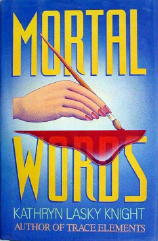
KATHRYN LASKY KNIGHT – Mortal Words.

Pocket, reprint paperback; 1st printing, July 1991. Hardcover edition: Summit Books, 1990.

   It’s a comfort then [after reading and reviewing Ben Sloane’s Hot Zone] to return to the real world, where deaths still occur, but when they do, they’re seriously mourned. The real world, unfortunately, is filled with violence, there’s no denying that, but it’s nice to be able to feel that you’re not the only one who feels that violence is the problem, and very seldom is it the solution.
KATHRYN LASKY KNIGHT

   On the top of the front cover, even before the title, is the heading: “Calista Jacobs is back!” Unfortunately, this is the first I knew about Trace Elements, which was Callista’s first mystery-adventure, along with her precocious son Charley, who is now 13, so I never knew she was away.

   Luckily (in a matter of speaking) enough references to the earlier book are made that I may not even have to go out looking for it. In terms of updating her life, in Mortal Words Calista is now a widow. She is also a world-famous illustrator of children’s books, and she and Charley live in that hotbed of liberalism, Cambridge, Mass.

   This is definitely not a book for readers of a more conservative persuasion. The book opens with Calista and her friends being harassed by a fervent right-wing fundamentalist at a librarian’s literary conference, and the plot grows to include born-again evangelists, evolutionary racists, and Nazi-inspired sperm banks. Moral cripples all, according to Ms. Knight, but nonetheless they embody a powerful anti-science movement, and quite the nasty combination indeed.

   Naturally Calista is opposed to all this with every fiber of her being, and equally naturally it makes her an obvious target. Murder also occurs, but with Charley’s computer-hacking abilities and general intellectual curiosity, along with Calista’s growing friendship with Archie Baldwin, noted archaeologist, the villains stand very little chance.

   As you may have gathered, here is a mystery that is bursting the seams of plain old (and old-fashioned) detective fiction, and in my opinion, it certainly wouldn’t hurt anybody to read it. As a detective story, though, I think it’s seriously flawed by the total lack of attention the Boston police force pay to the murder and to the invaders of Calista’s home.

   They are so severely excluded from the story, as a matter of fact, that you begin to wonder if they could possibly be in on the plot. I hope I’m not saying too much without a [WARNING: Plot Alert] that they are not, but it certainly makes the rest of the story a little harder to swallow.

   This same lack of concern on the part of Calista and Archie as to their safety, and that of Charley, is just as hard to accept. If murder and the invasion of one’s home isn’t warning enough that their opponents are serious, what is?

— Reprinted from Mystery*File 33, Sept 1991 (revised).


[UPDATE] 12-23-08.   The author wrote only four books in the series. As Kathryn Lasky, she’s been much prolific as a writer of children’s books, both fiction and non-fiction, for which she’s been given a list of awards as long as your arm. Expanded from her entry the Revised Crime Fiction IV, by Allen J. Hubin, here are her four mysteries, all with Calista Jacobs:

KNIGHT, KATHRYN LASKY. 1944- .
      Trace Elements. Norton, hc, 1986. Pocket, pb, 1987.
KATHRYN LASKY KNIGHT

      Mortal Words. Summit, 1990. Pocket, pb, 1991.
      Mumbo Jumbo. Summit 1991. Pocket, pb, 1992.
      Dark Swan. St. Martin’s, 1994. Worldwide, pb, 1996.
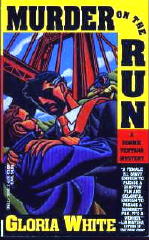
GLORIA WHITE – Murder on the Run.

Dell, paperback original. First printing, July 1991.

   According to page one, Ronnie Ventana is the half-Mexican daughter of a pair of jewel thieves. Somehow she is now a PI. According the short bio at the end of the book, this is Gloria White’s first novel.

GLORIA WHITE Ronnie Ventana

   Of these two statements, the first one is more than a little unusual, but it’s actually the second one that’s harder to believe. This is a very good book, and if I had any say in the matter (which I don’t, since I’m not involved in voting for any book for any award) I think it could easily be nominated for Best First Novel in anybody’s league.

   It begins like this. Ronnie is out running near Golden Gate Bridge one morning, when she spots two men struggling. One pushes the other into the water, and then she is pursued by the one who did the pushing. Luckily she gets away.

   Two problems follow right away: (1) the body is not discovered immediately, and (2) she recognizes the person who did the dumping as Pete August, a PI who once worked for the D.A.’s office, and who was also once on the police department — and in brief, a fair-headed, high profile boy with all his former connections still intact.

   Snubbed by the police, Ronnie keeps on the case. More deaths follow, and she manages to get a homicide detective named Philly Post interested. Ronnie is a lady who doesn’t give up, and the story has both ginger and snap.

   There is even an unexpected twist ahead. The only problem is the ending. It’s too predictable. A little too obvious. I saw it caning. One good twist deserves another, as the saying goes, and I didn’t get it.

   Don’t get me wrong, though. This book is as good as any of the other female PI novels I’ve read in recent months, and some of them were as good as some of the males of the species. (A number of them were even better.)

— Reprinted from Mystery*File 33, Sept 1991 (slightly revised).


[UPDATE] 12-20-08. This is the first review I’ve reprinted since I announced the new focus for this blog posted last weekend but revised earlier today. I was doing movie reviews back in 1991 as well as now, and the ones in this old issue of M*F will soon be showing up here also.

   As for Gloria White, her PI character Ronnie Ventana didn’t have as long a career as I was hoping when I wrote this review. In spite of a slew of award nominations, which I’m pleased to have anticipated, Dell dropped her books after only four outings. Luckily, and this doesn’t always happen, two more books in the series have come out in recent years, and in hardcover to boot.

   Expanded from her entry in the Revised Crime Fiction IV, by Allen J. Hubin, here’s a list of all of Gloria White’s mystery fiction:

WHITE, GLORIA.    Series character: PI Ronnie Ventana in all.
      * Murder on the Run. Dell, pbo, 1991. [Anthony Award finalist]
      * Money to Burn. Dell, pbo, 1993.
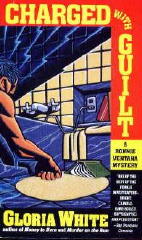
      * Charged with Guilt. Dell, pbo, 1995. [Edgar Award Finalist, Shamus Award Nominee, Anthony Award Finalist]

GLORIA WHITE Ronnie Ventana

      * Sunset and Santiago. Dell, pbo. 1997. [Edgar Award Finalist, Shamus Award Finalist]
      * Death Notes. Severn House, hc, April 2005.
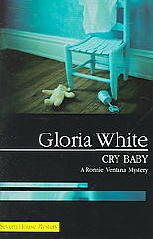
      * Cry Baby. Severn House, hc, June 2006; trade paperback, June 2007.

GLORIA WHITE Ronnie Ventana

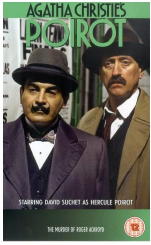
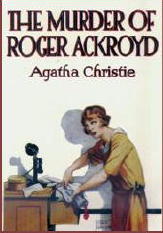
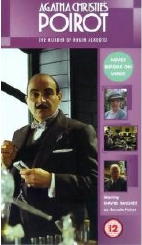
THE MURDER OF ROGER ACKROYD. TV movie/episode of Agatha Christie: Poirot. First shown in the UK on 2 January 2000 [Season 7, Episode 1]. David Suchet, Philip Jackson, Oliver Ford Davies, Selina Cadell, Roger Frost, Malcolm Terris, Nigel Cooke, Daisy Beaumont, Flora Montgomery. Based on Agatha Christie’s novel of the same name. Screenwriter: Andrew Grieve. Director: Clive Exton.

AGATHA CHRISTIE Roger Ackroyd

   It’s been a long time since I first read the book — something like 55 years ago — and it was also the last time. This is one of only two detective novels for which I remember the ending and who did it, and the other was by Agatha Christie also.

   Which is why the book has been only a one-time affair for me. The details I don’t remember, but I do remember Hercule Poirot — it was probably my introduction to him, but I couldn’t swear to that — and once you’ve read a novel he’s in, if you’re a detective story fan of any kind, he’s a character you’ll also never forget.

   Confession time. I’ve never seen David Suchet as Poirot until now. Pure negligence on my part, or a certain lack of resolve, whatever. Right now, at the moment, I am typing this, I’m a convert. 100 percent. Suchet is Hercule Poirot, to the ultimate and finest detail.

AGATHA CHRISTIE Roger Ackroyd

   If you know the story about Roger Ackroyd’s murder, and without my saying more, I am assuming that you do, you might wonder how it could be filmed. If it were up to me, I’d do as direct an adaptation as I could, but Andrew Grieve goes at it sort of sideways and this misses the point of the tale entirely. (At the beginning of the film Poirot is reading from the killer’s diary.)

   The characters in this film are among those that are also in the book, but some research into other reviewers’ commentaries say that not all of the characters in the book are in the movie, present and accounted for.

   There is also an extra murder that is not in the book (or again, so I’m told). And on my own, with no help from others, I certainly did not recognize the shootout in the chemical factory between the killer on one side at the end, and Poirot and Inspector Japp (Philip Jackson) on the other. Good grief. What were they thinking?

AGATHA CHRISTIE Roger Ackroyd

   I also wondered about the scene in Poirot’s old semi-abandoned city apartment (the movie begins as he’s “enjoying” his retirement far out in the country). Poirot seems choked up about the place, the furniture covered in sheets, with bad memories flooding his mind. What was that all about? (Perhaps it has to do something with the fact that I started watching the Suchet series with Season 7?)

   All in all, I suppose one could easily enjoy this made-for-TV movie if one did not know the story, nor the character, ahead of time. I can usually tune things out so that I can watch the film the screenwriter and director want to tell while I’m watching, which I did just fine. But why on earth did they want to tell this one?

   I exclude David Suchet from blame. Even if he had something to say about the story, I’m going to say he didn’t, and I’m looking forward to his next outing in the boxed set I just bought myself as an early Christmas present.

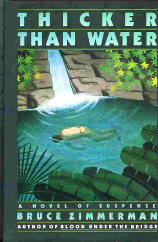
BRUCE ZIMMERMAN – Thicker Than Water.

Detective Book Club; reprint hardcover [3-in-1 edition]. First edition: HarperCollins, 1991. Paperback reprint: Harper, 1993.

BRUCE ZIMMERMAN

   In the five year period from 1989 to 1994, Bruce Zimmerman wrote four mystery thrillers featuring phobia therapist Quinn Parker, but since then he seems to have disappeared. Or at least I’ve found nothing more about him than what’s in Al Hubin’s Crime Fiction III, even using a quick search on the Internet. The four books and nothing more.    [See also the UPDATE below.]

   From the book at hand, the second in the series, Zimmerman seems to have been aiming at the moderately-boiled Travis McGee market. Treating phobia patients as a profession seems to be a good way of getting the San Francisco based Parker into all kinds of scrapes, but in this book, nothing is made of it.

   Parker gets involved this time when he gives a good buddy a hand after he inherits a half-million dollar estate in Jamaica and finds there are exceedingly dangerous strings attached.

   Zimmerman is very good at thumbnail dead-on descriptions of the people found in his books, and more than once I was brought suddenly to attention by a plot twist that was (to say the least) unexpected. But as a detective, Quinn Parker is — well, if inept is not quite the right word, then to say the least, he’s not very good at it. One additional death, if not two, can be attributed directly to Parker’s entirely unsavvy approach to the business at hand.

   Worse, he seems all but blithely unaware of it. He swallows hard, and it’s on to the next chapter. Nor is the ending particularly neat and tidy, with one explanation in particular producing (in my mind) many more questions than answer.

   From mind-boggling turns of plot to mind-blowing maladroitness, that’s the mix. Worth spending an evening’s reading time on, but not likely to be remembered strongly by more than a few of those who do.

— December 2002 (very slightly revised)


[UPDATE] 12-18-08. First of all, notice that I referred to Crime Fiction III in this review. The latest edition of Al Hubin’s book (but available only on CD) is the Revised Crime Fiction IV.

   Secondly, either the Internet contains more than it did six years ago, or I’m getting better at Google. Was Google around six years ago? Maybe not. Either way, I found out why there were four Quinn Parker mysteries (as stated in the review) and only four.

   Bruce Zimmerman, as it turns out, discovered Hollywood, or Hollywood discovered him. To his lasting great fortune, Zimmerman started writing for TV in 1998, and in 2000 he turned producer. Series to his credit in the latter capacity (thanks to IMDB) include The District, Judging Amy, Desperate Housewives, CSI: NY, and K-Ville. (I really liked that last series, a cop show taking place in New Orleans, but I think I was the only one. After last year’s writers’ strike, it never returned.)

   And thanks to the previously mentioned Crime Fiction IV, slightly expanded, here’s a list of the mystery novels that Bruce Zimmerman produced:

ZIMMERMAN, BRUCE. 1952- . Series character: Quinn Parker, in all four.
      Blood Under the Bridge. Harper, hc, 1989; St.Martin’s, pb, 1990.   [Nominated for an Edgar in the Best First Novel category.]

BRUCE ZIMMERMAN

      Thicker Than Water. Harper, hc, 1991; ppbk, 1993.
      Full-Bodied Red. Harper, hc, 1993; ppbk, 1994.
      Crimson Green. Harper, hc, 1994; ppbk, 1995.

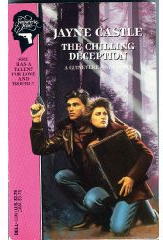
JAYNE CASTLE – The Chilling Deception.

Dell, paperback original. First printing, August 1986.

   Speaking of numbers of books sold, as I was in my preceding review of Richard S. Prather’s Over My Dear Body, Jayne Castle is no slouch in racking up sales, which were up to seven million in print at the time The Chilling Deception came out. (Ms. Castle is also known as Stephanie James and Jayne Ann Krentz, which also happens to be her real name.)

JAYNE CASTLE Chilling Deception

   That many of her books are romances without a hint of mystery to them makes no difference at all, especially to the IRS and other more mortal bean-counters.   [Jayne Krentz is also Amanda Quick, under which name many of her more mystery-oriented books have appeared, but she didn’t use that name until several years after this review first appeared.]

   Prompted, I assume, by the success of such TV series as Remington Steele and Moonlighting, in which the pseudo-romance between the leading characters is featured as prominently as the detective story itself, book publishers (never ones not to sense a dollar when a dollar is there) have decided to get in on the action. Hence, the second of the adventures of Guinevere Jones, exclusive secretarial assistant, and Zachariah Justis, sophisticated security specialist.

   They have a romance going — or more properly, perhaps, an affair — and in between trying to help their combined client in this book out from whatever trouble he is in — he won’t tell them — Guinevere is trying to pin Zach down as to what exactly their relationship is, and Zach, he’s simply trying to pin Guinevere down. In bed, that is.

   There is more explicit sex in this book than in Richard Prather’s, say, and nothing else could be more indicative as to how times have changed. Swooning is hardly enough for today’s readers — and I imagine I’m talking about the female half of the population, for I don’t believe many males will read this book.

   And if they do, they are likely to find the other scenes, those in which Guinevere and Zach talk (or, when they’re alone, think) about their relationship, something less than totally compelling. (I hope I’m not maligning men too much.)

   I have little idea how the aforementioned female half of the population will go for this book and this series, except to say that a track record of seven million books is quite a record to build on.

— From Mystery.File 1, January 1987 (greatly revised).


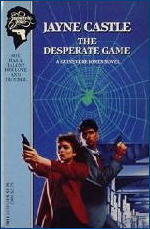
[UPDATE] 12-12-08. There were in all four books in the series. They all came out in 1986. Expanded from the Revised Crime Fiction IV, by Allen J. Hubin, here’s a complete list:

JONES, GUINEVERE
      o The Desperate Game (n.) Dell, pbo, June 1986.

JAYNE CASTLE Desperate Game

      o The Chilling Deception (n.) Dell, pbo, Aug 1986.
      o The Sinister Touch (n.) Dell, pbo, Oct 1986.
      o The Fatal Fortune (n.) Dell, pbo, Dec 1986.

JAYNE CASTLE Fatal Fortune

   She has her own page on the Thrilling Detective website, devoted to private eyes of all kinds, but other than that, I don’t know how successful the series was.

   Except for this. If you were to search for any of these four books on Amazon, which is where you will find the most accurate prices books are really going for, you will find only one for which the asking price is less than $22.50, and I’m willing to wager that that one book won’t last long at that price.

   Apparently none have been reprinted. If that’s so, one wonders why, as the market for Jayne Ann Krentz’s fiction seems to know no bounds. If her total was seven million books in print in 1986, one can only imagine what it is now.

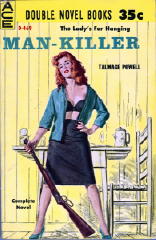
TALMAGE POWELL – Man-Killer.

Ace Double D-469; paperback original. First printing, 1960.

TALMAGE POWELL

   Speaking of “workmanlike prose,” as I was a little while ago — in the review of the other half of this Ace Double, as a matter of fact — I know Talmage Powell wrote a good deal for the pulps, so I’m not surprised to find anything he wrote totally readable — even, to coin a phrase, “hillbilly mystery fiction,” of which this might be a prime example (complete with moonshiners, deputy sheriffs and other dumb hicks).

   [The other half was Bob McKnight’s Running Scared, and you can find my comments here.]

   If a lack of tightly knit plotting may have been McKnight’s Achilles heel in the other half of the double volume, then a tendency toward melodramatic dialogue is Powell’s in his portion. Or maybe I’m not the one to judge. Perhaps old aristocratic ladies now on hard times actually speak the way they do in this book while contemplating their future — and the future of wayward sons who (in this book) insist on helping a poor hill girl accused of killing her husband days before her divorce becomes final.

   Or maybe the subject matter just naturally leads toward melodrama. More solidly plotted than McKnight’s book, Man-Killer nonetheless lacks the compulsive (not to say screwy) readability of Running Scared, which, on the whole, if you were to ask, I’ve decided is the better of the two.

— From Mystery.File 1, January 1987 (heavily revised).


[UPDATE] Later the same day.   I didn’t do it ahead of time, and maybe I should have, but in the first comment to this post, August West happened to mention Talmage Powell’s private eye character Ed Rivers. Having a few minutes on my hands, I followed up with a list of all five detective novels that he was in. Check it out.

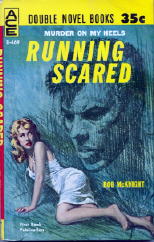
BOB McKNIGHT – Running Scared.

Ace Double D-469; paperback original; 1st printing, 1960.

   I meant to say something about George Harmon Coxe’s “workmanlike” prose in my recent review of Murder for Two, but it could be said just about as well right here. [The phrase is a common one; Google just a moment ago produced about 3000 hits.] What I mean by the term is this: a style of writing that you just don’t notice.

   Nothing so fancy as to call attention to itself, although as a standard that’s hardly enough. It can’t be anything other than a subjective assessment, one that varies from person to person.

   Nonetheless, assuming that there is such a concept, I think that “workmanlike prose” was more common with writers whose background was working for the pulp magazines. Writers whose job it was to tell a story, to get on with it, before their readers got bored and went on to something else.

BOB McKNIGHT

   Coxe was such a writer. Frank Gruber was another. The most famous was probably Erle Stanley Gardner. None would get much of notice for their writing from a professor of literature, but because they were good writers, they captured the reader’s attention from page one onward.

   Although I don’t believe he ever wrote for the pulps. He came along a little too late for that. He was a paperback writer. He never had a book come out in hardcover, so in the overall scheme of things he’s on a far lower scale than either a Gardner or a Coxe, who both made it big. But a storyteller? Yes.

   The plot of Running Scared is that of your basic, everyday nitwit hero in a not quite everyday basic situation. He’s the kind of guy who has reasons for not calling the cops on page two — for if he had, there would be no story. He watches a murder take place, committed by someone driving his ex-wife’s car, and then he gets a call warning him that she has reported the car stolen. By him.

   He goes to her apartment (after being beaten up by two hoods on the way), befriends another girl there, hides her in a bathroom hamper when the cops come calling, and then finds her shot to death inside the hamper when the cops leave.

   I am not making this up. Actually, it reads very well. McKnight had the knack of making you believe nonsense like this all the while you realize that it is nonsense. Workmanlike prose, remember? One could easily picture an Alan Ladd or a Dick Powell in the leading role.

   But in the end, this is about all there is to say about the book. The pace is terrific, and I guarantee you that once stated, you will keep reading. Unfortunately, I cannot tell you that there is any overall depth to either the characters or the story. It’s too lightweight to be considered memorable, and the non-meticulous details of the plot are exactly that.

   What Running Scared is, though, is fun to read.

— From Mystery.File 1, January 1987 (heavily revised).


TALMAGE POWELL

[UPDATE] 12-09-08.   My comments on the other half of this Ace Double will be posted here shortly. For the record, it is Man-Killer, by Talmage Powell, an author who really did start out writing for the pulp magazines before shifting into a career, mystery-wise, of mostly paperback originals.

   As for Bob McKnight, here below is a complete list of his novel-length mystery fiction, as compiled in the Revised Crime Fiction IV, by Allen J. Hubin. Surprisingly enough to me, when I wrote this review I obviously didn’t recognize PI Nathan Hawk as being in this book and as being a series character. I thought so little of him, apparently, that I didn’t even mention his name. (I don’t think he was the main protagonist, but perhaps he was.)

   [INSERTED LATER.] I have located my copy of Ace Double D-469, and I was “right” and Al has erred in including Nathan Hawk as a Series Character in Running Scared. The primary protagonist is a guy named Harlan Jamieson and no PI’s are in the picture at all. I’ve so informed Al, and the deletion of Mr. Hawk from this book will be so mentioned in the next installment of the online Addenda. Also added will be the setting: St. Petersburg, Florida, so established by the mention of Al Lang Field early on in the story.

   And as long as I’ve brought him up, Nathan Hawk is included in Kevin Burton Smith’s website devoted to Private Eye fiction. He says, in part: “Tough guy eye NATHAN HAWK, transplanted northerner in Sun City, Florida, shot and slugged his way through ten novels published by ACE in the late fifties and early sixties. Detective Lieutenant Toby Duane lends a hand when he can, and dishes out plenty of friendly ‘damn yankee’ jibes along the way.”

   Running Scared is the only one of McKnight’s books I’ve ever read. Even though my judgment was qualified, I’m a sucker for books with wacky openings like this, even if the endings don’t pan out so well in comparison. Given an opportunity, I absolutely would read another.

McKNIGHT, BOB. 1906-1981. Mining engineer, pilot and horse-racing handicapper before semi-retiring to Florida.
      Downwind (n.) Ace Double D-217, 1957 [Santa Fe, NM]
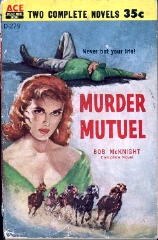
      Murder Mutuel (n.) Ace Double D-279, 1958 [Nathan Hawk; Florida]

BOB McKNIGHT

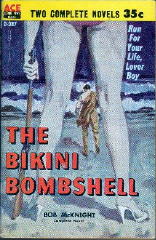
      The Bikini Bombshell (n.) Ace Double D-387, 1959 [Nathan Hawk; Florida]

BOB McKNIGHT

      Swamp Sanctuary (n.) Ace Double D-411, 1959 [Florida]
      Kiss the Babe Goodbye (n.) Ace Double D-447, 1960 [Nathan Hawk; Florida]
      Running Scared (n.) Ace Double D-469, 1960 [DELETE Nathan Hawk; ADD setting: Florida (St. Petersburg)]
      Secret Sinners (n.) Merit 35, 1960 [Nathan Hawk; Florida]
      A Slice of Death (n.) Ace Double D-419, 1960 [Florida]
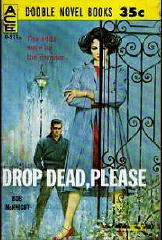
      Drop Dead, Please (n.) Ace Double D-511, 1961 [Florida]

BOB McKNIGHT

      The Flying Eye (n.) Ace Double F-102, 1961 [Florida]
      A Stone Around Her Neck (n.) Ace Double F-143, 1962 [Nathan Hawk; Florida]
      Homicide Handicap (n.) Ace Double F-229, 1963 [Nathan Hawk; Florida]

GRAHAM THOMAS – Malice Downstream.

Fawcett Books; paperback original; 1st printing, December 2002.

GRAHAM THOMAS

   Graham Thomas is a Canadian writer (British Columbia) who seems to have the British down pat, both the countryside and the countrymen. This is the fifth case for Detective-Chief Superintendent Erskine Powell, all paperback originals, and in the age of bloated mysteries running up to 400 pages or more, they’re lean and mean at a mere 200 plus.

   In Malice Downstream Powell is found recuperating from a previous injury at a small village called Houghton Bridge, known almost only for its superb chalk stream fishing, and home of the renown Mayfly Club. Taking his mind off his almost healed leg, and to a lesser extent his failing marriage, Powell also finds murder, with roots in the past. Totally out-of-bounds in taking a hand in investigating a case he shouldn’t be, he’s obviously the epitome of a busman on holiday.

   The detective work is solid if not flashy, with a villain rather obvious from first meeting, but if fly-fishing is an art you’re interested in, this is the book for you. And even if you’re not, if you can enjoy reading about the enthusiasm that someone else has for their near-obsessive hobbies, then this is also the book for you.

   Overall a male-oriented book, but still very cozy in nature. Snug and insightful, in a minor key sort of way.

— December 2002 (slightly revised)


[UPDATE] 12-09-08. Until I looked him up in the Revised Crime Fiction IV, by Allen J. Hubin, I did not know that Graham Thomas was a pen name, but it is so. I’m guessing, of course, but perhaps Kosakoski did not sound “British” enough to someone whose opinion mattered.

   Using his entry in CFIV as a basis, here below is a complete list of the Graham Thomas mysteries. Chief Supt. Erskine Powell is in all of them.

   Note: In the original version of this review, I stated that Malice Downstream was the sixth in the series. It does not appear to be so, nor was there ever a sixth.

THOMAS, GRAHAM. Pseudonym of Gordon Kosakoski, 1950- .
      Malice in the Highlands. Ivy, pbo, Jan 1998.

GRAHAM THOMAS

      Malice in Cornwall. Ivy, pbo, June 1998.
      Malice on the Moors. Ivy, pbo, Aug 1999.
      Malice in London. Ivy, pbo, April 2000.
      Malice Downstream. Fawcett, pbo, Dec 2002.

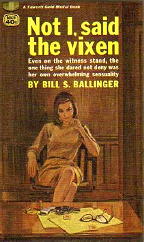
BILL S. BALLINGER – Not I, Said the Vixen

Gold Medal k1529; paperback original, 1965.

   Ballinger had a long career as a mystery writer as well as working for television and the movies, but for some strange reason, this is the first book of his I’ve read. So, whether this one is any way typical or non-typical of his fiction, I couldn’t tell you.

BILL S. BALLINGER Not I Said the Vixen

   His one-time protagonist in this largely courtroom affair is Cyrus March, perhaps the best defense attorney in the country. But unlike Perry Mason, say, March also has a drinking problem. And somewhat unlike Perry Mason, his client admits to pulling the trigger in the fatal shooting of a wealthy female socialite.

   Like so many of Perry Mason’s clients, Cyrus March’s is a beautiful woman, perhaps even narcissistic, and her story is that the victim was an unknown intruder in her apartment. March’s problems with the bottle began with the death of his wife, and unlike Perry Mason, he soon declares his love for person he’s defending.

   The dialogue is sometimes stilted, and the action often stagy, but every once in a while Ballinger mixes in a brilliant turn of phrase that makes you remember why you’d rather be reading instead of watching the tube. He also alternates chapters between first and third person, an unusual format that doesn’t quite click, even though you know why he’s using it.

   Lesbianism is a key ingredient of what makes the courtroom drama go — it’s seemingly kept at arm’s length at first, but the nuances become less and less subtle as the story works its way out.

   Rather a minor effort overall, but if you ever find a copy to read, I think it’ll keep you interested all the way through. It did me, and sometimes that’s all you need.

— December 2002


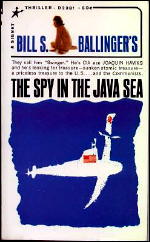
[UPDATE] 12-05-08.   Out of curiosity, I checked again to see if Cyrus March showed up in any of Ballinger’s other mystery fiction, but I’ve found nothing to suggest that he did. Ballinger did have a series character named Joaquin Hawks, who was in five paperback originals put out by Signet in the two year period 1965-66.

   As a Native American detective, tribal affiliation unknown, Hawks is mentioned in my list of N.A. sleuths on the primary M*F website, but I’ve not read any of his adventures. Another website says that he “is a case officer in the Central Intelligence Agency. His normal beat is Southeast Asia.”

   If you follow that last link, you’ll find a lot more information about him. For the record, here’s a list of all five of the Joaquin Hawks books, expanded from the Revised Crime Fiction IV, by Allen J. Hubin:

             HAWKS, JOAQUIN:
      The Spy in the Jungle (n.) Signet D2674, pbo, May 1965 [Viet Nam]
      The Chinese Mask (n.) Signet D2715, pbo, June 1965 [China]
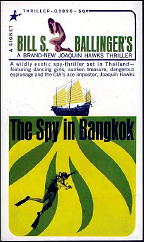
      The Spy in Bangkok (n.) Signet D2820, pbo, Dec 1965 [Thailand]

BALLINGER Spy in Java Sea

      The Spy at Angkor Wat (n.) Signet D2899, pbo, May 1966 [Cambodia]
      The Spy in the Java Sea (n.) Signet D2981, pbo, Sept 1966 [Far East]

BALLINGER Spy in Java Sea

A 1001 MIDNIGHTS Review by Marcia Muller & Bill Pronzini:


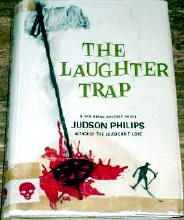
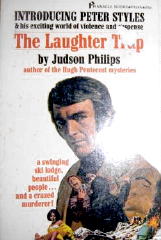
JUDSON PHILIPS – The Laughter Trap. Dodd Mead, hardcover, 1964. Hardcover reprint: Detective Book Club [3-in-1 edition], December 1964. Paperback reprint: Pinnacle P154N, January 1973.

JUDSON PHILIPS Laughter Trap

   Although his work as Hugh Pentecost is better known, Judson Philips has published some excellent novels of suspense and detection under his own name, and created one notable series character — Peter Styles, a national columnist for Newsview magazine who specializes in human-interest stories.

   The Laughter Trap is the first of many novels featuring Styles and dramatizes the tragic events that irrevocably altered the shape of his life and career.

   While on their way home from the Darlbrook Lodge in the Green Mountains of Vermont, Styles and his elderly father, Herbert, a successful but alcoholic advertising executive, are forced off the road by two thrill killers. Herbert Styles dies in the fiery wreck; Peter is thrown free, but sustains a serious injury that forces doctors to amputate his right leg halfway between the ankle and the knee.

JUDSON PHILIPS Laughter Trap

   He recovers with the help of a former lover, Liz Connors, whose husband is a doctor specializing in prosthetic devices. His new artificial leg allows him to move around with only the slightest limp, and once he has recovered, he devotes his life to an ongoing search for the men who cost him his father and his leg. His only clue is the “hideous high giggling laugh” he heard before the crash.

   All of this is told in flashback and through conversations with others as Styles returns a year later to Darlbrook Lodge. He has wired for private accommodations, but ends up sharing a room with the lodge’s publicity man, Jim Tranter, through whose eyes we view the rest of the story.

   Styles’s first evening at the lodge is without unusual incident — until he awakens Tranter in the middle of the night, claiming he has again heard the hideous laughter. In the morning, a much more disturbing event is revealed: Two young women staying in one of the cabins — Jane Pritchard and Martha Towers have been brutally stabbed to death. Jane Pritchard’s father appears on the scene, accompanied by his other daughter, Laura, and offers a reward for the apprehension of the slayer.

   Styles interests himself in the investigation, believing the killings and the laughter he heard have a connection. By the time he solves the grisly double homicide, the usually peaceful atmosphere of the mountain lodge has been disrupted by yet another killing, an attempted murder, a melee in the bar, and dangerous undercurrents of hatred and suspicion. But while Styles finds satisfaction in the resolution of the case, he finds only frustration in his search for the driver of the car who took his father’s life.

JUDSON PHILIPS

   Styles continues his quest in such other novels as The Twisted People (1965), Nightmare at Dawn (1970), Walk a Crooked Mile (1975), and Why Murder (1979).

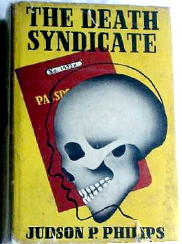
   Of the other series characters created by Philips under his own name, the most interesting are Carole Trevor of the Old Town Detective Agency and her ex-husband, wealthy man-about-town Maxwell Blythe, who appear in two early mysteries: The Death Syndicate (1938) and Death Delivers a Postcard (1939).

         ———

   Reprinted with permission from 1001 Midnights, edited by Bill Pronzini & Marcia Muller and published by The Battered Silicon Dispatch Box, 2007.   Copyright © 1986, 2007 by the Pronzini-Muller Family Trust.

« Previous PageNext Page »