Characters


VICTORIA SILVER – Death of a Harvard Freshman.

Bantam; paperback original; 1st printing, April, 1984.

   Dialogue is an important component of mystery fiction — the most devious plots are often undone by speech patterns that border on either the most stilted or the most incomprehensible, but I am convinced that Harvard freshmen really do talk like the characters in this book. Central Connecticut State (where once I taught) is not Harvard, by any means of comparison, but it is not Outer Slobovia, either, and I think I’m a reasonable person to judge.
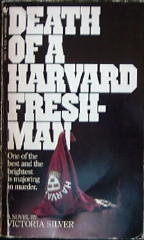
VICTORIA SILVER Death of a Harvard Freshman

   (Mostly I talked to students about courses, grades, and whatever it is that actuaries actually do, and not about personal things like life, sex and whatever else it was that consumed the thinking time of college students back in the mid-1980s, but I still think I’m a reasonable person to judge. Or I was then.)

   Sort of surprisingly enough, this is very much a classical detective story, rather uncommon today, with a limited number of suspects (the fellow members of Lauren Adler’s freshman seminar on the Russian Revolution), a great amount of misdirection in the matter of solving the murder of black student activist Russell Bernard — or rather suspicion directed equally in all directions — and clues derived solely from large amounts of conversation, pieced together from differing accounts of each suspect’s activities and personalities, with very little physical action involved.

   This is also very much an amateur investigation. The police do what they do offstage, and only one faculty member has a major speaking role. Besides the murder — as in the case of Rasputin, perhaps to destroy Russell’s political influence — and its solution, this is also a novel in which each of the characters are seeking their own identity — whether Jewish, black, gay, southern aristocrat, preppie, or L.A. modern.

   I’ll say it again. The characters are real. This is one book I wouldn’t mind reading again, and there are few mysteries I would ever say that about.

Note: Silver’s second mystery, Death of a Radcliffe Roommate (Bantam, 1986), has been published already, and it also features Lauren Adler. Without expanded its borders beyond that of the campus community, this would seem to be a very limited series of books. But as long as I’m nowhere in the vicinity of a school where Lauren’s nearby, I’m really pleased that we haven’t yet seen the last of this fascinating young lady.

— From Mystery.File 1, January 1987 (revised).


[UPDATE] 12-04-08.   Most of the revisions were made to reflect that I’m no longer teaching, so what I know about current students’ speech patterns is rather problematical. What I was comparing, though, were students in the 1980s and they way they talked and the way the students talked in Victoria Silver’s book, which also took place in the 1980s.

   “Victoria Silver,” by the way, is not the author’s real name, and as far as I know, it is not known who the real author was. I suspect that many of the characters in her books were based on people she actually knew. (Googling for more information on her, most of the web pages that came to view were about, you guessed it, Victoria silver.)

   And as I also suspected in the last paragraph of my review, at least between the lines, these were the only two cases of murder in which Lauren Adler ever found herself involved.
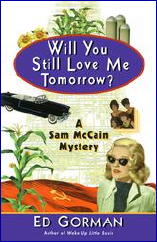
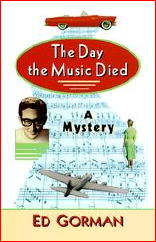
ED GORMAN – Will You Still Love Me Tomorrow?

Berkley; paperback reprint; December 2002. Hardcover edition: Carroll & Graf, January 2001.

ED GORMAN Sam McCain

   Not to make it too personal, but September 1959 was the month I started my senior year in high school, and that’s the very same autumn in which this nostalgic trip back to small-town America takes place. I was younger then than Gorman’s private eye protagonist, Sam McCain, but I remember drive-in movies, rock-and-roll, drugstore lunch counters, Gold Medal paperbacks, and Edd “Kookie” Byrnes.

   I also remember some of the darker sides of life in the late 50s: polio; segregation; Khrushchev’s threats; the remnants of McCarthyism. And it’s the Communist menace, or threat thereof, that forms the background for this latest of three mysteries Gorman has placed in Black River Falls, Iowa.

   The first death is that of a liberal former member of Truman’s administration, and the body count slowly but surely begins to climb from there. As good as the mystery is, even more enjoyable is Sam’s love life, which to put it mildly, is a mess, and I identified with every awkward moment of it.

   Along with an unerring sense of that not-so-long-ago period of American history, Gorman’s quiet but sarcastically obvious sense of humor is what makes this book worth looking for. Very enjoyable.

— November 2002 (slightly revised)


[UPDATE] 12-02-08. After a gap of three years — too long! — Sam McCain made his seventh appearance last year in Fools Rush In, which I haven’t read yet. I will have to do something about that.

      The Day the Music Died. Carroll & Graf, Jan 1999; Berkley, pb, Apr 2000.

ED GORMAN Sam McCain

      Wake Up Little Susie. Carroll & Graf, Jan 2000; Berkley, pb, Feb 2001.
      Will You Still Love Me Tomorrow? Carroll & Graf, Jan 2001; Berkley, pb, Dec 2002.
      Save the Last Dance For Me. Carroll & Graf, Feb 2002; Worldwide, pb, July 2003.
      Everybody’s Somebody’s Fool. Carroll & Graf, Dec 2002; Worldwide, pb, June 2004.
      Breaking Up Is Hard To Do. Carroll & Graf, Feb 2004; Worldwide, 2005.
      Fools Rush In. Pegasus, Mar 2007; trade paperback, Mar 2009.

ED GORMAN Sam McCain

JOHN PENN – A Deadly Sickness.

Bantam, reprint paperback; 1st printing, Nov 1986. Hardcover edition: Charles Scribner’s Sons, 1985. UK first edition: Collins Crime Club, hc, 1985.

JOHN PENN

   There is a type of British detective story I read and greatly enjoy, and I’d have to say that Agatha Christie represents it best.

   It’s an old-fashioned sort of story, one seldom taking place in London, but rather in one of the many villages England seems to be endlessly populated with. The police may take part, but the primary focus is often on other main characters, all of whom are more or less involved with the mystery, some more than others.

   And so, I have discovered John Penn. Everything I said above seems to apply. The first case Detective Superintendent Thorne and Sergeant Abbot worked on together seems to have been A Will to Kill, also recently published by Bantam. As in this one, a young girl is the key figure, and the same local doctor makes an appearance in each.

   In fact he is more of a main character in this one, as the police make only a late and mostly routine appearance in finally solving the death of the wealthy Sir Oliver Poston. The identity of the killer is unknown to the reader, of course, but what’s also a mystery, for a while, is what actually happened after his heir’s drunken accident on the occasion of his 40th birthday, preceding the death of his father. (Of the whole crowd, only the young girl mentioned above seems not to know.)

   As I am aware that most of you are completely capable of reading between the lines, I have probably said too much already. For that reason, I liked A Will to Kill more, but sometimes even when you know what’s going to happen, it’s fascinating to watch well-developed characters as they go through their paces.

— From Mystery.File 1, January 1987 (heavily revised).


[UPDATE] 11-24-08.  By some strange coincidence, when I used my computer to check the date just now, it also told me the time, which was exactly 11:24. I think this may be the day I should buy a whole stack of lottery tickets!

    When I wrote this review, over 20 years ago, I was rather down on British mystery and thriller fiction. How do I know? I deleted the first two paragraphs, neither of which do you see here, nor will you ever see them.

JOHN PENN

    I’ve changed my mind about British detective stories in the meantime. Maybe I’ve slowed down and I enjoy the pace of the older “humdrums” (of which category I do not consider the above to be an example) a lot more than I did when I was younger, but the glitz and glamour of present-day London and other larger cities, with all of their problems with the younger generation and immigrant populations, holds a lot of interest for me as well.

    I believe what remains of the review reads smoothly enough. Enough time has elapsed enough since I wrote it that I cannot tell you, however, whether the doctor figure that I mentioned was the same person, or if I meant to use him as a generic character.

    “John Penn,” and I did not know this when I wrote the review, was the joint pseudonym of Paula Harcourt and John H. Trotman. The latter did not write any mystery fiction of his own, but the former, who died in 1999, has a list of over 20 books to her individual credit in Al Hubin’s Crime Fiction IV, mostly of the espionage thriller variety, from what I can deduce from their titles.

    From CFIV then, here’s a list of all of John Penn’s work. Series characters: GT = Insp. (Supt.) George Thorne; DT = Chief Insp. (Supt.) Dick Tansey. (Most of the Tansey books have never been published in the US.)

* Notice of Death (n.) Collins 1982
* Deceitful Death (n.) Collins 1983
* A Will to Kill (n.) Collins 1983. GT
* Mortal Term (n.) Collins 1984. GT

JOHN PENN

* A Deadly Sickness (n.) Collins 1985. GT
* Barren Revenge (n.) Collins 1986. GT
* Unto the Grave (n.) Collins 1986. GT
* Accident Prone (n.) Collins 1987. GT
* Outrageous Exposures (n.) Collins 1988. DT

JOHN PENN

* A Feast of Death (n.) Collins 1989. DT
* A Killing to Hide (n.) Collins 1990. DT
* Death’s Long Shadow (n.) Collins 1991. DT
* A Knife Ill-Used (n.) Collins 1991. DT
* A Legacy of Death (n.) Collins 1992. DT
* A Haven of Danger (n.) Collins 1993. DT
* Widow’s End (n.) Collins 1993. DT
* The Guilty Party (n.) Collins 1994. DT
* So Many Steps to Death (n.) Collins 1995. DT
* Bridal Shroud (n.) Collins 1996. DT

JOHN PENN

* Sterner Stuff (n.) Collins 1997. DT

STEPHANIE BARRON – Jane and the Stillroom Maid: Being the Fifth Jane Austen Mystery.

Bantam, hardcover; August 2000. Reprint paperback, May 2001.

   Never having read any of Jane Austen’s works, or at least none that I can recall, I may not be the ideal person to be reviewing this book. On the other hand, speaking as a mystery fan, I thought the Jane Austen in this make-believe fiction does superbly well in her role as a full-fledged detective. By way of presentation, the book is related to us by her “editor” Stephanie Barron (a/k/a Francine Matthews), and I enjoyed it immensely.

STEPHANIE BARRON Jane Austen

   The year of the text is 1806, when it was entirely possible that Jane Austen could have been visiting Derbyshire, where she could have seen the house she used as an inspiration for Pemberley, the grand manor in the novel, as Barron says, “we now know as Pride and Prejudice.”

   And if she were in Derbyshire, is it not possible that she could have been once again (see the subtitle) involved in a murder there, this time of an apothecary maid in the most mysterious of circumstances?

   This is a well-plotted, well-told throwback to the Golden Age of detective fiction, in my humble opinion, with complication piled on complication. The maid has been shot in the forehead, but her body has been mutilated in a manner such as to cast blame on the demonic Masons the local folk fear so greatly. A sacrifice of some sort? More, and perhaps most puzzling, she is dressed in men’s clothing.

   Jane’s investigation — for definitely no timid wallflower is she — suggests that the maid’s death involves those well above her station. For many reasons, there are many who are not displeased that she is dead. Once again Lord Harold, the Gentleman Rogue in Jane’s life, is available to give her entrance to the world of the local gentry; if not for him, doors otherwise opened would have remained closed, and the case would never have been solved.

   Told in what satisfies me as being Jane Austen’s own words, with touches of delicate humor throughout, here’s a trip back in time I can’t recommend more. Charming and delectable; a complete pleasure.

— November 2002 (slightly revised)


   Bibliographic data:

      The JANE AUSTEN series —

1. Jane and the Unpleasantness at Scargrave Manor (1996)

STEPHANIE BARRON Jane Austen

2. Jane and the Man of the Cloth (1997)
3. Jane and the Wandering Eye (1998)
4. Jane and the Genius of the Place (1999)
5. Jane and the Stillroom Maid (2000)
6. Jane and the Prisoner of Wool House (2001)
7. Jane and the Ghosts of Netley (2003)
8. Jane and His Lordship’s Legacy (2005)
9. Jane and the Barque of Frailty (2006)

STEPHANIE BARRON Jane Austen

   Stephanie Barron’s most recent book, A Flaw in the Blood (Feb 2008), may be the first in a new historical series. In this one Irish barrister Patrick Fitzgerald, along with his ward Georgiana “Georgie” Armistead, initiates an enquiry into the death of Queen Victoria’s beloved Prince Albert.

REVIEWED BY WALTER ALBERT:         


STEPHEN BOOTH – Scared to Live. HarperCollins, UK, hardcover, 2006; Bantam, US, hc, May 2008.

      —, Dying to Sin, 2007. HarperCollins, UK, hc, Sept 2007.

STEPHEN BOOTH Scared to Love

   I’m not going to mince words about the latest installment in this British rural procedural series: it’s far too long for the interest it generates in its investigation, of the murder of a middle-aged woman who turns out not to be what she seems to be.

   Booth has always reveled in details about the region but the protracted and not really very interesting investigation, and, in particular, the handling of one of his two main characters, D.S. Diane Fry, sapped much of my interest in the novel.

   Diane is an outsider to the region and has become increasingly dissatisfied with her job (and life), and Booth, perhaps himself dissatisfied with the character, has no firm sense of the direction in which he might take her. I didn’t find the character “development,” if that’s what it is, believable. She just comes across as unhappy and unpleasant, and any sympathy I’ve felt earlier for this troubled D.S. greatly diminished.

   I can only hope that Booth gets a firmer grip on her character in the next novel although I’m not really sure that I care to see if he does.

   [ … ]

STEPHEN BOOTH Dying to Sin

   As an addendum to this rather glum take on Booth’s novel, I’m happy to report that the next novel, Dying to Sin, finds Booth in a return to form, with DS Fry and DC Cooper working together to trace the history of skeletons turned up in ground breaking work by the new owner of a local farm, a history that will lead to a third body and a trail of abuse and murder that leads the investigators far afield in their attempts to identify the remains and track down the perpetrators.

   The novel is also a record of the tremendous changes in farming and landowning that are transforming the landscape of rural England. Fry is perhaps no more content with her present assignment than she was in the preceding novel, but she’s able to work effectively within its framework and the more settled Ben Cooper.

DEBORAH DONNELLY – Died to Match.

Dell, paperback original; 1st printing, October 2002.

DEBORAH DONNELLY

   I missed the first one, of course, but I managed to catch up with Deborah Donnelly in this, her second mystery novel. The protagonist in both is Carnegie Kincaid, who’s a high-profile wedding planner in the city of Seattle. While she’s not number one, her clientele still consists of some of the wealthier big-names in town.

   In Died to Match an engagement masquerade party for two of the latter — wealthy big-names, that is — held at the Seattle Aquarium, results in one bridesmaid falling (or jumping or being pushed) into the ocean. Later on yet another one — a bridesmaid, that is — is found murdered in an exhibit with her head crushed in.

   There are a lot of characters to keep track of, which has the advantage of providing a host of possible suspects, but some of them seem to come and go without being fully introduced. Carnegie has a male friend, a newspaper reporter named Aaron, with whom she is having a touch-and-go almost romance. He seems to be the unthreatened jealous type. She thinks he smokes too much.

   The book itself is just over 300 pages long. About half of it is devoted to the various vicissitudes of the wedding planning business, Carnegie’s off-and-on affair with Aaron, and me just in general wondering why the wedding is going on as scheduled with someone (seemingly) stalking the bridesmaids like this.

   Donnelly does some fast talking and shuffling around to explain this (reference Aunt Enid, who may live not much longer) and lest I seem to be neglecting the other half of the book, she does a better-than-average job of providing all of the clues, false leads, and other required paraphernalia of an honest-to-goodness detective story.

   I doubt that I’m among the primary audience intended for this book, but in all honesty, Deborah Donnelly certainly delivers everything her readers are looking for, and maybe others, like me, who are satisfied as well.

— November 2002 (revised)


[UPDATE]  11-22-08. For whatever reason, the wedding planner ambiance, or the fact that the books were a rare breed these days, fully clued detective stories (or hopefully, a combination of both), the series seems to have caught on, at least for a while. There are six of them in all; you’ll find a complete list below. The bad news is that the last one came out nearly two years ago, and there’s not been another one since.

  Veiled Threats. Dell, pbo, Jan 2002. “In the first Wedding Planner Mystery, Carnegie ventures off her Seattle house-boat to deal with a handsome suitor, an annoying reporter, and a kidnapped bride.”

DEBORAH DONNELLY

  Died To Match. Dell, pbo, Oct 2002. “When a Halloween engagement party turns murderous, Carnegie finds herself costumed as a bridesmaid and stalked by a killer!”

  May the Best Man Die. Dell, pbo, Sept 2003. “In this Yuletide caper, Carnegie encounters a drowning at a bachelor party, a stripper in a Santa suit, and a murderous chase through a coffee roasting plant…”

  Death Takes a Honeymoon. Dell, pbo, Apr 2005. “Where there’s smoke, there’s murder, in this fiery tale of smoldering smokejumpers, hot-tempered actresses, and a super-heated Sun Valley summer.”

  You May Now Kill The Bride. Dell, pbo, Jan 2006. “On picturesque San Juan Island, love and lavender are in the air. But so are poisonous gossip, passionate jealousy…and murder.”

  Bride and Doom. Dell, pbo, Dec 2006. “When a baseball-themed engagement party is crashed by a corpse, Carnegie steps up to the plate to clear her pal of murder. Too bad her fiancé Aaron has suddenly come down with Relationship Deficit Disorder…”

DEBORAH DONNELLY

   Note: The short synopses above came from Deborah Donnelly’s website.

A 1001 MIDNIGHTS Review by John Lutz:


GEORGE C. CHESBRO – Shadow of a Broken Man.   Simon & Schuster, hardcover, 1977. Paperback reprints: Signet, 1978; Dell, 1987.

GEORGE C. CHESBRO Shadow of a Broken Man

   This is the first Chesbro novel featuring Dr. Robert Fredrickson, a professor of criminology who doubles as a private detective, is a dwarf, and is known to his friends as Mongo. A onetime top circus performer, Mongo possesses some very useful skills for tight situations, among them tumbling and gymnastic ability and a black belt in karate.

   While preparing to leave for vacation in Acapulco, Mongo is approached by Mike Foster, who married the widow of famous architect Victor Rafferty. Foster’s wife, Elizabeth, happened to see a photograph of a new museum in an architectural magazine, and is convinced that the design is the work of her husband.

   But Victor died five years ago, and the museum’s design is listed as the work of a man named Richard Patern. Victor Rafferty died from a fall into an open smelting furnace, so there was essentially no body to be recovered, and Elizabeth is haunted by the conviction that Rafferty is still alive. Mike Foster’s marriage is suffering; he wants Mongo to clear up this matter so he and Elizabeth can get on with their lives.

GEORGE C. CHESBRO Shadow of a Broken Man

   Mongo assumes there won’t be too much complication here, so he postpones his vacation and accepts the case. His first move is to consult professor of design Franklin Manning, resident architectural genius, who flatly tells Mongo that the museum is Rafferty’s design, without question.

   And suddenly Mongo is involved in something much more complex and dangerous than he imagined. Russian and French agents are part of the package, as are U.N. Secretary Rolfe Thaag and more than one victim of Communist brutality.

   The writing here is literate and fast-paced, the plot is intricate, the concept is bizarre yet entirely plausible. This is a well-spiced recipe that results in haute cuisine.

   Chesbro is also the author of City of Whispering Stone (1978), An Affair of Sorcerers (1979), and The Beasts of Valhalla (1985), which likewise feature Mongo.

GEORGE C. CHESBRO Shadow of a Broken Man

         ———
   Reprinted with permission from 1001 Midnights, edited by Bill Pronzini & Marcia Muller and published by The Battered Silicon Dispatch Box, 2007.   Copyright © 1986, 2007 by the Pronzini-Muller Family Trust.

GEORGE C. CHESBRO, R. I. P.   On a sad note to go with this review, news of George Chesbro’s passing is making the rounds of the mystery fiction blogs today. The best reportage, as usual, is on The Rap Sheet, including some of Jeff Pierce’s personal remembrances of the author.  — Steve

PHILIP ATLEE’S JOE GALL SERIES,
by George Kelley

JOE GALL

   Joe Gall is the Cadillac of hardass spies. Sure, Matt Helm can crush a foe’s kidneys with a crowbar, but would Helm allow himself to be turned into a heroin addict as Gall does in The Death Bird Contract (Fawcett, 1966), surely one of the best books James Atlee Phillips (who writes the Joe Gall series as “Philip Atlee”) ever wrote?

   I started the Joe Gall series early on with The Green Wound (Fawcett, 1963) and The Paper Pistol Contract (Fawcett, 1966). I was immediately impressed by the quality of the writing:

   The man seemed to be trying to walk up into the sky. One second he was strolling along the noon street in Laredo, distinguishable in the polyglot crowd only by his little white leather cap. Then he lunged forward and went gusting into an antic dance. Face contorted under the direct sunlight, he whirled and took two enormous sweeping steps, high and sideways. Racking away from the glittering store windows, he caromed into the parked car and jackknifed into the gutter. (The Green Wound, page 1)

JOE GALL

   We find out later that the man was carrying nearly half a kilo of uncut heroin in his butt, sealed in pliofilm and insertion surgically assisted. However, something went wrong: the bundle busted and a pound of pure heroin blasted into the tissues of the man’s body without warning. And the description of the event is graphic, yet at the same time poetic.

   The other trademark of the Joe Gall series is detailed references to local food, buildings, streets, and exotic customs. The reason is that James Atlee Phillips visited each of the sites of the novels in the series, many times writing the first draft on location to be sure to capture faithfully the local flavor. (Details of Phillips’ writing habits were related to me by a friend of his, Tom Van Zandt.)

   From Van Zandt’s information, Joe Gall is a projection of Phillips’ own fiery personality and style. Early in the series, Phillips has a minor character describe Joe Gall’s role that remains more or less consistant throughout the series:

JOE GALL

    “You are a greedy-guts, companero, like me. You want the best of everything; the best wines, the most attractive women, the clean overhead smash in tennis…. And you do these things well, almost with a Spanish style. But the flaw is always there. You are trying to sneak around the edges of your society, an anonymous man getting the best of it. Without making any obeisance to its smug gods of mass stupidity, automation, and regimentation…. You would appear to be, although you have not told me so, some kind of roving executioner in the holy name of Democracy. You think you can do this, as part-time work, and nurture your soul in an Ozark Mountain retreat. Not so, Josef. If you work in an abattoir, you get blood on you.” (The Silken Baroness, page 53)

   Joe Gall has class. He works only on a contract basis for large sums of money and spends most of his time in a fabulous mountain retreat in the Ozarks. He’s similar in style and flair to that legendary Western “consultant,” Paladin.

JOE GALL

   In terms of quality, I like the first four books in the series best. The Skeleton Coast Contract (Fawcett, 1968) features my favorite Joe Gall scene: Joe’s staked out on an anthill, and I assure you the description will make you itchy and wiggly for weeks. I have a certain amount of sentimental fondness for The Canadian Bomber Contract (Fawcett, 1971) because my home town is Niagara Falls, New York and I appreciate the fact that Phillips took the time to write an adventure taking place in my backyard and get it right.

   I recommend all the books in the Joe Gall series without reservation, but you have my preferences. The later books seemed to lack vitality and The Last Domino Contract (Fawcett, 1976) has Joe Gall calling it quits. Whether Phillips brings Gall out of retirement remains to be seen; however we have several top quality books to continue to enjoy while they remain in print.

– From The MYSTERY FANcier, Vol. 3, No. 2, Mar-Apr 1979       (very slightly revised).


      Bibliographic data: The JOE GALL books. [Expanded from Crime Fiction IV, by Allen J. Hubin.]

   Pagoda, as by James Atlee Phillips. Macmillan, hardcover, 1951. Bantam 1055, paperback, 1952. [Burma]. Joe Gall is an independent soldier of fortune.

JOE GALL

All later books are paperback originals:

   The Green Wound. Gold Medal k1321, July 1963 [New Orleans, LA] Joe Gall is now a semi-retired contract agent for the CIA. Reprinted as The Green Wound Contract, Gold Medal, 1967.
   The Silken Baroness. Gold Medal k1489, 1964 [Canary Islands] Reprinted as The Silken Baroness Contract, Gold Medal, 1966
   The Death Bird Contract. Gold Medal d1632, 1966 [Mexico]
   The Paper Pistol Contract. Gold Medal d1634, 1966 [Tahiti]

JOE GALL

   The Irish Beauty Contract. Gold Medal d1694, 1966 [Bolivia]
   The Star Ruby Contract. Gold Medal d1770, 1967 [Burma]
   The Rockabye Contract. Gold Medal d1901, 1968 [Caribbean]
   The Skeleton Coast Contract. Gold Medal D1977, 1968 [Africa]
   The Ill Wind Contract. Gold Medal R2087, 1969 [Indonesia]
   The Trembling Earth Contract. Gold Medal, 1969 [U.S. South]
   The Fer-de-Lance Contract. Gold Medal, Jan 1971 [Caribbean]
   The Canadian Bomber Contract. Gold Medal T2450, August 1971 [Montreal, Canada]
   The White Wolverine Contract. Gold Medal T2508, Dec 1971 [Vancouver, Canada]
   The Kiwi Contract. Gold Medal T2530, Feb 1972 [New Zealand]
   The Judah Lion Contract. Gold Medal T2608, Sept 1972 [Ethiopia]
   The Spice Route Contract. Gold Medal T2697, April 1973 [Middle East]
   The Shankill Road Contract. Gold Medal T2819, Sept 1973 [Ireland]

JOE GALL

   The Underground Cities Contract. Gold Medal M2925, Feb 1974 [Turkey]
   The Kowloon Contract. Gold Medal M3028, August 1974 [Hong Kong]
   The Black Venus Contract. Gold Medal M3187, Feb 1975 [South America]
   The Makassar Strait Contract. Gold Medal P3477, March 1976 [Indonesia]

JOE GALL

   The Last Domino Contract. Gold Medal 1-3587, 1976 [Korea]

Note: In a chart created by R. Jeff Banks accompanying the first appearance of this article, he points out that the background of the unnamed hero of The Deadly Mermaid by James Atlee Phillips (Dell 1st Edn #26, pb, 1954) is very similar to that of Joe Gall’s.

THE CURMUDGEON IN THE CORNER
by William R. Loeser

ARTHUR W. UPFIELD – An Author Bites the Dust.

ARTHUR W. UPFIELD An Author Bites the Dust

Angus & Robertson, Australia, hardcover, 1948. Doubleday Crime Club, US, hc, 1948. Many reprint editions, both hardcover and soft, including Angus & Robertson, UK-Australia, hc, 1967; and Scribner’s, US, ppbk, August 1987 (both shown).

   The most under-rated writer of detective fiction is certainly Arthur Upfield. His books provide levels of characterization and description of places exceptional in the mystery. Most importantly, his half-aborigine Detective Inspector Napoleon Bonaparte can and does detect.

ARTHUR W. UPFIELD An Author Bites the Dust

   Moreover, Mr. Upfield did not, to my knowledge, write a bad book. For the first few chapters, though, of An Author Bites the Dust, I thought he had; for Mr. Upfield had difficulty breathing life into the dry husks of the coterie of colonial litterateurs led by the soon-to-die Mervyn Blake, who see their purpose in life as shaping the future of Australian literature.

   Fortunately, other characters appear and Bonaparte is able through questioning to make some of the remaining writers come to life. It turns out the unenviable Blake met his death from poisoning by coffin dust (i.e. ptomaine spores latent in the dust we all become — would it work?) for a motive so well-wrought, all-encompassing, and completely literary that description would take pages.

   Let my “fair play” in not disclosing the murderer serve as an additional incentive for those of you who have not, to read this excellent book. Cat fanciers will want to know that the clue that starts Bony on the path to success is delivered to him by a cat.

ARTHUR W. UPFIELD An Author Bites the Dust

   Other thoughts: I wonder if the mystery writer Clarence B. Bagshott who appears here in a minor role was an intended or sub-conscious self-portrayal of the author? I wonder also if the American compositor and proofreader thought the “De Cameron” (p. 18) was a clan of Scots who emigrated to France?

   Most of all, I wonder — as I’ve wondered while reading each of Mr. Upfield’s books — how a half-caste named Napoleon Bonaparte could move through the generally upper-middle-class society of Australia of the 1930’s and 40’s with so few comments about his name (one here) and without a snub due to his ancestry (In this book he even poses briefly as a South African (!) journalist.)

– From The MYSTERY FANcier, Vol. 3, No. 2, Mar-Apr 1979       (very slightly revised)..


A 1001 MIDNIGHTS Review by Kate Mattes:


WILLIAM G. TAPPLY – The Dutch Blue Error. Charles Scribner’s Sons, hardcover, 1984. Paperback reprint: Ballantine, 1985.

WILLIAM TAPPLY Dutch Blue Error

   The Dutch Blue Error is the second book in the Brady Coyne series. Coyne, a lawyer to Boston Brahmins, finds detective work is often what his clients want. Since Coyne is divorced, has an apartment overlooking Boston Harbor and loves to fish and play golf, he likes the money he gets from his clients and usually obliges them.

   In his second book, we meet Xerxes (“Zerk”) Garret, a young black law graduate who substitutes for Coyne’s pregnant secretary while studying for the bar exams. Oliver Hazard Perry Weston summons Coyne to help him quietly buy a duplicate of the Dutch Blue Error, a stamp owned by Weston and thought to be one of a kind.

   Weston takes great pride in his stamp collection, especially since being confined to his house in a wheelchair. Tormented by the thought that his stamp might not be unique (Weston is not an attractive person, treating his adoring son badly), he asks Coyne to act as “his legs” and locate the stamp, validate it, and then negotiate payment.

WILLIAM TAPPLY Dutch Blue Error

   Coyne reluctantly agrees, and these chores lead him to some unusual characters as he keeps appointments in the Combat Zone, Harvard Square and the Peabody Museum, where he and Zerk have a body on their hands.

   The police quickly settle on Zerk as the likely murderer, and suddenly Coyne has an increased desire to straighten out the question of the Dutch Blue Error and clear Zerk. The book is well plotted and the ending is both unpredictable and realistic.

   Death at Charity’s Point, the first in the Coyne series and winner of the 1984 Scribner’s Crime Novel Award, features Coyne’s investigation of the apparent suicide of a wealthy client’s son at a liberal boarding school. While this is an intriguing case, Coyne’s politics and sensitivities are vague. In The Dutch Blue Error, he is more clearly defined and likable.

   Brady Coyne also makes a cameo appearance in The Penny Ferry by Rick Boyer.

         ———
   Reprinted with permission from 1001 Midnights, edited by Bill Pronzini & Marcia Muller and published by The Battered Silicon Dispatch Box, 2007.   Copyright © 1986, 2007 by the Pronzini-Muller Family Trust.

« Previous PageNext Page »