Characters


REVIEWED BY WALTER ALBERT:         


SUSAN KANDEL. Shamus in the Green Room, 2006.
      —, Christietown, 2007.

SUSAN KANDEL

   Cece Caruso, a biographer of mystery writers and an amateur sleuth, after cases involving research connected with her biographies of Erie Stanley Gardner and the writers of the Nancy Drew series, turns her attention to Dashiell Hammett and Agatha Christie.

   In Shamus, after her biography of Hammett has been published to some acclaim, she’s hired by the producer of a new film about Hammett to tutor the actor who will play the writer/detective.

   In my reviews of the two earlier books I noted that that Cece was often as much concerned about her clothes as her sleuthing, but that’s definitely not true this time. There’s an occasional sign of Cece’s clothes buying addiction, but the focus is definitely on the Hammett connection and the novel is all the stronger for it.

SUSAN KANDEL

   Christietown is something of a return to the clothes conscious Cece of the first two books, but she’s having some trouble finishing her biography of Christie, bogging down in the puzzling segment of Christie’s life that, in 1926, found her fleeing her marriage and the subject of a week-long manhunt that received extraordinary media coverage.

   Eventually, her breakthrough in understanding this facet of Christie’s life also leads to a breakthrough in her understanding of the murders connected with a real estate development, a Christietown that is attempting to recreate a village from Christie’s era in the Mojave desert.

   This is currently one of my favorite series and while there’s no teaser for a fifth novel, I’m hoping that’s not a sign that the series has ended.

   Bibliographic data:

      SUSAN KANDEL

I Dreamed I Married Perry Mason. William Morrow, hc, May 2004. Avon, pb, March 2005.

SUSAN KANDEL

Not a Girl Detective. Willliam Morrow, hc, May 2005. Avon, pb, March 2006.

Shamus in the Green Room. William Morrow, hc, May 2006. Avon, pb, May 2007.

Christietown. Harper, trade pb, May 2007. Avon, pb, June 2008.

      >>>

[UPDATE]   The chances that there will be more books in the series are awfully slim, or so it seems. You can find Susan Kandel’s website here, but only the four books are mentioned, and her calendar of events is all but empty after June of this year.   — Steve

[UPDATE #2]  11-18-08.  Good news, straight from Susan Kandel herself:

  Hi Steve,

   Thanks for the note — there is indeed a fifth Cece book, called Vertigo a Go Go, which will be out early next fall (2009), again from Harper. I took a year off to rest (!), but the series continues! I think the problem is I haven’t updated my website in years (literally), and I’m planning to get to that this fall so readers have a sense of what’s coming up for me.

All best

   Susan

WILLIAM G. TAPPLY – Cutter’s Run.  St. Martin’s Press; paperback reprint, November 2002. Hardcover first edition: St. Martin’s, 1998.

WILLIAM TAPPLY Cutter's Run

   Tapply has been writing the Brady Coyne books for a long time, since 1984, and for some reason he’s still not the big name in the mystery field I think he should be after nearly 20 years. Note that it took almost four and a half years for this one to move from hardcover to paperback. By any standard that’s a long time to be kept on hold.

   I think that Tapply may be working against the grain — that the current market is demanding fluffier and fleecier female fiction, while the machio-er and male-oriented mysteries are left to manage for themselves.

   But to the case at hand. Coyne is a low-profile Boston attorney who seems to run into mysterious doings wherever he goes. This time it’s swastikas in Maine, a poisoned dog, and a reclusive African-American lady who then disappears. Tapply’s prose is deceptively smooth, like the surface of a quiet pond suddenly revealing gnarly snags below. One of his greatest assets as a writer is the shivery sort of anticipation he produces when you (think you) know what’s coming.

WILLIAM TAPPLY Cutter's Run

   Coyne has been spending his weekends in the small, rustic, backwoods country town of Garrison with a lady friend named Alex. From the outside they seem to be very compatible, but there are hints of trouble there too. Besides the mystery, a good deal of the rest of the story is about a huge communications gap between the sexes that — from a sympathetic male point of view — mystifies me as much as it does Brady Coyne.

   Tapply is a smooth, experienced writer, but where he may be the weakest, or so it seemed to me this time around, is in the detective end of things. Coyne gets the local sheriff interested in the case easily enough — in fact, he even makes Coyne a deputy — but why is it that he (Coyne) is the only one to investigate the missing woman’s home? Brady also does a lot of other detective work, but the case is solved by what amounts (in retrospect) as near happenstance.

   So is this what’s holding Tapply back? He’s good, but he’s just never found the key to what would make him great? Or is it — and this is what I hinted at this before — that he’s a male writer in a field where the Sisters in Crime are now the leading edge?

— November 2002 (revised)


[UPDATE] 11-17-08.   Bill Tapply and Brady Coyne are still going strong, I’m happy to say, no matter what I wrote back then, with books and more adventures showing up on the shelves at Borders on a regular basis. I still don’t think he gets the recognition he deserves, not nearly as much as he should have, after a career as long as his — and it’s not over yet!

GARY PHILLIPS – Shooter’s Point.

Kensington/Dafina; paperback reprint, Oct 2002. Hardcover first edition: Kensington, October 2001.

GARY PHILLIPS Shooter's Point

   If you’re looking for an over-the-top medium-to-hardboiled mystery crime novel starring a statuesque black ex-Las Vegas showgirl as detective, look no further. This is it, the second in the series of adventures of Martha Chainey, courier extraordinaire to the city’s high-rollers, hustlers, players and gamblers.

   While it might be better to read the previous book, High Hand, first, most of the action of the first book is recapped well enough to get the gist of this followup adventure. Which is a Good Thing, as the action more or less picks up where the previous one left off.

   And this one begins with the assassination of one of two boxers during a championship bout taking place in a casino arena, then continues with the simultaneous theft of money that is not supposed to exist from a secret underground room — Phillips thinks locked rooms are an Agatha Christie specialty, but who remembers John Dickson Carr these days — and when Chainey finds her good friend, female boxer Moya Reese, murdered in a shabby motel room, she starts to take it personally.

GARY PHILLIPS Shooter's Point

   Also involved is a hugely popular rap star, King Diamond, a cult of positive-thinking Nymnatists who have been sponsoring the murdered boxer, and various and sundry other casino owners and scam-artists. Martial law is imposed, Jaguars are wrecked by runaway tanks, and the usual Vegas night life goes on.

   If you turn your mind off and go with the flow, Phillips has a take-no-prisoners approach to crime fiction that will keep you jazzed for hours. It’s not a detective mystery, I warn you, though. Any attempt to keep track of who knows what when and why (or why not) is doomed to failure. In the over 24 hours it takes Martha Chainey to call the case closed, she does not sleep at all, and in her wanderings here and there across Las Vegas, everywhere she goes she just happens to meet someone else involved in the plot.

   Personally I hit page 118 and realized I didn’t have a clue as to what was going on, kept on going and discovered it didn’t really matter. Sound like your kind of novel? If you’ve read this far, I’ll bet it is.

— October 2002


[UPDATE] 11-16-08.   I’m going to have to find my copy of High Hand, which I still haven’t read. (I always seem to read books and their sequels in the wrong order.)

   While these are the only books that Martha Chainey has appeared in, she also was in a short story called “Beginner’s Luck” (Shades of Black: Crime and Mystery Stories by African-American Writers, Berkley, hc, 2004; trade ppbk, 2005).

BILL PRONZINI – Starvation Camp.

BILL PRONZINI Starvation Camp

Berkley; paperback reprint, December 2001. Hardcover: Doubleday, January 1984. Large print hardcover: Thorndike, March 2003.

   There’s no doubt that the most well-known gold rush in North American history was the one that took place in California, circa 1849. But to those of us who grew up listening to the radio in the 1950s and the frost-bitten tales of Sergeant Preston of the Mounties and his lead dog Yukon King, there’s another: the rush for gold that took place in Alaska and the Canadian Yukon Territory in the early 1900’s. Incessant winds howling across the airwaves, and cold? You’d better believe it.

   And when supplies ran low, food became as scarce and as valuable as gold itself. In this recently reprinted novel, published as a western, when Corporal Zach McQuestion’s good friend Molly Malone is murdered for her storehouse of provisions, he becomes personally involved.

BILL PRONZINI Starvation Camp

   As a crime or mystery novel, which this definitely also is, the plot is essentially one-directional. Simply follow the killers, wherever they go, and in this case, down the coast from Skagway to Seattle to San Francisco and beyond.

   What Pronzini offers as background is even more of a leading attraction: the rough and tumble life of a boisterous young frontier America, just after the heyday of the cowboys, as towns were growing up and open spaces were just starting to fill in.

   The result is pure entertainment, save for one small-sized caveat: The story ends begging for a sequel; unfortunately, it never happened.

— October 2002 (revised)


[UPDATE] 11-14-08.   I asked Bill whether Zach McQuestion has ever appeared in any of his short stories, or if perhaps he’s shown up in one of the Sabina Carpenter and/or John Quincannon tales. Here’s his reply:

  Steve:

BILL PRONZINI Starvation Camp

   Re the McQuestion character: Starvation Camp was intended to be the first of a trilogy featuring him and his quest to find George Blanton and bring him to justice. Two things kept this from happening: I got sidetracked into other projects, including a plethora of anthologies that took up a lot of my time; and my editor at Doubleday was replaced and the new one didn’t seem as keen on the trilogy idea. Too bad. I’m pretty sure I’d’ve have enjoyed writing another McQuestion or two.

   No, McQuestion hasn’t turned up in a Quincannon story. But since they’re contemporaries, it’s a good idea; I’ll see what I can do along those lines.

Best,

   Bill

A 1001 MIDNIGHTS Review by Bill Pronzini:


HERMAN PETERSEN – Old Bones.

Duell, Sloan & Pearce, hardcover, 1943. Paperback reprint: Dell 127, 1947 [mapback edition].

   Herman Petersen was a prolific contributor to the aviation, adventure, and detective pulps of the Twenties and Thirties; one of his stories appears in the famous “Ku Klux Klan Number” of Black Mask (June 1, 1923). Between 1940 and 1943, he published four crime novels advertised by the publisher of three of them, Duell, Sloan & Pearce, as “quietly sinister mysteries with a rural background.”

HERMAN PETERSON Old Bones

   All four are set in an unnamed county in an unspecified part of the country (presumably upstate New York, Petersen’s home base). Three feature a team of more or less amateur sleuths: old Doc Miller, the county coroner; Paul Burns, the D.A.; and the narrator, Ben Wayne, a gentleman farmer. Miller does most of the sleuthing, Burns most of the worrying, and Wayne most of the leg work.

   Old Bones, the last and nominally best of the Doc Miller books, begins with the discovery — by Wayne’s wife, Marian — of a jumble of old bones wedged into the bottom of a standpipe at an abandoned gristmill.

   Before the authorities can remove them, someone else gets there first and tries unsuccessfully to hide them. Doc Miller’s eventual examination and investigation reveal that the bones are those of Nathaniel Wight, a black-sheep member of the district’s leading family; that he died of a crushed skull; and that he has evidently been dead for five years — ever since the night he was banished by old Aunt She, eldest and most imperious of the Wights, who believed he had seduced his cousin Amelia.

HERMAN PETERSON Old Bones

   It soon becomes apparent that someone in the Wight family, or someone close to it — perhaps more than one person — is willing to go to any lengths to keep the truth about Nate’s death from surfacing along with his bones.

   Much of the action takes place at or near the mill, and in the swamp that separates it from the Waynes’ farm, known as Dark House. In one harrowing episode, Wayne nearly drowns inside the standpipe; in another he is attacked in the mill loft and superficially stabbed.

   A second murder, the actions of a transient who has been bothering women in the area, a nightmarish stormy-night chase through the swamp on the trail of a kidnapped girl, and a tense and fiery conclusion are some of the other highlights.

   Old Bones drips atmosphere and understated menace. Its mystery is well constructed, with some legitimate detection on Doc Miller’s part; there is a nice sense of realism in the characters; and the touches of folksy humor are adroitly handled.

HERMAN PETERSON Murder RFD

   The novel does have its flaws: We are told almost nothing about the backgrounds and private lives of the protagonists, people we want to know better; the solution to the mystery comes a little too easily and quickly; and more could have been done with the final confrontation. But the pluses here far outweigh the minuses. This and Petersen’s other servings of fictional Americana are well worth tracking down.

   Doc Miller, Paul Bums, and the Waynes are also featured in Murder in the Making (1940) and Murder R.F.D. (1942). The D.A ‘s Daughter (1943) also has a rural setting and emphasizes comedy along with murder and mischief.

   Petersen’s only other mystery novel, “The House in the Wilderness,” was published serially in 1957 and did not see book publication.

         ———
   Reprinted with permission from 1001 Midnights, edited by Bill Pronzini & Marcia Muller and published by The Battered Silicon Dispatch Box, 2007.   Copyright © 1986, 2007 by the Pronzini-Muller Family Trust.

DENISE DANKS – Phreak.

Orion, UK, paperback reprint, 1999; reissued 2001. Hardcover edition: Gollancz, UK, 1998. No US edition.

DENISE DANKS

   Big cities in England in today’s mass computer and telecommunication age are no longer very much like what they were like in Agatha Christie’s day (to pick an obvious example) and hard-bitten investigative journalist Georgina Powers might well be the most complete antithesis of Miss Marple (to pick another) I think you can find.

   Miss Marple was a pretty sharp lady, and there were quite a few secrets in rural English villages that she was aware of, but in her wildest imagination, I just don’t think there’s any way she could have foreseen anything as hard on the senses as this.

   A world of neon lights, computer hackers and phone phreakers, booze and dope, dingy buildings and easy sex, that is; a London teeming with Asians, informants and other unsavory and often unkempt individuals operating “at the edge of the post-modern world.” Without much warning, it’s like stepping into the science-fictional world of a Philip K. Dick, except that his worlds were often only props, and this is real.

   The first death of that of a young Muslim phone hacker Georgina had been cultivating for a story. His T-shirt has her lipstick on it, making the police as interested in her as they are in finding the killer.

   Since this is fifth Mrs. Powers novel, it takes some time to catch up with all of her friends and acquaintances. Other than that, there’s no need to ask questions. It’s sit back and go along for the ride time, and perhaps take a shower afterward. This is Raymond Chandler territory, without a doubt. Chandler is far the better writer, but Ms. Danks’ streets are darker and meaner, and the edges, if possible, are even sharper.

   Not for everyone’s taste, but if you’re a fan, say, of the SFnal cyberpunk movement, here’s a mystery novel that’s very much in sync.

— September 2002


Bibliographic data:    [Expanded from Crime Fiction IV, by Allen J. Hubin.]

  DANKS, DENISE. Journalist and screenwriter living in London.

         Georgina Powers series:

   1. The Pizza House Crash. Futura, UK, paperback, 1989. Published in the US as User Deadly, St. Martin’s, hardcover, 1992.

DENISE DANKS

   2. Better Off Dead. Macdonald, UK, hc, 1991.
   3. Frame Grabber. Constable, UK, hc, 1992; St. Martin’s, US, hc, 1993.
   4. Wink a Hopeful Eye. Macmillan, UK, hc; St. Martin’s, US, hc, 1994.
   5. Phreak. Gollancz, UK, hc, 1998.
   6. Torso. Gollancz, UK, hc, 1999.

DENISE DANKS

   7. Baby Love. Gollancz, UK, hc, 2001.

   All of the books have been reprinted in the UK as Orion paperbacks.

[UPDATE] 11-12-08. Noting that the last book in the series came out in 2001, one wonders what has happened to Denise Danks’ career, and what she has been doing in the past seven years. If anyone can say, please let us know.

ROSS MACDONALD – The Drowning Pool.

ROSS MACDONALD The Drowning Pool

Bantam, paperback reprint; movie tie-in edition, 1970s. Hardcover first edition: Alfred A. Knopf, 1950. Many reprint editions, both hardcover and soft.

   I wasn’t thinking very much about it, so when I picked this book up and started to read, I found myself caught up in a small time warp, which caught me by surprise, but it was one of my own making.

   I’ll explain.

   On both covers, front and back, there are a dozen or more color shots taken from the movie, released in 1975. Lots of photos of Paul Newman, in other words, in all kinds of situations, plus a handful more with Joanne Woodward in them — all rather tiny, but the immediate effect was to put me in a mellow 70s sort of mood, when both Paul and Joanne were much younger, and so was I.

ROSS MACDONALD The Drowning Pool

   So when I hit page 9, where Lew Archer stops at one of those old-fashioned motor courts that consists of small cottages that the owner walks you down to and lets you inspect the accommodations before you register, it was jarring, and it immediately sent me back to the copyright page only to discover that — whoa! — the book came out in 1950.

   It wasn’t a 1970s book, at all. (And it took only a little more effort to look up the fact that The Drowning Pool was only the second novel that Archer appeared in; the first was The Moving Target, from 1949. Where does the time go?)

   We don’t learn a whole lot about Archer’s background in this book. Previously married and now separated, or perhaps more likely, divorced, that’s about all we learn about him — except for his strong standards of right and wrong. Beware to the client who hires him and changes her mind. Once hired to do a job — in this case, to discover who sent a woman with an already shaky marriage a letter that threatens to tell all — he’s in it to the end.

ROSS MACDONALD The Drowning Pool

   Beginning with a marriage on the rocks, Archer’s slow but methodical investigation expands to include a daughter who at 15 is too young to attract the such serious intentions from the family chauffeur; her grandmother, the matriarch of the family; a police chief who is obviously smitten with Archer’s client; a weak-kneed husband who never had to work a day in his life; and oil — which means money, trouble, and murder.

   It’s a complex case, laid out by Macdonald in simple fashion. It would have been easy to make a tangled mess of the various threads of the plot darting here and there — Archer is on the road a lot, and in serious trouble more than once — but the telling is clean, straight-forward, and filled with enough picturesque similes and metaphors to fill a book.

   Here are just a few — I can’t resist:

   Page 77:   “For an instant I was the man in the [distorted] mirror, the shadow-figure without a life of his own who peered with one large eye and one small eye through dirty glass at the dirty lives of people in a very dirty world.”

   Page 79:   [talking to a very young prostitute] “Her breasts were pointed like a dilemma. I pushed on past.”

ROSS MACDONALD The Drowning Pool

   Page 82:   “[Graham] Court was a row of decaying shacks bent around a strip of withering grass. A worn gravel drive brought the world to their broken-down doorsteps, if the world was interested. A few of the shacks leaked light through chinks in their warped frame sides. [The office] looked abandoned, as if the proprietor had given up for good.”

   Right now I don’t remember much of the movie, whether it followed the book very well or not, but either way, I think I’ll always have Paul Newman in mind when I read any of the Archer books. This one is a good one, and while all the clues point one way, except for one or two puzzling gaps, which — as it turns out — are nothing to be concerned about. Macdonald knew what he was doing, and any loose ends are firmly nailed down, solidly, to perfection, and with no seams showing.

— August 2002 (slightly revised)

A 1001 MIDNIGHTS Review by Susan Dunlap:


ELIZABETH PETERS

ELIZABETH PETERS – Crocodile on the Sandbank. Dodd, Mead & Co., hardcover, 1975. Paperback reprint: Fawcett Crest, 1976. Many other reprint editions, both hardcover and soft.

   Crocodile on the Sandbank is a wonderfully amusing romp in Egypt in the 1880s with all the trimmings — dahabeeyahs (houseboats), royal tombs, and mummies, both dead and walking. Into the world of archaeology blunders a self-proclaimed “middle-aged spinster” (age thirty-two) who has used her newly inherited fortune to leave England and her avaricious relatives.

   Sensing herself to be plain, Miss Amelia Peabody has decided against marriage, saying, “Why should any independent, intelligent female choose to subject herself to the whims and tyrannies of a husband? I assure you, I have yet to meet any man as sensible as myself.” But then she meets Radcliff Emerson, a voluble and single-minded sociologist. A Tracy-Hepburn relationship immediately develops.

ELIZABETH PETERS

   Where she meets Radcliff is at an archaeological dig he and his brother share on the Nile. Amelia and her companion, a young woman she befriended in Rome, have stopped there for a brief visit, but the short stay they envisioned is lengthened by a series of threatening events, endangering the artifacts and finally the lives of the four protagonists.

   The story is told from Amelia’s viewpoint. She is exceptionally well educated, full of endurance, and never, never forgoes her principles. Peters’s skill is in keeping the friction inherent in this situation amusing, yet making the characters just realistic enough to be credible and immensely likable. And though the reader realizes the outcome of the plot before Amelia does, it doesn’t matter, it is the interchange between the characters that is the delight of the book.

ELIZABETH PETERS

   In further adventures, presented in the form of Amelia’s memoirs — The Curse of the Pharaohs (1981) and The Mummy Case (1985) — she marries Emerson and returns to the Nile with an expanded cast of characters, including her precocious son, Ramses, and an Egyptian cat, Bastet.

   Peters (whose real name is Barbara Mertz, and who also writes as Barbara Michaels) has written such other entertaining novels as The Jackal’s Head (1968), Borrower of the Night (1973), The Copenhagen Connection (1982), and Die for Love (1984).

         ———
   Reprinted with permission from 1001 Midnights, edited by Bill Pronzini & Marcia Muller and published by The Battered Silicon Dispatch Box, 2007.   Copyright © 1986, 2007 by the Pronzini-Muller Family Trust.

REVIEWED BY KEVIN KILLIAN:         


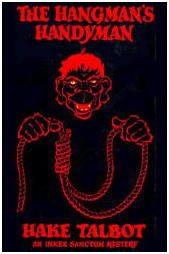
TALBOT Hangman's Handyman

HAKE TALBOT – The Hangman’s Handyman. Simon & Schuster, hardcover, 1942. Pulp magazine reprint: Two Complete Detective Books #24, January 1944. Trade paperback: Ramble House, 2005.

   Some peculiarities of construction prevent Hake Talbot’s first novel from attaining the first rank, but it remains an engaging curiosity with plenty of atmosphere. A few years down the pike, he would write Rim of the Pit, one of the great detective novels of the twentieth century, and while this is far from that, it has its moments.

   Rogan Kincaid makes a memorable entrance, dripping in oilskins, on the morning after an orgiastic dinner at The Kraken, the baronial stone mansion on its own island off the Carolina coast. Only Rogan could have braved the storm, Rogan Kincaid, the man’s man, dangerous gambler whose exploits around the world are legend in the underworld.

HAKE TALBOT Hangman's Handyman

   But he’s not all bad, he’s sensitive and loves to give women a good time. As showgirl Nancy Garwood struggles to tell him what happened the night before, bits and shards of memory return to her until, with a scream, she recalls a repressed memory, that their host, Jackson Frant, the owner of The Kraken, had been cursed by his half brother Lord Tethryn of England, according to the old family curse, and he had instantly died.

   Laid up in his bed, he now awaits the police. When Rogan goes to see Frant, he can barely make out the features of his old friend: a seemingly supernatural power connected to the family curse (“”Od rot you!””) has caused decay to happen at super-fast rates — the body seems as if it has been dead for weeks instead of mere hours!

HAKE TALBOT Hangman's Handyman

   Talbot drapes layers and layers of medieval and early American horror/folktale material on the bones of his fragile story. You can tell he really loved his research. As Rim of the Pit depends on the native American legend of the Windigo, The Hangman’s Handyman just drips and squelches with Undine trivia. You will believe that a heap of seaweed can stand up of its own volition, move across the room towards you, and strangle you to death!

   Much of the action of the book turns into an “origin story” explaining the true and romantic background of the hardened gambler who calls himself Rogan Kincaid. This part of the story: unbelievable to the point of being ridiculous, and I notice that Talbot discarded Kincaid’s aristocratic origins by the time he embarked on the superior work of Rim of the Pit, but Talbot completists won’t mind a little icing on their cake.

A 1001 MIDNIGHTS Review by Marcia Muller:


TONY HILLERMAN – The Ghostway. San Diego: Dennis McMillan, 1984. (Limited edition.) Also published in a regular trade edition by Harper & Row, 1985. Paperback reprint: Avon, 1986. Many other reprint editions, both hardcover and soft.

TONY HILLERMAN The Ghostway

   Hillerman’s second series character, Navajo tribal policeman Jim Chee, is a younger man than Joe Leaphorn and more closely tied to mainstream American society. Because of this, he is perhaps less interesting than Leaphorn, and the Chee books lack the haunting, magical quality of Hillerman’s earlier work. Chee is nonetheless a complex character and the dichotomies he must face within himself are closely intertwined with the plots.

   The Ghostway concerns a Los Angeles Navajo who has shot a hoodlum to death and in turn been seriously wounded in a parking lot on the reservation. The FBI is looking for the man — Albert Gorman — for some reason that they do not discuss in detail with the Navajo police, and he is traced to the hogan of a relative, Ashie Begay.

   But when Chee, the sheriff’s deputy, and the FBI agents arrive at the hogan, they find no signs of life; the hogan’s smoke hole has been plugged, its doorway boarded over, and a hole cut in one side. To Chee this means someone has died inside and the hogan thought to be possessed by the malicious chindi (ghost) of the dead person has been abandoned.

TONY HILLERMAN The Ghostway

   There are things that bother Chee about the situation: Ashie Begay was a wise old man, accustomed to death, and he loved his home; surely when he saw that Albert Gorman, the wounded man, was close to death, he would have moved him outside, as is the custom.

   And when Chee finds Gorman’s body, it has been prepared as the dead are supposed to be, except Begay has neglected to wash the corpse’s hair with yucca suds. Did something interrupt the preparations? And where has Ashie Begay gone?

   At the time the case begins, Chee is facing a tough personal decision: Should he join the FBI and leave the reservation with his white lover, Mary Landon? Or should he stay on here where his roots are and risk losing her?

   Before he can resolve this, however, Ashie Begay’s granddaughter, Margaret Billy Sosi, disappears from her boarding school, and Chee must track her down. Eventually he finds her in Begay’s contaminated hogan — a place where even he, with his logical policeman’s mind, is loath to step — but she quickly eludes him.

   He follows her to Los Angeles, where Navajos of the Turkey Clan, to which she belongs, live in abject poverty. Chee’s investigation takes him back to the reservation again, and into its far reaches where a Ghostway (purifying ceremony) is being performed. And at the ceremony, he must confront not only a killer but also the cultural conflict within himself.

TONY HILLERMAN

   While not as powerful as the Leaphorn novels, The Ghostway ties its thematic matter into the plot in an extremely satisfying way, and Chee is developed to greater depth than before. Any reader will be eager to see how he resolves his conflicts in future novels.

   The previous Chee books are People of Darkness (1980) and The Dark Wind (1982).

         ———
   Reprinted with permission from 1001 Midnights, edited by Bill Pronzini & Marcia Muller and published by The Battered Silicon Dispatch Box, 2007.   Copyright © 1986, 2007 by the Pronzini-Muller Family Trust.

« Previous PageNext Page »