Characters


   When Ron Goulart came to Gary Lovisi’s paperback show this past Sunday, it was as a guest, and he had with him copies of Cheap Thrills and Good Girl Art available for sale and signing. See my previous post, and in particular Walker Martin’s comment in which he describes each of them more fully. He also praises them both very highly, a sentiment I wholeheartedly agree with.

   I asked Ron if he still had copies, and he says no, but they’re both easily available from Amazon and other Internet dealers as well as the publisher, hermespress.com.

RON GOULART Groucho Marx

   He does have copies of books in his “Groucho Marx, Detective” series, though, which he’ll gladly sell you for $20 each and pictorially autograph in his inimitable style (my words). You can email him if you’re interested, or just to say hello. (Click on the link.)

   None of the Groucho books ever came out in paperback, which is a criminal offense in itself. The only editions were hardcovers from St. Martin’s Press. Here’s a complete list. (You’ll have to ask him which ones he has.)

      Groucho Marx, Master Detective (1998)
      Elementary, My Dear Groucho (1999)
      Groucho Marx, Private Eye (1999)
      Groucho Marx and the Broadway Murders (2001)
      Groucho Marx, Secret Agent (2002)
      Groucho Marx, King of the Jungle (2005)

From my copy:

RON GOULART Groucho Marx

GRIF STOCKLEY – Probable Cause.

Ivy, paperback reprint; 1st printing, December 1993. Hardcover edition: Simon & Schuster, October 1992.

Grif Stockley

   According to the information provided inside the back cover of Probable Cause, the second of his two recorded adventures, Grif Stockley was (in 1993) “an attorney for Central Arkansas Legal Services, which was funded by the federal government to provide representation to indigents in civil cases.”

   As an author, his series character is Gideon Page, a middle-aged attorney whose first case after striking out on his own is highly is highly charged with racial overtones. And undertones, too, for that matter. His client is a black psychologist who’s accused of killing a retarded girl he was administering electric shock therapy to with a cattle prod. Why is the case so difficult? The man was having an affair with the wealthy girl’s mother, who is white.

   Large portions of this novel are taken up with detective work, but for the most part what this is an intimate, inside look at how the justice system actually works, with lots of snapshot character studies of the people who either try to make it work, or (in some cases) try to make it work on their behalf.

   Page’s life with his precocious and sensitive high school daughter (Rosa, her mother, is dead) and his platonic love affair with Rainey, a social worker at a local state hospital, are essential parts of the story, more than background matter, although not part of the case itself.

   This is the legal equivalent of a multi-faceted and well-diversified police procedural, in other words, as Page divides his time among his other clients, colleagues and adversaries, told by someone who’s been there. One suspects with some amount of surety that some of Stockley’s own clients, colleagues and adversaries may find more than a little similarities between themselves and some of the people populating this book.

   There’s very little spelled out in black and white, pun intended, including the ending, nor as to what might happen next in Gideon Page’s life. I for one will be looking eagerly for more in the local used book stores. Unaccountably, this is the only one of his adventures that I own.

   Thanks to Crime Fiction IV, by Allen J. Hubin, here are the others:

STOCKLEY, GRIF. 1944- .
      Expert Testimony. Summit Books, 1991.

Grif Stockley

      Probable Cause. Simon & Schuster, 1992.
      Religious Conviction. Simon & Schuster, 1993.
      Illegal Motion. Simon & Schuster, 1995.
      Blind Justice. Simon & Schuster, 1997.

   And if you’re interested, here’s a link for more information on Grif Stockley himself.

NANCY PICKARD – No Body.

Pocket, paperback reprint; 1st printing, November 1987. Hardcover edition: Charles Scribner’s Sons, October 1986.

   I can sum up one impression of this book in one short sentence: More, I think, about funeral homes than I wanted to know.

   This was the third appearance of Jenny Cain, Nancy Pickard’s first series character, and the first to be published in hardcover, the previous two being paperback originals from Avon. For the record, here’s a list of all of Jenny’s full-length cases. (There are no short stories about her, as far as I’ve been able to discover.)

      Generous Death. Avon, pb, 1984.

NANCY PICKARD

      Say No to Murder. Avon, pb 1985. Winner of the first Anthony Award for Best Paperback Original Mystery.
      No Body. Scribner, 1986. Nominated for an Anthony.
      Marriage Is Murder. Scribner, 1987. Winner of the Macavity Award for Best Mystery Novel.
      Dead Crazy. Scribner, 1988. Nominated for both the Agatha and Anthony awards.
      Bum Steer. Pocket, 1990. Winner of the Agatha Award for Best Mystery Novel.
      I. O. U.  Pocket, 1991. Edgar Nominee for Best Mystery Novel, Agatha Winner for Best Mystery Novel, Macavity Winner for Best Mystery Novel.
      But I Wouldn’t Want to Die There. Pocket, 1993.
      Confession. Pocket, 1994.
      Twilight. Pocket, 1995. Nominated for an Agatha Award.

NANCY PICKARD

   I may have missed some of the nominations the books in the series have gathered, but even so, it’s an impressive list.

   The title of Twilight suggests that it may be the last in the series. Given that 13 years have gone by since it came out and Pickard has begun another series in the meantime (one featuring true-crime author Marie Lightfoot), Jenny may have packed up her sleuthing duties for good.

NANCY PICKARD No Body

   Jenny is the director of the Port Frederick Civic Foundation, which means that she knows all the important people in a small town. Also helping to explain why he has such success in getting involved (and solving) crimes of murder is the fact that she lives with Detective Geof Bushfield of the local police department. (I don’t believe it was ever stated in No Body, but Port Frederick is in Massachusetts. While reading it, I was under the slight assumption that it was in Maryland.)

   No Body is strong on humor, but other books in the series become gradually darker, or so I’ve been led to believe. Nonetheless, I think the Jenny Cain books fall in the forefront of the cozy, malice domestic movement in which amateur detectives, most of them women, have gradually taken over the non-thriller portion of the mystery publishing world today, filled as it is with quilters, herbalists, catsitters, wedding planners and so on.

   One of Jenny’s problems to solve at this book is that of 133 missing bodies in a 19th century and now closed cemetery. But while investigating the archives of the Harbor Lights Funeral Home, a more serious current crime is committed — the body of a dead man’s secret lover is found in his cover just before it’s put to earth.

NANCY PICKARD No Body

   Many of the secondary characters presumably appeared in the first two books in the series. They seem familiar enough to the author that she doesn’t feel the need to overly describe them or get them involved. For the most part they stay in the background, allowing a full focus to be placed on solving the murder. Good news, as I far as I am concerned.

   Geof is called out of town for most of the book, in fact, allowing Jenny nearly free rein in tackling the case, not always successfully, adding immensely to the comic effect. The ending is quite a spine-tingler — caused by Jenny’s not quite thinking things through — but the story becomes quite a page-turner at the conclusion, there’s no doubt about that at all.

[FOLLOW-UP.]  Who would I pick to play Jenny Cain in the movies? Maybe a younger Shirley MacLaine. As for Lew Riss, the disheveled dope-smoking local reporter with dreams of a Pulitizer (and a hopeful but unrequited yearning for Jenny), perhaps Richard Dreyfuss would do.

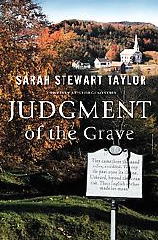
SARAH STEWART TAYLOR – Judgment of the Grave.

St. Martin’s; reprint paperback; 1st pr., Aug 2006. Hardcover edition: St. Martin’s; July 2005.

   It is impossible to keep up. When I go looking for whatever book to read next, I often pick one out at random, and invariably it’s the second or third in a series, almost never the first. (I used to teach college courses in probability, so I’m not complaining. I know exactly what the odds are, and they’re against me.)

   Judgment of the Grave is the third of four of the recorded adventures of Harvard-based art historian, Sweeney St. George. It’s early in this review, instead of at the end, where I often do it, but here’s a list of all four. All came out first from St. Martin’s in hardcover, then in paperback:

      O’ Artful Death. 2003 / June 2004.

SARAH STEWART TAYLOR

      Mansions of the Dead. July 2004 / May 2005.
      Judgment of the Grave. July 2005 / Aug 2006.
      Still As Death. Sept 2006 / Oct 2007.

   And in spite of excellent reviews and good sales rankings on Amazon, these four appear to be all there’s going to be. Sarah Stewart Taylor’s website does not seem to have been updated since October 2007 and the last entry in her blog is dated May 2, 2007.

SARAH STEWART TAYLOR

   That’s a shame. In spite of some quibbles which I’ll get to shortly, I enjoyed Judgment of the Grave quite thoroughly. So well, in fact, that if I knew where my copy was, I’d read Still As Death next, just to find out what happens to Sweeney and her romantic difficulties in her followup adventure. And failing that, go back and read one or both of the first two (see above), just to learn how all of her romantic difficulties began in the first place.

   Quibbles: These very same Sweeney’s romantic difficulties — and all of the problems the other characters have in Judgment of the Grave. They’re a major part of the story, and they tend to overpower the detective story involved.

   But what they also help create is a dark, atmospheric tale filled with angst, anxiety and sorrow, beginning with the opening scene (after a short prologue) in which Sweeney meets a young 12-year-old boy with leukemia while she’s researching gravestones in a Concord MA cemetery.

   Cambridge police detective Tim Quinn, whom Sweeney has met before and seems to have a history with, meets her again as he follows up on a missing person’s report — a professor having a similar interest in gravestones and the history of the Revolutionary War has disappeared after taking part in a battle re-enactment up near Concord. Quinn’s wife committed suicide, we learn, and he’s forced to take his 10-month-old daughter along with him. Sweeney is a multi-tasker. She babysits and helps solve the mystery at the same time.

SARAH STEWART TAYLOR

   Meanwhile Sweeney’s almost-but-not-quite-affair with Ian has been put on hold while he’s home in England. Phone calls every night. I don’t quite understand where Toby fits in, but he somehow seems to have overnight privileges.

   Also often crowding the mystery aside are long expository pages on the War of Independence, how it was conducted, how not all of the colonists were fighting for freedom, and how much the British depended on spies.

   The latter may be the reason for the present day killings, or perhaps not, because all of the other character’s marriages are either broken or on the verge, and jealousy or revenge are also excellent reasons for murder. A veritable Peyton Place, without the same degree of notoriety or sensationalism.

   I suppose you already know, having gotten this far, whether or not you will ever read any of the books in the series, but nonetheless, with a bit of pruning down and firming up, and filmed in black-and-white, or with dark, shadowy indoor scenes contrasted with the bright colors of an autumn New England sky, Judgment to the Grave would be as noirish as they come. It’s not Los Angeles, but there are a lot of dark secrets in Massachusetts too.

[COMMENT.]  Later the same day. I’m embarrassed to point this out, but while searching for some more information about the author on Google, I discovered that I’d totally forgotten that Walter Albert reviewed this same book here on Mystery*File, and not too long ago.

   He liked it too.

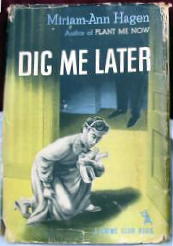
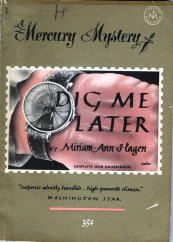
DIG ME LATER – Miriam-Ann Hagen.

Mercury Mystery 157; digest-sized paperback; no date stated, but generally accepted as being 1951. Hardcover edition: Doubleday/Crime Club; 1949. Hardcover reprint: Detective Book Club, 3-in-1 edition, August 1949.

MIRIAM-ANN HAGEN Dig Me Later

   I mean no offense to anyone named Hortense, or who knows anyone with the name Hortense, but it IS an old-fashioned name, I believe you have to admit, and a series of mysteries with a leading character named Hortense Clinton is going to be considered light-hearted from the outset, whether it is true or not.

   But true it is, or at the least, this second of three mysteries she was involved in certainly is. When a murder occurs across the hall to her in her Manhattan apartment, Hortense accidentally confronts the killer with her night clothes on, blemish cream on her face, chin strap on, and a band across her forehead.

   Of course squatting down on the floor as she was, all she could see before she was knocked unconscious was the killer’s pant legs and shoes. But if the killer was the dead man’s nephew making his getaway as she was putting her milk bottles out, why did he take the time to take her diamond watch?

   As it happens, the answer to that question is clear to any reader who’s been paying attention and has read Chapter One carefully, so anyone who reads detective stories for the detective work in them isn’t going to find much of any substance to mull over in this one.

   But the characters are what might keep you reading, as the did me, somewhat wacky and somewhat confusing, or confused themselves as to why so many of them end up with Hortense in a resort hotel in Nova Scotia where she flees when her notoriety in Manhattan proves to be too much for her.

   The killer is obvious enough in retrospect, but there are plenty of false trails to be followed and examined carefully before the final denouement. Most – but not all – the questions are answered, and Hortense Clinton survives to be involved in another murder another day. (See the bibliography below.)

   But before getting to that, I didn’t do any research on the author before beginning the book – I seldom do, as I prefer to let the book speak for the author, not his/her reputation or background. I almost never even read the blurbs on the jacket flaps or the back cover.

   So it took me a while to place Ms. Hagen’s style of writing, even though I have to admit that I should have known. It’s a style that feels itself necessary to explain the smallest detail, to spell out things so that the reader will fully understand, and yet is smooth enough, and clever enough to stay interesting. I am not denigrating it in any way. It’s a style of writing I most certainly and definitely admire.

MIRIAM-ANN HAGEN Dig Me Later

   I wish I could explain better what I mean, but here’s a sample, and maybe that will help. Picking a page and a selection at random from the first chapter, take this as an example. Hortense is being asked by the police to identify the nephew’s shoes:

    Although she wouldn’t raise her eyes above the feet she was asked to identify, she had a feeling that the simple monosyllable had been a blow to the young man and that he had stiffened under it. “Yes,” she repeated hastily, “like this man’s or like most men’s. You could go out in the street and within ten minutes bring in a hundred men, and I’d look at their feet and have to say yes, about that size.”

    “Sure, Miss Clinton,” said the detective. “Sure. We don’t expect you to say it was this man’s feet you saw. That would be asking too much. We just want you to tell us if it could have been this man’s feet, that the ones you saw weren’t so much bigger or smaller or anything that you’d know they couldn’t have been his or even that you’d think maybe they couldn’t be his.”

    They worked at it, trying to pin her down to some sort of statement, but Hortense refused to say more that what she could say with certainty, until finally, in a burst of frankness, they told her exactly what they wanted of her, and to that she had to give them the answer that satisfied them….

   Which was, to cut the story off short, that she wouldn’t later be able to testify in court that it couldn’t have been the man that the suspected of being the killer.

   I don’t know if that was enough of a sample for you to tell, and maybe you never heard of Aaron Marc Stein, also known as George Bagby and Hampton Stone, but the writing is identical. But if you have, then I’m sure you spotted the similarity, and probably even before I made the connection. And if you’ve been paying attention to this blog, as I should have been, or at least my only claim for ignorance was that I forgot, in one of Mike Nevins’s columns for M*F, he happened to have mentioned in passing that Miriam-Ann Hagen was Aaron Marc Stein’s sister.

   The title comes from a bit of jazzy jargon from the 1940s that I don’t think was used appropriately in the novel, but to expand the context a little, take a look at the three mystery novels that Miriam-Ann Hagen wrote, courtesy of Crime Fiction IV, by Allen J. Hubin:

HAGEN, MIRIAM-ANN (1903-1984)
       Plant Me Now (n.) Doubleday 1947 [Hortense Clinton; Train]
       Dig Me Later (n.) Doubleday 1949 [Hortense Clinton; Canada]
       Murder-But Natch (n.) Doubleday 1951 [Hortense Clinton; Ship]


[UPDATE] 09-28-08.  I asked Mike Nevins to read my comments and then to consider the possibility that Aaron Marc Stein might have written the Hortense Clinton books under his sister’s name. Here’s his reply. I’m sure he’s right, but the thought lingers on…

   Interesting review! Aaron and Miriam were exceptionally close siblings, and you’re absolutely right that she modeled her style and structure on his. He must have read those books before publication and may have edited them a bit, but I have no reason to think he ghosted them for her.

          Best,

             Mike

HERE'S FLASH CASEY

HERE’S FLASH CASEY. Grand National Pictures, 1938. Eric Linden, Boots Mallory, Cully Richards, Holmes Herbert, Joseph Crehan, Howard Lang. Based on the story “Return Engagement,” by George Harmon Coxe (Black Mask, March 1934). Director: Lynn Shores.

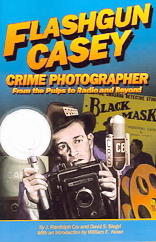
   A copy of Black Mask from 1934 with “Return Engagement” in it is going to be hard to find, if you don’t already own one, but you can also find it in a much more recent book about the leading character: Flashgun Casey, Crime Photographer: From the Pulps to Radio and Beyond, by J. Randolph Cox and David S. Siegel.

   I wish I had my copy at hand, because any resemblance of the Flash Casey in this movie and the Casey I remember reading other stories about is — to put it bluntly — none at all. Someone else is going to have to read it, the original story, that is, and be willing to tell us about it.

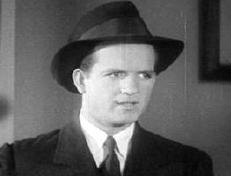
   I’ve also been hard-pressed to come up with posters or stills from the film. I have one of Eric Linden, who plays Casey, and some kind of trading card of Boots Mallory, who plays Casey’s girl friend of sorts, Kay Lanning, the society page editor of the newspaper where Casey, fresh out of college, lands his first paying job. (And at $18 a week, it is not much of a job. It is a wonder what Kay sees in him.)

GEORGE HARMON COXE

   What you can do, however, is watch the entire movie online. Go to www.archive.org, click on the right spot, and there it is. Marvelous!

   In a matter of speaking, of course. I’m talking about Internet technology, not the quality of the film. Eric Linden, whose career lasted about ten years through the 1930s, plays Casey as a naive college kid for all it’s worth, which is maybe the dime it would cost you to see it back in 1938. And if I haven’t happened to have mentioned it before, this is a comedy film all the way, so it’s not Linden who’s responsible for his actions.

HERE'S FLASH CASEY

   What might possibly qualify this as a crime film? Almost nothing, as long as you’ve asked, but Casey does take some candid photos at a society affair that an unscrupulous gang of blackmailers alters and tries to make a bundle on. Bungling that, they kidnap Kay, and Flash comes to the rescue by commandeering an ambulance…

   Besides being an actress for a short while, Patricia “Boots” Mallory was also a good-looking dancer and an actress. Her film career ended in 1938, but she had married film producer William Cagney, brother of actor James Cagney, back in 1932, well before then. She later married actor Herbert Marshall, to whom she was still wed when she died in 1958.

   So, as you can see, here’s my review. Two paragraphs about the movie itself, surrounded by a lot of fluff. Go watch the movie itself and see if it deserves more.

A 1001 MIDNIGHTS Review
by Max Allan Collins and James L. Traylor:


MICKEY SPILLANE Day of the Guns

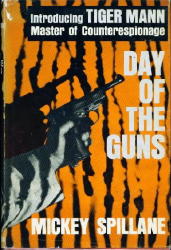
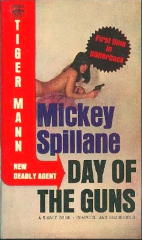
MICKEY SPILLANE – Day of the Guns.

E. P. Dutton, hardcover, 1964. Signet D2643, paperback, April 1965. [Several later printings.]

   Properly overshadowed by Mike Hammer, espionage agent Tiger Mann is the hero of Mickey Spillane’s only other series of mystery novels. Mann remains a pale shadow of the mighty Mike, a Bond-era reworking of the Hammer formula; but the first of the series has considered merit.

   Tiger Mann is employed by an espionage organization funded by ultraright-wing billionaire Martin Grady, of self-professed altruistic, patriotic purposes. Chatting with a Broadway columnist in a nightclub, Tiger spots a beautiful woman who strikingly resembles a Nazi spy named Rondine who attempted to kill him years before.

   Though he loved Rondine, Tiger has sworn to kill her should he encounter her again. The woman, Edith Caine, professes not to be Rondine, but Tiger refuses to believe her and sets out to learn what she is up to. Soon he is battling a Communist conspiracy, and in a striptease finale that purposely evokes and invokes the classic conclusion of I, the Jury, Tiger must face the naked truth about Rondine.

MICKEY SPILLANE Day of the Guns

   Day of the Guns is a fast-moving and fine example of Spillane’s mature craftsmanship; he has great fun doing twists on himself, as the conclusion of the novel shows. But this book – and, particularly, later Tiger Mann entries – lacks the conviction of the Hammer novels.

   Tiger Mann is Mike Hammer in secret-agent drag: His style and world are Hammer’s; despite mentions of faraway places, the action is confined to New York. But while Hammer is an antiorganization man, Tiger, for all his lone-wolf posturing, is a company man. This goes against the Spillane grain.

   The three other Tiger Mann novels are Bloody Sunrise (1965), The Death Dealers (1965), and The By-Pass Control (1966). Each declines in quality.

         ———
   Reprinted with permission from 1001 Midnights, edited by Bill Pronzini & Marcia Muller and published by The Battered Silicon Dispatch Box, 2007.   Copyright © 1986, 2007 by the Pronzini-Muller Family Trust.

A 1001 MIDNIGHTS Review by Bill Crider:


MICKEY SPILLANE I the Jury

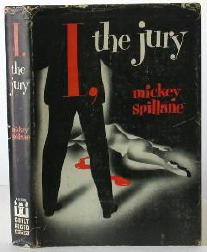
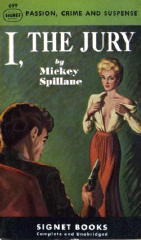
MICKEY SPILLANE – I, the Jury.

E. P. Dutton, hardcover, 1947. Signet 699, paperback, 1948. [Many later printings.]

   When Mickey Spillane published I, the Jury in 1947, Hammett’s first novel had been in print nearly twenty years and Carroll John Daly and Raymond Chandler were still writing. Yet there is little doubt that Spillane’s book was a seminal work of tough-guy fiction, inspiring hundreds of imitators in the booming paperback market of the 1950s. No one, however, was quite able to match Spillane’s unique combination of action, sex, and right-wing vengeance.

   The main character of I, the Jury is Spillane’s most famous creation, Mike Hammer — tough, implacable, and prone to violence, with perhaps even a touch of madness. When his war buddy is murdered, Hammer swears to get revenge: “And by Christ, I’m not letting the killer go through the tedious process of the law.”

MICKEY SPILLANE I the Jury

   Hammer smashes his way through the suspects (“My fist went in up to the wrist in his stomach”) until he determines the guilty party, whom he has sworn to kill in exactly the same way his friend was murdered. Along the way, he meets the nymphomaniac Bellemy sisters, one of whom has a strategically located strawberry birthmark; Charlotte Manning, a beautiful psychiatrist; Hal Kines, the improbable white slaver; and of course he fends off the advances of Velda, his sexy, loyal secretary.

   He finally confronts the killer in a slam-bang ending never to be forgotten by anyone who has read it, concluding with perhaps the best last line in all of Spillane’s books, most of which have memorable, melodramatic climaxes.

   Spillane’s novels have been attacked for their violence and their vigilante spirit, and no doubt these things are present in the books. But Spillane is first and foremost a storyteller, and his stories, no matter how improbable, always work, pulling the reader along willingly or unwillingly into Mike Hammer’s violent world.

   I, the Jury was brought to the screen in 1949, with Biff Elliott in the starring role. Like the novel, it emphasizes violence and has an ending to enrage the sensibilities of any feminist who happens to watch it.

MICKEY SPILLANE I the Jury


         ———
   Reprinted with permission from 1001 Midnights, edited by Bill Pronzini & Marcia Muller and published by The Battered Silicon Dispatch Box, 2007.   Copyright © 1986, 2007 by the Pronzini-Muller Family Trust.

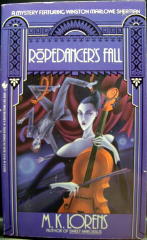
M. K. LORENS – Ropedancer’s Fall. Bantam; paperback original; 1st printing, August 1990.
M. K. LORENS

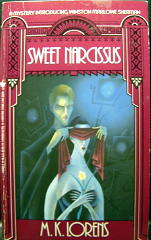
   I’ll begin with a confession of sorts. Back when M. K. Lorens’ first book, Sweet Narcissus, came out, it looked particularly appetizing and I gave it a try, but I didn’t get very far.

   Whether I wrote a review of the book, based on what I had managed to read, I have no idea. I suspect not, but I might have. Isn’t giving up on a book worth pointing out, as long as you say so very clearly and carefully?

   And point out just why it was that you came to a dead end with it, without loudly and vociferously saying how greatly the author’s fault it was? (Even though in large part it may have been?)

   In any case I haven’t come across it recently, “it” referring to the review which I may or may not have written, so the point is moot.

   But the second book in the series recently surfaced, and remembering my earlier experience, I said to myself, here’s my opportunity to give the author another chance.

   Lorens’ detective is the key attraction, a gent by the name of Winston Marlowe Sheridan who writes a “Gilded Age” series of mystery fiction himself, but under the well-disguised pseudonym of Henrietta Slocum. Slocum’s character in turn is named G. Winchester Hyde. How can one resist?

   A portly fellow, Sheridan himself is a professor of literature at a New England college, and on occasion he finds himself involved in cases of murder, for which he places his sense of deduction on the line to solve.
M. K. LORENS

   In this case the dead man in Ropedancer’s Fall is John Falkner, whose one novel won a Pulitzer, but who was never able to write another one and who had been recently been reduced to being to PBS talk-show host, albeit a very good one. And as he was a long-time on-and-off friend of Sheridan’s, as well as a hopeless reclamation project, Sheridan takes his death very personally.

   All well and good, but — and you knew this was coming, perhaps? — the telling is dense and nearly impenetrable — over 260 pages of small print — filled with Sheridan’s enormous entourage of friends and acquaintances, some closer than others, and their multitude of spouses and ex-spouses and intermingled offspring and foster children. And as the book goes on, the list of the above gets longer and longer — a snowballing effect figuratively if not literally.

   But given some time to get to know them, the list of characters does becomes manageable, and the writing, while dense, is also delightfully incisive and witty. Eventually, though, it begins to dawn on the reader (or at least this one) that the investigation is going absolutely nowhere. Wheels within wheels, but all of them are spinning and spinning, and spurting up little but slush.

   Skipping to the end, after about 160 pages, and sure enough, nothing happened in Chapter Twenty that couldn’t have been predicted after reading Chapter Two.

   Recommended if you’re a fan of clever, witty repartee between clever, witty people. (Do NOT read any sense of sarcasm into this statement.) Not recommended if you like a hands-on mystery to solve in your detective fiction.

      BIBLIOGRAPHIC DATA. [Expanded from Crime Fiction IV, by Allen J. Hubin.]

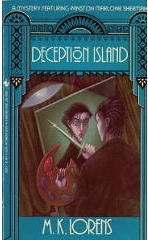
LORENS, M(ARGARET) K(EILSTRUP). 1945- . Pseudonym: Margaret Lawrence. Series Character: Winston Marlowe Sherman, in all. [The distinctive artwork for the covers you see is by Merritt Dekle.]

      Sweet Narcissus. Bantam, pbo, August 1989. [corrected year !]
      Ropedancer’s Fall. Bantam, pbo, August 1990.
      Deception Island. Bantam, pbo, November 1990.

M. K. LORENS

      Dreamland. Doubleday, hardcover, April 1992; Bantam, pb, March 1993.
      Sorrowheart. Doubleday, hc, April 1993; Bantam, pb, April 1994.

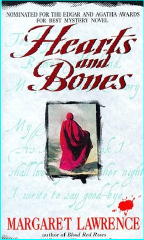
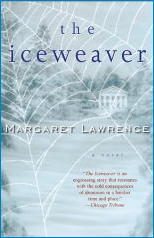
LAWRENCE, MARGARET. Pseudonym of Margaret Keilstrup Lorens. SC: Midwife Hannah Trevor, in the first three; her daughter Jennet, who is deaf, appears in the fourth. Setting: Maine, 1780s.

      Hearts and Bones, Avon, pbo, October 1997. [Nominated for Edgar, Agatha, and Anthony awards]

Martha Lawrence

      Blood Red Roses, Avon, pbo, October 1998.
      The Burning Bride, Avon, pbo, September 1999.
      The Iceweaver, Morrow, hc, July 2000. Trade paperback: Harper, July 2001.

Martha Lawrence

REVIEWED BY WALTER ALBERT:         


P. C. DOHERTY

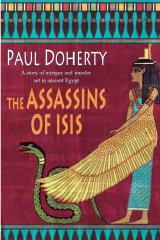
P. C. DOHERTY – The Assassins of Isis. St. Martin’s, hardcover, November 2006. Originally published in the UK by Headline: hardcover, August 2004; trade paperback, August 2005.

   In this fifth novel in the Egyptian series featuring Lord Amerotke, Chief Judge of Pharaoh Queen Hatusu, tombs of the Pharaohs are being looted in the Valley of the Kings, a retired military hero, General Suten, is improbably murdered by a horde of vipers that attack him on his rooftop sanctuary, and four virgin handmaids have disappeared from the Temple of Isis.

   Not improbably, Amerotke finds that the events are linked and that they pose a threat to the Pharaoh herself.

   I read this at a single sitting, propelled through it by the dazzling pyrotechnics of Doherty’s intricate plotting, and by the richly embroidered splendor of the court setting in which much of the novel is set.

JANE JAKEMAN

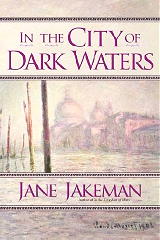
JANE JAKEMAN – In the City of Dark Waters. Berkley Prime Crime, hardcover, May 2006.

   In this sequel to In the Kingdom of Mists, French Impressionist artist Claude Monet’s role is considerably reduced although there are a few passages describing him at his easel in Venice that have some of the magic of the earlier novel.

   There’s a new protagonist, British lawyer Revel Callendar, who’s doing a reduced version of the once obligatory European Tour in Venice when he’s drafted by the British consul to do some paperwork for the once powerful Casimiri family after the death of the principessa, a British citizen by birth and a Casimiri by marriage.

   The relationships in the crumbling, gloomy Casimiri palazio are as murky as the Venetian canals, and even more dangerous to outsiders. As if that situation weren’t enough to occupy him, Callendar, who’s introduced to Monet by the consul, accepts a commission from Monet to go to Paris to look in on the situation in the family of Monet’s wife, Alice, whose first husband has been murdered.

   There’s some similarity between the murders in the two families, but Jakeman’s handling of the interlocking story lines doesn’t quite come together, and the introduction of Monet and the Parisian episode, while interesting (and based on an actual event), seems too calculated to be entirely convincing. All in all, something of a disappointment.

BIBLIOGRAPHIC DATA:

   The Lord Amerotke Novels by P. C. Doherty. [Dates are those for the UK editions, all published by Headline.]

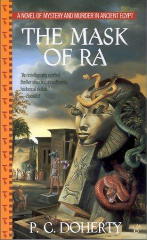
The Mask of Ra, 1998.

P. C. DOHERTY

The Horus Killings, 1999.
The Anubis Slayings, 2000.
The Slayers of Seth, 2001.
The Assassins of Isis, 2004.
The Poisoner of Ptah, 2007.

   The Claude Monet novels by Jane Jakeman.

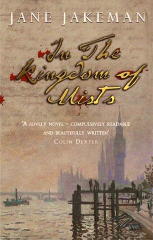
In the Kingdom of the Mists, 2004.

JANE JACKMAN

In the City of Dark Waters, 2006.

« Previous PageNext Page »