Characters


A REVIEW BY MARY REED:
   

VAN DINE Scarab Murder Case

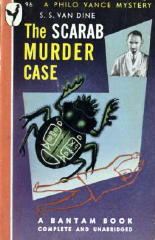
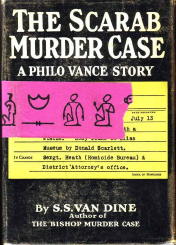
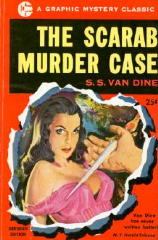
S. S. VAN DINE – The Scarab Murder Case.

Charles Scribner’s Sons, hardcover, 1930. Cassell, UK, hardcover, 1930. Paperback reprints include: Bantam #96, 1947; Graphic #89, 1954, abridged; Scribner’s, 1984. British film: 1936, with Wilfrid Hyde-White as Vance, Graham Cheswright as Markham, and Henri De Vries as Dr Bliss. (No prints are known to exist.)

   Philanthropist Benjamin H. Kyle is found murdered in a private museum run by Egyptologist Dr Mindrum Bliss. Philo Vance becomes involved when Donald Scarlett, a British college friend now working for Dr Bliss, arrives in a terrible haste. Scarlett had gone to the museum, discovered Kyle’s body, and then left rapidly because he did not want to get involved. He has come to Vance for help.

VAN DINE Scarab Murder Case

   DA John Markham and his police department cohorts are soon on the job, assisted by Vance. It transpires Kyle was funding Bliss’s Egyptian expeditions and when found is clutching a financial document drawn up by Bliss, whose scarab cravat pin is on the floor nearby.

   It looks bad, especially given the only fingerprints on the statuette that crushed Kyle’s head belong to Bliss, and so does a shoe with a bloody sole. Is it an all too obvious attempt to pin the murder on him? If so, why?

   Suspects include half-Egyptian Mrs Meryt-Amen Bliss, who is a lot younger than her husband, and her Egyptian servant Anupu Hani, who insists Dr Bliss’s excavations are sacrilegious tomb plunderings.

VAN DINE Scarab Murder Case

   Assistant curator Robert Salveter, Kyle’s nephew, not only seems overly interested in Mrs Bliss but will receive a large inheritance under Kyle’s will. The servants seem a shifty pair as well — Dingle, the cook, who hints she may know more than she lets on, and butler Brush, who goes about looking terrified.

My verdict:  The Scarab Murder Case is a book or two into the Vance series and his verbal embroidery has toned down considerably although still retaining his distinctive “voice”, while the narrator’s footnotes proliferate as usual.

VAN DINE Scarab Murder Case

   Markham is now a personal friend of Vance’s, remaining rather a Doubting Thomas when it comes to the psychology of criminals, Vance’s preferred method of solving crimes.

   Fortunately Vance is extremely knowledgeable in matters ancient Egyptian, which also comes in very handy in this instance. Those keen on Egyptology will enjoy certain nuggets of interest strewn here and there, although overall the pace of the novel is slow.

   I guessed the identity of the culprit and suspect many readers will too, but as for proving it, ah, that is a task only Philo Vance could accomplish, and accomplish it he does despite the clouds of ever-present cigarette smoke and various devilish machinations.

      E-text: http://gutenberg.net.au/ebooks02/0200361.txt

         Mary R
http://home.epix.net/~maywrite/


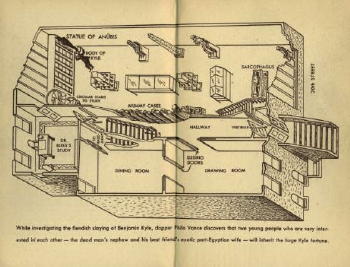
[BONUS.]   For those of you who love maps in their mystery reading material, this is for you. From inside the front cover of the Bantam edition comes this two-page layout of the murder scene, thanks to Bruce Black and the bookscans website:

VAN DINE Scarab Murder Case

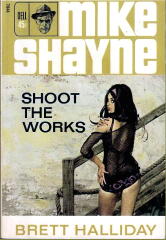
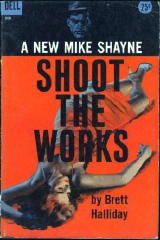
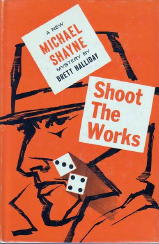
BRETT HALLIDAY – Shoot the Works.

Dell 7844; paperback reprint, December 1965; cover: Robert McGinnis. Earlier paperback edition: Dell 988, September 1958; cover: Robert Stanley. Hardcover edition: Torquil / Dodd Mead, 1957.

BRETT HALLIDAY Shoot the Works

   According to the blurb on the hardcover edition, this was the 30th Mike Shayne novel that Brett Halliday wrote, which is to say Davis Dresser, who was still actively writing them in 1957. It takes place in Miami, with all of the usual players in place: Lucy Hamilton, Shayne’s secretary and close lady friend; Chief Will Gentry, of Homicide; and Timothy Rourke, ace reporter of the Daily News.

   I may be wrong, but while I can’t tell you in which book the four of them all appeared in together for the first time, I think they were in all of them from at least this point on – the point of time being this book, Shoot the Works, of course.

   It’s Lucy who gets Mike involved in this one. The mother of one of her closest friends comes home early from a trip to New York City only to find her husband shot to death in their apartment. Worse, he has a bag packed on the bed – and two airplane tickets to South America in his pocket.

BRETT HALLIDAY Shoot the Works

   Against his better judgment, at the urging of the dead man’s wife, who wishes to avoid a scandal and the notoriety that might end her daughter’s precarious pregnancy, Mike takes the tickets and withholds the evidence from Gentry.

   This has two serious repercussions. Gentry knows Shayne is holding something back, but he doesn’t know what; and secondly, Shayne finds himself in a serious bind: when his client is suspected, there’s no way he can get on Gentry’s good side, as the tickets will make the case against her even stronger.

   This is a murder case (and investigation) from beginning to end, with very little room left for anything that passes for more than surface characterizations. Shayne seriously flirts with a couple of ladies who seem completely willing to let him have their way with them – his relationship with Lucy seems to allow him the possibility, as far as he’s concerned, that is.

BRETT HALLIDAY Shoot the Works

   There are a couple of finely devised twists and turns of the plot, mostly based on statements and actions misinterpreted and misunderstood – nicely done – and one piece of evidence that Shayne obtains under unusual conditions, and I caught the significance of that, even though it isn’t brought up again until much later.

   The only drawback to this detective puzzle of a novel – other than the incessant smoking and sipping down cognacs – if that’s a drawback, that is – is the paucity of murder suspects involved. One might simply guess at the killer’s identity, and by the laws of probability one might actually be right.

   Without the pleasure of putting the facts together as they should be put. Otherwise where’s the satisfaction?

MARY FITT – Mizmaze.

Penguin, UK, reprint paperback: 1961. Hardcover editions: Michael Joseph, UK, 1959; British Book Centre, US, 1959.

   Perhaps it’s wrong-end-to in doing so, but I think I’ll begin this time by listing all of mysteries that Mary Fitt wrote, either under that name or her own, plus one other pen name. (I think you may be as surprised as I was at how long a list it turns out to be.)

   Courtesy, then, of Crime Fiction IV, by Allen J. Hubin:

FITT, MARY. Pseudonym of Kathleen Freeman, 1897-1959; other pseudonym: Stuart Mary Wick.

Murder Mars the Tour (n.) Nicholson 1936 [Austria]
Three Sisters Flew Home (n.) Nicholson 1936 [England]

Mary Fitt

Bulls Like Death (n.) Nicholson 1937 [Berlin]
The Three Hunting Horns (n.) Nicholson 1937 [France]
Expected Death (n.) Nicholson 1938 [Supt. Mallett; England]
Sky-Rocket (n.) Nicholson 1938 [Supt. Mallett; England]
Death at Dancing Stones (n.) Nicholson 1939 [Supt. Mallett; England]
Murder of a Mouse (n.) Nicholson 1939 [Supt. Mallett; England]
Death Starts a Rumor (n.) Nicholson 1940 [Supt. Mallett; England]
Death and Mary Dazill (n.) Joseph 1941 [Supt. Mallett; England] US title: Aftermath of Murder.
Death on Herons’ Mere (n.) Joseph 1941 [Supt. Mallett; England] US title: Death Finds a Target.
Requiem for Robert (n.) Joseph 1942 [Supt. Mallett; England]
Clues to Christabel (n.) Joseph 1944 [Supt. Mallett; England]

Mary Fitt

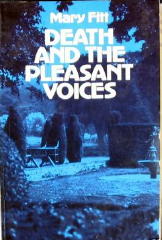
Death and the Pleasant Voices (n.) Joseph 1946 [Supt. Mallett; England]

Mary Fitt

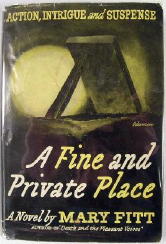
A Fine and Private Place (n.) Macdonald 1947 [Supt. Mallett; England]

Mary Fitt

Death and the Bright Day (n.) Macdonald 1948 [Supt. Mallett; England]
The Banquet Ceases (n.) Macdonald 1949 [Supt. Mallett; England]
Pity for Pamela (n.) Macdonald 1950 [England]
An Ill Wind (n.) Macdonald 1951 [Supt. Mallett; England]
Death and the Shortest Day (n.) Macdonald 1952 [Supt. Mallett; England]
The Night-Watchman’s Friend (n.) Macdonald 1953 [England]
Love from Elizabeth (n.) Macdonald 1954 [Supt. Mallett; England]
The Man Who Shot Birds and other tales of mystery and detection (co) Macdonald 1954 [Supt. Mallett; England]
Sweet Poison (n.) Macdonald 1956 [Supt. Mallett; England]
The Late Uncle Max (n.) Macdonald 1957 [Mediterranean Island]
Case for the Defence (n.) Macdonald 1958 [England]
Mizmaze (n.) Joseph 1959 [Supt. Mallett; England]
There Are More Ways of Killing… (n.) Joseph 1960 [England]

FREEMAN, KATHLEEN. 1897-1959. Pseudonyms: Mary Fitt & Stuart Mary Wick.

The Intruder, and other stories (co) Cape 1926
Gown and Shroud (n.) Macdonald 1947 [Academia; England]

WICK, STUART MARY. Pseudonym of Kathleen Freeman, 1897-1959; other pseudonym: Mary Fitt.

And Where’s Mr. Bellamy? (n.) Hutchinson 1948
-The Statue and the Lady (n.) Hodder 1950

   Kathleen Freeman herself was a British classical scholar who attended the University College of South Wales and Monmouthshire in Cardiff, where she was appointed Lecturer in Greek in 1919, but resigning from the University in 1946.

   As a writer of detective fiction, the author’s primary series character, Supt. Mallett, began his career in 1938, when the Golden Age of Detection was in full sway, and did not end until this book, Mizmaze, in 1959. Quite a career, 18 books in all, for a fictional character whom I’m sure none but the most devout aficionados remember. (The latter is a category which I unhappily confess does not include me, as this is the first book by Mary Fitt that I’ve ever read.)
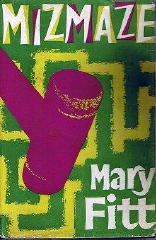
MARY FITT Mizmaze

   And in spite of some serious problems I found with the book, it will not be my last. Some of her mysteries were published in the US by Doubleday’s Crime Club imprint, for example, and while I have not read them, I do have them.

   But get to the book itself, shall I? It’s one of those old-fashioned detective stories in which the murder takes pace (or already has taken place) in Chapter One, and there’s nothing else in the book but the solving of the crime.

   Well, that and sorting through all of the relationships between the characters, some of which is relevant to the case and some of it not, but it’s all part and parcel of solving the crime, is it not?

   Dead is the patriarch of the Hatley family, found with fatal head injury in the center of the maze at his home, both called Mizmaze. The murder weapon: a croquet mallet. Surviving family: two daughters, one Alethea (Lethy), who never can be relied on to tell the truth, her father’s pride and joy, the other Angela, a devilish girl who her father seems to have intensely disliked. A dysfunctional family: yes, no doubts about it.

   Alethea’s former husband is also visiting upon the fatal weekend, along with his new wife, a former actress more than 30 years older than he. (The victim had much to do with the breakup of his daughter’s marriage.) Two others are possible suspects: a 6 foot 8 giant with pituitary problems, in love with Althea but Angela in love with him, plus his mother.

   More than you wanted to know, I suppose. Solving the case are Superintendent Mallet and his close friend, Dr. Fitzbrown, but truth be told, it is the latter who does the bulk of the questioning of the suspects.

   From the summary so far, I imagine that you already have a good grasp of the story line (and more importantly, whether or not this is a book for you.) And by the way, that the deadly blunt instrument was a mallet did not escape Fitzbrown’s attention, either. He comments on it immediately.
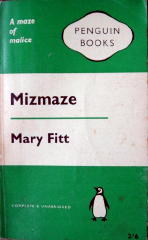
MARY FITT Mizmaze

   Problems, as previously alluded to: lapses in continuity in the telling. On page 23, Fitzbrown says that Hatley was followed by the killer into the maze. On page 24, he clearly states that someone with deadly intent was waiting for Hartley at or near the center of the maze.

   More. On page 132 Horick (the giant) comes downstairs from his sickbed to confront the rest of the entourage. On page 143 he comes down again as if for the first time, surprised to see them all there.

   There is also a previously never-mentioned spouse of one of the participants who shows up without notice at nearly the last moment, and a killer who suddenly turns into a madman (or woman) at the end, claiming responsibility and threatening to kill all of the others, the pair of sleuths included, only to fall victim himself (or herself) to a deus ex machina which is as amusing as it is fortuitous.

   And there’s the key right there, only I didn’t realize it until I was done, and indeed I did finish it, flaws and all, staying up 30 minutes past my planned bedtime to do so. I’m sure it wasn’t meant to be so, but if I were to be asked about an unintentional spoof of Golden Age detective stories, right now Mizmaze would be an example that I’d point to first.

   I suppose that may sound unkind. I don’t mean it to be, and so far I can’t explain my attraction to this book any better than I am. The characters are more than eccentric — you might even call them just plain looney — but they’re nonetheless real enough: devious, worried, clever, burdened down by life and love — or entirely human, in other words.

   Even Dr. Fitzbrown finds one of the women attractive enough to spend a short minute with her in a kiss, even though she’s still very much a suspect — and I wonder how that turns out. The book ends abruptly with the killer’s downfall, and this is the last appearance in print of either sleuth.

[COMMENT] 08-21-08. I have discovered that I am not the only mystery fan who has struggled with Mary Fitt and her detective fiction. On the John Dickson Carr forum, I have found a long post by Xavier Lechard in which he tries to come to grips with her books. The following except should demonstrate, and still be within the bounds of fair usage:

    “But did Fitt write Golden Age mysteries? As far as chronology is concerned, there isn’t a doubt about it. Stylistically, however, the matter is much more debatable. If we admit that Golden Age mysteries are about a crime and its resolution through logical reasoning by an amateur or professional detective, then we have a problem with Death and Mary Dazill which is almost devoid of any detection, as well as with Clues to Christabel which has no detective in the proper sense….”

   And may I recommend Xavier’s own blog to you? Entitled At the Villa Rose, it’s jam-packed full of serious commentary and replies on the state, status and structure of the Golden Age detective story.
REVIEWED BY WALTER ALBERT:         


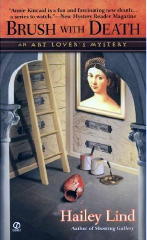
HAILEY LIND – Brush with Death. Signet, paperback original; July 2007.

HAILEY LIND

   Annie Kincaid’s family background is dominated by a talented grandfather who’s a notoriously successful painter of art forgeries, but Annie, who’s inherited his artistic talent, is trying to live a more conventional life by keeping a career as a “faux finisher” afloat. However, she continues to find that her grandfather’s notoriety and her own somewhat checkered past keep interfering with her good intentions.

   The books keep getting better, and the most recent, and third in the series, has Annie attempting to authenticate a possible original Raphael painting masquerading in a local cemetery as nineteenth century copy, and had me turning the pages with the fervor of the true convert.

   The two sisters co-writing the mysteries as Hailey Lind have a somewhat jaundiced view of the art scene and each chapter is headed by quotes by a famous painter or art historian countered by a cynical restatement credited to Georges LeFleur (Annie’s grandfather) that reflects the authors’ viewpoint.

   A paperback original series that outclasses many of the hardcover series I read.

  Bio-bibliographic Data:

HAILEY LIND. One half of “Hailey Lind” is Julie Goodson-Lawes, a San Francisco Bay Area muralist and portrait painter with her own faux finishing and design business. She graduated from UC Santa Cruz with a major in Latin American studies before earning Masters Degrees in Anthropology and Social Welfare from the State University of New York at Albany.

   The sister who’s the other half of the two-author writing team, Carolyn J. Lawes, received a BA in History from the University of Santa Clara, and an MA and a PhD in History from UC Davis. She is currently an Associate Professor of History at Old Dominion University in Norfolk, Virginia, where she specializes in American women’s history.
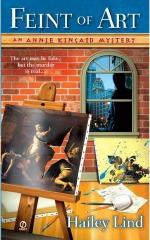
      Feint of Art. Signet, pbo, January 2006. Nominated for an Agatha.  [Best First Novel]

HAILEY LIND

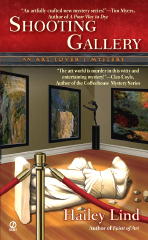
      Shooting Gallery. Signet, pbo, October 2006.
HAILEY LIND

      Brush with Death. Signet, pbo, July 2007.

      >>

[UPDATE] 08-14-08.  An email reply from half of the Hailey Lind combo:

  Hello Steve,

   Thank Walter for me for the lovely review! I especially like the part about out-classing the hardbacks… I’ll keep that one by my computer when I need a boost.

   Unfortunately, Signet has decided not to renew the contract for more titles in the Art Lover’s Mystery series…at least for the time-being. Though the books have garnered a lot of support, been nominated for awards and translated into foreign languages, they simply didn’t sell enough across the board. As I’m sure you know, book publishing is a cutthroat business these days.

   I’m working on some other projects now (including one about historic home renovation, and another featuring a witch with a vintage clothing store!), but I haven’t given up on Annie Kincaid and the gang–they’re much too much fun. Book 4 in the series, Arsenic and Old Paint, is almost finished, and I feel confident that one way or another it will be published, along with numbers 5 and 6 which are already plotted.

   I’ll try to keep you posted as to my progress.

Thanks again,

   Hailey (Julie–the artist half)

Hailey Lind
Feint of Art; Shooting Gallery; Brush with Death
www.haileylind.com
www.artloversmysteries.blogspot.com
www.truefauxdesigns.com (for art lovers…)

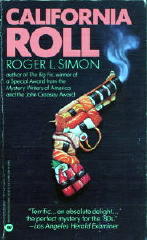
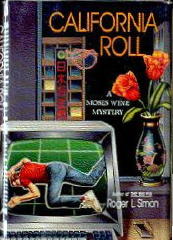
ROGER L. SIMON – California Roll.

Warner, paperback reprint; 1st pr., June 1986. Hardcover edition: Villard, March 1985. Trade paperback: I Books, Jan 2001.

   I think what I will do is to quote private eye Moses Wine in his own words. The first three paragraphs of California Roll will do as much to set the stage as anything that I could say:

Roger L. Simon

   I never sold out before because nobody ever asked me. In all it took around twenty minutes. It would have taken around three, but the guy on the other end was so profusely apologetic, he wouldn’t give me a chance to say yes.

   Actually, if had any idea of my then depressed state, he might have known that all he had to do was whistle. I was in the midst of a pronounced mid-life crisis somewhere between Gail Sheehy’s Passages and the advice column of a minor metropolitan daily. I felt like a human cliché. Most of the time I would sit around in my room in my bathrobe, listening to Leadbelly albums and bemoaning my situation: three months shy of my fortieth birthday and still a private detective with nothing to show for it but a leaky two-bedroom cottage on Wonderland Drive and a battered Porsche with a sever transmission problem. My political ideals, when I could remember them, felt like the rehash of a twenty-year-old Marcuse paperback. My work, when I had some, was boring. And my body, however hard I fought against it, was beginning its slow, inexorable slide to oblivion.
   Beyond this, my kids were growing up and didn’t want much more to do with me than an occasional overpriced visit to a sushi bar, while my ex-wife, who had dropped out of law school to live with a movie producer with a chalet in Vail, still asked for alimony. And to top it all off, my own lovelife was in the doghouse since the glorious Louise went back to her nitwit stockbroker husband after three years because, after all, she had her security to think about. And all around me my sixties buddies were getting rich. “Fuck it, Moses,” they would say. “Reagan’s in the White House. If you can’t lick ’em, join ’em!”

   Moses was, as far as I have been able to determine, the first counter-cultural PI in the books, starting out as a pot-smoking California hippie detective in 1973 and having a whole career of life-altering adventures from that point on, but always the same person, always with new problems, or so his books have been described to me. (I’m relying here on some of the comments I found after a quick Google through the Internet, with (as usual) Kevin Burton Smith at thrillingdetective.com having the most concise but illuminating things to say.)

   Here’s the entire list of Moses Wine adventures. I’ve read only two of them, I’m sorry to say.

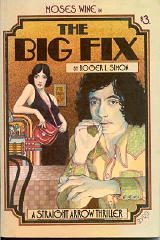
The Big Fix. Straight Arrow, trade pb, 1973.
   Andre Deutsch, hc, UK, 1974.
   Pocket, pb, March 1974.
   Pocket, pb, September 1978.
   Warner, pb, July 1984.
   I Books, trade pb, July 2000.

Roger L. Simon

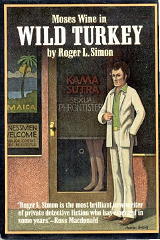
Wild Turkey. Straight Arrow, hc, 1974.
   Pocket, pb, February 1976.
   Warner, pb, September 1984.
   I Books, trade pb, July 2000.

Roger L. Simon

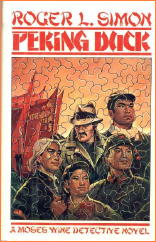
Peking Duck. Simon & Schuster, hc, June 1979.
   Detective Book Club, reprint hc, 3-in-1 volume, Sept-Oct 1979.
   Warner, pb, September 1987.
   I Books, trade pb, November 2000.

Roger L. Simon

California Roll. Villard, hc, March 1985.
   Warner, pb, June 1986.
   I Books, trade pb, January 2001.

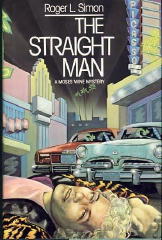
The Straight Man. Villard, hc, September 1986.
   Warner, pb, October 1987.
   I Books, trade pb, June 2001.

Roger L. Simon

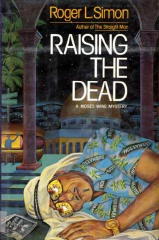
Raising the Dead. Villard, hc, July 1988.
   Warner, pb, August 1989.

Roger L. Simon

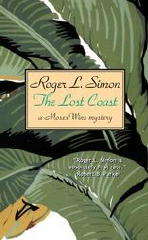
The Lost Coast. Harpercollins, hc, 1997.
   I Books, trade pb, March 2000.
   I Books, hc, May 2003.

Roger L. Simon

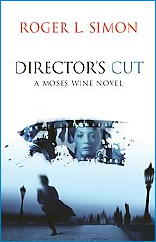
Director’s Cut. Atria, hc, June 2003.
   I Books, trade pb, December 2005. [Scheduled but possibly never published.]

Roger L. Simon

   Getting back to California Roll, however, and as you can probably imagine, the match-up of Moses Wine with corporate California — the computer business in its early stages — does not go well. There is a parallel theme, not thinly disguised, in the fact that Alex Wiznitsky (aka The Wiz), the head of Tulip (not Apple), newly worth $234,000,000 and who hires Moses to be the new head of security — he also finds that immense, immeasurable wealth is not what it is cracked up to be. He, the Wiz, would rather be, one feels, back in his garage tinkering around on his own.

   He, the Wiz, also says, on page 13, “They’re t-trying to take the company away from me, Moses.”

Roger L. Simon

   I don’t think the plot of the mystery adventure novel that follows makes a whole lot of sense, although it certainly follows the usual path of a private eye novel in practice, although with a sense that the latter is not entirely the sort of story Mr. Simon intended to tell.

   Characters come on stage to amuse and entertain us for a while, and then they are seemingly jettisoned when the story verves off in another direction — to Japan, say, for several chapters — and then back again to California.

   One excellent creation along these lines is Mr. Hodaka, a translator Moses hires in Japan who turns out also to be the writer of Japanese pulp detective stories and who eagerly finds the opportunity to be of assistance to Moses along those lines to be very exciting, along with his fellow members in the Maltese Falcon society. A girl named Laura Suzuki, on the other hand, whom Moses makes love to on page 62 (in brief but explicit detail), finds her role in the story (later on) much less to her liking.

   On page 170 is a sort of semi-capsule summary: “… it was a two-tiered game … being played out on one level by large corporate entities and nation-states and on another by human beings struggling desperately for survival in this sad vale of tears.”

   Which, if nothing else I’ve said so far, may give you an inkling of where either the book succeeds or fails. Or if it does not, here is another take on the book’s intentions — and ordinarily I perhaps should not do this, which is to quote the last two lines of the book (or that is to say, to quote a quote from Hagakure: The Book of the Samurai) — but if you were paying attention up above, there’s nothing in this that will surprise you, not an iota:

    “Human life lasts but an instant. One should spend it doing what one pleases. In this world fleeting as a dream, to live in misery doing only what one dislikes is foolishness!”

— May 2006

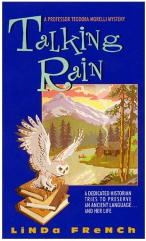
LINDA FRENCH – Coffee to Die For.

Avon, paperback original. First printing, December 1998.

   Linda French is the author’s maiden name, and this is second of three mystery novels she wrote under this byline. All of them take place in the northwestern corner of Washington state, with the leading character in each of them being Teodora “Teddy” Morelli, a history professor who lives in Bellingham. According to Google is about 85 miles north of Seattle, which is where most of Coffee to Die For takes place.

   Not so coincidentally, according to Amazon, Linda French is a history professor who lives in Bellingham, Washington.

   Based on her entry the Revised Crime Fiction IV, by Allen J. Hubin, here’s a list of her mystery fiction in book form:

FRENCH, LINDA. Pseudonym of Linda Mariz, 1948-
      * Talking Rain. Avon, pbo, April 1998.

LINDA FRENCH

      * Coffee to Die For. Avon, pbo, Dec 1998.
      * Steeped in Murder. Avon, pbo, Dec 1999.

   Under her married name, Ms. French also wrote the following pair of mysteries:

MARIZ, LINDA (Catherine French) 1948- . Pseudonym: Linda French.
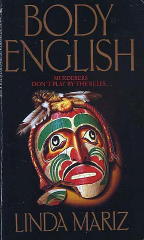
      * Body English. Bantam, pbo, Feb 1992.

LINDA FRENCH

      * Snake Dance. Bantam, pbo, Aug 1992.

   Anthropologist Laura Ireland, who’s also based in Washington state, is featured in both of these, although the second one takes place in Louisiana’s Cajun country. (She’s also a tall championship volleyball player, while Teddy Morelli is short, maybe five foot three.)

   Of the five, Coffee to Die For is the only one I’ve read, and while one should never say “never,” all things considered, I’m not likely to read another, or at least not right away.

   It’s not that it’s badly written, mind you, for it’s not. It’s not, shall we say, my cup of naturally flavored chocolate coffee. In fact, I suspected this from the very first paragraph, which I will quote:

LINDA FRENCH

    “From the balcony, Teddy Morelli dumped a forty-pound bale of fiberfill over the rail. She stared into the hopper, mesmerized as the compressed air of the stuffing machine ravaged the bale, plumping it to thirty times its former volume. A single block of fiberfill would fatten seventy-five of her sister Daisy’s exquisite woolen bunnies. But down on the floor of Bunny Business, Inc., her sister was not happy.”

   How cozier could you get than a mystery full of woolen bunnies?

   Dead, eventually, is Daisy’s philandering husband Leo, a scientist who (a) has recently developed the aforementioned naturally flavored chocolate coffee plant, and (b) has even more recently given himself a present in the form of a young, new (and beautiful) lab assistant by the name of Molly Thistle.

   When he’s found murdered in his laboratory office, no one sheds a tear. Teddy and Dolly assume that Molly did it, only to discover that she has an unbreakable alibi. It is not known whom the police suspect, unless it is Daisy, since they are visible on the scene for a maximum of seven pages out of 210 in all.

   Which means that the percentage of professional police participation is just over 3%. I’ve heard of low-carb diets, but this is far too low for me.

   The rest of the book is filled with Teddy’s extended family and circle of friends, along with some goons with whom Leo was partner’s with in some sort of cannabis deal, now gone bad. Among the circle of friends, by the way, is Teddy’s ex-husband Aurie Scholl, a knee surgeon who works with the Seahawks, who’s hoping they can get back together sometime.

   Four out of five reviewers on Amazon left positive comments, but keeping in mind that I’m not a member of the target audience for books like this, I need something more solid to chew on.

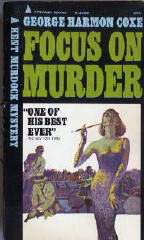
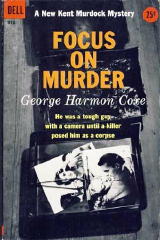
GEORGE HARMON COXE – Focus on Murder.

Pyramid R-1259; reprint paperback; 1st printing, January 1966. Cover by Frank Kalan. Hardcover edition: Alfred A. Knopf, March 1954. Hardcover reprint: Dollar Mystery Guild, June 1954. Previous paperback reprint: Dell 970, 1958.

COXE Murder with Pictures

   What with two paperback editions and (more importantly) a book club edition, this is not a difficult book to find, if you all you want to do is to have one to read.

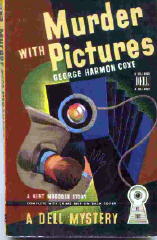
   In his prime, if Coxe was not a bestselling author like Gardner and Christie, his sales must have been steady if not spectacular, as his career in hardcovers began in 1935, with Murder with Pictures (with Kent Murdock) and did not end until No Place for Murder in 1975 (not with Kent Murdoch, but with PI Jack Fenner, who also appeared in that very first book).

   Here’s something interesting. While Jack Fenner appeared in 12 cases chronicled by Coxe, his only solo appearance was that last one, which appeared when the author was 74. (Coxe himself lived another nine years, until 1984.)

   Coxe is probably best known for his series character “Flashgun” or “Flash” Casey, a tough Boston-based news photographer who began his crime-solving in the pages of Black Mask magazine, circa 1934, but (after a quick double-check to confirm this) he wrote far many more novels in which Boston-based news photographer Kent Murdock appeared (23) than those in which Casey was the detective of record (only five).

COXE Focus on Murder

   The difference in fame, relatively speaking, is probably due to the fact that Casey had a long-running radio show named after him, and two movies based on his exploits, while Murdock had neither.

   Kevin Burton Smith over at his Thrilling Detective website suggests that Murdock is Casey with the rough edges smoothed off. Given Casey’s early pulp fiction days, he is probably quite correct in that assessment. Since their paths seem to have never crossed, that only adds credence to a hypothesis that one was really the alter ego of the other (and therefore could not appear in the same book at the same time).

   Whatever. Although his roots were definitely in the pulps, I would still consider Coxe as an author solidly in the detective story tradition of the so-called Golden Age. If you do indeed come across a copy of this book, and if my review and other chatter convinces you to read it as well — which I certainly am attempting to do — be sure to strap yourself in for a fast-paced sequence of action and clues which you’ll have to keep your eyes on every minute of the way.

   Let’s get the basic story line out of the way first. A colleague of Murdock’s at the Courier is found murdered shortly in his apartment after his (Murdock’s) departure, said colleague (as it turns out) having been a blackmailer in his spare time. That Murdock happened to have been in Ralph Stacy’s place of residence is important but not significant in the sense that he becomes one of the suspects –Lt. Bacon has worked with Casey before, and I’ll get back to this in a moment — but (as it turns out) an entire parade of suspects was in and out of the apartment and/or lurking around the building both before and after Murdock comes on the scene.

COXE Focus on Murder

   There is nothing like good old-fashioned (and dirty) blackmail to create a long list of such suspects, not to mention a wife who has just moved out, a current girl friend and a close boy friend of said girl friend, who just happens to be the jazz singer shown on the cover. Murdock is also personally offended by the murder in a personal sense, being a true-blood newspaperman through and through, nor can the reader help be offended as well.

   Coxe also had an excellent insight into the way people in the real world (mostly male, I concede) react to tragedy and other things, which includes matters of right versus wrong, in a strangely tweedy sort of way. He also seems to have been quite the jazz aficionado. I won’t quote Murdock’s conversation with pianist Jack Frost about Art Tatum on page 80 — it’s rather long — but there is nothing said here about Tatum that anyone could possibly dispute.

   By page 116, Lt. Bacon has (figuratively) thrown up his hands and asks Murdock, quite unofficially of course, to give him (Bacon) whatever assistance he (Murdock) can. And of course he (Murdock) does, again with neither the final flourish of a Christie or a Gardner (to pick a couple of prime examples) out of the air, but with the somewhat subdued manner of a magician whose apparent casualness catches you blinking, with the sudden understanding of just how easily the unwary reader (me, this time) can be taken in.

— March 2005 (slightly revised)

[UPDATE] 08-06-08.   Well, as you can see, whatever reservations I had about Coxe’s plotting abilities in One Hour to Kill were completely non-existent in this Kent Murdock mystery published some ten years earlier. I’ll really have to read that other book again, as I simply can’t tell you if I was really as hard on it then as I’m reading into my own review of it now.

   Other the other hand, I’ve just finished Fashioned for Murder (from 1947), and I didn’t find a whole lot to be happy about at all. (This is what prompted my going back and digging out these earlier two reviews.) I’ll get my review of it posted soon, but of course I will have to write it first.

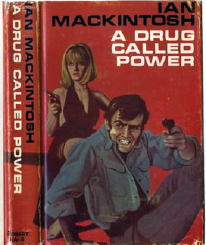
IAN MACKINTOSH – A Drug Called Power.

Robert Hale; UK, hardcover, 1968.

IAN MACKINTOSH A Drug Called Power

   Author and TV writer-producer Ian Mackintosh has come up three time already on this blog. The first instance was in a posting of some addenda to the Revised Crime Fiction IV, in which some biographical data was given for the author, and adding the setting of a novelization he did of the British TV show The Sandbaggers.

   This was followed by an email posting from Tise Vahimagi that included some data about some of the other TV shows Mackintosh was involved with. A few days later a post from British mystery bookseller Jamie Sturgeon appeared; in this the spelling of the author’s last name was discussed and possibly even settled.

   I don’t have the autographed copy of A Drug Called Power that was illustrated in that latter post. What I have is a much less valuable one formerly belonging to a library somewhere in the UK. (Well, to be precise, it’s the City of London Police Library, whatever that might mean.)

   And I wish I could recommend it to you, but I can’t. Not at least without a whole lot of reservations, that is, and eventually I will tell you about some of them. It’s the second in a series of three high-intensity action thrillers involving Tim Blackgrove, apparently a private eye in the first of his adventures (see below), but that seems to have had a bad ending (involving a woman he loved), and he’s turned into anti-narcotics vigilante by the time the second one has begun.

   The books:    [Data taken from the Revised Crime Fiction IV, by Allen J. Hubin.]

IAN MACKINTOSH

BLACKGROVE, TIM
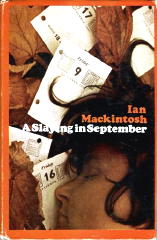
       A Slaying in September (n.) Hale 1967 [Antwerp, Belgium]
       A Drug Called Power (n.) Hale 1968 [with Sue Dell; Scotland]
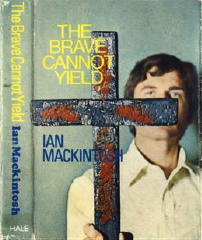
       The Brave Cannot Yield (n.) Hale 1970 [with Sue Dell; Scotland]

   Let me explain about Sue Dell, if I may (and if I can). As I said above, Blackgrove is a single-minded and totally ruthless vigilante of the Donald Pendleton–Marc “The Executioner” Bolan type, about 30, and in the prologue he meets a 19-year-old girl, Sue Dell, whom he makes his partner. Their relationship is chaste, for all I could tell, but (and I’ll get back to this) extremely violent (not toward each other, I hasten to add).

   As partners in their two-person anti-crime squad, they are extremely successful, calling themselves the Trans-World Independent Narcotics Squad (T.W.I.N.S.). Maybe that tells you something about the general level the book’s written on already.

   Although things are cheerfully working out very well on their own, when MI5 comes calling, they accept the employment, the challenge, and the change to save not only England but the world from a new Mastermind of Crime, complete with deadly poisons with which to blackmail the capitals of Europe into submission, one by one.

   That’s about all of the plot I need to tell you, I suppose, and the story is told in a Gosh Wow (i.e., semi-corny) sort of way that television shows used be conducted back in the 1960s and 70, except for one thing: the level of violence, and the lack of compunction in killing and maiming for life, left and right. This is both the Good Guys and the Bad Guys, mind you, including the 19-year-old, five foot two and beautiful Sue Dell.

   Take for example, the events at and around page 100, and judge for yourself. The wife of an opposing drug dealer is dowsed with oil, set on fire with a flame-thrower, and they watch as her body curls up in a blackened crisp. The drug dealer himself? Dumped into a vat of acid, with his head propped up to made sure it stays above the …

   Forget it. That’s enough, even though the book does improve from here on in. (I skimmed a lot, just so that I could tell you this, assuming that like me, you’d want to know.) What I don’t know is what kind of person this book was written for, but it isn’t me, nor was it ever.

   Nor is there any warning on the jacket about the sadistic sort of violence-oriented pornography that awaits the unwary reader inside. When you buy an Executioner novel, for example, you know exactly what you’re paying for.

   So be forewarned, that’s all I say. After an investment of 100 pages, there was enough of interest for me to finish A Drug Called Power, albeit very quickly, and the two starring characters were intriguing enough that reading the next one in the series is not entirely out of the question, just to see what happens to them, should one turn up. Don’t take even this small glimmer of positivity as a recommendation, though. I’d rather not take the responsibility.

       >>>

   Other crime fiction by IAN MACKINTOSH, excluding the TV tie-in’s covered in earlier posts:

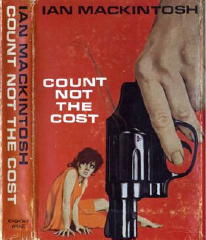
      Count Not the Cost (n.) Hale 1968 [England; Hong Kong]

IAN MACKINTOSH

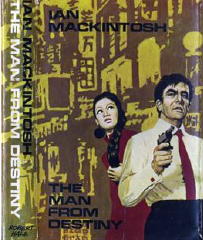
      The Man from Destiny (n.) Hale 1969 [Hong Kong]

IAN MACKINTOSH


   PS. Thanks to Jamie Sturgeon for providing the cover images.

[UPDATE] 02-24-09.   One last cover image, this one sent me once again by Jamie Sturgeon. Other than the TV novelizations, this constitutes a complete cover gallery of Ian Mackintosh’s crime novels, five in all.

IAN MACKINTOSH

REX STOUT – The League of Frightened Men.

STOUT League of Frightened Gentlemen

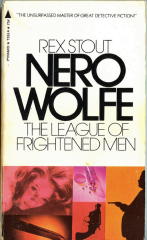
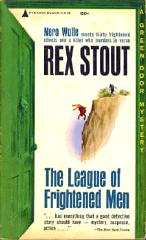
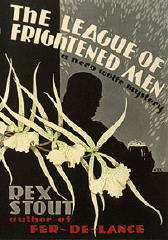
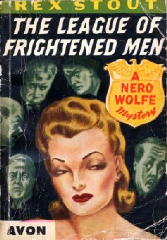
Pyramid, paperback reprint; 1st printing, Oct 1963 [Green Door Mystery]; 5th printing, Jan 1972 (shown). Serialized in The Saturday Evening Post, June 15 to July 20, 1935, as “The Frightened Men.” Hardcover first edition: Farrar & Rinehart, 1935. Cassell, UK, hardcover, 1935. Other paperback reprints include: Avon, 1942; Jonathan Press Mystery #J-33, n.d., digest, abridged; Mercury Mystery #48,n.d., digest, abridged; Jove, June 1979; Bantam, January 1995; Bantam (with Fer-de-Lance), 2008, trade ppbk.

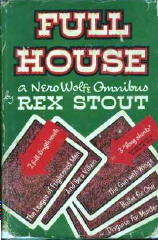
   While I can’t tell you either the day or the month, I can tell you exactly what year it was that I read The League of Frightened Men the first time. It was 1955. The reason I can be so sure about this is because I’d just joined the Dollar Mystery Guild, and one of the first selections they sent me was Full House, an omnibus volume containing two Nero Wolfe novels and a collection of short stories, and it was absolutely marvelous.

STOUT League of Frightened Gentlemen

   The other novel was And Be a Villain (1948) and the collection was Curtains for Three (1951) — I know because I just looked it up, as otherwise details like these I hadn’t remembered. While I can’t tell you how long it took me, what I do recall is reading the book through from cover to cover. It was as if a new world of detective fiction had opened up to me. (I still have the book today.)

   It was the first time, perhaps, that I’d found the characters in a detective novel to be actual people, including the detectives, especially in contrast to the more one-dimensional ones found in, say, the Perry Mason novels, as perfect as puzzle mysteries his books were to me back in 1955.

   Not that at the age of thirteen I really knew this was what it was that was different about the Nero Wolfe stories. At that age I’d barely begun to realize that a reader was allowed to have critical opinions about the books they read or the TV shows they saw.

   Time passes. This past week it was that I read The League of Frightened Men for the second time, and while I did not remember first of all, who did it, some of the major plot points did come back to me. The byplay between Nero Wolfe and Archie Goodwin, his assistant and number one leg man, came back of course, as that is the probably the number one reason that the Nero Wolfe novels are still read today.

STOUT League of Frightened Gentlemen

   But the villain of the piece, Paul Chapin, the crippled genius the League is so frightened of, he was scary then, and he was still scary to me today. Permanently disabled because of an undergraduate Harvard prank, he’s the center of attention any time he’s on stage (so to speak), and it is no wonder when members of the so-called League of Atonement begin to die or disappear under suspicious circumstances, it is assumed at once that Chapin is responsible, and they call on Wolfe for help.

   The verses the members have received do not help. Here’s the first verse of the first one, sometime else that came back to me right away, after a gap of over 50 years from the first time I read it:

      Ye should have killed me, watched the last mean sigh
      Sneak through my nostril like a fugitive slave
      Slinking through bondage.
      Ye should have killed me.
      Ye killed the man,
      Ye should have killed me!

STOUT League of Frightened Gentlemen

   Powerful stuff, as I say, then and now. Maybe overly melodramatic? You might say so, but I’d beg to differ. It’s perfect for the novel and the resulting case for Wolfe and Archie, and perfect for me.

   The League of Frightened Men (1935) was the second of the Nero Wolfe novels. The first was Fer-de-Lance (1934) — the final one being Family Affair in 1975 — and not all of the characterizations were set in stone at this early date, although many of Wolfe’s many eccentricities had already been established: his rigid schedule, his aversion to leaving his home for the outside world (although he does in League and more often, I suspect, than his reputation would suggest), the orchid room upstairs, and so on.

   I am not sure how someone born after 1975, that being the date of his last appearance, would react to Nero Wolfe if he or she would happen to read one of his detective stories today, especially an early one like League.

STOUT League of Frightened Gentlemen

   I called Rex Stout’s characters “actual people” a while ago, and while he’s an exaggeration, no doubt, I have no problem envisioning someone like Wolfe living the way he does and acting the way he does.

   His adventures certainly wouldn’t have been as successful, though, without Archie to bring him back down to earth when the story needs it, and Archie, while he’s more than sharp enough in many ways, I just can’t picture him being given center stage and a case to solve on his own.

   League is a long book, perhaps a little too long, and the pace sags noticeably in the middle. Wolfe often knows things that neither the reader nor Archie does not, or at least not right away. In 1955 I thought this was a wonderful book, but I can see now why it may not be one for the novice Rex Stout reader to start off with.

   On the other hand, why not? The water’s fine, the images are sharp, the people detailed, and with the few caveats I’ve just stated, it’s still a terrific job of storytelling.

S. F. X. DEAN – Such Pretty Toys.

Tor, paperback reprint; 1st printing, Oct 1986. Hardcover edition: Walker. 1982. Trade paperback: Felony & Mayhem, 2007 (shown).

S. F. X. DEAN

   So, what’s the word I want? Synchronicity? What are the odds that any two mysteries you happen to pick up, one after the other, would both take place in Sante Fe, New Mexico? (Not unless you were trying, that is.)

   And listen to this. The woman who sells Professor Neil Kelly his bus ticket believes that Sante Fe is inhabited solely by “Indians and psychiatrists and other divorced women.” She’d either just been there, or else she’d just finished reading the same book I just did.

   [NOTE: This preceding book was False Impressions, by Karin Berne, in which divorced Elllie Gordon solves a murder while visiting Sante Fe. You can find my review here.]

   Actually Kelly takes the bus only from Albuquerque, there being no direct flights from Boston. If you haven’t read his first adventure, By Frequent Anguish, you wouldn’t know that Professor Kelly is an English teacher at Old Hampton College, apparently a fictionalized version of a school like Smith, Amherst or Hampshire — or perhaps a conglomerate version of all of them. In that earlier book, Kelly solved the murder of a student he was about to marry, and not surprisingly, I found it a fairly gloomy affair.

S. F. X. DEAN

   In this one, following close upon the heels of the first, the dead girl’s father is murdered and the mother blinded in an explosion, one apparently aimed at the latter, a part-time CIA agent. The trail leads to a half-sister in New Mexico, which is where Sante Fe comes in, as well as assorted FBI and CIA agents, not all on the same side, for some reason.

   The difference in tone between this book and the False Impressions is enormous. In the earlier novel, murder is posed primarily as a puzzle to be solved. In Such Pretty Toys murder is easily seen to be the crisis and tragedy it really is, rather than existing as the focal point of a work whose only purpose is entertainment.

   I am bothered by this, but both approaches are undeniably valid ones. Both are are not only accepted but taken for granted in mystery fiction. Personally, I lean toward Dean’s approach. In the two cases at hand, I think his is overall the better book, and yet I can’t say I didn’t enjoy the Berne book as well.

   In terms of demonstrating the tensions and personal anguish that a murder in the family should arouse, however, Professor Kelly’s venture into the real world of espionage and world-wide intrigue is also the more honest of the two, by far.

   But I also think that Dean might have chosen another family for tragedy to strike. The point kept bothering me, throughout the book, that the Laceys have been through quite enough, thank you. This time around, why not someone else?

— From Mystery.File 1, January 1987 (slightly revised).


[UPDATE] 07-25-08.   I don’t know if the term “cozy mystery” was in wide usage back in 1987, but perhaps not, otherwise I might have used it to describe False Impressions, which I used in strong contrast to Such Pretty Toys. I’m on better terms with the sub-genre of cozies now than I was back then, as long as they take death as a serious matter. (Some don’t, but hopefully only a few. One I remember most distinctly — and with much distaste — was one in which the lady sleuth whispers and giggles with her male friend all through the victim’s funeral service. I read no further.)

BIBLIOGRAPHIC DATA.   Taken from the Revised Crime Fiction IV, by Allen J. Hubin. Series character: Prof. Neil Kelly, in all:

DEAN, S. F. X. Pseudonym of Francis D. Smith, ca.1926- .
    * By Frequent Anguish (n.) Walker 1982 [Academia; Massachusetts]
    * Such Pretty Toys (n.) Walker 1982 [New Mexico]
    * Ceremony of Innocence (n.) Walker 1984 [England]

S. F. X. DEAN

    * It Can’t Be My Grave (n.) Walker 1984 [England]
    * Death and the Mad Heroine (n.) Walker 1985 [Massachusetts]
    * Nantucket Soap Opera (n.) Atheneum 1987 [Nantucket]

   Said Newgate Callendar in a New York Times review of Ceremony of Innocence (15 July 1984):   “S. F. X. Dean, whose real name is Francis Smith, is a professor of humanities at Hampshire College in Amherst, Mass. He concentrated in Chinese studies at Harvard and during World War II was a weather analyst in the Pacific for the Navy.”

[FURTHER COMMENT] 07-26-08.   It has belatedly occurred to me to describe what I call a cozy mystery. A definition on Wikipedia summarizes my own thoughts very well, if not quite exactly: “‘Cozy mysteries’ began in the late 20th century as a reinvention of the Golden Age whodunnit; these novels generally shy away from violence and suspense and frequently feature female amateur detectives. Modern cozy mysteries are frequently, though not necessarily in either case, humorous and thematic (culinary mystery, animal mystery, quilting mystery, etc.).”

   I do not think of Golden Age puzzle mysteries as cozies. Agatha Christie is NOT a cozy mystery writer. If I were to add to the Wiki definition, I would include a phrase to the effect that large chunks of cozy mysteries are taken up with the personal relationships and interactions between the characters, their families, their friends and fellow hobbyists, but with such relationships having nothing to do with the causes of the crime or the solving of the crime, nor are they in any way a consequence of the crime, except in the most incidental fashion.

   Current-day cozies can very well include a puzzle plot approach to solving the crime. As the Wiki definition says, and I hadn’t thought of this in so many words, the current cozies are a “reinvention of the Golden Age whodunnit.” But the way cozies become flawed — or even fail, in my opinion — is by either including too much non-crime related material, or (as in the example I mentioned above) by not taking the process of solving the crime seriously enough.

   And to be truthful, even though (and especially because) I was the one to bring it up in the first place, I can’t tell you whether or not False Impressions actually is a cozy. I’d have to read it again to be sure. From the review, it sounds as though it might be, but since I also admired the puzzle aspect, if it is, then it’s one of the good ones.

« Previous PageNext Page »