Characters


ANTHONY GILBERT – The Black Stage.

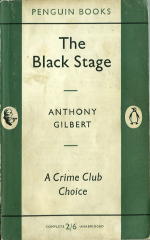
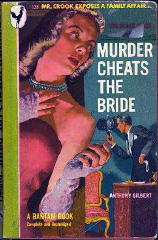
Penguin, UK, paperback reprint, 1955. Hardcover first edition: Collins Crime Club, 1945. US edition: Smith & Durrell, hc, 1946. Also published as: Murder Cheats the Bride, Bantam #138, pb, 1948.
ANTHONY GILBERT

   Between 1936 and 1974 there were, by my count, 50 recorded adventures of a slightly seedy, badly dressed and deliberately vulgar barrister detective named Arthur Crook, of which total this is one. The author, Anthony Gilbert, is described thusly on the back cover of the 1955 British paperback I happen to have:

    “Little is known about the author except that his books are among the most popular stories written today…”

   Of course we know better now, but it’s remarkable that the secret was kept a secret for so long. Anthony Gilbert was in real life a lady named Lucy Beatrice Malleson (1899-1973), and she has a whole string of other novels to her credit, not all criminous, both under this pen name and two or three others.

   The earliest of the Crook stories were never published in the US, but after some point in the early 1940s, all of them seem to have been. Why was he called Crook? What a delightful deceit!

   I’ve not read too many of them, and none recently, but I think The Black Stage fits the general overall pattern. Gilbert allows the events leading the inevitable murder to build up gradually, letting the characters (sans Crook) have full rein over their actions and letting the reader in on all of their possible motives, until at last the deed is done. In The Black Stage, that’s on page 74. (The lights had gone out immediately before, and when they are restored someone is standing with a gun in her hand over a body on the floor.) Crook is not met until page 94 (out of 219 in all), having been hired to represent the interests of Anne Vereker, the young woman being held for trial.

   Which means, to Crook, finding the true guilty party. Perhaps it’s true in other books in the series, but there’s no courtroom theatrics in this book, only – toward the end – a reconstruction of the crime, designed solely to confuse the real killer into identifying him or herself.
ANTHONY GILBERT

   Somewhat earlier, on page 148, Crook confides to his assistant that he knows who the killer is. If this had been an Ellery Queen novel, it would have been a terrific spot to have placed a “Challenge to the Reader.” Which I would have failed, which I almost always do, and in this case, shame on me.

   You might be wondering if the 74 pages of preliminary action were at all boring. No, absolutely not. Not at all.

   Each of the characters in the drama is wonderfully drawn, and with the widow about to marry a man who is so obviously only looking out for himself (and the woman’s diamonds), and not the others living at Four Acres who would be her heirs or who depend so greatly on Tessa Goodier – stop and take a breath, Steve – it is clear almost from the beginning who the victim will be.

   The anticipation only grows and grows, in other words. The ensuing events and the subsequent investigation of the crime is, believe it or not, marginally less interesting – the actions and behavior of the participants less well described. (The author was trying, I believe, to make a relatively simply crime more complex and complicated than it needed to be, but if the middle events were not part of the story, then of course the book would have been, from anyone’s point of view, something less in length than a novel.)

   But I love maps in crime novels (and there is one) and re-creations of crimes (of which I have already mentioned there is one also), so all is not lost, and in fact, much is regained.

   One is only left to wonder in the end, then, whether the RAF officer Anne Vereker met after the war on the train she’s taking back to her home in the English countryside will manage to find her again. Could it be that now that the war is over, that class status will no longer make a difference to them?

   (Not that she may even remember him, but it was he, in the only other part of the story where he comes in again, who recommended Arthur Crook to her cousin to act in her defense. That should count for something, shouldn’t it?)
REVIEWED BY WALTER ALBERT:         


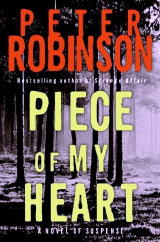
PETER ROBINSON – Piece of My Heart. William Morrow, hardcover, May 2006. Paperback edition: Harper, April 2007.

PETER ROBINSON Piece of My Heart

   Robinson’s latest DCI Banks mystery skillfully alternates between a 1969 investigation into the murder of a young woman at a rock concert by DI Stanley Chadwick and the present-day investigation by Banks into the murder of a journalist who was working on a project involving a band, the Mad Hatters, connected to the earlier investigation.

   Banks has moved back into his restored cottage which is now outfitted with high-end audio and video equipment from his late brother’s apartment, is adjusting to a new, ambitious boss, is still friendly with but no longer dating DI Annie Cabot, and displays his usual mix of thorough professionalism and stubborn independence that has always marked his investigative style.

   And once again brings things to a successful conclusion. Another entertaining entry in a long-running, well-developed series.

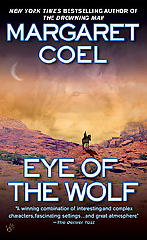
MARGARET COEL Eye of the Wolf

MARGARET COEL – Eye of the Wolf. Berkley: hardcover, September 2005; paperback, September 2006.

   I don’t find myself compulsively keeping up with this series, but the Indian reservation setting continues to interest me, even though I find the series suffers from the too predictable relationship of lawyer Vicky Holden and Jesuit priest, Father O’Malley.

   Vicky is one of those bruised women who populate the current mystery scene, with a painful personal life that is less interesting than the case or cases that engage their professional attention.

   I suppose this is intended to give them some of the density of the mainstream novel, but the convention is vastly overused and I think it’s time to give it a rest.

A REVIEW BY MARY REED:
   

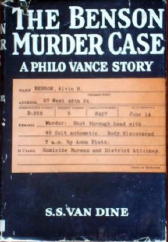
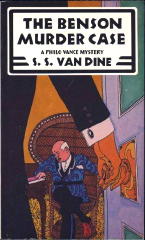
S. S. VAN DINE – The Benson Murder Case. Charles Scribner’s Sons, 1926. Hardcover reprints include: A. L. Burt, no date (shown); Gregg Press, 1980. Paperback reprints include: Pocket #333, 1945 (shown); Fawcett Gold Medal T2006, no date (ca.1968); Scribner’s, 1983 (shown).

S. VAN DINE The Benson Murder Case

   Narrator ‘Van’ Van Dine originally met Philo Vance at college and is now not only a close friend but also his full-time legal and financial advisor. He is thus on the spot to record cases in which Vance becomes involved.

   Vance is rich and cultured, possessing many beautiful and rare examples of art and artefacts from various eras and continents. He easily out-Wimseys Wimsey, what with addressing people as ‘Old dear’ and constantly talkin’ ragin’ nonsense, often dropping French or German into conversations with an occasional bit of Latin for variety, not to mention quoting luminaries such as Milton, Longfellow, Cervantes, and Rousseau as well as Spinoza and Descartes. But it’s all a front, of course.

   John Markham, DA for NY County, arrives at Vance’s flat while Van and Vance are discussing business and announces wealthy broker Alvin Benson has been murdered. Alvin’s brother Major Anthony Benson has asked Markham to take charge, and Markham had promised Vance he would take him along on his next important investigation. It seems the authorities were casual about protocol as well as crime scenes, because not only do both Vance and Van tag along but they are also present at several interrogations.

S. VAN DINE The Benson Murder Case

   At one point Vance produces a list of suspects based upon reasoning from available information and physical evidence. The only snag is they are innocent. It is a demonstration of his conviction that “The truth can be learned only by an analysis of the psychological factors of a crime and an application of them to the individual”.

   Who then is the culprit? The actress Muriel St Clair, in whom the dead man had taken more than a passing interest? Her fiance Captain Philip Leacock, he of the hasty temper and jealous disposition? Major Benson, given the brothers did not get along? What about Mrs Anna Platz, Alvin’s housekeeper, who seems to be hiding something, or the precious and impecunious Leander Pfyfe, a close friend of the deceased?

My verdict: Some will find Vance’s insistence on keeping the identity of the murderer secret irritating but given he had it sussed out within an hour or two of visiting the crime scene, one can see why.

S. VAN DINE The Benson Murder Case

   To be fair, he all but takes Markham’s hand and leads him to the culprit. There are clues aplenty, and to my delight the author provided those much-loved and now sadly missed tidbits — a room plan, a character list, and footnotes from Van.

   Although readers may find Vance’s lit’r’y meanderin’s a bit tedious, his explanation of his psychological reasonings are interesting and convincing, although I am still not certain if the author was sending it up or using it as a genuine plot device. All in all, however, a good read with plenty of red herrings to confuse the issue.

      Etext:
http://gutenberg.net.au/ebooks02/0200341h.html

         Mary R

http://home.epix.net/~maywrite/


[EDITORIAL COMMENT.]  Mary sent me this review back in September of  ’07, along with a backlog of others. (Sorry, Mary!) I’ll get more of them online here soon, but after posting Bill Loeser’s recent comments about the same book, I thought I ought to pull this one out of the queue and give it some priority, the idea being that two independent views of a book are better than one, and certainly far better than none. (Where else has The Benson Murder Case been reviewed in the last 10 or 20 years?)

   That’s a rhetorical question. You needn’t answer it.

— Steve

THE CURMUDGEON IN THE CORNER
by William R. Loeser

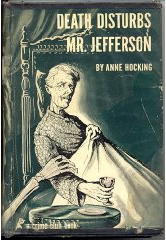
ANNE HOCKING Death Disturbs Mr. Jefferson

   Based on an overall favorable review in Barzun & Taylor’s A Catalogue of Crime, I read Anne Hocking’s Death Disturbs Mr. Jefferson (1950). Solicitor Jefferson is found dead in bed, and it soon becomes apparent that someone had put a ringer in his bottle of sleeping pills.

   At first, Jefferson seems to be an estimable character – he had no use for people and lives only for his glass collection – but it is discovered that he has been supporting his hobby/habit by blackmail on the basis of documents entrusted to him professionally.

   At this point the reader is all on the side of the murderer. In a good touch, Ms. Hocking has overcome our misplaced running with the hare by making the culprit one of the blackmailees.

   Most of the detection is ordinary policework and elimination of suspects because they aren’t “capable” of the crime. There is little action – even the killer is collared offstage.

   Not bad, not good.

– From The MYSTERY FANcier, Vol. 3, No. 2, Mar-Apr 1979       (slightly revised).


BIBLIOGRAPHIC DATA: [Taken from the Revised Crime Fiction IV, by Allen J. Hubin.]

ANN HOCKING – Death Disturbs Mr. Jefferson. Doubleday Crime Club, hardcover, 1950. Geoffrey Bles, UK, hardcover, 1951.

CHIEF INSPECTOR WILLIAM AUSTEN
. Author: Anne Hocking, pseudonym of Mona Messer Hocking, (1890-1966).

Ill Deeds Done (n.) Bles 1938 [England]
The Little Victims Play (n.) Bles 1938 [England]
Old Mrs. Fitzgerald (n.) Bles 1939 [England]  US title: Deadly Is the Evil Tongue.
So Many Doors (n.) Bles 1939 [Cyprus]
The Wicked Flee (n.) Bles 1940 [England]
Miss Milverton (n.) Bles 1941 [England]  US title: Poison Is a Bitter Brew
Night’s Candles (n.) Bles 1941 [Cyprus]
One Shall Be Taken (n.) Bles 1942 [England]
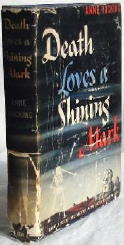
Nile Green (n.) Bles 1943 [Cairo]  US title: Death Leaves a Shining Mark.

ANNE HOCKING

Six Green Bottles (n.) Bles 1943 [England]
The Vultures Gather (n.) Bles 1945 [England]
Death at the Wedding (n.) Bles 1946 [England]
Prussian Blue (n.) Bles 1947 [England]  US title: The Finishing Touch.
At “The Cedars” (n.) Bles 1949 [England]
Death Disturbs Mr. Jefferson (n.) Bles 1951 [London]
Mediterranean Murder (n.) Evans 1951 [Spain; Ship]  US title: Killing Kin.
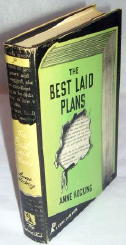
The Best Laid Plans (n.) Bles 1952 [England]

ANNE HOCKING

There’s Death in the Cup (n.) Evans 1952 [England]
Death Among the Tulips (n.) Allen 1953 [England]
The Evil That Men Do (n.) Allen 1953 [England]
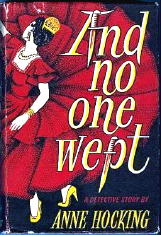
And No One Wept (n.) Allen 1954 [England]

ANNE HOCKING

Poison in Paradise (n.) Allen 1955 [England]
A Reason for Murder (n.) Allen 1955 [England]
Murder at Mid-Day (n.) Allen 1956 [Spain]
Relative Murder (n.) Allen 1957 [England]
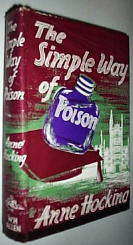
The Simple Way of Poison (n.) Allen 1957 [Oxford]

ANNE HOCKING

Epitaph for a Nurse (n.) Allen 1958 [England]  US title: A Victim Must Be Found.
Poisoned Chalice (n.) Long 1959 [England]
To Cease Upon the Midnight (n.) Long 1959 [England]
The Thin-Spun Life (n.) Long 1960 [England]
Candidates for Murder (n.) Long 1961 [England]
He Had to Die (n.) Long 1962 [England]
Murder Cries Out (n.) Long 1968 [England]

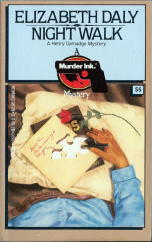
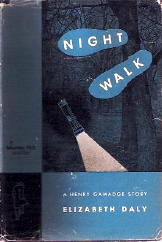
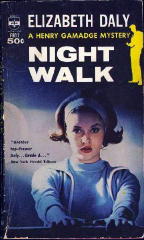
ELIZABETH DALY – Night Walk.

Dell, paperback reprint; Murder Ink series #55; 1st printing, December 1982. Hardcover first edition: Rinehart & Co., 1947. Hardcover reprint: Detective Book Club, 3-in-1 edition, February 1948. Other paperback edition: Berkley F811, 1963.

ELIZABETH DALY Night Walk

   A scarce book, relatively speaking. On ABE at the moment there are only 24 copies of all of the various editions combined. The “Murder Ink” series is a nice set to own, by the way. Wouldst that a mass-market publisher would consider doing today a long series of classic detective novels like this one, with a parallel and equally long one presented under the auspices of the “Scene of the Crime” bookshop on the West Coast.

   Authors like Sheila Radley, V. C. Clinton-Baddeley, W. J. Burley, Douglas Clark, Colin Watson, and Patricia Moyes (Murder Ink); and Gladys Mitchell, Anthony Berkeley, Alan Hunter, and Gwendoline Butler (Scene of the Crime). Hardly any of them even in print today.

   I’ll forgo my usual bibliographic discussion of the author, Elizabeth Daly. You can read the preceding review for that. Even though I read The Book of Lion over four years ago, the same kinds of feelings were evoked this afternoon and evening in finishing up Night Walk. A strong sense of nostalgia for the past, quite definitely, but there’s also (as I suspect in all of Daly’s fiction) an unmistakable love of things literary, bookish, and yes, libraries, where a portion of the current book takes place.

ELIZABETH DALY Night Walk

   The scene is a small, isolated town in Westchester County, New York, which even though perhaps less than 50 miles from Manhattan, lives (or did in 1947) almost as though in a different, earlier era, and obviously in a far different place. A place where, if a murder occurs, it can be blamed on a tramp. A homicidal maniac, more likely.

   The first four chapters, in fact, do nothing more than to follow the trail of the killer, first to a small scale rest and rehab facility for the rich and well-to-do, then the aforementioned lilbrary, then the local inn, and then and only then, to the home of the Carringtons’, where the senior member, an invalid, is later found dead in his bed.

   Henry Gamadge is called in on the behest of a friend who finds himself caught up by accident by the police, a stranger to the area, but with an ulterior motive he’d rather not make public.

   Gamadge, having an in with the police, a friend on the force in the city having put in a good word for him, does his usual low key type of investigation. In fact, the first 100 pages he’s on the job seem to be nothing more than retracing the steps of the killer on the path connecting his (or her) various stops along his way. Nothing seems to escape Gamadge’s attention, however.

ELIZABETH DALY Night Walk

   To the reader, though, the lack of a “Watson” is a bit of a frustration, as we see what Gamadge sees, but we do not have access to his thought processes. On the other hand, however, there are none of those “You know my methods,” tossed off to his subordinates as if only to tease us.

   It’s a trade-off, of course, and if I were to read more of Elizabeth Daly, I think I might eventually catch on to the way she includes her clues — all very fair and above board, I might very well make sure you understand.

   What it also means is that it takes the last 18 pages or so for Gamadge to explain all, and ’tis nice, the explanation is, indeed. One wishes perhaps only more stage presence from Clara, otherwise known as Mrs. Gamadge. She comes to Frazer’s Mills only at the end of the book, appearing on only one or maybe two of the pages in the last 18.

   Plotwise, I might mention a small couple of glitches in the summing up or the previous telling of the tale, but they’re so minor, for what good reason, I ask myself now, should I bring them up now? So I won’t, no more than I already have.

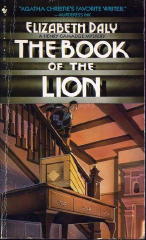
ELIZABETH DALY – The Book of the Lion.

Bantam paperback, 1st printing, 1985. Hardcover edition: Rinehart & Co., 1948. Hardcover reprint: Detective Book Club, September 1948. Earlier paperback editions: Bestseller Mystery #112, circa 1949; Berkley F700, circa 1963.

   For a lady who didn’t start writing mysteries until she was in her early 60s, Elizabeth Daly was one of the more prolific author in the 1940s, publishing sixteen adventures of Henry Gamadge, the leading character in each of her books, during the twelve year period beginning in 1940 and ending in 1951.

ELIZABETH DALY The Book of the Lion.

   It’s doubtful, though, if any but the most dedicated of mystery readers know of her work today. For the volume of work she did, Elizabeth Daly seems to be under-appreciated and all but forgotten. According to Amazon, only one of her books is currently in print: Unexpected Night (Otto Penzler’s Classic American Mystery Library, 1994).

   And I’ll confess that in spite of many opportunities to do so, this is the first of her novels that I’ve read, and I can’t tell you why. In case, you’ll have to take the comments that follow as being based on a sample of size one, no more (and no less).

   What Gamadge does (or did) for a living, precisely, based on this wispy, lightweight bit of mystery, escaped me for a while. He is called upon to look at a collection of letters that might have some value, even though he gently protests that he is not really qualified. He is later described as a graphologist – a handwriting expert – not to mention a noted criminologist (page 41). What he really seems to be, and he has a laboratory to back up this up, is an expert in old and rare books.

   All of which lends a strong literary flavor to the case that follows. The widow of a famed poet and playwright, but not in any financial sense, has the husband’s letters, but before Gamadge can view them, she has them sold and bundled out of her brother-in-law’s house, sight unseen.

   The end of the matter, perhaps, but Gamadge senses there was more to the sale than met the eye. He is proven right, although not in any way the police can follow up on, when the last person the dead man visited before his unsolved death also is found dead, an apparent suicide, and it takes Gamadge’s mild-mannered investigations to bring some closure and finality to the matter.

ELIZABETH DALY The Book of the Lion.

   Gamadge is the epitome of the genteel, bookish detective, the pure amateur, and he is very clever in the way he figures things out and puts the pieces of the puzzle together – and I still haven’t figured out how he knew what and when nor how.

   “The Book of the Lion,” by the way, would be a fabulous find, if it were ever found – especially in manuscript form as one of the lost books of Chaucer – and that is what piques Gamadge’s interest more than anything else, even if the chances are nearly one hundred percent that it’s a forgery.

   Even if the plot is flimsy and gossamer thin, Daly’s characters are perfectly described, even those the most minor, and she has a sense of humor that can often catch you unaware. Gamadge’s wife Clara, who does not appear often enough in this novel, is a charming young woman who seems to adore Henry.

   I particularly liked the following exchange, from page 112. Clara and Henry are talking about the beautifully naive young cousin of the widow who had the letters:

    “And she loves to ride in taxis,” said Gamadge, “and I wish her taste in sandwiches were better. Still, they’re cheap.”

    Clara said calmly, “Henry loves her because she’s a victim and doesn’t resent it.”

    “Doesn’t know it,” Gamadge corrected her. “There’s nothing more beautiful than a martyr who isn’t aware of the fact.” He picked up Clara’s hand and held it against his cheek. As he laid it down again, she said: “I can’t imagine what you mean.”

    “That’s what I mean.” Gamadge was laughing too.

— January 2004


[UPDATE] 07-16-08.
  Four and a half years later, and there aren’t any of Elizabeth Daly’s books in print. I’m guessing, but I imagine both she and Henry Gamadge are even less well-known now than they were then. Tastes change, I know, but it’s still a shame.

   And in the “credit where credit is due” department: The cover of the Bestseller edition came from www.bookscans.com, a website with a most worthy goal: to display the covers of every vintage paperback ever published in the US through 1970 or so. I sent Bruce Black, the proprietor, a few he’s missing earlier this week, and if you’re a collector, you might consider doing the same.

[UPDATE] 07-23-08.   Good news! I was in error when I said Daly is no longer in print. See the comment left today by Les Blatt.

REVIEWED BY WALTER ALBERT:         


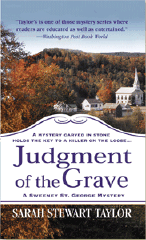
SARAH STEWART TAYLOR Judgment of the Grave

SARAH STEWART TAYLOR – Judgment of the Grave. St. Martin’s Press: hardcover, June 2005; paperback, August 2006.

   Sweeney St. George, temporarily relieved of her academic teaching duties, pursues her interest in funerary art (mainly gravestones) by relocating to Concord to do primary research on the bizarre headstones carved by a Revolutionary era stonecutter. She finds herself following the trail already opened up by another scholar who’s disappeared and is presumed to be dead.

   I prefer Sweeney in her academic setting, where she seems more at home, but the novel, if somewhat over ingenious in its plotting, is still a pleasing mix of scholarship and murder, both of them natural lures for the always inquisitive protagonist.

ANN WALDRON Unholy Death

ANN WALDRON – Unholy Death in Princeton. Berkley, paperback original, March 2005.

   A novel somewhat in the same vein as the one above. It features a protagonist (McLeod Dulaney) who’s a prizewinning journalist doing research for a biography on an abolitionist newspaperman at Princeton Seminary.

   In comparison with Taylor’s book, however, Waldron’s novel is cluttered with forgettable characters and really awful dialogue, further compromised by a meandering plot and an improbable climax.

BIBLIOGRAPHIC DATA:

   The Sweeney St. George mysteries:

O’ Artful Death. St. Martin’s, hc, 2003.
Mansions of the Dead. St. Martin’s, hc, July 2004.
Judgment of the Grave. St. Martin’s, hc, June 2005.
Still As Death. St. Martin’s, hc, Sept 2006.

   The McLeod Dulaney mysteries:

The Princeton Murders. Berkley,pb, Jan 2003.
Death of a Princeton President. Berkley, pb, Feb 2004.
Unholy Death in Princeton. Berkley, pb, Mar 2005.
A Rare Murder in Princeton. Berkley, pb, Apr 2006.
The Princeton Imposter. Berkley, pb, Jan 2007.

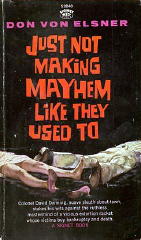
DON VON ELSNER – Just Not Making Mayhem Like They Used To.

Signet S2040; paperback original, December 1961.

   Have you ever read fifty pages into a book late into the evening, look up at the clock, see that it says that it’s one o’clock in the morning, and realize that the last 30 pages haven’t made much sense at all?

   I hate to say it of any book, but that’s what happened to me with this one. It’s not that I was tired, which is what I assumed the next morning, and maybe that’s what you’re thinking too, but no, that wasn’t it. I tried again, on and off, the whole week that followed. I struggled, I skimmed, and I skipped, and if you want to forgo reading the rest of this review for any of the reasons listed, you’d be right. I wouldn’t blame you in the least.

   This is the second recorded adventure of Colonel David Danning, lawyer, bridge player, and judo expert, among other accomplishments. If nothing else, the titles of his cases are designed to catch your attention. Expanded from the author’s entry in the Revised Crime Fiction IV, by Allen J. Hubin:

      Those Who Prey Together Slay Together. Signet D1943, June 1961.

DON VON ELSNER

      Just Not Making Mayhem Like They Used To. Signet S2020, Dec 1961.
      Don’t Just Stand There, Do Someone. Signet S2134, 1962
      You Can’t Do Business with Murder. Signet S2214, Dec 1962
      Who Says a Corpse Has to Be Dull. Signet G2407, 1963
      Pour a Swindle Through a Loophole. Belmont 92-604, Sept 1964
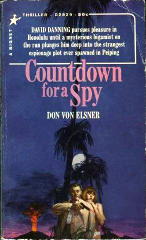
      Countdown for a Spy. Signet D2829, Jan 1966.

DON VON ELSNER

      A Bullet for Your Dreams. Lancer 73-709, 1968.

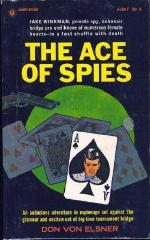
   Yes, I agree; the originality does tend to tail off toward the end. For the record, Von Elsner’s other mysteries feature Jake Winkman, a professional bridge player who helps out the CIA from time to time:

      How to Succeed at Murder Without Really Trying. Signet 1963. Reprinted as: The Jake of Diamonds. Award, 1967 (not a misprint)
      The Ace of Spies. Award 1966

DON VON ELSNER

      The Jack of Hearts. Award 1968

   According to Contemporary Authors, Don Von Elser (1909-1997) was a Life Master of the American Contract Bridge League, which explains why his heroes happen to be expert players too.

   Danning is hired by an underwriters association in Mayhem to find out why so many small businessmen have been committing suicide recently at such an unnatural rate. Danning immediately suspects a gang of blackmailers at work, and he accepts the job. Five months later, he’s still working, with no results to speak of. On page 22: “A vague pattern began to take shape in Danning’s mind.”

DON VON ELSNER

   But then, at long last, the logjam breaks. Danning comes across the story of Homer Pettingill, the man whose misadventures were related to the reader in Chapters One and Two, and hold on to reins, honey, we’re off to the races, and the book doesn’t stop until page 142 and the case is closed.

   Assisting Danning are his adoring secretary Nell Sheridan, who has to prod him into taking cases to boost his disposition; Dr. Greta Nevin of UCLA, who possesses the longest and loveliest legs of any psychology professor in the world; his son Bob, whom he calls Duke, and vice versa, and who looks exactly like him; and a whole agency of private detectives at his continuous beck and call.

   As I type this, it’s beginning to dawn on me that I may have simply been in the wrong mood to read this book, but here’s what is it that goes wrong, as far as I’ve been able to decide, humorous approach prevailing or not.

   Danning’s case is built upon nothing but coincidence and guesswork. Two guys in a hotel chosen at random might be the pair of con men that they’re looking for – of all the gin joints in all the towns in all the world – and yes, they are the ones they’re looking for, a silly escapade with the married folks in the room next door notwithstanding.

   I’ve have thought they’d have investigated the mechanics of the crime and the actual way it was pulled off, but no, no questions are asked along those lines, save very obliquely. But after all of the fancy scheming to get the goods on the bad guys – I skimmed a lot here – it turns out in the recap and the explanations at the end, it all depends on guess what? The mechanics of the crime and the actual way it was pulled off.

   Which you’ve got to read to believe. I don’t, not even for a minute. There’s a good chance that you’ll disagree with me on any or all of this, but I have a hunch that you won’t.

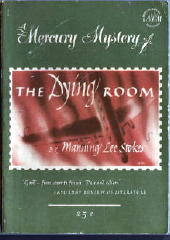
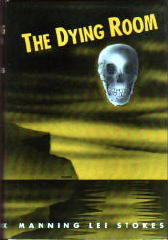
MANNING LEE STOKES – The Dying Room. Mercury Mystery #124; digest-sized paperback; no date stated. Hardcover edition: Phoenix Press, 1947.

MANNING LEE STOKES

   This is strange — really strange, as a matter of fact. There are six copies of this book available for sale on ABE as I type this, and five of them are the paperback version. Guess which one’s the least expensive? The hardcover edition from Phoenix. Even without a dust jacket on the hardcover, explain that if you can.

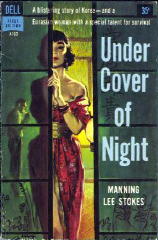
   Manning Lee Stokes was born in 1911 and died in 1976, and at best, he had what you might call a mixed writing career. The Dying Room was one of his earliest books — his first four were published by Phoenix, beginning in 1945, and in chronological order, this one’s the third. From Phoenix he went to paperback originals (Graphic Books) and then wrote several others for another designed-for-libraries hardcover publisher, Arcadia House. One book was published Dell in 1958, but from 1960 on, he wrote nothing that appeared under his own name.

MANNING LEE STOKES

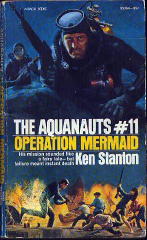
   He wrote some of the early Nick Carter spy thrillers from Award in the 1960s, for example, a few of the John Eagle “Expeditor” men’s adventure novels from Pyramid in the 1970s as by Paul Edwards, and as Ken Stanton, all eleven of the “Aquanauts” books (with leading character Tiger Shark) that came out from Macfadden and Manor, also in the 1970s. (I have all the Expeditor books, I believe, but I have no explanation as to why I have NONE of the Aquanauts books.)

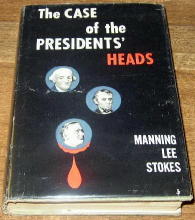
   Stokes also wrote some of the sex-oriented SF-Fantasy “Blade” novels from Pinnacle, or so I’m told, but there’s certainly no reason to go into that, or at least not here. One other series character whom he created and who is worth mentioning is Christopher Fenn, who solved a couple of the cases from Arcadia House in the late 1950s, including The Case of the Presidents’ Heads, shown smoewhere below and to the left. Fenn was a private eye or criminologist of perhaps no great renown, but he is listed on Kevin Burton Smith’s PI website, so he has not been totally forgotten.

MANNING LEE STOKES

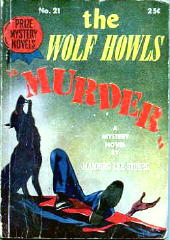
   But there is private eye that Kevin does not know about — a rare event — a gent called Barnabas Jones who appeared in both The Wolf Howls “Murder” (Phoenix Press, 1945) and Green for a Grave (Phoenix Press, 1946). And something that Al Hubin does not know about (yet) is that Barnabas Jones also shows up for a short appearance in The Dying Room. Even though Jones is not the leading character and his part is small, his role is a relatively important one, substantially more than a walk-on or cameo, and I’ll get there very shortly.

   Before I do, however, let me say this up front. The Dying Room is a much better book — and detective novel — than I expected it to be. Phoenix Press is not noted for its gems and works of art in the world of crime and mystery fiction, but you could do much worse than finding a copy of The Dying Room to read somewhere and somehow, hopefully not paying too much for it, no more than ten to fifteen dollars or so, and maybe less if you’re lucky. (My copy cost me five dollars if you were to split the money up as part of a group lot, and when I found it among the others, my first reaction was that I paid too much.)

MANNING LEE STOKES

   Telling the tale is Tom Fain, an ex-soldier with a splinter of a German shell embedded in his brain. About to be moved into the “dying room” at the Fort Tyner station hospital after his latest unsuccessful surgery, Fain decides to make a break for it. And with the help of a sympathetic nurse’s aide named Helen, escape he does.

   On his way to see his ailing stepmother, the only mother he has ever known, he stops to visit with an old friend — the aforementioned Barnabas Jones, who offers him a job, but with other things on his mind at the time, Fain turns him down. (Mr. Jones makes another appearance and more importantly, in his professional capacity, later on.) Failing to reach his stepmother before she died, and avoiding a pickup by a pair of MP’s on his trail, Fain heads back to New York (and Helen) on an airplane — which is where the story begins, or at least the mystery part.

MANNING LEE STOKES

   Fain sits next to a good-looking girl — no, change that, make it a beautiful girl — with whom he strikes up a lively conversation. Things are going well, but there’s nothing like a small disaster to get a story really going. Both Fain and the girl survive the crash. He’s more or less OK, but she is not. Her memory is gone, and a new one — one of her former life — has replaced it. Unfortunately there is a two-year gap in what she remembers. She doesn’t remember Fain, but being convinced that he helped save her life, she invites him to her new (old?) home to recover.

   There was a question mark there, as you will have noticed. Is the girl the missing heir to a considerable fortune? Or is she a fraud? Fifty million dollars is at stake. (I did say considerable.) Several persons try to hire him — it turns out that he, before the war, was a private eye himself. And as it turns out, and not too surprisingly, someone is playing a dangerous (and deadly) game, and Fain, as he quickly discovers, was never given the rules under which it’s being played.

MANNING LEE STOKES

   But as a detective, Fain gives his clients their money’s worth, and in similar fashion does Stokes the author. A six-point summary on page 98 is as precise and to the point as any I’ve read in a work of detective fiction in quite a while. No power point presentation could have produced anything better.

   The ending gets a little too melodramatic, perhaps — well, no perhaps about it — and the prologue most certainly could have been ditched, which very nearly goes without saying, as most prologues could be (should be) ditched, but (and this is a big but) this book is as entertaining as anything I’ve watched on television this week.

   That someone never recognized that this book would make for an awfully good movie is something to be regretted. Filmed in black-and-white, with some professionally done noir-ish touches, perhaps, maybe even a great one.

— July 2006


[UPDATE] 07-11-08. Looks like I never told Kevin about Barnabas Jones, but I will today. (One of course wonders immediately if the gent is related to the later Barnaby Jones of TV fame. Probably not. There are a lot of Joneses in this country.)

   Barnabas Jones’s brief appearance in The Dying Room is now included in Part 5 of the online Addenda to the Revised Crime Fiction IV, along with a complete listing for each of the PI series he did, both early in his career.

IT’S ABOUT CRIME
by Marvin Lachman

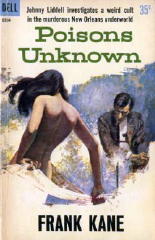
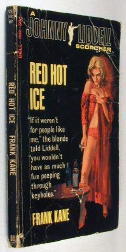
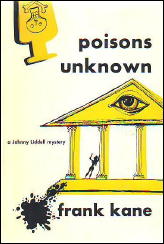
   In clichesville, the equivalent of the gothic heroine is our old friend, the Private Eye — male variety. Frank Kane’s Johnny Liddell was a harmless example of the species — not vicious like Mickey Spillane but not possessing the social conscience of Mike Shayne of Lew Archer either. Recent reading of three of Kane’s books back-to-back showed that he “borrowed” liberally from himself. By the third book I had a feeling of déjà vu, and a fast rereading showed why, as the following quotes indicate. (NOTE: All page numbers are from Dell paperback editions.)

FRANK KANE

Poisons Unknown, page 63: “Gabby Benton was on her second cup of coffee, third cigarette, and fourth fingernail when Johnny Liddell stepped out of a cab. . . ”

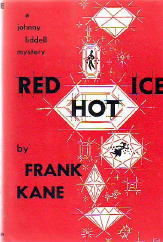
Red Hot Ice, page 18: “Muggsy Kiely was on her third cup of coffee and her fourth fingernail when Johnny Liddlell walked into….”

Red Hot Ice, page 27: “Her legs were long, sensuously shaped. Full rounded thighs swelled into high-set hips, converged into a narrow waist. Her breasts were firm and full, their pink tips straining upward.”

Poisons Unknown, page 182: “The whiteness of her body gleamed in the reflected light from the windows. Her legs were long, sensuously shaped. Full rounded thighs swelled into high-set hips, converged into the narrow waist he had admired earlier in the evening. Her breasts were full and high, their pink tips straining upward.”

A Short Bier, page 60: “The whiteness of her body gleamed in the spotlight. Her legs were long, sensuously shaped. Full rounded thighs swelled into high-set hips, and converged into a narrow waist. A thin wisp of a brassiere made a halfhearted attempt to cover the full breasts, their pink tips straining upward.”

FRANK KANE

Poisons Unknown, pages 49-50: “The pealing of the phone at his ear was shrill, strident, insistent. Johnny Liddell groaned, cursed softly, and dug his head under the pillow. The noise refused to go away. He opened one eye experimentally, squinted at the window shade and noted that it still wasn’t light. He tried to wipe the sleep from his eyes, but it wouldn’t wipe away.”

Red Hot Ice, page 40: “The telephone on the-night table started to shrill discordantly. Johnny Liddell groaned, cursed sleepily, and dug his head further into the pillow. The noise refused to go away. He opened one eye experimentally; he could see by the half-drawn shade that it was still night…. He tried to wipe the sleep from his eyes, but it wouldn’t wipe.”

Red Hot Ice, page 90: “Muggsy Kiely … opened the door herself in response to his knock. She was wearing a robe that clung to a figure that was decidedly worth clinging to.”

A Short Bier, page 39: “Muggsy Kiely opened the door in response to his knock. She was wearing a hostess gown that clung to curves that were obviously worth clinging to.”

Poisons Unknown, page 20: “… seemingly unaware that the front of her housecoat had sagged open with breathtaking effect.”

A Short Bier, page 41: “…seemed unaware that the front of her hostess gown had sagged open with breathtaking effect.”

   With that technique, coupled with no great originality of plotting, it’s surprising Kane only wrote thirty-one books about his hero.

    Books reviewed or discussed in this installment:

FRANK KANE – Poisons Unknown. Ives Washburn, hardcover, 1953. Dell 822, paperback, 1955. Dell D334, pb, January 1960.

FRANK KANE

  —, Red Hot Ice. Ives Washburn, hardcover, 1955. Dell 991, pb, 1956. Dell 7292, pb, November 1967.

FRANK KANE

  —, A Short Bier. Dell First Edn B150, paperback original, July 1960.

« Previous PageNext Page »