Characters


HENRY KANE – Until You Are Dead.

Signet S1835; paperback reprint, August 1960 (Barye Phillips cover). Hardcover edition: Simon & Schuster, 1951. UK editions: T. V. Boardman, hc, 1952; ppbk, 1953. Earlier US paperback edition: Dell 580, 1952, mapback (Victor Kalin cover).
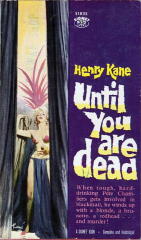
HENRY KANE Until You Are Dead.

   In order of publication, Until You Are Dead was either the sixth or seventh of Henry Kane’s series of detective tales featuring a suave Manhattan private eye named Peter Chambers. (The reason I’m not more definitive on this is that there were two of Chambers’ adventures in 1951. With nothing else to go on, I’m going to suggest that this one is #6, since it was came out from Simon & Schuster, who published the first five, and A Corpse for Christmas appeared from Lippincott, suggesting a change in publisher. The Christmas aspect of the latter also suggests that it was published later in the year, once again making Until You Are Dead the earlier one.)

   Such is life in the fast armchair-detective lane.

   Also of note is that Kane’s first three short stores, one of which, “Kudos for the Kid” (May 1947) may have been the overall first appearance of Peter Chambers, were published in Esquire, which was a prestigious magazine to be in at the time.

   After 1951, though, all of Kane’s novel length fiction in the US, most but not all adventures of Peter Chambers, came out as paperback originals, first from Avon, then Dell and many of the others including Signet, before both Kane and Chambers ended up in a series of X-rated books from Lancer in 1970.
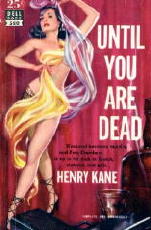
HENRY KANE Until You Are Dead.

   Oops. I see I erred in one thing I just said. There was a series of novels about Inspector MacGregor that appeared in hardcover from Macmillan between 1965 and 1968. These all took place in New York City, but I don’t know if I’ve ever seen any of them. (I no longer remember all of the books I’ve seen.)

   It’s not clear how sharp an operator Chambers is, and how close to the legal edges he usually runs, but he seems to know his way around and to know a lot of people who come close to running the town. Really running the town, that is. But either way, he draws the line at aiding and abetting a jazz musician turned blackmailer — the guy had seen a killing in a night spot men’s room, a guy high in the rackets who tossed Kermit Teshle (that’s his name) a hundred dollar bill and left.

   Teshle wants more. Chambers says no. Enter Ivy Teshle, his sister, a girl who dances for a living while trying to make it to Broadway. (See either of the two covers shown.) She meets him in his office, worried about her brother, on page 15, and on page 17 she is kissing him. Chambers says yes.

   It is that kind of book, and Chambers is that kind of private eye, and Henry Kane is that kind of writer.

   Kermit ends up dead, and Chambers is in it up to his neck.
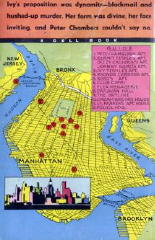
HENRY KANE Until You Are Dead.

   As a writing stylist, Henry Kane is pretty good. Not in Raymond Chandler’s league, but he can rattle off the dialogue when he wants to, which is often, and he can go into philosophical matters with equal ease. Once in a while these discussions become what in the vernacular might be called full-fledged rants, or here in New England, “wig-outs.” Example, pages 85 and 86:

   I went to the cabinet and broke out a new bottle of Scotch (here he goes again). I peeled the cellophane off the top and clipped off the cork. I poured into a shot glass and swallowed it. I poured again and put the bottle away. I held up the glass and looked at amber glistening in the sunlight and mused. People say I drink too much. The hell with them. People say that nobody can drink that much. The hell with them, I know people who drink more. People say I’ll have no liver left when I’m old. The hell with then, who wants a liver when you’re old? Literary critics rant. The … (excuse me). Let them rant (between drinks). I like to drink. So far, it agrees with me. When it stops agreeing with me, I’ll listen to the literary critics, as I sorrow under the burden of cirrhosis. There are all kinds of people. It makes for an interesting world. There are people who smoke three packs of cigarettes before they really get going for the evening in the night clubs. There are prime ministers who smoke eighteen fat cigars a day. There are people who buy pornographic books which they read every day but Sunday. There people who push against people on subways. There are people who play footsie with strangers at movies. There are people who drink four ice cream sodas at a smack. There are secret eaters of constant pickles. There are people who go for smoked tongue with mustard by the heap. There are people who slush through a pound of cream candies during one chapter of a thick book with significance. There are pistachio nut eaters. There are marijuana smokers. There are opium addicts. There are movie goers (including matinees). There are people devote celibate lives to devising instruments of mass destruction. There are soda-pop drinkers. There are frankfurter nuts. There are sun-bathers, vegetable eaters, vitamin girls, hormone boys, sidewalk psychiatrists, neon hunters, nylon oglers, stamp collectors, headline readers, glass crunchers, five-mile hikers, deep breathers, left-handed pitchers, sweepstake winners, golf players, winter swimmers, and guys that make parachute jumps at the age of a hundred and nine. There are even philosophical detectives.

   Me. I like to drink (among other things). So what?


   Whew. He caught me there, but only twice, thank goodness. (How about you?)

   With a passage like that to recommend this book, I wish the mystery had an ending to match. It’s OK, don’t get me wrong. It just isn’t up to the one I’d been waiting for. (I don’t think it could have.)
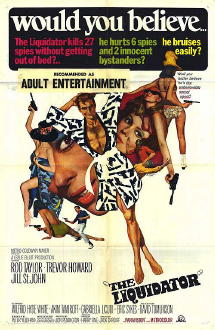
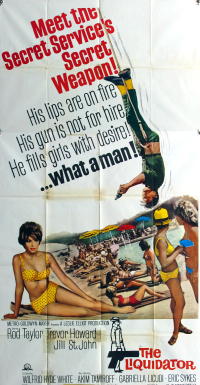
THE LIQUIDATOR. MGM, 1965. Rod Taylor, Jill St. John, Trevor Howard, Wilfred Hyde-White. Song over opening credits: sung by Shirley Bassey. Based on the novel of the same name by John Gardner. Director: Jack Cardiff.

THE LIQUIDATOR

   Anti-hero secret agent Boysie Oakes has come up before on this blog, back when I read and reviewed Understrike, a later book in the series. That’s when I also listed all of the books in the series, so I needn’t do it here.

   But I will repeat myself a bit by describing how I saw Mr. Oakes back then:

    “The gimmick in the Boysie Oakes books […] is that as a spy, he’s supposedly inept, a coward who’s wracked with fear and stomach cramps at the thought of confronting the enemy, and a consummate womanizer. Or in other words, the direct opposite of Bond, save maybe the last category, although Bond usually stuck to one girl per book (didn’t he?).”

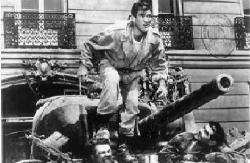
   I also wondered about how Mr. Oakes got into the spy business in the first place, if he’s that inept and that much of a coward. Well, wonder no more, Mr. Lewis. The opening scene of the movie version of The Liquidator, filmed in black-and-white (with the rest of the movie in color), tells us exactly that. In the closing days of World War II, during the liberation of Paris, Boysie Oakes (Rod Taylor) accidentally saved the life of a British agent named Mostyn. See below and to the right:

THE LIQUIDATOR

   Mostyn (Trevor Howard), never one to forget favors like that, but also not knowing how accidental his rescue was, calls on Boysie much later on to fill a new position in his Department, that of assassin, to eliminate those embarrassing people (double agents and the like) who would provide the press with more scandals, either by defecting or being arrested before they could defect.

   Tempted by the promises of a mid-60s Hugh Hefner life of luxury when not working, even before he knows what “working” actually means, Boysie accepts. Bad move. How does he get out of actually doing the work? In the most delightfully engaging way – assuming of course you agree that the victims actually need to be, um, liquidated.

THE LIQUIDATOR

   There is some satire involved here, as well as a slight touch of spoofery, and by this time half the movie is over. Of course there is another hour to fill, and with beautious Jill St. John (as Iris, Mostyn’s right-hand assistant) on hand to accompany Boysie on a strictly unauthorized trip for two to the Riviera, you’d think it would be filled most handsomely.

   Not so. The people who put out the film thought they needed a plot, but the plot they give us is pure pap. Things do not go nearly as well as Boysie had planned. First he’s kidnapped (amusingly before anything serious happens in the bedroom), then released and/or allowed to escape, then sent off on a fool’s mission to do some serious damage back in the UK.

THE LIQUIDATOR

   I’ve not read The Liquidator, the book, but at least one source says the movie people actually followed the book fairly closely. Perhaps they did, but they missed something, that something perhaps being that in spite of the movie being largely a spoof – which it definitely is until the shooting starts …

   That’s it. That’s exactly when things started going wrong. Right then, when the movie people began to make a straight (but still more than a little goofy) action picture out of what until then was a mild and gentle satirical poke at Mr. Bond.

   One other note. In the book I read, as you may recall from the review excerpt above, Boysie was described as being a coward.

   That’s hard to play on the screen, so that part was downplayed, or so it seems to me. Rod Taylor simply plays Boysie as a good-natured chap, a fellow who’s rather inept (as also previously described) and gets sick in airplanes (and you know where that will lead) but this is about as far into that direction the movie goes.

   This was the only film version of the character that was ever made.

REVIEWED BY WALTER ALBERT:         


MARY ANNA EVANS

      MARY ANNA EVANS —

   Relics. Poisoned Pen Press; trade paperback, Feb 2007 trade paperback; hardcover edition, August 2005.

   Effigies. Poisoned Pen Press, hardcover, January 2007.

   These two novels, the second and third in a series, feature Faye Longchamp, an archaeological graduate student. In Relics, she’s directing a project on an ethnically isolated Alabama group, the Sujosa, who have shown an unusual resistance to diseases that include AIDs, while in Effigies, she’s part of a team excavating a site in Neshoba County, Mississippi, where the Choctaw nation is thought to have been born. When mysterious deaths occur in each case, it’s left to Faye to investigate.

MARY ANNA EVANS

   Evans’ style is a bit heavy at times, with the scientific data weighing somewhat heavily on the narrative, but Faye is talented and possessed of a strongly independent mind that, coupled with a natural empathy for the native cultures she is investigating, make her a most sympathetic protagonist. The interaction with other members of the team and with the local population are thorny in both novels, and I found these both emotionally and intellectually satisfying.

[COMMENT] There is one earlier book in the series, as Walter mentions: Artifacts (2003); and one more recent one: Findings (2008).    — Steve

   In her review of Round the Fire Stories, by Arthur Conan Doyle, posted here in May a year ago, Mary Reed began by saying:

   None of the Round The Fire Stories features Mr. Sherlock Holmes, although two mention anonymous letters to the press presenting solutions which some readers believe to have penned by the great detective himself (“The Man With the Watches” and “The Lost Special”).

   And then in a footnote, she later added the following:

   In “The Man With The Watches” we see: “There was a letter in the Daily Gazette, over the signature of a well-known criminal investigator…”

   â€œ… and then we have “The Lost Special,” in which we learn of a letter: “… which appeared in the Times, over the signature of an amateur reasoner of some celebrity at that date, attempted to deal with the matter in a critical and semi-scientific manner. An extract must suffice, although the curious can see the whole letter in the issue of the 3rd of July.

“‘It is one of the elementary principles of practical reasoning,’ he remarked, ‘that when the impossible has been eliminated the residuum, however improbable, must contain the truth’.”

   And I think we’ll agree the second letter in particular has his grammatical fingerprints all over it, but it raises another question: why didn’t Conan Doyle write these two adventures as Holmes stories? Were these stories written during a period when he was thoroughly tired of his own creation?


[WARNING: SOME PLOT ELEMENTS MAY BE REVEALED.]

   In a comment left last April, and inexplicably never acknowledged by me until now, Brian Gould replied by saying:

 Mary:

   You ask, “Why didn’t Conan Doyle write these two adventures as Holmes stories?”

   A clue to the answer, I believe, is that in both cases the unnamed letter writer was wrong. In “The Lost Special,” the train had been driven onto one of the four side lines of which it was earlier remarked that they “may be eliminated from our inquiry, for, to prevent possible accidents, the rails nearest to the main line have been taken up, and there is no longer any connection.” The villains had temporarily relaid the missing rails.

   In “The Man With The Watches,” nobody jumped from one train to another. The dead man had been in the Euston to Manchester express all along, but had removed his disguise before his accidental killing, which occurred when his criminal associate attempted to shoot a third man who had joined them in their compartment but missed.

   Doyle’s intention, surely, is humorous. He is simply making fun of his own creation, Sherlock Holmes, who does not usually commit such blunders.

Kind regards,

   Brian Gould


>>>>>>>

   My apologies to Mr. Gould for not pointing out this very useful reply until now. My only excuse is that I was out of town attending the Bordentown pulp and paperback show around the time his comment was posted, and I suspect that in the rush to catch up when I was back here at home, I simply failed to.

   But here’s what I discovered that prompted my attention back to “The Lost Special” again, a rare find: one the “missing” episodes of Suspense, one of Old Time Radio’s best-known, and longest-lasting mystery programs.

THE LOST SPECIAL (Suspense)

   I won’t post a link directly to the MP3, but I strongly recommend you go to Randy Riddle’s podcast blog and listen to it there, along with more information about both the disk and the program Of special note, until he found the disk, the program may not have been listened to in over 60 years, a “lost special” in and of itself. Excepted from Randy’s comments, here’s the basic info:

   Unheard publicly since September 30, 1943, we bring you Orson Welles starring in “The Lost Special” a “tale well calculated to keep in you Suspense!.” Originally broadcast on the CBS radio network, but now lost, the version heard here was distributed by the Armed Forces Radio Service as program 24 in the Suspense series.

    “The Lost Special” is based on a Sir Arthur Conan Doyle story and concerns a train that mysteriously disappears. The story was also used on the series Escape on February 12, 1949, so it may seem familiar. (You can give it a listen here.) However, in the “Suspense” version, the story is told by the main character and framed as a broadcast by a condemned man that will reveal the identity of persons responsible for certain crimes.

       […]

   Orson Welles appeared in the series Suspense eight times between 1942 and 1944 in such classics as “The Hitchhiker” and “Donovan’s Brain.” One of Welles’ performances, “The Lost Special,” was thought to be one of about thirty-five Suspense programs missing out of over 900 broadcast during the run of the series.


   Go visit, listen, and enjoy!

RICHARD ELLINGTON – It’s a Crime. Pocket 756; 1st printing, Dec 1950. Hardcover: William Morrow, 1948.

   Richard Ellington (1914-1980) wrote only five mysteries, and all five featured a Manhattan-based private eye named Steve Drake. This is the second of them, and for the record, using Al Hubin’s Revised Crime Fiction IV as a basis, here’s a list of all five, along with (eventually) paperback covers for all of them:

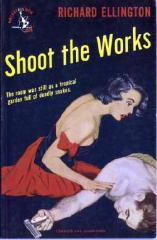
      Shoot the Works. Morrow, 1948; Pocket #624, 1949.

RICHARD ELLINGTON

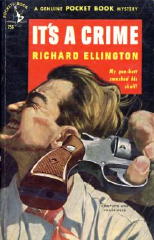
      It’s a Crime. Morrow, 1948; Pocket #756, 1950.

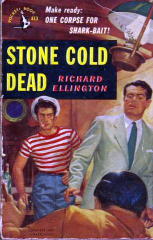
      Stone Cold Dead. Morrow, 1950; Pocket #813, 1951.

RICHARD ELLINGTON

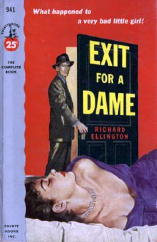
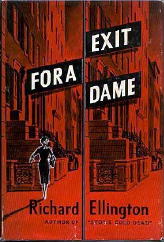
      Exit for a Dame. Morrow, 1951; Pocket #941, 1953.

RICHARD ELLINGTON

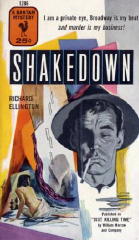
      Just Killing Time. Morrow, 1953; Bantam #1286 as Shakedown, 1955.

RICHARD ELLINGTON

   Thanks to the Cook-Miller index to digest mystery magazines, we learn that Ellington also published three short stories in Manhunt and one in Mike Shayne Mystery Magazine:

       “Fan Club” Manhunt, April 1953.
       “The Ripper” Manhunt, August 1953 .
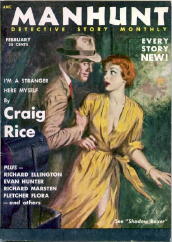
       “Shadow Boxer” Manhunt, February 1954.

RICHARD ELLINGTON

       “‘Good-By, Cora'” Mike Shayne, February 1968

   At least the first of these is a Steve Drake yarn as well. I’m not sure about any of the others. According to the brief biography of Ellington inside the front cover of this paperback edition, he was heavily involved with radio both before and after the war: acting, announcing and writing. What he ended up doing after the career in writing mysteries ended I don’t yet know; perhaps writing for television? (A later search on www.imdb.com turned up nothing.)

RICHARD ELLINGTON

   The cover of the paperback edition of It’s a Crime will give you an idea of the kind of mystery it is, or if not, at least it’s a portrayal of the one scene that the people at Pocket thought might sell the book. Paul Kresse is the artist, and in the center foreground is the butt end of a gun being grasped by the barrel (only part of the fingers showing) and being used to clout a man in the head. Side view, tie askew, he’s obviously in excruciating pain.

   Quoted from the text: “My gun-butt smashed his skull.”

   Granted that the scene is in the book, and so is another in close proximity of the same guy with a tommy gun, firing away at Drake before he gets away, only to turn the tables, as shown on the cover, but …

   Steve Drake is really only medium-boiled, about 6 or 7 on a standard HB (hard-boiled) scale ranging from 1 to 10. I’ll quote Mr. Drake, who tells his own story, from pages 60-61:

    “She was dead, of course. Just the limp position of the arm hanging over the tub told me that. Don’t let anyone kid you. It’s only in very rare cases that you have to listen for heartbeats and feel pulses. They look dead, they don’t look the way they did before. If you don’t believe me, go to the morgue, go to a funeral, go join the police force, wait for the next draft … What the hell am I talking about? Okay, it scared me. It made me jittery. It always does. It would you, too. You might throw up. You might even faint. I didn’t. But then I’m a tough guy.”

   Drake actually has two cases in this adventure. The first is a wandering husband caper. The second is a case of blackmail, the victim being the male half of a famous Broadway husband-and-wife duo. That the two cases are connected comes as no surprise to anyone who has read as many mysteries as you and I, but Drake himself takes it in with a slightly perplexed stride.

   What is surprising, and it really shouldn’t have been, is that this prime example of lower-echelon tough-guy fiction turns out to have a complex and finely tuned detective story plot to go with it. There are many, many people with access to the dead girl’s apartment, and before her death there were enough of them going in and out that it would take a minute-by-minute timetable to keep it all clear.

RICHARD ELLINGTON

   After the non-essentials have been eliminated, all of the suspects that remain have iron-clad alibis, and takes a huge effort in deduction on Steve Drake’s art to crack one of them. It’s a plot worthy of Ellery Queen, say, without quite the same finesse — relying on what seems like sheer chance on the part of the killer, and of course the aforementioned coincidence that involves Drake in both cases to begin with.

   It’s a neat double combo, in other words, and very much worth seeking out. I’d especially like to locate my copy of the next book in the series. The love affair that Drake seems to find himself in as this one goes along seems to bloom very quickly, and if I read the last couple of pages correctly, Drake proposes marriage and the same time he says he going to be spending the money he made on this case on a trip to St. Thomas. Does she go too, or will she wait for him patiently at home?

   These are things an inquiring minds like to know.

— December 2003


[UPDATE] 06-28-08.    Prompting my posting this review from the past was an email this morning from SF writer Robert Silverberg:

    “Something led me to your web site this morning and an old entry about the forgotten mystery writer Richard Ellington. You ask what he did when he stopped writing mysteries.

    “What he did was open a hotel in the Caribbean — perhaps on St. Thomas. (I don’t remember which island, really — it was a long time ago.) I visited it somewhere in the early 1960s and spent a pleasant afternoon exchanging shop talk with him, he talking about mysteries and me about science fiction. As I say, a long time ago, and I have no other details to offer.”

   Then from a follow-up email:

    “A little googling reveals that he was a delegate to the 1964 Republican convention, representing St. John in the Virgin Islands. Since I visited St. John in that era, that must have been where his hotel was.”

— Robert Silverberg

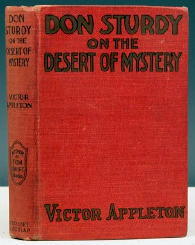
VICTOR APPLETON – Don Sturdy on the Desert of Mystery, or Autoing in the Land of the Caravans

Grosset & Dunlap; c.1925.

   Here’s the first paragraph. Read this and see how you could possibly resist reading on:

    “It certainly is a great idea, to cross the Sahara Desert by auto,” remarked Captain Frank Sturdy, as he sat on the shaded veranda of an Algerian hotel and looked out on the shimmering sea of sand stretching away to the horizon.

DON STURDY Desert of Mystery

   On the next page:

    “Gee, that sounds good to me, Uncle Frank!” broke in Don Sturdy, a tall, muscular boy of fourteen, who had been listening to the discussion. “What a lot of wonderful things a fellow would see on a trip like that!”

   And of course off they go, and besides having a fine adventure, there are also a few more tangible goals: to locate the famed Cemetery of the Elephants, to view the fabulous City of Brass, and to find the fantastic Cave of Emeralds.

   Not to mention finding missing father of Don’s new friend Brick, who has been kidnapped by natives and is being held for ransom. Their means of transportation out across the desert, as I pictured them, are three early SUV prototypes, equipped with tank treads (and side curtains).

   Along the way they encounter numerous dangers: landslides, tarantulas, sandstorms, a band of thieving Arabs and more. It certainly made me feel fourteen again. I read a lot of the early Hardy Boys mysteries when I was a kid, the older thicker ones that belonged to my great-uncle, but never one of the Don Sturdy books, until now. What fun!

   But the adult that’s also inside my head found a bit of wonderment at the pacing. On page 209 they are trapped in a cave surrounded by the combined forces of the native kidnappers and the band of Arab thieves. Things indeed look black, as black as they could be.

   Not to worry. By page 211 they have escaped, and not only that, they’ve made their way back clear across the desert, and they’re busily making plans for their next adventure. Whoosh! And whoo-wee!

— March 2002


[UPDATE] 06-27-08.    Copies in dust jacket are a bit scarce, although certainly not overly expensive ($20 and up on ABE). At any rate, I’ve not been able to come up with a decent one to show you. I think as a young boy I automatically threw the jackets of my books away. So did every other kid, except the smart ones.

REVIEWED BY WALTER ALBERT:         


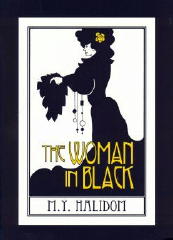
M. Y. HALIDOM – The Woman in Black. Ash-Tree Press, 2007. Introduction by Richard Dalby.

HALIDOM The Woman in Black

   This vampire novel was first published in 1906, and is another in this Canadian publisher’s series of vintage supernatural fiction. “The Woman in Black” is a glamorous seductress, leaving more than broken hearts in her chilling wake. The novel borders, at times, on the edge of parody, but was certainly worth resurrecting, although its audience is undoubtedly a limited one.

   The series is often chiefly distinguished by its scholarly introductions. That is certainly the case here, as Richard Dalby traces the life and career of a forgotten writer with his characteristic grace. He does go a bit far, however, in claiming this to be a forgotten “gem.” A gem it may be, but hardly one of great price or quality.

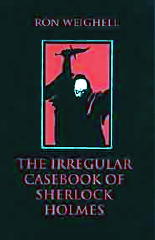
RON WEIGHELL Holmes
RON WEIGHELL – The Irregular Casebook of Sherlock Holmes. Calabash Press, 2000.

   This collection of five Holmes pastiches carries the celebrated detective and his companion and historian Dr. Watson into the realm of the weird and the fantastic, a subject for which Holmes had little patience.

   The stories are pleasantly atmospheric but it must be admitted that none of the them produces the authentic chill that Doyle, even as he’s putting to rest the aroma of the supernatural in a story like The Hound of the Baskerville, produces.


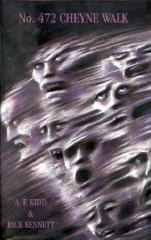
A. F. KIDD & RICK KENNETT – No. 472 Cheyne Walk: Carnacki — The Untold Stories. Ash-Tree Press, 2002.

KIDD & KENNETT Carnacki

   One of the classics of the Victorian & Edwardian fantastic story is William Hope Hodgson’s Carnacki, the Ghost-Finder. The modern writers, A. F. (“Chico”) Kidd and Rick Kennett have revived Hodgson’s scholarly researcher into the outre in a dozen stories that bring together a group of friends with a common interest in the supernatural who, after dinner, settle themselves in comfortable armchairs to listen to their host’s tale of another of the cases in which he has once again laid to rest a supernatural entity or entities.

   Such undertakings (the revival of a classic ghost-hunter) are generally doomed to a failure of some proportion but, as such efforts go, this displays some imagination. I would imagine that a solitary reader, regaling himself with a good cigar and a fine brandy, by a winter fire, might have quite a capital time with the stories. I read them under less appropriate circumstances (a hot summer afternoon, the room chilled by air conditioning) and still derived pleasure from their leisurely, willfully archaic style.

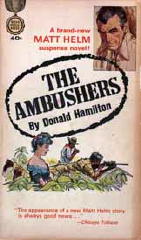
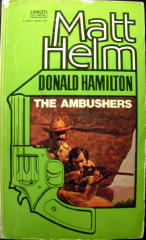
DONALD HAMILTON – The Ambushers

Gold Medal k1333, paperback original. First printing: 1963. Reprinted several times.

DONALD HAMILTON Ambushers

   When readers and critics talk about hard-boiled writers, Donald Hamilton’s name never seems to come up, and it should. There may be two reasons for this. First, he didn’t write about private eyes. His primary hero, who appeared in 27 spy fiction novels for Gold Medal between 1960 and 1993, was Matt Helm, a hard-as-nails agent for an unnamed branch of the US government, but still not a private detective. Secondly, Dean Martin, and those godawful movies. I enjoyed them at the time, but I was only in my 20s. What can I tell you?

   In the order of appearance, this is the 6th in the series. Starting in a Latin American country falsely called Costa Verde, where Helm takes out the leader of a gang of cutthroat revolutionaries, back to Washington, then out west to Tucson and into northern Mexico, where a leftover Nazi overling has been spotted, Hamilton doesn’t let the story die of the doldrums, to say the least.

   There is a girl. Reminiscent of many John D. MacDonald stories, this one needs a rescue, and then some therapeutic rehabilitation. But in this case, Sheila, the agent who ran into problems in Costa Verde, is an essential part of the story, and its ending as well.

DONALD HAMILTON Ambushers

   As for Helm, he improvises quickly, making (for example) being caught in a trap all part of the plan, and he has no false compunctions or misgivings about what his job entails. He’s in a rough line of work, no doubt about it, with little or no tolerance for error. James Bond is more famous than he, with more of a Continental flair (and better movies) but by a good margin, Matt Helm is the tougher of the two.

— July 2002


[UPDATE] 06-19-08.    My comment at the beginning of this review may have been true when I wrote it, but in the six years between then and now, I think Donald Hamilton has been given his due, at least on blogs and the Internet, if not in terms of new editions of his books at Borders and Barnes & Noble. (Hard Case Crime has reprinted Night Walker, a non- Matt Helm book, and I hope it has done well.)

   So it may be that neither Helm nor Hamilton are truly forgotten, but the Matt Helm books have been so long out of print that anyone in their 20s now is very likely never to have heard of him in the first place. Unless they read blogs like this one, and Bruce Grossman’s reviews over at bookgasm and Bill Crider on his blog and John Fraser on his website

[UPDATE #2] Just after posting this, I went to check my email and by some uncanny coincidence, I discovered that Ed Crocker had posted a long reminiscence about Donald Hamilton on an earlier post here on the Mystery*File blog, back when Hamilton’s death was first reported. I’ve kept what he had to say there, but I’ve moved it here as well. It’s the first comment you’ll see below. Thanks, Ed!

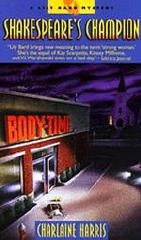
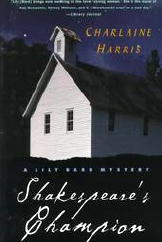
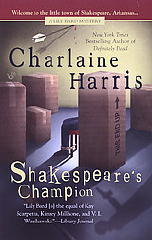
CHARLAINE HARRIS – Shakespeare’s Champion.

CHARLAINE HARRIS Shakespeare's Champion

Dell; paperback reprint, November 1998. Hardcover first edition: St. Martin’s, December 1997. Later paperback edition: Berkley, December 2006.

   You could have fooled me, and I was. I didn’t see it coming. I thought this book was one of those “cozy” mysteries that have been flooding the paperbacks shelves at Borders and other outlets over the past ten years or more. What with ice-skating detectives, teddy-bear-collecting detectives, quilting detective, herbal-shop-owner detectives, fudge-making detectives — which is not to put any of them down, as long-time readers of this blog know that most certainly do I not make a habit of — I was caught leaning the wrong way this time, and Ouch.

   Lily Bard is the detective in this one, her second appearance of five so far, and she cleans houses for a living in a small town named Shakespeare, somewhere in Arkansas. What would you think, if that were all you knew about the series?

   My guess is that you’d be wrong, too. There are more dead bodies in this than any Robert B. Parker books you’ve read, and if you stacked two or three of them together, the count might then just start to be close.

CHARLAINE HARRIS Shakespeare's Champion

   There are some things I was unhappy about in this book, the criminous part focusing on racial hatred and violence, but neither that fact nor Lily Bard herself is one of them. She’s quite a lady, having come to Shakespeare to run away from her past, but she works out nearly every morning in the local gym (body building and karate), and does not take any sass from anybody. Hard-boiled, flinty — but in a totally feminine sense — independent. Name it, she’s it.

   I may as well start enumerating some of the problems I had with the book, even though I still haven’t told you much about the story line. First, the prologue, which is not told by Lily, while the rest of the book is. I hate prologues, especially when they are as useless as this one.

   Secondly, while I can understand Lily’s reticence in talking about her past — and she doesn’t for the longest time in this one — she already has in the first one. Revealed her secrets, that is, to at least some of the people in her new life.

   This means that someone who’s already read the first book, as I haven’t, would be reading a totally different book than I was, as he or she would already know the players and the tensions (many sexual) between them, and I didn’t. Lily’s conversation with Claude Friedrich, the local chief of police, as she spurns his amorous advances — soon after the discovery of the first body (although it really isn’t– the first body, that is) — makes a lot more sense later on, then it does in Chapter One. The reader of book one knows, but the reader of book two hasn’t a clue.

CHARLAINE HARRIS Shakespeare's Champion

   I’m making this complicated, but going back and re-reading what I just wrote, it’s correct, and I think I will stay with it the way it is. There has been a series of deaths in Shakespeare, and only gradually are they revealed, and of course they’re important. The blurb on the back cover puts things in the right order, chronologically, but I have to admit that this is only a minor quibble, although a frustrating one, as the characters’ actions reflect what they know, and we (the reader) do not.

   But here’s the greatest problem I found with this book. With a scene of violence as horrific as the one that occurs in this book — if it were to have happened in the real world — it would have made national headlines, news crews from every channel on the cable dial would have been in town, snooping around 24/7, and a real investigation would have gone on, the ending not relying on three people sneaking around at night to uncover the culprits and their plot on their own. And in spite of all of the bloodshed, this strictly amateurish way of nabbing the killers is perhaps what makes this dark and sobering tale story a “cozy” mystery after all.

   Would I read another Lily Bard tale, though? You bet I would. She’s quite a lady.

POSTSCRIPT.    I know they’re too small for the details to be all that helpful, but each of the cover images that I’ve found to add to this post illustrate three different but still vitally important aspects of the book, and in three different styles. I like all three of them.

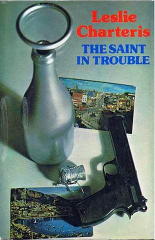
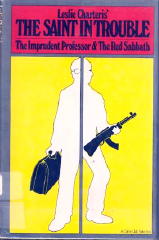
LESLIE CHARTERIS – The Saint in Trouble.

LESLIE CHARTERIS The Saint in Trouble

Detective Book Club; hardcover reprint (3-in-1 edition), May 1979. Coronet, UK, paperback, 1978. First UK hardcover edition: Hodder & Stoughton, 1979. Doubleday Crime Club, US, hardcover, 1978. No US paperback edition.

   Although this reprint volume doesn’t mention it, Charteris apparently had very little to do with this book. According to Al Hubin’s Crime Fiction IV, the book was adapted by Graham Weaver from original teleplays by Terence Feely and John Kruse.

   Which certainly explains a lot. Charteris may have had something to do with final revisions, but there’s not much substance to either of the two short novels in this book. I was reminded more of the James Bond movies (not the books) than anything else, without all of the spectacular visuals. (And without that, what’s left?)

   In “The Imprudent Professor”, the Saint (Simon Templar, aka Sebastian Tombs) helps prevent a scientist from defecting to the Soviet Union. It seems he has a solar energy alternative to fossil fuel, and the Free World cartels insist on keeping the discovery covered up.

LESLIE CHARTERIS The Saint in Trouble

   The sunny Cannes background is nice, and Simon meets at least two very good-looking young ladies, but (as far as I can tell) one of the pieces of evidence the Saint proceeds on never occurred.

   To verify that certain things never change, in “The Red Sabbath” Simon returns to London to help a (good-looking) female Israeli agent track down a Arab terrorist trying to defect from his comrades to South America. Again we get a intimate inside look at the London underworld, but beyond that, it’s a matter only of luck and fortunate timing that helps the dashing modern-day privateer prevail.

   Except for the lapse of a kind mentioned above, the writing is polished enough, but the stories themselves are rather superficial and perfunctory. A disappointment.

— January 2002.


LESLIE CHARTERIS The Saint in Trouble

[UPDATE] 06-19-08.    Now that I have resources (the Internet) that I did not have when I wrote this review — or I was too new at it then to use them — I can now tell you that I’ve identified “The Imprudent Professor” has having been televised on 19 November 1978 as part of the series The Return of the Saint, starring Ian Ogilvy. (“The Red Sabbath” remains unidentified.)

   The series played in the US as The Friday Late Night Movie on CBS, or so I understand, but I don’t remember seeing it, or even knowing about it — and in spite of my generally negative reaction to the book, I’d have liked to have.

   Maybe copies still exist? I’ll check into it.

« Previous PageNext Page »