Characters


NICHOLAS BLAKE – Thou Shell of Death.

Berkley F1002; paperback reprint, 1964. Hardcover first edition: Collins Crime Club (UK), 1936. US hardcover first edition: Harper & Brothers, 1936, as Shell of Death. [Reprinted in The Nicholas Blake Treasury (Volume 1), Nelson Doubleday, 1964, containing: Thou Shell of Death; The Beast Must Die; and The Corpse in the Snowman.] Other US paperbacks: Penguin, US, 1944, as Shell of Death; Perennial, US, 1977, as Thou Shell of Death.
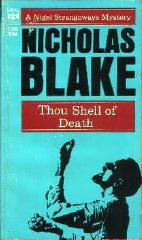
NICHOLAS BLAKE Thou Shell of Death

   Even though they have the same author — Nicholas Blake — what a night and day difference there is between this book and the previous one by him, reported on here. This is the second mystery Blake wrote — the first was A Question of Proof — and it’s the second appearance of Nigel Strangeways as well.

   The conventions of the Golden Age of Detection are very much evident in this earlier book — complete with anonymous threatening letters, a call for assistance from the recipient, an aging but still engaging ex-flying hero of the previous war, a house party at Christmas time with all of the possible suspects in attendance.

   And then death strikes. Is it suicide? Only one set of footprints are found in the snow leading to the small hut where Fergus O’Brien’s body is found.

   Or is it murder? Strangeways’ deductions soon answer the question in positive fashion, solving as he does the “locked room” aspect of the case in quick order. By that I mean by page 72, out of a total of 192. (Paperbacks were thin and the print was small, back in 1964.)

   But I digress. More mysterious doings occur, all of them complicating the mystery even more, rather than clearing them up at all. It is all rather fascinating and interesting and static until (a) Nigel takes a quick trip to Ireland to uncover some facts about the past, and (b) he returns to Dower House only to find himself falling in love with one of the possible suspects, regretting greatly that his prior hypotheses made her one of the primary ones, in the eyes of Scotland Yard.
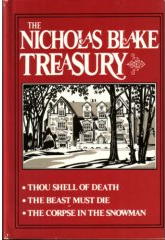
NICHOLAS BLAKE Thou Shell of Death

   As a detective, Nigel himself seems to be only an amateur, in the finest sense of the word. He is called upon in this instance due to the fact that his uncle, Sir John Strangeways, is an Assistant-Commissioner of Police. This allows the dilettantish Nigel to conduct his investigations with the full cooperation of the authorities, if not their down-right awe and admiration.

   I’m not sure that dilettante is precisely the right word. From the Internet comes the following definition: a dabbler: an amateur who engages in an activity without serious intentions and who pretends to have knowledge. Nigel Strangeways is serious all right, and he puts the pieces of the puzzle in excellent fashion.

   If the early Ellery Queen took after Philo Vance, then I believe that Nigel Strangeways follows in the same footsteps as that very same Ellery Queen, whether directly or in parallel — I have no way of knowing whether Cecil Day-Lewis ever read any of the Queenian adventures or not, but they’re cut from the same cloth, no doubt about it.

   As for the case in hand, inspired by a 17th century work by a playwright not previously known to me, Cyril Tourneur, who published The Revenger’s Tragedy in 1607. [NOTE: See Al Guthrie’s comment.] The title of Blake’s work, Thou Shell of Death, comes from a direct quote, which I dare not repeat, for fear of, um, forsooth, revealing too much.
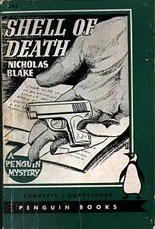
NICHOLAS BLAKE Thou Shell of Death

   It takes Nigel the entire last chapter, eighteen pages (small print), to untangle all of the twisted threads of the plot, remarking once on a remarkable (well, yes) coincidence that made the killer’s plan succeed the way that it did, not mentioning the much huger one that initiated the entire sequence of events in the first place.

   That, plus the entire sheer unlikelihood of anyone plotting such a strikingly complex, ingenious, and therefore inept scheme in the second place — well, that’s simply the joy of author trying to outwit reader that makes the reading — and the challenge — all the more pleasurable.

   Blake’s own career, as seen by the earlier post on this blog, eventually went in other directions, as did Ellery Queen’s in tandem. But which kind of story was better, and which are they better known for today? You tell me.

— November 2004.
IT’S ABOUT CRIME
by Marvin Lachman

P.D.JAMES Unsuitable Job

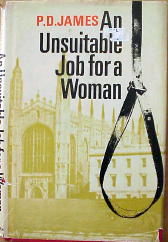
   The Private Eye novel, I’m thankful, is still with us though recent events show that type of detective might eventually become our latest folk heroine. First, we had the female op who stole the show from Inspector Dalgleish in P.D. James’ An Unsuitable Job for a Woman (1972), relegating him to a bit part. I still believe Mrs. James is missing a good bet for another series character.

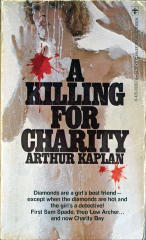
   Charity Bay, Arthur Kaplan’s detective in A Killing for Charity (1976) started as secretary to a San Francisco detective and, after learning the job, moved to New York where she charges an inflationary $300 a day, plus expenses, for her services. Kaplan has his titular detective display her very good figure to advantage. Charity begins the book by having intercourse with a man to set him up for an arrest. Later, Kaplan gets her into one of those clothes-torn, figure-exposed situations that pulp illustrators thrived on.

MARCIA MULLER Shoes

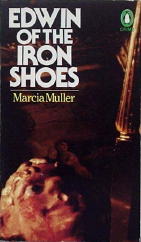
   In Marcia B. Muller’s Edwin of the Iron Shoes (1977), female private detective Sharon McCone remains in San Francisco where she does investigative work for a store-front legal cooperative. McCone develops a relationship with art-loving Lt. Greg Marcus, S.F.P.D. Except for the possibility of romance, they get along together as the Marlowes et al have traditionally gotten along with the official police.

   The book, except for one good scene authentically describing the Seal Rock area, ends in a blaze of … coincidence. Kaplan and Muller have proven that the only limitations on the success of female private detectives in the future will be the artistic limits of their creators.

– To be continued.


    Books reviewed or discussed in this installment:

P. D. JAMES – An Unsuitable Job for a Woman. Faber, UK, hardcover, 1972. Scribner, US, hc, 1973. Many paperback reprints in both countries. Film: Boyd, 1981 (scw: Elizabeth MacKay, Brian Scobie, Christopher Petit; dir: Petit). Four episode TV-series (ITV-PBS), 1997-1999, one installment of which was based on this book.    NOTE: Besides the TV series, Cordelia Gray made one additional appearance in book form, a solo case recorded in The Skull Beneath the Skin (Faber, UK, 1982).

ARTHUR KAPLAN – A Killing for Charity. Coward-McCann, hardcover, 1976; Berkley, pb, 1977.    NOTE: This was the only appearance of Charity Bay.

ARTHUR KAPLAN Charity


MARCIA MULLER – Edwin of the Iron Shoes. David McKay, hardcover, 1977. Penguin, US, pb, 1978. Several other US paperback editions. Women’s Press, UK, pb, 1993.    NOTE: This was Sharon McCone’s debut entry. She has since appeared in 25 novels and nearly as many short stories.

Reprinted from the The MYSTERY FANcier, Mar-Apr 1979.

      The first paragraph below is good news recently received from Bill Contento:

    The online edition of THE CRIME FIGHTERS, by W.O.G. Lofts and Derek Adley, has been updated, now listing fictional detectives “Abbott, Detective” through “Hyer, Henry ‘Hank’.”

   Say the authors Derek Adley (1927-1991) and Bill Lofts (1923-1997) in their introduction:

    “… What we do claim, however, is that the number of detective types listed here is many times greater than in any previous work on this subject. In fact, we have had to limit the number of inclusions owing to space considerations. We already have a thousand or so sleuths in hand, so if this compilation proves to be a success adequate material for a second one is available, and omissions here could then be rectified.

    “This is essentially a bibliography of the following fictional characters:

       * the private detective

       * the private eye

       * the official police investigator

       * the amateur sleuth

       * the adventurer type of detective, such as Bulldog Drummond and Norman Conquest, who were always on the side of law and order, as well as Robin Hood types like the Saint who were active on both sides

       * the secret service agent of the Tiger Standish type, who nearly always worked with the Special Branch at Scotland Yard (but not those of the James Bond type, who were purely engaged in spying and espionage and rarely worked in collaboration with the police).

    “Thus, in general, we cover the fighters of evil-doers, but of course not including the American super-hero of the Superman type. The closest we come to this type is The Shadow and Doc Savage, who, while having certain mystic powers, are nonetheless ordinary men.”


   The information was never published in the authors’ lifetime. Says Al Hubin as part of his editorial introduction, “The text appears to have been written mostly in the 1960s and so does not cover detectives introduced later.”

   The only version of The Crime Fighters still in existence is apparently the photocopy of the original manuscript in the hands of Al Hubin, who’s working with Bill, Steve Holland and others to put the data online.

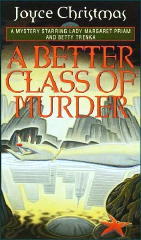
JOYCE CHRISTMAS – A Better Class of Murder.

Fawcett, paperback original; 1st printing, Dec 2000.

JOYCE CHRISTMAS

   Question. Did Hercule Poirot and Miss Marple ever appear in a story together? I don’t think so, but I might be wrong. I know that Perry Mason and the detective duo of Bertha Cool and Donald Lam never appeared in the same book. But think about it. Wouldn’t have either one been quite an event? Crossovers like this used to be rare in the comic book field, now it’s so common they do it all the time, even between DC and Marvel, two different publishers and direct competitors, if you will.

   But for mystery fiction, it’s not an everyday occurrence. (*) So to have the first appearance together of Joyce Christmas’s two main characters, Manhattan socialite Lady Margaret Priam (ten previous books) and retired office manager Betty Trenka (four earlier mysteries), well, when it first came out, her fans must have been grabbing the book right off the shelf.

   For me, though, this is the first of either series I’ve read, and it’s (in a word) disappointing. The two characters could not be from two more different worlds, but that’s not the problem. Poirot and Miss Marple are equally opposite in many ways, but just consider the puzzles they might have solved together — I think Agatha Christie could easily have come up with a couple of absolute knockouts. They would have been doozies.

JOYCE CHRISTMAS

   That’s not the case here. In fact, there’s very little case to be solved, and neither Lady Margaret or Miss Trenka get within 50 miles of the crime itself. Betty Trenka is asked by a neighboring suburbanite, a computer expert by trade, to do another job entirely, one that takes her into New York City, and thus into Lady Margaret’s social set, almost incidentally so. The connection turns out to be a dead woman whose body had been found earlier, back in (further) upstate Connecticut, involved somehow with a missing and essential computer disk.

   As crimes go, this is a rather mild one, and the solution is unravelled more or less perfunctorily, with no further ado or commotion. Lady Margaret has nothing to do but show Betty Trenka around the city, which the latter’s naiveté does make amusing, and perhaps even mildly interesting. All in all, though, what you should expect from this book is a lot more talk than there is action, of which there is none, neither physical nor mental.

— April 2001


COMMENT (*). 06-05-08. It wasn’t true then, and while it may be more true now, crossover appearances between mystery characters still happen only about .01 of 1% percent of the time. Of course in comic books it happens so often that it’s taken for granted, and it’s boring.

         JOYCE CHRISTMAS: A Checklist —

[Expanded upon from her entry in the Revised Crime Fiction IV, by Allen J. Hubin. All of her mysteries were published as paperback originals by Fawcett, or in the case of the earlier ones, Fawcett Gold Medal.]

   Lady Margaret Priam

1. Suddenly in Her Sorbet (1988)
2. Simply to Die for (1989)
3. A Fete Worse Than Death (1990)
4. A Stunning Way to Die (1991)
5. Friend or Faux (1991)
6. It’s Her Funeral (1992)
7. A Perfect Day for Dying (1993)
8. Mourning Gloria (1996)
9. Going Out in Style (1998)
10. Dying Well (2000)

   Betty Trenka

1. This Business Is Murder (1993)
2. Death at Face Value (1995)
3. Downsized to Death (1997)
4. Mood to Murder (1999)

   Lady Margaret Priam & Betty Trenka in tandem

1. A Better Class of Murder (2000)
2. Forged in Blood (2002)

FIRST YOU READ, THEN YOU WRITE
by Francis M. Nevins

   There’s a general rule to which the most conspicuous exception in our genre is Agatha Christie: when an author dies, his work dies too. Certainly Aaron Marc Stein’s has. He was born in 1906, graduated summa cum laude from Princeton, wrote a couple of avant-garde novels which were published thanks to endorsements from Theodore Dreiser, then turned to mystery fiction under the pseudonym of George Bagby and, a few years later, under his own name too.

AARON MARC STEIN George Bagby

   He quickly learned how to parlay his day jobs and other activities into backgrounds for the early Bagby novels, using his time as radio critic for a New York paper to create his own station in Murder on the Nose (1938), dipping into his memories of apparently liquor-soaked Princeton reunions for The Corpse with the Purple Thighs (1939), employing his stint at the madhouse known as Time magazine in Red Is for Killing (1941).

   During World War II he abandoned fiction to serve as an Army cryptographer, but after the war he became a full-time author and wrote so prolifically and skillfully that in the early 1950s, when he was turning out four or more titles a year, New York Times mystery critic Anthony Boucher called him the most reliable professional detective novelist in the United States.

   Between 1935 and his death half a century later he produced an astounding 110 book-length mysteries: 51 as Bagby chronicling the cases of the NYPD’s sore-footed Inspector Schmidt; 18 as Hampton Stone about New York Assistant District Attorneys Gibson and Mac; 18 under his own name with the archaeologist-detective duo of Tim Mulligan and Elsie Mae Hunt as protagonists and, when his publishers demanded stronger beer in their Steins, 23 with adventurous civil engineer Matt Erridge in the lead.

AARON MARC STEIN George Bagby

   Factor in his one non-crime novel as Bagby plus one stand-alone crime novel under his own name and those two early literary experiments and you have a total of 114 books. He also wrote occasional short stories, which cry out to be collected. Most of his Bagby and Stone novels are set in and around New York, which Aaron knew and loved and characterized as vividly as any of his human beings, while most of his orthonymous books feature exotic locales in Central and South America or Europe.

   I had been reading him since my teens but never got to spend quality time with him until the mid-1970s when we both joined the board of the University of California’s Mystery Library, and we remained friends for the rest of his life. In 1979 he received the Grand Master award from Mystery Writers of America. Later he and I served together on the board of Bantam s Collection of Mystery Classics.

   His health was failing but he continued to turn out a book or two a year well into his seventies. Acclaimed by colleagues and connoisseurs, he never attained the popular success he so richly deserved. He died of cancer in 1985. That was almost a quarter century ago but I still remember him fondly.

AARON MARC STEIN George Bagby

   Since the early 1960s he had lived in a co-op on Park Avenue and 88th Street with his sister Miriam-Ann Hagen (who also wrote a few whodunits of her own) and her husband Joe. They had bought it for $34,000 which they’d won gambling at Las Vegas in a single night. At the time of his death the unit was worth well over a million. In effect he had an apartment inside the apartment, and after he and Miriam had died Joe invited me to stay in Aaron’s quarters whenever I was in New York – which allowed me the unique experience of reading several of Aaron’s later novels in the room where he’d written them.

   For most readers today his huge body of work remains an undiscovered treasure. Any who care to remedy that loss would do well to begin with his books from the years when he earned that accolade from Boucher: perhaps the Bagby titles Drop Dead (1949) and Dead Drunk (1953), or The Girl with the Hole in Her Head (1949) as by Stone, or Days of Misfortune (1949) under his own name. I still reread him regularly and with pleasure.

***

   Of all the 20th-century poets who made significant contributions to the whodunit, our Poetry Corner guest this month is probably the most distinguished. Cecil Day-Lewis (1904-1972) is best known today as the father of actor Daniel Day-Lewis, but in his lifetime he served as England’s Poet Laureate and, as Nicholas Blake, the creator of amateur sleuth Nigel Strangeways, he was considered one of the finest crime novelists of his generation.

Head of a Traveller

   He combined both interests in the Strangeways novel Head of a Traveler (1949), which Thomas M. Leitch summarized superbly in his chapter on Blake for Volume One of Mystery and Suspense Writers: The Literature of Crime, Detection, and Espionage (1998). “The central figure is the distinguished poet Robert Seaton, whose household is destroyed by the unexpected discovery of his brother Oswald’s decapitated corpse….[T]he real interest of the novel is in its impassioned examination of the costs of poetry – the lengths to which poets and those who love them will go in pursuit of their craft.”

   Anthony Boucher, reviewing the novel in his “Speaking of Crime” column (Ellery Queen’s Mystery Magazine, August 1949), suggested that “Blake knows so much about his theme, the nature of poetic creation, that he never quite conveys it convincingly to the reader.” But those with twin passions for poetry and mystery fiction may well find Head of a Traveler the single most rewarding whodunit they’ve ever read.

***

MACDONALD Drowning Pool

   As one whose usual breakfast is fruit and a piece of whole-grain toast, I am avocado-green with envy at the morning meals characters like Nero Wolfe can tuck away. But Wolfe’s most lavish spread seems Spartan next to that of Walter Kilbourne, the cartoonish take on Sydney Greenstreet in Ross Macdonald’s second Lew Archer novel, The Drowning Pool (1950):

    “He ate with a gobbling passion. A piece of ham and four eggs, six pieces of toast; a kidney and a pair of mountain trout; eight pancakes with eight small sausages; a quart of raspberries, a pint of cream, a quart of coffee. I watched him the way you watch the animals at the zoo, hoping he’d choke to death….”

   What, no platter of cream-filled tortes for dessert?

***

   Just as this column was about to sail off into cyberspace to its destination came the news that Sydney Pollack died of cancer on Memorial Day at age 73. He was a Hoosier, born in Lafayette, Indiana on July 1, 1934, and began his show-business career as an actor. In the early Sixties he moved into directing and helmed episodes of many network TV crime-suspense series including Cain’s Hundred, Target: The Corruptors, The Alfred Hitchcock Hour, The Defenders, The Fugitive.

   His Hitchcock episode “The Black Curtain” (November 16, 1962) was nominally based on Cornell Woolrich’s 1941 noir novel of the same name but had almost nothing in common with the book except for the springboard situation as Frank Townsend (Richard Basehart) recovers from a second blow on the head and learns that for the past few years he’s been suffering from amnesia and leading another life.

   Pollack’s most successful feature-length contributions to our genre were the cynical thrillers Three Days of the Condor (1975) and The Firm (1993), whose bad guys were respectively the CIA and the legal profession: not bad choices at all.

Three Days of the Condor

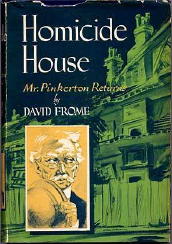
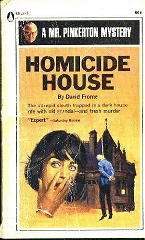
DAVID FROME – Homicide House. Popular Library; paperback reprint. No date stated, but circa 1969. First edition: Rinehart, 1950. British title: Murder on the Square. Robert Hale, 1951. US hardcover reprint: Detective Book Club (3-in-1 edition), July 1950. Previously serialized in The Saturday Evening Post in seven parts between September 24 and November 5, 1949.

   Since the subtitle of the hardcover edition is “Mr. Pinkerton Returns,” I’ll begin by listing all of the Evan Pinkerton books. While David Frome was byline listed on all of the books, you might better know “him” as Leslie Ford, author of the Grace Latham and Colonel John Primrose mysteries. Taken from Crime Fiction IV, by Allen J. Hubin:

The Hammersmith Murders (n.) Doubleday 1930 [England]
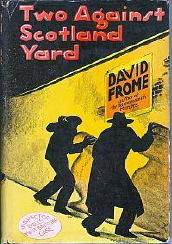
Two Against Scotland Yard (n.) Farrar 1931 [England]

DAVID FROME Homicide House

The Man from Scotland Yard (n.) Farrar 1932 [England]
The Eel Pie Murders (n.) Farrar 1933 [England]
Mr. Pinkerton Finds a Body (n.) Farrar 1934 [Oxford]
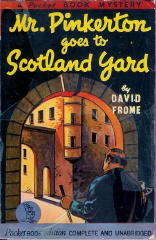
Mr. Pinkerton Goes to Scotland Yard (n.) Farrar 1934 [England]

DAVID FROME Homicide House

Mr. Pinkerton Grows a Beard (n.) Farrar 1935 [England]
Mr. Pinkerton Has the Clue (n.) Farrar 1936 [England]
The Black Envelope (n.) Farrar 1937 [Brighton]
Mr. Pinkerton at the Old Angel (n.) Farrar 1939 [England]
Homicide House (n.) Rinehart 1950 [England]

   As you see, there was a gap well over ten years long between this, the last book in the series and the preceding one. There were 10 or 11 Grace Latham books that appeared in the interim. It wasn’t as though the author, whose real name was Zenith Jones Brown, 1898-1983, wasn’t doing any writing in the meantime. As Leslie Ford, her last book appeared in 1962 (Trial by Ambush) a non-series book.

   My review of Ford’s The Woman in Black appeared here on the M*F blog a while back, in case you’d like to go back and take a look.

DAVID FROME Homicide House

   There are a couple of ways I could continue from here, and by flipping a mental coin, I’ll say something first about Mr. Pinkerton, whose adventures in murder mysteries I’ve now read the first I ever have. I’d assumed he was a stalwart sort of fellow, confidently solving crimes by the dozens as a friend and chief confidant of Chief Inspector Bull of Scotland Yard.

   Wrong, all the way around. Evan Pinkerton is the meekest, most afraid-of-his-own shadow detective sleuth there has to be ever been. Now a widower and owner of an small apartment building in Godolphin Square, he is afraid to tell the landlady that he is indeed the owner, disbelieving as he does that he is himself. Perhaps his penny-pinching wife will come back from the grave and take it away from him, he fears. (This is being hen-pecked to the extreme, one thinks, and rightly so.)

   And so he is stuck in a miserable room on the third floor, sharing a bath with the cook, who fortunately enough, is very seldom seen. The crimes he has solved, they must have been more or less by accident, as Bull has forcefully demanded that he quite positively stay away from any futures brushes with murder cases that need looking into.

   Which leaves the current one at hand to tell you about. What struck me most, from the very first page, is that here is a mystery that is centered about a building that has been damaged by the bombing during the war. It’s now a few years after the war, and about all that is standing in the home across the square from Mr. Pinkerton’s are a few walls and the charred remains of a stone staircase. Nerves are often still shattered and decent food is still a problem.

Anthony Gilbert: Death Blackout

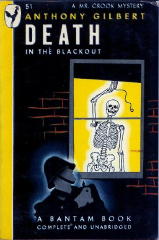
   I may be wrong about this, but I am pointing this out because I do not believe that very many British mysteries written during or just after the war actually dwell on how difficult a time it really was for the general population. This is one of the few exceptions I can actually think of at the moment, the other being Anthony Gilbert’s Death in the Blackout (1942). I’m sure there are more, but if there were many, it would seem that the opening scenes of this book would not have struck me as being so unusual.

   What I also found very striking is that how strong a Woolrich-ian sense of the sudden infatuation, coincidence and/or disorientation there is in the first few chapters. On page 7 Mr. Pinkerton meets Daniel McGrath hunting for the house that was damaged, seeking for the girl who had once lived there and whom he had met in a bomb shelter during the war, and here he is, six years later, having just come from America and planning to ask her to marry him, not even knowing her name.

   Of course she now lives in the same building as Mr. Pinkerton, and of course she is not yet married, and of course she recognizes him immediately, but of course she slaps his face when she learns his name, his name being the same as a noted detective she assumes has come to find and arrest her father.

   Whew. This makes for terrific reading, to be sure.

   Here from page 43 is a passage that I hope illustrates exactly what I am saying. It describes their first meeting in six years, from McGrath’s point of view, as she is getting off a train:

    She raised her head and pushed her dark hair from her forehead with a quick nervous gesture before she stooped to gather up her bags. For Dan McGrath standing outside on the damp murky platform it was as vivid an instant as he had ever lived. He was back in the Underground shelter on the dark, chilling stairs, the reek of fear and antiseptics in his nostrils, all hell loose in the invisible world above them, his arms tight around her, feeling her pounding heart against him, her breath in staccato tempo cool against his burning cheek. It was the instant he had lived six years to feel again. It was a sharp renascence, an affirmation of a dream that was no star-dusted illusion but brilliant reality, swelling his heart, melting it with sudden warmth and glowing tenderness. He had had a vision, and he had doubted it. There on the platform in the instant his doubts had been swept away.


DAVID FROME Homicide House

   No mere mystery story could top a passage like this, and while Homicide House tries, it is doomed to failure. True love prevails — is it OK if I tell you that? — but with difficulty, some by purely natural causes, and some by authorial hand only — or if not the latter, then the wonderfully funny fickleness of fate.

   Mary Winship’s father has disappeared, many years before — she now lives with her sickly mother and a truly formidable aunt in Mr. Pinkerton’s building — and vanishing at the same time was a valuable painting. And with Daniel McGrath unwittingly stirring things up, dead bodies begin to accumulate in Mr. Pinkerton’s abode.

   The latter’s not much of a detective, or at least he’s not in this book, but his activities toward that end also initiate worry and concern on the part of a blackmailer and a killer, not (it is eventually discerned) one and the same. It all works out in the end, but the first seven chapters are what I’ll remember from this book, and not the last two (with a connecting bridge of largely filler material in between).

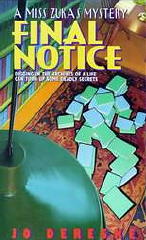
JO DERESKE – Final Notice.

Avon, paperback original. First printing, November 1998.

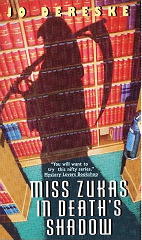
JO DERESKE Death's Shadow

   This is the sixth in Dereske’s “Miss Zukas” series, and as usual in my random, non-systematic way of doing things, the only one of them that I’ve read before this one is the one that follows this one.

   And in fact, the incident that initiates that very same next one, Miss Zukas in Death’s Shadow, occurs on pages 18 and 19 of this one – she’s given a traffic ticket on the way to the airport to pick up her elderly aunt who’s coming in from Michigan for a visit.

   Being a reference librarian either reinforces Helma’s sense of what is correct and proper, or it is what caused her to become a librarian in the first place. And being given a summons for turning right on a yellow light definitely does not fit her sense of what is correct and proper. Allow me to quote:

    “I can’t sign this,” she told [the policeman].

    “It’s not an admission of guilt, ma’am.” His voice grew louder, higher pitched. “You’re only acknowledging receipt of the ticket.”

    “Then you’ll have to make it readable. You’ve spelled Wilhelmina incorrectly. I believe the time noted here is three minutes into the future. I can see your badge number is 087 but I’m unable to read your name: Olsen? Carolson? Camden? This document is too illegible for me to sign my name to. I’d like a rewritten ticket, please.”


   Sure enough, at the beginning of the next book, the only one before this one that I’ve read, Miss Zukas is doing community service at a homeless shelter. I hope you don’t get the wrong idea, though. Miss Zukas is in her 30s, I believe, perhaps almost 40, but unfortunately I didn’t make a note of where I saw a reference to her age. If I have it wrong, I’ll change this small piece of data, and unless you remember, you’ll never know I had it wrong.

   But the point is, she’s not a dottering old lady librarian, and while she’s not married, she does have a sort of boy friend in Bellehaven’s chief of police, Wayne Gallant. (Bellehaven is a fictional town, I believe, in Washington state.) This romance, if indeed that is what it is, is the strangest romance I’ve ever read about, as they are both rather reticent to speak about their relationship, even to each other.

JO DERESKE Final Notice

   When Wayne Gallant’s ex-wife comes to town in Final Notice to reclaim her former husband, though, things between them (Helma and Wayne Gallant) begin to come to a boil. If a relationship can boil at less than room temperature, this one does. (He is always referred to Wayne Gallant, by the way, and when he calls Helma on the telephone, he says, “Helma, this is Wayne Gallant.” I found that … strange. In a nice sense, mind you.)

   The dotty old lady in Final Notice is actually Helma’s Aunt Em, who back in Michigan (where she has lived her entire life, so far, or so Helma believes but soon discovers that it was not so) she had a “brain incident” and has become in behavior rather, shall we say, eccentric. And talkative. About her past. A past that Helma’s family had never talked about. Especially the time Aunt Em spent in Chicago during the rum-running days of Al Capone.

   Dead in Helma’s apartment building parking lot is the same man who tried to steal Aunt Em’s purse at the airport. The identification is clinched by the three stab wounds in his arm produced by Aunt Em’s hat pin. Coincidence? Not very likely, but who? And why?

   I enjoyed this, indeed I did. The detective work is minor, but it’s not dislodged, disrupted and disposed of completely. The characters are only mildly wacky and perhaps just as normal as any other group of people, including Miss Zukas’s fellow librarians, especially the director, a lady who believes that psychological color testing is a good way to maintain staff morale. Miss Zukas refuses. Naturally.

   Here’s a list of all of Jo Dereske’s novel-length mystery fiction. Ruby Crane is a graphologist by profession, a forgery expert at a California detective agency. I’ve not read any of her adventures, but I’m sure that I read somewhere that she may be a cousin of Miss Zukas. If so, I imagine the cases she solves may be as much of a sneaky pleasure to read as this one.

    Miss Zukas. All are Avon paperback originals.

1. Miss Zukas and the Library Murders (1994)
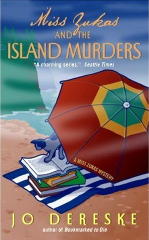
2. Miss Zukas and the Island Murders (1995)

JO DERESKE Island Murders

3. Miss Zukas and the Stroke of Death (1995)
4. Miss Zukas and the Raven’s Dance (1996)
5. Out of Circulation (1997)
6. Final Notice (1998)
7. Miss Zukas in Death’s Shadow (1999)
8. Miss Zukas Shelves the Evidence (2001)
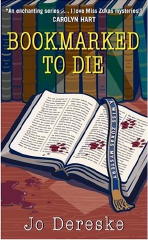
9. Bookmarked to Die (2006)

JO DERESKE Bookmarked

10. Catalogue of Death (2007)
11. Index to Murder (2008)


    Ruby Crane. All are Dell paperback originals.

1. Savage Cut (1996)
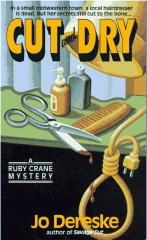
2. Cut and Dry (1997)

JO DERESKE Cut and Dry

3. Short Cut (1998)

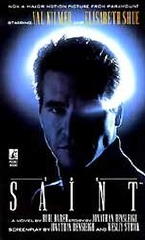
THE SAINT. 1997. Val Kilmer, Elizabeth Shue, Rade Serbedzija, Valery Nikolaev, Alun Armstrong (as Inspector Teal), Roger Moore (voice only). Based on the character created by Leslie Charteris. Directed by Philip Noyce. [Novelization by Burl Barer; Pocket, 1997.]

THE SAINT Kilmer Shue

   My first reaction? Beware of movies about fictional characters whose creators are not included in the on-screen credits. That’s what the common wisdom says, or if it doesn’t, it should.

   Be also wary – this is my own advice – of movies that begin by telling the childhood origins of the character. Especially when said character’s exploits extended for well over a fifty year period (1928-1983) – under the control of said creator if not always written – without the creator ever finding the need to chronicle the characters origins, which are always (perhaps) best left to the reader’s imagination.

   The reviews of this movie were almost universally bad, although in some cases as if reluctantly so, but – and this is a big but – the reaction of ordinary civilian reviewers (on IMDB, for example) have been almost universally positive. Some call it their favorite movie of all time, others while not going that far, admit to having watched it over and over again many times.

   Why the great disconnect? I’ve thought it over for a couple of days now, and I’ve listened to the director’s voice-over commentary, which (as usual) pointed out any number of items I missed the first time through, and I think the division of opinion comes down to this.

   Those who liked the movie did not know anything about Charteris’s character – a devil-may-care adventurer with an ever-present twinkle in his eye as he swindled the bad guys’ loot right from under their eyes – nor did they know anything of Roger Moore’s TV version of the character (much less George Sanders in the movie versions).

THE SAINT Kilmer Shue

   Roger Moore, I personally liked in the role, although (as I remember) he was a little stiff and not quite as rakishly (more impishly, perhaps) devil-may-care as I would have liked.

   But Moore stopped playing the Saint in 1969, which (I’m guessing) is well before most of the viewing audience for this new version was born, and Val Kilmer is all they know (and all they got). Which may sound snarky, and if so, I mean only 30 to 40 percent of it.

   For in fact, if you take the character he plays – he is not even Simon Templar yet, as this revisionist story would have it – without an idea of who he is to become – I think you might even enjoy watching this tormented loner, unsure of his true identity, a thief with undated Internet gimmicks and capabilities – not to mention his many disguises which are as varied and clever as they are numerous – and seeing him grow into someone whom the director refers to as “worthy of Sainthood.”

THE SAINT Kilmer Shue

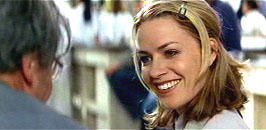
   Thanks, of course, to the love of a beautiful woman, Dr. Emma Russell, played by Elizabeth Shue, an expert on cold fusion, the formulas for which some scummy post-Communist Russians would love to get their hands on.

   That Emma Russell acts like she is sixteen years old and has never been within two feet of a man before is very nearly beside the point. She is innocent and vulnerable, and she is what Val Kilmer’s character needs to shake up his life and start him over again. (He certainly needs it.)

   It also does not seem to matter that cold fusion does not seem to work, then or now, even though when a miracle is desperately needed in the movie – and in the middle of Red Square yet! – a miracle is certainly what indeed does happen.

THE SAINT Kilmer Shue

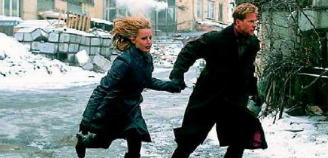
   Emma Russell’s heart condition also seems improve greatly as the movie goes on. Perhaps it is all the running she does, or edging her way with Simon along the icy flank of the Moscow River, or escaping with him through the city’s underground tunnels. Exercise like this is just what the doctor ordered. Or needed.

THE SAINT Kilmer Shue

   An earlier version in which she dies in the end was wisely, wisely reconsidered. The ending is a bit of a muddle anyway, but if her cheery optimism had been squashed in the end like a bug, the audience would have roundly booed. I would have, at least, and loudly.

   My second reaction, then, ignoring the fact that movie is about a character I think I should know — but as the film goes on, I realize in frustration (if not something akin to anger) that I do not — with my expectations suitably altered, I enjoyed the movie considerably more the second time through than I did the first.

   But will I ever watch it again? The future is hazy on that, but the possibility is higher than the chance that I will ever watch a version with George Sanders in it more than once. One with Roger Moore in it, from TV? Yes.

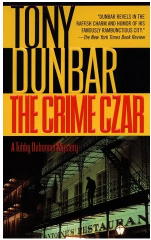
TONY DUNBAR – The Crime Czar.

Dell, paperback original; first printing, November 1998.

   My first reaction, when starting to read this fifth recorded New Orleans adventure of only slightly sleazy attorney Tubby Dubonnet, is that it takes place before hurricane Katrina came along. What a sorrowful scab on this country’s face that city is now. There’s a lot of atmosphere in this book, more or less a continuation of the preceding one, and I’ll get back to that aspect of it in a minute.

   The background of eccentric native inhabitants and local cuisine is combined with a hand-brewed melange of hoodlums, crooked politicians and judges, and the laissez faire approach to life of Tubby himself to produce a potpourri of wackiness and Southern charm. (Well, I concede that crooked politicians are not charming, nor is the occasional violence that rips its way into the tale that Tony Dunbar has to tell in The Crime Czar, but there you are.)

   The Tony Dunbar novels so far, as expanded upon from the listing in Crime Fiction IV, by Allen J. Hubin. All take place in New Orleans, Louisiana.

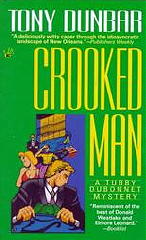
         # Crooked Man. Putnam, hc, 1994. Berkley, pb, 1996

TONY DUNBAR City of Beads

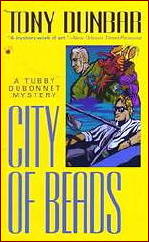
         # City of Beads. Putnam, hc, 1995. Berkley, pb, 1996.

TONY DUNBAR City of Beads

         # Trick Question. Putnam, hc, 1996. Berkley, pb, 1997.
         # Shelter from the Storm. Putnam, hc, 1997. Berkley, pb,1998.
         # The Crime Czar. Dell, pb, 1998.
         # Lucky Man. Dell, pb, 1999.
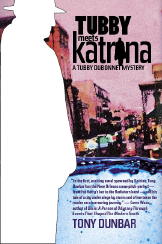
         # Tubby Meets Katrina. NewSouth, hc, 2006.

TONY DUNBAR Tubby Meets Katrina

   And of course I have a couple of comments. The story in The Crime Czar seems to pick up right after Shelter from the Storm ends, leaving some open, unanswered questions as it does so. It is strange, then, to see the series switch not only from hardcover to paperback in the transition, but from one publisher to another as well.

   The other obvious comment is that I did not know about this most recent book in the series until about five minutes ago, and I want to read it. Mr. Dunbar is obviously in love with the town where he lives – even with my having read only the one book in the series so far, I know this – and I need to know what he has felt and presumably still feels about the destruction (if not the rebuilding) of the city that was New Orleans.

   I’ve ordered it online today.

TONY DUNBAR Crime Czar

   As for The Crime Czar, as mentioned up above, the story reads like a Chapter Two, and I’m sure it would have helped to have read Shelter from The Storm before it. The ongoing crime-tinged saga that is Tubby Dubonnet’s life does not seem to come in pre-packaged segments. It is, instead, continuous.

   Tubby’s target in the book at hand: the man who seems to be behind all of the crooked wheelings and dealings in New Orleans, and for one instance in particular, the death of his friend Dan, left severely wounded in the earlier book.

   Add to the tale a hooker named Daisy, boiling mad at the death of her new boy friend; a gang of Vietnamese gunmen, aiming to avenge the shooting of three of their countrymen; and Marguerite, upon whom Tubby is sweet, and another leftover from the previous book, having managed to flee with a fortune in jewelry. Don’t ask. I didn’t, and the story still went down swell.

   It — the story — isn’t a major one, mind you. A minor caper, that is all. When one judge with his hand out goes down, another one pops up immediately. When one crooked cop is caught with his pants down, another one comes along with no delay. The fun is in the reading, though — a joyous, fun-loving affair for the most part, Big Easy style.

    NOTE:  No crawfish were harmed in the writing of this review.

MR. MOTO'S LAST WARNING

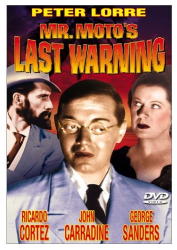
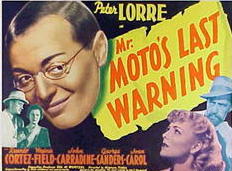
MR. MOTO’S LAST WARNING. 20th Century-Fox, 1939. Peter Lorre, Ricardo Cortez, Virginia Field, John Carradine, George Sanders. Based on the character created by John P. Marquand. Screenwriters; Philip MacDonald and Norman Foster. Director: Norman Foster.

   I’m told that Mr. Moto’s Last Warning, the sixth of eight Mr. Moto films – see below – is the only one that’s in the public domain. This explains two things. First, why I was able to buy a copy on DVD at this evening’s local library sale for only $2.00, and secondly why I paid too much, as I discovered later: You can watch the entire movie for free online. Click here.

   Disclaimer: I have not watched the free version all the way through, but it appears that it’s the entire film that’s available.

   Here’s a complete list of the Mr. Moto films:

         * Think Fast, Mr. Moto (1937)
         * Thank You, Mr. Moto (1937)
         * Mr. Moto’s Gamble (1937)
         * Mr. Moto Takes a Chance (1938)
         * Mysterious Mr. Moto (1938)
         * Mr. Moto’s Last Warning (1939)
         * Danger Island (1939)
         * Mr. Moto Takes a Vacation (1939)

MR. MOTO'S LAST WARNING

   As you see Peter Lorre and 20th Century-Fox stopped making them well before the US became involved in World War II, a wisely-taken cautionary move, as by nationality, Mr. Moto was very definitely Japanese. By profession, he was a secret agent for the “International Police,” and since he was very proficient in either judo or ju jistsu (I imagine there’s a difference) his movies were a lot more action-oriented than either Mr. Chan’s or Mr. Wong’s.

   Exemplified quite well, thank you, by Mr. Moto’s Last Warning, in which any number of people are killed or very nearly so, including (surprisingly enough) some of the good guys, one in rather gruesome fashion. Because of a partially muffled sound track at the beginning, it took me a while to figure out what the story was about, but eventually all became clear, except for one question: what country were the bad guys (Cortez and Sanders, primarily) working for? Forthrightly, it is never stated.

   Scene: Port Said, Egypt. Plot: To create an incident involving the incoming French fleet that will break the bonds of friendship between France and England. Mr. Moto, working undercover as an antiques dealer, gets wind of the plans and sends out the warning that’s stated in the title.

MR. MOTO'S LAST WARNING

   The movie is surprisingly well done. The actors are all pros at this sort of game, the script makes sense (not surprisingly, considering the hand of Philip MacDonald at the helm), and the comedic interludes are only a trifle overdone.

   For the most part, the story takes itself seriously. I especially liked the bad girl to good girl transformation of Virginia Field as Connie, lover of Fabian (Ricardo Cortez), the ventriloquist (yes) behind the entire scheme.

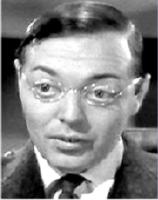
   That’s her in the lower right corner of the lobby card, the best I’ve been able to come up with. I’m also not sure how well the Peter Lorre image will come out. It looks not quite in focus to me, but it’s the best I can offer so far. Coming directly from the film, I think it should give you a better idea of how he appears in the movie, as compared to the DVD box or even the lobby card.

« Previous PageNext Page »