Characters


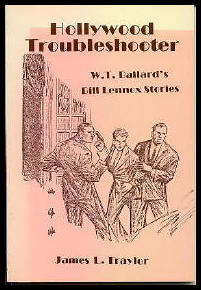
W. T. BALLARD – Hollywood Troubleshooter. Edited by JAMES L. TRAYLOR. Popular Press, Bowling Green University; trade paperback; 1985. Also published in hardcover.
W. T. Ballard

   Subtitled “W. T. Ballard’s Bill Lennox Stories,” not only does this book contain five of the twenty-seven of them that appeared in Black Mask during that magazine’s heyday, probably the best-known detective pulp of them all, but all of the following are included as well: an overview of Ballard’s career by Traylor and a short biographical sketch by Ballard himself, both extremely informative; an introduction to the Lennox stories and novels; and last but not least, a complete bibliography for all of Ballard’s long and prolific writing career.

   It’s a cliché, I suppose, but this is a book that should be on the shelf of every pulp detective fan, no ifs, ands or buts. After a lengthy career for the pulp magazines — even before he started writing for Black Mask in 1933, he had already been published in the October 1927 issue of Brief Stories — Ballard switched with the times to writing novels, some in hardcover, but most of them paperback originals.

   When he found the market for his mystery fiction was drying up, Ballard switched to writing westerns, most of these coming out under the pen names of either Todhunter Ballard or John Hunter. In the 1950s and 60s he wrote a number of television plays as well, for such series as Death Valley Days, Wild Bill Hickok and Shotgun Slade.

   While the Lennox stories in Black Mask appeared only from 1933 to 1942, he was apparently fond enough of Lennox as a character to continue writing about his adventures in hardcover form: Say Yes to Murder (Putnam, 1942), Murder Can’t Stop (McKay, 1946), and Dealing Out Death (McKay, 1947). Much later on, a fourth book, Lights, Camera, Murder (Belmont, pb, 1960), finally appeared, published for some reason under the name of John Shepherd.

   Here’s a suggestion from me. Lennox may have been the first Hollywood troubleshooter to have appeared in fictional form, the right-hand man for Consolidated Studio’s production chief, Sol Spurck. Having no specific title, according to the last of the five stories in this book, Lennox’s assignment was “to iron out whatever bottlenecks developed in the production schedule.” Murder is often one of those bottlenecks, as well as any other kind of behavior that might affect the studio’s star and starlets — including blackmail, crooked horse racing, gambling debts or the like. (Hollywood, crime and cover-ups somehow seem to go together naturally, at least in days gone by, if not today.)

   Whenever a pulp writer got a hot series going, there was often of crew of regulars that began to appear in the same stories the main character did, and Ballard was no different. (He may even have been one of the forerunners of the idea.) Given only self-contained glimpses here and there, and spread over the run, you won’t get the full flavor of this in the same way that a long-time regular reader of Black Mask might have been able to, but Nancy Hobbs, for example, who writes about movies, has short but very striking roles in the first two of them. Later on, it comes as no surprise to learn, she appears in his adventures as a long term girl friend and lover, although marriage does not seem to be in the cards for either of them.

   The earlier stories are told in the more terse hard-boiled style popularized by Dashiell Hammett, but by the end of the run some personal background had been built up around Lennox, making him a bit more human — but without losing any of the sheer sensationalism of the pulps. Lennox’s final Black Mask appearance, for example, is a case in which a killer sends his victim through the buzzsaw at a still very much functioning lumber mill.

   Although the tales contained in the book are, in all honesty, not among the finest the pages of vintage pulp magazine fiction can offer, they’re certainly right up there in the second level from the top. And if you’re like me, when you’ve finished reading the five in the book, you’re going to wish that somebody would publish them all of the Lennox stories, and then the “Red Drake” ones, then all of the Ace G-Man Stories, and on and on and on.

   Stories contained in this volume, all from Black Mask:

“A Little Different” September 1933 [Lennox’s first appearance]
“A Million-Dollar Tramp” October 1933
“Gamblers Don’t Win” April 1935
“Scars of Murder” November 1939
“Lights, Action — Killer!” May 1942 [his last magazine appearance]

Postscript: Looking back at this review several days later, all I can think of is that I didn’t provide you with an excerpt from any of the stories. This one’s from early in the very last one, “Lights, Action — Killer!” I don’t think it needs any more introduction from me, other than to say that Lennox is talking to Sol Spurck about the latter’s latest movie, which is in trouble, as usual:
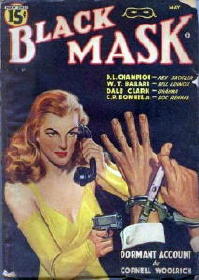
    “The script,” said Lennox, “stinks.” When he had first come west, he had been surprised at the language which served the film colony, but after six years he spoke no other. He was too busy to think about himself, his likes or dislikes.

Ballard - Black Mask

    At first he had dreamed of writing a book, a lot of books, but as the weeks drifted into years, he still spoke of quitting pictures, of going east and settling down to write.

    That time never seemed to come. Through experience, he had learned to make his interest, his enthusiasms, and his softer feelings under a shell of hardness which was the only phoney thing about him. He had become flippant, since the town understood nothing else. He had ceased to admit that he could read, or that he liked good books. He gambled when he could, needing the false excitement of the game as a safety valve for his nerves.

    But although he refused to admit it, even to himself, he was still moved by enthusiasm for each new picture, still hoped that some day someone would cut loose and make, not the old formula story, but something really new, something different. All the bitterness and boredom of his job was in his voice when he said, “They dipped the barrel dry for hokum on this, Sol. If we had Pearl White, we could make the greatest serial out of this that was ever made.”

    “Funny,” said Spurck. “Mama and I was just talking at dinner. Them old days was different. Pictures was fun then, and not always the headache which we have now got.”

— August 2004


UPDATE [06-23-07]. Here, for the sake of completeness, is a complete list of Lennox short fiction:

“A Little Different” (September 1933, Black Mask)
“A Million Dollar Tramp” (October 1933, Black Mask)
“Positively the Best Liar” (November 1933, Black Mask)
“Trouble-Hunted” (January 1934, Black Mask)
“Tears Don’t Help” (April 1934, Black Mask)
“That’s Hollywood” (May 1934, Black Mask)
“Whatta Guy” (July 1934, Black Mask)
“Crime’s Web” (September 1934, Black Mask)
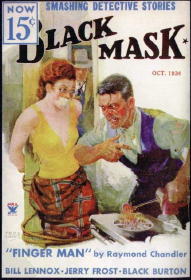
“Snatching is Dynamite” (October 1934, Black Mask)
Black Mask

“In Dead Man’s Alley” (November 1934, Black Mask)
“Murder Isn’t Legal” (December 1934, Black Mask)
“Gambler’s Don’t Win” (April 1935, Black Mask)
“Numbers With Lead” (January 1936, Black Mask)
“Blackmailers Die Hard” (May 1936, Black Mask)
“Whipsawed” (December 1936, Black Mask)
“There’s No Excuse for Murder” (September 1936, Black Mask)
“This is Murder” (March 1937, Black Mask)
“Fortune Deals Death” (July 1937, Black Mask)
“Mobster Guns” (November 1938, Black Mask)
“No Parole from Death” (February 1939, Black Mask)
“Scars of Murder” (November 1939, Black Mask)
“Pictures for Murder” (September 1940, Black Mask)
“The Lady with the Light Blue Hair” (January 1941, Black Mask)
“Not in the Script” (July 1941, Black Mask)
“Murder is a Sweet Idea” (November 1941, Black Mask)
“The Colt and the Killer” (February 1942, Black Mask)
“Lights, Action — Killer!” (May 1942, Black Mask)

   Now don’t you wish that someone would publish them all?
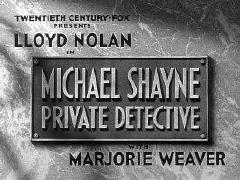
Michael Shayne

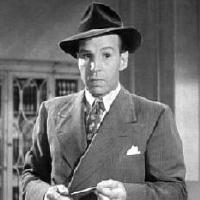
MICHAEL SHAYNE: PRIVATE DETECTIVE. 20th Century Fox, 1940. Lloyd Nolan, Marjorie Weaver, Walter Abel, Elizabeth Patterson, Donald MacBride, Douglas Dumbrille. Based on the novel Dividend on Death, by Brett Halliday. Director: Eugene Ford.

   Some random thoughts that may shape themselves into a review, and maybe not. What you see is what you get. The recently released DVD set of the first few Shayne movies calls them noir. Not so. It’s a good selling point, but when it gets to the point that every black and white movie made in the 1940s with a crime or mystery in it is called noir, the word simply no longer has any meaning.

   The first true noir film may have been The Maltese Falcon; I really haven’t thought about it too much, but it certainly could have been one of the first. I suppose it all depends on your own personal definition of noir.

   MSPD came out a few months before TMF, and it may have been a step in the right direction, but it’s way too light-hearted, and Lloyd Nolan is a little too goofy in the leading role, for the film, based on author Brett Halliday’s Dividend on Death, to be anything close to noir, using anyone’s definition. TMF is played straight, giving audiences the feeling for what a tough mystery film (as opposed to gangster movie) could really be like.

   At least, as I thought for a while, Michael Shayne doesn’t have a stooge for a sidekick in this movie — another step in the right direction — but on the other hand, Chief Painter (Donald MacBride) has a cop as his right hand man who is as dumb as they come, and Shayne does have Aunt Olivia (Elizabeth Patterson), who’s a dedicated fan of Ellery Queen, murder mysteries and The Baffle Book, to give him strong support when it counts.

Lloyd Nolan

   Nolan I called goofy, but he’s still immensely enjoyable in the role, as long as you don’t think of him as Brett Halliday’s Michael Shayne. Seeing the repo men moving the furniture out of his office at the beginning of the film, when cases have apparently been tough to come by for him, certainly sets a certain tone. And watching him cover himself with a blanket when Phyllis Brighton (Marjorie Weaver), whom he’s been hired to bodyguard by her rich father, catches him with his pants down, is mildly funny but hardly, I suspect, how the real Michael Shayne might have reacted in the same situation.

   Not that the real Michael Shayne was really truly tough-as-nails hardboiled or one of theose super-sexed PI’s who came along later, but Lloyd Nolan, he wasn’t either.

   Perhaps as the series goes along, given the TMF influence, the humor lessens and the mystery is played straight, but even if it doesn’t, I’m not going to be concerned about it.

   The story has to do with a gambling casino, horse-racing, a murder, a ditched dame, a possible suicide note, the switching of the barrels of two guns, a bottle of ketchup and a piece of jewelry that comes unpinned at the wrong time, perhaps even a couple of times. It really is a complicated case, I grant you that, which is one of the things I had in mind when I called this a possible transition into true noir from detective films that felt they also had to make the audience laugh.

   It’s remarkable, looking back now, how all of the plot is made to fit into a tight 77 minutes, which I have a hunch is a little longer than the average murder mystery movie at the time. I’ve watched it twice now, and there’s not a minute that’s really wasted. It was well worth the time, and if I may say so, probably yours as well.

Lloyd Nolan

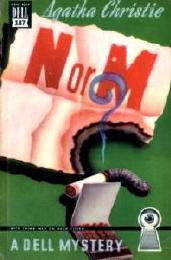
AGATHA CHRISTIE – N or M?

Dell 187, reprint paperback: mapback edition; no date stated, but generally accepted as 1947. Hardcover editions: Collins Crime Club (UK), 1941; Dodd, Mead (US), 1941.

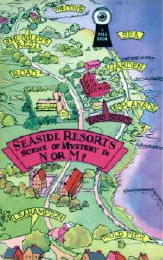
   I will not be so foolhardy as to list all of the editions that this book has been published in, nor will I supply more than the front and back cover of this particular mapback edition, especially since the jackets of the respective hardcover editions are so rather plain and unexciting.

   But speaking of mapbacks, what I just realized now, strangely enough, is that not once while reading N or M? did I refer to the back cover. Not until getting an image ready for uploading did I even think of it. And so, looking it just now, I find it utterly remarkable that while I all of the geographical details of the small seaside resort town of Leahampton essentially wrong in my mind, the overall picture in my head was exactly right. (And of course who is there to say that the artist who drew the map had the details right?)

N or M?

   This is a Tuppence and Tommy (Beresford) book, and if you were to check the date that the book was published (1941), you might immediately gather that this wartime book had something to do with the war, and indeed it does. (It is my impression that relatively few murder mysteries published during the war ever mentioned the war, but this one does, and directly so. Other handedly, my impression could be totally false. It is a subject worthy of further investigation.)

   I have not read the earlier books in the Tuppence and Tommy series in quite some time, so I do not recall in which one of them the twosome were secret agents in World War I, but when this book begins, they are beginning to feel their age, not to mention the pain of their rejection, as sitting on the sidelines is not their idea of how to spend the time they find free on their hands, nor in any way how to make the best use of their abilities.

   A small pause here while I investigate and come back with a short list of the books in which the pair of intrepid adventurers appeared:

      The Secret Adversary, 1922. [This must be the World War I adventure .]

      Partners in Crime, 1929. [A story collection disguised as a novel.]

      N or M?, 1941.

      By the Pricking of My Thumbs, 1968.

      Postern of Fate, 1973.

   That’s quite a range of dates, and the gap between the 3rd and 4th is a huge one, 27 years, but I don’t imagine that it is anywhere near a record — the longest break between appearance of series characters. (A question like this is something else I wish I had more time to look into.)

   But back to the story. Luckily enough Tommy is offered a job by the British equivalent of Homeland Security, so hush-hush, he is advised, that he should not even tell Tuppence. Who, of course, has other ideas, and thus indeed there is a story.

   It seems that a pair of spies for the Germans, N (a man) and M (a woman) are located in the aforementioned seaside resort town of Leahampton, and in particular they may even be living there in a private hotel called Sans Souci. An amateur is precisely what is required, Tommy is told, as a professional would be spotted right away.

N or M?

   During wartime towns like Leahampton would be populated by (as related on page 14): “old ladies, old colonels, unimpeachable spinsters, dubious customers, fishy customers, a foreigner or two. In fact, a mixed bag.” And the two spies, Tommy again is advised, are among them.

   Now if there are people Agatha Christie could write about more capably than “old ladies, old colonels, unimpeachable spinsters, dubious customers, fishy customers, a foreigner or two,” I don’t know who they would be, nor do I know of any other mystery writer could outdo her in this regard, either.

   What with the number of people staying on at Sans Souci to describe and make distinguishable, it might have been a Herculean task to succeed in doing so, but what Agatha Christie had was a knack of instant characterization for the inhabitants of her stories, and so it is here. And there is more. Christie is often put down for mysteries that focus more on the plots than they do on the writing of them, but such critics are generally wrong, as this book amply demonstrates. It is so smoothly written that 50 pages flash by in what seems to be an instant — gently humorous at times, sometimes (later on) deadly serious, and with a sense that something suspicious is always going on.

   There are a good many suspects at hand, in other words, in an oddly arranged version of the closed manor house type of mystery, but with little of substance to back up this statement, I do not believe that spies and espionage were Ms. Christie’s strongest points. Or in other words, where the book fails, if indeed it does, is in the plotting, which seems forced and unconvincing, concluding with some derring-do and remarkable rescuing that seems entirely fortuitous.

   And that the bring-down-the-curtain revelation at the end was one that I was suspicious about myself several pages earlier — “What’s going on here?” I wondered to myself (you’ll have to take my word for it) — which only goes to reinforce the statement I made in the preceding paragraph. Entirely enjoyable then, is my conclusion, but weakest precisely (and curiously) where you’d expect an Agatha Christie novel not to be.

— July 2006

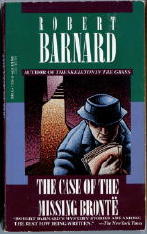
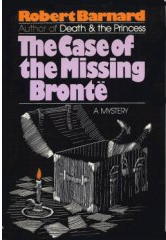
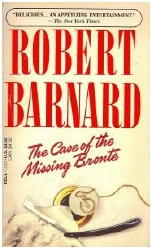
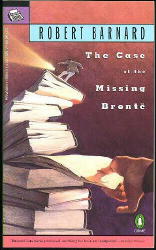
ROBERT BARNARD – The Case of the Missing Brontë

Dell 11108; paperback reprint, May 1989. Hardcover edition: Scribner’s, 1983. Previous Dell editions: June 1984; 1986. Penguin, paperback, November 1994. First published in the UK: Collins Crime Club, 1983, as The Missing Brontë.

Missing Bronte

   This was – I have a confession to make – my first reading of a Robert Barnard mystery novel. I don’t know why that should be so. I just never read one before. But at a library sale not too long ago, and I got there late, mind you, and in the mystery section of the paperback tent were, lined up all in a row, about a dozen of his books. I couldn’t resist. I grabbed them all, and this is one of them.

   Not knowing what to expect, it’s difficult to suggest that I was disappointed, because I wasn’t, but it (um) wasn’t exactly what I expected. I had the strong sense that Barnard’s books are filled with an understated British humor, and in that regard I was right. But I also expected more detection (or deduction, to choose the right word, which never hurts) than there is in The Case of the Missing Brontë. There may be detection on the part of Scotland Yard Superintendent Perry Trethowan, but I think that his wife Jan may have done more of the deducing in this book than does Perry, she having taken an interest in the case even though having never read one of the Brontë books before –

   I’ll start at the beginning, which is very, very funny, with the Trethowan family (one son) on a short summer holiday and stopping for a short respite in a small Yorkshire village, in which mother and father meet an old woman in a pub with a story: a find that she had made in some old family papers.

   Could it be the manuscript of a never-published Emily Brontë novel? The Trethowans are quickly convinced, but so are other members of Miss Edith Wing’s family (distant relatives) and assorted thugs and academics – don’t be concerned; it’s easy to tell them apart, most of the time. The academics are simply thuggish in more refined ways.

   When Edith Wing is knocked on the head and the papers stolen, Trethowan has a case on his hands officially, but why Scotland Yard allows such a leisurely investigation to occur on such a minor matter is a (shall we say) a mystery. But we (the reader) are thankful that they do, as the resulting novel is small marvel of small town japery and incisive cultural commentary, British style, through and through.

Missing Bronte

   A few quotes will suffice to illustrate, perhaps. From page 38. Perry is interrogating the Reverend Amos Macklehose, the aforementioned distant cousin:

    “ [have you a notion] of anyone who might have had special motive for doing Miss Wing harm?”

    “No, indeed. Indeed, no. A harmless spinster lady, and a true friend and kind nurse in time of distress. Who could find a motive for violence in the blameless life of such a one? You must look to th violence of the age, Superintendent. The inborn seed of wrath. Only last night on television – our Tabernacle congregation has after much heart-searching and prayer come to the conclusion that there is no intrinsic reason why television should not be regarded as one of the Gifts of God –”

    “Really? I can think of any number.”

Or from page 95, Perry again:

    … I had bungled the whole thing.

    Not that I would have been likely to get much out of any further overheard conversation. Eavesdropping on a foreign conversation is a bit like observing the sex life of earwigs – a lot’s going on, but you don’t get the point of it at all.

Missing Bronte

   Barnard, I have neglected to say, has written a large number of mystery novels, most of them, I feel somewhat able to say, very much like this one, or at least I suspect so. Some of them are standalone thrillers, while others have other series characters other than Trethowan, with occasional instances of crossovers by the characters between them. Here are the ones in which the latter appears, thanks to Al Hubin’s Crime Fiction IV, the point being that I hope to be reading another one soon. Listed chronologically:

TRETHOWAN, INSP. PERRY
       o Sheer Torture (n.) Collins 1981   [US: Death by Sheer Torture]
       o Death and the Princess (n.) Collins 1982  [US: The Cherry Blossom Corpse]
       o The Missing Brontë (n.) Collins 1983   [US: The Case of the Missing Brontë]
       o Bodies (n.) Collins 1986
       o Death in Purple Prose (n.) Collins 1987   [US: The Cherry Blossom Corpse]

Missing Bronte


— March 2007

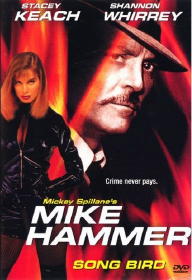
MIKE HAMMER: SONG BIRD. 2003. Movie compiled from two episodes of Mike Hammer, Private Eye, May 10 & 17, 1998. Stacy Keach, Shannon Whirrey, with Jack Sheldon, Moira Walley, Frank Stallone. Based on characters created by Mickey Spillane. Director: Jonathan Winfrey.

   As far as I’m concerned, Stacy Keach is Mike Hammer on TV. Not Mickey Spillane’s Mike Hammer, I didn’t say that. But as a savvy, trenchcoat-wearing private eye handy both with a gun (Betsy) and a quip – “Lila B. went through piano players like Janis Joplin did bottles of whiskey” – who just happens to be named Mike Hammer on the small screen, there simply is or was no better.

   The TV series that this film was taken from was the third or fourth time he’d taken the role, if I have the chronology correct. I’m taking this information from http://www.stacykeach.com/hammer-series.htm, but I’ll take the responsibility if I happen to be restating it incorrectly.

1. MICKEY SPILLANE’S MURDER ME, MURDER YOU. (1983, CBS, TV movie)

2. MICKEY SPILLANE’S MIKE HAMMER. (1984-1985, CBS, series). 22 60-minute episodes.

3. THE NEW MIKE HAMMER. (1986-1987, CBS, series). 22 60-minute episodes.

4. MIKE HAMMER, PRIVATE EYE. (1997, syndicated series). 26 60-minute episodes.

Mike Hammer: Song Bird

    By the time the syndicated series came along, episodes of which I don’t remember ever seeing before, he seems to have mellowed into the part, fitting into the role as if it were an old shoe, an old dog who no longer needs to learn new tricks. In this series Velda was played by Shannon Whirrey, who gets second billing on the DVD case. Whirry began her career playing what are generically called erotic B-movies. Playing Velda was a step up into better roles.

    “Song Bird” is a heartfelt homage to jazz, smoky jazz clubs, jittery, jiving jazz musicians and jazz singers that doesn’t make a lot of sense as a murder mystery, but I’ve watched it twice in the last couple of months, and I’m bound to be watching it a few times more.

    Jack Sheldon in the real world is a wise-cracking jazz singer and trumpet player who in “Song Bird” plays a wise-cracking jazz singer and trumpet player named Des Long who has a jazz band and who’s a good friend of Mike Hammer. Moira Walley’s name is not even on the DVD case. She’s the thin, blonde, and slightly flighty jazz singer Lila B. who drops in for a few sets with Des’s band every so often, as the mood strikes her, and who’s in love with Johnny Dive (Frank Stallone) a gangster who’s gotten in bad with the boss of the mob he’s a member of, and who is not likely to survive very much longer as a result.

    Forget the story. I can’t even find a decent photo of Moira Walley to show you, but she’s as perfect in the role of Lila B. as Jack Sheldon is playing Jack Sheldon. Or Stacy Keach playing Mike Hammer. The rest of the cast may not even need to be there, except that there is a story, one which I’ve already suggested that you forget.

    And forget the lousy reviews that Moira Walley received. Off-key warbling? No way. The role she plays may be off-key, intentionally, but hardly the warbling. A weak vocalist who reaches for every note and only looks flustered and out of it when she’s required to say lines? The guy must have been watching another movie altogether. Forget him too.

    Watch this one for the music, and don’t forget to listen. They’re all having a great time, gats, gorgeous girls and gams (and more), gangsters and jazzheads, and so did I.

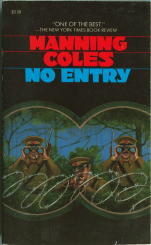
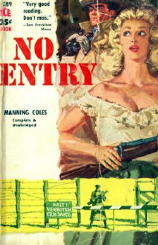
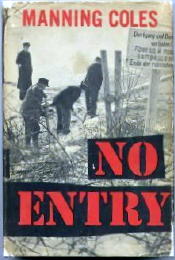
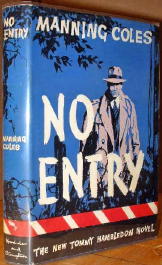
MANNING COLES – No Entry

Carroll & Graf, paperback reprint; 1st pr., November 1985. Hardcover editions: Hodder & Stoughton (UK), 1958; Doubleday (Crime Club), June 1958. Hardcover reprint: Mystery Guild [book club], July 1958. Contained in Five Spy Novels, Howard Haycraft, ed., Doubleday, Oct 1962. Other paperback edition: Ace D-389, no date stated [1959].

No Entry

   I imagine that if you know anything about Manning Coles the author, you may already know that there never was a Manning Coles. The semi-jovial spy thrillers that appeared under his name were actually written by two friends and neighbors in England, Cyril Henry Coles (1899-1965) and Adelaide Frances Oke Manning (1891-1959), all but a few of them starring the steadfast British agent, Tommy Hambledon.

   Some of this information came from Tom and Enid Schantz’s introduction to the four ghost novels that Manning Coles also wrote (appearing under the byline Francis Gaite in England) and which the Schantzes have reprinted as part of their highly recommended Rue Morgue line of books. But according to Tom and Enid, Cyril Henry Coles wrote the last three Hambledon books after his collaborator died, but Hubin’s Crime Fiction IV lists only the last two as having been written by Coles and without Manning:

      Search for a Sultan [by Cyril Henry Coles & Tom Hammerton]. Hodder, 1961, hc; Doubleday, 1961.
      The House at Pluck’s Gutter [by Cyril Henry Coles & Tom Hammerton]. Hodder, 1963, hc; Pyramid, 1968.

   Question: Was the previous book [Crime in Concrete (Hodder, 1960, hc). U.S. title: Concrete Crime. Doubleday, 1960] written by C. H. Coles alone or with another collaborator?

No Entry

   No matter how it works out, this places No Entry as either the last or next-to-last in Manning’s tenure, and unfortunately it’s not one of the better one in the series. If you don’t start with the first two, Drink to Yesterday (Doubleday, 1940) and A Toast to Tomorrow (Doubleday, 1941), preferably in that order, then any of the other immediate post-war books will do. In No Entry, however, decidedly a Cold War novel, the two authors seem to have run out of steam.

   It’s not entirely a book not worth your time, but the minute the young naive son of a British diplomat unwittingly crosses the border from West Germany to East, and Hambledon arrives to see what he can do about the situation, you know that he’s going to find a way across the nearly impenetrable border, and make his way back out again.

   None the less, Coles – from now on “Coles” will refer to Coles the pair – has a beautifully laid-back way with dialogue that I can’t describe better than that, but which tickles my fancy every time I read one of their books. Take, for example, the following passage occurring early on, on page 20, after Hambledon finds a body in his hotel room. (Nothing like starting a story with a quick bracer to the spine like this.)

    Hambledon nodded. “He is still there. The reason for disturbing you at this unreasonable hour was to ask you to be so good as to have him removed.”

    “But he – is he being held – what did he say – who is he?”

    “I don’t know who he is except that he is not George Micklejohn, and he said nothing. He is quite dead, mein Herr, of a bullet through the head.”

    “Dead,” said the Chief of Police, rising to his feet and pressing a bell on his desk, “dead, in your room –”

    “Without being unduly squeamish,” said Tommy Hambledon, “I dislike corpses in my bedroom. Disconcerting. Unhygienic.”

   Here’s another relatively long quote that will tell you some more about the complications that occur in the story as it goes along. From page 66, as the man driving Hambledon around the area next to the border says:

No Entry

    “I have told the Herr all I know, I think. It is all vague, nobody knows anything definitely, and one whispers stories from one to another, they are not very reliable, the Herr knows? Some plans were stolen, it is said, the Russian army by an officer, and this young Englishman had them. He was captured and escaped again. The Russians were still looking for him yesterday so he must be in hiding somewhere but nobody knows where. If anyone were hiding him they would not talk, naturally.”

    “I suppose not. No.”

   When Hambledon finally does cross the border, it is in a old automobile constructed of various makes and models, and he adds some gunk to the engine to make it misfire uncontrollably, belching black smoke and threatening almost to explode if one were to look at in a threatening manner. Which is a huge amount of fun to read until you (the reader) realize that there really is no point to such a matter of calling so much attention to oneself, if you are in enemy territory under false pretenses and with high hopes of retreating back across the border with another person with you.

    Does such behavior make you less suspicious? Does it draw attention away from you and more toward the automobile? What sort of agent would behave in such a fashion, he must not be an agent, perhaps? I’m the one supplying the possibilities. Coles does not. The uproar goes on, stops, and with or without it, the story seems to continue as it would have, either way.

   And while things do not go smoothly, naturally, crossing the border back again still seems all too easy. (I am discussing matters of plot importance that I would not generally do, but as it is clear from the beginning, as I pointed out before, that this is what the story is going to be, in essence, and what is going to happen, I do not believe that I am being unwise in doing so.)

   Coles seems to be very familiar with the area in which the story takes place, which adds immensely to the pleasure provided by say, the first two-thirds of the book. The final third is where the letdown occurs, and even so, it doesn’t make this a bad book, only one that’s disappointing in a way that suggests that it might have been better.

No Entry

PostScript: I’ve never really had a solid picture in my mind of what Tommy Hambledon looks like. If I think of the various “Tommy”s that I know, none of them, I do not believe, resemble Mr. Hambledon. As I was reading, therefore, I made notes of any mention of his physical appearance that Coles provided, and perhaps it was deliberate, but there were not many:

      Page 19. “broad shoulders”
      Page 91. “blue eyes”
      Page 129. “he was not a tall man”
      Page 165. “… slipped like a prowling cat”

   And that’s it. I haven’t tried to look elsewhere, online or in any of the other Manning Coles books I have. I’ll allow you to tell me more, if you can?

–June 2004

   The following observation and question was posted by Vince Keenan as one of several comments following my review of Donald Westlake’s Pity Him Afterwards. Since I don’t have an answer, nor can I find a website that says anything relevant, I decided to make a separate blog entry of it.   — Steve


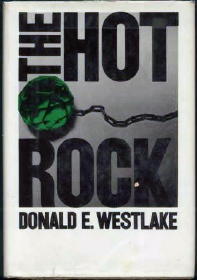
   I recently reread Westlake’s The Hot Rock for the first time in ages and was struck by the fact that Grofield makes an appearance. One of the members of Dortmunder’s crew, Alan Greenwood, is forced to change his last name after he’s arrested. We learn in the book’s penultimate chapter that he’s now Alan Grofield.

    Grofield had already been established in the Parker series as well as his own books at this point. So is this a belated origin story, as they say in the comics field?

–Vince


[UPDATE]  Later the same evening. I don’t know anything more about Greenwood / Grofield than I did earlier today, but I did some surfing and came up with the following somewhat relevant information. First of all, first editions of The Hot Rock in dust jacket (1970) are starting to get pricey. You can pick up Fair ex-library copies for $15, but be prepared to spend in the low three-figure range for one in VG condition.

The Hot Rock

Even copies of the first printing Pocket paperback are hard to find, although not expensive. The cover image below is taken from a later Canadian printing.

The Hot Rock

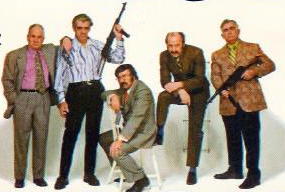
There was a movie made of the book, and do you know, I had completely forgotten that it was Robert Redford who played Dortmunder. His brother-in-law, Andrew Kelp, is played by George Segal in the 1972 movie. Others in the gang are Ron Liebman as Stan Murch, and Paul Sand as Alan Greenberg. The image below was taken from the laserdisc version.

The Hot Rock [Laser]

As for Paul Sand, it was surprising difficult to find a photo of him. The one below came from the classic extravaganza TV series, Supertrain (1979). Too bad it’s a few years too late to be useful, but so far, it’s the best I have.

Supertrain

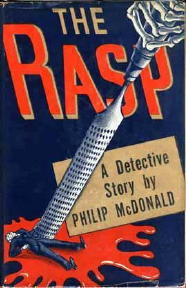
PHILIP MacDONALD – The Rasp

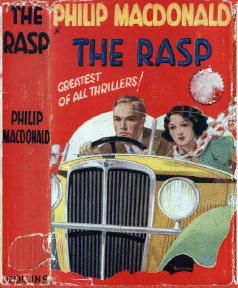
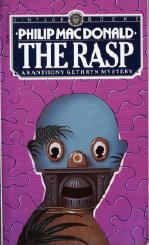
British hardcover: Collins, 1924 (see photo). US hardcover: Dial Press, 1925. Hardcover reprints (US): Scribner’s (S.S.Van Dine Detective Library), 1929; Mason Publishing Co., 1936 (see photo). Contained in Three for Midnight (with Murder Gone Mad and The Rynox Murder), Nelson Doubleday, 1962. Paperback reprints (US): Penguin #586, 1946; Avon G1257, 1965; Avon (Classic Crime Collection) PN268, 1970; Dover, 1979; Vintage, June 1984 (see photo); Carroll & Graf, 1984.

   There was a British film based on the novel that came out in 1932, and Philip MacDonald also wrote the screenplay. According to IMDB, the featured players that appeared in the movie were Claude Horton (as Anthony Gethryn), Phyllis Loring (Lucia Masterson), C.M. Hallard (Sir Arthur Coates), James Raglan (Alan Deacon), Thomas Weguelin (Inspector Boyd), Carol Coombe (Dora Masterson) and Leonard Brett (Jimmy Masterson). If you think you’d like to see this on DVD sometime soon, so would I, and so would a lot of other people. This is a “lost” film, with no known copies in existence.

   I hadn’t realized it before this, but MacDonald was involved in a good number of other movies, all as author of the original story, as screenwriter, or — as also with Rynox, also made in 1932 — both. I’ll go into some of the other fare at some other time, but the good news for Rynox is that after also having been lost for 40 years, it turned out to only have been misplaced. A print was discovered in 1990 after 50 years in the Pinewood Studios vaults, acquired by the National Film Archive and transferred onto safety film. Is it on DVD yet? Probably not, but maybe?

The Rasp

   As for the book itself, now that my usual opening digression is over, a nice copy of the British first in jacket will set you back, I am sure, a figure in the low four-digit range. If all you care to do is to find a copy to read, you shouldn’t have to pay more than three or four dollars. Although I have several other editions, the one I just read was the 1984 edition from Vintage Books, and as far as the story’s concerned, there was still plenty of value left.

   As a Haycraft-Queen Cornerstone title, there may be more value from historical perspective than there is from a pure story point of view, although I was certainly entertained all of the way through. On the other hand, most readers of contemporary detective fiction will probably not get all that far into it, if they even pick it up in the first place.

    This was MacDonald’s first book. It was therefore also obviously the debut of his long-time detective character, Colonel Anthony Gethryn. Gethryn’s career started fast, with ten recorded cases between 1924 and 1933, then one in 1938, followed by a long gap until The List of Adrian Messenger came out in 1960. (There may have been some shorter fiction that appeared in the interim, but during the war years, there was very little if anything that MacDonald produced in the way of mystery fiction.)

    To most mystery readers day — to return to the thought I was having a paragraph or so before — a book that was written in 1924 is going to appear as a period piece, stodgy, if not out-and-out primitive. The “rules” of detective fiction were still being formalized — what constituted “fair play” and all that goes with it. This comment does not apply to thrillers, for which authors had other objectives.

   Working largely without a “Watson” to bounce his ideas off of, Gethryn notices a lot of things but often keeps them to himself, or at least the significance of them, which helps to explain the necessity of the entirely remarkable 46 page letter that Gethryn writes to the police afterward, laying out in immaculate detail all of his thought processes as he worked his way through the case.

    Let me repeat that. Forty-six pages. Is there a denouement longer than this to be found in any other work of detective fiction?

The Rasp

    Dead, you may (at last) be interested in knowing, is a noted member of the government. A cabinet minister, in fact, a fellow named John Hoode. The murder weapon is the titular woodworking tool. The place, the study in Hoode’s country residence. The suspects are primarily the few friends, relatives, staff and servants who were also in attendance that fateful evening, as Gethryn soon eliminates The Woman in the case, to his relief, for he has become madly infatuated with her. She is Mrs. Lucia Lemesurier, a widow — her previous husband apparently being eliminated in the movie version — as soon as he meets her it is with an all-but adolescent passion that renders him near speechless in her presence.

    Accused by the C.I.D. is Hoode’s secretary, Alan Deacon, to whom all of the evidence seems to point. This includes the most damning: his and only his fingerprints were found on the woodmaking murder weapon. There is a good summation of the facts against Deacon on page 121. Gethryn demurs, however, and reassures the gentleman’s lady friend that all shall be well.

    Another detective writer’s creation is mentioned on page 43, where Gethryn declaims somewhat unhappily:

    “And I feel as futile as if I were Sherlock Holmes trying to solve a case of Lecoq’s.” He put a hand to his head. “There’s something about this room that’s haunting me! What is the damned thing? Boyd, there’s something wrong about this blasted place, I tell you!”

   For the most part, however, Gethryn putters about most happily, this game of investigation invigorating him no end, ending days of malaise after his return from the war (the first one). Most of Chapter Two is a mini-biography of Anthony Ruthven Gethryn, for those who would like to know more, but in essence he is the well-to-do bored genius, who needs the incentive of a murder to be solved to be at ease with himself.

   At least that’s his persona in this, his first appearance. Whether, like Ellery Queen, he changed over the years, at the moment I cannot tell you. Perhaps you can tell me.

PostScript: I found another quote that I intended to include, and I didn’t. I can’t find an appropriate place to put it now, without interrupting whatever train of thought I was riding at a particular juncture, so I’ll put it here. What this seems to do is reinforce several of the ideas I was working on, especially toward the end of what I was saying. From pages 111-112, with Gethryn visiting Lucia in her drawing room:

    For a moment his eyes closed. Behind the lids there arose a picture of her face — a picture strangely more clear than any given by actual sight.

    “You,” said Lucia, “ought to be asleep. Yes, you ought! Not tiring yourself out to make conversation for a hysterical woman that can’t keep her emotions under control.”

    “The closing of the eyes,” Anthony said, opening them, “merely indicates that the great detective is what we call thrashing out a knotty problem. He always closes his eyes you know. He couldn’t do anything with ’em open.”

    She smiled. “I’m afraid I don’t believe you, you know. I think you’ve simply done so much to-day that you’re simply tired out.”

    “Really, I assure you, no. We never sleep until a case is finished. Never.”

PostScript #2. I really do not know what to make of the cover of the paperback edition that I read.

The Rasp

— May 2005


UPDATE [06-02-07]  I’ve belatedly decided to include a list of all of the Gethryn novels. UK editions only, but the US titles are given if they were changed. Taken from Crime Fiction IV, by Allen J. Hubin:

* The Rasp (n.) Collins 1924 [England]
* The White Crow (n.) Collins 1928 [England]
* The Link (n.) Collins 1930 [England]
* The Noose (n.) Collins 1930 [London]
* The Choice (n.) Collins 1931 [England] US: The Polferry Riddle
* The Wraith (n.) Collins 1931 [England; 1920]
* The Crime Conductor (n.) Collins 1932 [London]
* The Maze (n.) Collins 1932 [London] US: Persons Unknown
* Rope to Spare (n.) Collins 1932 [England]
* Death on My Left (n.) Collins 1933 [England]
* The Nursemaid Who Disappeared (n.) Collins 1938 [London]
* The List of Adrian Messenger (n.) Jenkins 1960 [London]

JOHN SPAIN – The Evil Star

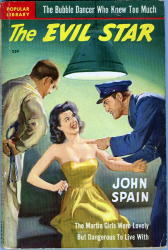
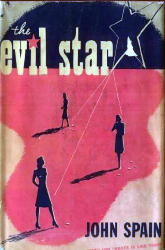
Popular Library 239, paperback reprint; no date stated [1950]. First Edition: E. P. Dutton, hardcover; April 1944. Digest paperback reprint: Detective Novel Classic #44 [date?]. Magazine appearance: Thrilling Mystery Novel Magazine, Spring 1945.

   The detective in charge of the case that develops in The Evil Star is Lt. Steve McCord, a member of the Los Angeles Police Department, Homicide Detail. Cleve F. Adams, noted pulp fiction writer who wrote a tidy sum of hardcover novels as well, wrote three novels as by John Spain. The other two featured a private eye named Bill Rye.

The Evil Star

   The link will take you to Kevin Burton Smith’s Thrilling Detective website, where you will, if you wish, learn more about a couple of other PI’s, one named Rex McBride (five novels), the other John J. Shannon (two books). From Adam’s pulp days but no stories in book-length form, Kevin also has an entry for Violet McDade & Nevada Alvarado, two very early fictional private eyes in the overall scheme of things (seven novelettes in Clues Detective Magazine between 1935 and 1937).

    Since these detectives are fairly well-documented, there’s no need for me to do so, which means all the more space to discuss the book at hand. (The rundown in the paragraph above does not include all of Adams’s novels, however. Perhaps I’ll get back to some of the rest of his fiction sometime soon.)

    This is a complicated case, and I won’t even begin to try to spell anything out for you. What’s sort of unique, though, is that there are not twins involved, but triplets. Three young women named Faith, Hope and Charity, and while they live far apart and separate lives, they for some reason all turn up in LA at the same time.

   Charity is a school teacher, in town for a national convention of school supervisors.

    Faith is a secretary and traveling companion of an elderly woman named Gretchen Van Dorn, who is also wealthy and the owner of the Ayvil Star, said to have a curse on it. (We’ve heard that story before.)

   Hope is another story altogether. She’s a bubble dancer from San Francisco who disappears from police headquarters after being brought in bruised and without her memory. She may be involved, it turns out, with the killing of a crooked LA public works commissioner named Welles up in San Francisco.

   If you were to put some of the pieces of the puzzle from here, as meager as I’ve left the details, some of them, I’m sure, would fall right into place.

    I might mention two other matters, though. First, there seems to be a leak in the LAPD, and McCord might be the person responsible, so most of the time he’s working on the case unofficially and on leave from the department. Secondly, and the reason he stays working on the case, is that he quickly falls for one of the sisters, and Charity in particular. Solidly and with a loud thud. So solidly that he cannot believe his good fortune, thinking that she might vanish like a piece of fog or mist in his hand. It colors his thinking, but so do various konks on the head and the killing of at least one good friend on the force.

The Evil Star

    The end result is a hard-boiled case combined with a semi-screwy caper that has aspirations of being a detective story, with an ending definitely not from Agatha Christie. From page 157 (of 159):

   — [the killer, name omitted] sighed gustily, lifted [his/her] gun at McCord, hesitated for one brief fatal second. In that second McCord shot [him/her] squarely in the mouth.

   This never happened in a Christie novel, or did it? I haven’t read all of hers, and some of the endings in her books may have been equally tough, in a purely figurative sense, mind you. You tell me.

   But to get back to John Spain’s book, it all turns out well in the end. Just in case you were wondering.

— March 2007

   Melville Davisson Post was born in 1869 and died in 1930, and is considered by some to be America’s Greatest Mystery Writer. He is best known for his primary series character, Virginia backwoodsman Uncle Abner, who with great religious and moral rectitude solved crimes during the presidency of Thomas Jefferson.

   Lesser known are two other characters, Randolph Mason, a lawyer in the 1890s who advises his clients on how to commit crimes and avoid punishment; and the detective of note in the book reviewed below, Sir Henry Marquis. “In the far corners of the earth and in the most intimately known places the reader travels. In delightful suspense he follows the destinies of singers, hoboes, mock priests, beautiful creoles, sinister hunchbacks, and German officers to their inevitable climax.”

   And with that brief introduction, Mary Reed will take it from here.

– Steve


MELVILLE DAVISSON POST – The Sleuth of St. James’s Square

D. Appleton & Co., New York & London, hardcover, 1920.

   The sleuth who lives in a large house in St. James’s Square, London, is Sir Henry Marquis, head of the Criminal Investigation Department of Scotland Yard. He also owns a country mansion and a villa on the French Riviera and internal evidence suggests he was educated at Rugby’s famous public school and Oxford University. He previously ran the English secret service in the India-Burma border area and had also been busy in unspecified places in Asia, although there is reason to suppose he is familiar with Mongolia. Sir Henry belongs to the Empire Club in Piccadilly and apparently goes to the opera now and then.

   He is enthusiastic about scientific methods for solving crimes, mentioning dactyloscopic (fingerprint) bureaus and photographie mitrique in particular, but also laments lack of “intuitive impulse” in the men under his command. However, not all the cases in this collection of short stories are solved by deduction or even intuitive impulse, and indeed one or two end in triumph for those on the wrong side of the law. Oddly enough, although Sir Henry is the titular sleuth, in some stories he is not directly involved and in a couple he is referred to only in passing.

   Shall we begin?

Sleuth of St. James's Square

   “The Thing On The Hearth” is blamed for the death of Mr Rodman, a scientist who invented a process to make precious gems. He is found dead in a locked room guarded by an Oriental servant and his death involves what appears to be a visitor from … somewhere else. Sir Henry visit Rodman’s New England mansion to investigate the matter.

   In the next tale, Sir Henry has been looking over the memoirs of Captain Walker, head of the US Secret Service. In their ensuing discussion Walker tells him the tale of an inebriate hobo, who, when everyone else had failed, was instrumental in locating a number of stolen plates for war bonds, thus earning “The Reward.”

   The following adventure involves a large sum of money Madame Barras is foolishly carrying on an unaccompanied two mile journey through the forest lying between the home of an old school friend and the village hotel in which madame is staying. Sir Henry is also a hotel guest and helps search for “The Lost Lady.”

   The titled parents of a young man fighting at the front in France are extremely distressed. His fiancee has been staying out half the night motoring all over the landscape with Mr Meadows, and even admits to having deliberately picked him up! But when Mr Meadows obligingly gives a lift to Sir Henry, who is on his way to investigate a murder, footprints from “The Cambered Foot,” not to mention other clews, turn out to be not at all what they seem.

   In the next story, an Englishman, an American, and an Italian are *not* sitting in a bar but rather are chatting about the justice systems of their respective countries at Sir Henry’s villa. The Italian count relates how it was legally possible for “The Man In The Green Hat,” proved without a shadow of doubt to have been guilty of premeditated murder, to escape the death penalty.

   Sir Henry owns a diary kept by the daughter of his ancestor Mr Pendleton, a justice of the peace in colonial Virginia. The diary describes cases in which Pendleton was involved and this one concerns dissolute Lucian Morrow’s wish to buy a beautiful Hispanic girl from Mr Zindorf, whose ownership of her is dubious to say the least. However “The Wrong Sign” turns out to be right for saving the innocent.

   Another Pendleton story follows. Peyton Marshall’s will favouring Englishman Anthony Gosford has gone missing, and it transpires Marshall’s son has hidden it for what appears to be good reason. But can the lad’s unsupported claims be proved, allowing him to inherit what his father promised him? “The Fortune Teller” will reveal the answer.

   The next tale relates a third case involving Sir Henry’s ancestor. Pendleton meets a girl wandering about in despair. This is not surprising given her uncle, with whom she had been living, has just kicked her out of his house after informing her that her father was a rogue who robbed him and absconded. “The Hole In The Mahogany Panel” bears mute witness to the truth.

   After the war is over, the traitoress Lady Muriel is in desperate financial straits as she can no longer sell British secrets. She overhears a conversation that ultimately leads to her to commit murder in order to steal an explorer’s watercolour of, and map showing the route to, a lake in the French Congo where treasure lies at “The End Of The Road.”

   In “The Last Adventure” explorer Charlie Taylor has been trying to find the ancient route of gold-bearing caravans crossing Mongolia in order to salvage the precious metal from those that foundered. After he returns to America with only a few months to live, his friend Barclay undertakes to sell Taylor’s map to the location of a heap o’ gold to Nute Hardman, a man who had previously cheated Taylor.

   Continuing onward, jewel dealer Douglas Hargrave meets Sir Henry at their London club. Sir Henry is puzzling over an advertisement run in papers in three European capitals, trying to deduce what “The American Horses” represent in an obviously coded message. Then Hargrave meets a lady who wants to buy a large lot of valuable gems from a Rumanian who demands payment in cash….

   Lisa Lewis, American Ambassadoress, relates next a curious tale at a dinner party at Sir Henry’s house. “The Dominion Railroad Company” has experienced a number of terrible accidents and fears numerous reports alleging negligence will lead to its bankruptcy. Yet despite all possible precautions the Montreal Express derails because of “The Spread Rails.” Lisa’s friend Marion Warfield, who has revised a highly praised textbook on circumstantial evidence, solves the mystery.

   At the same dinner party Sir Henry describes the case of the hardhearted lawyer who demands more money to represent a butler on trial for murdering his employer. The money cannot be found and the accused’s wife wanders the streets in despair. A wealthy opera singer takes pity on her, treats her to a meal, and listens to her story. Is she a fairy godmother in the modern equivalent of “The Pumpkin Coach,” and can she help the man on trial?

   In the case following, Miss Carstair is having doubts about her marriage to diplomat Lord Eckhart despite her fiance’s gift of a stunning ruby necklace, for she is extremely troubled by gossip he is the worst ne’er do well in London. While she is pondering the matter Dr Tsan-Sgam, who has been dining with Sir Henry, arrives with news of the death of her father in the Gobi Desert, ultimately learning of its connection to “The Yellow Flower.”

   Up next, a post-war story narrated next by a weekend guest at Sir Henry’s country house. Sir Henry reveals the true story of an incident on a hospital ship boarded by Prussian submarine commander Plutonberg. Wounded St Alban defies him with the fighting words “Don’t threaten, fire if you like!”, becoming an instant hero to the British. But there’s a lot more to it than that, and a situation as bitter as the rolling waves is revealed in “A Satire of the Sea.”

   In the final yarn, the uncle of narrator Robin tries to put him off visiting him, but the envelope in which the letter arrives has a hastily scrawled appeal to ignore the contents and come to The House By The Loch. Will his uncle’s labours to cast a perfect Buddha ever be successful? Who is the highlander sitting knitting while talking about the Ten Commandments and taking a great deal of interest in the movements of Robin’s uncle?

   My verdict: A first rate collection with several stories having a O. Henryesque twist or two and catching the reader by surprise. My favourites were “The Last Adventure,” a wonderful biter-bit yarn, and “A Satire of the Sea,” with its psychological underpinnings. An author’s note for “The Man In The Green Hat” cites a specific case and readers may like to know it was heard by the West Virginia Supreme Court of Appeals in 1913.

    Etext: http://onlinebooks.library.upenn.edu/

         Mary R

http://home.epix.net/~maywrite/


Original story appearances [taken from Crime Fiction IV, by Allen J. Hubin] —

* American Horses • ss The Saturday Evening Post Dec 23 1916
* The Cambered Foot [“The Man from America”] • ss Ladies Home Journal Nov 1916
* The End of the Road • ss Hearst’s Magazine Nov 1921
* The Fortune Teller • ss Red Book Magazine Aug 1918
* The Hole in the Mahogany Panel • ss Ladies Home Journal Apr 1916
* The House by the Loch • ss Hearst’s Magazine May 1920
* The Last Adventure • ss Hearst’s Magazine Sep 1921
* The Lost Lady • ss McCall’s Jun 1920
* The Man in the Green Hat • ss The Saturday Evening Post Feb 27 1915
* The Pumpkin Coach • ss Hearst’s Magazine Oct 1916
* The Reward [“Five Thousand Dollars Reward”] • ss The Saturday Evening Post Feb 15 1919
* A Satire of the Sea • ss Hearst’s Magazine Feb 1918
* The Spread Rails • ss Hearst’s Magazine Jan 1916
* The Thing on the Hearth • ss Red Book Magazine May 1919
* The Wrong Sign [“The Witness of the Earth”] • ss Hearst’s Magazine Apr 1916; with added material.
* The Yellow Flower • ss Pictorial Review Oct 1919

« Previous PageNext Page »