Science Fiction & Fantasy


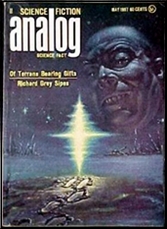
ANALOG SCIENCE FICTION May 1967. Editor: John W. Campbell. Cover art: Kelly Freas. Overall rating: ***

RICHARD GREY SIPES “Of Terrans Bearing Gifts.” Novelette. Quite predictable Analog story of warlike planet defeated by traders from Earth, bringing psionic inventions, especially so since the story begins with the ending. Adequate but annoying. (2)

CHRISTOPHER ANVIL “Experts in the Field.” Another Analog type – bringing in an outsider to solve a problem. This time, that of a culture without a spoken language. (3)

BOB SHAW “Burden of Proof.” Slow glass (*) has another possible use: evidence in a court of law. Excellent idea; good development here. (4)

MIKE HODOUS “Dead End.” Earthmen trick a planet of centaurs into accepting a false FTL drive, Too much scientific terminology thrown around. (2)

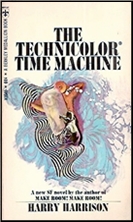
HARRY HARRISON “The Time-Machined Saga.” Serial; part 3 of 3. See review of complete novel soon.

– March 1968


(*) From an online website: “Slow glass was an amusing scientific toy. Light traveled through it so slowly that, looking through a pane of it, you might see what had happened five minutes ago on the other side — or five years.”

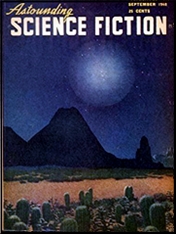
ASTOUNDING SCIENCE FICTION. September 1948. Editor: John W. Campbell, Jr. Cover artist: Chesley Bonestell.  Overall rating: ***

GEORGE O. SMITH “The Catspaw.” Novella. Two people are given conflicting information about a possible space-drive in their dreams. Tom Barden is given knowledge of the necessary science; Edith Ward is warned by an opposing faction that the drive is unstable and dangerous. Are they guinea pigs? The plot line is cleverly worked out, but the scientific jargon can be skipped. (4)

PETER PHILLIPS “Dreams Are Sacred.” A sports writer is sent into the dreams of an overworked fantasy writer to bring him back to reality. Excellent except for lack of an effective ending. (4)

RENE LAFAYETTE “The Great Air Monopoly.” Novelette. Ole Doc Methuselah stops over on a planet where one man has control of the only drugs useful against hay fever, and the machinery to keep ragweed circulating. Not much of a story and indifferently told. (1)

MACK CHAPMAN LEA “The Gorgons.” The natives on an uncharted planet were friendly, but their mental screens came down at night. (3)

JOHN D. MacDONALD “Dance of a New World.” A recruiter for a projected colony and a dancer in a tavern on Venus go to that world together. (2)

ARTHUR C. CLARKE “Inheritance.” Realistic story of the first space probes, by a man and his son. Point not clear. (2)

– March 1968

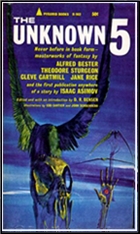
D. R. BENSEN, Editor – The Unknown Five. Pyramid R-962, paperback original; 1st printing, January 1964. Cover art by John Schoenherr.

   A collection of five stories in all, four of them reprinted from the pages of Unknown, plus one by Isaac Asimov which was accepted for publication shortly before that magazine folded, but never actually having appeared in print in it before it did. Strange to say, that one is also the weakest of the five. But even knowing that the other four were chosen from the best of the magazine, the only restriction being the stories never having been published in book form before, Unknown well deserves its reputation among fantasy fans.   Overall rating: ****

ISAAC ASIMOV “Author, Author!” Novelette. In which author Graham Dorn’s famous detective Reginald de Metzter comes to life and demands his say in future plots. Too slaphappy and hectic rather than truly funny.  (2)

CLEVE CARTMILL “The Bargain.” (From Unknown Worlds, August 1942.) Death gives immortality to a woman in exchange for information the world should not have. The “folksy” approach entertains.  (4)

THEODORE STURGEON & JAMES H. BEARD “The Hag Saleen.” (From Unknown Worlds, December 1942). A man and his wife and daughter living in a small cabin in the bayous arouse the anger of a swamp witch. Besides the basic background, the story’s excellence depends on balance between fantasy and the explainable.  (5)

ALFRED BESTER “Hell Is Forever.” (From Unknown Worlds, August 1942,) Short novel. Five degenerate people, in the search for newer and stranger sensations, enter into a bargain giving them their choice of realities. Their new worlds are not what they expect, however:
   An artist can create only in his own distorted image. A woman wishing the strength to kill her husband finds that strength only in an unhappy extension of herself. An imaginative man find truth only in hell, or is it heaven?  A woman without love becomes the Consort of a God. A logical man finds he cannot kill himself — for they are all dead already.
   The meaning of hell is twisted to suit each personality, resulting in a story that should be analyzed more deeply and thoroughly to reveal all its implications.  *****

JANE RICE “The Crest of the Wave.” (From Unknown Fantasy Fiction, June 1941.) A St. Louis gambler is tossed from a bridge, but his drowned body revenges his death. Extremely picturesque language adds to a rather average ghost story. (3)

– March 1968

ALGIS BUDRYS – The Iron Thorn. Serialized in If Science Fiction, January-April 1967, the latter issue of which was reviewed here. Published in book form as The Amsirs and the Iron Thorn (Gold Medal d1852, paperback original, 1967; cover art by Frank Frazetta).

   On a cold desert planet, later discovered to be Mars, two races live – men, and the Amsirs they hunt. Both colonies surround Thorn, metal towers which provide air and warmth within a small radius.

   Honor Jackson discovers that the Amsirs are intelligent, not vicious, and allows himself to be captured. In the Amsir settlement, he fins a spaceship and eventually the truth behind the experimental genetic colonization of Mars. Returning to Earth, he finds civilization has become sterile and the experiment forgotten.

   Three of the installments [in If SF] are exciting and well done, but the fourth is a distinct disappointment. Maybe Budrys has a point to make, but it doesn’t come through. Flat. Of characterization, the cybernetic spaceship and its robot doctor seemed the most real, and it was from the time of their destruction immediately upon bringing Jackson to Earth that the story faded fast.

   Jackson himself is sympathetically portrayed. Rugged and individualistic enough to escape Mars, but one wonders how he shall fare on the Earth of the future.

Rating: ****

–February 1968

JOHN D. MacDONALD “Ring Around the Redhead.” First published in Startling Stories, November 1948. First reprinted in Science-Fiction Adventures in Dimension, edited by Groff Conklin (Vanguard Press, hardcover, 1953). First collected in Other Times, Other Worlds (Fawcett Gold Medal, paperback original, October 1978).

   I don’t imagine that any young SF reader coming across this story in the (at the time) most recent issue of Startling Stories had any idea that the author would become rich and famous a few years later as the John D. MacDonald you and I know today as, for example, the author of the series of mystery novels for which he is most remembered, thous about “salvage expert” Travis McGee.

   Nor did, I suppose, those fans of the Travis McGee books happen to know that he started out writing SF stories — as well as mysteries — for the pulp magazines of the late 1940s. I don’t know if all of his early SF work were later collected in Other Times, Other Worlds (1978), but there are sixteen of them, and ones MacDonald much have felt worth reprinting at the time.

   â€œRing Around the Redhead” is, well, one of them, and it begins with a defendant in court having been accused of murdering his next door neighbor, and in a most vicious fashion: the dead man had been decapitated as if by a mammoth pair of tin snips. When the defendant, an amateur tinkerer, gets to tell his story to the jury, it really is quite a story. Having strangely discovered a mysterious ring in his workshop in the basement, he learns by trial and error that by reaching through it, he can bring back, among other items, valuable jewels, for example. (This is why he is seen arguing with the neighbor, who has discovered this.)

   One day, then, he brings a beautiful girl back through the ring, a redhead, who is wearing next to nothing but strangely still something.

   Hence the title of the story, which has no other objective than to be fun and amusing. No deep scientific principles are discussed in this tale. What this tale reminded me of, more than anything else, are the SF stories very common back in the early 30s, based on speculation but not a whole lot of down-to-earth physics – but, in this case, a tale that’s a whole lot better written.

   Nonetheless, without a solid background in science, JDM must have decided that science fiction was not a field where he had much of a future. Considering how things worked out for him, this was a wise choice.

ROCKET STORIES. July 1953. Vol. 1, No. 2. Edited by Wade Kaempfert [Lester del Rey]. Cover: Schomberg. Overall rating: 1½ stars.

ALGIS BUDRYS “Blood on My Jets.” Complete novel. Detached Operator Ash Holcomb of the SBI is hired to fly the first ship into hyperspace, but as old friend and his iwfe, known since Academy days, plot to steal it from him. Not much of a story, but it reads well enough. (2)

GEORGE O. SMITH “Home Is the Spaceman.” An experimental FTL ship is stopped by a policeman for speeding. (2)

MILTON LESSER “Picnic.” A husband, wife, and two brats stop on a living asteroid for a picnic. (0)

POUL ANDERSON “The Temple of Earth.” Novelette. Civilization on the Moon is headed downhill unless the priests and their knowledge of science can take over. Too much fighting. (2)

BEN SMITH “Sequel.” The paths of three former Academy students meet in space. (3)

CHARLES E. FRITCH “Breathe There a Man.” Rebellion on an Earth where the very air is taxed. The first plot twist really didn’t seem believable. (1)

IRVING COX, JR. “To the Sons of Tomorrow.” Novelette. The crew of a wrecked spaceship become the gods of a new Earth. Distortion of proper names didn’t help. (2)

WILLIAM SCARFF “Firegod.” A fair point to be made, but a basic flaw ruins story of a man playing god. [Pen name of Algis Budrys.] (1)

–February 1968

EDMUND COOPER – All Fools’ Day. Berkley X1469, US, paperback, 1967. Cover art by Hoot von Zitzewitz. Previously published in the UK by Hodder & Stoughton, hardcover, 1966, and in the US by Walker, hardcover, 1966.

   Beginning in 1971, solar radiation cause the world’s suicide rate to increase sharply. Ten years later, only the Transnormals are still alive – the creative, the fanatic, and the crazy [have] inherit[ed] the Earth. The book follows the life of Greville, a former advertising executive, in this new world as he searches for love, purpose, and direction.

   Perhaps written for a wider audience than the usual SF one, the story loses impact simply because of the overuse of its theme, particularly by [British] writers. Frustrating in its deliberate irrationality, the civilization of this savage world seems doomed, but Greville forms the basis of a new world from a group of anarchists.

   The sudden optimism of the ending comes as a relief from the previously established tone, but it is not altogether satisfying. One point of disagreement: mathematicians are among the first to die (page 17), symbolizing [the loss] of normality and supreme stability, but mathematicians can be as crazy as anyone.

Rating: ****½

–February 1968

GALAXY SF, April 1967. Editor: Frederik Pohl. Cover artist: [Douglas] Chaffee. Overall rating: ***½.

KEITH LAUMER “Thunderhead.” Novelette. A lieutenant of the Fleet Navy, who has manned his planetary post for twenty years, though it is clear that he has been forgotten, receives a message at last. In response, he climbs to the mountaintop beacon and sets a diversion for a fleeing enemy. Deliberately sentimental, the story is obvious from the beginning, but still succeeds. (4)

ROBIN SCOTT “Fair Test.” Aliens consider a segregated Earth. (2)

CHRISTOPHER ANVIL “The New Member.” Bangolia joins the UN and immediately becomes a pest to everyone. Humorous. (2)

JAMES McKIMMEY “The Young Priests of Adytum 199.” The childish survivors of the war do not tolerate deviation from their norm. (5)

HOWARD HAYDEN “The Purpose of Life.” Novella. Dr. West, in telepathic control of Mao III, precipitates a crisis that buries hem and fifty Esks 4000 feet below Peking. The Esks multiply furiously, threatening the food supply, and a tunnel to the surface must be dug. The discovery and fulfillment of the purpose of the Esks on Earth is rather anticlimactic. Immortal life after death requires the death of billions. Dr. West dies too. ***½

[Note: This was number seven of eight stories Hayden wrote about the Esks. These were indigenous Canadian Inuits transformed by an Alien presence into an apparently benign, fast-breeding new species called Esks. (From the online SF Encyclopedia.)]

PIERS ANTHONY “Within the Cloud.” Clouds have a sense of humor also. (3)

KRIS NEVILLE “Ballenger’s People.” Burt Ballenger operates as a nation, as a democracy. (3)

HARRY HARRISON “You Men of Violence.” A mutation of homo spaiens develops, one unable to kill. At least, actively. (3)

–February 1968

IF SCIENCE FICTION – January 1954. Editor: James L. Quinn. Cover art: Ken Fagg. Overall rating: **½ stars.

EVAN HUNTER “Malice in Wonderland.” Short novel. The world of the future is bizarrely (and accurately?) portrayed as the arena of conflict between the Vikes, or vicarious pleasure-seekers, and the Rees, or realists. Van Brant, agent of authors of pabacks and sensos, is caught in that conflict as the Ree reaction takes over. The ending comes a bit too fast, and the background seems a little shallow, but a very good effort. (4)

ALAN E. NOURSE “Letter of the Law.” A planet of logical liars comes up against the expected paradox. (1)

HARRY HARRISON “Navy Day.” The Navy, about to be abolished, fights back. (0)

JAMES E. GUNN “A Word for Freedom.” An analogy is made between narrowness of language and encroachments upon individual freedoms. (2)

RICHARD WILSON “Double Take.” A young man has difficulty separating reality from filmed fantasy. (2)

DAMON KNIGHT “Anachron.” A time-machine enables a man to steal treasures from the future but becomes too ambitious. (3)

MACK REYNOLDS “Off Course.” A collector for the Carthis zoo is mistaken for an envoy. (1)

–February 1968

JOHN JAKES – When the Star Kings Die. Dragonard #1. Ace G-656, paperback original, 1967. Cover by Jack Gaughan. Second printing, 1978.

   When Max Dragonard, ex-Regulator, is broken out of prison by his old commander, he is assigned to investigate the revolutionary organization called Heart Flag. The Lords of the Exchange, rulers of II Galaxy and previously immortal, are dying, and no one seems to know why. Dragonard is captured by the High Commander of the Regulators and betrays his friend.

   At the command of Lord Mishubi II, he is sentenced to die. Escape to the Heart Flag movement reveals to him the secret of immortality which has been kept from the ordinary people of the galaxy.

   Quite better than expected, the story improves as it continues. One can hardly help but think of the old Planet Stories tradition, but it would seem that there is more complexity and development in this novel than the usual stereotyped space-adventure.

   Dragonard’s own mental defect, correction of which was denied him, helps persuade him of the Lords’ treachery, a nice touch. The girl he loves is killed under bitter circumstances, but there is another who is waiting for his love. And Jeremy’s dream of life for all must be destroyed, but only temporarily, to free the galaxy from one man’s control.

Rating: ***½

–February 1968

         The Dragonard series –

1 When the Star Kings Die (1967)
2 The Planet Wizard (1969)
3 Tonight We Steal the Stars (1969)

« Previous PageNext Page »