Science Fiction & Fantasy


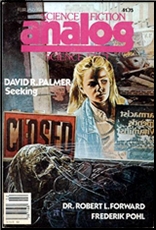
FREDERIK POHL “Servant of the People.” First published in Analog SF, February 1983. Collected in Midas World (St, Martin’s Press, hardcover, 1983) and Platinum Pohl (Tor, hardcover, 2003). Reprinted in The Best Science Fiction of the Year #13, edited by Terry Carr (Baen, paperback, August 1984). Nominated for a Hugo for Best Short Story, 1984.

   Sometime in the near future, standing at a point in time circa 1983, a US Congressman, having served in that role for over twenty terms, begins his campaign for yet another election cycle. Although it is becoming harder, he enjoys campaigning, meeting people, kissing babies, endless meals out at greasy diners, the whole bit.

   To his mind, his greatest achievement is having been instrumental in passing a law allowing robots to vote, even those coming fresh off the assembly line.

   Imagine his loving wife’s consternation, then, when they discover his newest opponent is … a robot itself.

   Given this basic premise, I have a feeling that everyone reading this will have their ow ideas of how the story should take place from here. And I also suspect it won’t be very much different from the one I imagined it would be, which in turn was awfully close to the one that SF Grand Master Frederik Pohl wrote.

   Speaking for myself only, the story Pohl wrote is yards better than anything I might have come up with. While not up there at, say a Hemingway level, Pohl was a master of crisp clear prose with a keen visionary and often sardonic  eye on what the future might bring for this country, if not the entire world.

   The only thing wrong with this tale, from my point of view is the premise. Passing a law in this country that would allow robots to vote? No way, no how.

   This is a theoretical exercise only. A “what if” proposition carried to a logical conclusion, and of course, there’s nothing wrong with that. To my mind, it’s precisely what serious science fiction is/was designed to do.

Rating: B plus
   

PostScript: I read this in Terry Carr’s Best of the Year anthology for 1983, published exactly forty years ago. That’s a nice round number. I will have to wait and see, but at the moment I’m planning to  continue working my way through it and reporting back here as I go. Don’t change that dial!

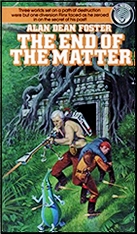
ALAN DEAN FOSTER – The End of the Matter. Pip & Flinx #4.Del Ray, paperback original; 1st printing, November 1977. Cover art by Darrell Sweet. Multiple later printings.

   In this, the fourth adventure in a long-running series (18 novels and a handful of short stories), the orphaned young man nicknamed Flinx continues his search for his parents – or, well, just his father now; although she is now dead, he has learned who his mother was in the book immediately preceding this one. Pip, by the way, is a minidrag (flying snake) who accompanies him, wrapped around his neck, wherever he goes.

   And since Flinx has his own spaceship (!), he can go wherever a casual hint suggests he go, even with members of a cult of black-clad assassins hard on his trail. Along the way he picks up other companions, some of whom do not survive. One that does is a blue four-eyed, four-armed, four-legged alien who speaks only gibberish in verse.

   There is more at stake than finding Flinx’s father, though. A whole section of the known universe is at risk of being swallowed up by a rogue collapsar, unless Flinx and his friends can avoid his enemies long enough to find the ancient weapon, now lost, that can stop it.

   I don’t think I will spoil anything by telling you that that is exactly what they do, with enough knowledge of theoretical astrophysics on their side, The fun is getting there, in good old-fashioned Edgar Rice Burroughs style, mixed with more than a dash of Edmond Hamilton, in his early “world wrecker” days.

   This is pure out-and-out space opera, in other words, but written in a wholly literate fashion by an author who knows what adventure is all about, when you have the whole universe at your disposal to set your stories in.

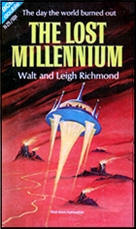
WALT & LEIGH RICHMOND – The Lost Millennium. Ace Double H-19, paperback original; 1st printing, 1967. Published back-to-back with The Road to the Rim, by A. Bertram Chandler (reviewed here). Reprinted as Siva! (Ace, paperback, May 1969.

   Shades of Velikovsky! (And to be sure, there he is, on page 18.) An archaeologist tells an engineer, about to complete construction of a solar tap, the story of how a previous civilization had developed the same technology and destroyed the Earth, or Atalama, of that time. Explained in the course of the story are most of the bases of Judaism, Hinduism, and mythologies from around the world, complete with present-day flying saucers.

   The scientific background would satisfy Analog‘s standards, but its heresy would prohibit its publication even there. There is no story; only a means for presenting a theory. In this form, however, it only makes it harder for serious work to be proposed, if any. A garbled mess. And what are the transposers, first introduced on page 93? Who are the mysterious people returning to Earth? What is going on?

Rating:  *

– March 1968
REVIEWED BY DAVID VINEYARD:


VARGO STATTEN – Ultra Spectrum. Scion, UK, paperback, 1952. Also currently available in ebook form.

   The din of the storm was so overwhelming the two men could hardly hear each other’s shouts as they worked with determined energy atop the three-hundred-foot high electric pylon.

   
   So much for setting. Our protagonist, he’s no hero, is Sidney Cassels, and he and Jim Prescott are on the giant pylon trying to keep the whole thing from collapsing in a terrible storm. Jim is getting a bit nervous too, not about the storm, though.

   There is a strange look in Sid’s eye, and could it possibly have something to do with their rivalry for the girl Mary Carson waiting below with their boss Fred Ashworth?

   â€œYou may not believe me,” Sid said bitterly, drawing himself up so that his face was close enough to Jim Prescott’s for him to hear the words, “but I’ve been waiting for a chance like this for months! We’re up here alone, Jim — undisturbed! An accident would be considered the most natural thing in the world!”

   Jim Prescott felt instinctively for the wrench in his belt. “What the hell are you talking about, man?”

   â€œI’m talking about Mary.”

   And Jim takes the three hundred foot drop as they watch helpless below, unable to see Sid pushed him, the perfect murder until Sid is struck by lightning.

   This novel being Science Fiction in the mode of a Thirties B monster movie this does not take the paperback original Gold Medal thriller path you may be expecting, though what happens next is in its own way as hardboiled as anything from its American cousins.

   Sid wakes up and in pretty good shape, no one suspecting he might have murdered Jim, save for one thing, soon after he starts to glow. He doesn’t just glow, he can produce a pretty good charge, and without heat, cold light, the dream of energy without heat loss.

   Sid is no benefactor to mankind, and while he is trying to figure out what to do with this gift, he makes a few mistakes. The first and biggest is he tells Mary.

   And Mary, who could have sailed out of any Gold Medal novel as the fatal femme with an eye for herself, promptly sells Sid out to his ambitious boss, not that you can really blame her after Sid lights up.

   In surprise he glanced down, and then gave a start. Though the twilight had now deepened to near-night he could see his hands! Not actually as hands, but as dim red outlines, glowing as a slightly heated poker glows in a dark room.

   â€œWhat the devil—!” he ejaculated, jumping up and staring at his fingers. “What’s happened to them?”

   â€œYour face is the same!” Mary cried, horrified. “It’s — it’s awful!”

   A girl, certainly one no better than Mary, has a reason to think of herself. She tells Fred Ashworth Sidney’s manager and his doctor, Billings, tells his big boss, Denham Roberts, the President of the International Power and Light Combine.

   And they would kind of like to know how Sid generates that heat, and not for the betterment of mankind or Sid.

   Sid ends up kidnapped and held prisoner, probed and prodded and measured, and when they have discovered the secret of cold light they send Sid off to be killed and his body dumped deep in a deserted mine shaft.

   Sid’s a tough lad though. He kills the hitman and he keeps himself hidden in a small village while he waits to see what happens.

   Meanwhile Roberts has invested in cold light, International Power and Light now selling cold lamps provided to people’s home and flooding the market.

   The moment is ripe and Sid slips back, but he doesn’t reveal himself. He’s discovered he can infect people with a mild case of what he has, so he sneaks around and quietly does so, just enough that stock in International Power and Light is falling and Scotland Yard in the person of Inspector Hodge is poking around.

   Now Sid shows up with his little extortion plan. Cut him 75% of International Power and Light stock and he’ll clear the cold light lamps of suspicion.

   Roberts doesn’t go for that, and Sid isn’t the forgiving type. He does go back to Mary, but time has passed, she has married, and as she tells him while she may be a the kind of a woman who will cheat on a guy for money she isn’t a murderer. Soon he is on the run and captured by Hodge, who, unable to risk touching Sid, outwits him and drops a rope on him hauling him to jail before they untie him.

   But Sid is still the key to cold light, and if he will cooperate …

   Not our boy Sid, and from there the book rushes to its fairly obvious conclusion.

   As Hodge sums it up, “Let’s get a rope round him. He was due for a rope, anyway.”

   Vargo Statten was British pulp writer John Russell Fearn, best known for his long running Science Fiction superwoman super science Golden Amazon saga. After a parting of the ways with his American pulp magazine publishers over payment in 1943, Fearn took up Crime and Westerns as well as SF in Britain and made a success of it under his own name and numerous pseudonyms (he was already Polton Cross and Thornton Ayre in the States). Vargo Statten was successful enough as a pseudonym it even got its own pulp. Some have suggested it was a shared pseudonym, but all the books as by Statten are Fearn. Volstead Gribdan was a shared pseudonym he, E. C. Tubb, and others used.

   Ultra Spectrum was one of the later Vargo Statten books that had begun to share the interest in crime reflected in his mystery and crime books.

   Frankly, as a science fiction concept cold light doesn’t really support a book this long (most of the Vargo Statten “novels” run roughly 35,000 to 45,000 words), at best its an episode of The Outer Limits or a low budget SF monster movie. There is no real character development, no growth. Everyone is exactly what they are when you meet them and no better or worse when it ends. The writing is good but nothing better, and while it is a compelling read, it is all empty mental calories.

   I enjoyed it enough. Fearn was a gifted storyteller, but for all the moving around and action nothing happens to anyone you care enough about to be involved with. Sid isn’t even so bad you are cheering for him to get what he deserves.

   He was alive, he killed a guy, he got hit by lightning, he glowed in the dark, he got screwed over by a few people, he tried to take revenge but wasn’t as smart as he thought, and he ended badly.

   You could make art out of that. Others have, pretty good art too.

   Fearn doesn’t bother.

   I suspect you probably won’t either.

A. BERTRAM CHANDLER – The Road to the Rim. Ace Double H-29, paperback original, 1967 (**). Cover art by Jerome Podwil. Previously serialized in If Science Fiction, April-May, 1967. Collected in To the Galactic Rim (Baen, trade paperback, 2011; mass market paperback, 2012).

   Chronologically, the first “Rim Worlds” story, or at least the first featuring John Grimes. Here he is Ensign Grimes of the Space Survey Service, newly commissioned and incredibly naive. While on passage to his assigned base, he joins a merchant ship captain on an illegal mission of revenge.

   The purser, Jane Pentecost, likely influences his decision, but piracy, after all, cannot be condoned. Afterward, the captain and Jane must leave for the Rim, but Grimes is partially exonerated by their success in destroying the attackers. Since it had already been written, we know there is more to come.

   Not a complete novel as far as development is concerned. An episode, though an important one, in the life of Grimes. Characterization is flat and unreal, changing too much, too abruptly. Grimes worries about his motivations but lets the action and events carry him on.

Rating: **½

NOTE: The version serialized in If SF is identical except for the partial deletion of a scene with Jane in a detention cell.

(**) The novel on the reverse side of the Ace Double paperback, The Lost Millennium, by Walt and Leigh Richmond will be reviewed here soon.

– March 1968

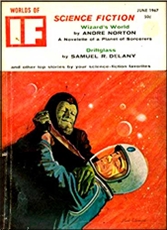
IF SCIENCE FICTION, May 1967. Editor: Frederik Pohl. Cover art: Jack Gaughan. Overall rating: ***½ stars.

KEITH LAUMER “Spaceman!” Serial, part 1 of 3. To be reviewed after the July issue.

TERRY CARR “The Robots Are Here.” Novelette. Robots from the future are busily blocking alternate time tracks in the interest of man. Pleasant, but short and hence inconsequential. (3)

CHARLES W. RUNYON “The Youth Addicts.” Novelette. An attempt to enter the dream memories of a friend’s wife ends in a very strange love triangle., Derivative, but a slightly new twist. (4)

H. H. HOLLIS. Novelette. “The Long, Slow Orbits.” Novelette. A man and woman operate an “underground railroad” for maltreated cyborgs, or “coggers.” Analog to Black situation clear but not pushed. Can anyone be imprisoned in a Klein bottle? (3)

B. K. FILER “The Hole.” First story. Fossils are being destroyed – to hide the secret of the formation of intelligent life on Earth. (4)

A. BERTRAM CHANDLER. “The Road to the Rim.” Serial, Part 2 of 2. To be reported on soon.

– March 1968

SAMUEL R. DELANY – The Einstein Intersection. Ace F-427, paperback original; 1st printing, March 1967. Many reprint editions exist, but the Bantam paperback of April 1981 is the first US edition that includes a chapter missing from the Ace paperback original. Cover art by Jack Gaughan.

   In a new Earth, peopled with new inhabitants, Lo Lobey leaves his village and travels to find Friza, to return her to life. He meets various characters: Kid Death, Spider, Green-eye, and the Dove.

   Symbolic garbage, trailing off to meaninglessness. Some people might be impressed by this; not I. Read the back cover and forget the rest.

Rating: **½

– March 1968


[UPDATE.] The Einstein Intersection won the Nebula voting for 1968, and came in second for the Hugo award.

THOMAS M. DISCH “Voices of the Kill.” First published in Full Spectrum, edited by Lou Aronica & Shawna McCarthy (Bantam Spectra, paperback original, September 1988). Reprinted in The Year’s Best Fantasy: Second Annual Collection, edited by Ellen Datlow & Terri Windling (St. Martin’s Press, trade paperback, 1989). Collected in The Wall of America (Tachyon, softcover, 2008).

   Thomas M. Disch was an author almost as well-known for his poetry as he was for his unique blend of science fiction and fantasy. While “Voices of the Kill” is a fantasy tale through and through, it is poetry as well, and in a way as opaque to me as most poetry is.

   It is the story of a man who, living alone in a cabin along a stream, falls in love (of sorts) with the flowing water, or (perhaps better said) is seduced by the stream, lying at night as he does in its waters and soothing embrace, listening to it talk to him.

   I do not know why Nixie asks him to place a twenty dollar bill under a stone in its (her?) depths. When William’s cousin Barry comes to visit, the overnight stays in the stream must end. When the two travel down it to its outlet into the sea, Nixie is annoyed.

   And what is the significance of the black woman in a pea-green swimsuit who is playing there with her son on the beach? (She does return.)

   In spite of these and other questions I cannot answer, the effect of this story is one I cannot get out of my head. Good poetry (and fantasy) can have an amazing effect on one’s mind. It is no wonder this was the lead story in the Full Spectrum anthology where it first appeared.

WORLDS OF TOMORROW – May 1967. Editor: Frederik Pohl. Cover artist: [Douglas] Chaffee. Overall rating: ***½.

FRED SABERHAGEN “Stone Man.” Novelette. One planet in the universe is such that time is a variable capable of physical control. The berserkers’ attempt to destroy life there takes them back to the time of the first colonists so that the race can be exterminated at once. Very human story of conflict and life in wartime. (4)

      ADDED UPDATE: Taken from Wikipedia:

   â€œThe Berserker series is a series of space opera science fiction short stories and novels [begun in 1963] by Fred Saberhagen, in which robotic self-replicating machines strive to destroy all life.

   “These Berserkers, named after the human berserker warriors of Norse legend, are doomsday weapons left over from an interstellar war between two races of extraterrestrials…”

DOUGLAS R. MASON “Squared Out with Poplars.” A mad scientist uses human brains for his computers. A strange excuse for a love story. (2)

DAVID A. KYLE “Base Ten.” Novelette. A missing little finger keeps a man marooned in space for eighteen years. A different story of “first contact.” (5)

SIMON TULLY “Whose Brother Is My Sister?” Novelette. Alien scientists combine with those of Earth to prove a theoretical relationship between space and time. Their efforts to stop time do not succeed entirely, as the flow of time is simply reversed. The alien culture is superbly created. (4)

MACK REYNOLDS “The Throwaway Age.” Novelette. A spy who thinks of the enemy as “commies” is assigned to infiltrate a new group concerned with the waste of America’s resource and man-power. Reynolds has good points, but tells a poor story. (3)

– March 1968

HARRY HARRISON – The Time-Machined Saga. Serialized in Analog SF, March-May, 1967. Published in book form as The Technicolor® Time Machine (Doubleday, hardcover, 1967; Berkley, paperback, 1968).

   A movie company finances the construction of an inventor’s time machine, they choose only to make another filmed epic. This time with authentic background, however, with certain alterations in the Hollywood tradition.

   Going back to the 11th century, they turn their cameras on the historic Viking expedition to North America. But it is their efforts in promoting the recreated voyage that produces the original – a neat circle in time.

   Beginning almost as slapstick, the story gradually settles down to a gentle tongue-in-cheek adventure in time, with nothing else to recommend it. The ending is obvious; something else is hoped for. Actually enjoyable once expectation are lowered.

Rating: ***½

– March 1968

« Previous PageNext Page »