Crime Fiction IV


   It was just over a month ago — on September 18th, to be precise — that I announced that Part 19 of the Addenda to the Revised Crime Fiction IV, by Allen J. Hubin, was online.

   But new data has continued to flow in — it never seems to even slow down — and Part 20 was uploaded this morning. In WordPerfect format, this installment was a mere 29 pages long.

   Most of the information consists of added (or corrected) years of birth and/or death, but a sizable chunk of what otherwise is new you will already have seen (I hope) in Victor Berch’s checklist of Tip Top Detective Tales. See the previous post on this blog.

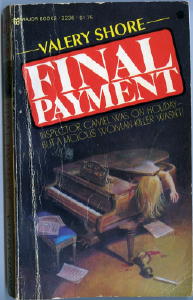
Valery Shore

   Also in Part 20, but rather hidden so that you might not notice it without my pointing it out, is that we have recently learned that the mystery novel, Final Payment, by “Valery Shore,” reviewed here several months ago, was not the sole work of Lon Viser, as until now has always been assumed.

   A comment left by Lon Viser’s son, and confirmed by a separate email from the wife of another son, apparently sent independently of each other, says that the book was written by — well, I’ll allow Ed Viser to tell it:

    “I can certainly remember when Yvonne Beltzer, Rhoda Luczon (my mother) and my Dad, Lon Viser wrote this book. The name Valery Shore came from the magazine my parents started Valley & Shore Magazine, later named by the owners Valley Magazine (San Fernando Valley), a sort of Sunset Magazine for the L.A. suburbs. He also wrote several books under other pen names.”

   Last week on his blog, Pulpetti, Juri Nummelin discussed the career of Gold Medal paperback writer Frank Castle, prompted by his (Juri’s) discovery of one of Castle’s books that was published in Finland but never in this country.

   This turns out, as Juri explains, not to have been an uncommon event. Several other American authors apparently had some of their books published in Finnish but never in English, including Dean Owen, Bruce Cassiday and Robert Sidney Bowen. Here’s the cover of the Castle book, the title of which, roughly translated, means “The Sowers of the Doom.”

Frank Castle: Sowers of Doom

   If you’re interested, Juri does the obliging thing and translates the first few paragraphs back into English.

   The post prompted several comments about Castle’s career, and just a few minutes ago, I chipped in with the following:

   Not much seems to be known about Frank Castle. You and the other commenters seem to have covered almost everything he did, unless you count his role as The Punisher for Marvel Comics beginning sometime around 1974. But maybe that was a different Frank Castle. And like the comic book guy, maybe our Frank Castle wasn’t his real name either.

   For his mystery fiction, here’s what appears in Al Hubin’s Crime Fiction IV:

   FRANK CASTLE. Born in New Mexico; graduate of University of Oklahoma; magazine and book writer. Pseudonym: Steve Thurman.
      Move Along, Stranger (n.) Gold Medal 1954
      Dead–and Kicking (n.) Gold Medal 1956 [California]

Dead and Kicking

      The Violent Hours (n.) Gold Medal 1956 [Los Angeles, CA]

The Violent Hours

      Lovely and Lethal (n.) Gold Medal 1957 [California]

Lovely and Lethal

      Murder in Red (n.) Gold Medal 1957 [New Mexico]

Murder in Red

      Vengeance Under Law (n.) Gold Medal 1957 [New Mexico; Past]
      Hawaiian Eye (n.) Dell 1962 [Hawaii]

Murder in Red

   STEVE THURMAN
      Night After Night (n.) Monarch 1959 [Ship]

Steve Thurman

      “Mad Dog” Coll (n.) Monarch 1961 [New York City, NY; 1932] Novelization of film: Columbia, 1961.

      I haven’t put together a list of the westerns Castle wrote under both names, but at a quick glance, he may have written more of those than he did crime novels. (And I’ve only realized this just now, but there’s at least one book overlap between his western novels and the crime fiction that’s already been listed.)

      I’ve read some of his Gold Medals, but since that was when they first came out, I couldn’t tell you anything about them. I do remember a few of the covers, though. (See above.)

   The death of Denny Martin Flinn, a rather unique contributor to the realm of detective fiction, does not seem to have been widely noted in the world of mystery fandom. The fact appears in Part 19 of the Addenda of the Revised Crime Fiction IV, which I’m working on now. Otherwise only Jiro Kimura’s Gumshoe Site seems to have mentioned it.

   Obituaries have appeared in several entertainment-oriented news sources, however, including Variety and Broadway World. A man of talent in many fields, Mr. Flynn died of complications of cancer on August 24th of this year. He was 59.

   Here are his credits in CFIV, by Allen J. Hubin, slightly updated and amended. I’ll get back to the books in a minute.

      FLINN, DENNY MARTIN (1947- 2007)
           San Francisco Kills (Bantam, 1991, pb)  [Spencer Holmes; San Francisco, CA]
           Killer Finish (Bantam, 1991, pb)  [Spencer Holmes; San Francisco, CA]

   But first, here are some of Mr. Flinn’s non-mystery writing accomplishments. For more information on any of these, you may follow the links above.

   ● He performed on Broadway in Sugar and the revivals of Pal Joey and the Pearl Bailey company of Hello, Dolly!

   ● He choreographed Charles Strouse’s off-Broadway musical Six and he restaged Sugar for its West Coast premiere.

   ● As a performer, he appeared in the national companies of Fiddler on the Roof, starring Jan Peerce and Theodore Bikel as well as two-and-a-half years in one of the national tours of A Chorus Line.

   ● Flinn wrote and directed the musical Groucho, starring Lewis J. Stadlen, which played off-Broadway and toured the country for two years.

   ● As a writer, his first book was What They Did for Love, the story of the making of the Broadway musical A Chorus Line.

   ● He co-authored with Nicholas Meyer the screenplay for Star Trek VI: The Undiscovered Country.

      THE MYSTERY NOVELS:

San Francisco Kills. Bantam, pb, January 1991.

San Francisco Kills

      From the front cover:    “He bears the family name and has a talent for detection. Just call him Holmes … Spencer Holmes.”

      From the back cover:   … If there be any here present who knows just cause why they may not be lawfully be joined in marriage, I require him now make it known …

   Following the priest’s request, a shot rang out and the groom fell dead.

   What kind of killer was clever enough to get away with murder in front of hundreds of witnesses? That is just the sort of question that appeals to Spencer Holmes, a San Francisco detective who has inherited a fascination for foul play, a talent for deduction, good looks, and hoards of money from his illustrious grandfather, the immortal super sleuth Sherlock Holmes.

   In a case as complicated as they come, Spencer Holmes, assisted by his inscrutable companion, Sowhat Dihje, must use his formidable intelligence to follow a faint trail that leads from the mansions of the well-to-do into the not-so-distant past – to ferret out a remakable affair of friendship, love … and murder.

Killer Finish. Bantam, pb, August 1991.

Killer Finish

   From the front cover:   “When it comes to solving crimes, he was born to it. … He’s Spencer Holmes, San Francisco sleuth.”

   From the back cover:    “It does appear that the Great Gandolfo has suffered an irreversible mistake in an otherwise well-conducted act!”

   And in this case, appearances were not deceiving. The Great Gandolfo was run through with his own sword, and it didn’t take a Sherlock Holmes to see that the erstwhile magician had died on stage – literally.

   What it did take was Spencer Holmes, Sherlock’s equally talented grandson, who happened to be attending Gandolfo’s final performance. And what the master sleuth, along with his sidekick, Sowhat Dihje, finds upon investigation, is a twisted trail of colorful suspects, grand illusions, missing persons, and voices from the dead. And that is only the beginning. For in the city by the bay, the mixture of magic and murder is potent – so potent that even the most pedigreed of detectives will be astounded by a … KILLER FINISH.

   In a short author’s biography on the final page of Killer Finish, it was announced that Mr. Flinn was working on a third novel, one called Lady Killer. For whatever reason, it was never published.

   Searching the Internet, it appears that Irene Adler is the lady in question, if you are asking the one I think you are, and on another site it is stated that “Spencer’s mansion in Frisco has a Nero Wolfe Room, which perhaps hints at his parentage, since it has already been well-established that Wolfe is Sherlock Holmes’ son.”

   On page 14 of San Francisco Kills, the plaque attached to the door of Holmes’ mansion door reads:

SPENCER HOLMES
Consulting Detective
2210 Baker Street

which I believe entitles him to be called a Private Detective. One who does not do divorce or “keyhole” work, but one who takes only the cases that intrigue him the most.

   One other site briefly describes the books are humorous pastiches. Here, for example, from page 194 of the same book cited above, is the following passage. Spencer Holmes is speaking to a fellow who has just finished a game of tennis:

    “How was your game today?” Spencer inquired.

    “Fine. And yours?”

    “Afoot.”

    “I don’t think I understand.”

    “I’m sorry. It is a colloquial expression. Before your time, I think.”

    “Ah.”

  Steve:

Cheap Thrills

   Goodness, it’s been a long time since we’ve encountered each other. I’ll be at Gary Lovisi’s doings next Sunday but you don’t seem to attend them any more. A very handsome new edition of Cheap Thrills came out earlier this year, with color illustrations and reprints of many of the actual letters I gathered when first doing the book many long years ago. My next book is due out in October, entitled Good Girl Art and covering that comic book genre from Sheena to the present.

   As to your blog about the Phantom. Here’s a correction on pennames. I am not now nor never have been Marshall Macao. This attribution is, I think, due to the fact that some chap wrote some sleazy kung fu books and a listmaker mixed them up with the two novelizations of the old Kung Fu TV show I did. Macao was once a Portuguese possession and I am half Portuguese, but that’s the only connection.

   The source of the Frank S. Shawn penname, which I have oft explained to crowds of uninterested fans of mine, is this — I took the name of my wife, Frances and the initial of my younger son, Steffan, and the first name of my older son Sean, and fashioned an alias.

   I actually worked with Falk on these, dropped into his Park Ave. South apartment once, talked to him on the phone quite a bit. The novels were all based on old strip continuities and King Features would send me proofs of whatever strips were being adapted. Of course, with the novels I had to add quite a bit in the way of characters and subplots. And the books were much better written.

Good Girl Art

   Bruce Cassiday also did three of Avon’s Flash Gordon novels back then. I wrote the first three but got tired of dealing with the fellow at King Features, who was a lintpicker (as we used to say in the old days). He complained several times that I was ending chapters in the middle of the page and thus robbing them of several half pages of copy that they were paying for.

   I got the Phantom job originally because Falk, who didn’t keep up with things, had offered it to Alfred Bester, a friend of mine. Bester had ghosted Falk’s strip for a while during WWII and gone on to write The Demolished Man, etc. Knowing nothing of this, Falk assumed he’d be available for the assignment.

   Working with Falk was no problem. One of the few things he told me not to do was mention the color of the Phantom’s costume. At the time it was purple in America, but red and brown in other countries.

   Keep in touch.

Best,

      Ron Goulart


>> Alas, I won’t be at Gary’s paperback show once again this year. It’s next Sunday, but I go to Michigan every Columbus Day weekend to visit my sister, and my brother comes over from London Ontario for a short family get-together. Something had to give, and Gary’s show will go on, but without me, I’m sorry to say.

   Thanks for your comments on working with Lee Falk, though, and I’ll pass the word along to Al Hubin to delete your Marshall Macao reference. Question: You did two of the four novelizations of the Kung Fu TV series. None of the books (as by Howard Lee) are in Crime Fiction IV. I remember the series, and in fact have the first season on DVD. Would you say that the books as written have enough crime content that they should be included? My general impression is that they do.

   To everyone who’s planning their Christmas and holiday present list, from spouses, kids, parents, or simply to give yourself, there are a couple of big hints subtly hidden on this page.

— Steve

   I was “processing” a box of hero paperbacks the other day, and along with the Batman and Dick Tracy books (recently covered here) was a nearly complete set of the Avon adventures of comic strip hero, The Phantom. Nominally by Lee Falk, also the creator of Mandrake the Magician, identifying who the true authors really were is a complicated matter, and it has not been well-stated in Al Hubin’s Crime Fiction IV.

   Using the books themselves as a guide, plus information found here and there on the Internet, here’s my attempt to untangle the true ownership of each of the books. Al’s been out of town this week, so my facts, as I’ve put them forth, are still subject to his approval. If you have any information to the contrary for any of the statements below, let me know. I’ve no qualms about correcting errors!

FALK, LEE (HARRISON). 1911-1999. Correction of year of birth. Born Leon Harrison Gross, he took his surname as a young man from the middle name of his stepfather, Albert Falk Epstein. American playwright and theatrical director/producer; best known as the creator of two comic strip heroes, The Phantom and Mandrake the Magician. The following is a complete rewriting of his entry in the (Revised) Crime Fiction IV. Several of the books in the series of Avon paperback originals were written by Falk. The rest were written by other authors; often these authors are named, but with the statement that the books were based on Falk’s original stories. SC in all titles: The Phantom.

      _The Assassins. Written by Carson Bingham, a pseudonym of Bruce Cassiday, qq.v. Avon, pb, 1975.
      The Curse of the Two-Headed Bull. Credited to Carson Bingham, q.v., on the title page, but in an Author’s Note, Falk states that the book was written by him. The attribution to Bingham was a publisher’s error. Avon, pb, 1975.
      _The Goggle-Eyed Pirates. Ghost-written by Ron Goulart, q.v. Avon, pb, 1974. [The name Frank S. Shawn does not appear on the title page.]
      _The Golden Circle. Written by Frank S. Shaw [sic], a pseudonym of Ron Goulart, qq.v. Avon, pb, 1973. Due to a publisher’s error, Goulart’s pen name for the series, Frank S. Shawn, was misspelled.
      _The Hydra Monster. Written by Frank S. Shawn, a pseudonym of Ron Goulart, qq.v. Avon, pb, 1973.
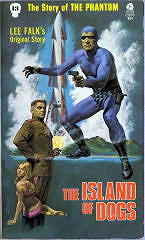
_      The Island of Dogs. Written by Warren Shanahan, q.v. Avon, pb, 1975.
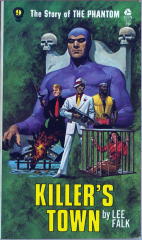
      Killer’s Town. Avon, pb, 1973.

Killer's Town (Lee Falk)

      The Mysterious Ambassador. Avon, pb, 1973.
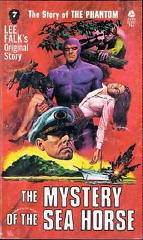
      _The Mystery of the Sea Horse. Written by Frank S. Shawn, a pseudonym of Ron Goulart, qq.v. Avon, pb, 1973.
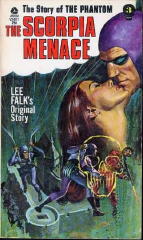
      _The Scorpia Menace. (Corrected spelling.) Written by Basil Copper, q.v. Avon, pb, 1972.
      _The Slave Market of Mucar. Written by Basil Copper, q.v. Avon, pb, 1972.
      The Story of the Phantom. Avon, pb, 1972.
      _The Swamp Rats. Written by Frank S. Shawn, a pseudonym of Ron Goulart, qq.v. Avon, pb, 1974.
      The Vampires and the Witch. Avon, pb, 1974.
      _The Veiled Lady. Written by Frank S. Shawn, a pseudonym of Ron Goulart, qq.v. Avon, pb, 1973.

CASSIDAY, BRUCE. 1920-2005. Add year of death. Pulp writer and editor, radio scriptwriter, and author of many works of crime fiction under his own name and several pseudonyms: Carson Bingham, q.v., Mary Anne Drew, C. K. Fong, Annie Laurie McAllister, Annie Laurie McMurdie & Michael Stratford.

BINGHAM, CARSON. Pseudonym of Bruce Cassiday, 1920-2005, q.v. To three crime novels written by the author under this pen name in the (Revised) Crime Fiction IV, add the following:

      The Assassins. Avon, pb, 1975. Note: This is a book in “The Phantom” series, created by Lee Falk, q.v.
      _The Curse of the Two-Headed Bull. Avon, pb, 1975. A book in “The Phantom” series. Credited to Carson Bingham on the title page, but in an Author’s Note, Lee Falk states that the book was written by him. The attribution to Bingham was a publisher’s error.

COPPER, BASIL. 1924- . Among other works of crime fiction included in the (Revised) Crime Fiction IV are six collections of Solar Pons stories, a character created by August Derleth, and 52 book-length adventures of private eye Mike Faraday. The two entries below are newly added here to the author’s own entry.

      The Scorpia Menace. (Corrected spelling.) Avon, pb, 1972. Note: This is a book in “The Phantom” series, created by Lee Falk, q.v.

The Scorpia Menace

      The Slave Market of Mucar. Avon, pb, 1972. Note: This is a book in “The Phantom” series, created by Lee Falk, q.v.

GOULART, RON(ALD JOSEPH). 1933- . Mystery & science fiction writer as well as a historian of pulps, comic books & comic strips. Add pseudonym: Frank S. Shawn, q.v. Other pseudonyms & house names: Josephine Kains, Chad Calhoun, Marshall Macao, Ian R. Jamieson, Kenneth Robeson & William Shatner. As Shawn, the author of several books in “The Phantom” series created by Lee Falk, q.v.

SHAWN, FRANK S. Add as a pseudonym of Ron(ald Joseph) Goulart, 1933- , q.v. Other pseudonyms & house names: Josephine Kains, Chad Calhoun, Marshall Macao, Ian R. Jamieson, Kenneth Robeson & William Shatner. As Shawn, the author of several books in “The Phantom” series created by Lee Falk, q.v. These are listed below.

      The Goggle-Eyed Pirates. Avon, pb, 1974. [Note: The name Frank S. Shawn does not appear on the title page.]
      The Golden Circle. Avon, pb, 1973. Due to a publisher’s error, the name of the author was misspelled as Frank S. Shaw.
      The Hydra Monster. Avon, pb, 1973.
      The Mystery of the Sea Horse. Avon, pb, 1973.

Mystery of the Sea Horse

      The Swamp Rats. Avon, pb, 1974.
      The Veiled Lady. Avon, pb, 1973.

SHANAHAN, WARREN. Author of one book in “The Phantom” series created by Lee Falk, q.v. The title below, the only one in the author’s entry in the (Revised) Crime Fiction IV, is now directly attributed to him.

      The Island of Dogs. Avon, pb, 1975.

Island of Dogs (The Phantom)


OPEN QUESTION: It is unknown who Warren Shanahan was. He contributed to at least two combat-oriented collections of true stories published by Pyramid (One Against the Enemy, 1963; and Medal of Honor, 1967), but I’ve found no other writing credits for him.

[UPDATE] Later this same evening. On a hunch, I checked out Michael Cook’s Index to the Digest Mystery Magazines, and there was Warren J. Shanahan, author of five stories that appeared in Guilty (2), Trapped (2), and Manhunt (1), all in the 1950s.

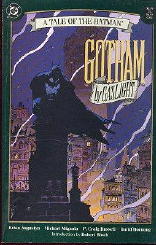
BRIAN AUGUSTYN – Gotham by Gaslight: An Alternative History of the Batman.

DC Comics; graphic novel; 1st printing, 1989. Script: Brian Augustyn; pencils: Michael Mignola; inks: P. Craig Russell. Introduction by Robert Bloch.

   What it is that makes (and establishes) a cultural icon is difficult if completely impossible to predict, but with plenty of hindsight at our command, it is absolutely certain that both the Batman and Jack the Ripper each and individually most definitely are.

   Did they ever meet? Of course not, but on the other hand, why not? This particular graphic novel (or sophisticated comic book, if you prefer, with sturdy cardstock covers, glossy pages and no ads) was not designated with the “Elseworlds” label, but according the various comic sites on the Internet, it was the first, and it was so successful that an entire series of such novels followed.

Gotham by Gaslight

   So what is (or are) Elseworlds? Allow me to quote from the equivalent of the DC handbook: “In Elseworlds, heroes are taken from their usual settings and put into strange times and places – some that have existed, and others that can’t, couldn’t or shouldn’t exist. The result is stories that make characters who are as familiar as yesterday seem as fresh as tomorrow.”

   After Robert Bloch’s introduction, supplied just in case an unwary comic book reader does happen to be unfamiliar with Jack the Ripper – and a nice touch, at that – comes a retelling of the origin of the Batman: the holdup man who guns down Bruce Wayne’s parents before his very eyes; the young lad then devoting his life to take up the cause of justice against criminals and the underworld behind a mask, a costume and a long, free-flowing cape. Except this time it is the late 1880s, and this is not the current Batman at all.

   At the same time as Bruce Wayne is taking up his new career, a horrible slayer of prostitutes in London seems to have made his way to Gotham, a city well-known to comic book readers as the home stomping grounds of the Batman, Inspector Gordon and all of the other characters of current legend (and so it appears) no matter what universe they may happen to be in.

   The coincidence in timing is far too obvious for some, and Bruce Wayne, unable to account for his whereabouts and not being home at night, is first confronted, then arrested and convicted of being the Ripper. In his jail cell, going over the piles of documents, photos and other evidence against him, provided by Gordon, not convinced of his guilt, it is Bruce Wayne the detective that spots the clue that will nail the killer, if only he were not scheduled to be executed for the crimes himself in the morning.

   Truthfully, however, while this certainly qualifies Gotham by Gaslight as an entry in Al Hubin’s Crime Fiction IV – it is not there now, but other Batman graphic novels are – the detection, if not minor, is hardly of the fair play variety. In terms of the reader playing detective him- or herself, this is also mere child’s play, as it were, there being only one other suspect and that being one who only appears in one previous panel.

   The attraction here is the small delights provided by viewing the Batman legend from another perspective in an unexpected context – as if with new eyes – and the delightful art from Mignola and Russell. Grays and blues and browns dominate, as well as exquisite details in Victorian-era architecture, wearing apparel and facial foliage.

   You have to be a Batman fan, perhaps – and if you’re not, it’s sure as shouting that I’m not going to make you one – but if you are, this is a sure-fire classic must-read.

— May 2006


[UPDATE] 09-22-07. I’ve reprinted this review, of course, because of the coverage of the original Batman in the previous post. Other than that, there’s been no attempt to rewrite it to make it more of a followup than this. It’s as I wrote it when it first appeared. But as I suggested, though, this particular book now does appear in the Addenda to the Revised CFIV.

   In his search for completeness in compiling his bibliography of the field, Crime Fiction IV, Al Hubin has cast a wider net than you might have imagined. In this particular blog entry, I offer two cases in point to illustrate this.

   Most observers, for example might not consider Batman as a character whose exploits would be included in CFIV, but indeed they are, and quite extensively too, as long as they appeared in book form, including (more recently) graphic novels. Batman has gone several phases in his nearly 70-year-long career in fighting crime, and you could do no worse than to check out his Wikipedia entry for more information.

   The current incarnation is an crime-obsessed, near-crazed madman with few friends, even among his fellow superheroes. More likeable was the Batman of the early 1950s, which is when he was one of my favorites, my old Golden Age. He never had superpowers, but besides being agile and athletic, neither of which I was, he also solved crimes by the use of his brains, an ability which I could much more easily identify with.

   And of course his never-leave-home-without-it utility belt, one of which I always wished I had. For some reason, though, it never showed up in the yearly Sears Christmas catalog, no matter how hard I looked.

   The entries for Batman in Part 19 of the Addenda are for a series of paperback originals from the 1960s, reprinting some of his adventures from my “Golden Age” of the 1950s.

KANE, BOB. 1916-1998. Noted comic book artist and writer. Add: Born Robert Kahn, he is said to have legally changed his name to Bob Kane at age 18. Note: In at least the three books indicated with a (*) below, Bob Kane is credited only as the creator of Batman as a character. Different writers and artists were in fact largely responsible for the original comic book stories.

   * Batman. Signet, pb, 1966. Add: Collects the following Batman comic book stories, plus introduction:

The Legend of the Batman (Six page introduction: Batman #1, 1940; reprinted from Detective Comics #33, November 1939)
The Crazy Crime Clown! (Batman #74, December 1952-January 1953)
The Crime Predictor (Batman #77, June-July 1953)
Fan-Mail of Danger (Batman #92, June 1955)
The Man Who Could Change Fingerprints! (Batman #82, March 1954)
The Testing of Batman! (Batman #83, April 1954)
The Web of Doom! (Batman #90, March 1955)

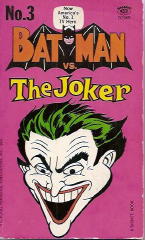
   * Batman vs. The Joker. Signet, pb, 1966. SC: Batman. Collects the following Batman comic book stories. Correction: There are only five, not six stories in this collection.

Batman vs. The Joker

Batman – Clown of Crime! (Batman #85, August 1954)
The Challenge of the Joker (Batman #136, December 1960)
The Joker’s Journal (Detective Comics #193, March 1953)
The Joker’s Millions (Detective Comics #180, February 1952)
The Joker’s Winning Team (Batman #86, September 1954)

   * Batman vs. the Penguin. Signet, pb, 1966. Add: Collects the following Batman comic book stories:

The Golden Eggs (Batman #99, April-May 1956)
The Parasols of Plunder (Batman #70, April-May 1952)
The Penguin’s Fabulous Fowls! (Batman #76, April-May 1953)
The Return of the Penguin (Batman #155, May 1963)
The Sleeping Beauties of Gotham City (Batman #84, June 1954)


   This next character with a mention in Part 19 of the Addenda is more immediately recognizable as a detective, of course, that being Dick Tracy, star of comic strip, radio, TV, and more recently, the big screen. I grew up in a town where Tracy was the front page attraction on the Sunday comics section, but strangely enough, I never followed his adventures. I’m not sure why, but I think I always thought the artwork was a little too crude, the villains too outrageously unbelievable, or a combination of both.

   No matter. Dick Tracy was, and probably still is, the epitome of a good guy, big city cop.

GOULD, CHESTER. 1900-1985. Cartoonist and creator of the long-running Dick Tracy newspaper comic strip. While his entry in the (Revised) Crime Fiction IV includes several other books based on the character, the three paperback originals listed below constitute three books in the “Dick Tracy: His Greatest Cases” series, one requiring a correction and one newly added.

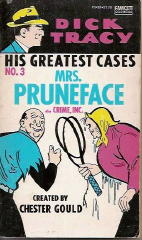
   Add: Mrs. Pruneface plus Crime, Inc. Gold Medal, pb, 1976. SC: Dick Tracy. Two stories in comic strip form.

Dick Tracy

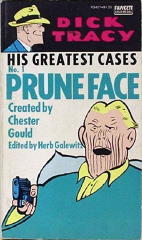
   Pruneface. Gold Medal, pb, 1975. SC: Dick Tracy. Comic strip reprints.

Dick Tracy

   Snowflake and Shaky plus The Black Pearl. Gold Medal, pb, 1975. SC: Dick Tracy. Correction of title; two stories in comic strip form.

   As he does at regular intervals, Al Hubin sent me this morning Part 19 to his ongoing online Addenda to the Revised Edition of Crime Fiction IV, and within minutes (or so) I had it uploaded and ready to read.

   There are no major discoveries in this installment, perhaps none that haven’t already been mentioned in these pages already, but for additions and corrections to the entries for authors ranging from Salar Abdah to A. T. Worden, you might want to take a look.

   This new page is all in plain text, without the annotations I’ve been adding to previous chunks of the Addenda. I’ve recently finished Part 3, for example, on the main page, and I’m about to start merging it into the combined alphabetical sections of Parts 1 and 2.

   Of possible interest are the following entries from Part 12, which indicate a family connection that hadn’t been pointed out before in CFIV:

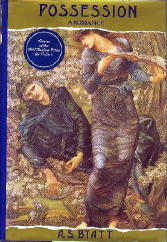
BYATT, A(NTONIA) S(USAN) (née DRABBLE). 1936- . Daughter of J. F. Drabble, 1906-1982, and sister of Margaret Drabble, 1939- , qq.v. Broadcaster, reviewer, editor, prize-winning author. Of several novels, one is included in the (Revised) Crime Fiction IV as having marginal crime content. See below.

    –Possession. Chatto & Windus, UK, hc, 1990; Random House, US, hc, 1990.

Byatt: Possession


DRABBLE, J(OHN) F(REDERICK). 1906-1982. Add year of death. Barrister and county court judge; father of A. S. Byatt, 1936- , and Margaret Drabble, 1939- , qq.v. Author of one book included in the (Revised) Crime Fiction IV. See below.

    Death’s Second Self. Sidgwick & Jackson, UK, hc, 1971. [Described by one online bookseller as “a diabolical crime piece.”]

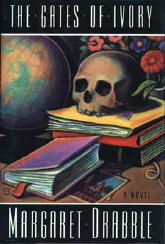
DRABBLE, MARGARET. 1939- . Daughter of J. F. Drabble, 1906-1982, and sister of A. S. Byatt, 1936- , qq.v. Biographer, critic, and prize-winnning author of many works of fiction, including one novel cited in the (Revised) Crime Fiction IV. See below.

    The Gates of Ivory. Viking, UK, hc, 1991; Viking, US, hc, 1992. [A London psychiatrist receives a cryptic package in the mail. Deciphering the message leads her to the chaos and corruption of Southeast Asia.]

The Gates of Ivory


   From the sublime, in terms of status in the literary world, to the less so — and I say this even though the late Mike Avallone was a friend of mine — we have the following entry from Part 18. [Note that this does not constitute the entire body of work for the previously mentioned Mr. Avallone. All that are listed here are the titles requiring additions or changes.]

AVALLONE, MICHAEL (ANGELO, JR.)

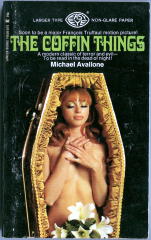
   The Coffin Things. Lancer, pb, 1968. Add setting: NY State (the Adirondacks). Note: According to the front cover, the book was “soon to be a major François Truffaut motion picture.” The movie does not appear to ever have been made.

The Coffin Things


   The Werewolf Walks Tonight. Warner, pb, 1974. #2 in the “Satan Sleuth” series, which relate the occult adventures of Philip St. George, a masked avenger who fights the forces of darkness. Add setting: Tennessee-Kentucky border.

   Note: There were three books that appeared in the Satan Sleuth series. According to one website no longer accessible, Avallone wrote two others that have never been published:

* VAMPIRES WILD (unpublished 1975) Philip St. George combats sorcery and Satanism in cynical Hollywood and comes face to face with the oldest living movie star. Is timeless Lola Vane actually who and what she seems to be? Do vampires really walk again in the modern age?

* ZOMBIE DEPOT (unpublished 1976) Philip St. George travels to Haiti to fight the legendary Baron Samedi, the Man Who Will Not Die. Not even Voodoo can explain the existence of The Python, incredible ringleader of a cult beyond sanity.

   It was well over a year ago that Victor Berch, Bill Pronzini and I put together our annotated bibliography of Dutton’s line of Guilt Edged hardcover mysteries, and luckily we haven’t had to make very many corrections.

   The Guilt Edged line lasted from 1947 to 1956, with the two most highly collectible authors in the group arguably being Mickey Spillane and Fredric Brown. There were lots of unknowns as well, but William Campbell Gault was a Guilt Edged author, and so were Lionel White, Stewart Sterling and Sam S. Taylor.

   If you know all of those names, congratulate yourself. If you know all but the last one, give yourself only half a pat on the back. It was in Sam S. Taylor’s entry in which we recently discovered that we were in error. According to all of the sources we consulted at the time, Taylor was supposed have died in 1958, soon after his last book. Not so, and I’ll get to the correct date in a minute.

   First, though, is Taylor’s complete entry in Crime Fiction IV, by Allen J. Hubin, as it stood until a few weeks ago, slightly edited and expanded.

   TAYLOR, SAM(UEL) S. (1895-1958); see pseudonym Lehi Zane; Radio and film scriptwriter, short story writer. Series Character: Neal Cotten, in all titles.

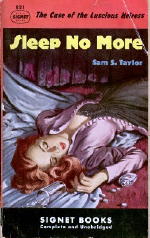
       * Sleep No More. Dutton, hc, 1949. Signet 821, pb, 1950. Boardman, UK, 1951.
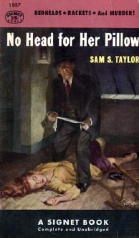
       * No Head for Her Pillow. Dutton, hc, 1952. Signet 1057, pb, 1953. Foulsham, UK, 1954.
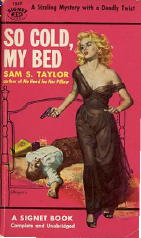
       * So Cold, My Bed. Dutton, hc,1953. Signet 1247, pb, 1955. Foulsham, UK, 1955.

   ZANE, LEHI; pseudonym of Sam(uel) S. Taylor

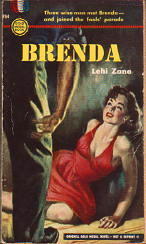
       * Brenda. Gold Medal 264, pbo, 1952. Red Seal, UK, 1957.

   It turns out that both dates for Mr. Taylor were wrong. After reading our first efforts, one of his sons emailed me, stating that his father died in 1994, not 1958. This was enough to go on. Victor then did a search in Social Security records and came up with a Samuel S. Taylor who was born October 11, 1903 and died February 1994 in California.

   Having a ready-made excuse for compiling a compleat profile, we did, and here is the result. Jackets of the hardcovers in the Bill Pronzini collection provided the blurbs and other information. The paperback covers came from various other sources. I still can’t get to my own accumulation of books.

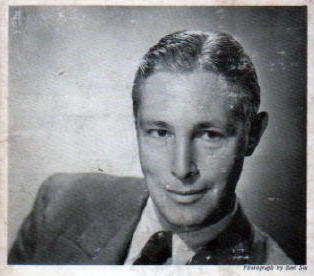
   First a photograph of Mr. Taylor, found on the back cover of his second book, along with a short biography underneath it:

Sam S. Taylor

      ABOUT THE AUTHOR:

   Sam S. Taylor, author of No Head for Her Pillow, is the author of one other mystery story, Sleep No More, published by E. P. Dutton & Company in 1949. Innumerable radio scripts, and a good many magazine stories round out a full writing career.

   Upon receiving a medical discharge from the U. S. Coast Guard in 1943, Mr. Taylor affiliated himself with the Army Signal Corps as expert consultant on training films, where he also wrote many scripts for Army posts.

   His personal interest in crime (from the observer’s seat) stems from that time when, as a member of the New York City special panel of jurors, he was called to serve on the famous Jimmy Hines case, prosecuted by Gov. Thomas E. Dewey.

   When Mr. Taylor first married his beautiful French Canadian bride, she spoke no English; Mr. Taylor now has a French accent after three years of marriage.

   Mr. Taylor makes his home in Tarzana, California, with his wife and baby.

      SLEEP NO MORE.

Sam S. Taylor

   From the hardcover front dust jacket flap:

   Delving into the private life of a luscious copper heiress, especially one with a tangle of soft red hair and a roving eye, was going to be a pleasure

   Or so thought Neal Cotten, head of the brand-new Cotten Bureau of Investigation. That was before a simple case of blackmail developed into a hunt for a desperate killer … a grim hunt that led from a luxurious mansion in Pacific Crest to a shoddy flop-house on Skid Row; from a remote ranch in Nevada to a crooked gambling house in Angel Gardens.

   The chase uncovered a secret rendezvous high up in Clearwater Canyon, a will with some startling changes, a fat bankbook hidden under a filmy negligee, a muscle-bound extra who didn’t go to Reno — and a handsome movie idol who played with fire once too often

   But none of it made sense. Not until Neal took Jennie, the Polish waitress, to see Madame Butterfly … and Jennie innocently gave him the lead that cracked the case wide open.

   A swift-paced tale of homicide and passion, of violence and corruption, set against the vivid background of Los Angeles, Sleep No More will be devoured by mystery fans in one breathless sitting.

Sam S. Taylor

      NO HEAD FOR HER PILLOW.

    From the hardcover front jacket flap:

   It may be an everyday occurrence among artists and art dealers to mutter vindictively, “Oh, I could kill him!” as it is among the brotherhood of almost any other business.

   No Head for Her Pillow has a couple of artists, an art dealer, some racketeers, some newspaper people, and Neal Cotten, director of the Cotten Bureau of Investigation and his own chief operative. It was a good thing for California art circles that Neal was hired by Colonel Millard Baldwin, publisher of the San Vincente Sun, to aid in the Sun‘s campaign against the slot-machine racket in the city.

   It happens that Col. Baldwin’s two daughters, Sharon and Diana, were on intimate terms with the others of the San Vicente art world, one being a painter, the other a sculptress. Diana, the sculptress, appeals mightily to Neal Cotten who sees her as a “king-size dame with a mass of sunset hair.”

   Investigations, of whatever kind, often lead to murder, as well as vice versa, and slot machines sometimes turn up more than merely lemons. The proof of these adages is offered, with dividends, in No Head for Her Pillow, a fast exciting mystery that is almost as tough as a forty-cent steak.

      SO COLD, MY BED.

Sam S. Taylor

    From the hardcover front jacket flap:

   Private eye Neal Cotten has a visit from a beautiful doll who commissions him to trace her aunt, an oldtime actress. Her story sounds phony but she pays cash so he takes the job. His first link to her whereabouts is a thug who offers to sell him information, but the deal is never closed. The thug is murdered.

   Neal stays with it and finds the old actress who spends most of her time in a specially made coffin. Then Neal gets a new client — the governor’s wife, no less, who thinks her stepdaughter is running in bad company. There is a link between the murdered thug and his pals, the beautiful client, the lady in the coffin and the governor’s family, but it is one murder and many near misses later that Neal gets the pitch and solves the case, with a night club singer in distress slowing up the process considerably.

   Sam Taylor is already known for his original and fast-paced mysteries through his earlier books Sleep No More and No Head For Her Pillow. His new one, So Cold, My Bed spells top entertainment for the mystery fan as it again features Neal Cotten, the hard-boiled but likeable private eye who has a way with the ladies and an affinity for easy money and screwy cases.

           BRENDA.

Sam S. Taylor

      From the front cover:

      Three wise men met Brenda — and joined the fools’ parade

      From the back cover:

                BRENDA

   There was the simple, pious valley town.

   And there was luscious, lustful Brenda.

   The hard-handed farmers knew work — and prayer.

   Brenda knew pleasure — and conquest.

   Tragedy rode on the wings of passion when good and evil clashed.


   Sam S. Taylor also published five criminous short stories in the early 50s:

       “Summer is a Bad Time” — Manhunt, October 1953.
       “A Clear Picture” — Manhunt, May 1954.
       “State Line” — Manhunt, September 1954.
       “The General Slept Here” — Manhunt, April 1955 (with Neal Cotten).
       “Dig It, Brother” — The Saint, May 1956.

   This is the second in a series of checklists compiled by Victor Berch of turn-of-last-century authors whose careers consisted largely of novelizing plays having varying degrees of criminous content. The first was Helen Burrell Gibson D’Apery, 1842-1915, who wrote as Olive Harper.

   The author of interest this time around is Grace Miller White, 1868-1957, who wrote an even longer list of such novelizations, as you’ll see in a moment, all within the very narrow time frame of 1901 to 1907.

   After 1907 either the market for such novelizations began to dry up or (equally possible) a severe case of fatigue on Ms. White’s part had set in. According to Al Hubin, she wrote four additional novels worthy of inclusion in his bibliography, Crime Fiction IV, as follows. (The dashes indicate marginal crime content.)

      -From the Valley of the Missing (n.) Watt 1911
      -When Tragedy Grins (n.) Watt 1912 [Paris]
      -The Ghost of Glen George (n.) Macaulay 1925
      The Square Mark [with H. L. Deakin] (n.) Dutton 1930 [Academia]

   At the moment, I know nothing more about Grace Miller White’s life. For a short account of the practice of novelizing plays, the introduction to Olive Harper’s entry will have to do for now. (Follow the link above.)

   In the checklist that follows, no dashes are included. By the time this information is incorporated into the online Addenda to the Revised Crime Fiction IV, such indications of lesser crime content will have been determined and included.

THE MYSTERY NOVELIZATIONS OF GRACE MILLER WHITE
by Victor A. Berch

  Alone in the World (Ogilvie,1905, pb) Novelization of play in 4 acts by Owen Davis

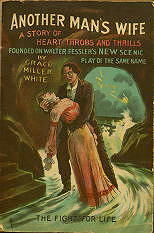
  Another Man’s Wife; or, The Life That Kills (Ogilvie,1905, pb) Novelization of 4 act play The Life That Kills, by Walter [W.] Fessler

Another Man's Wife

  Because She Loved (Ogilvie,1904, pb) Novelization of play in 4 acts by John Reinhart

  Broadway After Dark (Ogilvie,1907, pb) Novelization of play in 4 acts by John Oliver, pseud. of Owen Davis. Silent film: Warner Bros., 1924 (adapt.: Douglas Doty; dir.: Monte Bell)

  A Child of the Slums (Ogilvie,1904. pb) Novelization of play in 4 acts by W Howell Poole and Henry Belmar

  The Child Wife (Ogilvie,1904, pb) Novelization of play in 4 acts by Charles A[lonzo] Taylor or Hal Reid

  The Confessions of a Wife (Ogilvie,1905, pb) Novelization of play in 4 acts by Owen Davis

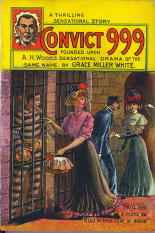
  Convict 999 (Ogilvie,1907, pb) Novelization of play in 4 acts by John Oliver, pseud. of Owen Davis

Convict 999

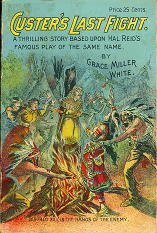
  Custer’s Last Fight (Ogilvie,1905, pb) Novelization of play in 4 acts by [James] Hal[leck] Reid. Also contains two Sherlock Holmes stories by A. Conan Doyle.

Custer's Last Fight

  Dangers of a Working Girl (Ogilvie,1904, pb) Novelization of play in 4 acts by Martin Hurley, pseud of Owen Davis. Originally titled Dealers in White Women.

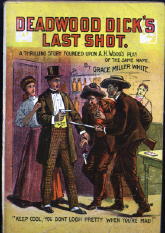
  Deadwood Dick’s Last Shot (Ogilvie,1907, pb) Novelization of play in 4 acts by Owen Davis

Deadwood Dick

  Deserted at the Altar (Ogilvie,1905, pb) Novelization of play in 4 acts by Pierce Kingsley

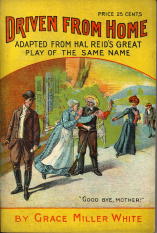
  Driven from Home (Ogilvie,1903, pb) Novelization of play in 4 acts by Arnold Wolford (?) and Owen Davis

Driven from Home

  Edna, the Pretty Typewriter (Ogilvie,1907, pb) Novelization of play in 4 acts by John Oliver, pseud of Owen Davis

  Fallen by the Wayside; or, A Chorus Girl’s Luck (Ogilvie,1907, pb) Novelization of play in 4 acts by John Oliver, pseud. of Owen Davis. Originally titled A Chorus Girl’s Luck in New York

  Fast Life in New York (Ogilvie,1905, pb) Novelization of play in 4 acts by Theodore Kremer

  From Rags to Riches (Ogilvie,1904, pb) Novelization of play in 4 acts by Charles A[lonzo] Taylor

  From Tramp to Millionaire (Ogilvie,1906, pb) Novelization of play in 4 acts by Owen Davis. Originally titled The Power of Money; or, In the Clutches of the Trust

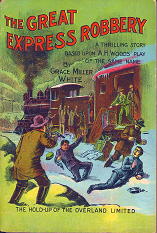
  The Great Express Robbery (Ogilvie,1907, pb) Novelization of play in 4 acts by Owen Davis

Great Express Robbery

  Her Mad Marriage (Ogilvie,1905, pb) Novelization of play in 4 acts by Frank [Charles] Allen

  The Holy City (Ogilvie,1905, pb) Novelization of play in 4 acts by Clarence Bennett

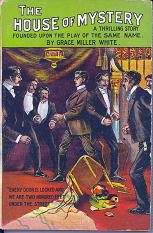
  The House of Mystery (Ogilvie,1905, pb) Novelization of play in 4 acts by [Arthur] Langdon McCormick. Originally titled The House of Mystery and the Black Five

House of Mystery

  How Hearts Are Broken (Ogilvie,1905, pb) Novelization of play in 4 acts by [Arthur] Langdon McCormick

  Human Hearts (Ogilvie,1904, pb) Novelization of play in 4 acts by [James] Hal[leck] Reid. Originally titled Human Hearts; or, Logan’s Luck

Human Hearts

  Lights of Home (Ogilvie,1904, pb) Novelization of play in 4 acts by Lottie Blair Parker

  Lured from Home (Ogilvie,1906, pb) Novelization of play in 4 acts by [James] Hal[leck] Reid
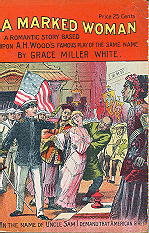
  A Marked Woman (Ogilvie,1907, pb) Novelization of play in 4 acts by Owen Davis. Silent film: World Film Corp., 1914; (scw: Owen Davis; dir.: O. A. C. Lund) [China]

A Marked Woman

  A Midnight Marriage (Ogilvie,1903, pb) Novelization of play in 4 acts by Walter [W.] Fessler

  Nellie, the Beautiful Cloak Model (Ogilvie,1906, pb) Novelization of play in 4 acts by Owen Davis. Silent film: Goldwyn Pictures, 1924 (adapt. H. H. Van Loan; dir.: Emmett Flynn)

  No Wedding Bells for Her (Ogilvie,1903, pb) Novelization of play in 4 acts by Theodore Kremer

  The Peddler (Ogilvie,1903, pb) Novelization of play in 4 acts by [James] Hal[leck] Reid

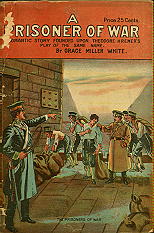
  A Prisoner of War (Ogilvie,1904, pb) Novelization of play in 4 acts by Theodore Kremer.

Prisoner of War

The Queen of the Cowboys (Ogilvie,1907, pb) Novelization of play in 4 acts by Joseph B[yron] Totten

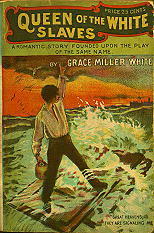
  Queen of the White Slaves (Ogilvie,1904, pb) Novelization of play in 5 acts by Arthur J[ohn] Lamb

Queen of the White Slaves

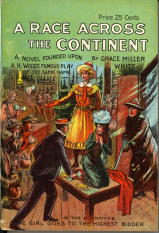
  A Race Across the Continent (Ogilvie,1907, pb) Novelization of play in 4 acts by John Oliver, pseud. of Owen Davis

Race Across the Continent

  Rachel Goldstein (Ogilvie,1904, pb) Novelization of play in 4 acts by Theodore Kremer

  A Ragged Hero (Ogilvie,1904, pb) Novelization of play in 4 acts by Maurice J. Fielding

  A Royal Slave (Ogilvie,1905, pb) Novelization of play in 4 acts by Clarence Bennett

  Ruled Off the Turf (Ogilvie,1906, pb) Novelization of play in 4 acts by John Oliver, pseud. of Owen Davis

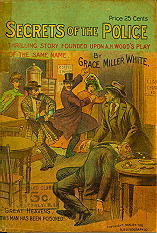
  Secrets of the Police (Ogilvie,1906, pb) Novelization of play in 4 acts by Owen Davis and Arthur J[ohn] Lamb [Paris, London, New York City]

Secrets of the Police

  Shadows of a Great City (Ogilvie,1904, pb) Novelization of play in 4 acts by Livingston Robert Shewell

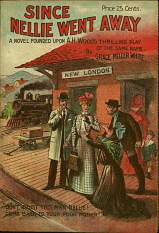
  Since Nellie Went Away (Ogilvie,1907, pb) Novelization of play in 4 acts by Owen Davis

Since Nellie Went Away

  Sky Farm (Ogilvie,1904, pb) Novelization of play in 4 acts by Edward E. Kidder

  The Street Singer (Ogilvie,1904, pb) Novelization of play in 4 acts by [James] Hal[leck] Reid

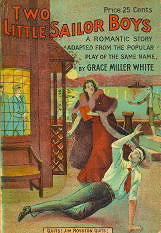
  Two Little Sailor Boys (Ogilvie,1904, pb) Novelization of play in 4 acts by Walter Howard

Two Little Sailor Boys

  Under the North Star (Ogilvie,1906, pb) Novelization of play in 4 acts by Clarence Bennett

  The Vacant Chair (Ogilvie,1904, pb) Novelization of play in 4 acts by Joseph B[yron] Totten

  The Warning Bell (Ogilvie,1906, pb) Novelization of play in 4 acts

  Way Back in ’61(Ogilvie,1905, pb) Novelization of play in 4 acts by Clarence Bennett

  Wedded, But No Wife (Ogilvie,1904, pb) Novelization of play in 4 acts by Maurice J. Fielding and Conninghame Price

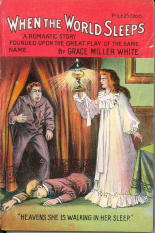
  When the World Sleeps (Ogilvie,1906, pb) Novelization of play in 4 acts by [Arthur] Langdon McCormick and Lawrence Marston

When the World Sleeps

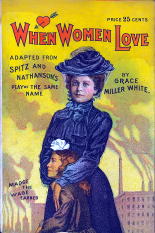
  When Women Love (Ogilvie,1904, pb) Novelization of play in 4 acts by Abraham A. Spitz

When Women Love

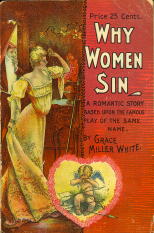
  Why Women Sin (Ogilvie,1904, pb) Novelization of play in 4 acts by William C. Murphy. Silent film: Wistaria Productions, 1920 (scw:Lloyd Lonergan; dir.: Burton King) [New Jersey]

Why Women Sin

  A Wife’s Secret (Ogilvie,1904, pb) Novelization of play in 4 acts by [James] Hal[leck] Reid

« Previous PageNext Page »