Crime Fiction IV


   Here’s both a private eye and a private eye author you’re not too likely to have heard of before. Sam Carroll is the PI, and Robert Leigh is the author. Both of two books were published in England, one of them was published here in the US, and neither of them ever appeared in paperback. Once upon a time private eye novels were always published in paperback, and often paperback only. Not any more.

   Here, before going to the books themselves, is the author’s entry in Crime Fiction IV, by Allen J. Hubin:
      
LEIGH, ROBERT (1933- )
      * The Cheap Dream (London: Macmillan, 1982, hc) [Sam Carroll; London] U.S. title (?): First and Last Murder. St. Martin’s, 1983.
      * _First and Last Murder (St. Martin’s, 1983, hc) See: The Cheap Dream (Macmillan (London) 1982).
      * The Girl with the Bright Head (London: Macmillan, 1982, hc) [Sam Carroll]

   We can make some additions and correction to that entry right away. The US novel entitled First and Last Murder is not The Cheap Dream, as conjectured, but the The Girl with the Bright Head, which happens to be Leigh’s second novel. The setting is London, the same as the first one.

THE CHEAP DREAM
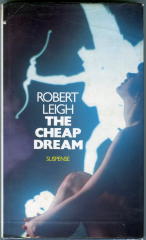
The Cheap Dream

      From the front inside DJ flap:

    “I reached for a cigarette and then heard the rhythmic pocking of the record player. As I looked down at it I saw that the record was still spinning. The machine hadn’t been damaged in all the violence. There was blood on it and one drop had stayed in a groove. It spun around with the record like a rose in a whirlpool.”

    Sam Carroll was good at finding out what really goes on behind the neon glitter of modern London. He aspires to the highest level of the ‘crusader’ private eye. His world is bounded by central London, and focussed on Soho. This is a London of the most depraved character, of sex in many forms, drugs, gambling, reckless and dissolute extravagance. It is peopled by pop stars, models, prostitutes, negroes, journalists, a fringe world of night-birds awash with money and frenetic for ‘happiness’ or release.

    A man of wealth, a publisher of shady magazines, wants Carroll to investigate the circumstances of the death of a girl called Valentine: a drug addict, she appeared to have died from an overdose. But an ‘open verdict’ had been returned so there seemed to be something worth investigating.

   As he wades through the expensive twilight of the city, Carroll runs into an assortment of other characters who don’t wish him well and soon finds himself on the floor in a Pimlico basement next to a small black corpse.

   An exciting and weird story is told with clarity and elegance in this unusual first novel.

      From the inside back DJ flap:
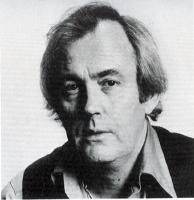
Robert Leigh

ROBERT LEIGH was born in 1933. His first job was as a junior reporter on the Kent Messenger and he subsequently worked in Paris (carrying sandwich boards for the Jean Cocteau cinema), in Soho and Victoria (selling ice cream, writing for literary magazines), in Holland (writing a column for a Dutch daily newspaper), in Spain (coaching a local village football team, writing articles for the New York Times) and is now back in London running an advertising consultancy.

He still plays a lot of sport from Sunday morning football to canoeing and badminton, and has plans for further Sam Carroll novels.

      Review excerpts (from the back cover of The Girl with the Bright Head):

“A fresh talent stirs.” The Guardian.

“Does more than pass muster.” The Observer.

“Undoubted talent.” Catholic Herald.

“Augurs well for subsequent thrillers.” Manchester Evening News.

THE GIRL WITH THE BRIGHT HEAD
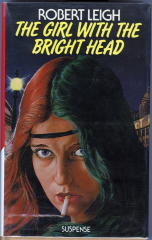
Girl with the Bright Head

      From the inside DJ flap:

   In his first novel, The Cheap Dream, Robert Leigh introduced the private investigator Sam Carroll. Carroll belongs to the ‘crusader’ school of private eyes and his first recorded adventure took place amid the candy-floss glitter and deepest vice that stains a spectrum of society not far below the surface of London, and Soho in particular.

   It is in the same setting – all too realistically described – that Carroll now sets out to rescue the ‘girl with the bright head.’

    “The thing you might have noticed about her was that her hair was parted in the middle and that one wing of it was red while the other was bright green.”

   She was trying (rather ineptly) to set up as a whore, but Carroll detected an innocence in her: he was also reminded of another girl who said that ‘she was going to sin until she died.’

   This bit of rescue work involves Carroll with Charlene’s complicated family, also with some pretty callous thugs, then a messy murder and then the police. In fact Carroll is in deep trouble.

   Violence and evil pervade these events, but Carroll is his own man. In the end, he fights his way through to survival, only to discover a weird twist at the end.

   Robert Leigh’s second novel is a ‘good read,’ but something more serious is at issue in its depiction of an aspect of London life and in Carroll’s own attitudes to these corrupt and wicked people.

FIRST AND LAST MURDER (aka THE GIRL WITH THE BRIGHT HEAD)
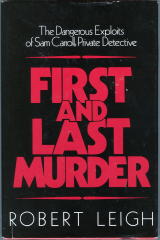
First and Last Murder

      The blurb on the DJ flaps is an abridged version of the one above, with the last paragraph replaced by:

   In the tradition of Raymond Chandler and Dashiell Hammett, Robert Leigh writes with the vividness and precision of a worldly poet, demonstrating that he is a new detective novelist of extraordinary promise.

   [There is no indication of the book’s previous title. As I’m sure you’ll agree, the cover is hardly designed to catch a would-be buyer’s eye. The book was published back in the day when 90% of the hardcover mysteries produced were sold directly to libraries.]
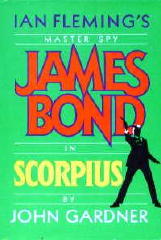
      Best-selling spy novelist John Gardner passed away on 3 August 2007.

Scorpius

   Best-known as the most prolific of the writers contracted to continue the adventures of James Bond after the death of Ian Fleming, Gardner, a former Anglican clergyman and recovering alcoholic, would eventually write 16 Bond novels, more than Fleming wrote himself, between 1981 and 1996.

   Ironically, Gardner broke into spy fiction with a series about Boysie Oakes, a cowardly, selfish, and not particularly patriotic character who’s dragooned into spy work pretty much against his will. Oakes was created to be more or less the antithesis of Bond, yet the Oakes novels were an integral part of the resume that got Gardner the Bond gig.

   Though his Bond novels are probably his best-known and most popular work, his reputation as a top-flight cloak-and-dagger writer would be secure if he’d never written a single word about 007. Two series in particular stand as his best work in the sub-genre.

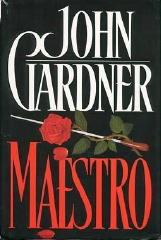
   His five novels featuring Herbie Kruger, a naturalized Brit of German birth who, after emigrating, has become the top agent of MI-6, are among the best series of British spy novels in the post-Le Carre era. Kruger debuted in The Nostradamus Traitor. The penultimate novel in the Kruger series, Maestro, was reportedly Gardner’s personal favorite of all his books.

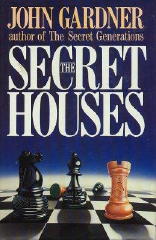
Secret Houses

   Kruger also makes a few cameo appearances in Gardner’s “Secret” trilogy, featuring the British Railtons and the American Farthings, two families, related by marriage, who defend freedom by choosing careers in their respective countries’ intelligence services. The trilogy effectively combined the multi-generational family saga, historical fiction, and espionage in an ambitious project that attempted, largely successfully, to show the history of espionage from just before World War I to the early 60s. The three books in the trilogy are The Secret Generations, The Secret Houses, and The Secret Families.

   Most identified with spy fiction, Gardner was a versatile writer who could easily slip into other mystery sub-genres. A pair of carefully researched novels set in the world of Sherlock Holmes, for example, were told from the point of view of Professor Moriarty, depicting the iconic villain less as the effete “criminal mastermind” Conan Doyle portrayed than as a Victorian version of Al Capone or Don Corleone. Originally planned as a trilogy, the third novel has never appeared.

   Two police procedurals, A Complete State of Death and The Corner Men, featured Scotland Yard detective Roger Torrey. The first, with the setting changed from London to New York, became the Charles Bronson film The Stone Killer.

Absolution

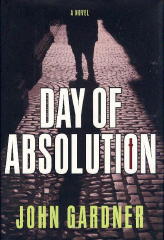
   Between 1995 and 2001, Gardner abruptly stopped writing while he simultaneously fought cancer and the grief caused by his wife’s death. Winning his battle with the disease and coming to terms with the death of his spouse, he returned to writing with a vengeance, turning out a top-notch international thriller, Day of Absolution, and starting a new historical police procedural series about Suzie Mountford, a London Metropolitan policewoman fighting crime, and sexism,in the early years of World War II. The latest Mountford novel, No Human Enemy, will appear in bookstores later this month. Reportedly, the long-awaited third novel in the Moriarty trilogy is also being readied for publication.

   He’ll be missed.

      THE BOOKS. Adapted from Crime Fiction IV, by Allen J. Hubin.

GARDNER, JOHN (Edmund) (1926-2007 ) British editions only, unless US titles differ.

* The Liquidator (n.) Muller 1964 [Boysie Oakes]
* Understrike (n.) Muller 1965 [Boysie Oakes]
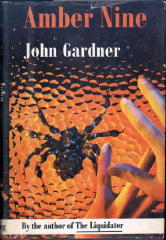
* Amber Nine (n.) Muller 1966 [Boysie Oakes]

Amber Nine

* Madrigal (n.) Muller 1967 [Boysie Oakes]
* Hideaway. Corgi 1968. Story collection.
* A Complete State of Death (n.) Cape 1969 [Derek Torry]
* Founder Member (n.) Muller 1969 [Boysie Oakes]
* The Airline Pirates (n.) Hodder 1970 [Boysie Oakes]
* -The Censor (n.) NEL 1970
* Traitor’s Exit (n.) Muller 1970 [Boysie Oakes]
* Air Apparent (n.) Putnam 1971; See: The Airline Pirates (Hodder 1970).
* The Stone Killer (n.) Award 1973; See: A Complete State of Death (Cape 1969).
* The Assassination File (co) Corgi 1974
* The Corner Men (n.) Joseph 1974 [Derek Torry]
* The Return of Moriarty (n.) Weidenfeld 1974 [Prof. James Moriarty]
* A Killer for a Song (n.) Hodder 1975 [Boysie Oakes]
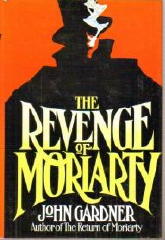
* The Revenge of Moriarty (n.) Weidenfeld 1975 [Prof. James Moriarty]

Revenge of Moriarty

* To Run a Little Faster (n.) Joseph 1976
* The Werewolf Trace (n.) Hodder 1977
* The Dancing Dodo (n.) Hodder 1978
* The Nostradamus Traitor (n.) Hodder 1979 [Herbie Kruger]
* The Garden of Weapons (n.) Hodder 1980 [Herbie Kruger]
* Golgotha (n.) Allen 1980 [England; 1990]
* The Last Trump (n.) McGraw 1980; See: Golgotha (Allen 1980).
* License Renewed (n.) Cape 1981 [James Bond]
* For Special Services (n.) Cape 1982 [James Bond]
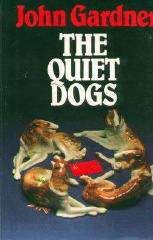
* The Quiet Dogs (n.) Hodder 1982 [Herbie Kruger]

Quiet Dogs

* Flamingo (n.) Hodder 1983
* Icebreaker (n.) Cape 1983 [James Bond]
* Role of Honour (n.) Cape 1984 [James Bond]
* The Secret Generations (n.) Heinemann 1985 [Railton family; Farthing family]
* Nobody Lives Forever (n.) Cape 1986 [James Bond]
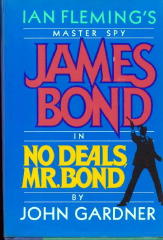
* No Deals, Mr. Bond (n.) Cape 1987 [James Bond]

No Deals Mr. Bond

* Scorpius (n.) Hodder 1988 [James Bond]
* The Secret Houses (n.) Bantam 1988 [Railton family; Farthing family; Herbie Kruger]
* License to Kill (n.) Coronet 1989 [James Bond]
* The Secret Families (n.) Bantam 1989 [Railton family; Farthing family; Herbie Kruger]
* Win, Lose or Die (n.) Hodder 1989 [James Bond]
* Brokenclaw (n.) Hodder 1990 [James Bond]
* The Man from Barbarossa (n.) Hodder 1991 [James Bond]
* Death Is Forever (n.) Hodder 1992 [James Bond]
* Maestro (n.) Bantam 1993 [Herbie Kruger]

Maestro

* Never Send Flowers (n.) Hodder 1993 [James Bond]
* Seafire (n.) Hodder 1994 [James Bond]
* Confessor (n.) Bantam-UK 1995 [Herbie Kruger]
* Goldeneye (n.) Coronet 1995 [James Bond]
* Cold Fall (n.) Hodder 1996 [James Bond]
* Day of Absolution (n.) Scribner-US 2000

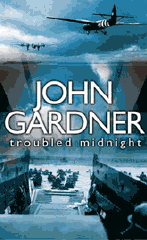
Troubled Midnight

   Detective Sergeant Suzie Mountford novels —

* Bottled Spider (2002)
* The Streets of Town (2003)
* Angels Dining at the Ritz (2004)
* Troubled Midnight (2005)
* No Human Enemy (2007)


   For more on John Gardner’s life, as he told it himself, go to

      http://www.john-gardner.com/past.html


   From this morning’s online www.booktrade.info:

      MAGDALEN NABB

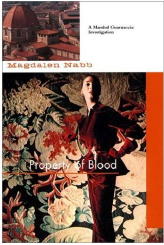
Property of Blood

Posted at 8:56AM Tuesday 21 Aug 2007:

   William Heinemann and Diogenes Verlag AG report that Magdalen Nabb sadly died suddenly at the weekend. Her funeral was held on Monday in Florence. […]

   Her novels which featured Florentine investigator Marshal Guarnaccia include Death of an Englishman, Property of Blood, and most recently, Some Bitter Taste and The Innocent.

   William Heinemann intend to publish her last novel, Vita Nuova, in 2008, with an Arrow paperback scheduled for 2009.

      BIOGRAPHY:     [Taken from her website]

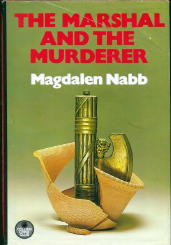
   Magdalen Nabb was born in Church, a moorland village in Lancashire, England. She studied art and, later, pottery which she taught in an English art school whilst exhibiting her own work until 1975 when she moved to Florence in Italy. There, she continued to work on pottery in a majolica studio in Montelupo Fiorentino, a pottery town near Florence, and began writing. It was in Montelupo that she met the model for Marshal Guarnaccia. The town itself, with its tumbledown factories and its wonderful restaurant, are featured in The Marshal and the Murderer. She still lives and writes in Florence, near enough to the carabinieri station in the Pitti Palace to stroll there regularly and have a chat with the marshal who keeps her up to date on crime in the city. […]

   Having been a fan of Georges Simenon’s novels for as long as she can remember, she was astonished and overjoyed when Simenon wrote to congratulate her on her first novel. Their correspondence continued until his death and, until then, the first copy of each book went to him. His presence is very much missed but in difficult moments she can still get advice from him by browsing through his books and his letters.

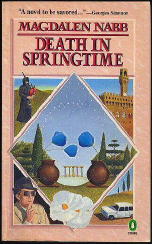
      SIMENON’S PREFACE TO DEATH IN SPRINGTIME:

  “Dear friend and fellow author,

Death in Springtime

    “What a pleasure it is to wander with you through the streets of Florence, with their carabinieri, working people, trattorie, even their noisy tourists. It is all so alive: its sounds audible, its smells as perceptible as the light morning mist above the Arno’s swift current; and then up into the foothills, where the Sardinian shepherds, their traditions and the almost unchanged rhythm of their lifestyle, are just as skilfully portrayed. What wouldn’t one give to taste one of their ricotta cheeses!

    “You have managed to absorb it all and to depict it vividly, whether it is the various ranks of the carabinieri, and of course the ineffable Substitute Prosecutor, or the trattorie in the early morning hours. There is never a false note. You even capture that shimmer in the air which is so peculiar to this city and to the still untamed countryside close at hand.

    “This is a novel to be savoured, even more than its two predecessors. It is the first time I have seen the theme of kidnapping treated so simply and so plausibly. Although the cast of characters is large, they are so well etched in a few words that their comings and goings are easily followed.

    “Bravissimo! You have more than fulfilled your promise.”

         Georges Simenon
            Lausanne, April 1983

      THE BOOKS:     [Expanded from Crime Fiction IV, by Allen J. Hubin.]

NABB, MAGDALEN (1947-2007) Series character: Marshal Salvatore Guarnaccia (MG).

* Death of an Englishman (n.) Collins 1981; Scribner 1982. MG
* Death of a Dutchman (n.) Collins 1982; Scribner, 1983. MG
* Death in Springtime (n.) Collins 1983; Scribner, 1984. MG
* Death in Autumn (n.) Collins 1985; Scribner 1985. MG
* The Prosecutor [with Paolo Vagheggi] (n.) Collins 1986; St. Martin’s, 1988.
* The Marshal and the Murderer (n.) Collins 1987; Scribner 1988. MG

Marshal and Murderer

* The Marshal and the Madwoman (n.) Collins 1988; Scribner 1988. MG
* The Marshal’s Own Case (n.) Collins 1990; Scribner 1990. MG
* The Marshal Makes His Report (n.) Collins 1991; Harper 1992. MG
* The Marshal at the Villa Torrini (n.) Collins 1993; Harper 1994. MG
* The Monster of Florence (n.) Collins 1996; no US edition. MG

   The following novels are not included in CFIV, having been published after the book’s end date of the year 2000. The bibliographic data for these may be incomplete or in error.

* Property of Blood. Heinemann; Soho Press, 2001. MG
* Some Bitter Taste. Heinemann 2003; Soho Press, 2003. MG
* The Innocent. Heinemann 2005; Soho Press, 2005. MG
* Vita Nuova. Heinemann 2008 MG?

   Although Al Hubin has cast a very wide net in putting together Crime Fiction IV, he still hasn’t caught everything. Once in a while I come across a book that seems crime-related enough that it ought to be included, and it isn’t, or not yet.

   The latest of these rare instances is the following author and title, which will appear shortly in Part 18 of the Addenda to the Revised edition of CFIV:

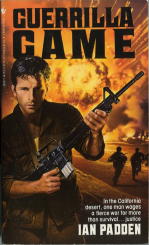
Guerrilla Game      PADDEN, IAN.
         Guerrilla Game. Bantam, pbo, June 1987.

      From the front cover:

    “In the California desert, one man wages a fierce war for more than survival … justice.”

         From the back cover:

      IT STARTED AS A WAR GAME …

on a mock battlefield in the California desert — until the “enemy” started firing live ammunition and a young trainee wound up dead,

      IT ENDED IN MURDER.

Captain Ronald Cochrane of U.S. Special Forces knew the attack wasn’t an accident. Alone, he was going back to the desert to prove that Carl Nathan was murdered in cold blood … even if he had to risk a court martial to do it. What Cochrane didn’t know was that he was already a man marked for death … the target of a powerful military underworld and a corrupt superior who was setting him up for the ultimate double-cross.

      NOW IT WAS A ONE MAN WAR.

For Cochrane, the game was over and the real war is about to begin. And he will need every commando trick in the book to survive …

                  GUERRILLA GAME.

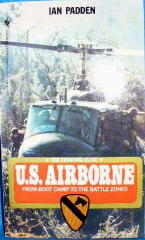
   Ian Padden is also the author of a series of non-fiction “The Fighting Elite” books on the military. One of these is shown, The Fighting Elite: U.S. Airborne: From Boot Camp to the Battle Zones:

The Fighting Elite

   A couple of weeks ago I posted all I knew about mystery writer Mark Strange, who doesn’t exist and never did. The one book “he” wrote was the collaborative effort of three women and one man, all friends and/or related to one another. I invite you to go back and read about the authors. This post, though, is about the novel itself, as British bookseller Jamie Sturgeon has found a copy, and he’s passed along to me what he’s learned about it.

   First, here’s the entry as it appears in the Addenda to the revised edition of Crime Fiction IV, by Allen J. Hubin:

      STRANGE, MARK. Joint pseudonym of Adrian Leslie Stephen, Karin Costelloe Stephen, Marjorie Colville Strachey, & Rachel Costelloe Strachey, q.q.v. Under this pen name, the author of one novel in the (Revised) Crime Fiction IV; see below:
         Midnight. Faber, hc, 1927. [Academia; England]

   Here from Jamie is more about the book:

      Steve,

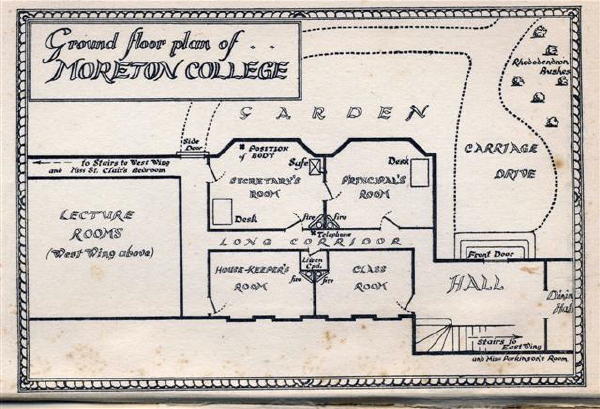
   It looks like a fairly typical 1920s murder mystery, set in a women’s teacher training college. There’s a plan of the ground floor of the college opposite the title page. Here is the authors’ note after the title page:

      AUTHORS’ NOTE:

    “THIS story was the work of four people, M., A., R., and K. The method adopted was simple and can be recommended to those readers who feel sure that they could themselves write a detective story if it was not so much trouble. M., A. and K. discussed the plot and then wrote alternate chapters until the book was completed in outline. R. was then called upon and then inserted 10,000 additional words distributed evenly among the different parts. The authors defy the public to trace their separate hands or locate the padding.”

   Here’s a scan of the ground floor plan mentioned above:

Mark Strange

Cheers,

   Jamie

   An obituary for Nicholas William Wollaston, writer, born June 23 1926, died April 23 2007, appeared in the online Guardian, May 9, 2007, from which the following paragraphs are excerpted:

    “Nick was born in Gloucestershire, the son of the naturalist and explorer Sandy Wollaston, doctor and botanist on the first Everest expedition in 1921 […] A forebear was the eminent early 19th-century chemist William Hyde Wollaston.    […]

    “Wollaston also published seven novels. They contain passages of vivid and imaginative writing — the physical and mental trauma of being stuck in an Alpine crevasse in Jupiter Laughs (1967), the lovingly clinical account of a devout Indian bathing and self-administering an enema in Pharaoh’s Chicken (1969), […] the horrors of a Japanese prisoner-of-war camp in The Stones of Bau (1987), possibly his finest novel — and they were well received.    […]

    “The publisher who said he was incapable of a dull sentence and the reviewer who described his writing as ‘refreshing as a cool wind to a sweat-soaked wayfarer’ were right. Wollaston was a consummate stylist — the briefest book review in the Observer was perfectly shaped — yet what he wrote never suggested the careful polishing that undoubtedly went into it; it was supremely natural.”

   A complete online bibliography of Mr. Wollaston’s work can be found here.

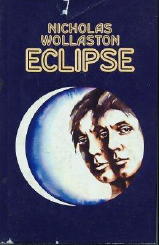
Eclipse

   Not mentioned in the tribute taken from the Guardian was the only novel he wrote which is included in Crime Fiction IV, by Allen J. Hubin:

      WOLLASTON, NICHOLAS (1926-2007)
         * Eclipse (London: Macmillan, 1974, hc) Walker, 1974. Film: Celandine, 1977 (scw & dir: Simon Perry).

   The film is obscure enough that it’s not even included on IMDB.com, but a very short synopsis in the BFI database says “Story of the possession of one man – his mind, heart and soul – by his twin brother.”

   Of the book itself, one online bookseller says, “The author’s fourth novel, about identical twins, one of which is killed in a boating accident while sailing with the other.”

   So much for putting this blog on vacation, you might be thinking. But I can explain. It’s been too hot this August to do much but rearrange the boxes in the garage. No heavy lifting, in other words, but I have been peeking in and recording the contents of a large number of these boxes, some of which haven’t been peeked into since I came home from whatever bookstore, garage sale or library sale I’d been to that day.

   And once in a while I come across something that catches my eye more than usual, and I make myself a note to the effect, here’s something I have to tell you about and I can’t wait.

Manx McCatty

   Case in point. Here’s the entry as it is in Crime Fiction IV, by Allen J. Hubin:

      REED, CHRISTOPHER; Playwright and musical comedy lyricist and composer; living in Oregon.
         * The Big Scratch (Ballantine, 1988, pb) [San Francisco, CA]

   Nothing more. Nothing to indicate that this is a private eye novel, and in fact the PI in this novel is so novel that he is not even included in Kevin Burton Smith’s thrillingdetective.com website: One Manx McCatty.

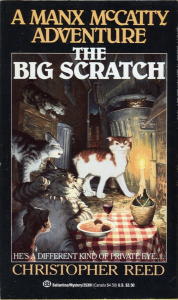
   The actual title, and I must tell Al this, is A Manx McCatty Adventure: The Big Scratch. You’ve already peeked at the cover, so you already know, or you’ve guessed, but in case not, or even if you have, read on. From the back cover:

MANX McCATTY

INSTANT I.D.: Cool cat from the docks.

STRENGTHS: Thinks fast on his paws.

WEAKNESSES: Fresh-caught fish and a silver-gray Persian named Pasha.

DAILY ROUTINE: Keeps the bad guys in line, snags a cat-sized snooze.

   Evil lurks along the mean streets of San Francisco – Fisherman’s Wharf, North Beach, the fog-enshrouded waterfronts. And, as usual, hardboiled hero Manx McCatty is outnumbered by blackguards: low-life hoods, stoolies, extortionists, and Gato Nostro kingpin Tabby Tonelli.

   But dastardly villains haven’t stopped the superior snooper cat before. He’s too smart to trip into their traps; far too cagey to be caught in their web of danger. A cat’s cat, Manx McCatty is one feisty feline who licks his chops at a challenge … the tougher the odds, the sweeter the prize.


   And from instead the front cover:

    “I was nosing into the notorious Gato Nostro, a powerful organization of sleazeball felines who specialize in various forms of terror, extortion, protection, black marketeering, and, most recently, the exportation of cats to different parts of the world.

    “The news caused such an uproar that an investigation was called for, and, as always, I was elected to prowl around and find out what I could. That didn’t bother me. Investigation is my game.

    “I flexed my paws and hit the street.”

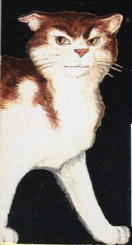
Manx McCatty

   I’ve not been able to find out very much about the author, Christopher Reed. Nothing on Google, though admittedly I haven’t yet done an exhaustive search. All that’s known, at the moment, is what’s found at the end of the book:

ABOUT THE AUTHOR –

A MANX McCATTY ADVENTURE: THE BIG SCRATCH marks the debut of CHRISTOPHER REED as a novelist. He is, principally, a playwright and musical comedy lyricist. His theatre works, including THE FINAL ACT and (in collaboration with Ron Martell and Cynthia Carle) SHOOTIN’ STARS, have been performed in New York and other cities. Mr. Reed lives in Ashland, Oregon, where he has recently completed a second novel featuring Manx McCatty.

   If the book was written, it was never published, and perhaps there’s a story behind that. In the meantime, the book’s not hard to find online – there are only six copies on ABE, but most are not pricey – so grab one while you, and sit back and relax and begin reading:

    “The fog dropped in like a huge, soggy pancake. As I wound my way along the deserted waterfront, I wondered how air could ever get so wet. Just being near the piers made me nervous, but the eerie glow of the naked dock lights and the lapping of the waves against the creaking pilings really ruffled my fur.

    “Something moved and I sprang. The little garbage mouse didn’t have time for even a quick regret before I served him up like the blue plate special down at Sylvester’s any Tuesday night.”

   The book is illustrated, too, and by the same fellow who did the cover artwork. He really ought to be mentioned, so I will: Tom Newsom.

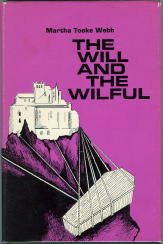
   There is only one entry for Mrs. Webb in Crime Fiction IV, by Allen J. Hubin:

      WEBB, MARTHA TOOKE
         * The Will and the Wilful (Dorrance, 1969, hc)

   And that’s all there is for her, nothing more. Until this past week, that is, when Al Hubin discovered that she was born June 23, 1908, and died on November 23, 2001. This information will, of course, appear shortly in the Addenda to the Revised Edition of CFIV.

   The book she wrote is not common, but neither is it terribly difficult to find. With the assistance of bookseller Jon Rieley-Goddard of Baldy Books in upstate New York, I have a scan of the front cover that I can show you, and from the back cover jacket flap, a lengthy profile of the author herself. I’ll get back to that shortly.

The Will and the Wilfull

   First, though, a short description of the book itself. From the blurb on the front flap:

    “A series of macabre murders shatters the peaceful existence of an affluent lakeside community in upstate New York. … First to die is lovely Janice Rhodes, electrocuted by a floor lamp, with which someone has tampered, turning it into a lethal weapon.

    “Sally Martin, a close friend and confidante of the two Rhodes girls, is the narrator of this tense and intricate thriller. She recoils with unbelieving horror at the news of the bizarre murders of three members of the Rhodes household and then barely escapes death, herself.

    “Suspicion falls on the guardians assigned to the Rhodes girls in the unusual will left by Dr. Rhodes before he and his second wife are killed in a highway accident, and on the girls’ two suitors. For Sheroff Brandon and Private Eye Rob Cummings, it is a perplexing case.

    “For Sally Martin and the frightened community, it is a nightmare.

    “For the reader, it is a masterpiece of suspense and intrigue. It is a safe bet that even veteran devotees of the whodunnit will never guess the outcome!”

   The last paragraph reveals the author’s intent with this book. In spite of the blurb’s early emphasis on bizarre deaths, this is a whodunnit of largely a cozy nature, with a little romantic suspense added in for good measure.

   From the jacket flap inside the back cover, more on Martha Tooke Webb, who …

    “… was born in Syracuse, New York, where she attended the public schools and Syracuse University. After her marriage, she and her husband moved to Rochester, where she studied portrait painting under the late Harold Bishop. Her paintings have been exhibited at the Great Lakes Exhibition and the New York State Exhibition, as well as at local art galleries in Rochester.

    “The author and her husband now live on the beautiful Oneida Lake in central New York. She is proud of her flower garden, which abounds in many varieties of roses. …”

Donna Frey left a comment on my blog entry about gothic romance mystery paperbacks a while back, and I thought it might be more useful if posted my reply as a new blog entry, instead of leaving it hidden where no one would find it.

Here’s what Donna asked:

    “I have a 1953 copy of Theresa Charles’ Fairer Than She, and I’ve always loved it. The heroine is psychic, and TC is such a good writer. Would like to buy her other books but there is never a plot description on Amazon or eBay so it’s buying blind. I don’t like the Nurse in love with Doctor books. How do I get a description before I buy? And does anyone know of a bio of Ms. Charles? Would like to read about her. Thanks.”

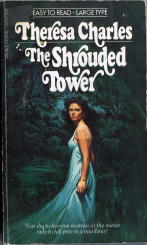
Theresa Charles

Donna, you’re not alone in liking the gothics that Theresa Charles wrote. I’ve been asked a few times before to be on the lookout for her books by people trying to find them. (They’re not all that difficult to come across, but again there must be a demand for them. The asking prices online start around $4.00, which as the low end price for a gothic, is rather high.)

As far as a biography is concerned, technically speaking, there is or was no “Theresa Charles.” That was the joint pen name of two British authors, Irene Maude Swatridge and Charles John Swatridge, neither no longer living. Other than their names, though, I’ve never found much of anything more about them. I assume they are were a married couple, but of course this doesn’t mean that they were. Irene also wrote a few books on her own, using a pair of other pen names. I’ll list the titles below.

You’re right in being wary of buying any books by Theresa Charles without knowing more about them. A lot of the books under her name appear to have been straight romance novels, including (yes) Doctor-Nurse affairs. The list of titles below are from Crime Fiction IV, by Allen J. Hubin. With one possible (and obvious) exception, these would be your best bets as books to start hunting down. [UK = British edition.]

CHARLES, THERESA; pseudonym of Irene Maude Swatridge & Charles John Swatridge; other pseudonyms: Leslie Lance & Jan Tempest
* The Burning Beacon (Cassell, UK, 1956, hc) Lancer, 1966.
* Fairer Than She (Cassell, UK, 1953, hc) Dell, 1968.
* Happy Now I Go (Longman[s], UK, 1947, hc) U.S. title: Dark Legacy. Dell, 1968.
* House on the Rocks (Hale, UK, 1962, hc) Paperback Library, 1966.
* The Man for Me (Hale, UK, 1965, hc) U.S. title: The Shrouded Tower. Ace, 1966.
* Nurse Alice in Love (Hale, UK, 1964, hc) U.S. title: Lady in the Mist. Ace, 1966.
* Proud Citadel (Hale, UK, 1967, hc) Dell, 1967.
* Widower’s Wife (Hale, UK, 1963, hc) U.S. title: Return to Terror. Paperback Library, 1966.

LANCE, LESLIE; pseudonym of Irene Maude Swatridge; other pseudonyms: Theresa Charles & Jan Tempest
* The Bride of Emersham (Pyramid, 1967, pb) British title?
* Dark Stranger (Low, UK, 1946, hc)
* The Girl in the Mauve Mini (Hale, UK, 1979, hc)
* The House in the Woods (Ace, 1973, pb) British title?

TEMPEST, JAN; pseudonym of Irene Maude Swatridge; other pseudonyms: Theresa Charles & Leslie Lance
* House of the Pines (Mills, UK, 1946, hc) Ace, 1968.

I hope this helps!

   Even though acting was what she did for a living, Morgan Taylor somehow also managed to find herself solving two cases of murder in her short-lived career as a detective fiction character. She was the creation of two longtime friends who lived in Chicago, Susan Sussman and Sarajane Avidon.

   A former journalist, Susan Sussman is the more prolific writer of the pair, as a visit to her website will show. A third book in the series, A Voice for Murder, is mentioned as being in preparation, but alas, it appears it was never completed.

   Sarajane Avidon, a professional actress and award-winning artist, was born in 1941 as Sara Jane Levey, and died in 2006 after a long struggle with cancer. See a photo of her here, along with a brief account of her battle with the disease.

   Their combined entry in Crime Fiction IV, by Allen J. Hubin, reads as follows, slightly revised and expanded:

      SUSSMAN, SUSAN with AVIDON, SARAJANE
         * Audition for Murder. St. Martin’s, hc, January 1999. Worldwide, pb, June 2000. SC: Morgan Taylor. Setting: Chicago, IL; Theatre
         * Cruising for Murder. St. Martin’s, hc, July 2000. Worldwide, pb, May 2002. SC: Morgan Taylor. Setting: Ship

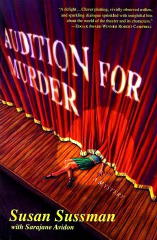
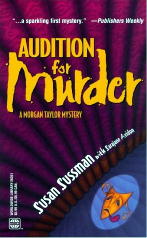
AUDITION FOR MURDER

      Book Description:

Audition for Murder

   Welcome to the world of Morgan Taylor, a thirty-something struggling actress who is dying for a juicy role in a prestigious revival on the Chicago stage. She hasn’t had a role in months, and the chance to work with the esteemed director Martin Wexler has her practically salivating.

   Though Morgan shows up right on time for the audition, Lily London, her assigned auditioning partner and a cantankerous older woman Morgan has never really liked, seems to have forgotten. Morgan gets more and more anxious until it seems that nothing can salvage this chance. Her mood is shot, her nerves are frazzled, she’s got the stage manager for an auditioning partner. When it’s all over, of course, Morgan finally comes across Lily–dead, lying cold on the floor of the theater bathroom….

   The character of Morgan Taylor is fresh and thoroughly entertaining; she’s as dramatic as the most talented actresses and as shrewd as the most calculating investigator–in short, a perfect amateur sleuth. Her debut, Audition for Murder, peopled by a delightful supporting cast, including Morgan’s best friend, Beth, who suffers from MS, and Beth’s finicky dog, Hamlet, is one of those rare mysteries that delivers a wonderfully written story and an engaging, suspenseful puzzle.

      Review Excerpts:

Publishers Weekly: “From novelist Sussman […] and actress Avidon comes a sparkling first mystery, told in the present tense, that displays no opening night jitters as Chicago actress Morgan Taylor makes her memorable sleuthing debut. […] Even the bit players make notable contributions in Sussman’s entertaining and witty romp, which will have readers applauding for an encore.”

Booklist: “Anyone interested in the theater will especially appreciate this hilarious look at the mounting of a 40-year-old play in Chicago. Playing the lead in both the novel and the play is Morgan Taylor, a funny, smart-mouthed, totally endearing character who never forgets to thank the “theater gods” for her successes. […] Although this is Morgan’s first outing, one strongly hopes that Sussman and Avidon will give her an encore.”

Audition for Murder


CRUISING FOR MURDER

      Book Description:

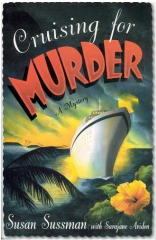
Cruising for Murder

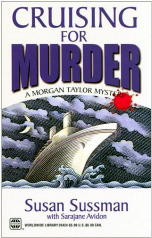
   Now that the touring production of Rent has just closed and a Chicago winter has descended, dancer/singer Morgan Taylor impulsively accepts a gig on a Caribbean cruise ship, anticipating three weeks of show tunes and suntans — not a stage set for murder.

   Her friend Kathy, the show’s production director, neglected to tell Morgan that the entertainer she’s replacing died under mysterious circumstances. And when Morgan’s beautiful, backstabbing roommate is found floating in the turquoise waters of the Bahamas — neatly zipped into a garment bag — things look ominous indeed.

   Neatly sidestepping a stalker, dangerous threats and a sinister shipboard mystery, Morgan remains, as always, a seasoned performer. She may be in a killer’s spotlight, but the show must go on. Morgan just hopes it continues to be a live performance.

      Review Excerpts:

Publishers Weekly: “In her second appearance […] as an amateur sleuth, wisecracking Chicago actress Morgan Taylor grabs center stage and never lets go in this frothy, high seas murder mystery. […] The solution to the two murders that the authors conjure up hardly registers, since their heroine’s overwhelming personality has upstaged even the plot long before the end. A subplot involving Morgan’s Uncle Leo, who turns up on the cruise accompanied not by his wife, Bertha, but by a gorgeous blonde, presumably will be resolved another time Morgan hits the boards.”

Kirkus Reviews: “A bouncy, self-deprecating heroine holds the plot together with wisecracks. Not quite up to Stephanie Plum’s high jinks but still, like Audition for Murder, very cute.”

School Library Journal: “The first-person narration, lively and contemporary, quickly draws readers into the mind and world of the funny, feisty protagonist. Some unlikely plot devices and a rather complicated solution won’t detract from most readers’ enjoyment of this light and finely rendered diversion, and teens will probably come hurrying back for the first Morgan Taylor adventure, Audition for Murder.”

Cruising for Murder


[UPDATE] 08-14-07. An interview with Susan Sussman, including her answers to several of my questions about Morgan Taylor and Sarajane Avidon, appears in this later post on the M*F blog.

« Previous PageNext Page »