Crime Fiction IV


PHILIP MacDONALD – The Rasp

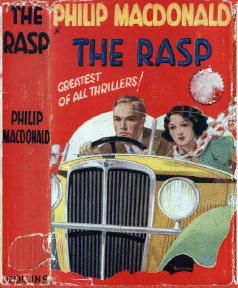
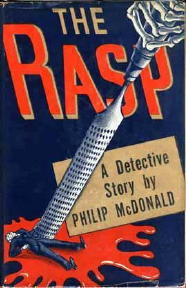
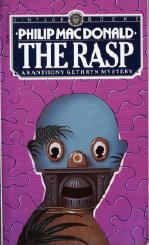
British hardcover: Collins, 1924 (see photo). US hardcover: Dial Press, 1925. Hardcover reprints (US): Scribner’s (S.S.Van Dine Detective Library), 1929; Mason Publishing Co., 1936 (see photo). Contained in Three for Midnight (with Murder Gone Mad and The Rynox Murder), Nelson Doubleday, 1962. Paperback reprints (US): Penguin #586, 1946; Avon G1257, 1965; Avon (Classic Crime Collection) PN268, 1970; Dover, 1979; Vintage, June 1984 (see photo); Carroll & Graf, 1984.

   There was a British film based on the novel that came out in 1932, and Philip MacDonald also wrote the screenplay. According to IMDB, the featured players that appeared in the movie were Claude Horton (as Anthony Gethryn), Phyllis Loring (Lucia Masterson), C.M. Hallard (Sir Arthur Coates), James Raglan (Alan Deacon), Thomas Weguelin (Inspector Boyd), Carol Coombe (Dora Masterson) and Leonard Brett (Jimmy Masterson). If you think you’d like to see this on DVD sometime soon, so would I, and so would a lot of other people. This is a “lost” film, with no known copies in existence.

   I hadn’t realized it before this, but MacDonald was involved in a good number of other movies, all as author of the original story, as screenwriter, or — as also with Rynox, also made in 1932 — both. I’ll go into some of the other fare at some other time, but the good news for Rynox is that after also having been lost for 40 years, it turned out to only have been misplaced. A print was discovered in 1990 after 50 years in the Pinewood Studios vaults, acquired by the National Film Archive and transferred onto safety film. Is it on DVD yet? Probably not, but maybe?
The Rasp

   As for the book itself, now that my usual opening digression is over, a nice copy of the British first in jacket will set you back, I am sure, a figure in the low four-digit range. If all you care to do is to find a copy to read, you shouldn’t have to pay more than three or four dollars. Although I have several other editions, the one I just read was the 1984 edition from Vintage Books, and as far as the story’s concerned, there was still plenty of value left.

   As a Haycraft-Queen Cornerstone title, there may be more value from historical perspective than there is from a pure story point of view, although I was certainly entertained all of the way through. On the other hand, most readers of contemporary detective fiction will probably not get all that far into it, if they even pick it up in the first place.

    This was MacDonald’s first book. It was therefore also obviously the debut of his long-time detective character, Colonel Anthony Gethryn. Gethryn’s career started fast, with ten recorded cases between 1924 and 1933, then one in 1938, followed by a long gap until The List of Adrian Messenger came out in 1960. (There may have been some shorter fiction that appeared in the interim, but during the war years, there was very little if anything that MacDonald produced in the way of mystery fiction.)

    To most mystery readers day — to return to the thought I was having a paragraph or so before — a book that was written in 1924 is going to appear as a period piece, stodgy, if not out-and-out primitive. The “rules” of detective fiction were still being formalized — what constituted “fair play” and all that goes with it. This comment does not apply to thrillers, for which authors had other objectives.

   Working largely without a “Watson” to bounce his ideas off of, Gethryn notices a lot of things but often keeps them to himself, or at least the significance of them, which helps to explain the necessity of the entirely remarkable 46 page letter that Gethryn writes to the police afterward, laying out in immaculate detail all of his thought processes as he worked his way through the case.

    Let me repeat that. Forty-six pages. Is there a denouement longer than this to be found in any other work of detective fiction?
The Rasp

    Dead, you may (at last) be interested in knowing, is a noted member of the government. A cabinet minister, in fact, a fellow named John Hoode. The murder weapon is the titular woodworking tool. The place, the study in Hoode’s country residence. The suspects are primarily the few friends, relatives, staff and servants who were also in attendance that fateful evening, as Gethryn soon eliminates The Woman in the case, to his relief, for he has become madly infatuated with her. She is Mrs. Lucia Lemesurier, a widow — her previous husband apparently being eliminated in the movie version — as soon as he meets her it is with an all-but adolescent passion that renders him near speechless in her presence.

    Accused by the C.I.D. is Hoode’s secretary, Alan Deacon, to whom all of the evidence seems to point. This includes the most damning: his and only his fingerprints were found on the woodmaking murder weapon. There is a good summation of the facts against Deacon on page 121. Gethryn demurs, however, and reassures the gentleman’s lady friend that all shall be well.

    Another detective writer’s creation is mentioned on page 43, where Gethryn declaims somewhat unhappily:

    “And I feel as futile as if I were Sherlock Holmes trying to solve a case of Lecoq’s.” He put a hand to his head. “There’s something about this room that’s haunting me! What is the damned thing? Boyd, there’s something wrong about this blasted place, I tell you!”

   For the most part, however, Gethryn putters about most happily, this game of investigation invigorating him no end, ending days of malaise after his return from the war (the first one). Most of Chapter Two is a mini-biography of Anthony Ruthven Gethryn, for those who would like to know more, but in essence he is the well-to-do bored genius, who needs the incentive of a murder to be solved to be at ease with himself.

   At least that’s his persona in this, his first appearance. Whether, like Ellery Queen, he changed over the years, at the moment I cannot tell you. Perhaps you can tell me.

PostScript: I found another quote that I intended to include, and I didn’t. I can’t find an appropriate place to put it now, without interrupting whatever train of thought I was riding at a particular juncture, so I’ll put it here. What this seems to do is reinforce several of the ideas I was working on, especially toward the end of what I was saying. From pages 111-112, with Gethryn visiting Lucia in her drawing room:

    For a moment his eyes closed. Behind the lids there arose a picture of her face — a picture strangely more clear than any given by actual sight.

    “You,” said Lucia, “ought to be asleep. Yes, you ought! Not tiring yourself out to make conversation for a hysterical woman that can’t keep her emotions under control.”

    “The closing of the eyes,” Anthony said, opening them, “merely indicates that the great detective is what we call thrashing out a knotty problem. He always closes his eyes you know. He couldn’t do anything with ’em open.”

    She smiled. “I’m afraid I don’t believe you, you know. I think you’ve simply done so much to-day that you’re simply tired out.”

    “Really, I assure you, no. We never sleep until a case is finished. Never.”

PostScript #2. I really do not know what to make of the cover of the paperback edition that I read.
The Rasp

— May 2005


UPDATE [06-02-07]  I’ve belatedly decided to include a list of all of the Gethryn novels. UK editions only, but the US titles are given if they were changed. Taken from Crime Fiction IV, by Allen J. Hubin:

* The Rasp (n.) Collins 1924 [England]
* The White Crow (n.) Collins 1928 [England]
* The Link (n.) Collins 1930 [England]
* The Noose (n.) Collins 1930 [London]
* The Choice (n.) Collins 1931 [England] US: The Polferry Riddle
* The Wraith (n.) Collins 1931 [England; 1920]
* The Crime Conductor (n.) Collins 1932 [London]
* The Maze (n.) Collins 1932 [London] US: Persons Unknown
* Rope to Spare (n.) Collins 1932 [England]
* Death on My Left (n.) Collins 1933 [England]
* The Nursemaid Who Disappeared (n.) Collins 1938 [London]
* The List of Adrian Messenger (n.) Jenkins 1960 [London]
   As often happens, a blog entry on one subject will produce one on another, often an author which inspires a comment that generates a lot of research on yet another author, only accidentally related to the first one.

   Case in point:

   I reviewed the movie Catch Me a Spy not too long ago, a film based on a spy thriller by George Marton. No death date for Marton was known, but some fast research readily came up with one, and a short profile for him soon followed.

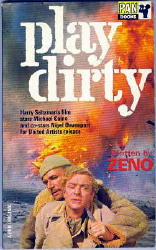
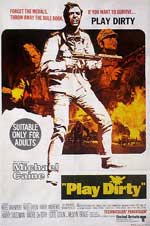
   A comment left by Juri Nummelin wondered if the Marton’s story, “Play Dirty,” made into a film of the same name, meant that Marton and the pseudonymous “Zeno,” who wrote the novelization of the film, were one and the same man.

Play Dirty

   The answer, as it turns out, is no, the two are not the same at all. It was John Herrington in England who came up with the answer as to who Zeno was, although (with the advent of the Internet) it does not seem to have been a highly guarded secret.

   Taken from a succession of emails from John —

   This is a bio from the paperback of one of his books:

   Before being commissioned in the field Z was himself a sergeant in the British First Airborne Division. Served with them in North Africa and Central Mediterranean, and at Arnheim – though he managed to escape. For last few months of his service, was deputy Assistant Adjutant General of an area in Southern India.

   After the war, he has led an eventful life! Committed murder and jailed for it. Definitely eventful.

   Ah, tracked the murder down. According to the Times, on the evening of the 23rd March 1958 Eric Battye, proprietor of the Mackworth Hotel, Swansea, was stabbed to death by one Gerald Theodore Lamarque, aged 46, of no fixed address. (A comment by his daughter on another web page says a ‘crime of passion’).

   Found his death. His death is registered in London City in the fourth quarter of 1978, so October sounds correct. Date of birth given as 2nd June 1920, so the age in the murder report appears wrong.

   And found his birth. Gerald T. La Marque (mother’s name Norton) registered in West Ham 3rd quarter of 1920. A typo I presume, as his father was Robert Gerald Lamarque, born 1886, married Dorothy C. Norton in 1912. It seems his father lived in West Ham most of his life.

   Zeno’s prior entry in Crime Fiction IV, by Allen J. Hubin, previously contained only one title, and as you will see below, next to no other information about him:

      ZENO; pseudonym
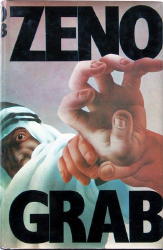
         * Grab (London: Macmillan, 1970, hc) [Africa] Stein, 1970.

   A further investigation on my part produced the following partial bibliography for him. It is incomplete, as I suspect that some titles that aren’t so indicated may have been published in the UK in hardcover, most likely by Macmillan.

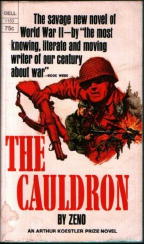
The Cauldron. Stein & Day, hc, 1967; Dell, pb, 1968. Pan, UK, pb.

    “The savage new novel of World War II – by the most knowing, literate and moving writer of our century about war” and “The Author of this extrordinary novel is now serving a life sentance for homicide. He has been in the past a soldier, a sailor and a farmer. He fought with the British 1st Airborne Division at Arnhem. This is the story of a platoon in that ill-fated battle. It makes every other novel of war seem like a tale for children…”

   “The Cauldron traces the fortunes of the men of a single pathfinder platoon, from their pre flight briefing in afternoon sunlight on an English airfield to the bitter end nine days later, trapped with the shattered remnants of the parachute brigade in the smoking ruins of Arnhem, The Dutch village that came to be known as the cauldron.”

   Winner of an Arthur Koestler prize for prison literature.

The Cauldron


Life. Stein & Day, hc, 1968. Macmillan, hc, UK, 1968; Pan, UK, pb, 1970.

   The author’s experience in Wormwood Scrubs prison as a ‘lifer.’ “A startling human document and a biting triumph born out of one man’s conscience. A prison book with a difference.”

Life, by Zeno


Play Dirty. Dell, pb, 1969. Pan, UK, pb, 1969.   Novelization of the movie of the same title.  No hardcover editions.

   Led by a young demolition expert, with a callous mass-murderer as his deputy, a bizarre group of killers and perverts — the scum of the Middle East — are sent on a desperate mission behind Rommel’s lines… Hating the Germans a little more than they hate each other, the exploits of these ruthless saboteurs are studded with murder, treachery and heroism as they fight a bitter war — knowing the winner must play dirty.

Play Dirty


Grab. Stein & Day, hc, 1970. Macmillan, UK, hc, 1970; Pan, UK, pb, 1972.

   Thriller about an ex-MI6 agent hired to collect an Arab in the desert and finding himself pitted against a sinister syndicate called the Greeks.

Grab, by Zeno


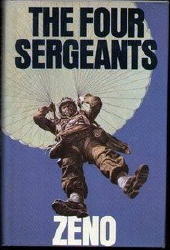
The Four Sergeants. Atheneum, hc,1977. Pan, UK, pb

   World War II fiction: “In the summer of 1943, four platoon sergeants, with precarious orders from their generals, parachute into Sicily to blow up a bridge.” Another citation says: “The 21st Independent Parachute Company included at least 26 Austrian, German, Polish and Czech anti-Nazi Refugees, who volunteered from the Pioneer Corps, using mostly Irish and Scottish Nommes de Guerre — almost all of whom were Jewish. In the novel The Four Sergeants by Zeno, their courage is described as outstanding by the author, who fought with them.”

Four Sergeants


   Of these titles, Play Dirty has been included in Part 15 of the online Addenda to the Revised Crime Fiction IV, just uploaded, but with a hyphen to indicate marginal crime-related content.

   A long obituary for noted journalist and war correspondent Edward S. Behr appeared in yesterday’s New York Times. He died in Paris last Saturday at the age of 81. Among his many other jobs and positions, Mr. Behr was a reporter and editor for Newsweek magazine between 1965 and 1988.

   According to the Times, he “covered wars in Algeria, Albania, Congo, Vietnam, Lebanon, and Northern Ireland … wrote about China’s Cultural Revolution … went to Cuba after the 1962 missile crisis. And in 1968 alone he covered the Tet offensive in Vietnam, the student riots in Paris and the Soviet occupation of Prague.”

   Author of 19 books, including biographies of Nicolae Ceausescu and Emperor Hirohito of Japan, Mr. Behr began his career in journalism with Reuters in London while earning degrees from Cambridge University in 1951 and 1953.

   Of interest to mystery readers, especially those who enjoy spy and suspense fiction, is his one entry in Crime Fiction IV, by Allen J. Hubin:

      BEHR, EDWARD (Samuel) (1926-2007)
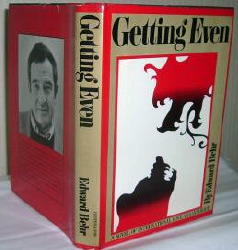
        * Getting Even (Harper, 1980, hc) [Paris] H. Hamilton, 1980. (No paperback editions.)

Getting Even

   A bookseller on ABE describes the book this way, most likely taken, at least in part, from a blurb on the cover:

    “Espionage novel about a French spy who seeks revenge for the betrayal of his Chinese lover. It was a note left in a supermarket which set everything in motion, a cry for help from a beautiful young secretary in a Western embassy of the Chinese People’s Republic which led to her forcible liberation, a brief but passionate love affair with her liberator, their betrayal, and his intricate and extraordinary revenge. Novel based on two true events — a Chinese diplomat defected from the embassy of the People’s Republic of China in The Hague in 1970 returning voluntarily to China in 1973. Similarly, a Chinese mission official requested political asylum while passing through Orly Airport in May 1971, but was handed back to the Chinese authorities against his will. Beyond these two events, none of the characters or institutions in this book exist.”

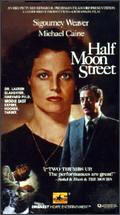
   Mr. Behr was also the co-screenwriter for Half Moon Street, a film based on Paul Theroux’s Doctor Slaughter (H. Hamilton, UK, hc, 1984; U.S. title: Half Moon Street, Houghton Mifflin), a book also included in CFIV.

Half Moon

   The film starred Sigourney Weaver and Michael Caine, with the plot line described on IMDB as follows:

   Dr. Lauren Slaughter, a research fellow at the Arab-Anglo Institute in London is utterly frustrated by her job. To supplement her income, she starts moonlighting at the Jasmine Escort Service, where she has more control over men and money than she does at the office. On one of her ‘dates’, Lauren meets the politician Lord Bulbeck who is trying to mediate a peace accord between the Arabs and Israelis. Bulbeck falls in love with his escort, and unwittingly, Lauren becomes a pawn in some very dirty politics.

   A review in the New York Times says in part:

   As directed and co-written by Bob Swaim, Half Moon Street displays an odd eagerness to stay within the bounds of familiar genres, even where none exist. A change that takes the sting out of Mr. Theroux’s ending, and a bit of miscasting designed to drum up an impossible romance, are only two of the unhelpful modifications that have been made. And as played by Sigourney Weaver, Lauren becomes a good deal less complex. She merely seems arrogant, patronizing and unbearably smug.

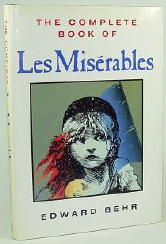
   Mr. Behr also wrote a history of Prohibition in the US and large illustrated books about the Broadway musicals Miss Saigon and Les Misérables.

Les Miserables

   A few posts back, mystery writer George Marton was discussed, this in conjunction with my comments on the movie based on a thriller mystery he co-authored with Tibor Méray, Catch Me a Spy.

   I listed there the books he had to his credit in Crime Fiction IV, a list that’s repeated below. I also pointed out he was born in 1900, but that no year of death had been noted, and that that was all I knew of the man.

   Thanks the investigative endeavors of Victor Berch and Ted Murphy, working separately, I can now tell you more. First, a repeat of George Marton’s entry in CFIV, adding his year of death and correcting his year of birth.

    MARTON, GEORGE (1899-1979)
         * The Raven Never More [with Tibor Méray] (n.) Spearman 1966.
         * Catch Me a Spy [with Tibor Méray] (n.) Allen 1971; Harper, 1969.
         * Three-Cornered Cover [with Christopher Felix] (n.) Allen 1973; Holt, 1972.
         * The Obelisk Conspiracy [with Michael Burren] (n.) Allen 1975; Stuart, 1976.
         * Alarum (n.) Allen 1977
         * The Janus Pope (n.) Allen 1980; Dell, 1979.

   While the books above all fall generally into the category of spy fiction, I’ve yet to come up with much in terms of story descriptions — and this is rather surprising — nor have I found scans of any of the covers, not one. Both of these omissions will be taken care of in a later post.

   His full name was George Nicholas Marton. Born June 3, 1899, in Budapest, Hungary; died April 13, 1979, in West Hollywood, California. Of the Jewish faith, Mr. Marton earned a PhD from the Sorbonne in 1924 and was a internationally known literary agent in Vienna between 1925 and 1937, and in Paris from 1937 to 1939.

   Fleeing the Nazis and coming to the US aboard the SS Normandie on March 30, 1939, he became president of the Playmarket Agency in Los Angeles from 1939 to 1944, later working for MGM. During World War II, Mr. Marton served in the Office of Strategic Services (OSS) and the National Guard. Returning to Paris, he became the literary agent for 20th Century Fox in Paris until his retirement in 1963 or 1969. (There are conflicting dates given for the latter.)

   It was not until his retirement that he turned seriously to writing. Besides the film based on one of his novels, one other, Play Dirty (1968), came from an original story he wrote. The movie, a “Dirty Dozen” type of war drama, was directed by André De Toth and starred Michael Caine in the leading role.

   His final novel, The Janus Pope, did not appear until after his death from cancer at the age of 79.

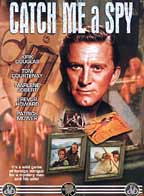
CATCH ME A SPY. [a/k/a TO CATCH A SPY] Capitole Films, 1971. Kirk Douglas, Marlène Jobert, Trevor Howard, Tom Courtenay, Patrick Mower. Based on the novel Catch Me a Spy by George Marton & Tibor Méray. Co-screenwriter & director: Dick Clement.

Catch Me a Spy

   The particulars on the novel, as per Crime Fiction IV, by Allen J. Hubin, are as follows:

      Catch Me a Spy (with Tibor Méray). Allen, UK, hc, 1971; Harper, US, hc,1969.

   The author twosome wrote one other book together:

      The Raven Never More (with Tibor Méray). London: Spearman, hc,1966.

      This is the extent of Tibor Méray’s entries in CFIV. George Marton has a small number of other books listed for him. All are hardcover editions unless indicated otherwise:

   MARTON, GEORGE (1900- )

      * Three-Cornered Cover [with Christopher Felix] (n.) Allen, UK, 1973; Holt, US, 1972.
      * The Obelisk Conspiracy [with Michael Burren] (n.) Allen, UK, 1975; Stuart, US, 1976. [France]
      * Alarum (n.) Allen, UK, 1977.
      * The Janus Pope (n.) Allen, UK, 1980. Dell, US, pb, 1979.

   I imagine George Marton has passed away by this time, but at the moment I have to confess that this is all I know about him.

To Catch a Spy

   And after all, this is a review of the film that was based on one of his books, and one I enjoyed but have rather mixed feelings about. The plot, however, should come first, and so I shall. Fabienne (Marlène Jobert), the rather naive young niece of a British intelligence official (Trevor Howard) is romanced and quickly married to John Fenton (Patrick Mower), but their honeymoon in Bucharest is rudely (if not crudely) interrupted by Fenton’s arrest and whisking off to Russia, where an exchange for a spy in Britain’s hands is demanded.

   When the swap falls through (and this is meant literally), the spy the Russians wanted not being available, in order to obtain her husband back, Fabienne must find another spy to offer them instead. This is where a chap named Andrej (Kirk Douglas) comes in.

   As there are in all good spy movies, there are several secrets behind some of these statements, none of which will I reveal, but after some quarreling and other small rows between the (now) two primary participants, a mutual kidnapping and several other humorous interludes, the day is saved — in a frenzy of final revelations and speedboat chases.

Marlene Jobert

   And I confess that I did not realize for a while that there WERE humorous interludes in this movie, and it took me several double-takes before I fully caught on. British humor is rather dry, often with a “did they really mean that?” sort of approach to comedy, at least on the viewer’s part, or so it was for me.

   I should have mentioned before now that this is a British film, in spite of Kirk Douglas being a well-known American star, and Marlène Jobert being equally well-known in France, but not in the US until recently, when it was revealed that she is the mother of Eva Green, female star of the most recent James Bond movie.

   But to get back to the point I was making, the movie we are talking about (and not Casino Royale) is amusing but not hilarious. It was also done in, at least for me, by accents. Both the British accents in this film, sometimes near impenetrable, and Mlle. Jobert’s French accent, often in a whispery voice, have convinced me that I might enjoy the movie even more if I were to watch it again and give them (the accents) a second try, which indeed I may.

   Or not. I didn’t see the attraction between the two leads. Kirk Douglas is tall and scruffy looking, while Mlle. Jobert appears short and pixie-ish if not waif-ish. She seems to all but disappear whenever they are on the screen together, standing one next to the other. Perhaps another viewing of this film would convince me otherwise, but right now, after seeing the movie only once, I can’t imagine opposites ever attracting each other as strongly as they are supposed to have done in To Catch a Spy.

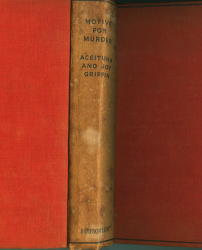
ACEITUNA & JOY GRIFFIN – Motive for Murder

Sampson Low, Marston & Co; UK, hardcover. No date stated (but 1935, according to CFIV).

   Neither lady was an author I’d heard of before I happened to read this book, and if you were tell me that you have a complete set of their combined works, I’m not sure I’d believe you. Joy Griffin has only the one co-authorship to her credit in Crime Fiction IV, by Allen J. Hubin. Aceituna Griffin, on the other hand, has a few others, the first few of them of only marginal crime content, as indicated:

      GRIFFIN, (Editha) ACEITUNA (1876-1949)

-Mrs. Vannock (n.) Nash 1907
-The Tavistocks (n.) Laurie 1908
-Pearl and Plain (n.) Longman[s] 1927
-Amber and Jade (n.) Longman[s] 1928
-Genesta (n.) Murray 1930
-Conscience (n.) Murray 1931
Delia’s Dilemma (n.) Pawling 1934
Motive for Murder [with Joy Griffin] (n.) Low 1935 [England]
Commandments Six and Eight (n.) Low 1936
The Punt Murder (n.) Low 1936 [England
Sweets and Sinners (n.) Low 1937
“Where There Is a Will…” (n.) Low 1939

   By the judicious use of Google, I’ve found a few other non-crime books by her, romance and/or historical fiction by the looks of the titles. I won’t list them here, but the link is there to follow if you wish.

   I did discover that Aceituna’s maiden name was Thurlow, which is something that Al Hubin hasn’t happened to have mentioned. Her husband’s name was Robert Chaloner Griffin, which throws my initial supposition that Joy and Aceituna were sisters right out the proverbial window.

   Except for the book at hand, that’s as far as I’ve been able to go in digging up information about either of the authors. In regards to the book itself, I have to confess that I was hoping for more when I picked it up to read. Which of course is a comment you should immediately ignore, since a general rule of thumb for reviewers is to review the book you have, and not the book you thought you had.

Motive for Murder

   Which is the story of Clarissa Lovell, a naive young girl nearing the age of 21 who was brought up by foster parents in a quiet, isolated section of England. When the two elderly folks who raised her decide to try their hand in Africa and become missionaries, Clarissa’s only option is to go live in London with her guardian and his wife, who are nearly strangers to her, and a change of scenery so abrupt from her previously sheltered life that her head spins at the thought of it.

   What’s many times worse is that the new people who are now in charge of her life have Plans for her. The most immediate of these is that she marry their son, Gilbert, who seems only moderately interested in the idea himself. You may have noticed a phrase that I mentioned in the paragraph above — nearing the age of 21 — and I imagine that may give you an idea of what the Plans are all about.

    Entangled in a web of deceit like this, as she slowly but surely finds out, she succeeds in making her escape, and only in the nick of time — matters having gotten rather tense right about then — and she heads off for Sicily on her own, where…

    I’m sorry to say that I can’t say more, but please rest assured that things do not fare for her well there either, with Mrs. Maxton, her guardian’s wife, picking up her trail more quickly than sin.

   You may also rely on my saying so that the unscrupulous plotters are really, really up to no good. Before Clarissa realizes it, she is once again in a rather bad spot. You may be surprised to learn that this rather naive approach to story-telling nevertheless makes for moderately enjoyable reading — if, and it’s a big if, you have the patience to give the book its head and allow it to find its own way, which it does very well indeed, thank you very much.

   There is no detection in this book, though, a fact which is still greatly to my own personal regret, no matter what rule of thumb happens to be in force, just a good old-fashioned dose of gothic suspense taking place in another time and another place rather far from our own. Young girls could still be terribly unsophisticated in 1935, and maybe they were in the mid-1960s and 1970s when the gothic romance craze hit both England and the US again for reasons not yet totally clear, but other than that, not in recent times that I can think of, no.

— February 2007

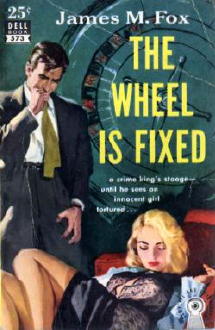
JAMES M. FOX – The Wheel Is Fixed

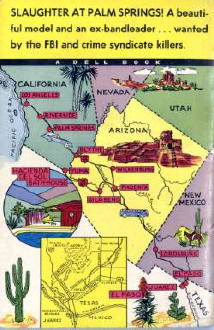
Dell 573; paperback reprint; no date stated, but circa 1951; mapback edition. Hardcover edition: Little, Brown; 1951. Also: Raven House #33, pb, 1980; 2nd printing (#22), pb, 1982.

   I may have the Raven House numbering scheme all wrong. The first printings you got only by subscribing to their overall line of books, which is what I did at the time. I never paid their mass market distribution (the later printings) much attention — who cared? — and they WERE different. There was a noticeable discrepancy in which books were published in one versus the other, for example, and a different numbering on those that were. To get information on the later printings now, all I’m able to do is look online to see how sellers describe their books for sale, which I have to admit, even between you and me, is a pretty pitiful way to conduct honest-to-goodness research.

   [UPDATE: It belatedly has occurred to me that Michael L. Cook included a complete checklist of the subscription Raven’s (through #72) in his book on book clubs, Murder by Mail (Bowling Green University Popular Press, revised edition, 1983). I can therefore confirm that The Wheel Is Fixed was indeed #33. What the numbers were in the list of later printings, however, Mr. Cook does not say.]

   The other books by Fox that were reprinted in the Raven House line are:

      #45. A Shroud for Mr. Bundy. [A John and Suzy Marshall mystery published in hardcover by Little Brown in 1952 and reprinted by Jonathan Press as a digest-sized paperback.]

      #61. The Coven. [A paperback original; 1981.]

   Fox, whose real name was Johannes Matthijs Willem Knipscheer (1908-1989), had a mystery-writing career that began in 1943 with the first John and Suzy Marshall book, and ended in 1989 with a mystery western from PaperJacks entitled Crunch.

   Not that I know very much about the Marshalls, but since Fox’s career began with one of their adventures – and in fact The Wheel Is Fixed is the first one which is not – and it’s their books that Fox may be remembered most for, if at all, I’ll go ahead and provide you with a complete checklist of them, taken from Crime Fiction IV, by Allen J. Hubin:

      Don’t Try Anything Funny. Davies, UK, 1943.
      Hell on the Way. Davies, UK, 1943.
      Journey Into Danger. Cherry Tree UK, pb, 1943.
      Cheese from a Mousetrap. Davies, UK, 1944.
      The Lady Regrets. Coward-McCann, 1947. Dell 338, pb, 1949.
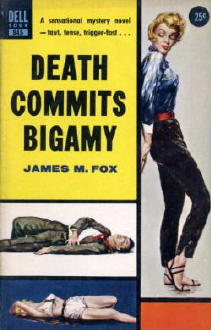
      Death Commits Bigamy. Coward-McCann, 1948. Graphic 14, pb, 1949. Dell 845, pb, 1955.

Death Commits Bigamy

      The Inconvenient Bride. Coward-McCann, 1948. Dell 463, pb, 1950.
      The Gentle Hangman. Little Brown, 1950. Dell 526, pb, 1951.
      The Aleutian Blue Mink. Little Brown, 1951. Dell 623, pb, 1952, as Fatal in Furs.
      The Iron Virgin. Little Brown, 1951. Dell 719, pb, 1953.
      The Scarlet Slippers. Little Brown, 1952. Dell 685, pb, 1953.
      A Shroud for Mr. Bundy. Little Brown, 1952. Jonathan Press J92, digest-sized pb, March 1957.
      Bright Serpent. Little Brown, 1953. Jonathan Press J96, digest-sized pb, probably early 1958, as Rites for a Killer.

   Plus one short story:

      “Start from Scratch.” Four-and-Twenty Bloodhounds, Anthony Boucher, editor, Simon & Schuster, 1950.

   Most of the stories took place in Los Angeles, CA. Why the first ones were published in the UK, I do not know, nor why they were never published here. (I do have a copy of Cheese from a Mousetrap. Perhaps I need to read it.)

   On his Thrilling Detective website, Kevin Burton Smith refers to the Marshalls as “Nick and Nora wanna-be’s.” Since once again I’ve not read one that I remember reading, I’m going have to fall back on quoting Kevin and leave it at that, for now: “Where Nick and Nora were rather urbane and urban sophisticates, constantly traveling from one trouble spot to another, martinis in hand, Johnny and Suzy were suburban all the way, beer-drinkers and homebodies, who didn’t have to go far, it seemed, to find trouble. It always seemed to find them, thanks to Johnny’s job as a private detective.”

   By 1953, the market demand for the Marshalls seems to have disappeared. All of the books written by Fox wrote after then seem to be action- and adventure-oriented, although I am allowing myself to say that only on the basis of seeing the names of the titles, in which stock you should know how much to put.       [FOOTNOTE]

The Wheel Is Fixed

   The Wheel Is Fixed appeared before at least the last three Marshalls, and it starts out as if it’s going to be one of the best unknown noirs ever written. A former orchestra leader named Rick Bailey and a girl named Lorna, described in a newspaper as a motion picture actress, are holed up in El Paso as fugitives from justice. Hunt Couple in Palm Springs Swim Pool Massacre, reads the headline of that very same newspaper. “They found the car in Phoenix yesterday,” Rick tells us, the reader, “which proves that we crossed a State line and makes us eligible for five years in the Federal penitentiary right there.”

    Lorna’s hands are bandaged, making it difficult for the couple to escape notice, and they see strange men on their trail everywhere they go. Checking into the Cortex Hotel, they hope against hope they will be able to cross the Rio Grande on the following day.

James Fox mapback

   At which point [end of Chapter One] Rick decides to put down the entire story down on paper, so that “at least the truth will be known, and the deal will have to from the top of the deck.”

   It’s flashback time, in other words, and unfortunately the next part of the story is not nearly as gripping as either the beginning. As for the ending, that comes later, which of course you knew before I told you, and I’ll get to it shortly. But what happens next, or first, if you are still with me, is that Bailey, down on his luck, is hired by a well-heeled gangster (and a heel to boot) to get a woman out of his son’s hair. A semi-interesting sojourn to Palm Springs develops from there, and several false starts later – or so they seem at the time – we finally, 150 pages later, get to the crux of the matter, and hence the headline.

   Thirty more pages from there, we have caught up with the present, and Rick Bailey has run out of things to put down on paper. The last remaining twelve pages are worthy of the opening chapter, let me tell you, in case I’d left you wondering, complete with at least one sock-removing twist I didn’t see coming, maybe even both sox, lulled perhaps to unawareness by the soporific middle stanza, or at least that’s the way I’m telling it.

    It is uneven, the story is, but in 1951 they built mystery and detective fiction of every subgenre and variety on puzzles and twists, and as I say,so it is here in the end. This particular effort on the part of Mr. Fox has not fared well over time, in terms of general recognition then and hardly now. All in all, this is mostly a forgotten book by an all but forgotten writer, but I’ll remember it for its good (if not great) parts at either end, and noticeably less for its lack of pace and cohesiveness in the middle.

— July 2006


[FOOTNOTE]  When I first wrote the review, which as you can see was nearly a year ago, I was somewhat less inclined toward completeness in providing checklists than I am now. Here is it the next day on the blog, and here are the rest of Fox’s mystery titles. I said they were action- and adventure-oriented. Feel free to judge for yourself.  [US first editions only, unless indicated; settings and series characters, if any, are included.]

# The Wheel Is Fixed (n.) Little 1951 [California]
# Code Three (n.) Little 1953 [Sgt. Jerry Long; Sgt. Chuck Conley; Los Angeles, CA]
# Dark Crusade (n.) Little 1954 [Steve Harvester; Paris]
# Free Ride (n.) Popular Library 1957 [Sgt. Jerry Long; Sgt. Chuck Conley; Train; U.S. South]
# Save Them for Violence (n.) Monarch 1959 [Mexico]
# Dead Pigeon (n.) Hammond, UK, 1967. US title: Dead Canary, Manor, pb, 1979. [Sgt. Jerry Long; Sgt. Chuck Conley]
# Operation Dancing Dog (n.) Walker 1974 [Steve Harvester]
# The Coven (n.) Raven 1981 [California]
# Crunch (n.) PaperJacks 1988 [U.S. West]

   Melville Davisson Post was born in 1869 and died in 1930, and is considered by some to be America’s Greatest Mystery Writer. He is best known for his primary series character, Virginia backwoodsman Uncle Abner, who with great religious and moral rectitude solved crimes during the presidency of Thomas Jefferson.

   Lesser known are two other characters, Randolph Mason, a lawyer in the 1890s who advises his clients on how to commit crimes and avoid punishment; and the detective of note in the book reviewed below, Sir Henry Marquis. “In the far corners of the earth and in the most intimately known places the reader travels. In delightful suspense he follows the destinies of singers, hoboes, mock priests, beautiful creoles, sinister hunchbacks, and German officers to their inevitable climax.”

   And with that brief introduction, Mary Reed will take it from here.

– Steve


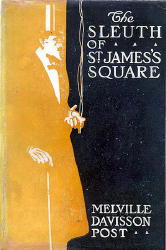
MELVILLE DAVISSON POST – The Sleuth of St. James’s Square

D. Appleton & Co., New York & London, hardcover, 1920.

   The sleuth who lives in a large house in St. James’s Square, London, is Sir Henry Marquis, head of the Criminal Investigation Department of Scotland Yard. He also owns a country mansion and a villa on the French Riviera and internal evidence suggests he was educated at Rugby’s famous public school and Oxford University. He previously ran the English secret service in the India-Burma border area and had also been busy in unspecified places in Asia, although there is reason to suppose he is familiar with Mongolia. Sir Henry belongs to the Empire Club in Piccadilly and apparently goes to the opera now and then.

   He is enthusiastic about scientific methods for solving crimes, mentioning dactyloscopic (fingerprint) bureaus and photographie mitrique in particular, but also laments lack of “intuitive impulse” in the men under his command. However, not all the cases in this collection of short stories are solved by deduction or even intuitive impulse, and indeed one or two end in triumph for those on the wrong side of the law. Oddly enough, although Sir Henry is the titular sleuth, in some stories he is not directly involved and in a couple he is referred to only in passing.

   Shall we begin?

Sleuth of St. James's Square

   “The Thing On The Hearth” is blamed for the death of Mr Rodman, a scientist who invented a process to make precious gems. He is found dead in a locked room guarded by an Oriental servant and his death involves what appears to be a visitor from … somewhere else. Sir Henry visit Rodman’s New England mansion to investigate the matter.

   In the next tale, Sir Henry has been looking over the memoirs of Captain Walker, head of the US Secret Service. In their ensuing discussion Walker tells him the tale of an inebriate hobo, who, when everyone else had failed, was instrumental in locating a number of stolen plates for war bonds, thus earning “The Reward.”

   The following adventure involves a large sum of money Madame Barras is foolishly carrying on an unaccompanied two mile journey through the forest lying between the home of an old school friend and the village hotel in which madame is staying. Sir Henry is also a hotel guest and helps search for “The Lost Lady.”

   The titled parents of a young man fighting at the front in France are extremely distressed. His fiancee has been staying out half the night motoring all over the landscape with Mr Meadows, and even admits to having deliberately picked him up! But when Mr Meadows obligingly gives a lift to Sir Henry, who is on his way to investigate a murder, footprints from “The Cambered Foot,” not to mention other clews, turn out to be not at all what they seem.

   In the next story, an Englishman, an American, and an Italian are *not* sitting in a bar but rather are chatting about the justice systems of their respective countries at Sir Henry’s villa. The Italian count relates how it was legally possible for “The Man In The Green Hat,” proved without a shadow of doubt to have been guilty of premeditated murder, to escape the death penalty.

   Sir Henry owns a diary kept by the daughter of his ancestor Mr Pendleton, a justice of the peace in colonial Virginia. The diary describes cases in which Pendleton was involved and this one concerns dissolute Lucian Morrow’s wish to buy a beautiful Hispanic girl from Mr Zindorf, whose ownership of her is dubious to say the least. However “The Wrong Sign” turns out to be right for saving the innocent.

   Another Pendleton story follows. Peyton Marshall’s will favouring Englishman Anthony Gosford has gone missing, and it transpires Marshall’s son has hidden it for what appears to be good reason. But can the lad’s unsupported claims be proved, allowing him to inherit what his father promised him? “The Fortune Teller” will reveal the answer.

   The next tale relates a third case involving Sir Henry’s ancestor. Pendleton meets a girl wandering about in despair. This is not surprising given her uncle, with whom she had been living, has just kicked her out of his house after informing her that her father was a rogue who robbed him and absconded. “The Hole In The Mahogany Panel” bears mute witness to the truth.

   After the war is over, the traitoress Lady Muriel is in desperate financial straits as she can no longer sell British secrets. She overhears a conversation that ultimately leads to her to commit murder in order to steal an explorer’s watercolour of, and map showing the route to, a lake in the French Congo where treasure lies at “The End Of The Road.”

   In “The Last Adventure” explorer Charlie Taylor has been trying to find the ancient route of gold-bearing caravans crossing Mongolia in order to salvage the precious metal from those that foundered. After he returns to America with only a few months to live, his friend Barclay undertakes to sell Taylor’s map to the location of a heap o’ gold to Nute Hardman, a man who had previously cheated Taylor.

   Continuing onward, jewel dealer Douglas Hargrave meets Sir Henry at their London club. Sir Henry is puzzling over an advertisement run in papers in three European capitals, trying to deduce what “The American Horses” represent in an obviously coded message. Then Hargrave meets a lady who wants to buy a large lot of valuable gems from a Rumanian who demands payment in cash….

   Lisa Lewis, American Ambassadoress, relates next a curious tale at a dinner party at Sir Henry’s house. “The Dominion Railroad Company” has experienced a number of terrible accidents and fears numerous reports alleging negligence will lead to its bankruptcy. Yet despite all possible precautions the Montreal Express derails because of “The Spread Rails.” Lisa’s friend Marion Warfield, who has revised a highly praised textbook on circumstantial evidence, solves the mystery.

   At the same dinner party Sir Henry describes the case of the hardhearted lawyer who demands more money to represent a butler on trial for murdering his employer. The money cannot be found and the accused’s wife wanders the streets in despair. A wealthy opera singer takes pity on her, treats her to a meal, and listens to her story. Is she a fairy godmother in the modern equivalent of “The Pumpkin Coach,” and can she help the man on trial?

   In the case following, Miss Carstair is having doubts about her marriage to diplomat Lord Eckhart despite her fiance’s gift of a stunning ruby necklace, for she is extremely troubled by gossip he is the worst ne’er do well in London. While she is pondering the matter Dr Tsan-Sgam, who has been dining with Sir Henry, arrives with news of the death of her father in the Gobi Desert, ultimately learning of its connection to “The Yellow Flower.”

   Up next, a post-war story narrated next by a weekend guest at Sir Henry’s country house. Sir Henry reveals the true story of an incident on a hospital ship boarded by Prussian submarine commander Plutonberg. Wounded St Alban defies him with the fighting words “Don’t threaten, fire if you like!”, becoming an instant hero to the British. But there’s a lot more to it than that, and a situation as bitter as the rolling waves is revealed in “A Satire of the Sea.”

   In the final yarn, the uncle of narrator Robin tries to put him off visiting him, but the envelope in which the letter arrives has a hastily scrawled appeal to ignore the contents and come to The House By The Loch. Will his uncle’s labours to cast a perfect Buddha ever be successful? Who is the highlander sitting knitting while talking about the Ten Commandments and taking a great deal of interest in the movements of Robin’s uncle?

   My verdict: A first rate collection with several stories having a O. Henryesque twist or two and catching the reader by surprise. My favourites were “The Last Adventure,” a wonderful biter-bit yarn, and “A Satire of the Sea,” with its psychological underpinnings. An author’s note for “The Man In The Green Hat” cites a specific case and readers may like to know it was heard by the West Virginia Supreme Court of Appeals in 1913.

    Etext: http://onlinebooks.library.upenn.edu/

         Mary R

http://home.epix.net/~maywrite/


Original story appearances [taken from Crime Fiction IV, by Allen J. Hubin] —

* American Horses • ss The Saturday Evening Post Dec 23 1916
* The Cambered Foot [“The Man from America”] • ss Ladies Home Journal Nov 1916
* The End of the Road • ss Hearst’s Magazine Nov 1921
* The Fortune Teller • ss Red Book Magazine Aug 1918
* The Hole in the Mahogany Panel • ss Ladies Home Journal Apr 1916
* The House by the Loch • ss Hearst’s Magazine May 1920
* The Last Adventure • ss Hearst’s Magazine Sep 1921
* The Lost Lady • ss McCall’s Jun 1920
* The Man in the Green Hat • ss The Saturday Evening Post Feb 27 1915
* The Pumpkin Coach • ss Hearst’s Magazine Oct 1916
* The Reward [“Five Thousand Dollars Reward”] • ss The Saturday Evening Post Feb 15 1919
* A Satire of the Sea • ss Hearst’s Magazine Feb 1918
* The Spread Rails • ss Hearst’s Magazine Jan 1916
* The Thing on the Hearth • ss Red Book Magazine May 1919
* The Wrong Sign [“The Witness of the Earth”] • ss Hearst’s Magazine Apr 1916; with added material.
* The Yellow Flower • ss Pictorial Review Oct 1919

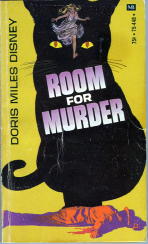
DORIS MILES DISNEY – Room for Murder

Macfadden 75-448; paperback, 2nd printing, October 1971; 1st printing, Macfadden 60-392, April 1969. First Edition: Doubleday/Crime Club, 1955.

   Explain this to me, if you can. Doris Miles Disney, while very popular in her day – and I’ll get back to that in a minute – and I haven’t checked to see how true this is for her other books, but at least the one I have here in my hand has all but vanished from the Internet marketplace. I find only six copies for sale, including none of the hardcover edition, ranging in price from $16.81, including shipping, to $34.49. The cheapest one, by the way, will be coming from the UK, if you were to order it.

    I don’t know whether it’s low supply or high demand, but what on earth is going on? It’s a good book, but by no stretch of the imagination is it a great one. It’s also very much not typical of books being written today, and that’s something else I’ve have to get back to.

   But in terms of describing Mrs. Disney’s popularity, here’s a list of her books, as taken from Crime Fiction IV, by Allen J. Hubin:

  DISNEY, DORIS MILES (1907-1976) US editions only; series characters and settings included:

* A Compound for Death (n.) Doubleday 1943 [Jim O’Neill; New England]
* Murder on a Tangent (n.) Doubleday 1945 [Jim O’Neill; Connecticut]
* Dark Road (n.) Doubleday 1946 [Jeff DiMarco; New England]
* Who Rides a Tiger (n.) Doubleday 1946 [Connecticut]
* Appointment at Nine (n.) Doubleday 1947 [Jim O’Neill; Connecticut]
* Enduring Old Charms (n.) Doubleday 1947 [Massachusetts]
* Testimony by Silence (n.) Doubleday 1948 [Connecticut; 1880s]
* That Which Is Crooked (n.) Doubleday 1948 [Connecticut; 1898-1946]
* Count the Ways (n.) Doubleday 1949 [Connecticut]
* Family Skeleton (n.) Doubleday 1949 [Jeff DiMarco; Connecticut]
* Fire at Will (n.) Doubleday 1950 [Jim O’Neill; Connecticut]
* Look Back on Murder (n.) Doubleday 1951 [New England]
* Straw Man (n.) Doubleday 1951 [Jeff DiMarco; Connecticut]
* Heavy, Heavy Hangs (n.) Doubleday 1952 [New England]
* Do Unto Others (n.) Doubleday 1953 [New England]
* Prescription: Murder (n.) Doubleday 1953 [New England]
* The Last Straw (n.) Doubleday 1954 [Jim O’Neill; Connecticut]
* Room for Murder (n.) Doubleday 1955 [Connecticut]
* Trick or Treat (n.) Doubleday 1955 [Jeff DiMarco; Connecticut]
* Unappointed Rounds (n.) Doubleday 1956 [David Madden; Connecticut]
* Method in Madness (n.) Doubleday 1957 [Jeff DiMarco; Connecticut]
* My Neighbor’s Wife (n.) Doubleday 1957 [Connecticut]
* Black Mail (n.) Doubleday 1958 [David Madden; Connecticut]
* Did She Fall or Was She Pushed? (n.) Doubleday 1959 [Jeff DiMarco; Rhode Island]
* No Next of Kin (n.) Doubleday 1959 [Connecticut]
* Dark Lady (n.) Doubleday 1960 [Connecticut]
* Mrs. Meeker’s Money (n.) Doubleday 1961 [David Madden; Connecticut]
* Find the Woman (n.) Doubleday 1962 [Jeff DiMarco; Connecticut; Maine]
* Should Auld Acquaintance (n.) Doubleday 1962 [Connecticut]
* Here Lies (n.) Doubleday 1963 [Connecticut]
* The Departure of Mr. Gaudette (n.) Doubleday 1964 [Connecticut]
* The Hospitality of the House (n.) Doubleday 1964 [New York]
* Shadow of a Man (n.) Doubleday 1965 [Connecticut]
* At Some Forgotten Door (n.) Doubleday 1966 [Connecticut; 1886]
* The Magic Grandfather (n.) Doubleday 1966 [Connecticut]
* Night of Clear Choice (n.) Doubleday 1967 [Connecticut]
* Money for the Taking (n.) Doubleday 1968 [Connecticut; Vermont]
* Voice from the Grave (n.) Doubleday 1968 [Maine]
* Two Little Children and How They Grew (n.) Doubleday 1969 [Connecticut]
* Do Not Fold, Spindle or Mutilate (n.) Doubleday 1970 [Virginia]
* The Chandler Policy (n.) Putnam 1971 [Jeff DiMarco; Connecticut]
* Three’s a Crowd (n.) Doubleday 1971 [Virginia]
* The Day Miss Bessie Lewis Disappeared (n.) Doubleday 1972 [Virginia]
* Only Couples Need Apply (n.) Doubleday 1973 [Connecticut]
* Don’t Go Into the Woods Today (n.) Doubleday 1974 [Connecticut]
* Cry for Help (n.) Doubleday 1975 [Virginia]
* Winifred (n.) Doubleday 1976 [Virginia]

    Did you spot the book from Putnam in there? I don’t know how or why that happened. It otherwise seems like a long and production relationship with Doubleday, one that lasted for nearly 35 years.

    For some basic biographical data, one online source says briefly of the author:

Doris Miles Disney (22 Dec 1907-9 Mar 1976) insurance employee, social agency publicist.

   For the long version, you can learn more here. (This webpage comes from doing a search in Google books, so you may have to repeat the search.) If you were to have gathered from the locale of many of her stories that she may have been from Connecticut, you would have been correct. She was born in Glastonbury, two towns over from me.

   Of her series characters, Jim O’Neill is a Connecticut county detective; Jeff DiMarco is an insurance investigator; and David Madden is a US postal inspector. From all accounts, Mrs. Disney began her career writing traditional detective stories, but began writing suspense thrillers that grew progressively darker as the years went on. Even so, a dose of comedy could often be found in her mysteries as well.

   Case in point, the book in hand, the only one of the above that I’ve read in, say, 30 years or so, making it the only one I can talk about with more than vague generalities. I won’t say I laughed out loud while reading it, but if intermittent chuckling counts, this is a funny book. There are some noirish qualities to it as well – by which I do not mean to say hard-boiled in any way, shape or form – far from it – but behind the walls of the rooming house where the book is centered there’s a definite sense of uneasiness that never quite goes away.

Room for Murder

   Running the rooming house are two spinster sisters named Aggie and Kate, Irish through and through, and who argue and quarrel with each other nearly all day long, or at least whenever they’re in the same room together. Nonetheless, having spent their lives together so far, the reader can tell that they could never live apart. Their niece Teresa has lived with the two women for most of her life and is now of marriageable age, but to her aunts’ ever growing frustration, she shows no signs of finding a suitable man to marry, or wishing to.

   There are other relatives, and of course there are the boarders, some of them long-term and some relatively new, and all have their own particular eccentricities, shall we say. It is one of the more recent roomers who is found dead after coming home after what appears to have been a long night of drinking. Suicide is the verdict of the local (Somerset, Connecticut) police department. Aggie, who reads true crime magazines, is not so sure, and surprisingly enough, ventures out on a long trip from home alone to prove it.

    I have not mentioned Dennis Callahan yet. He is one of the policeman called to the scene of the roomer’s death, and while he is there, he and Teresa immediately catch each other’s eye, much to the two sister’s displeasure. A mere policeman, he is, even though he has a solid Irish name – and there’s a story behind that as well.

   The case itself is complicated, and unfortunately, to my own personal regret, most of the detection takes place offstage. On the other hand, Mrs. Disney doesn’t pull any punches. As cozy and light as the banter in the rooming house is, there is a villain that is as nasty as any you will find in many other much tougher venues. It’s a clever mix that I found both unusual and, well, delightful.

— February 2007

   You probably won’t recognize Rod MacLeish, nephew of poet Archibald MacLeish and noted NPR commentator who died in 2006, as having written a novel that was nominated for an Edgar by the Mystery Writers of America, but as it happens, he did.

   Here’s his complete entry in Crime Fiction IV, by Allen J. Hubin, only slightly expanded:

   MacLEISH, RODERICK (1926-2006 )
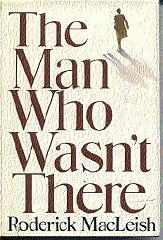
      * The Man Who Wasn’t There (n.) Random House, hc, 1976; Fawcett Crest, pb, 1977 [Washington, D.C.]
      * Carnaby Rex (n.) Weidenfeld, UK, 1976; See: The Man Who Wasn’t There (Random House,1976)
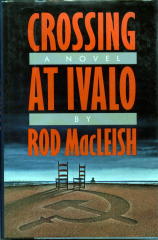
      * Crossing at Ivalo (n.) Little Brown, hc, 1990, as by Rod MacLeish. Zebra, pb, 1992.

Ivalo

   In case you may be wondering, it was the latter that caught the eye of the MWA. One online seller describes it thusly: “The principal architect of the Soviet ‘Star Wars’ system is kidnapped and his abductors offer him for sale to the Soviets and Americans. The Russians don’t want anyone to have him and the Americans want to learn all that he knows.”

   His earlier book having crime-related components, The Man Who Wasn’t There, is cryptically described by one seller thusly: “Millionaire film star, claiming to be his twin, reads of his death.” A second synopsis provided by another seller, probably from the back of the book itself, says: “From the quiet elegance of Georgetown to Hollywood and Paris, this novel moves inexorably toward the innermost recesses of a man’s mind. The suspense builds to a terrifying pitch in a climactic scene – a scene no reader will soon forget.”

Man Who Wasn't There

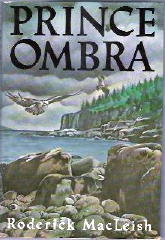
   Another book, this one with no criminous overtones, is A Time of Fear (Viking Press, 1958), the “story of a small town in the way of development.” Yet another, a science fiction fantasy thriller, is Prince Ombra (Congdon & Weed, hc, 1982; Tor, pb, 1983) in which the title character, “Prince Ombra is the lord of every mortal nightmare. He has appeared in the world a thousand times, and the rememberers have given him a thousand names – Goliath, the murderous Philistine; Mordred, enemy of Camelot. The heroes of legend have offered their lives in confrontation with the evil one. Among them have been David and Arthur, king of the Celts.”

Prince Ombra

   Or in other words, a book about a boy with magic powers in modern-day New England. During his journalist days, Mr. MacLeish also wrote a non-fiction book, The Sun Stood Still, about the 1967 Arab-Israeli war.

   According to an National Public Radio [NPR] tribute to one of their long-time contributors:

   MacLeish worked as a news director for WBZ radio in Boston in the early 1950s and later moved to London, where he was assigned the job of establishing a foreign news department for Westinghouse Broadcasting Co. He also worked for CBS News in Washington in the early 1970s, doing political commentary, and was a commentator and news analyst for NPR [during the early days of Morning Edition.]

   When he wasn’t covering foreign conflicts, he traveled the country writing social and political commentaries, including producing a program focused on race relations, A Month in the Country, with Bernard Shaw.

   MacLeish was also […] the broadcast voice of the Philadelphia Orchestra, and […] his documentary on the Hermitage in St. Petersburg was nominated for an Emmy.

« Previous PageNext Page »