Crime Fiction IV


   A couple of months ago I reviewed a book by Marguerite Silverman entitled The Vet It Was That Died. I didn’t include any biographical information on the author because at the time, I couldn’t find any. Nor was there anything more about her in Crime Fiction IV, by Allen J. Hubin, only the following list of the three books she wrote:

   SILVERMAN, MARGUERITE R(uth)
      * The Vet It Was That Died (n.) Nicholson 1945 [Chief Insp. Christopher Adrian; England]
      * Who Should Have Died? (n.) Nicholson 1948 [Chief Insp. Christopher Adrian; England]
      * 9 Had No Alibi (n.) Nicholson 1951 [Chief Insp. Christopher Adrian; England]

   
   For my overall opinion of the book, you can read the review. Here?s a quote, though, from somewhere early on:

   … The primary detective in each is Chief Inspector Christopher Adrian. Coming to his assistance in this one, at least, a relatively minor affair, is a newly graduated veterinarian surgeon by the name of Helena Goodwin.

   Helena’s involvement with the mystery is due only to this, her first job, however, and in fact she’s one of those immediately on the scene when her body of her veterinarian employer is found.

   
   Keep this in mind, as this will be important later. I no longer remember the reason — and this was only yesterday, mind you — but I happened to Google the author’s name, and up came up several websites I hadn’t seen before. Marguerite Silverman is not a common name, but neither is it uncommon, which makes a big difference when trying to locate an author when all you have to work with is her or her name.

   But one or two of these websites mentioned Marguerite Silverman as being — a veterinarian! And yet another site where I found her name was in relation to pets and their well-being.

   I asked British librarian-sleuth John Herrington if I was onto something, and indeed, yes he agreed, sending me this paragraph about her, found here:

   Marguerite R Silverman, MRCVS, ACIS, graduated from the Royal Veterinary College in 1935 and spent some time in companion animal practice before the Second World War. She then changed career and developed a successful business in verbatim recording (before the invention of the tape recorder). In 1958, following a holiday visit to Israel during which she had been distressed by the scale of the animal suffering she had seen, she founded the Society for Animal Welfare in Israel. […] In 1986 she approached UFAW about the possibility of SAWI being taken under its wing […] She died peacefully at a nursing home, near her home in Catcott in Somerset, on Friday 5 December 2003, aged 89.

   
   For those of us who are acronym-disabled, Google helps out in this manner also:

      MRCVS = Member of the Royal College of Veterinary Surgeon
      ACIS = Associate of the Chartered Institute of Secretaries
      UFAW = Universities Federation for Animal Welfare

   Working backward from her age at the time she died, along with the fact that she passed away so late in the year, it means that Miss Silverman, who apparently never married, was born in 1914. Unfortunately the Somerset Local Studied Library had no obituary on record for her. Then in a later email, John reported that: “According to Freebmd, her birth was registered in Southampton in June 1914. (Entry is incorrect as transcriber has read the R for Ruth as an M — magnification of the entry shows it as a poor R.)”

   I’ve still read only the one book of the three that Marguerite Silverman wrote. Knowing that she was a veterinarian herself, and learning of her lifelong love of animals, puts the book into a perspective I hadn’t had before. It also puts tracking down her other two mysteries several notches higher on my scale of things to do. Both are rather scarce, unfortunately.

      —

[UPDATE] 05-07-07. Although neither John nor I realized it, Al Hubin already had the information on Miss Silverman’s birth and death dates. See his Addenda #9 for the Revised CFIV.

   Here’s something that caught my eye a few days ago. A book just out from mystery writer Allison Brennan is entitled Fear No Evil. As it turns out, it’s part of a one-two-three punch in a series of crime novels connected by title and characters:

Allison Brennan

      Speak No Evil (Ballantine, pbo, Jan 30 2007) Homicide detective Carina Kincaid.

      See No Evil (Ballantine, pbo, Feb 27 2007) Private eye Connor Kincaid.

      Fear No Evil (Ballantine, pbo, Mar 27, 2007) Forensic psychiatrist Dillon Kincaid.

   What caught my eye was none of above, however. Not the titles, not the characters, not the quick time frame in which the books were published.

   It was this:

Alice Brennan

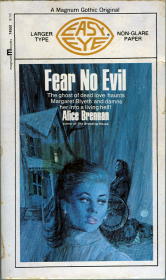
   A book by Alice Brennan with the same title as the third in Allison Brennan’s series of books, Fear No Evil, was published by Lancer in 1970. As I’m sure you can tell from the cover, Alice Brennan’s book is a gothic romance. Allison Brennan’s book, to put it in a category, might be called a psychological thriller — but then again, perhaps that’s what those old gothics have somewhat evolved into — books that are called either romantic suspense or psychological thrillers.

   Here’s Allison Brennan’s reaction when I emailed her about my find:

  Hi Steve:

   I didn’t know that little bit of trivia! I’ll have to try and find the book. Brennan is my married name and my husband doesn’t recall an Alice in his family, but part of his family lives in Canada and he doesn’t know all his relatives up there. Brennan is a very, very common name in Ireland and Canada. In fact, I think Brennan is one of the top ten most common Irish surnames.

   Thanks for the info! Truly an odd coincidence . . .

                        A

   Allison Brennan           www.allisonbrennan.com


   Looking up Alice Brennan in Al Hubin’s Crime Fiction IV, here’s her complete entry. It’s easy to tell that most of her books, if not all of them, fall in the “gothic” category:

BRENNAN, ALICE (1913-1973) Born in St. Louis; has been dancer, hat-check girl, secretary; living in Avoca, Michigan, in 1960s.

* Circle of Fear (n.) Monarch 1964
* The Brooding House (n.) Lancer 1965 [Michigan]
* Litany of Evil (n.) Lancer 1969
* Candace (n.) Paperback Library 1970
* Fear No Evil (n.) Lancer 74660, 1970 [Michigan]       FOOTNOTE.
* Castle Mirage (n.) Belmont 1971 [Oregon]
* The Devil’s Dreamer (n.) Lancer 1971
* Never to Die (n.) Lancer 1971 [Michigan]
* The Haunted (n.) Lancer 1972
* To Kill a Witch (n.) Lancer 1972
* Ghost at Stagmere (n.) Paperback Library 1973
* Sleep Well, Christine (n.) Avon 1973
* Devil Take All (n.) Popular Library 1974 [Michigan]
* House of the Fiery Cauldron (n.) Berkley 1975
* A Matter of Witchcraft (n.) Berkley 1975
* Thirty Days Hath July (n.) Avon 1975 [Michigan]

   And here’s something else you can do with CFIV. You can look up titles:

      # Fear No Evil • Leigh Brackett • (n.) (Corgi, 1960, pb) See: The Tiger Among Us (Doubleday 1957).

      # Fear No Evil • Alice Brennan • (n.) (Lancer, 1967, pb)

      # Fear No Evil • John Gordon Davis • (n.) (Collins, 1982, hc)

   I’m sorry to say that I haven’t been able to come up with a cover for Leigh Brackett’s book, not even of the original US title. Here’s a short synopsis, however: “The Tiger Among Us (1957) was a story of a citizen-turned-vigilante, who seeks to revenge himself on a gang of juvenile delinquents; it was filmed as 13 West Street starring Alan Ladd.”

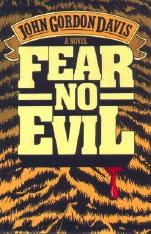
   A quick summary of the Davis book: “This is an epic story of the most dramatic theft of our time, of two extraordinary men, Davey and Charlie, circus hands, who try to return their animals to freedom.”

Davis

   And just for completeness, a description of Alice Brennan’s book, taken from the back cover: “When Margaret Blyeth came back to the lake country of her childhood seeking proof that she was not responsible for the death of a man who had claimed to love her, she quickly came under the spell of Mom Pet .. and just as quickly found herself enmeshed in a web of terror!”

   From Allison Brennan’s website: “In cyperspace, no one can hear you scream… Five years ago FBI agent Kate Donovan took on a sadistic killer and lost. Now running from her own government in order to prove her innocence in another girl’s gruesome murder, Kate teams with forensic psychiatrist Dillon Kincaid to find the killer’s chamber of horrors before Dillon’s sister Lucy is slaughtered live on the Internet.”

   Four books, one title, four totally different stories.

FOOTNOTE. The date stated for this book in CFIV, 1967, has been discovered to be an error. Another error exists in Graham Holroyd’s Paperback Prices and Checklist, which incorrectly lists Lancer number 74660 as Litany of Evil, which came earlier [74-580].

   Chester H. Opal was a one-shot author, at least as far as the world of crime and mystery fiction is concerned. The single entry for him in Crime Fiction IV, by Allen J. Hubin is:

LORRAINE, JOHN; pseudonym of Chester H. Opal
      * Men of Career (Crown, 1960, hc)

   According to what Al has learned, Mr. Opal was born February 9, 1918, and died on February 27, 2006. Neither date was known before. The subtitle of Men of Career is: A Novel About the Foreign Service, which makes the following Internet discovery come as no surprise:

   Deposited with Georgetown University’s Foreign Affairs Oral History Program is an interview with Chester H. Opal (USIA), or the United States Information Agency.

   Further investigation reveals that in his folder is a transcript of an interview he had with G. Lewis Schmidt, in which he discussed Poland (1946-49); Italy (1949-50); Planning Staff (1950-52); Vienna, Austria (1952-53); Mexico (1954-56); Naval War College (1956); Saigon, Vietnam (1957-60); Deputy Director of Television Service (1961-62); Schmidt Task Force on Europe (1962-63); Assistant Director for Europe (1963); Beirut, Lebanon (1964-66).

***

   Playwright Robert Lord, born in New Zealand on July 18, 1945, also has but one credit to his name in Crime Fiction IV, as follows:

LORD, ROBERT (Needham)
      * Country Cops (Broadway, 1988, pb) 2-act play.

   Based on information from Contemporary Authors, Mr. Lord lived in the US between the years 1974 to 1990, when he returned in New Zealand, where he died of cancer in January 1992.

   Further biographical information can easily be found on the Internet. A complete list of his plays can be found at http://www.playmarket.org.nz/, for example.

   Also learned from that website is that Mr Lord, “wrote numerous television programs as well as the screenplay for the New Zealand feature Pictures. At the time of his death, he was working on the screenplay The Big Ditch.”

   Described as a black comedy farce, Country Cops was first produced at the Dorset Theater Festival in Vermont. Synopsis:  “Set in a police station in small-town New Zealand. Jasper Sharp is sent from the city to solve a murder.”

    Ian Covell, from a post he made to the FictionMags Yahoo group:

   Thanks for alerting me that so much had been cleared up (though I can tell you the bibliography still has a couple of errors).

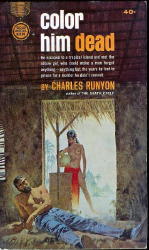
   I am “pleased” to find that the many books I thought were missing (there was a note [F&SF July 1974] that Runyon had written “over 30 published novels in 14 years of writing”) turn out to be much less (just over 20), and indeed, I have half of them.. definitely the SF, though not the Ellery Queen’s or the adult stuff.. The Black Moth is one of the finest, darkest thrillers I have ever read… and Color Him Dead is an unpredictable, excellent work. Soulmate is definitely adult horror. .

   The corrections and additions pointed out by Ian in the remainder of his post have already been incorporated into the bibliography. They include:

INCARNATE, the paperback from Manor, was published in 1977. (Previously “no date.”)

KISS THE GIRLS AND MAKE THEM DIE. Correct spelling of Runyan to Runyon.

I, WEAPON. The hardcover was published in July 1974, not 1971, which necessitated a change in the chronological order in the SF section. The paperback from Popular Library appeared in December 1977.

   Short Stories:

“In Case of Danger” F&SF, December 1975 — the actual title is longer and funnier, “In Case of Danger, Prsp the Ntxivbw”

      and add the following:

“Happiness Squad” – Fantastic, March 1967
“The Youth Addicts” – Worlds of IF, May 1967

   Charles also had a letter appear in F&SF, September 1975. [This does not appear in the bibliography, but it is certainly worth a mention here.]

   Ian also cited one British paperback reprint of one of Charles’ books, but since this means that other UK editions are omitted, I’ve decided not to include it for now, based on an “all or none” philosophy.

   Also from Ian: “I have a penned note of something called Hang Up from Gold Medal, circa 1969, but it really is just penciled in, not confirmed; may be an early title of No Place to Hide or even Power Kill.”

   And from Allen J. Hubin: “I’ve got the three Mark West titles listed in Addenda #14, each with a dash.” The dash, of course, indicating marginal crime content; the Addenda referring to the Revised Crime Fiction IV.

          —

   Thanks to Ian Covell in a followup email, and a judicious search of the Internet, I now have equal-sized cover scans for all of Charles Runyon’s novels. (One is a third printing, but other than that, it’s complete.)

   I’ve also cleaned up a couple of glitches that I created this morning. See the bibliography as it appears now on the primary Mystery*File website.

[UPDATE] 05-04-07. An email from Charles Runyon:

  Dear Ian, et al:

   Thanks for the kind words and the help in researching my past. You dug up some interesting material, not the least of which was that enigmatic Hang-Up which was supposedly published by Gold Medal in 1969. According to my wife’s Little Black Book, that was my original title for No Place to Hide.

   I sold a story entitled “The Day it All Hung Out” to Escapade Magazine in October 69. An amusing little tour de force, which I remember reading when it came out. I haven’t yet been able to find any copies of it in my files, but I’m keeping my eyes open.

   I sold a few other stories to the men’s magazines, such as Adam Yearbook, “There Must be More than This” and Knight, “The Appointment” but “The Day…” was the best according to my memory — not excluding “The Naked Bums,” which was the title Men put on their serialization of The Death Cycle. (If you’re looking for the Ultimate in Egregious Reprints, that’s gotta be IT.)

   I think the discrepancy in the number of books published arose from the fact that I counted foreign language editions at the beginning. Or maybe I was just exaggerating.

   Regards to you, Ian, and everybody else, Chas.

   Recently brought to the attention of mystery readers was the hitherto unnoted death of crime fiction author Michael Kenyon. Born in Yorkshire England in 1935, he lived in the US off and on after his university days for many years before eventually becoming an American citizen in 1997. He died in Southampton NY in 2005.

   Mr. Kenyon has a long list of credits in Crime Fiction IV, by Allen J. Hubin, most of them featuring in the starring role either Ireland’s Superintendent O’Malley or Inspector Henry Peckover of Scotland Yard. One book, The Elgar Variation (US title) seems to be somewhat of a transition point between the two series, with both characters sharing the top billing (see below).

KENYON, MICHAEL (1931-2005); occasional US pseudonym Daniel Forbes.

    * May You Die in Ireland (n.) Collins 1965; Morrow, 1965. Fawcett Crest R1211, pb, 1968. [Supt. O’Malley; Ireland]

Ireland

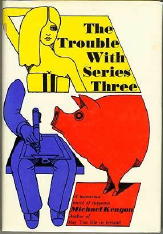
   * The Whole Hog (n.) Collins 1967; Morrow 1967, as The Trouble with Series Three. [Illinois; Academia]
    * Out of Season (n.) Collins 1968 [Channel Islands]. No US publication.
   * The 100,000 Welcomes (n.) Collins 1970; Coward, 1970. [Supt. O’Malley; Ireland]
    * The Shooting of Dan McGrew (n.) Collins 1972; McKay, 1975. [Supt. O’Malley; Ireland]

McGrew

   * A Sorry State (n.) Collins 1974; McKay, 1974. [Supt. O’Malley; Philippines]
    * Mr. Big (n.) Collins 1975; Coward, 1975, as by Daniel Forbes. [England]
    * The Rapist (n.) Collins 1977; Coward, 1977, as by Daniel Forbes. Dell 17294, pb, 1982. [Supt. O’Malley; Ireland]
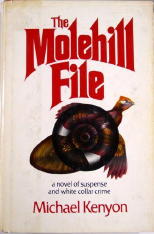
    * Deep Pocket (n.) Collins 1978; Coward, 1978, as The Molehill File. [Insp. Henry Peckover; England]
    * Zigzag (n.) Collins 1981; Coward 1981, as The Elgar Variation. [Insp. Henry Peckover; Supt. O’Malley; England]
    * The God Squad Bod (n.) Collins 1982; Doubleday 1982, as The Man at the Wheel. Avon 70381, pb, 1988. [Insp. Henry Peckover; London]
    *A Free Range Wife (n.) Collins 1983; Doubleday, 1983. Avon 70382, pb, 1988. [Insp. Henry Peckover; France]
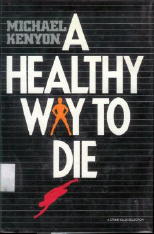
    *A Healthy Way to Die (n.) Hodder 1986; Doubleday, 1986. Avon 70380, pb, 1987. [Insp. Henry Peckover; England]
    * Peckover Holds the Baby (n.) Severn 1988; Doubleday, 1988. Avon 70636, pb, 1988. [Insp. Henry Peckover; Belize]
    * Kill the Butler! (n.) Macmillan 1991; St. Martin’s, 1993. [Insp. Henry Peckover; Long Island, NY]
    * Peckover Joins the Choir (n.) Macmillan 1992; St. Martin’s, 1994. [Insp. Henry Peckover; Belgium]
    * Peckover and the Bog Man (n.) Macmillan 1994; St. Martin’s, 1995. [Insp. Henry Peckover; Scotland]

   Compiled by using resources available on the Internet, the following collection of short synopses does not include all of the books above, but it does provide a fairly substantial glimpse into the kind of mystery fiction Mr. Kenyon wrote:

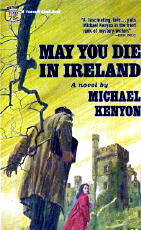
   May You Die in Ireland. The letter bearing the news that William Foley, easy-going math professor at a Midwestern university, had become the owner of a castle in Ireland was certainly cause for celebration. But the legacy that made him king of a castle also turned him into a human carrier pigeon, the unwitting bearer of a deadly secret, and a living time bomb.

   The Whole Hog aka The Trouble with Series Three. Arthur Appleyard experiments with pigs and their feeds.. one day he finds series three batch, including Marlon and Humphrey, have been given a magical ingredients of critical importance to the space race and the cold war!

Series Three

   Out of Season. Mystery set in Jersey as a German man returns to the island where his father was once stationed, to be met by hostility and bizarre events.

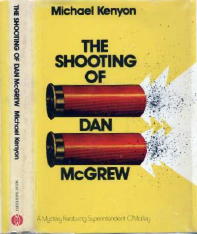
   The Shooting of Dan McGrew. In this hilarious Irish crime story, O’Malley investigates the disappearance of two prospectors working a mine site together.

   The Rapist. Dungoole in County Cork begins to unravel when a visiting American feminist is raped, and later murder occurs.

   Deep Pocket aka The Molehill File. Detective-Inspector Henry Peckover, “a passable published poet,” links the “murder of a May fair tart to a web of political, financial and sexual hanky-panky that encompasses a titled M.P., a police chief superintendent who turns drag queen by night, Middlesex pols and proles, bird hunters of all varieties and an Arab sheik bent on making the green and pheasant land an adjunct of Riyadh.” (Time Magazine, July 17, 1978)

   Zigzag aka The Elgar Variation. A simple escort-the-prisoner run goes awry when the man escapes just as Chief Inspector Peckover is about to take over.

   God Squad Bod aka The Man at the Wheel. Scotland Yard’s newly formed God Squad is following Paster J. C. Jones very closely. A Henry Peckover novel.

    A Free-Range Wife. Peckover finds himself in France at the Chateau de Mordan, where more is on the menu than escargots and chips: a modern-day Jack the Ripper.

   A Healthy Way to Die. An elite spa features beautiful bodies and murder for Inspector Henry Peckover of Scotland Yard.

Healthy

   Peckover Holds the Baby. Peckover is sent to Belize to track down a cocaine king and lands feet first in a messy brew of murder, drug running and kidnapping.

   Kill the Butler. It’s madcap mayhem when Inspector Henry Peckover goes undercover as a butler on a Long Island estate to find a millionaire’s murderer.

   Peckover Joins the Choir. Chief Inspector Henry Peckover and Detective Constable Jason Twitty go undercover as choir singers to investigate a series of continental art thefts.

   Peckover and the Bog Man. When Sir Gilbert Potter, whose blustering grows offensive at a dinner party, is murdered by a knife through his voicebox, Henry Peckover and his assistant Jason Twitty must investigate.

   While Barzun & Tayor in A Catalogue of Crime were not impressed with the two of Kenyon’s works they read – May You Die in Ireland “A bad first try,” and The Molehill File “rather turgid plotting and prose” – one suspects that humor combined with mystery were not what they were looking for. Craig Rice’s books are panned by them, for example, as being filled with “ill-advised humor.”

Molehill

   Other commentators have invariably made referenceto the humor in Kenyon’s mystery fiction and have been more favorably impressed. Reading what else they have had to say, along with the synopses above, the impression that’s gathered is that under the veneer of light-hearted gaiety in Mr. Kenyon’s work is a solid core of seriousness and — in the good old Irish tradition — a healthy dose of tragedy.

   I heard today from Charles Runyon, who’s been battling the flu. Going through his records, he’s come up with the following changes to his bibliography, posted here a couple of days ago.

    ● “Rum and Chaser” was the title put on one of my stories by Scott Meredith (or somebody working there at the time; perhaps Terry Carr) but that didn’t go down with the editor of Manhunt, who replaced it with my original title, “The Last Kill.” At least I think that was my original title; I used to have the magazine (Manhunt, April 1961) but I don’t seem able to find it now. Probably best to just leave out “Rum and Chaser” entirely.

   The book entitled Something Wicked (Lancer, pb, 1973) is included in Crime Fiction IV, by Allen J. Hubin, but tracking down a copy has proven to be a very difficult task. Both Victor Berch and I had come to the conclusion that it has never been published. The next comment from Charles confirmed my growing suspicion:

    ● Something Wicked was apparently the title put on Dorian-7 by the inheritors (if that is the right word) of the Lancer properties. At the time I was trying to switch from Scott Meredith to Richard Curtis and there was considerable confusion. Richard reported making several visits to the SM agency to winnow out all my stuff, but I do not recall getting paid for anything entitled Something Wicked. Maybe I did; my wife can’t find her financial records for that era so perhaps we could just sweep that little paradox under the carpet of the past. (Does this mean The Curse is actually working? Chills and premonitions.)

    So that it may be read more easily, I’ve moved the article entitled “The Curse of Dorian-7 to the primary Mystery*File website.

    ● A Killer is a Lonely Man was my title for To Kill a Dead Man (Major, 1976). [The former title sometimes appears as an unpublished book written by Charles.] It would be more appropriate in my case to retitle it To Revive a Dead Man because I’m about ready to make a major effort to resurrect my corpse which has been mouldering away (according to the report in SF Encyclopedia) since 1987.

    All of these changes are now in place. Thanks again to Charles Runyon and Ed Gorman for helping put together all of the pieces on this project, as they have. And to Charles, it’s great to have you back!

   Genevieve Holden, the author of seven mystery novels between 1953 and 1976, died Sunday, April 22nd, in Atlanta GA at the age of 87. As a mystery writer born and raised in Mississippi, she is one of the many authors honored by being included in the University of Mississippi’s online archive exhibit entitled Murder With Southern Hospitality: An Exhibition of Mississippi Mysteries.

   Excerpted from the page devoted to her is the following biographical summary:

    “Genevieve Holden is the penname of Genevieve Long Pou, who was born in Tupelo, Mississippi in 1919. She attended the University of Mississippi for two years before transferring to the University of Georgia. After college, Pou worked on the Birmingham Post and the Idaho Statesman before writing her first mystery in 1953.

Kate

    “Set in the South, Pou’s books epitomize the subgenre termed ‘Gothic,’ known more widely these days as ‘Romantic Suspense.’ Written primarily for a female audience, books of this nature feature heroines in dangerous situations who tend to find themselves attracted to handsome yet potentially menacing men.”

   Expanded from her entry in Crime Fiction IV, by Allen J. Hubin, here is her complete bibliography. Each of her books was published first in hardcover by Doubleday, all of them under their famed ‘Crime Club’ imprint.

HOLDEN, GENEVIEVE; pseudonym of Genevieve Long Pou, (1919-2007)

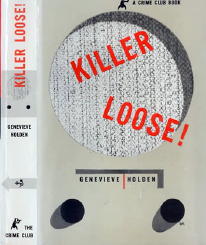
      * Killer Loose! (n.) Doubleday, hc, 1953. Detective Book Club, hc reprint, June 1953. Bestseller Mystery B172, digest pb, abridged. [Lt. Al White; U.S. South]

Loose

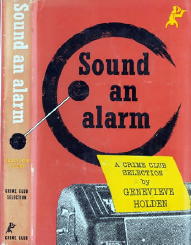
      * Sound an Alarm (n.) Doubleday, hc, 1954. Detective Book Club, hc reprint, May 1954. [Lt. Al White; U.S. South]

      * The Velvet Target (n.) Doubleday 1956. Ace G-554, pb, 1965. [Lt. Al White; U.S. South]

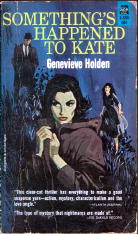
      * Something’s Happened to Kate (n.) Doubleday 1958. Ace G-558, pb, 1965. [Lt. Al White; U.S. South]

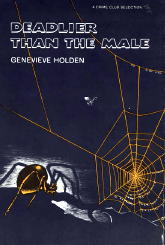
      * Deadlier Than the Male (n.) Doubleday 1961. Detective Book Club, hc reprint, August 1961. [New Orleans, LA]

      * Don’t Go in Alone (n.) Doubleday 1965 [Atlanta, GA]

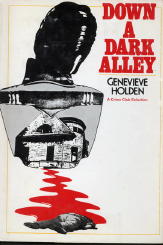
      * Down a Dark Alley (n.) Doubleday 1976 [Atlanta, GA]

   Reiterating what was said by the librarians at U-Miss about the nature of her books, the two reprinted by Ace were published as part of their ‘gothics’ line of paperbacks. The cover shown is quite typical; no would-be reader, almost invariably female, would look at the cover and not know what to expect if it were to be picked up and read.

   Covers sometimes lie, however. Belying my own words, Barzun and Taylor include one of her books in A Catalogue of Crime, saying about Deadlier Than the Male:

Deadlier

    “Here is more evidence tending to show that it is possible for an author of detective fiction to outgrow his or her earlier deficiencies. G.H. has written at least three other tales featuring the deep South and miscellaneous private eyes, examination of which disclosed nothing palatable. The present work differs markedly. Hank Farrell, the private detective, is a plausible ex-cop; the chase of a lady who does in one rich husband after another is reasonable; and it is enlivened by the discovery that she is hot on Ferrell’s trail.”

   Using Ellen Nehr’s Doubleday Crime Club Companion 1928-1991 as a guide, here are some comments on Mrs. Pou’s other novels, based on the blurbs on the inside front dust jacket flaps:

   Killer Loose! The leading character is Janet Milton, who with her young nephew Tolly, goes on the run from a psychopathic killer, apparently dressed in the uniform of a sheriff’s deputy. Lt. Al White is not mentioned.

   Sound an Alarm. In true ‘gothic’ fashion, Linda Stanley is hired as a governess for a grandchild and young heir. The house is a mansion with “cavernous halls with a sense of portending evil.” Lt. Al White again is not mentioned in the blurb.

Sound

   The Velvet Target. Eve Halsey is suspicious of her new uncle, believing that her wealthy aunt had made a bad choice in marrying him. Lt. White agrees, and he begins a race against time to rescue Eve when the honeymooners take her along.

   Something’s Happened to Kate. Menacing danger is in store for Kate Woodley after she meets handsome Jim Garrett – and disappears. Lt. Al White not mentioned in the blurb.

   Deadlier Than the Male. It is difficult to say for sure, but contrary to Barzun & Taylor, this seems to be the first book in which a PI is involved, Hank Farrell in this case.

   Don’t Go In Alone. Police detective Captain Mark Latham has a case of three missing Atlanta women on his hands, all of whom went into vacant homes on the real estate market and disappeared.

   Down a Dark Alley. Captain Mark Lathan (sic) returns [a series character previously unknown to Al Hubin] to solve the shocking murder of member of a motorcycle gang. Dinah Prentiss’s Victorian aunt is the primary suspect.

Alley

   Without knowing more about her books than this, do you also get the impression that there was a lot more toughness to Ms. Holden’s mysteries than you might have assumed at first?

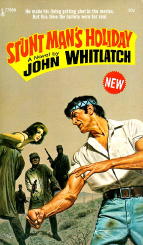
JOHN WHITLATCH – Stunt Man’s Holiday

Pocket 77660; paperback original; 1st printing, May 1973.

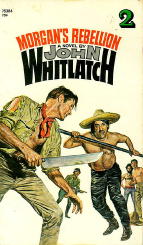
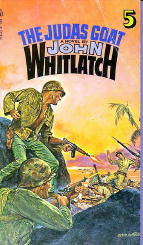
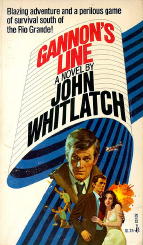
    I don’t know very much about John Whitlatch, and I don’t know anyone who does. In many, many ways he was the last of the true pulp fiction writers, even though his first book was published in 1969. Between then and 1976 he wrote 11 novels in a wide range of categories for Pocket, ten of them in one four years period.

   All of them paperback originals – crime, adventure, westerns, war, motorcycle gangs, the whole gamut. The titles were not all that remarkable, but the covers – the covers were lurid and eye-catching, and the books were reprinted over and over again. One presumes that they sold well.

Morgan's Rebellion

    Only three of them were listed in Crime Fiction IV, by Allen J. Hubin, but in Addenda #10 a complete revision of his entry now includes all of the books he wrote, as follows:

WHITLATCH, JOHN. No biographical information is known about this author of eleven popular pulp fiction paperbacks in the 1960s and 70s. While specific genres, settings and time periods vary widely, there is a criminous element in each of them. With Tom Power, one of the survivors of the event, John Whitlatch later co-authored Shoot-Out At Dawn (Phoenix Books, pb, 1981), an account of what took place at a remote Southern Arizona cabin in 1918. SC: John Gannon = JG; Captain Jamey Morgan = JM.

Gannon’s Vendetta. Pocket 75383, pbo, 1969. JG “Do not forget, gentlemen – violence is the only thing they understand. If in doubt, kill.”

Morgan’s Rebellion. Pocket 75384, pbo, 1969. “Prison made a man of Morgan. And the man became a legend.”

Tanner’s Lemming. Pocket 75616, pbo, Sept 1970. “Tanner – the man who single-fistedly quashed a student takeover and tongue-lashed its leaders into silence at a turbulent school-board showdown. Tanner – the man who had never flown a plane, yet took the stick when a pilot died in midair and landed safely. Tanner – the man whose blunt business sense had won him a place in a Senator’s inner circle. Tanner – had he blown a hole in the heart of the man millions of Americans revered? Had he killed Senator Stanton? Could he have been the assassin?”

The Iron Shirt. Pocket 75642, pbo, 1970. [West] “Jonathan Fontaine swore it … in the smoking remains of his homestead, over the charred, mutilated body of his young daughter. He had gone East but now was back in Arizona with a specially equipped rifle. And he had a fresh lead on the Indian – the one who had worn a necklace of human fingers and The Iron Shirt.” [Marginal: primarily a Western.]

The Judas Goat. Pocket 75643, pbo, 1970. “Hand-picked from the entire US World War II army, they were a unique company. Twelve men led by a lieutenant, as able as he was arrogant, and a sharp, seasoned sergeant who was militantly silent about his past. Twelve fighters, among them an ugly man, a black man, on old World War I scout, a southern redneck, and a mountain climber. They were a strange assortment, but tough and tenacious – and they didn’t care too much about living. To the General they were the army’s answer to the marines. To the Colonel they were a crack team … the best he could assemble. To the Lieutenant they were ‘animals.’ And by the time their brutal training had ended they were Killers!”

Judas Goat

Lafitte’s Legacy. Pocket 75670, pbo, Sept 1971. [Louisiana] “The last of the Lafittes had come back from Arizona to visit his dying grandfather. But enemies lay in wait, blcoking his way with fallen trees, terrorizing his wife with poisonous snakes, signalling their malice with voodoo dolls. Someone wanted the old treasure map that was his legacy. But his adversaries had not reckoned with the pirate blood that was also part of Lafitte’s legacy. He would fight with all the guile and guts, tenacity and ingenuity that had made his legendary ancestor the terror of the bayou.”

Frank T.’s Plan. Pocket 77587, pbo, Oct 1972. “To avenge his daughter’s death, an old man pits himself against the most violent forces of evil.”

Stunt Man’s Holiday. Pocket 77660, pbo, May 1973. [Arizona] “He made his living getting shot in the movies. But this time the bullets were real.”

Cory’s Losers. Pocket 77661, pbo, May 1973. “The little western town was full of crooked operators – and Cory wanted revenge on every one of them.”

Morgan’s Assassin. Pocket 77659, pbo, Aug 1973. “A squad of mean, smart killers was out to bring the nation to its knees. Only one man was tough enough to stop them –El Arquito!”

Gannon’s Line. Pocket 80743, pbo, Oct 1976. [Mexico] JG “Blazing adventure and a perilous game of survival south of the Rio Grande!”

Gannon's Line

    Victor Berch has checked the copyright records for the earlier books, and from the evidence found he says, “John Whitlach seems to be a real name. There was no indication in the records that this was a pseudonym.” Also interesting is the fact that, he goes on to say, “Nor are there any renewal records for any of his 1969 books.”

   Stunt Man’s Holiday is a crime novel, and in a more than minor way, it’s even a “fair play” detective story. Max Besh is the stunt man that the title advertises, not to mention a full-blooded Apache who needs all of his heritage, as it turns out, to follow a gang of bank robbers on a long, exhausting chase through the Arizona desert after they kidnap the girl he’s traveling with, along with the wife of a Don Rickles look- (and act-) alike Jewish comedian named Les Rick.

    And that’s the entire plot right there, summed up in only one sentence, even allowing for the fact that it’s a long one, which I grant you. Les Rick starts out being deliberately unlikable, but he gradually shows his worth (if not his innate cowboy ability) by accompanying Max the entire distance, by which I mean the entire book. Here’s an example of Max’s tracking skills, taken from page 132, where Rick asks if they’re getting closer:

    “I don’t think so. But in this heat it’s hard to tell; the tracks are just plain old dry and the manure dries within minutes …”

    “Huh!” Rick said with amazement. “But what’s this about the manure?”

    “Well,” Besh said, with his first grin in several hours, “it’s not exactly like reading tea leaves, but you can tell this much from examining the droppings. Fresh manure is moist and dries as it ages. So in seventy- to eighty-degree weather you can make a rough guess as to two, three days. But what I’ve seen today is too dry already to make a guess.”

    “I’ll be damned!” Rick said …

Stunt Man's Holiday

   The writing is competent enough, but as the excerpt shows, it may also be straightforward to a fault. And in all honesty, if you haven’t gathered where I’m headed already, as opposed to the opening scenes that take place in Las Vegas, the rest of the tale is rather skimpy in plot. Take the long trek in the desert, for example, in which (in retrospect) nothing really happens, except to allow the reader to watch as Besh and Rick, natural-born opposites, react against the other and get to know (if not understand) each other more.

   Nonetheless, what Whitlatch is rather adept and clever at, in this book at least, is in making the reader think something is happening – a hint here, building an anticipation there, adding to the puzzle now and again – when perhaps the something that is happening is a whole lot less. The ending, which is rather violent – all of a sudden, you see, things really do start to happen – is what the reader has been eagerly waiting for, he suddenly realizes, and he is finally rewarded. (Not many women will read John Whitlatch’s books, I suspect, but as always, I may be wrong.)

   What was unexpected, on the other hand, is that – as I mentioned earlier – this is a detective story of sorts. Not everything is what it seems, and since it is fairly obvious that it is not, I do not believe I am revealing anything I should not be. There are clues as to what is going on, in other words, if one reads slowly enough. But because they are not emphasized, it is easy to lose track of them as the story heads off in another direction, which it does.

   Or to be more specific, the crux of whole affair depends upon what was discovered way back on page 86. If you’re paying attention, and make yourself notes of what’s happening when it happens, you’ll have it figured out at the same time that Besh does, guaranteed – but he’s not talking. And Rick– as early into his education of the way of the west as it is when it happens – don’t count on him. He’s simply not swift enough.

   All in all, though? Not entirely what I expected. Whether that’s good or bad, I leave for you to decide.

— February 2007


PostScript: For a Gallery of all the Whitlatch covers, check out this page on the primary Mystery*File website.

   As you probably know, a good many writers who are well-known in other fields other than crime and mystery fiction have, on occasion, produced books which fall into the category of interest to us here — even if you have to wrench the boundaries out of shape a little, à la Art Buchwald, whose passing was covered here earlier this year, as you may recall.

   Axel Madsen, who died of cancer a week ago yesterday in California at the age of 76, is one of those authors. His entry in Crime Fiction IV, by Allen J. Hubin, is admittedly slim, but there it is nonetheless, and without the need for a stretch of any kind at all:

MADSEN, AXEL (1930-2007)
       * Borderlines (New York: Macmillan, 1975, hc) [Mexico]

   It is doubtful that Mr. Madsen made much money on the book, which will be returned to shortly. He began his writing career as a Hollywood film reporter in the 1960s and 70s, according to an obituary from the online edition of the Examiner, becoming famous if not wealthy by foregoing fiction and instead producing an eye-catching array of biographies of Hollywood stars, fashion designers, and other jet setters of the world.

   Subjects of his books include Billy Wilder, John Huston, Coco Chanel, Barbara Stanwyck, Andre Malraux, Simone de Beauvoir, and John Jacob Astor, and the list is far from complete. According to the Examiner, who should know, “his most popular works, however, were salacious Hollywood fare such as Gloria and Joe: The Star-Crossed Love Affair of Gloria Swanson and Joe Kennedy in 1988 and The Sewing Circle: Female Stars Who Loved Other Women in 1995.”

   It was Al Hubin who spotted Mr. Madsen as the author of Borderlines, the book largely taking place in Mexico. One webpage entitled Archaeology in Fiction Bibliography calls it a novel of stela smuggling.

Borderlines

   Strangely enough, googling on the phrase “stela smuggling” brings up only the site already cited. It must not be a very common occupation, it is to be presumed, but it is still somewhat surprising that the profession has not been taken up more widely, considering that a stela is — among other possibilities — a “Maya stone monolith, frequently engraved with hieroglyphs.”

   One online bookseller offering the book for sale describes it thusly:   “A story of international smuggling for the highest of stakes: power and reputation. It is a fast-paced suspense novel that could be taken from today’s headlines – and one that ends with a cynical plot twist.”   Right down our alley.

   Borrowing again from the article in the Examiner:   “Born in 1930 in Copenhagen to a Danish father and French mother, [Axel Madsen] grew up in Paris and worked for the New York Herald Tribune in the early 1950s.

    “Following a stint with United Press International in Canada, he headed to Hollywood in the 1960s. There, he did publicity for movie studios and worked as freelance correspondent for various publications before dedicating himself full time to writing books.”

[UPDATE] 05-01-07.  Excerpted from an email from Victor Berch, who also pointed out several typos, since fixed:

    “Just read your obit notice on Axel Madsen. Am not sure whether you want to include his book: Unisave: Ace Books, [Feb] 1980. It is s-f, but deals with killing off the elderly population (what greater crime??).”

Unisave

   From the blurb on the cover:  “In a dangerously overpopulated world the first line of defense has been breached. The birth quota had been a civilized measure: each adult had the right to replace himself with one child. Couples with two children reported to their local population care centres and were quietly restricted. But this had not stabilized the worlds population at 24 billion. Now, a harder less ‘civilized’ choice has to be made. The proposition — Geriatric Bingo — death for 1 in 3 amongst ‘eligibles’ in a standing room only world.”

   For a version with many more cover images, please see the main M*F website.

[UPDATE] 05-18-07. The link above is now the location of the “official” bibliography. It contains the additions made today and not found below. Any additional corrections will also be made to only the one found on the main M*F website.

      As Charles Runyon:

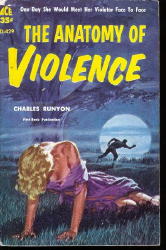
# The Anatomy of Violence (n.) Ace D-429, pbo, 1960 “One day she would meet her violator face to face.”

Anatomy of Violence

# The Death Cycle (n.) Gold Medal s1268, pbo, January 1963. “Behind them a murdered man. Ahead of them a lot of loving, lying, speeding and spending.

# Color Him Dead (n.) Gold Medal k1320, pbo, July 1963 [Caribbean] “He escaped to a tropical island and met the native girl who could make a man forget anything – anything but the years he lost in prison for a murder he didn’t commit.”

Color Him Dead

= Reprinted as The Incarnate, Manor Books 15235, pb, 1977. “There was nothing she would not do to make him forget.”

# The Prettiest Girl I Ever Killed (n.) Gold Medal k1507, pbo, 1965. “A strange novel of suspense.”

# -Bloody Jungle (n.) Ace G-594, pbo, 1966 [Viet Nam], as by Charles W. Runyon. “A powerful novel of the Green Berets in Vietnam.”

# The Black Moth (n.) Fawcett Gold Medal d1873; 1967 [Illinois] “They were spoiled, over-ripe little girls too wise for their years and some of them had to die, those who wore … The Black Moth.”

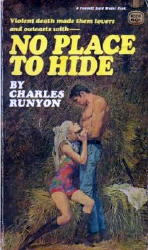
# No Place to Hide (n.) Gold Medal R2218, pbo, 1970. “Violent death made them lovers and outcasts with – No Place to Hide.” [Robert McGinnis cover]

No Place to Hide

# Power Kill (n.) Gold Medal T2560, pbo, May 1972. “First-rate suspense … compellingly readable.” — Mario Puzo.

# Something Wicked (n.) Lancer 1973.

   — UPDATE from Charles: Something Wicked was apparently the title put on Dorian-7 by the inheritors (if that is the right word) of the Lancer properties. [This makes this the book that Lancer paid for but never published before they went out of business. For more on the “curse” on this book, Charles has much more to say here.]

# To Kill a Dead Man (n.) Major 3061, pbo, 1976 [Caribbean] “He was an assassin for hire – no assignment was too large!”

    — UPDATE from Charles: A Killer is a Lonely Man was my title for this novel. [The latter title appears in some bibliographies as an unpublished book that Charles wrote.]

# Kiss the Girls and Make Them Die (n.) Pyramid 03963, pbo, 1977, as by Charles W. Runyon. [Hospital] “In the sterile white corridors of a mental ward – and the unexplored passages of the mind – unfolds a novel of heart-clutching terror, with a cast of characters caught inextricably in its lurking mystery.”

      As Ellery Queen

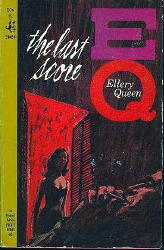
# The Last Score (n.) Pocket Books 50486, pbo, November 1964. Signet Q6102; pb, Oct 1974 [Mexico] (Rich couple’s daughter is kidnapped under the nose of her travel agent chaperone Reid Rance while on vacation in Mexico, and he’s got to get her back.)

The Last Score

# The Killer Touch (n.) Pocket Books 50494, pbo, October 1965. Signet Q6514, pb, 1975. [Caribbean] “There are many ways to die, sometimes nature holds the most special ones.”

# Kiss and Kill (n.) Dell 4567, pbo, April 1969. [Mexico] “The lady was luscious, and death followed everywhere she went.”

      As Charles Runyon, Jr.

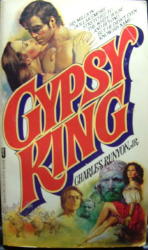
Gypsy King (n.) Jove 04041, pbo, 1979. Historical Romance. “His million dollar empire stretched to the White House and beyond, but he didn’t even know his name.”

Gypsy King

      As Charles W. Runyon

Pig World (n.) Doubleday, hc, 1971. SF.

= Lancer 75446, pb, n.d. “Charles W. Runyon’s harrowing new novel of the near future – when millions of captive minds will have but one master!”

Pig World

Ames Holbrook, Deity (n.) Curtis 07202, pbo, 1972. SF.

Soulmate (n.) Avon 18028, pbo, March 1974. Horror. Expanded from the story “Soulmate” Magazine of Fantasy & Science Fiction, April 1970. “A contemporary horror tale & a strong one, not recommended for the squeamish.”

I, Weapon (n.) Doubleday, hc, July 1974. SF.

= Popular Library 04127, pb, December 1977. “He was the ultimate man – and humankind’s last hope for survival.”

      As Mark West

Office Affair (n.) Beacon B-421Y, pbo, 1961. “She learned her tricks at the bottom of the heap – and he was her ticket to the top!”

Office Affair

His Boss’ Wife (n.) Beacon B-466F, pbo, 1962. “He was a man on the make and this time he wanted – his boss’ wife.”

Object of Lust (n.) Beacon B-468F, pbo, 1962. “She was beautiful, lonely and an … object of lust.”

●● Asked about the criminous content of the Mark West books, here’s what Charles had to say:

   “Crime in the Beacon books? In Object of Lust, Lewis stalked the woman and then kidnapped her and held her prisoner in a cave. (The setting is Branson, Mo, famous for caves and country music.)

   “His Boss’ Wife involves a traveling maggie crew run by a dominant male who intimidates his females into doing his will, and controls the young males by parceling out the favors of his harem. Crimes abound, since these maggies are always on the line between fraud, larceny, breaking and entering, flirting daily with accusations of rape and assault.

   “I still have these kids coming to my door and delivering the same sales pitch I used to hand out back in ’50 when I did my tour as a maggie. Sex predominates, because the editor had a feeling that readers wouldn’t stick past page 38 unless they read at least one explicitly graphic sex act. For me the important element was the tribal conflict between The Old Man and the brash upstart who joined the crew one morning in Minneapolis.

   “In Office Affair, the crime was Insider Trading, which landed Milliken and several others in the slammer. Involves the aggressive young CEO of Wolverine Pipeline Co and his lovely Chief Stockholder, who fight off a hostile takeover while enjoying a sex-romp around the executive suite.”


      Mystery and Suspense Stories

“Hangover Manhunt” Manhunt, December 1960

“The Last Kill” Manhunt, April 1961.

    — UPDATE from Charles: “Rum and Chaser” was the title put on this story by Scott Meredith (or somebody working there at the time; perhaps Terry Carr) but that didn’t go down with the editor of Manhunt, who replaced it with my original title, “The Last Kill.”

“The Possessive Female” Manhunt, June 1961

“Sales Pitch” (by Mark Starr) Manhunt, June 1961

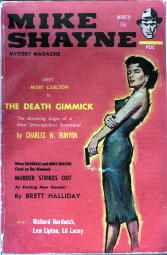
“The Death Gimmick” Mike Shayne Mystery, March 1962

Death Gimmick

“The Waiting Room” Alfred Hitchcock Mystery, October 1969

“Cycle Death Run.” Men, April 1970 (**)

“The Dead Survive” Mike Shane Mystery, September 1974

“A Good Head for Murder” Alfred Hitchcock Mystery, November 1974

“The Company of Brave, Rich Men” Alfred Hitchcock Mystery, April 1975

“An Act of Simple Kindness” Mike Shane Mystery, November 1975

“Death Is My Passenger” Mike Shayne Mystery, June 1976

(**) Since this magazine is probably the most difficult of Charles’ appearances in print to come by, here courtesy of the Internet, is a summary of the story line:

    “Cycle Death Run” concerns two bikers on the lam who trade wives in an effort to preserve the peace. Jeanne slowly falls in love with Carl for unexplained reasons. It may be because he does not beat her, or it may be because he awakens her as a women. More likely the motivation is not important to the story. Carl is a man, self–confident and self–reliant. He does not have to beat his women, though Jeanne wishes he would: “She almost hoped he would knock her down and beat her, for it would help assuage her own guilt. ‘I won’t be this foolish again,’ she said.” That she would love him is natural. “Cycle Death Run” ends with the unlikely image of Carl and Jeanne in paradise.

      Science Fiction and Fantasy

“First Man in a Satellite” Super Science Fiction, December 1958

“Solution Tomorrow” Fantastic, September 1959

“Remember Me, Peter Shepley” Fantastic, December 1960

“Happiness Squad” Fantastic, March 1967

“The Youth Addicts” Worlds of IF, May 1967

“Sweet Helen” Magazine of Fantasy & Science Fiction [F&SF], September 1969

“Dream Patrol” F&SF, February 1970

“Soulmate” F&SF, April 1970. Expanded into the novel Soulmate (Avon, pbo, 1974)

“Once There Were Cows” F&SF, July 1974

“Noomyenoh” F&SF, January 1975

“Terminal” F&SF, August 1975

“In Case of Danger, Prsp the Ntxivbw” F&SF, December 1975

“Brain Diver” F&SF, March 1976

“The Sitter” F&SF, July 1976

“Daughter of the Vine” F&SF, April 1977

“Metafusion” Stellar 3: Science Fiction Stories, Judy-Lynn Del Rey, ed. (Ballantine/Del Rey, pbo, October 1977)

“The Liberation of Josephine” F&SF, September 1978

      – The basis for this bibliography was Crime Fiction IV, by Allen J. Hubin, and the records of Charles Runyon. Thanks also to Bill Crider and Charles Runyon for providing many of the cover images seen on this page.

      —

Ed Gorman interviews Charles Runyon

The Curse of Dorian-7

« Previous PageNext Page »