Crime Fiction IV


   Jiro Kimura, who has now owned and operated The Gumshoe Site for 11 years, reports that legal-thriller writer Lelia Kelly lost a long battle with breast cancer on March 13th. She was only 48.

   According to information on her website, Ms. Kelly, a banker for 15 years, left the world of finance in 1998 and turned to writing instead. Her first two books are included in Crime Fiction IV: 1749-2000, by Allen J. Hubin. A third title has since been added to her bibliography, all in her Atlanta-based Laura Chastain series:

KELLY, LELIA (1958-2007)
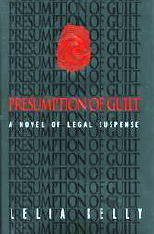
      * * Presumption of Guilt (NYC & London: Kensington, 1998, hc)
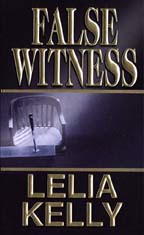
      * * False Witness (Kensington, 2000, hc)
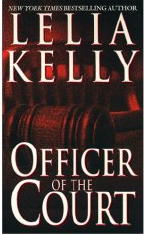
      * * Officer of the Court (Kensington, 2001, pbo)

   In her first appearance, Presumption of Guilt, Laura Chastain is a senior associate at a prestigious Atlanta law firm, but when the situation arises, she is surprised to discover she is good at criminal defense work, which is far from being a specialty of the firm.

Guilt

   According to the Booklist review of the book: “After she successfully defends the son of a corporate client against highly publicized rape charges, an Atlanta policeman strolls into her office, asking for help with charges that he killed a suspected child molester in custody at a police station. Despite management’s misgivings, Laura’s supervisor, poetry-spouting Tom Bailey, supports her desire to take the tabloid-ready, racially divisive brutality case.”

   By the time False Witness appeared, Laura had become an assistant DA, giving up her former (and much higher paying) position. Publishers Weekly described the story thusly: “Wealthy Christine Stanley has been murdered in her upscale Atlanta residence, leaving behind two shocked and bewildered children. Suspicion falls upon her husband, financial manager James T. Stanley, even though his alibi seems airtight (he was out of town on business).” Laura is also said to have a “a sweet, low-key romance.”

Witness

   In Officer of the Court, according to one reviewer on Amazon.com: “Lelia Kelly’s heroine once more surprises the reader by not following any pre-established rules of the game as a prosecutor. Kelly presents the interesting point of view, of what a prosecutor faces, when he/she knows the person on trial is really innocent of the crime. Chastain follows her own moral code, and not necessarily what the law, or the pattern of activities we have allowed to surround the law, dictates.” As of this date, all six reviewers on Amazon have given the book the maximum five stars out of five.

Court

   A fourth book was promised, but in a letter she posted on her website in October 2002, Ms. Kelly saddened her readers by saying that her cancer had returned. There would be a wait, she said, before Laura’s next case could be told. Sadly, it appears that the next chapter was not to be.

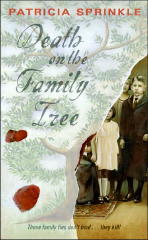
PATRICIA SPRINKLE – Death on a Family Tree

Avon, paperback original; 1st printing, January 2007.

   Here’s an author who’s been writing mysteries for quite a while, and (this may come as no surprise) this is the first one of hers that I’ve read. From the author’s website and a few other sources, including Crime Fiction IV, by Allen J. Hubin, I’ve come up with what I believe is a list of the books she’s done. Note that in some cases her byline is Patricia Houck Sprinkle.

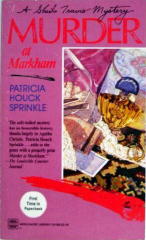
Sheila Travis Series: In Murder at Markham Sheila has been recently widowed and is working for a diplomatic training center in Chicago. Assisting her in solving crimes is her Aunt Mary, who hails from Atlanta, where Sheila frequently goes back to visit. In the third book in the series, Sheila moves back there permanently.

Markham

     Murder at Markham. St. Martin’s, hc, October 1988. Worldwide, pb, October 1992. Silver Dagger Mysteries, trade pb, revised, December 2001.
     Murder in the Charleston Manner. St. Martin’s, hc, May 1990. Worldwide, pb, April 1993. Silver Dagger Mysteries, trade pb, August 2003.
     Murder on Peachtree Street. St. Martin’s, hc, April 1991. Worldwide, pb, October 1993.
     Somebody’s Dead in Snellville. St. Martin’s, hc, August 1992. Worldwide, pb, July 1994.
     Death of a Dunwoody Matron. Doubleday, hc, April 1993. Bantam, pb, August 1994. Bella Rosa Books, trade pb, December 2005.
   A Mystery Bred in Buckham. Bantam, pbo, October 1994. Bella Rosa Books, trade pb, January 2007.
     Deadly Secrets on the St. Johns. Bantam, pbo, August 1995. [Note: This book is extremely scarce. There are only five copies offered for sale on Amazon, for example, with the lowest price being $44.50 for a copy in “good” condition.]

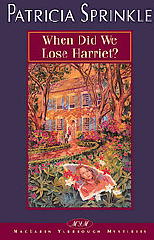
MacLaren Yarbrough Series: In the first book in the series, MacLaren is a wife of Judge Joe Riddley Yarbrough, a magistrate for the state of Georgia. In the second book, after her husband is shot, and two other people are murdered, MacLaren not only solves the crimes, but she takes over his position on the bench as well. After the first two novels were published by a Christian press, the rest of the series were published as mass-market paperback originals.

Harriet

When Did We Lose Harriet? Zondervan, pbo, November 1997.
But Why Shoot the Magistrate? Zondervan, pbo, September 1998.
Who Invited the Dead Man? Signet, pbo, July 2002.
Who Left That Body in the Rain? Signet, pbo, December 2002.
Who Let That Killer in the House? Signet, pbo, October 2003.
When Will the Dead Lady Sing? Signet, pb, June 2004.
Who Killed the Queen of Clubs? Signet, pbo, March 2005.
Did You Declare the Corpse? Signet, pbo, February 2006.
Guess Who’s Coming to Die? Signet, pbo, February 2007.

The Family Tree Series:

Death on the Family Tree. Avon, pbo, Jan 2007.
Sins of the Fathers. Coming in October 2007.

   From Ms. Sprinkle’s website she says about her work in progress: “Now I am deep in the tenth, and probably last, MacLaren Yarbrough mystery, What Are You Wearing To Die?” Which strongly suggests, of course, that she’s in the midst of shifting gears. Future mystery adventures will be concentrating Katharine Murray, a middle-aged Atlanta housewife who’s well-off and somewhat pampered, and whose first brush with crime in any form Death on the Family Tree is.

   The book begins on her 46th birthday, which she’s spending alone and which, unbeknownst to her, is her last day in her old comfortable life. Her children have moved out, and her husband Tom is out of town. Opening a box left to her by her recently departed Aunt Lucy, she finds two unusual items in among the junk: an ugly bronze necklace dating from the mid-1800s from Halstatt, Austria, and a diary, written in German and dating from a far more recent 1937.

   As she begins some genealogical researching she soon discovers relatives that she never knew she had, that there are secrets in her family she had never been told about, and that the diary means something to someone who will stop at nothing to possess it. You may have guessed that about the latter.

Family

   Also re-entering her life is a former boy friend, one she’d unceremoniously dumped before she married Tom, who is blissfully unaware that his absence in this crucially important time is his wife’s life is as serious as it is. Make that totally oblivious. (Speaking from a man’s point of view, he is a blithering idiot, and if he doesn’t watch out, he will deserve what he will most certainly get in the next book in the series.)

   Forgive me. I had to get that out of my system. It takes a while for all of Katharine’s family, her friends, and her friends’ families straightened out in the reader’s mind, and there surely are a lot of them, family, friends and relatives, that is. Katharine herself is prone to talking too much to all of them about her finds, and almost everyone else she meets. This was a tendency that this reader found almost intolerable, especially when all of this excessive talking leads to her being chased by cars, break-ins at her home, and eventually worse: several murders.

   It is soon clear (or it was to this reader) who is responsible for all of this nefarious activity, but Katharine, who even toward the end of the book still has not learned much about this Brand New World she is in, walks straight into the hands of the enemy, as if without a thought in her head.

   I don’t usually start yelling at characters in the mystery fiction I am reading, but I did this time. Perhaps that means that I cared? Perhaps so.

— January 2007

   Vince Keenan, my mystical master in all matters movie-wise, recently mentioned on his blog a soon-to-released boxed set of DVDs that is simply said, a must-not-miss. Available on March 20th is a boxed set of four Michael Shayne films from the forties that I have not seen in a long, long time, if ever.

   All four of them star Lloyd Nolan, whom you’d never go too far wrong by casting him as a semi-down-on-his heels private eye, but as Vince says, the perfect fellow would have been Ken Tobey.

   Contained in this set are:

Michael Shayne, Private Detective. 1940. This is one of the very few Mike Shayne movies that was actually based on a Mike Shayne novel. I’ve not checked to see how many of the rest of them were, but in this case it was Dividend on Death (Holt, 1939). [Note that Crime Fiction IV is in error on this point, and a statement to that effect has been made in the online Addenda to the Revised Edition, Part 12.]

The Man Who Wouldn’t Die.
1942. Credit is given to the Brett Halliday characters, but the novel it’s based on was Clayton Rawson’s No Coffin for the Corpse, a classic Great Merlini “locked room” mystery. Having never seen this film, and I’m very eager to, I don’t know how much of the plot line has been preserved, but for what it’s worth, way down in the IMBD credits is Charles Irwin as “Gus, the Great Merlini” (uncredited).

Sleepers West.
1941. This one’s based on Frederick Nebel’s mystery novel, Sleepers East. I don’t know. You tell me.

Poster

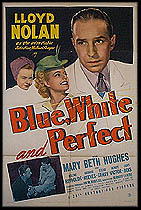
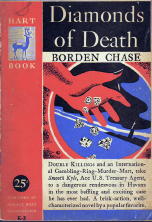
Blue, White and Perfect. 1942. Credit for the characters was once again given to Brett Halliday, but the story the movie’s based on was actually written by Borden Chase. It didn’t appear in book form until it came out as a 1947 digest paperback entitled Diamonds of Death (Hart K-2). The first appearance of the story was probably as a serial in one of the pulp fiction magazines in the 1930s.

Hart K2

   As much as I’d like to, I can’t review the movies now, but the odds are that I will, as soon as I’m able. Let’s go back to Vince’s comment that the perfect gent to play Michael Shayne would be Ken Tobey. (Looking back, I see that I’ve been assuming all along that you know who Mike Shayne is, and who Brett Halliday was. I didn’t intend to go into it here, and I won’t, but what I will do to send you to Kevin Burton Smith’s Thrilling Detective PI site, and trust to your good judgment to come back. It’s a gamble on my part, because I know from experience that you could easily get lost and spend days on end there, if you’re not careful.)

   Here’s a picture of Mike Shayne that was used on the covers of tons of 1950s Dell paperbacks. I’m not sure, but I suspect that the artist responsible was Robert Stanley. I’m sorry that it’s rather small, but it was only used in the corner of the covers.

Cover

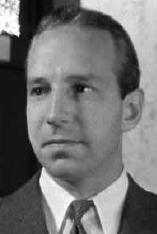
   Now here’s one of Lloyd Nolan. I can’t at the moment guarantee that this comes from one of the Mike Shayne movies, but I think it does. It’s the right vintage, at least:

Nolan

   Maybe he needs a hat and a cigarette drooping out of his lip, but I don’t see a resemblance.

   Here’s one of Hugh Beaumont. Before he became famous as Beaver’s dad, Hugh Beaumont remained fairly non-famous by playing the part of Mike Shayne in five films cranked out for PRC between 1946 and 1947. (Will these show up on DVD some day?)

Beaumont

   He isn’t bad, but it’s tough to tell, since all we see in this photo is his profile, but if you think about the Beaver’s show, and think Mike Shayne, do you get the same disconnect that I do?

   Mike Shayne was also the star of aTV show for one season on NBC, 1960-61. I was away at school then, and didn’t have time for TV, so I never saw it. I believe some of the shows are available on DVD, and if so, that’s one more item I’ll have to addto my next Amazon purchase. I also just realized that I didn’t mention that Richard Denning was the star. Here’s his likeness:

Denning

   Do you know what? As the years went on, I think the producers and the casting personnel were getting closer.

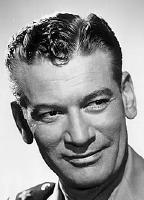
   Vince said Kenneth Tobey was the man, though, and I’m in full agreement. What do you think?

Tobey


[UPDATE] 03-19-07. A few typos have been corrected in the essay above, and several questions of a bibliographic nature have been answered, requiring a bit of revising here and there. This is now (um) the current version. Thanks again to Vince Keenan for allowing me to play on his ground.

   Jamie Sturgeon recently sent me a couple of emails about some of the obscure authors who’ve been discussed here. I’ve been remiss in not posting them earlier, but here at last they are. The first one concerns the inquiry about Arthur J. Rees.

  Steve,

   I wonder if Arthur J. Rees emigrated to Australia to live with his two sisters and died there? His last book, The Single Clue, although set in England, was published only in Melbourne in 1940.

      Best Wishes,

         Jamie

   Jamie, I hadn’t noticed that, and thanks. I’ve added the information to the list of Rees’s books in that previous post. There’s also a lengthy gap between that book and his previous one, which came out in 1934. There’s probably an explanation, but at this late date, it would be awfully hard to find someone who’d know.

   Jamie’s second email refers to the post I did on Ramble House Books as soon as I learned that Fender Tucker was reprinting a couple of mysteries by British author Rupert Penny:

  Hi Steve,

   Noticed your mention of Rupert Penny. Did you know about his pseudonym Martin Tanner? See Al’s Addenda Part 5 on CrimeFictionIV.com. Penny is also mentioned in Geoff Bradley’s CADS Supplement Private Passions Guilty Pleasures, where Martin Edwards’ Private Passion/Hidden Gem are the books by Rupert Penny. Martin Edwards says that Penny (Thornett), after he gave up writing crime fiction, became a leading figure in the British Iris Society, editing its yearbook.

      Best Wishes,

         Jamie

   You can follow the link to find Jamie’s information on Penny as Martin Tanner, but to save you the click of the mouse, here it is below. I believe that the years of birth and death for Thornett are new also.

TANNER, MARTIN. Pseudonym of Ernest Basil Charles Thornett, 1909-1970. Other pseudonym: Rupert Penny, q.v.
      Cut and Run. Eyre, 1941 (correcting publisher and date)

   Perhaps it’s clear from the title and Jamie’s mention of it what Private Passions Guilty Pleasures consists of, but if you go here you will learn more, and if you are like me, you will learn enough to know that it’s a must have.

   In short, however, in celebration of the 50th issue of Geoff Bradley’s printed zine called CADS, 87 crime writers, critics, fans and CADS contributors responded to the topic of what authors and what mysteries they have secretly (perhaps) enjoyed the most. Their comments were then compiled and published in booklet form separate from CADS #50, but mailed along with it.

   I don’t know if Jamie intended for me to mention it or not, but he’s one of the contributors, along with Martin Edwards, Colin Dexter, Reginald Hill and Peter Lovesey, to name but a few.

   CADS is short, by the way, for Crime and Detective Stories.

WILLIAM MAGNAY – The Hunt Ball Mystery.

Ward Lock, UK, hc, 1918. Brentano’s, US, hc, 1918. Other later printings exist, including Aldine Mystery Novels #22, UK, 1927. Etext at the Gutenberg Project.

   Give me a novel opening with a fellow arriving for a social gathering at a country house, and I’m as happy as the proverbial clam.

   The Hunt Ball Mystery begins in just this fashion, and right away we are in crisis mode. Hugh Gifford discovers he is without evening clothes due to a mistake made by the guard unloading luggage. Gifford and his friend Harry Kelson are going to a Hunt Ball to be held that evening at Wynford Place.

   The station master arranges for Gifford’s traps to be transferred to a down train at the next stop, although Gifford won’t get them until about ten. However, this still leaves time for him to attend the ball.

   The two men share a fly to the Golden Lion Hotel with a stranger who mentions he is also staying there and will be going to the ball. Gifford sniffily decides the man is not of their class, a conclusion based largely on the other’s looks and manner. The man is Clement Henshaw, brother of Gervase, whom Gifford knows by repute as a fellow legal eagle.

   Gifford insists Kelson goes on to the ball ahead of him, and Kelson and Henshaw depart. While waiting for his missing luggage, Gifford decides to stroll over to Wynford Place to take a look at its exterior. He returns two hours later, obviously having had a shock. Even so, he dons his now retrieved evening clothes and tootles off to the jamboree, where he makes the acquaintance of Dick Morriston, owner of Wynford Place, and Dick’s sister Edith.

   Not long before four next morning the hotel landlord pops in to ask if the Hunt Ball is over as Henshaw has not returned. After encouraging the landlord to lock the doors against his missing guest, Kelson pours himself a drink and suddenly notices blood on his shirt cuff.

   Then the missing Henshaw is found dead in a locked room with the key on the inside and an 80 feet drop from its window. The general consensus is Henshaw committed suicide. Gervase Henshaw, the dead man’s brother, disagrees, and so does the doctor who gives evidence at the inquest.

   At this point the mystery gallops off in full cry after the fox of whodunnit, how, and why. Revelations follow concerning what upset Gifford on his nocturnal walkabout, whence came the blood on Kelson’s cuff, the solution to the locked room matter, and so on.

   My verdict: I have long been a fan of the Country House Mystery and so was disposed to like The Hunt Ball. Alas, this particular visit to a rural estate was not too successful. The locked room solution is pedestrian and most readers will guess it. I found the characters unsympathetic and the police presented as inept, not least in overlooking a couple of clues — including one of a particularly glaring nature. Then too the introduction of an important witness was without previous hints of this person’s existence.

   It may be this novel was intended as a spoof of the Country House Mystery, but all in all, I found The Hunt Ball Mystery something of a disappointment.


   From Crime Fiction IV, by Allen J. Hubin, a chronological listing of Sir William Magnay’s other mystery fiction:

MAGNAY, [Sir] WILLIAM, 2nd baronet (1855-1917)

* The Fall of a Star (n.) Macmillan 1897.
* The Heiress of the Season (n.) Smith, Elder 1899. Appleton, US, 1899.
* The Pride of Life (n.) Smith, Elder 1899.
* The Man-Trap (n.) Smith, Elder 1900.
* The Red Chancellor (n.) Ward 1901. Brentano’s, US, 1901.
* The Man of the Hour (n.) Ward 1902.
* Count Zarka (n.) Ward 1903.
* -Fauconberg (n.) Ward 1905.
* -A Prince of Lovers (n.) Ward 1905.
* The Duke’s Dilemma (n.) Long 1906.
* The Master Spirit (n.) Ward 1906. Little, US, 1906.
* -The Amazing Duke (n.) Unwin 1907.
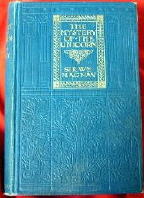
* The Mystery of the Unicorn (n.) Ward 1907. Street & Smith, US, 1910.

Unicorn

* The Pitfall (n.) Ward 1908.
* The Red Stain (n.) Ward 1908.
* A Poached Peerage (n.) Ward 1909.
* The Powers of Mischief (n.) Ward 1909.
* The Long Hand (n.) Paul 1912.
* Paul Burdon (n.) Paul 1912.
* Rogues in Arcady (n.) Ward 1912.
* The Fruit of Indiscretion (n.) Paul 1913.
* The Players (n.) Hodder 1913.
* The Price of Delusion (n.) Paul 1914.
* The Black Lake (n.) Paul 1915.
* The Cloak of Darkness (n.) Ward 1915.
* The Hunt Ball Mystery (n.) Ward 1918.
* The Flamards Mystery (n.) Pemberton 1942.
* The Eleventh Hour (n.) Odhams n.d.

   From John Herrington, as a followup to a previous blog entry describing the unsolved puzzle over who Golden Age mystery writer A. Fielding really was —


Hi Steve,

   Here are my latest notes on Fielding/Feilding in case someone can add anything.

   Further to my questioning of A. Fielding being the pen name of Lady Dorothy Feilding, I have a little more information — but also more questions.

   Working on the belief that her American publisher was correct in saying the author’s real name was Dorothy Feilding and had lived in Sheffield Terrace, Kensington, I retraced my steps and found that the statement was correct.

   Initially I checked the London telephone directories for the 1930s and — a Mrs A. Feilding was listed at 2 Sheffield Terrace from 1932 to 1936. A phone call to the Local Studies Library at Kensington, a check of the electoral roll for the period and there she was — Dorothy Feilding. No sign of Mr A. though. (Sadly, my previous enquiry had only seen the 1937/1938 rolls checked when she was no longer there).

    The phone books showed that she had moved to Islington for 1937, but by 1939 she had ‘disappeared’ from the listing.

   Unfortunately that is the sum of my search so far. A Dorothy Feilding (Mrs A.) was living in London circa 1932-1938 but so far no trace of her either side of that time. Also, there is no trace of Mr A. yet. Was she a widow, separated, was her husband away from home at the time? No idea. (Lady Dorothy’s husband was Charles Joseph, and anyway, his surname was Moore).

   There was an Albert Feilding born in Yorkshire in 1869, but cannot find another male A. Feilding from then to end of century. Possible the husband was not born in England or Wales, I wonder?

   There is also no trace of her in the probate registry up to the 1960s, but then she may died without making a will. I have yet to make a quarter by quarter search for her and her husband in the deaths registers.

   Not a great deal to say, but I think this at least removes Lady Dorothy from the scene.

   I have one other goodie which might be worth throwing out for comment.

   As you may now, the major English novelist C. P. Snow’s first book was a murder mystery, Death under Sail.

   Recently I was checking Author and Writers Who’s Who 1934 and came across the entry for a Kathryn Barber — who is in Crime Fiction IV for a couple of novels as Kay Lynn. But, to my surprise, her list of publications also include Death under Sail (in collaboration)!!

   Did a quick Google, but could find no mention of anyone but C. P. Snow in connection with the book..

   Wonder if anyone can throw any light on this?

Regards

   John


   From Crime Fiction IV:

SNOW, C(harles) P(ercy) [Baron Snow] (1905-1980)

* Death Under Sail (n.) Heinemann 1932 [Ship]
* -Strangers and Brothers (n.) Faber 1940 [Lewis Eliot; England; 1929-30]
* The Sleep of Reason (n.) Macmillan 1968 [Lewis Eliot; England; 1963-4]
* A Coat of Varnish (n.) Macmillan 1979 [London]

LYNN, KAY

* Laughing Mountains (n.) Hutchinson 1934
* Dark Shadows (n.) Hutchinson 1935


   By profession a dedicated newspaperman and sportswriter, Charles Einstein also dabbled in writing mystery and crime fiction. He died last week, and a more fitting and heartfelt tribute to him could not be found anywhere than this one by crime writer Wallace Stroby, who was also his editor at The Newark Star-Ledger for several years, not to mention a very close friend.

   You should read the entire piece yourself, of course, and I hope you will, but to illustrate what kind of interesting family Mr. Einstein came from, here are couple of paragraphs I’ve taken the liberty of excerpting from it:

   “His father was Harry Einstein, a radio, vaudeville and film comedian who billed himself as ‘Parkyakarkus’ and was a regular on Eddie Cantor’s NBC broadcast (he also became posthumously famous for suffering a fatal heart attack at a Friar’s Club roast in 1958, when tablemate Milton Berle’s cries of ‘Is there a doctor in the house?’ were misconstrued as shtick).

   “Charlie had two half-brothers as well, from his father’s second marriage – Albert Einstein and Bob Einstein. Albert, of course, eventually became writer/director/comedian Albert Brooks, and Bob went on to cable fame as ‘Super Dave Osborn’ and is now a regular on HBO’s Curb Your Enthusiasm.”

   As a sportswriter, Charles Einstein was, among other honors, a lifetime member of the Baseball Writers Association of America. His works include four Fireside Books of Baseball, The New Baseball Reader, and (with Willie Mays) Born to Play Ball and My Life In and Out of Baseball.

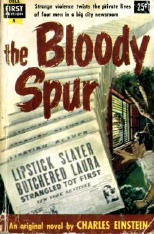
Spur

   As a mystery writer, his resume, while significant, is not nearly as extensive. Here’s a slightly expanded version of Mr. Einstein’s entry in Crime Fiction IV, by Allen J. Hubin:

EINSTEIN, CHARLES (1926-2007)

# The Bloody Spur (n.) Dell First Edition #5, pbo, 1953; reprinted as While the City Sleeps (Dell D86, 1956)
# Wiretap! (n.) Dell First Edition #76, pbo, 1955
# -The Last Laugh (n.) Dell First Edition A121, pbo, 1956
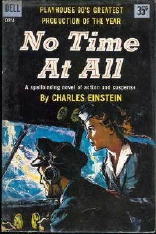
# No Time at All (n.) Simon & Schuster, hc, 1957. Dell, pb, 1958.
# The Naked City (co) Dell First Editon A180, pbo, 1959. Stories based on TV scripts by Stirling Silliphant.

• “And a Merry Christmas to the Force on Patrol”
• “Lady Bug, Lady Bug…”
• Line of Duty
• Meridian
• Nickel Ride
• The Other Face of Goodness
• Susquehanna 7-8367
• The Violent Circle

# The Blackjack Hijack (n) Random House, 1976. Fawcett Crest, pb, no date.

   I called his resume “significant,” and here are some details to back up that statement. First the movies, then the books the films were based on:

      THE MOVIES:

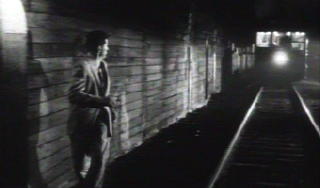
   The Bloody Spur was made into the RKO movie While the City Sleeps, 1956, directed by Fritz Lang. A top-notch film noir / social criticism film about the role of the media (newspapers vs. TV) while a serial killer is on the loose, it sounds as though it should be on DVD but for some reason, it does not seem to be. The movie stars Dana Andrews, George Sanders, Ida Lupino, Vincent Price, Rhonda Fleming, Howard Duff, Thomas Mitchell and Sally Forrest.

City

   No Time at All was filmed as an episode on Playhouse 90 in 1958. [See the cover of the paperback edition.] Available on video, an online description calls it: “A sort-of Airport of its time, this production tells of a stricken airliner that must make its way through the heaviest air traffic in the world without lights and radio. Among the cast members are William Lundigan, Jane Greer, Betsy Palmer, Keenan Wynn, Charles Bronson, Jack Haley, Buster Keaton, Chico Marx and Sylvia Sidney.”

No Time

   The Blackjack Hijack was the basis for the TV movie Nowhere to Run, 1978, starring David Janssen, Stefanie Powers and Allen Garfield. Synopsis of the movie, paraphrased from IMDB: “To get out of his marriage with Marian, world-weary Harry plans to fake his death and assume a new identity. His wife gets suspicious and hires a private eye, but when Harry discovers this, he hires the PI to work for him instead.”

      THE BOOKS:

   The Bloody Spur. “‘Help me for gods sake.’ Later the doctors would use these words to decipher the riddle of a perverted killer. Right now, the lipstick scrawl signaled the start of New York’s greatest manhunt.
   “And in the city room of the fabulous Kyne News empire, four big-time newsmen went into action. All four knew that an exclusive beat on the killings would mean the top job at Kyne – and they were all hungry for the job. Hungry enough to buck the police, sell out their mistresses, and commit blackmail. Four decent men – corrupted by the blood spur of ambition.”

   Wiretap! “Men with a golden ear. In the city of Aimerly they were the cops, the city prosecutor, the rackets boss. Their electronic spies recorded the intimacies of boudoir and office – intimacies later priced, and paid for.in cash or blood. Then a judge who knew where all the bodies were buried got himself murdered. And Sam Murray, State Crime Commission, walked into a maze of tapped phones, secret cameras, hidden mikes. Various people tried to sidetrack Sam, with the help of two ladies who were specialists at their work. But when Sam kept pushing, they gave him a choice – rot in jail, or send the last honest man in town to do it for him.”

   The Last Laugh. “Sam Prior was an off-stage straight man for Carl Anda and Jay-Jay Bailey, whom readers should be careful not to confuse with real-life entertainers, living or dead. And he was a straight man for his wife Rachel, whom he should have left where he found her, singing with her hips at a Borscht Circuit hotel. He tells his own story in his own words, warm and wry and funny. He’s a nice guy, and in the dog-eat-dog world of professional comics, they eat nice guys for breakfast.”
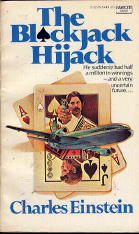
Hijack

   The Blackjack Hijack. About the author, taken from the dust jacket flap: “In a career that has included years as a wire-service newsman and feature writer in New York and Chicago, and as columnist and editor for two San Francisco dailies, Charles Einstein also has authored several hundred other works — books, screenplays, short stories, magazine articles. The Blackjack Hijack is his ninth novel and, he notes, the first in which he appears as a character in his own book, playing the part of an expert on the game of blackjack. Here art imitates life: in 1968 author Einstein published another book – now in its fourth printing and hailed by ranking computer programmers and other mathematicians as the best and simplest in the field — called How to Win at Blackjack. Both born in New England in the late 1920’s, the author and his wife first met as undergraduates at the University of Chicago, and with their four children, now all in their twenties, migrated subsequently from New York to Arizona to California.”
   There’s good news tonight!

   Taken from publisher Fender Tucker’s latest email newsletter, Ramble House Rambler #52, along with the other upcoming mystery fiction he’s promising to go to press with soon, I was doubly delighted this evening to see the following:

   Two books by Wade Wright, author of the Paul Cameron series. ECHO OF FEAR and DEATH AT NOSTALGIA STREET. The author, who lives in South Africa, is working with Ramble House to bring back all of his mystery novels.

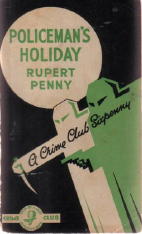
   Two novels from Rupert Penny, whose mysteries are filled with puzzles, time-charts, maps, railway schedules, etc. Thanks to friends in high places — Petaluma CA and Rockville MD — I was able to obtain copies of two hard-to-find titles: POLICEMAN’S HOLIDAY and POLICEMAN’S EVIDENCE. I’m working on them now.

   Delighted first of all because, as you may recall, John “Wade” Wright was interviewed here not too long ago. These will be the first US editions of any of his novels. It’s been a long wait, but it shouldn’t be too much longer. And if more are coming, as Fender seems to suggest, then all the better.

   As for Rupert Penny, he’s an author that I’ve always assumed to be a huge insiders’ secret. He wrote eight extremely scarce works of solid detective fiction between 1936 and 1941, and I’m lucky enough to have seven of them. I bought them back when they were still hard to find, but when you did, they were still relatively inexpensive. I don’t believe that I paid more than ten dollars for any one of them, but 30 to 35 years ago, ten dollars was a huge pile of change.

Holiday

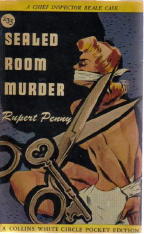
   Only two of the books are available on ABE at the moment. There is one copy of Sealed Room Murder, a Canadian paperback in VG condition for $145, and six copies of Policeman’s Holiday, all in paperback also, with asking prices ranging from $65 (a very worn reading copy) to $165. I haven’t checked the other online listing sites, but right now, not a single hardcover first edition is being offered on ABE.

   The Ramble House editions will be the first time that any of Rupert Penny’s will be available in the US. To whet your appetite, here’s a synopsis of Sealed-Room Murder. If your reading tastes are anything like mine, this will be hard to resist. (Unfortunately it’s not one of the book currently on Fender’s schedule, but I think it will get your mind thinking in the right direction.)

RUPERT PENNY excels all his previous form with this highly successful murder mystery. Unlike most “sealed-room ” stories, the problem is perfectly clear-cut and extremely simple in its elements. Where other mysteries try to baffle the reader by their complexity, this one will baffle by its simplicity. The story of Harriet Steele and the family that was forced upon her, is good reading even when considered as a straight novel, the situation is very real, very familiar and always lively and amusing in spite of the undertone of grimness. The thoroughly ingenious and exciting crime is put before the reader with scrupulous fairness so that he has every possible chance of leaping to the solution that will prove completely satisfying.

Sealed

   From Allen J. Hubin’s Crime Fiction IV, to whet your taste buds even more, assuming perhaps that the first two sell well, and that Fender can locate copies of the rest of them to reprint:

PENNY, RUPERT; pseudonym of Ernest Basil Charles Thornett. Series Character in all titles: Insp. (Chief Insp.) Edward (Ted) Beale.

* The Talkative Policeman (n.) Collins 1936
* Policeman in Armour (n.) Collins 1937
* Policeman’s Holiday (n.) Collins 1937
* The Lucky Policeman (n.) Collins 1938
* Policeman’s Evidence (n.) Collins 1938
* She Had to Have Gas (n.) Collins 1939
* Sweet Poison (n.) Collins 1940
* Sealed-Room Murder (n.) Collins 1941

   As part of the review that Mary Reed just did of Mary Roberts Rinehart’s When a Man Marries, it was noted that a free online edition exists. Here’s a complete list of all of MRR’s books which can be found on the Project Gutenberg website.

   * = title in Crime Fiction IV, by Allan J. Hubin.

   ** = title listed as having marginal crime content in CFIV.


Project Gutenberg Titles by

Mary Roberts Rinehart


* The After House (1914)

The Amazing Interlude

Bab: A Sub-Deb

* The Bat: A Novel From the Play by Mary Roberts Rinehart & Avery Hopwood (1926)

** The Breaking Point (1922)

* The Case of Jennie Brice (1913)

* The Circular Staircase (1908)

* The Confession, a short novel co-published with Sight Unseen (1921)

** Dangerous Days (1919)

K

Kings, Queens, and Pawns: An American Woman at the Front

Long Live the King

** Love Stories (1919; short story collection)

* The Man in Lower Ten (1909)

A Poor Wise Man

* Sight Unseen, a short novel co-published with The Confession (1921)

The Street of Seven Stars

* Tish: The Chronicle of Her Escapades and Excursions (1916; short story collection, some criminous)

The Truce of God

* When There’s a Will (1912)

** When a Man Marries (1909)

   Following my recent review of Mary Roberts Rinehart’s The Yellow Room, mystery writer Mary Reed posted this on the Yahoo Golden Age of Detection list as a follow-up companion piece. The crime element in When a Man Marries is so slight that the book is not currently included in Allen J. Hubin’s Crime Fiction IV, but as Mary will suggest, perhaps it should be.

   When a Man Marries is available online in etext form at the Gutenberg Project. Mary also points out that some additional biographical information on Mrs. Rinehart can be found online, including this website as a prime example.

   Mary Reed has her own website, shared with her co-author Eric Mayer; you are cordially invited to stop by. Mary and Eric also did a Pro-File interview for the original Mystery*File website before it went on its current long hiatus.

— Steve

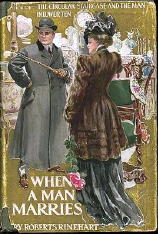
Rinehart

MARY ROBERTS RINEHART – When a Man Marries (Bobbs-Merrill; hc, 1909. Hardcover reprint: Grossett & Dunlap, no date. Wildside Press, trade ppbk, 2004)

   Being excessively fond of locked room mysteries, imagine my delight once I began reading When A Man Marries to find it based on a twist on same. Set in a house full of Bright Young Things (sent up mercilessly by the author, Mary Roberts Rinehart, whose The Circular Staircase is occasionally mentioned within these walls) the plot unspools as several BYT’s suddenly find themselves sequestered in a large house under quarantine because the butler has just been stricken with smallpox.

   Meantime, the protagonist has agreed to pretend to be the wife of the house owner. This came about because the BYTs are attending a dinner party at the house, during which their host learns his dragon of an aunt — who holds the purse strings — is coming for an unexpected visit. This rich aunt has not been told he is now divorced because then the flow of money would end (fortunately she hasn’t met the now ex-wife). Complications of course ensue including the rest of the servants decamping before the Board of Health quarantines the house, leaving in such haste they do not even bother to tell the master why they are leaving, the ungrateful things.

   There’s a policeman imprisoned in the furnace room, and no sooner is the house and its inhabitants securely locked down for the duration when valuable items such as jewelry start going missing … meanwhile, the ex-wife having arrived just before quarantine was declared is now concealed from the aunt’s eyes in the kitchen below stairs, Rich Aunt is also locked in the house with the entire bunch, and one of other Bright Young (Male) Things foolishly wagers a large sum the entire crew will get out of quarantine within 24 hours — quite illegally of course and talk about chronic lack of social conscience — plus there are newspapers reporters and photographers camping around the house as well as on the roof of the house next door to keep an interested public fully informed.

   It struck me as I read that it would have made a wonderful screwball comedy/mystery with Cary Grant playing the fellow imprisoned engineer from South America, who is most emphatically *not* a BYT. How could you not laugh out loud at the whole frothy affair?

   And I did, Oscar, I did.

[UPDATE] 03-09-07. When I asked Mary to say some more about the criminous content of When a Man Marries, this was her reply:

   I would describe this novel as a romantic comedy with mystery overtones, since the question of who pinched the jewelry plays a less prominent part than in other MRR works, and comes to prominence towards the end of the book. But little hints are planted here and there as I realised when I got to the solution and thought it over a bit.

   Thinking that Al Hubin might like to know this, I sent Mary’s comments on to him. Here’s what his response was, which was pretty much what I suspected it would be:

Steve,

   If anything I guess I err on the side of over-inclusion, and I think I’ll add this with a dash (Addenda #12).

Best,

Al

« Previous PageNext Page »