Crime Fiction IV


   Regarding my previous posts on Frederic Goldsmith and his mystery novel Murder in Mayfair, primarily this one, Jamie Sturgeon sent me the following email:

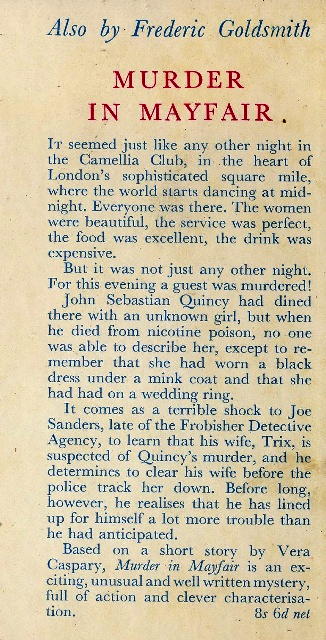
   By chance whilst going through my boxes of books I found a had a copy in dust wrapper of Frederic Goldsmith’s The Smugglers. I have scanned the blurb for Murder in Mayfair which was on the rear flap and attached it. The printed dedication in the book is to I.G., his father I presume. I did have a copy of Murder in Mayfair in a previous catalogue but I sold it.

Mayfair

   In the pair of emails that follow, Jamie added:

   Reading the blurb I wonder if the book could be based on the short novel by Vera Caspary, Lady in Mink? The US edition (book club only) was The Murder in the Stork Club.

and

   If Murder in Mayfair is a re-write of The Murder in the Stork Club, apparently the Caspary story first appeared in Good Housekeeping magazine (I did a google search).

                        Regards,
                           Jamie

    Comparing the pair of titles for Caspary’s book with the story line given in the blurb, it certainly looks like a match to me. I’m convinced. Thanks, Jamie! With this to go on, I also found the Good Housekeeping citation, from a Gutenberg list of copyright renewals:

R571103.
The Murder in the Stork Club. By
Vera Caspary. First appeared in Good
housekeeping magazine. NM: additions
& revisions. © 19Sep46; A8155.
Vera Caspary (A); 1Feb74; R571103.

   Case closed?

   As far as the individual entries in Al Hubin’s Crime Fiction IV are concerned, it’s easy to forget that there a life behind each and every one of them. There’s always much more than the listing can ever say, taken in isolation by itself. Here’s an example. The entry for Muriel Davidson looks like this:

DAVIDSON, MURIEL (1924-1983)

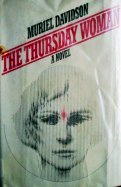
* The Thursday Woman (n.) Atheneum 1979 [Los Angeles, CA]
* -Hot Spot (n.) Marek 1980
* ’Til Death You Do Pay (n.) Marek 1981

   Two books which fall into the category of crime fiction, plus a third that’s only marginally so. The year of her birth, and the year of her death. You’d read this, glance at it for up to, say, several seconds, and then you’d go on to the next one, whichever the next one might be.

   Unless you were looking for her entry with a specific reason in mind, and until you happened to want more and decided to Google her name. There is another Muriel Davidson who has something to do with the Canadian census, and you’ll going to have to screen her out. Then you come to an entry that looks promising, you click on it, and that’s when you discover, quoting the following news item in the New York Times:

   AROUND THE NATION; Television Executive Found Slain on Coast

AP. Published: September 27, 1983

   A television executive who had reported receiving crank telephone calls was slain at her home in fashionable Benedict Canyon, the police said today.

   The police discovered the body of the executive, Muriel Davidson, 59 years old, at 1:45 A.M. today, Lieut. Dan Cooke said. There were no signs of a struggle. Neither the cause nor time of death was disclosed.

   Mrs. Davidson recently signed with Jay Bernstein Productions as vice president of film and television development.

   She wrote three mystery novels, The Hot Spot, The Thursday Woman and ’Til Death Do You Pay.

   Her husband, Bill, is a contributing editor to TV Guide.

    A followup story appeared the next day:

   AROUND THE NATION; Arrest Made in Slaying Of Hollywood Writer

UPI. Published: September 28, 1983

   A former aerospace worker who had received alcohol rehabilitation counseling from Muriel Davidson, a writer who published celebrity profiles and crime exposes in national magazines, was arrested today and charged with slaying Mrs. Davidson, who was also a television executive.

   The suspect, Robert Thom, 51 years old, was arrested at his home in Pasadena at 4:30 A.M. on information received from relatives and friends of Mrs. Davidson, who was found Monday shot to death at her home.

   To say that this was unexpected would be an understatement of some magnitude, and that’s putting it mildly.

   Now the reason I was looking up Mrs. Davidson was that I was doing some research on a made-for-TV movie entitled The Wednesday Woman, which was supposedly based on her novel The Thursday Woman, included in CFIV and mentioned in the first Times article above. I kept looking, hardly expecting to discover anything else of significance. That a mystery writer was murdered herself was unusual enough. That there was a second chorus coming would never have occurred to me. (You may remember the incident yourself, though, especially if you were living on the West Coast at the time.)

   It turns out that the made-for-TV movie, The Wednesday Woman, (CBS; Wed., May 24, 2000, 9 p.m.) if I am understanding the course of events correctly, was not exactly based on Mrs. Davidson’s book, but on her life, which in turn imitated the book that she had written earlier, The Thursday Woman. The movie was fiction based on a real-life sequence of events, which tragically mirrored the earlier work of fiction.

    I don’t suppose I’m making myself as clear as I should be. I realize this because it took me a while myself to put the chain of events into some sort of order. The website that seems to tell the story best is this one, but allow me to quote the essential passages, and then if you’re so inclined, you should certainly go read the rest of the story for yourself.

   First, however, a quote from the book itself:

Thursday

    “The most absorbing compelling novel I have read in years. It reminds me of the psychological novels of Georges Simenon.” Dr. William Nolen. Pure chance takes an average woman, Martha, into the courtroom of wife-murderer Everett. She has visceral sexual reaction to the accused criminal and becomes obsessed with “love” for a man she doesn’t know…

   And now the chain of events that I mentioned:

(1A) In addition to TV scripts, celebrity profiles and other magazine articles and books, the real Davidson wrote a novel titled The Thursday Woman, about an addictive woman who has an affair with a dangerous fruitcake.

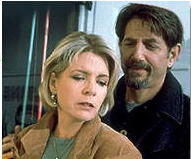
(1B) Besides writing for a magazine, the movie Muriel (played by Meredith Baxter) writes a novel with a similar plot titled The Wednesday Woman.

(2A) The real Muriel was murdered by Robert Thom, an alcoholic whom she met at a hospital where she counseled alcoholics once a week. A police report called the two “quite close.” A county probation officer said that just prior to her murder she had tried to sever her sporadic sexual relationship with Thom, who pleaded no contest to second-degree murder and was given a sentence of 17 years to life.

(2B) In the movie, Muriel is a recovering alcoholic, as is her psychotic lover (Peter Coyote) who tries to kill her after she wants to end their relationship.

Wednesday Woman

(3A) and (3B) The kicker that comes next, is that the real life Muriel is murdered. In the movie, she is not, to widespread critical disapproval. If you are portraying real events as closely as this movie does, they said, how can you get away with changing the ending, even if it’s one that leaves the viewer pleased and satisfied that everything in the end, um, ended well?

   You’ll have to answer that one yourself. I can’t give you any advice. I’m still marveling over the sheer audacity of real life to imitate fiction so closely in the first place, in this one single secluded entry in CFIV.

      —

UPDATE [01-30-07] From a brief email sent by Victor Berch:

   The California Death Index gives MD’s birth date as March 21, 1923; born in St. Paul, Minnesota. This seems to be verified in the 1930 US Census taken on April 8, 1930, where her age is given as 7 years old. Her maiden name was Friedland, so her entry should read:

      DAVIDSON, MURIEL (FRIEDLAND) 1923-1983.

   Even though Allen J. Hubin’s work on Crime Fiction IV is nominally closed, he is still accumulating Addenda for his massive bibliography, as I’ve mentioned before, and actively so at that. The Internet is a massive tool to have at your disposal, especially Google, as everyone reading this must surely know — an enormously valuable implement for scooping up data and facts that simply wasn’t available when most of the work on the book was being done.

   In Al’s case (and mine as well, if truth be told) he can now type in the name of an author whose vital statistics are scanty or non-existent (birth date, year of death, some biographical details) and/or the title of one of their books, and see what shows up.

   Sometimes you get nothing at all, and sometimes – if the name is too common – you get too much. It’s impossible, for example, to sort through all of the Bill Joneses of the world.

   Sometimes, however, you hit upon a nugget or two, or even more. Case in point. At the present time, or not until a couple of days ago, nothing was known about:

GOLDSMITH, FREDERIC
* * *Murder in Mayfair (Allen, 1954, hc) [London] Novelization of a short story by Vera Caspary, q.v.
* * *The Smugglers (Allen, 1955, hc)

   On the web now, though, is a site belonging to Paul K. Lyons which includes, among other things, pages of information for over 500 diarists. Besides writing a small amount of fiction, Paul has been a diarist himself since 1974, and he is in the process of making the entries available online.

   In January 1981 he happened to be reading a book called Murder in Mayfair (see above) and wrote about it in his diary. One line, and Google picked it up: “In the British Library I’ve been reading Murder in Mayfair written by my father, Frederic Goldsmith.”

   Al spotted this, immediately emailed Paul and received this reply:

    “My father Frederic Goldsmith wrote Murder in Mayfair published 1954, London, by W. H. Allen and The Smugglers published 1955, London, by W H Allen.

    “He was born in 1925, in Vienna, moved to the UK during his teens (taking on British citizenship which he retained throughout his life), and died in the US in 1989. His wife, Gail Goldsmith, lives in New York.

    “His father Isadore Goldsmith (IG) was a film producer, and IG’s second wife, Vera Caspary, was an American author (Laura).”

      [UPDATE: In a later email to me, Paul added the following:

    “I incorrectly spelled my grandfather’s name when writing to Al. He was known as Igee, but his first name was Isidor (not Isadore). It’s possible I picked up this mistake from IMDB, which has the same mistake.” ]

   And there’s the connection with Vera Caspary. Here’s one of that lady’s entries in CFIV:

Bedelia (Houghton, 1945, hc) [Connecticut; 1913] Eyre, 1945. Film: Corfield, 1946 (scw: Vera Caspary, Moie Charles, Herbert Victor, Roy Ridley, Isadore Goldsmith; dir: Lance Comfort).

   Emphasis mine. And here’s Isadore Goldsmith’s full entry in www.imdb.com:

Producer – filmography

1. The Tell-Tale Heart (1953/II) (producer)
2. The Scarf (1951) (producer) (as I.G. Goldsmith)
… aka The Dungeon
3. Three Husbands (1951) (producer) (as I.G. Goldsmith)
… aka Letter to Three Husbands
4. Out of the Blue (1947) (producer)
5. Bedelia (1946) (producer)
6. The Voice Within (1945) (producer)
7. Hatter’s Castle (1942) (producer)
8. The Stars Look Down (1940) (producer) (as I. Goldsmith)
9. I Killed the Count (1939) (producer)
… aka Who Is Guilty? (USA)
10. The Lilac Domino (1937) (producer)
11. Southern Roses (1936) (producer) (as Isidore Goldschmidt)
12. Whom the Gods Love: The Original Story of Mozart and His Wife (1936) (co-producer)
… aka Mozart (USA)
… aka Whom the Gods Love (UK: short title)

Writer – filmography

1. The Scarf (1951) (story) (as I.G. Goldsmith)
… aka The Dungeon
2. Bedelia (1946)

   One of the movies that caught my eye was The Scarf, which Isadore Goldsmith both produced and wrote the story it was based on. Was there some connection also to the book of the same title written by Robert Bloch (of Psycho fame)? No, not so. The co-author of the story, according to IMDB, was Edwin Rolfe, who has a single entry in CFIV himself:

ROLFE, EDWIN (1909-1954); Reporter, editor, foreign and war correspondent; poet; publicist for shows.
* * * The Glass Room (with Lester Fuller) (Rinehart, 1946, hc) [Los Angeles, CA] Low, 1948.

   And The Scarf, by Robert Bloch (Dial, 1947) seems to have never been made into a movie at all.

   As for Vera Caspary, she has many entries in CFIV (which I won’t repeat here), even more as a screenwriter in IMDB, and there is a full biography for her here.

   She’ll certainly best be known as the author of Laura, however, and (more than likely) for the movie more than for the book.

   But which of her stories did Frederick Goldsmith use to construct his novel Murder in Mayfair? At the moment I do not know, but if and when I do, you can be sure you will read about it here.

   Here are the first few lines of the obituary article in yesterday’s New York Times for Daniel Stern:

   Daniel Stern, who sifted through his careers in jazz and symphonic music, advertising, movies and academia for psychic grist for the bittersweet, tightly crafted novels and short stories that were his crowning achievement, died Wednesday in Houston. He was 79.

   I’ll get back to the coverage of Mr. Stern’s overall career in a minute, but among his other accomplishments, there’s one that makes him stand out from every other cellist who played with Charlie ‘Bird’ Parker, and that’s the fact that he also has an entry [one book] in Allen J. Hubin’s Crime Fiction IV:

STERN, DANIEL (1928- )

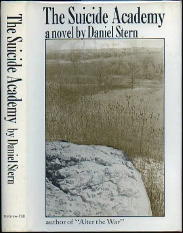
* * *The Suicide Academy (McGraw, 1968, hc) Allen, 1969.

Stern

   A blurb from the book itself says: “In The Suicide Academy Daniel Stern has taken a communal dream of our increasingly ordered times and turned it into a nightmare. Part spy story, part existential parable, this coldly brilliant novel makes for an unforgettable reading experience.”

   About the book, the New York Times also goes on to say, and I quote:

   The Suicide Academy (1968) imagines a world flecked with institutions where people can commit suicide. An administrator of one of them grapples with the morality of the government’s offer of more funds if suicides increase. Reviewing the book in The Village Voice, Anaïs Nin cited Mr. Stern’s ability to “toss all the facts into space, to reverse their chronological monotony, upset established curriculums.”

   From the descriptions so far – I haven’t read it, or I’d tell you more from a personal point of view – it appears to be a step beyond your usual book of crime and detection, if not two or three. To confirm this, here are some excerpts from a longer review, this one from Time magazine for September 20, 1968. It begins this way:

THE SUICIDE ACADEMY by Daniel Stern. 173 pages. McGraw-Hill. $5.95.

   Outrageous subjects that were once shocking sources of satanic laughter now seem hardly ticklish at all. Black Comedians today tend to be admired like TV gagmen and nightclub acrobats – less for jolt than for sheer agility.

   In that class, Daniel Stern, a critic-novelist (After the War, Miss America) long preoccupied with the dusty corners of the modern soul, proves a deft performer. His literary colleague Kurt Vonnegut recently toyed with industrialized suicide (Welcome to the Monkey House), but only as an example of the dehumanized modern world efficiently eliminating Malthusian excess. Stern’s Suicide Academy, by contrast, has a more promising metaphoric reach.

   In Stern’s establishment, the clients come for one day only. With the aid of a scrupulously neutral staff, they are measured and examined. Between bouts of play and sleep, they study their own lives and the world, life wish and death wish together. Then comes calm choice — a return to the world or death, an end reached through a wide range of means provided by the management. Suicides, Stern observes, are the graduate students of the academy.

   and it concludes:

   The Suicide Academy is left as a palatial metaphor hardly explored and barely furnished. It is largely unpeopled, too, except for Wolf’s [the head of the Academy’s] assistant, a splendidly grotesque, wasp-tongued Negro named Gilliatt. Archly antiSemitic, he quotes upbeat Talmudic texts to needle Wolf, and continually accuses him of secretly sabotaging the academy’s sacred neutrality in favor of life. Gilliatt reasons that the Jews invented resurrection and so are rotten with humanitarian sympathy. Gilliatt may be the best bit-part player of the literary year.

   Other accomplishments of Mr. Stern deserve a mention. Even though they’re outside the realm of crime fiction, they include:

● He was born on Jan. 18, 1928, and grew up on Manhattan’s Lower East Side and in the Bronx.

● He played the cello with Charlie Parker and the Indianapolis Symphony.

● He was a vice president at Warner Brothers Studios, CBS and the McCann-Erickson advertising firm.

● After nine novels, many of them well reviewed, Mr. Stern found his métier in the short story.

● At the time of his death, he was Cullen Distinguished Professor of English at the University of Houston.

● For Warner, he promoted the movie “Woodstock” with the line, “Nobody who was there will ever be the same. Be there.”

   As promised in the update at the end of the previous post, here are the appearances of Lt. Columbo in print. Some of these are becoming difficult to find, even with the assistance of the Internet to help track them down. I wish I were able to show you covers of all of them, but it would be rather crowded if I did, or if I could. Some I don’t have copies of myself.

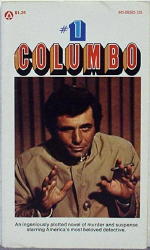
Columbo 1

LT. COLUMBO in book form –

* RICHARD LEVINSON & WILLIAM LINK:

o Prescription: Murder. French, 1963, pb. [Three-act play.]

* ALFRED LAWRENCE:

o Columbo. Popular Library, pbo, 1972.
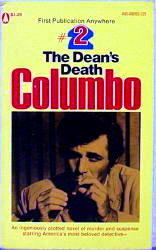
o The Dean’s Death. Popular Library, pbo, 1975.

* HENRY CLEMENT:

o Any Old Port in a Storm. Popular Library, pbo, 1975.
o By Dawn’s Early Light. Popular Library, pbo, 1975.

* LEE HAYS:

o A Deadly State of Mind. Popular Library, pbo, 1976.
o Murder by the Book. Popular Library, pbo, 1976.

Columbo 2

* BILL MAGEE & CARL SCHENCK:

o Columbo and the Samurai Sword. Black, hc, 1980. Note: This is one of the very few First Editions published by the Detective Book Club [known for their three-in-one editions, of which this is one, or a third thereof] and as such is rather scarce and hard to find.

* WILLIAM HARRINGTON:

o Columbo: The Grassy Knoll. Forge, hc, 1993.
o Columbo: The Helter Skelter Murders. Forge, hc, 1994.
o Columbo: The Hoffa Connection. Forge, hc, 1995.
o Columbo: The Game Show Killer. Forge, hc, 1996.
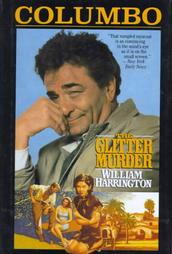
o Columbo: The Glitter Murder. Forge, hc, 1997.
o Columbo: The Hoover Files. St. Martin’s, hc, 1998.

Columbo 3

   Acknowledgments go as almost always to Allen J. Hubin, Crime Fiction IV, as the primary source for most of this data.

   I’ll also take this an opportunity to thank Mark Murphy one more time for pointing out where I could go on the web to keep finding more information about Lt. Columbo. In his most recent email to me, he added: “A guy named Mark Dawidziak wrote a book, The Columbo Phile, some years ago. It was quite authoritative. I’ve also found this link to an interview with him…”

   He’s right. There are commercials in this on-the-air interview, but you can skip them, and it’s very much worth listening to.

   To sum things up, I hope, without too many more updates, Columbo as a character has been around long enough, and he’s been popular enough, that there’s plenty of information out there on him, either in print or on the Internet. In these last couple of blog entries, I don’t imagine that I’ve added anything that’s really new about him, but hopefully I’ve presented what I’ve discovered in a straight-forward and useful fashion. I’ve also ironed out some of the contradictions popped up as I went along, and tried to set the record straight on a few statements I found that were either incomplete or simply not so.

   Or to put it another way, I certainly learned a lot.

   Here is but another of the alleys that researching can take you, if you are not wary, and even if you are. While looking up The Dow Hour of Great Mysteries — see the previous post — I found a short piece from the NY Times that suggested that Prescription: Murder, the first appearance of Lt. Colombo, the rumpled police detective made so famous by Peter Falk, made its first appearance on the Dow Hour.

   Not so, and I have Mark Murphy to thank for pointing me to a website that has the right stuff, or in other words, the correct information. Of course you can go there to read it for yourself, and in fact you should. I recommend it. But since I had it wrong in my previous post, it behooves me (I always wanted to say that) to at least set up the correct timetable of the events relating to Lt. Columbo in this one.

[Added 01-27-07] March 1960. According to Mark Dawidziak, writer of The Columbo Phile (Mysterious Press): “the very first appearance of the character wasn’t in a short story [by Richard Levinson & William Link] called “May I Come In?” The end of that story is a knock at the door: it’s the police, and if the door had opened it would have been Lieutenant Columbo standing there.”
   The story appeared in Alfred Hitchcock’s Mystery Magazine, but someone, an editor perhaps, changed the title to “Dear Corpus Delicti.”

May 29, 1960. A drama anthology called The Chevy Mystery Show began on NBC. Hosted by Walter Slezak, new scripts were dramatized every Sunday. There were no recurring characters or actors.

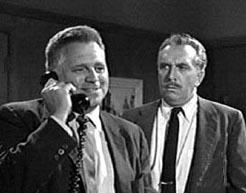
July 31, 1960. “Enough Rope,” was that evening’s presentation, an original story written by William Link and Richard Levinson, introducing to the world a police lieutenant named Columbo, played by a veteran character player named Bert Freed, who received “second-to-last billing in the opening credits.” He is not even included in the IMDB listings for that episode.

Freed

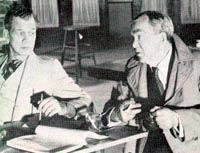
1962. “Prescription: Murder” the stage play opened, with veteran movie and stage actor Thomas Mitchell playing Lieutenant Columbo. This was Mitchell’s last role: “He died while the show was touring the United States and Canada, before it reached its Broadway premiere.”
   It is not clear whether the play ever reached Broadway. Some sources I’ve seen so far say yes, others say no.

Mitchell

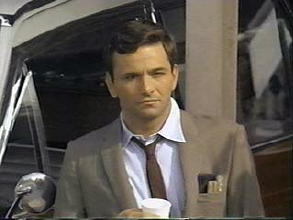
1968. Filmed in 1967, “Prescription: Murder” appeared as a made-for-TV movie, with Peter Falk in the starring role. It was intended to be a one-shot appearance for the character, but fate (and the character’s popularity) had a way of changing things.

   NOTE: What the author of the website cited above does, and in great detail, is to compare the story lines for each these first three appearances of Lt. Columbo, essentially the same story with differences, and how the character was presented and developed.

March 1, 1971. The pilot for the Columbo TV series was aired: “Ransom for a Dead Man.”

September 15, 1971. Columbo began its regular TV slot as a rotating part of the NBC Mystery Movie, with the first episode entitled “Murder by the Book.” When that overall umbrella series ended, Colombo continued to appear in a series of made-for-TV movies on a irregular basis. “Columbo Likes the Nightlife” was telecast in 2003, a stretch of some 35 years since Columbo began his run back in 1968.

Falk

   Peter Falk is now 80 years old. No one could possibly fill his shoes (or raincoat), so this may mark the end of Lt. Columbo on the small screen.

SIDEBAR: February 26, 1979, to March 19, 1980. Kate Loves a Mystery, starring Kate Mulgrew as Mrs. Columbo, had a short season of 13 episodes. The gimmick didn’t work out, the folks over at the Columbo lot disowned her, and by the end of the run, the leading character was named Callahan (and not even the wife of some other police detective named Columbo).

UPDATE [01-26-07] It’s later the same day, and I see that I’ve forgotten to list the books in which Lt. Columbo has appeared over the years, mostly as novelizations of various screenplays, I believe, although I could be wrong on that. It’s late, though, and I think it will wait for another day. (Tomorrow, I hope.)

   Most of the online sites that will be running obituaries of E(verette) HOWARD HUNT (Jr.) this week will concentrate on one thing and one thing only, and that is his involvement in the Watergate matter, a true focal point in this nation’s history. You say Watergate, and to everyone in the US who was more than eight years old at the time, what memories it brings.

   It was from Bill Crider’s blog that I learned the news of Mr. Hunt’s death (and Bill learned it from someone else), and the link he provides from Yahoo! News begins this way:

MIAMI – E. Howard Hunt, who helped organize the Watergate break-in, leading to the greatest scandal in American political history and the downfall of Richard Nixon’s presidency, died Tuesday. He was 88.

Hunt died at a Miami hospital after a lengthy bout with pneumonia, according to his son Austin Hunt.

The elder Hunt was many things: World War II soldier,CIA officer, organizer of both a Guatemalan coup and the botched Bay of Pigs invasion, and author of more than 80 books, many from the spy-tale genre.

   I’ll leave it to others to talk about the real life stuff. What I’ll do is see how many of the 80 books I can list, but counting only those from the spy-tale genre. Which, I hasten to add, were made all the more real by Mr. Hunt’s real-life background in matters of spying and inside-the-Beltway intrigue and adventure.

Source: Crime Fiction IV, by Allen J. Hubin.

As by E. HOWARD HUNT. Many of these are reprints of books published first under one of his several pseudonyms:

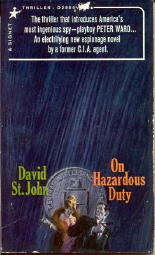
# On Hazardous Duty. Signet 1972; See: Signet, 1965 as by David St. John.
# Festival for Spies. Signet 1973; See: Signet, 1966 as by David St. John.
# My Body. Lancer 1973; See: Lancer, 1962 as by Robert Dietrich.
# One of Our Agents Is Missing. Signet 1973; See: Signet, 1967 as by David St. John.
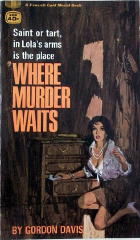
# Where Murder Waits. Gold Medal 1973; See: Gold Medal, 1965 as by Gordon Davis.
# From Cuba with Love. Pinnacle 1974; See: Ring Around Rosy (Gold Medal 1964), as by Gordon Davis.
# Return from Vorkuta. Signet 1974; See: Signet, 1965 as by David St. John.
# The Towers of Silence. Signet 1974; See: Signet, 1966 as by David St. John.
# The Venus Probe. Signet 1974; See: Signet, 1966 as by David St. John.
# Counterfeit Kill. Pinnacle 1975; See: Gold Medal, 1963 as by Gordon Davis.
# Washington Payoff. Pinnacle 1975; See: House Dick (Gold Medal 1961), as by Gordon Davis.
# Izmir. Fine 1996 [Jack Novak; Miami, FL]
# Dragon Teeth. Dutton 1997 [Jack Novak; China]
# Guilty Knowledge. Forge 1999 [Steve Bentley; Washington, D.C.]
# Sonora. Dutton 2000 [Jack Novak; Mexico]

   I have been meaning to track down a copy of that last appearance (in 1999) of swinging CPA-sleuth Steve Bentley, but so far I haven’t. I’ve often wondered how the gap of 37 years in Bentley’s life was filled in. Most of the Steve Bentley adventures were written as by Robert Dietrich. See below. Jack Novak is described in at least one book as a “rogue DEA agent.”

Hunt

As by HOWARD HUNT:

* Maelstrom (n.) Farrar 1948 [Mexico]
* -Bimini Run (n.) Farrar 1949 [Ship]
* Dark Encounter (n.) Signet 1950; See: Maelstrom (Farrar 1948).
* The Violent Ones (n.) Gold Medal 1950 [Paris]
* The Judas Hour (n.) Gold Medal 1951 [Prague]
* Whisper Her Name (n.) Gold Medal 1952 [Cuba]
* Lovers Are Losers (n.) Gold Medal 1953 [Los Angeles, CA]
* Cruel Is the Night (n.) Berkley 1955; See: Maelstrom (Farrar 1948).
* Little Miss Murder (n.) Phantom 1956
* The Berlin Ending (n.) Putnam 1973 [Neil Thorpe]
* The Hargrave Deception (n.) Stein 1980
* The Gaza Intercept (n.) Stein 1981 [Middle East]
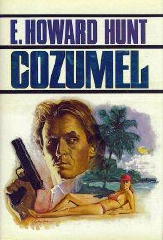
* Cozumel (n.) Stein 1985 [Jack Novak; Caribbean]
* The Kremlin Conspiracy (n.) Stein 1985 [Neil Thorpe; Moscow]
* Guadalajara (n.) Scarborough 1986 [Jack Novak; Mexico]
* Mazatlan (n.) Stein 1986 [Jack Novak; Mexico]
* Murder in State (n.) St. Martin’s 1990 [Washington, D.C.]
* Body Count (n.) St. Martin’s 1992
* Chinese Red (n.) St. Martin’s 1992
* Ixtapa (n.) Fine 1994 [Jack Novak; Mexico]
* Islamorada (n.) Fine 1995 [Jack Novak; Florida]
* The Paris Edge (n.) St. Martin’s 1995 [Paris]

   The hyphen before a title means that it contains only marginal crime content. The first Jack Novak books appeared in hardcover in this slight variation in the byline.

As by GORDON DAVIS:

* I Came to Kill. Gold Medal 1953 [Havana, Cuba]
* House Dick. Gold Medal 1961 [Washington, D.C.]
* Counterfeit Kill. Gold Medal 1963 [Washington, D.C.]
* Ring Around Rosy. Gold Medal 1964 [Florida]
* Where Murder Waits. Gold Medal 1965 [Panama]

Davis

   No series characters as by Davis, but from the locales, matched up with the titles, along with the fact that they were all published by Gold Medal, paperback home of the tough noirish crime novel, you can make a pretty good guess as to what kind of stories were going on.

As by ROBERT DIETRICH:

* The Cheat. Pyramid 1954
* One for the Road. Pyramid 1954 [Florida]
* Be My Victim. Dell 1956 [Florida]
* Murder on the Rocks. Dell 1957 [Steve Bentley; Washington, D.C.]
* The House on Q Street. Dell 1959 [Steve Bentley; Washington, D.C.]
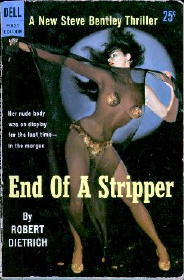
* End of a Stripper. Dell 1960 [Steve Bentley; Washington, D.C.]
* Mistress to Murder. Dell 1960 [Steve Bentley; Washington, D.C.]
* Murder on Her Mind. Dell 1960 [Steve Bentley; Washington, D.C.]
* Angel Eyes. Dell 1961 [Steve Bentley; Washington, D.C.]
* Steve Bentley’s Calypso Caper. Dell 1961 [Steve Bentley; Virgin Islands]
* Curtains for a Lover. Lancer 1962 [Steve Bentley; Washington, D.C.]
* My Body. Lancer 1962 [Steve Bentley; Nassau]

   More about Steve Bentley in a minute.

As by JOHN BAXTER:

* -A Gift for Gomala (n.) Lippincott 1962 [Washington, D.C.]

   A book I have not seen. Note the hyphen (see above).

As by P. S. DONOGHUE:

* The Dublin Affair. Fine 1988
* The Sankov Confession. Fine 1989

   I’ve not seen copies of these books, published in hardcover, but spy thrillers both, I am sure it is safe to say.

As by DAVID ST. JOHN:

* On Hazardous Duty. Signet 1965 [Peter Ward; France]
* Return from Vorkuta. Signet 1965 [Peter Ward; Spain]
* Festival for Spies. Signet 1966 [Peter Ward; Cambodia]
* The Towers of Silence. Signet 1966 [Peter Ward; India]
* The Venus Probe. Signet 1966 [Peter Ward]
* One of Our Agents Is Missing. Signet 1967 [Peter Ward; Tokyo]
* The Mongol Mask. Weybright 1968 [Peter Ward; China]
* The Sorcerers. Weybright 1969 [Peter Ward]
* The Coven. Weybright 1971 [Peter Ward; Washington, D.C.]
* Diabolus. Weybright 1971 [Peter Ward; France]

St John

From Time magazine, June 11, 1973

   The agent who had planted the mike in the target office had tested the key, so the first barrier would yield. But the lock on the office door was a later model —pin and tumbler—and they would have to make its key on the spot … “All right,” Peter said curtly, “I don’t want heroes, just the contents of the safe.”

   At first glance, this description of the espionage burglary of a government office building, contained in a yellowing 1965 paperback called On Hazardous Duty, might seem to be a rather ordinary experience in the life of ace CIA Agent Peter Ward. As the star of a series of fictional thrillers by David St. John, Ward has had far more exciting adventures. There was the time, for instance, when he was assigned to verify the identity of the man with the scarred face who was returning from 20 years in Soviet slave labor camps to claim the throne of Spain. Or the time he went to Japan on his own and wound up in “a wild round of I Spy, featuring Koto-playing geishas, Chi-Com masters, and a beautiful Nipponese belle who’s simply murder in the bath.” Hazardous Duty‘s burglary scene is of special interest, however, to readers who know that author David St. John is really E. Howard Hunt, the convicted Watergate conspirator.

   During the past 30 years, 20 of them spent working for the CIA, Hunt has managed to write no fewer than 47 novels under a string of pen names: John Baxter, Gordon Davis and Robert Dietrich, as well as David St. John. His chief characters are Agent Ward, a younger version of Hunt himself (they both went to Brown University), and a casual, thrill-hunting Washington C.P.A., Steve Bentley, who describes the nation’s capital as “a great town if you’ve got the stamina of a Cape buffalo and the wealth of a Punjab prince.” Most of the books are predictable concoctions of espionage and sex in exotic settings. Hunt is said to earn $20,000 a year from his writing.

   I promised to say more about Steve Bentley, and I’ll close with this. Here’s my review of End of a Stripper, written sometime in the fall of 2004:

  ROBERT DIETRICH – End of a Stripper.

Dell First Edition #A197; paperback original, June 1960.

   As all longtime fans who lived through the Watergate era know full well, Robert Dietrich was in reality burglar/criminal mastermind E. Howard Hunt, a gentleman who would probably have been far better off had he remained only a paperback writer. But even without knowing his full biography, I assume that Mr. Hunt always considered writing mysteries to be only a sideline – always preferring to live them instead, when he could, I’m sure.

   NOTE: For what it’s worth, from the rear jacket flap of Stranger in Town, his second [non-mystery] novel, we learn that HH earlier had several contributions published in The New Yorker and a Guggenheim Fellowship in Creative Writing.

   As “Robert Dietrich,” Hunt’s primary character was his two-fisted, hard-drinking CPA detective, Steve Bentley, a former agent for the Treasury, but whose nose for trouble led him into the exact same situations as any two-fisted, hard-drinking private eye would find himself in.

   For the record, here’s a list of all of the Steve Bentley books … [list omitted, as I’ve already just covered the same ground]

Dietrich

   In any case, that makes a gap of 37 years between appearances of a series character, which if it isn’t a record, it puts Steve Bentley right up there in the top five, I’m sure. (I have some notes on this, somewhere, if only I could find them.)

   But back to End of a Stripper, the third in the series, and the first of a subset of three that appeared in three successive months. (The old pulp authors used to do that, but a streak like this is relatively uncommon among the ranks of paperback writers. Can you come up with any others?)

   Relying on the old maxim that “sex sells,” the books starts out in a distinctive manner in, you guessed it, a Washington DC strip club, where Steve Bentley is treating an old out-of-town CPA buddy to a night on the town. As they are about to leave (a) Bentley leaves a tenner on the table without waiting for the change, and (b) the lovely Haitian dancer Linda Lee takes her turn at the stage. They stay.

   After the performance, which Bentley duly appreciates, but before the lights go back on, he spies a man being hustled out of the night club, but not before the gentleman drops something into Bentley’s pocket. Thus begins the adventure, an event that could happen only to the hero of a paperback novel, and never to someone such as you or I.

   The object in Bentley’s pocket is a camera, and the gentleman being hustled out, later found dead is a sleazy private detective named Mousey Morris. After being bumped around by two thugs desiring the camera, Bentley is in the case for good, as if Linda Lee’s charms were not enough.

   Steve Bentley, of course, is a private eye in all but name only, paperback style, with just a couple of differences. His client is himself, for one thing, and secondly, he has a good relationship with a friend on the police force, Detective Lieutenant Kellaway of the Homicide Division.

   He also has a close lady friend, Mary Beth Stuart, to whom he acts as an utter cad in this book, although he does not even seem to realize it, so struck by the charms of the aforesaid Linda Lee is he. One wonders if the relationship with Mary Beth carries over to future books in the series. For her sake, I hope not.

   Back in 1960, one’s manhood was also highly correlated with the amount of hi-fi stereo equipment one had back in one’s bachelor pad. More than several times Bentley whips out his trusty Ampex and puts on the latest Percy Faith and/or Ray Anthony recordings, either to relax by, or to induce a corresponding sense of relaxation within the current lady friend he is entertaining.

   This, you understand, is part of the charm of old paperback novels. A time-machine into the past, history à la Playboy magazine and never in schoolbooks, then or now. The mystery is suitably complicated and certainly succeeds on its own merits. It’s the surrounding – let’s say ambiance – that’s also very revealing. A couple of quotes, the first from page 57, as Bentley describes the area around the Chanteclair club:

   It was a part of town, once new, now shabby and decaying, where every drugstore and pool parlor fronts for the policy racket. Where Cocaine and Horse are peddled in the shadows; where muggers lurk in dark alleys. Where Negro families live and breed six to a room. A part of town that white men visit after dark to prospect for little sable-skinned girls; where even the corner grocer is a part-time pimp. Where the average man carries a straight razor or a Gillette blade inside a deck of matches. Bloodfield. And against all that one lone colored policeman for every five city blocks. One reason why Washington has, per capita, more rape, more crimes of violence, more liquor, more perversion and more crooked politicians than any other city in the country. Our fair city, I thought, and grimaced.

   Later on, on page 135, Bentley has just confronted a clerk behind the counter at a liquor store, where he’d stopped to make a phone call. The clerk had made a leering comment about a teen-aged girl who’d tried to pick Steve up:

   The bony Adam’s-apple bobbled. His thin lips opened and closed. His eyes darted unhappily at the phone booth. I turned and went out to the parking lot. A lovely town to raise a daughter in, I thought as I started the engine. Send her to public school and she gets started with the janitor or a football hero. Put her in private school and she learns perversion from a female gym teacher. Keep her out of school and the corner grocer knocks her off in the back room on a pile of potato sacks. The most you hope for is that she knows about contraceptives and doesn’t grow up a doper. The whole world’s gone crazy.

   No, sir. You don’t find this stuff in textbooks. That’s for sure.

UPDATE [01-24-07] Bill Crider has done yeoman’s work in putting together a slideshow of even more of the covers of Howard Hunt’s paperbacks. Not unexpectedly, most of them feature women, in various stages of dress or (mostly) undress. Don’t miss the chance to see as many of the covers as you will here, all in one spot!

UPDATE [01-25-07] Mystery writer Mark Coggins, author of a series of novels featuring jazz bass-playing private eye August Riordan, mentions this post on his blog, for which I thank him. He also goes on to quote an interesting letter from Raymond Chandler to Mr. Hunt, responding to the latter’s complaint that Chandler was plagiarizing himself in using his early pulp stories as construction material for his later novels. Fascinating stuff, and you should go read it.
     In memoriam

BARBARA SERANELLA

   Born: April 30, 1956
   Died: January 21, 2007

From Barbara Seranella’s webpage today comes some very sad news:

   Barbara Seranella, 50, bestselling mystery author and resident of Laguna Beach and PGA West in La Quinta, died peacefully on January 21, 2007, at 4:15 p.m. EST (1:15 p.m. PST) at the Cleveland Clinic in Cleveland, Ohio, with her husband Ron Seranella and her brother Dr. Larry Shore at her side. Barbara, who died of end-stage liver disease while awaiting a liver transplant, leaves behind her husband Ron, brothers Larry Shore of San Francisco and David Shore of Woodacre, parents Nate and Margie Shore of La Quinta, and stepdaughters Carrie Seranella and Shannon Howard.

   Private funeral arrangements are being made by the family. A celebration of Barbara’s life is being planned for February; details will be announced later.

From the “About Barbara” page of the same website:

   Seranella was born in Santa Monica, California and grew up in Pacific Palisades. After a restless childhood that included running away from home at 14, joining a hippie commune in the Haight, and riding with outlaw motorcycle clubs, she decided to settle down and do something normal so she became an auto mechanic.
   She worked at an Arco station in Sherman Oaks for five years and then a Texaco station in Brentwood for another twelve. At the Texaco station, she rose to the rank of service manager and then married her boss. Figuring she had taken her automotive career as far as it was going to carry her, she retired in 1993 to pursue the writing life.
   Seranella’s books have been hailed for their “gritty realism, smart plotting, taut suspense, and [their] highly original heroine.”

DeadMan's
      Her first novel.

Bibliography:

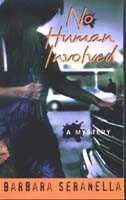
* No Human Involved. St. Martin’s, 1997 [Miranda “Munch” Mancini; Los Angeles, CA; 1970s]
* No Offense Intended. Harper, 1999 [Munch Mancini; Los Angeles, CA; 1977]
* Unwanted Company. Harper, 2000 [Munch Mancini; California; 1984]
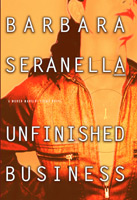
* Unfinished Business. Scribner, 2001 [Munch Mancini; California; mid-1980s]
* No Man Standing. Scribner, 2002 [Munch Mancini; California; 1980s]
* Unpaid Dues. Scribner, 2003 [Munch Mancini; California; 1980s]
* Unwilling Accomplice. Scribner, 2004 [Munch Mancini; California; 1985]
* An Acceptable Death. St. Martin’s, 2005 [Munch Mancini; Calfornia; 198–]
* Deadman’s Switch. St. Martin’s, 2007 [Charlotte Lyons]

“Misdirection,” which appears in the anthology, Greatest Hits: Original Stories of Hitmen, Hired Guns, and Private Eyes, edited by Robert Randisi, won the 2006 Anthony Award for Best Short Story.

Quoting from the Booklist [starred] review of An Acceptable Death:

    “Mancini herself has crawled up from the streets. As an ex-abuse victim, ex-prostitute, ex-biker old lady, ex-drug addict, she is both forever conscious of how lucky she is to be one of the few to escape and how unlucky the many others are who never do; this perspective, plus street smarts, enables her to go undercover convincingly. At this novel’s start, Mancini works as an auto mechanic in Santa Monica, has a nine-year-old daughter, and is involved in a relationship with an undercover narcotics detective.”

The book description for Deadman’s Switch, as taken from the Amazon website:

    “Charlotte Lyon can handle a crisis and has made that talent into a lucrative business. She describes it as crisis management, in which she supplies excellent and often unusual advice to suddenly troubled company heads about how to handle the press and the shareholders. And she goes beyond that, whenever she finds it necessary, to get to the bottom of the crisis itself. The job she has now is one of the latter; the derailment of a companys train that has killed both the engineer and a motion picture celebrity. Charlotte refuses to let her own demons — the recent death of her husband and a constantly nagging mother — keep her from going after who caused the accident.”

Unfinished

   A previous entry on this blog was entitled “Death Noted: ELINORE COWAN STONE (1885-1974).” Mrs. Stone was the author of one published mystery novel, Fear Rides the Fog (Appleton, 1937). Here are the results of some further investigation into her life:

      Some Biographical and Bibliographic Notes on Elinore Cowan Stone

by Victor Berch

    Elinore “Nellie” Rose Cowan was born March 22, 1883 in Adrian, MI, the daughter of John F. and Rebecca Caroline (McClaskey) Cowan. She was the eldest of four children. Her father was a minister.

    My choice for her birth year is based mainly on the 1900 US Census record. For it is in that census that people were required to give the month and year of birth. Although women were more inclined to make themselves younger by shaving off a year or two or more when reporting to the census taker, this habit was not restricted to women alone, as will be shown in a forthcoming note on Edwin Dial Torgerson.

    Through past ventures into genealogical research, I’d say that if a young lady had not reached her 20th birthday by 1900, then the accuracy of the 1900 Census would be most reliable. Bolstering my selection of her birth date is the fact that in the North Carolina Death Index, her birth date is given as 1883. Such information is usually supplied by a surviving family member, who, in this case, would have been her husband.

    Ms. Cowan was educated at Brighton High School (Boston, MA), Mt. Holyoke College (South Hadley, MA), Emerson School of Expression (Boston, MA) and the University of California. She taught at various high schools, private schools, Oahu College in Honolulu, Hawaii and the University of Colorado.

    In 1915, she married Clarence Arthur Stone. By 1917, they were living in New Mexico. As presented previously on this blog, the rest of her story is summed up in that newspaper announcement of her reaching her 90th birthday, March 22, 1973. She died on November 30, 1974.

    Some Additional Bibliographic Notes.

Contributions to periodicals:

Ain’t She the Beautiful, Woman’s Home Companion, June 1927
Alibi of Salvador, Collier’s Magazine, Aug. 8, 1925
Angela and the Fierce Cally Hope, Woman’s Home Companion, Sep. 1925
The Christmas Lamb, Good Housekeeping, Jan. 1935
Dirty Work at the Crossroads, American Magazine, Aug. 1931
The Fabric of Royalty, Good Housekeeping, Sep. 1926
An Hour Before Dinner, Collier’s Magazine, Dec. 18, 1926
José the Onlocky, Woman’s Home Companion, May 1925
A Little Black Box, Woman’s Home Companion, Jan. 1928
The Making of a Journalist, Woman’s Home Companion, Mar. 1929
The Mama of Manuelito, Century Magazine, Apr. 1923
No Dogs Allowed, The Delineator, July 1931
No Pumpkin Pie for Reckless Guys, Woman’s Home Companion, Nov. 1927
The Phantom of the Wagon Trains, Ladies’ Home Journal, Aug. 1924
A Question of Precedence, Woman’s Home Companion, Mar. 1925
Smoke, Good Housekeeping, July 1929
Somewhere in Russia, Woman’s Home Companion, Jan. 1925
Viva Oncle Sam!, Good Housekeeping, Oct. 1927
What Do We Wear?, Century Magazine, Sep. 1922
White Lilacs, Good Housekeeping, May 1929

    Contributions to newspapers:

Note: This part I found most difficult to obtain on-line as most of the newspapers that were presented on-line were partial runs. There were two that were short stories and it was no problem to cite the sources. But in the case of serials, there were only partial runs of the newspaper. The serials were syndicated by NEA Services, Inc. and ran in many different papers throughout the US. But some did not appear on the same dates and some did not appear in other newspapers serviced by NEA. I suppose it was up to each editor to decide which serials would run in his newspaper and when. The stories are chronologically arranged and those that are criminous in nature are denoted by *.

*Applied Science (ss) appeared in Every Week Magazine, in this instance a Sunday
supplement to the Lima (OH) Sunday News, Jan. 14, 1934.

*Two in a Fog (ss) appeared in the Fitchburg (MA) Sentinel, Oct 3, 1936

Belated Holiday (serial), at least Dec. 1937 and Jan . 1938

Love Laughs at the Doctor (serial) Mar. and Apr. 1938

Intern Trouble (serial) July and Aug. 1938

No Time to Marry (serial) Jan. and Feb. 1939

*Murder on the Boardwalk (serial) Aug. and Sep. 1939

*Footsteps in the Fog (serial) June and July 1941

        © Victor A. Berch, 2007

   I didn’t realize that Art Buchwald, the world-famous humorist who died three days ago, was among his other accomplishments, a crime fiction writer. I haven’t asked Al Hubin, author of Crime Fiction IV, for his opinion yet, but as of this evening, Mr. Buchwald has not been honored with an entry in his massive, all-inclusive bibliography of our field.

   Let me make a case for his inclusion, if I may, based on the following paragraph which I read in yesterday or today’s issue of the New York Times:

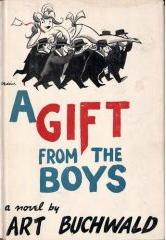
   “A guy showed up in my office covered with bandages and blood and told me he was a recent graduate of Sing Sing,” Mr. [Ben] Bradlee [former editor of the Washington Post] said. “He had done time for murder and was broke. He became a thorn in my side, and I got sick of him, so I sent him to Buchwald, just to get him out of my office. Art locked him up in a room and wrote a book about him, A Gift From the Boys. The guy had been deported and his mob friends gave him a girl as a goodbye present.”

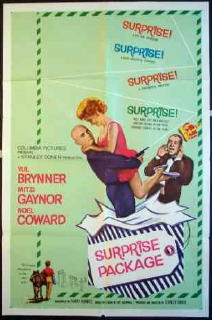
   The novel, by the way, published in 1958, became the basis of the 1960 movie Surprise Package with Yul Brynner and Mitzi Gaynor (as the Gift).

Buchwald1

   [The illustration on the jacket is by Dedini,
a cartoonist often spotted in New Yorker magazine.]

   The paragraph in the Times was interesting but hardly conclusive. I searched online for more evidence to back my case. From Bloomberg.com:

   The story centered on mobsters who were deported from the U.S. to Italy, where Buchwald traveled to interview organized crime figure Charles “Lucky” Luciano in Naples.

   Well, Mr. Buchwald was talking to the right people to help write a crime novel, all right, but I couldn’t come up with a more useful description of the book than what I have so far. Maybe I’d have better luck finding a plot outline of the movie, I thought.

   From Time magazine [Nov. 14, 1960]:

   Surprise Package (Columbia) is stuffed with expensive ingredients: Yul Brynner, Mitzi Gaynor, Noel Coward in front of the camera, Director Stanley (Seven Brides for Seven Brothers) Donen behind it plus a script by Harry (Reclining Figure) Kurnitz based on a novel (A Gift from the Boys) by Columnist Art Buchwald. But as far as entertainment is concerned, Package contains only what is known in show business as a bomb. Director Donen clearly intended to tell a shaggy-dog story the way John Huston did in his hilarious Beat the Devil but unfortunately, Donen’s dog turns out to be all bark and no bite. The hero (Brynner) is a big-time hood deported from the U.S. to his native Greece and confined by the Greek government to a small Aegean island. The story evolves around his attempt to get back in the money by relieving an exiled king (Noel Coward) of his million-dollar crown. Revolving ever more tediously, it goes down the drain in a clutter of words. Package is perhaps the year’s talkiest talkie. Coward: “It’s amazing how a girl so dumb that if you say hello she’s stuck for an answer can reel off a three-hour lecture on why wild mink is better.” Brynner, contemplating a statue of a discus thrower: “What sort of a country is dis? Puttin’ up a monument of a guy stealin’ hubcaps!”

Buchwald2

   So OK, Time didn’t like the movie, but there are points of the plot that are crime-related, wouldn’t you agree? Moving on, here is something extremely interesting I found on TVHeads.com.

   It was also during this period (sometime between 1948 and 1951) Buchwald was rumored and reported to have a very short lived affair with American actress Marilyn Monroe. The affair is said to have only lasted a few weeks, and it was said that Buchwald introduced Marilyn to Judaism (to which she later converted). Marilyn is said to be the basis in part for a character in Buchwald’s novel A Gift From The Boys published in 1958.

   Now I agree that this has nothing to do with my conjecture that Mr. Buchwald’s novel is a work of crime fiction, but if the TVHeads rumor is true, why all I can do is nod my head in agreement.

   Perhaps we should get serious for a moment. Here is my final piece of evidence, a comment from a semi-anonymous poster on IMDB.com:

    “This is a caper film involving a deported U.S. gangster played by Yul Brynner now living on a Greek island trying to steal the crown of the exiled King of Anatolia played by Coward. Along for the ride is Mitzi Gaynor as Brynner’s moll and the baddie played by George Coulouris from the People’s Republic of Anatolia, the gang that overthrew the king. The director is Stanley Donen from a novel by humorist Art Buchwald.

    “Brynner is terribly miscast in his part. A gangster I can believe him as, but he just has no flair for comedy. There were some comic moments in the King and I, but that’s overall, a serious part. Coward looks bored by the whole thing, I wish he had scripted and directed it also and he probably wished he did too. George Coulouris was his usual menacing self.”

   Well, what do you think? Is Mr. Buchwald in, or is he out?

[UPDATE: 01-21-07] An email reponse from Al Hubin, excerpted to refer only to my presentation above:

  Steve,

I’m convinced, though at this stage I’m inclined (for my next Addenda installment, Part 10) to use a dash [to indicate marginal crime content]. Good work on your part!

  Best,

    Al

>> My reply? I agree 100 percent. I couldn’t convince even myself that the book’s more than a marginal entry, but I’m still glad to know that Mr. Buchwald is in.

« Previous PageNext Page »