Stories I’m Reading


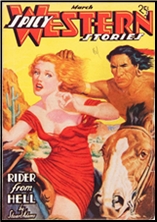
JAMES A. LAWSON “Hard Guy.” Short story. “Hard Guy” Dallas Duane #1. First published in Spicy Western Stories, March 1937. Collected in Dying Comes Hard (Black Dog Books, softcover, 2015) under the author’s real name, James P. Olsen. Introduction by James Reasoner.

   â€œHard Guy” Dallas Duane was an oil range troubleshooter in the 1930s, a fact that fully qualifies him as a PI. His adventures took him all over Oklahoma and Texas, often working undercover. And under the covers, too, which you will have already recognized for yourself if you saw that this first one was published in Spicy Western, a pulp magazine which took its title very very seriously.

   This first of 20 adventures has Hard Guy tracking down the killer of the local county attorney, all the while beating himself up for being tricked into being in the arms of very friendly saloon singer by the name of Nancy. Then follows ten pages of non-stop action, punctuated by the stops to wonder over the pulchritudinous delights of both Nancy and another girl named Kate, both of whom look very good, even with their clothes off, and even while less frequently with them on.

   Great literature this is not, as a wise man once told me, but if that wise man never read this story, I’m one up on him. I just did! And note this: the Black Dog collection collects all twenty of Hard Guy’s recorded adventures.


JAMES H. COBB “The Sound of Justice.” Kevin Pulaski #2. Novelette. First published in Ellery Queen’s Mystery Magazine, July 2005. Probably never reprinted.

   The Kevin Pulaski of the present is a retired veteran of the Los Angeles County Sheriff’s Department, but when he was in high school, back in Indiana in 1949, that he would grow up to be a lawman was the furthest thing from his mind. He was, in fact, a hod-rodder of the first magnitude, and a JD? His reply, “Man, I was there when they first came out.”

   That he had an off-and-on relationship with the local authorities at the time doesn’t matter when a good buddy is accused of stealing a small fortune of jewelry from his girl friend’s father’s store. Kevin goes the preliminary trial on his own initiative, and part of the evidence he provides is… Well, this small excerpt should explain:

   â€œI […turned] to face the judge’s desk. “I’m what you call establishing precedent. You see, Your Honor, every hot rod ever built has a kind of fingerprint. Something about it that is totally different from any other car in the world, the sound of its engine.”

   He demonstrates and his friend goes free. The story is cleanly told and not once pretentious. Even though I was never part of the hot rod culture in high school, I was fully aware of it, and I enjoyed this brief trip back in time.
   

      The Kevin Pulaski series —

Road Bomb (ss) Ellery Queen’s Mystery Magazine Mar/Apr 2004
The Sound of Justice (nv) Ellery Queen’s Mystery Magazine July 2005
Framed (ss) Ellery Queen’s Mystery Magazine June 2006
Over the Edge (ss) Ellery Queen’s Mystery Magazine July 2007
Body and Fender (ss) Ellery Queen’s Mystery Magazine August 2008
Desert and Swamp (ss) Ellery Queen’s Mystery Magazine Mar/Apr 2009

   and previously:

West on 66. Minotaur, hardcover, October 1999, and taking place in Pulaski’s days as a LA lawman.

   Just in case you were wondering how David Handler’s story “The Happy Couple” I reviewed here a couple of days ago ended, I have decided on a way to tell you, but only if you want to be told. Please read comment #1.

DAVID HANDLER “The Happy Couple.” Novelette. First published in Ellery Queen’s Mystery Magazine, July 2005. Not known to have been reprinted.

   David Handler is best known for his hardcover mysteries, most of which fall into either of two series: his Stewart Hoag and Lulu mysteries (of which there are twelve), or his Berger and Mitry tales (of which there are eleven). “The Happy Couple” is therefore a rarity: it’s one of only a small handful of short stories he’s written, and it’s a standalone.

   The narrator is Tim Ferris, as he tells a story that took place thirty years earlier when he was struggling young newspaper reporter in Manhattan. The first line gives a small hint of what is to come: “This is the ugliest show business story that I know.”

   Enamored of the Broadway stage, and superstar actress Barbara Darrow in particular, Ferris is thrilled beyond belief when he is offered an interview with her and her husband, the equally famous actor Anthony Beck. What he does not realize he is walking into is a love triangle between the two of them and Leigh Grayson, a young accomplished actress who is in a lesser role in the current play all three are in.

   Ferris himself finds himself strongly attracted to the latter, which does not please Ms Darrow and the games she loves to play. Not only does he find himself drawn into them as well, but so does the reader. You can simply feel the sexual tension growing, punctuated by Beck finding Darrow sitting naked in Ferris’s lap, an unwanted event by the latter, and totally surprised by it.

   The ending? Totally horrific. I won’t say more, but it is one that Ferris had to wait thirty years before he could tell it. This one’s a chiller.

MAX ALLAN COLLINS “A Wreath for Marley.” PI Richard Stone #1. First published in Dante’s Disciples, edited by Peter Crowther & Edward E. Kramer (White Wolf, 1995). Collected in Blue Christmas and Other Holiday Stories (Five Star, hardcover, 2001). Rewritten as “Blue Christmas,” an unpublished and unproduced screenplay.

   â€œA Wreath for Marley” takes place in Chicago, 1942, at Christmas time, and it doesn’t take long before you, the reader, realize that PI Richard Stone is a louse. He’s bribed his doctor to come up with a note to say he’s 4-F, he buys steak on the black market, and he has been sleeping with the widow of his now deceased former partner, Jacob Marley.

   Marley was shot and killed a full year ago, and to this date, Stone has done nothing about it. I don’t know if you know what’s ahead of him that evening, but if you are already suspecting that this is a mashup of Charles Dickens and The Maltese Falcon, you are one hundred percent correct.

   The ghost that Stone first meets is a gent named John Dillinger, and the one who takes Stone to see his (possible) future looks and sounds very much like the King himself, Elvis Presley. This in spite of the fact that in the real world, the latter is still only seven years old.

   You can get away with a lot of things when you’re writing fantasy, but you can take from me that this is a good one, even if you do know exactly where it is going. In his introduction to hardcover collection of several holiday-based stories he’s written, Max Allan Collins says that while this may not be his best story, it is his favorite one. I can see why.


      The Richard Stone series –

“A Wreath For Marley” (1995, Dante’s Disciples, Blue Christmas)
“A Bird for Becky” (1996, Shades of Noir, Blue Christmas)
“Flowers for Bill O’Reilly” (2001, Flesh and Blood, Blue Christmas)

CAROLINA GARCIA-AGUILERA “The Right Profile.” Short story. Maria Magdalena “Maggie” Morales #1. First published in Hit List: The Best of Latino Mystery, edited by Sarah Cortez & Liz Martínez (Arte Público Press, 2009). Probably never reprinted or collected.

   As a Cuban-American private eye based in Miami, Maggie Morales seems to work exclusively for a low level attorney named Bobbie O’Meara. (She tries to get paid in advance but doesn’t always succeed.) In this case, her only appearance on record, her assignment to get the goods on an ex-husband who claims he can’t pay the money he owes to his former wife because he can’t work. He’s a photographer by trade, and in court, he’s an awfully good faker.

   Posing as a client who needs a photo shoot done, Maggie gets the evidence that proves otherwise, with a final shot back at the man in court that he richly deserves. It’s a minor case, but even so, it provides the reader a solid ten minutes of reading fun. The author, Carolina Garcia-Aguilera, a PI herself, is better known for the six novels she has written about another Cuban-American private eye by the name of Lupe Solano, also based in Miami.

KIERAN SHEA “The Lifeguard Method.” Charlie Byrne #1. First published in Ellery Queen’s Mystery Magazine, August 2009. Probably never collected or reprinted.

   This is both Kieran Shea’s first published story and (of course) the first recorded case of PI Charlie Byrne. Although most of the story takes place in a room at the Trump Taj Mahal in Atlantic City, Byrne seems to be permanently based in Philadelphia. Most of his work is for hotshot litigator there, having saved his son Andy from drowning while working as a lifeguard at a beach when the boy was only six.

   Andy is now in his early 20s and is foolishly trying to scam his father out of fifty grand by faking his own kidnapping. Byrne is having none of it, but makes the initial mistake of taking everything for granted, a mistake he doesn’t make twice.

   In her introduction to the story, the editor points out that it was difficult to decide whether to put this tale in their Department of First Stories, or in their “Black Mask” section. They chose the latter, and it was a good choice. Without being able to say more, this is one of the most hard-boiled stories I’ve read in a long time.

   It was also stated in the introduction that the author was working on a novel involving Charlie Byrne, but if so, it may have never been completed. There was one more appearance for this otherwise one-shot PI, that being “Shift Work,” which was serialized in three parts in an ezine titled Crime Factory, March, May & July 2010.

LOREN D. ESTLEMAN “Robber’s Roost.” Short story. PI Amos Walker. First published in Mystery, April 1982. Collected in General Murders (Houghton Mifflin, hardcover, 1988) and Amos Walker: The Complete Story Collection (Gallery Books, hardcover, 2010).

   This was Amos Walker’s first appearance in short story form. While I have both hardcover collections, I read this one in its original magazine form, at the time when, according to the introduction, Estleman had written only two novels about Walker, his long running Detroit-based PI. (I don’t know whether he’s still active. From the information I have, he last appeared in The Lioness Is the Hunter (2017).

   This one’s a good one, based on the crime-ridden history of Michigan’s largest city. He takes a job from a long-retired cop in a nursing home who wants to find out what really happened to his adopted brother when he died some 50 years before. His car apparently fell through the ice while making a bootlegging run while crossing the river into the US from Canada. He’s positive that Eddie was killed by his boss, a former racketeer now also still alive, and he wants Walker to put him in prison.

   There is, of course, more to the story than that, but finding out what really did happen takes all of Walker’s skills as a detective. The story’s breezily told, maybe just a tad too breezily, but only a curmudgeon would cavil at such a small thing as that. Fans of PI stories who haven’t yet caught up with Amos Walker have a real treat coming.

HENRY KUTTNER “Don’t Look Now.” First published in Startling Stories, March 1948. Reprinted many times, including: My Best Science Fiction Story, edited by Oscar J. Friend & Leo Margulies (Merlin Press, hardcover, 1949); The Great Science Fiction Stories: Volume 10, 1948, edited by Isaac Asimov & Martin H. Greenberg (DAW, paperback, 1983); and Tales from the Spaceport Bar, edited by George H. Scithers & Darrell Schweitzer (Avon, paperback, 1987). Collected in Two-Handed Engine by Henry Kuttner & C. L. Moore (Centipede Press, hardcover, 2005).

   Mos Eisley and the spaceport bar. What a perfect scene. One that thousands of long time science fiction fans had read about and pictured in their minds for years. And there it was, having come to life right before their eyes.

   Bars where spacefarers come to talk, lie and swap yarns. Not all of them human. All kinds and shapes of aliens used Mos Eisley as a stopover point, a place to restock and refuel and catch up on the news. Or in some cases the bar is on Earth, and the conversation is between two men, and the Martians are the beings secretly ruling the world that one of the men is trying to convince the other he can see. Most of the time they are invisible, lurking just out the corner of your eye, but when you can see them, they are easily identified by their third eye. Right in the middle of their foreheads.

   This is a classic story, first published way back in 1948, and if you go looking, over 70 years later, I’m sure you can find a book in print that it’s in, or if not, then in ebook format. In those years after the war, there was a certain uncertainty, if not outright paranoia, about the possibility we were not alone in the universe, that mankind had lost control of things, and in “Don’t Look Now,” Kuttner, in his most humorous mode, capitalizes on it most excellently.

MICHAEL COLLINS “A Death in Monecito.” Short story. PI Dan Fortune. First published in Ellery Queen’s Mystery Magazine, April 1995. Collected in Fortune’s World (Crippen & Landru, 2000).

   Montecito is a small but exclusive community area located east of Santa Barbara, a fact which is important in how one-armed PI Dan Fortune approaches this case of murder he’s asked by the victim’s lawyer to look into. The woman’s death is assumed to have been perpetrated by a burglar caught in the act by her, but the arrangement of the furniture seems to Fortune’s client to have been changed. But why? No ordinary burglar would not have done that.

   Posing as a would-be buyer of the house, even before it goes on the market, Fortune does his initial investigation at the scene of the crime itself and by talking to the dead woman’s two daughters, as different from each other as night and day, one a rising Hollywood star, the other the owner of a local boutique. There are other suspects as well, if indeed a burglar was not responsible, and the solution to the cases is a nicely woven combination of clues (minor) and personalities (major).

   In spite of the bright clear skies of sunny California, or perhaps brought out all the more out in contrast, a melancholy mode persists throughout the story, as is the case in many of Fortune’s adventures, and the ending doubly so.

« Previous PageNext Page »