Stories I’m Reading


ROBERT SILVERBERG “Double Dare.” Short story. Galaxy Science Fiction, November 1956. Reprinted in The Fifth Galaxy Reader (1961). Collected in The Cube Root of Uncertainty (1970), among others.

   While published before I discovered science fiction magazines at the local newsstand, which would have been a couple of years later, this is the kind of SF story I enjoyed immensely when I did, and which I don’t come across all that frequently any more.

   Which is to say a “nuts and bolts” kind of SF story, in which either a Terran scientist or a pair of engineers from Earth — as in “Double Dare” — are given a problem to be solved, and whatever their motivation, they go ahead and do it.

   In this case, the stakes are raised about as high as they can go, starting with a bet in bar about which of two races, Earth’s or the alien Domerangi, is the better at solving technological problems. To settle the question, a team of two experts from Earth are sent to the Domerangi home planet, where they are presented with three engineering or physics problems to solve, with two of the Domerangi doing the same back on Earth.

   The first two tasks are easy, but the third is a tough one: to build a perpetual motion machine. Given the right incentive — and on a personal level it is to be able to go back home again — the two from Earth … but telling more would spoil the point of the story. Suffice to say that everything works out in very fine fashion, and with a added twist to the tale as well.

   Stories such as this one are built on cheery optimism, I grant you, but they’re also a lot of fun to read.

ERLE STANLEY GARDNER “The Silver Mask Murders.” The Man in the Silver Mask #3. Novelette. Detective Fiction Weekly, 23 November 1935.

   In the years during which Erle Stanley Gardner was one of the most prolific pulp writers around, he tried his hand not only at mysteries — tons of them — but westerns, adventure stories and even science fiction (collected in The Human Zero: The Science Fiction Stories of Erle Stanley Gardner, 1981). Given the undeniable fact of the latter, it should come as no surprise that he dabbled in the equivalent of the hero pulps as well.

   The most famous of the latter were The Shadow, The Spider, Operator #5 and so on. Most were the primary occupants of their own magazines. Gardner’s contributions to the genre consisted of only three long stories in the pages of Detective Fiction Weekly, all in 1935. Having read only this, the third and last of them, I don’t know if the hero in these stories was ever given a name. He seems to have been known only as The Man in the Silver Mask.

   You can probably guess why, but to confirm your suspicion, the cover of the magazine his third adventure appeared in will illustrate as well as words could do. Besides his general anonymity, nothing also is known about his background, nor why he feels to need to keep his identity a secret. All we know for sure is his fierce determination to fight crime.

   Assisting him in these endeavors are a hunchbacked Chinese mute servant by the name of Ah Wong, and a female secretary/assistant named Norma Lorne and described as “a rather slender, willowy young blonde,” who aids The Masked Man outside the office as well as in.

   In “The Silver Mask Murders” this vigilante on the side of justice comes up against a powerful nemesis named Thornton Acker, a lawyer whose clientele consists solely of other criminals who can afford his steep fees ($250,000 this time around) to help them get out of jams they can’t manage to do on their own.

   Acker’s task in this one is to make sure that a man in prison doesn’t testify against his boss in court, which he does in spectacular fashion. But the Man in the Silver Mask is working on the other side, that of law and order, and Acker’s meticulous planning soon begins to go further and further awry.

   For the most part, this is routine stuff, with a lot more violence, I suspect, than ever appeared in any other Erle Stanley Gardner story. One scene sticks out, though, one in which Silver Mask is threatening a hoodlum he’s holding captive with physical torture at the hands of his Chinese assistant. When asked later by Norma Lorne whether or not he was bluffing, Silver Mask confesses that he doesn’t know.

   The story ends with many underlings dead or in jail, but with Acker still at large. A blurb at the end of the story advertises that the next installment of the series would be coming soon, but it never did. The world of mystery fiction never noticed.


   The Man in the Silver Mask series —

The Man in the Silver Mask. Detective Fiction Weekly, July 13 1935


The Man Who Talked. Detective Fiction Weekly, September 7, 1935


The Silver Mask Murders, Detective Fiction Weekly, November 23, 1935

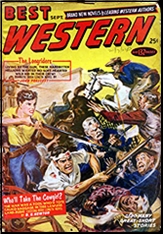
D. B. NEWTON “The Claim Jumpers.” Novella. First published in Best Western, September 1952 as “Who’ll Take the Cowgirl?” First collected in Range of No Return (Five Star, hardcover, 2005; Leisure, paperback, December 2006).

   In his long foreword to the two-story book collection, Jon Tuska makes the case for his theory that D(wight) B(ennett) Newton would be a lot more known today if he hadn’t been pushed by his agent to have much of his work published under pseudonyms. Names other than his own that he used over the years were Dwight Bennett, Clement Hardin, Ford Logan, Dan Temple and Hank Mitchum (eight of the long-running “Stagecoach” series in the 1980s).

   There’s a lot of truth in that statement. I’ve enjoyed all of the novels I’ve read by the above “authors,” and going back to the later years of his pulp-writing days, both of the two stories in Range of No Return are very well done. (His first published pulp western was in 1938, and over the years he wrote 150 or so more of them.)

   “The Claim Jumpers” takes place at an actual event, the Cherokee Strip Land Run (Oklahoma, 1893), as have many other stories and dramatic films over the years. Newton’s story does not rely on its historical significance, however. Rather it’s one told on a personal basis, which to me makes it all the more effective. When three cowpoke partners lose their fourth in the plan they’ve come up with, one of them succumbs to the charms of a woman he happens to meet, and he asks her to help them out.

   Things don’t go well, however. Someone seems to have leaked their plans to some Sooners who have settled into the land the partners had planned on settling, and they’re well equipped with guns. Did the girl betray them? All signs point to it.

   This is a story that combines a historical background with both action and characters that have some character to them, and at 70 pages, there’s plenty of time for Newton to develop both.

***

— “Range of No Return.” Short novel. First appeared in Complete Western Book Magazine, June 1949. Also first collected in Range of No Return (see above).

   And if anything, “Range of No Return” is even better. At almost twice the length of “The Claim Jumpers,” the action is nearly non-stop, but more than that, it fits in naturally with the story Newton has to tell. No gunfire for the sake of gunfire.

   Which is that of a young rancher who was framed for rustling cattle in his home town five years ago. With the sheriff’s assistance, who believed him innocent, he made tracks for Mexico, but now that his notoriety has died down, or so he hopes, he’s back, trying to pick up where he left off before his troubles began.

   But he’s wrong. The local ranchers have not forgotten, including the female owner of the ranch next to his. There are a couple of small twists in the tale from this point on, but they’re, I admit, only minor ones. But Newton has a good eye for describing his characters, as well as the area of Arizona hills and grasslands he places them in. Even though the basic story line is a familiar one, this is a solid piece of writing.

   If you’re a fan of western yarns, you could do a lot worse than to check out more of Newton’s stories, even his early purely pulp fiction. It’s better than most.

ERLE STANLEY GARDNER “Where Angels Fear to Tread.” Lee Sparler #1. Novelet. Published in Detective Fiction Weekly, 30 December 1939.

   Even though he got a huge cover blurb, most assuredly on the name value of the story’s author, Erle Stanley Gardner, as a private eye, Lee Sparler turned out to only be a one-and-done. By this time in 1939 Gardner was winding down his pulp-writing career. Perry Mason and the Donald Lam and Bertha Cool books were a lot more profitable, I’m sure.

   As a character, Sparler is worth talking about, though, and I could do no better than to use the words of Theo. W. Garr, president of The Planet Investigations, Inc. Here he is describing the qualities of the operative he plans to assign to a prospective client’s case:

   “He looks like a gigolo. He plays the harmonica. He raises hell with office discipline. He’s found that my old-maid bookkeeper is a romanticist at heart, and capitalizes on that knowledge. He discharges his responsibilities in a thoroughly irresponsible manner. He’s always broke. He plays the race horses. He wastes expense money, and he doesn’t seem to take himself, life, or anyone else seriously. His personality is thoroughly distasteful to me. He’s raising the devil with all my routine. He takes too many chances, and some day he’s going to get himself killed if I don’t fire him first. I have long suspected that he solves his cases by luck more than by brains and application, but the point is he gets results. Now then, do you want us to handle the case, or do you want your check back?”

   I don’t know how often a sales pitch like this would really be effective, but of course the client says yes, maybe a little doubtfully, but yes. His daughter, he believes, is being blackmailed. She’s always broke, and he thinks she’s been pawning her jewelry. Without letting her know she’s being watched, Sparler’s job is find out what’s going on. Which he does, and as it turns out, everything his boss said about him is true.

   I think Gardner had a lot of fun writing this story, and it shows. The twists in the tale that you expect in a Gardner story are only minor ones, however, and in fact, to my way of thinking, the story ends far too soon. I enjoyed it, though. It’s too bad that Lee Sparler had only the one adventure, but we can always hope that he got the girl.

LARS ANDERSON “The Domino Lady Collects.” Short story. Domino Lady #1. Originally published in Saucy Romantic Adventures, May 1936. Collected in Compliments of the Domino Lady (Bold Venture Press, 2004). Reprinted in The Big Book of Female Detectives, edited by Otto Penzler (Black Lizard, 2018).

   Not the first paragraph of the story, but close to the beginning, and introducing the first recorded adventure of The Domino Lady!

   A nightgown of sheerest, green silk was but scant concealment for her gorgeous figure. A chastely-rounded body and a slender waist served to accentuate the seductive softness of her hips and sloping contours of her slim thighs, while skin like the bloom on a peach glowed rosily in the reflected sunlight.

   Fairly tame stuff, by today’s standards, but while I don’t know for sure, I suspect that at a lot of newsstands in 1936, you had to ask if they carried copies of Saucy Romantic Adventures, and if you didn’t look like some kind of close-minded law enforcement officer, they might have been able to sell you one from under the counter.

   Copies of the magazine that have survived until today go for large amounts of money. Scarcity and high demand. Simple economics. It certainly can’t be great literature that buyers are looking for.

   In the Penzler edition, the story is only eight pages long, barely enough to introduce the character, describe what it is that motivate her to dress up in style but adding a domino mask to keep her real identity a secret. She also has a job she has been asked to do, which she does most efficiently (some indiscreet letters must be retrieved). She has vengeance on her mind, to avenge the killing of her father at the hands of the “state machine.” That the villain in this piece is not jailed or otherwise inconvenienced by her intrusion into his home may mean the story continues right on into the next one.

   It’s a mere trifle, nothing more, and when it comes down to it, the writing is nothing to get excited about, D-level at best. Lars Anderson may have been a house name. If he was a real person, nothing solid seems to be known about him, but that his semi-sexy tales are being reprinted — and that stories of the character he created continue to be written by other hands — does say something about his ability to capture the minds of readers still young at heart. A little nostalgia for days past doesn’t hurt either.


      The original Domino Lady series

The Domino Lady Collects. Saucy Romantic Adventures, May 1936
The Domino Lady Doubles Back. Saucy Romantic Adventures, June 1936
The Domino Lady’s Handicap. Saucy Romantic Adventures, July 1936
Emeralds Aboard. Saucy Romantic Adventures, August 1936
Black Legion. Saucy Romantic Adventures, October 1936
The Domino Lady’s Double. Mystery Adventure Magazine, November 1936

SHANNON CONNOR WINWARD “Witch’s Hour.” Novelet. First published in The Magazine of Fantasy & Science Fiction, May/June 2017.

   Fantasy stories with pseudo-medieval settings are very common. They usually come with castles and kings and queens, secret alliances and intrigue within the castle and with heads of other kingdoms, often with sons’ and daughters’ hands in marriage, with or without their approval.

   Such is the setting of “Witch’s Hour,” save for the primary protagonist, Esmelda, who heads the kitchen in Castle Lochhunte. She’s the head cook, in other words, and a good one, perhaps the best there is for miles around.

   But she has a problem. The ghost of the former cook, the man who she replaced, the man whose life she took when his groping hands became more than just a minor nuisance, is haunting her. That the king also has his eye on her, and not only for her finesse in the kitchen, is less of a problem — one in fact that she welcomes.

   But fantasy stories with pseudo-medieval settings need not always have happy endings, and this [PLOT ALERT!] is … You’ll have to read this one. The author, Shannon Connor Winward, is also an award-winning poet, and it shows.

RICHARD SALE “Chiller-Diller.” Daffy Dill #37. Short story. Detective Fiction Weekly, 24 June 1939. Reprinted in The Big Book of Female Detectives, edited by Otto Penzler (Black Lizard, 2018).

    Before he became well known in Hollywood circles as a writer, producer (Gentlemen Marry Brunettes) and director (Abandon Ship, Malaga, and so on), Richard Sale was a prolific writer of pulp fiction, with several hundred stories to his credit, including the long-running “Daffy” Dill series, beginning with “The Fifty Grand Brain” (Detective Fiction Weekly, 03 November 1934) and ending with “Death Flies High” (Flynn’s Detective Fiction, June 1943).

    “Chiller-Diller” is very much typical for the series, as breezy and fast-moving as you might expect a tale about a brash reporter for a New York City newspaper might be. The people in charge of the Chronicle have two stories going on at once: first the murder of a lady “cocktail” reporter for the rival Dispatchl and secondly the elopement of a young debutante with a notorious crooner slash hoodlum named Al Myers.

   Of course the two stories are connected, and it doesn’t take long for Daffy to find out how. The reason the tale is included in Otto Penzler’s The Big Book of Female Detectives is once again on the iffy side. Dinah Mason, the gossip columnist for the Chronicle and the love of Daffy’s life, is the one who found her rival’s body and is the one whose byline is on the story. She’s sent down to Florida for background information after that, however, and thereby essentially disappears from the story.

  FREDERICK NEBEL “Red Hot.” Jack Cardigan #27. Short story. Dime Detective, July 1, 1934. First collected in The Complete Casebook of Cardigan, Volume 3: 1934-35 (Altus Press, 2012). Reprinted in The Big Book of Female Detectives, edited by Otto Penzler (Black Lizard, 2018).

   Private eye Jack Cardigan appeared in some 44 hard-boiled tales published in Dime Detective Magazine between 1931 and 1937. Assisting him in many of his cases was Patricia Steward, sometimes in major ways. (I am not clear as to what her status actually was in the Cosmos Agency. Was she his secretary, or was she actually something more than that?)

   In “Red Hot,” Cardigan is hired by a client to find his nephew who left his family in bad standing, but now that his father has died, he is needed to be present for the reading of the will. Cardigan makes short work of finding the nephew, but the man flat out refuses to go back with his uncle.

   When Cardigan reports to the uncle, he assumes the man will confront his nephew directly, but the next morning Cardigan learns that the uncle has disappeared. Things happen very quickly from this point on, but not only is this a fast-moving story, it’s well plotted, too, ending in a most satisfactory fashion. (Many pulp yarns start off with a bang only to flag off badly at the end.)

   I read this one in the Penzler anthology, another giant doorstop of a book that’s well worth the money. I do question why this particular Cardigan story was used, though. Pat Steward is present throughout, but truth be told, besides being on hand to offer comfort to the nephew’s wife, she has very little to do.

ERLE STANLEY GARDNER “Cheating the Chair.” Sidney Zoom #14. Detective Fiction Weekly, 17 September 1932. [Added later:] Reprinted in The Casebook of Sidney Zoom, edited by Bill Pronzini. (Crippen & Landru, 2006).

   Alphabetically the last of the series detectives in the online Crime Fiction Index, I do not know if it is precisely correct to call Sidney Zoom a private eye. In this story, the only one of his adventures that I’ve read, he does not have a paying client, which would, I think, be one of the several criteria that must be satisfied to qualify.

   Zoom thinks of himself as a fighter for the underdog, and reads newspapers to find cases in which he believes justice is not being served. He appears to be independently wealthy. He has a devoted secretary named Vera Thurmond, and lives on a yacht with a captain on board to take him up and down the coast to wherever he needs to go.

   What attracts him to this current case, in which a disgruntled ex-convict is accused of killing the county attorney who sent him up, is that Zoom is convinced that the prosecutor’s version of what happened does not match the facts.

   In this regard, the detective work is fine, but the story gets muddled more than I’ve come to expect from Gardner. Zoom has to depend on bluffing the miscreants involved to secure the release of the accused man.

   As you can see from the list below, there were quite a few Sidney Zoom stories, but based on this one, while certainly readable, they may not be at the same level, quality-wise, as some of Gardner’s other series pulp heroes. I’ll have to investigate further.

       The Sidney Zoom stories —

The Higher Court (ss) Detective Fiction Weekly Mar 8 1930
(*) Willie the Weeper (ss) Detective Fiction Weekly Mar 29 1930
(*) My Name Is Zoom! (ss) Detective Fiction Weekly Apr 12 1930
The Purple Plume (ss) Detective Fiction Weekly May 24 1930
Time in for Tucker (ss) Detective Fiction Weekly Sep 13 1930
Strangler’s Silk (nv) Detective Fiction Weekly Jan 3 1931
The Death Penalty (nv) Detective Fiction Weekly Jan 17 1931
(*) Borrowed Bullets (nv) Detective Fiction Weekly Mar 21 1931
The Vanishing Corpse (nv) Detective Fiction Weekly Aug 15 1931
(*) Higher Up (nv) Detective Fiction Weekly Sep 19 1931
(*) The First Stone (nv) Detective Fiction Weekly Oct 24 1931
It Takes a Crook (nv) Detective Fiction Weekly Feb 6 1932
(*) The Green Door (nv) Detective Fiction Weekly Aug 20 1932
(*) Cheating the Chair (nv) Detective Fiction Weekly Sep 17 1932
(*) Inside Job (ss) Detective Fiction Weekly Jan 7 1933
(*) Lifted Bait (nv) Detective Fiction Weekly Oct 21 1933
(*) Stolen Thunder (nv) Detective Fiction Weekly May 19 1934

       (*) Included in The Casebook of Sidney Zoom.

A. E. APPLE “The Diamond Pirate.” Rafferty #2. Long novelette. First published in Detective Story Magazine, 22 October 1927. Reprinted in The Compleat Adventures of Mr. Chang and Mr. Rafferty, Battered Silicon Dispatch Box Press, hardcover, four volume set, 2010.

   I do not know whether the latter collection was ever published. “The Diamond Pirate” was the lead story of the October 22, 1927 issue of Detective Story Magazine, which is where I read it. It was preceded chronologically by “Rafferty, Master Rogue,” which appeared in the same magazine three weeks earlier.

   In that earlier story a master criminal named Rafferty outwitted a high-powered private eye by the name of Bradley and pulled off a bank robbery that netted him some twenty million dollars, a tidy sum, even today. In this second caper, Rafferty ups his game somewhat, intending to rob the diamond district en masse on a scale never seen before.

   The story opens in a mausoleum in a cemetery on a vicious rainswept night, as Rafferty’s closest lieutenants in crime meet in ear darkness to obtain the next step of instructions. In Act II, Rafferty obtains the services of a anarchic German scientist named Herr Heinie (…) but not before a long drawn-out confrontational scene between the two men takes place.

   Next, one of Rafferty’s assistants tries to defect to Bradley’s side, but the former gets wise, negates the loss and continues his plans. There is quite a bit of suspense that builds along way, but what may take the modern day reader by surprise — it did me — is that [PLOT ALERT!!] everything goes off smoothly. Rafferty and his gang make off with millions of dollars worth of diamonds, the last stage of their getaway accomplished by submarine. Bradley is a complete non-factor.

   There were over twenty tales told of Mr. Rafferty, at least two of them in conjunction with Mr. Chang, A. E. Apple’s equally long running version of a Chinese mastermind villain. I have no idea if Rafferty had the same amount of success in all of his ventures, but if all his schemes came off as easily as this one does, I have to wonder why the stories stayed as popular for as long as they did. A steady diet of tales such as this one would go nowhere quickly, as far as I am concerned.

« Previous PageNext Page »