Stories I’m Reading


SELECTED BY JONATHAN LEWIS:


ED GORMAN “The Order of Things Unknown.” First published in Lovecraft’s Legacy, edited by Robert E. Weinberg & Martin H. Greenberg (Tor, hardcover, 1990; St. Martin’s, trade paperback, 1996).

   Truthfully, I had no idea where this story was going. Not until I read a little further and got to learn a little more about the protagonist’s sordid past. Apparently, some years ago Richard Hanson murdered an innocent small town girl he picked up on the roadside. His was a vile act, a disgusting murder in every sense of the word. And apparently, this Hanson became a compulsive serial killer of women. During the day, he was a normal family man with a job, wife, and kids. But he also killed and he never knew exactly why he did it and what drove him to such depths of moral depravity.

   The why is the crux of the matter in Ed Gorman’s gripping homage to H. P. Lovecraft. In “The Order of Things Unknown,” Gorman engages in genre blending, mixing a dark crime story with cosmic, supernatural themes once found in Weird Tales and other similar pulps. That question of “why” – why does an average man engage in such unspeakable atrocities? – is answered with reference to the same dark forces that haunted Lovecraft’s imagination.

   Maybe Hanson isn’t a free agent, acting in accordance with free will. Maybe he’s at the mercy of dark forces beyond his control, a mere puppet on the play strings of an ancient god. Overall, a haunting read, one that demonstrates how well versed the late Ed Gorman was with the philosophical and theological issues that so concerned Lovecraft during his short, tumultuous life.
SELECTED BY JONATHAN LEWIS:


LORD DUNSANY “The Strange Drug of Dr. Caber.” Included in The Fourth Book of Jorkens (Jarrolds, UK, hardcover, 1947; Arkham House, US, hardcover, 1948). Reprinted many times including Alfred Hitchcock’s Sinister Spies [edited by Robert Arthur], Random House, hardcover, 1966.)

   There is a long tradition of tall tales being told being told by a single narrator in a gentleman’s club or bar. These include, among others, L. Sprague de Camp and Fletcher Pratt’s Tales from Gavagan’s Bar, Arthur C. Clarke’s Tales from the White Hart and Isaac Asimov’s Black Widowers and Union Club mysteries.

   The story in this particular entry in the category is but one of over 150 short stories written by Irish author Lord Dunsany, beginning in 1925, in which the leading character is a chap called Jorkens. “The Strange Drug of Dr. Caber.” is a (very) short fictional work is as much a puzzle as it is a crime or spy story.

   The tale begins in the Billiards Club where the unnamed narrator and others become involved in a debate as to whether pulling off a murder is easy or difficult. There is about to be an emerging consensus “that murder cannot successfully be committed,” when Jorkens. one of those present, begins to relate the story of one Dr. Caber.

   It is Dr. Caber’s tale that is thus presented for the remainder of the story. And it’s a clever one, perhaps more of a vignette than a short story, but nevertheless one I found to be a compelling read. In 1938, a group of likely British secret agents approached Dr. Caber in order to obtain his services for a most delicate project: kill “Norman Smith,” the pseudonym for a German spy in England.

   Caber reluctantly takes on the project and assures the men that he is going to be able to have “Smith” killed. But he will not mess with the enemy agent’s vicious huge Alsatian dog and he won’t utilize poison. He will merely have Smith pricked with a syringe and lead the man to believe he has been poisoned. As it turns out, Smith ends up dead soon enough.

   How Dr. Caber pulls this off and the role the Alsatian plays in the affair is the key to unlocking the puzzle.

SELECTED BY JONATHAN LEWIS:


MANLY WADE WELLMAN “Ever the Faith Endures.” First published in The Year’s Best Horror Stories: Series VI, edited by Gerald W. Page (Daw #297, paperback original; 1st printing, 1978). Collected in The Devil is Not Mocked and Other Warnings (Night Shade Books, hardcover, 2001).

   I love this type of atmospheric horror story. One in which a man goes in search of his roots in either the United Kingdom or New England and discovers some shocking family secret. That, or something far more sinister, ones in which a sense of slowly creeping dread permeates the entire story.

   Such is the case in Manly Wade Wellman’s “Ever the Faith Endures.” From the title, one might expect that the faith references would be Christianity. But let me assure you: that is far from the case. The faith that plays such an important role in the story is a pagan one. Specifically, the worship of the god Baal. The connection between that old god and the story’s protagonist becomes evident soon enough, particularly because his name is Wofford Belson. His original family name back in England was Belstone. As in Baal’s stone. You see where this might be going.

   Not only does the story tie in Wofford Belson’s quest to learn about his family’s distant past and to visit their original home back in England (Belson is an American), it also brings him face to face with a long distant cousin. She’s nice enough, and Belson takes an immediate liking to her. But she’s adamant that she can’t leave England and return to the States with him. You see, she’s been tasked with guarding something inside the Belstone estate. Something grotesquely evil. A being that could just as easily come straight from the imagination of one H. P. Lovecraft.

   Recommended.

MICHAEL F. FLYNN “Nexus.” Lead (and cover) novella in Analog Science Fiction, March-April 2017.

      Nexus: a connection or series of connections linking two or more things.

   This is a time-travel story taking place in the present that packs a series of multiple punches, each centered around one of the several characters involved:

    … a time traveler from the future who is trying to track down where his particular timeline has gone off the track, dooming billions of people; a woman who is immortal and who met the time traveler once before back in the Byzantine times; a member of a hidden alien race on Earth on the track of a possible invader that may have followed them here: a five-legged spider-like creature alone on Earth that hopes to use the time traveler’s machine to repair his/her/its spaceship; a female android who, inadvertently connecting the pieces of the plot together, wonders if the immortal woman could be another of her kind; and a woman with telepathic abilities who overhears a conversation that brings her into the tale as well.

   That all of these players meet at one crucial time in this planet’s history may happen by a series of striking coincidences, perhaps, but then again, perhaps not.

   Michael F. Flynn has been around as a strong proponent of hard science fiction for a while now, but this is the first work of his that I’ve read. This had to have been a difficult story to write, pulling all of the threads together as he does in a clear, concise fashion, with a light touch every so often as it’s needed. I’m impressed, and I’ll see what I can do to find more of his short fiction to read. Long SF novels are pretty much beyond me any more, I’m afraid.

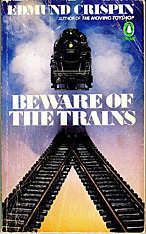
EDMUND CRISPIN “Beware of the Trains.” First published in The (London) Evening Standard, 1949. Lead story in the collection of the same title (Gollancz, UK, 1953; Walker, US, 1962).

   Is it possible to tell to tell an “impossible crime” mystery in ten pages and get away with it? The answer is yes, and “Beware of the Trains” is a fine unadulterated example.

   Crispin’s primary detective character, Gervase Fen, is by profession an Oxford professor, but he has a decided penchant for running into — and solving — all kinds of unusual crimes. In this story he is once again luckily on hand when the engineer of the train he is on mysteriously disappears, even though the police have the small station surrounded, hoping to nab a notorious burglar whom they suspect was on the train, but who is not.

   That the thief may never have been on the train means that the latter part of that previous sentence is not an impossible crime, but where is the driver?

   Fen uses his wits, does some searching, and comes up with the answer, all neatly and tidily done. Another author who specialized in short story impossibilities was Edward D. Hoch, some of whose efforts along these lines have been collected, but not enough of them to suit me.

ISAAC ASIMOV “The Cross of Lorraine.” First published in Ellery Queen’s Mystery Magazine, May 1976. Collected in Casebook of the Black Widowers (Doubleday, hardcover, 1980; Fawcett Crest, paperback, March 1981).

    The Black Widowers were a men-only dining club that met once a week in a private room of a Manhattan restaurant. Each evening one of the members brings a guest, who after dinner is questioned as to the reason for his existence. In the conversation that follows, a problem the guest has invariably comes up and is tackled by the members as a group. The solution to the problem, however, also invariably comes from Henry, the waiter.

    There were 66 of these stories altogether. Five collections of twelve stories each were published in Asimov’s lifetime. Some of the stories were original to each volume, otherwise all but two appeared first in EQMM. The last six plus eleven reprints were collected in The Return of the Black Widowers (Carroll & Graf, 2003).

    “The Cross of Lorraine” is the first story in the third collection, and it follows the pattern of all the others. While the guest, named Larri, is only a so-so magician, his fame comes from exposing phony mystics, and a lot of discussion takes place involving sleight of hand and misdirection, which is where Larri’s problem comes in.

   It seems that he lost track of a woman whose company he was enjoying on a bus ride. When he fell asleep, she got off at her stop, and his only clue is a young French lad’s assertion that he saw the double-barred Cross of Lorraine when she did so, but retracking the route, Larri could find no such symbol along the roadway.

   The solution is simple but exceedingly clever. You probably can’t read too many of these in a ow, and shouldn’t even try, but at a slow pace of only one at a time, these old-fashioned and clearly told puzzle stories, for that is what they are, are a lot of fun. They were among Asimov’s own favorite stories to tell as well.

SELECTED BY JONATHAN LEWIS:


H. G. WELLS “The Magic Shop.” The Strand Magazine, June 1903. First collected in Twelve Stories and a Dream (Macmillan, UK, hardcover, 1903) and The Country of the Blind and Other Stories (Thomas Nelson, US, hardcover, 1911). Reprinted and anthologized many times. Adapted for The Alfred Hitchcock Hour by John Collier, 10 January 1964, with David Opatoshu as Mr. Dulong. Readable online here.

   One of the many tropes in early science fiction was that of a shop or a building that is there one day, but gone the next. The very notion that one could randomly happen upon a commercial establishment one day and that it would be literally gone the next day is one of those quirky concepts that speculative writers play with so well.

   So it shouldn’t come as any surprise that when I began reading H.G. Wells’s “The Magic Shop,” that one of the first things I thought of was whether the eponymous shop would exist one day and vanish the next. Lo and behold, I was not disappointed. For in this rather whimsical tale, a father and his son visit a magic shop in London wherein they discover a wide array of magical and mystical items for sale. The father, a skeptic, and his son Gip encounter a proprietor who may not be lying when he tells them that he deals in real magic.

   There is something charmingly innocent about this story. The dialogue in particular harkens back to an almost fairy tale like innocence. Indeed, it’s Wells’s ability to conjure up a sense of wonder that makes this story about a magic shop doing its own disappearing act a short, but pleasurable read. Recommended.

ANDREW KLAVAN “All Our Yesterdays.” Lead story in Ellery Queen’s Mystery Magazine, March-April 2017.

   The story begins with a horrific view of life (and death) in the army trenches in France in World War I, then tells the story of a survivor identified only as Brooks, as he recuperates in a make-shift hospital facility in Gloucestershire.

   Suffering from uncontrollable blackouts, he finds a friend in Dr. William Haven, to whom he confides his fears that life will never be the same. Brooks believes that the Victorian era was the best time in the world to be alive. Standards have fallen. Women wear trousers now.

   But then when a girl is found brutally murdered, Brooks also fears that he is the one responsible, and we have at last the reason this story was chosen as the lead for this issue, with the life of a young barmaid named Nancy at stake — a tale perfectly told.

   Author of some 30 novels, Andrew Klavan has been nominated for the Edgar Award five times and has won twice, first for Mrs. White in 1984, which he wrote under the pen-name Margaret Tracy, as Best Paperback Original, then for The Rain in 1990 in the same category, a book he wrote as Keith Peterson.

NINA KIRIKI HOFFMAN “Vinegar and Cinnamon.” Lead (and cover) story in The Magazine of Fantasy & Science Fiction, January-February 2017.

   In a world in which magic exists, but not everyone has the same ability to cast spells, one family undergoes a small tragedy when the twelve year old sister transforms her fourteen year old brother into a rat. It was in fit of anger, and once done, she does not know how to reverse it.

   Luckily Sam decides that he likes being a rat. His sense of sense of smell is enhanced tremendously, for example, even though his vision is restricted to seeing only objects nearby.

   Even emotions have smells: “vinegar surprise, hot-pepper anger from Ma; baking-bread love from Pa; and caramel love and salt-water dismay from Maura.” Maura does her best to change Sam back again and he finally agrees to let her try. Does she succeed? Read this delightfully enjoyable homespun sort of tale and find out.

   Nina Kiriki Hoffman has written 17 novels, some for pre-teens and young adults, including The Thread That Binds the Bones, reviewed by Barry Gardner here on this blog. Her short story “Trophy Wives” won a 2008 Nebula award.

SELECTED BY JONATHAN LEWIS:


ROBERT BLOCH “The Chaney Legacy.” First published in Night Cry, Fall 1986. Reprinted many times, including Witches & Warlocks, edited by Marvin Kaye (SF Book Club, hardcover, 1990).

   How does an actor become a monster? What method does an actor have to utilize, what magic must they conjure up in order to become a cinematic fiend? Bela Lugosi didn’t just portray Dracula; he became Dracula. What about Boris Karloff and Peter Lorre? How did they become the characters they portrayed? And what of Lon Chaney, the famed silent film star who portrayed monsters, grotesque villains and strange looking men?

   That’s the obsession plaguing a character named Dale in Robert Bloch’s gripping and creepy little tale, “The Chaney Legacy.” Dale, a researcher of Hollywood lore, is faced with a choice: does he decide to live in a Hollywood Hills bungalow once inhabited by Chaney or does he maintain his romantic relationship with a local broadcaster named Debbie Curzon. True to his obsession with Chaney and the late actor’s films, Dale chooses the house.

   As any fable reminds us, it can be dangerous to pursue a question and a line of inquiry to its rightful conclusion. In his obsessive quest to understand how Chaney became the characters he portrayed, Dale stumbles upon a secret that would have better been left in the past. The secret comes in the form of a makeup kit with a mirror, the very makeup kit that Chaney apparently utilized to “become” the characters he portrayed in the silent films.

   But as any good student of horror fiction knows, sometimes secrets are dangerous. That’s definitely the case in this sublimely bizarre short story by Robert Bloch. Recommended for horror fiction and film fans alike.

« Previous PageNext Page »