Diary Reviews


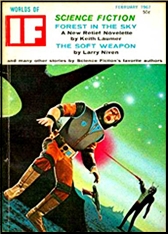
IF SCIENCE FICTION. February 1967. Editor: Frederick Pohl. Cover art: [Paul E.] Wenzel. Overall rating: 3 stars.

LARRY NIVEN “The Soft Weapon.” [Known Space series #14.] Novella. Two humans and a puppeteer have stolen from them a strange weapon from the past. Corresponding to each setting the weapon takes on a new shape and purpose. Much too long [43 pages]; not until the second half does there seem to be any story at all. (2)

   [Collected in Neutron Star (Ballantine, paperback original, 1968), and Playgrounds of the Mind (Tor, 1991).]

BRUCE McALLISTER “Gods of the Dark and Light.” A contrast between religions as settlers invade an isolated planet, and what religions become. (4)

   [Although this story has never been reprinted or collected, Bruce McAllister has written a long list of short fiction, and as of last year was still adding to that list.]

KEITH LAUMER “Forest in the Sky.” [Retief.] Novelette. On a planet where the inhabitants are forced to live in he sky to avoid the ferocity of their children on the ground, Retief again saves the diplomatic staff from the Grocci. Quite funny. (3)

   [First collected in Retief: Ambassador to Space (Doubleday, 1969 / Berkley, 1970.) The long running series of Retief adventures were a big hit back in the day.]

ALGIS BUDRYS “The Iron Thorn.” Serial, part 2 of 4. To be reviewed in its entirety at a later date.

ROBERT RAY “Confession.” A priest in North Australia receives an alien with a message of deep religious significance. Overdone. (2)

   [This was the author’s only published science fiction story.]

RICHARD WILSON “The Evil Ones.” Novelette. A murderer committed to a rest-home redeems himself by aiding aliens to repair their ship and leave Earth. Sentimental at the end, but effective. (4)

   [First collected in The Story Writer and Other Stories (Ramble House, 2011.) Wilson wrote only two novels, but was well known for a long list of short fiction.]

MATHER H. WALKER “The Dangers of Deepspace.” Glamorous space reality isn’t. (3)

   [The second “one shot wonder” in this issue.]

C. C. MacAPP “A Beachhead for Gree.” [Gree series.] Novelette. The battle against the Gree continues, this time on a planet of pacifists. From page 149: “It appears … you are as fanatical as those you fight.” A good point, but the evil of Gree overcomes. (3)

   [Never reprinted or collected. The last of nine stories about the long fought battle against the Gree.]

–December 1967

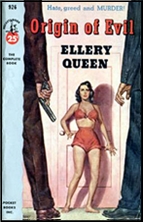
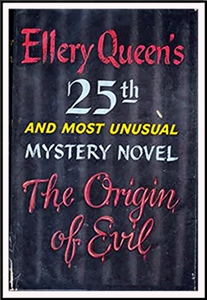
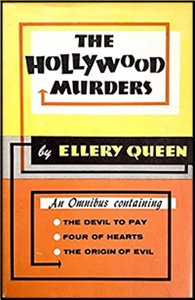
ELLERY QUEEN – The Origin of Evil. Little Brown, hardcover, 1951. Paperback reprints include: Pocket #926, 1953; #2926, 1956. Signet, 1972. Harper Perennial, 1992. Also one of the three novels included in the omnibus volume The Hollywood Murders (J. B. Lippincott, hardcover, 1951).

   Ellery returns to Hollywood and finds reports of its death premature, but a new Hollywood, to be sure. Revenge is apparently the motive for a series of mysterious threats to a pair of business partners; one of them dies of fright.

   It is the other, confined to a wheelchair, who believes he has worked out the murder scheme, but this time the real murderer is even more clever.

   The pseudo-Tarzan living in a tree is the most remarkable character, one most remembered. There seemed to be a bit more lenient attitude toward sex in this story than expected. Ellery falls in love with one unworthy; Paula Paris is not mentioned.

   The series of threats has a hidden significance, as well as the first threatening note. Was EQ’s presence a factor? Lack of evidence keeps justice from triumphing completely, not quite satisfying.

Rating: ***

–December 1967


ELLERY QUEEN – The Four of Hearts. Stokes, hardcover, 1938. Pocket Books #245, paperback, 1943. Reprinted many times, including as one of the three novels in the omnibus volume The Hollywood Murders (J. B. Lippincott, hardcover, 1951).

   The producer, not quite as eccentric as previously pictured (*) puts Ellery to work on a screenplay of the life stories of a famous actress and as equally famous actor. When they decide to patch up their feud which kept them apart for thirty years and finally marry, they are poisoned during their honeymoon flight. Ellery tried to keep the son and daughter apart but fails. The murderer plunges to his death as he tries to stop their wedding too.

   An interesting interpretation of Hollywood types, and not only includes the two wild Hollywood weddings, but the double funeral is also extravagantly Hollywood. Ellery falls in love with Paula Paris, a columnist who will not leave her home, but who is able to provide him with clues to solve the case.

   Good detection, a nicely complicated plot, with lots of detection and, even more, a book that’s fun to read — one of EQ’s best.

Rating: *****

–Nov-Dec 1967

   
(*) I assume but am not sure that this refers to the same producer Ellery worked for in The Devil to Pay, the previous “Hollywood” mystery and reviewed here.


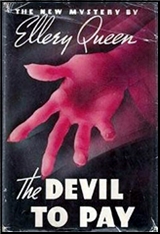
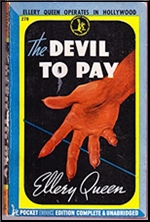
ELLERY QUEEN – The Devil to Pay. Stokes, hardcover, 1938. Pocket #270, paperback, 1944. Reprinted many times, including as one of the three novels in the omnibus volume The Hollywood Murders (J. B. Lippincott, hardcover, 1951). Also note: The Perfect Crime (Grosset & Dunlap, hardcover, 1942) was a novelization of the film Ellery Queen and the Perfect Crime (Columbia, 1941), which in turn was loosely based on this novel.

   Ellery, as Hilary “Scoop” King, the wildest type of parody of a newspaperman, solves the murder of a crooked financialist, Solly Spaeth. After disastrous floods in the Midwest, Ohippi hydroelectric project collapsed, leaving all other stockholders ruined, including Spaeth’s partner. There is also the matter of the correct will, so there are plenty of motives.

   A smooth, easy flow of words, a well-coordinated plot, and as “unlikely” but fairly obvious choice of murderer makes for enjoyable reading. However, there is nothing much to remember it by – I presumably have read it before, but nothing came back this time. Also included are Ellery’s experiences in trying to see an eccentric Hollywood producer.

Rating: ****

–November 1967


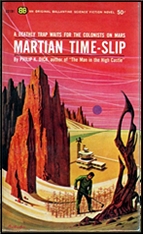
PHILIP K. DICK – Martian Time-Slip. Ballantine U2191, paperback original; 1st printing, 1964. Cover art by Ralph Brillhart. Previously serialized in Worlds of Tomorrow, August/October/December 1963 as “All We Marsmen.” [See Comment #2.] Collected in Five Novels of the 1960s & 70s (The Library of America #183, 2008).

   Mars in the early 21st century is not really an emigrant’s paradise: water and supplies from Earth are severely limited. The colonies barely self-supporting. The suicide of a black marketeer is the focus of events overwhelming a tightly-knit cast of characters, beset by their own problem of existence. “Death .. Sets a radiating process of action and emotion going…” (page 101).

   Neurosis, and schizophrenia in particular, is the main theme, personified by technician Jack Bohlen, who find himself lost in an autistic boy’s time-warped world. Individual characters are developed individually, possible only in the closed world of Mars.

   A great deal could be done in further development; for example, the society of the native Blackmen is barely touched upon. But it would add nothing to the plot, fitted together well.

Rating: ****

–November 1967

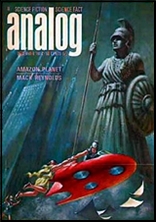
MACK REYNOLDS – Amazon Planet. United Planets #5. Serialized in Analog SF in three parts: December 1966 through February 1967. Ace, paperback, 1975.

   United Planets, with its variety of political systems, socioeconomic theories, and religions, is once again the [setting] for a lecture by Reynolds. This time Renny Bronston of Section G is sent to Amazonia to investigate the alleged suppression of the male half of the population. Amazonia is, however, a most enlightened planet, threatened with overthrow by the forces of a renegade G-agent.

   If it weren’t for the obviousness of the lecture, things might happen a little faster. Reynolds has good ideas, though, the most noteworthy being the possible use of time as monetary basis. A clever plot fits together well, except for a feeling of being just a little too forced.

Rating: 3½ stars.

–November 1967

ANALOG SCIENCE FICTION February 1967. Cover by Kelly Freas. Editor: John W. Campbell. Overall rating: 3 stars.

JOE POYER “Pioneer Trip.” The completion of the first manned flight to Mars must be weighed against a man’s life. Interesting problem, but conventional ending. (3)

JACK WODHAMS “There Is a Crooked Man.” Short novel. We are rapidly approaching the point where science and engineering can easily enable the criminal mind to outwit the law, if the particular law does indeed exist. Law enforcement becomes a hilarious problem, as Thorne Smith becomes SF, not fantasy. Not Analog’s usual stuff. (4)

J. B. MITCHEL “The Returning.” Alien takes over experimental US rocket to return home. (2)    [His only published SF story.]

MACK REYNOLDS “Amazon Planet.” Serial, part 3 of 3. Separate report forthcoming.

WINSTON P. SANDERS [POUL ANDERSON] “Elementary Mistake.” Crew sent to establish mattereaster [?] on a distant planet discovers they haven’t the necessary elements available. Too technical to make sense. (1)

–November 1967

SAMUEL R. DELANY – Babel-17. Ace F-288, paperback original, 1966. Reprinted many times, including: Bantam, paperback, 1982, with minor deletions restored. Nebula Award for Best Novel of the Year.

   Rydra Wong, a poet with a gift for languages, is given the task of deciphering Babel-17, a language apparently used by the invaders during their attack on Alliance installations. It is actually a weapon capable of taking over the thought processes of those who understand and use it.

   A brilliant display of strange characters and unusual science-fictional ideas, set in a realistic but mind-warping universe. Babel-17 itself enables one “to move through psychedelic perspective (page 108); is a “flexible matrix of analytic possibilities” (page 112).

   The night spent in Transport Town gathering a space crew is as effectively weird as any in horror fiction, with discorporate beings, including an active succubus, and cosmetically altered humans (the psychological implications of which are discussed on pages 51-52), combining to form a distinct world of their own.

   Later, the scene between Rydra and the Butcher as she teaches him the words “I” and “yes” is superb in both semantic and psychological interpretations. Delany includes himself in this universe, as Muels Araslyes, who once tripled with Rydra.

   An outstanding work, but his best is yet to come.

Rating: ****½

–November 1967

ELLERY QUEEN’S MYSTERY MAGAZINE – February 1967. Overall rating: 3½ stars.

STANLEY ELLIN “The Twelfth Statue.” Short novel. A movie producer noted for his quickie productions and his weakness for young girls disappears from his closed-off Italian movie set. The location of his body seems to be obvious halfway through, but Ellin still has some twists left, in addition to masterful background. (5)

JANE SPEED “Fair’s Fair.” A child’s view of murder, that of a man who killed a cat. (4)

CHARLES B. CHILD “A Quality of Mercy. Reprinted from Collier’s, 11 March 1950. Inspector Chafik solves the murder of a blackmailer, but destroys the incriminating etter. Excellent background an characterization. (4)

ROBERT L. FISH “The Adventure of the Perforated Ulster.” Schlock Homes breaks up a plot by a trading stamp company to destroy confidence in British clubs. Hilarious. (5)

JUDITH O’NEILL “The Identification.” First story. Woman betrays rebel organizer. Awkward beginning. (2)

R. BRETNOR “Specimen of the Week.” Anthropological species turns on guardian.. (1)

S. K. SNEDEGAR “Charles H. Goren Solves a Bridge Murder.” Too bad I don’t know anything about bridge, but story was poor anyway. (0)

VINCENT McCONNOR “The Man Who Collected Obits.” Man who works in a newspaper morgue discovers weird coincidence in the daily obituaries. (3)

PATRICIA HIGHSMITH “Camera Fiend.” Reprinted from Cosmopolitan, September 1960, as “Camera Finish.” A not-so-bright murderer allows his picture to be taken with his victim. (3)

ARTHUR PORGES “The Scientist and the Multiple Murder.” Eight men are electrocuted in s rooftop pool. Seems contrived. (3)

MARGERY SHARP “Driving Home.” Reprinted from Good Housekeeping, August 1956. Man needs wife’s alibi and thus saves their marriage. Too much soppy writing. (2)

LAWRENCE TREAT “F As in Frame-Up.” A spendthrift husband is framed for murder involving theft of necklace. Lieutenant Decker’s hunch plays off. (4)

-November 1967

LARRY MADDOCK – The Flying Saucer Gambit. Agent of T.E.R.R.A #1. Ace G-605, paperback original, 1966.

   The Temporal Entropy Rescue and Repair Agency sends the team of Hannibal Fortune and Webley to the year 1966 on Earth to stop Empire from using a new weapon capable of driving mankind insane. The trail leads from the plains of Kansas to the mountains of Arizona, where a last-ditch battle is fought in the cave headquarters of Empire.

   The basis of history, as expounded upon on page 56, is not that of individuals, but of social dynamics, determining a certain stability that makes temporal tampering difficult, although not impossible. It is Fortune’s job to maintain current time-lies, relative to the 26th Century, against Empire’s efforts to tyrannize the universe.

   All ends [of the story] are tidy, except for a lingering suspicion that time-travel should make warfare even easier. Or more complicated. The background seems well-researched, but the basic character of Hannibal Fortune does not yet seem settled – James Bond is a prototype, but the Bond of the books, or of the movies?

Rating: **½

–October 1967

      The Agent of T.E.R.R.A. series —

1. The Flying Saucer Gambit (1966)
2. The Golden Goddess Gambit (1967)
3. The Emerald Elephant Gambit (1967)
4. The Time Trap Gambit (1969)
   

Biblographic Update: Larry Maddock was the pen name of Jack Jardine, who wrote other SF novels and stories as Howard L. Myers. The comments following my earlier review of The Mind Monsters which he wrote under that name has quite a bit of discussion about him.

« Previous PageNext Page »